Article Contents:
- When choosing a carved icon: purpose and meaning of the choice
- How a carved icon differs from a printed and painted one
- Where carved icons are placed: spaces and scenarios
- Home: the red corner and home iconostasis
- Church and chapel: iconostasis and walls
- Chapel
- Gift
- How to choose the subject of a carved icon
- Icon of the Savior
- Icon of the Mother of God
- Nicholas the Wonderworker
- George the Victorious
- Sergius of Radonezh
- Guardian Angel
- Name Icon
- Temple Image
- How to Choose the Size of a Carved Icon
- Small Format: up to 200×150 mm
- Medium format: 200×150 — 400×300 mm
- Large format: from 400×300 mm and larger
- Practical rule of scale
- Material: why wood matters
- Oak
- Oak
- Linden
- Cedar
- Importance of blank quality
- Carving styles: from flat to deep
- Flat carving
- Relief Carving
- Deep carving and volumetric sculptural work
- Ornamental frame
- Combination of icon with cross and kiot
- Carved icon for home: what to consider when placing
- Place in the room
- Lamp near the icon
- Combination with other icons
- Surface care
- Coordination with Interior Design
- Carved icon for a church or chapel: professional approach
- Determine the installation location
- Agree on the subject
- Stylistic Unity
- Uniform material and tone
- Consider the mounting
- Lighting
- Coating for stability
- Ornament and framing: the architecture of the image
- Mistakes when choosing a carved wooden icon
- What to buy together with a carved icon
- Selection algorithm: how to buy a carved wooden icon without mistakes
- About the Company STAVROS
- FAQ: Answers to Popular Questions
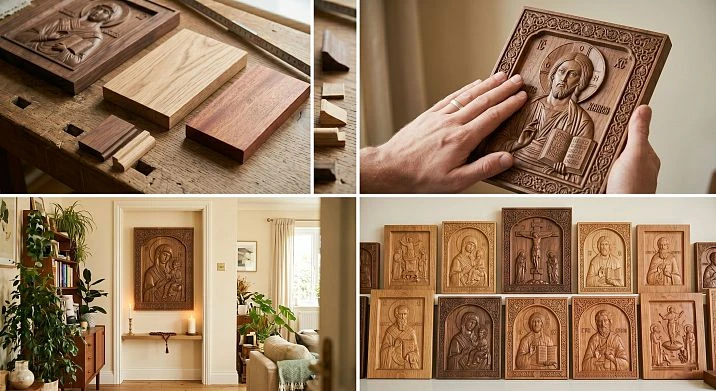
Wood and image are a union that has existed in Russian culture for as long as the Orthodox tradition itself. A carved wooden icon is an object where craftsmanship and spiritual content meet at one point. It is not just an image applied to a surface. It is an image that lives in the material — in its texture, warmth, relief, in how light glides over the facets of the carving and makes the face emerge from the depths.
Choosing a wooden icon is a task that requires attention. The subject and size, the type of wood and carving style, the placement location and combination with other elements of the space are all important here. To do this correctly means to acquire an item that will be appropriate both in the home's red corner, in a church space, and as a memorable gift for an important date.
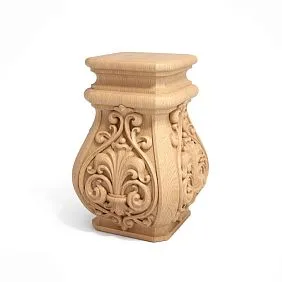
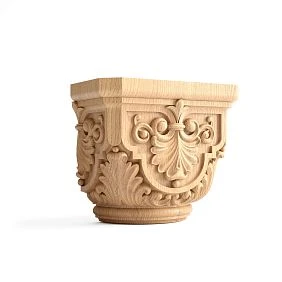
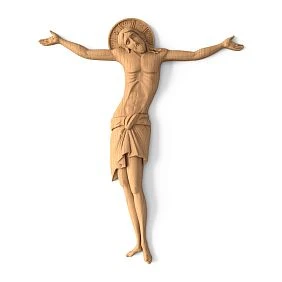
When choosing a carved icon: purpose and meaning of the choice
Before moving on to practice, it is worth understanding: why exactly a wooden carved icon? What is its difference from other forms?
A carved wooden icon is not a replacement for a painted icon nor its competitor. It is a separate form of Orthodox artistic product that has its own niche of application. It is chosen:
-
for a home iconostasis — when you want the corner with icons to be not just a shelf with images, but a cohesive space;
-
for the red corner — the traditional place in the home where the icon is the semantic center of the room;
-
for a church or chapel — as an element of church interior, wooden iconostasis, wall decor;
-
for a prayer room in a private house, country estate, hotel with an Orthodox character;
-
as a gift — for baptism, wedding, housewarming, anniversary, house consecration, memorable date;
-
as an independent decorative element of an Orthodox space.
Wooden church decor — this is a broad category, within which carved icons occupy a special place. They combine the tradition of wood carving and Orthodox symbolism, creating objects equally valuable as works of craftsmanship and as sacred objects.




How a carved icon differs from a printed and painted one
This question arises for many — and it is worth answering honestly and without exaggeration.
A printed icon is an image reproduced by printing on paper, cardboard, or board. It is affordable and easily reproducible. It does not involve manual labor.
A painted icon is an image painted with paints on gesso (a special primer) on a wooden base. This is a traditional iconographic canon requiring special art education and lengthy work.
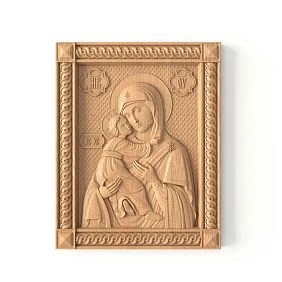
A carved wooden icon is an image created using carving techniques. Wood is not just a base, but the very material of the image. Relief, volume, fiber texture, depth of cut — all of this creates a visual and tactile image simultaneously.
| Parameter | Printed | Painted | Carved wooden |
|---|---|---|---|
| Handmade | No | Yes | Yes |
| Volume and relief | No | No | Yes |
| Natural material | Partially | Yes | Yes |
| Suitable for church interior | Limited | Yes | Yes |
| Combination with wooden decor | Weak | Neutral | Organic |
| Uniqueness | Low | High | High |
A wooden carved icon is perceived architecturally. It lives in space differently — creates a play of light and shadow, enters into dialogue with other wooden interior elements. Next to carved crosswith a wooden icon case and a solid wood iconostasis, such an icon looks not like an added element, but like an integral part of a unified image.
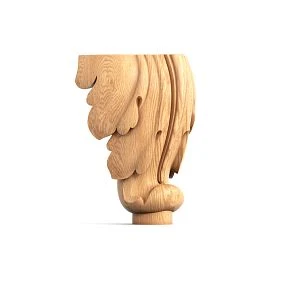
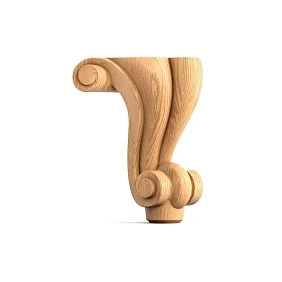
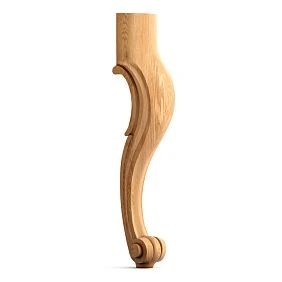
Our factory also produces:
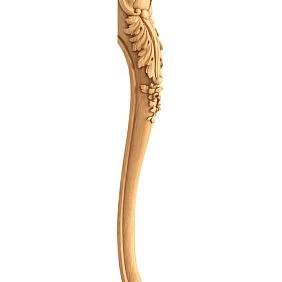

Where to place carved icons: spaces and scenarios
Get Consultation
Home: the red corner and home iconostasis
A home iconostasis is a space that, in Orthodox tradition, has its own place in every residential home. The red corner is the corner 'under the icons,' where the icon serves as the semantic and visual center.
A carved icon is well-suited for a home iconostasis because:
-
it creates a volumetric accent in the space of a shelf or corner;
-
it pairs well with wooden frames, shelves, and candle holders;
-
next to a lampada, it gains special expressiveness — warm light reveals the relief of the carving;
-
it fits into any style of wooden interior — from classic to country home.
For home placement, icons of compact and medium formats are more often chosen — so that the image does not dominate the room's space but is clearly visible from the prayer spot.
Temple and Chapel: Iconostasis and Walls
In the temple space, a carved wooden icon can be part of:
-
the iconostasis — where each image has its place in the architectural structure;
-
wall decor — in the altar area, on pillars, in the narthex;
-
icon cases — wooden glazed frames for especially venerated images;
-
lectern icons — small icons displayed for veneration.
For temple use, consistency is important: size, carving style, wood tone, and ornament character must match the overall interior design. Carved wooden decoration — overlays, ornamental elements, panels — should form a unified visual rhythm with the icons.
Chapel
A chapel is a small space where every element is especially noticeable. Here, a carved wooden icon works as an accent piece. The size is usually medium or large. The style matches the character of the chapel: strict classical carving or more expressive relief work. Combined with wooden cross creates a complete composition on the wall.
Gift
A carved wooden icon is one of the most respectful and memorable gifts in the Orthodox tradition. It is given for:
-
a child's baptism (name icon, Guardian Angel icon);
-
a wedding (icon of the Savior and the Mother of God — a pair);
-
a housewarming (icon for blessing a new home);
-
an anniversary (name icon, image of a particularly revered saint);
-
consecration of a house, church, or chapel;
-
a memorable church date.
When choosing a gift icon, it is important to consider the person's personality, their name, the saints they particularly venerate, and the appropriateness of the specific subject.
How to choose the subject of a carved icon
Choosing a subject is the most personal decision. There is no universal recipe, but there are a few guidelines.
Icon of the Savior
The image of Jesus Christ is the central image of an Orthodox home and church. "Savior" or "Lord Almighty" is a traditional choice for the red corner, home iconostasis, and the central image in a church space.
Icon of the Mother of God
"Theotokos" is an image of special veneration in the Orthodox tradition. There are many iconographic types: "Kazan", "Vladimir", "Tikhvin", "Smolensk", and others. The choice of a specific version may be determined by family tradition, place of residence, or special significance for a particular person.
Nicholas the Wonderworker
Saint Nicholas is one of the most venerated saints in Orthodoxy. His image is traditionally present in home iconostases, churches, and chapels. A carved icon with the image of Nicholas the Wonderworker is a suitable choice for a gift in almost any context.
George the Victorious
The Great Martyr George is an image of particular significance for warriors, defenders, and also for men bearing this name. It is often present in interiors associated with military or state service.
Sergius of Radonezh
Venerable Sergius is one of the most revered saints of the Russian Church. His image is traditional for home iconostases, as well as for educational institutions, monasteries, and chapels.
Guardian Angel
An image particularly suitable as a gift for baptism, name days, or for a child's room. A small carved icon of the Guardian Angel is a warm and fitting choice for a personal space.
Name Icon
An icon with the image of a specific person's heavenly patron is a name icon. This is the most personal of possible options. For a gift, it is one of the most significant choices.
Temple Image
If an icon is chosen for a specific church or chapel, its subject is usually determined by the dedication of the altar or the tradition of the particular parish. In this case, the choice of subject should be coordinated with the responsible persons — the rector or the ktitor.
How to Choose the Size of a Carved Icon
Size is not just a physical parameter. It is a decision about what role the image will play in the space.
Small format: up to 200×150 mm
A compact carved icon — for personal space: bedside shelf, small home iconostasis, workspace, travel icon. Carving on a small format must be clear and not too fine — otherwise details will be lost.
Medium format: 200×150 — 400×300 mm
The main format for home iconostasis, wall in living space, gift items. Allows for a full image with details, ornamental frame, and inscription.
Large format: from 400×300 mm and more
For a church, chapel, iconostasis, wall niches, public space. Here the carving can be complex, multi-level, with rich ornamentation. A large image on a big wall is a full-fledged architectural element.
Practical rule of scale
Viewing distance determines the minimum size. If the icon will be viewed from 1–2 meters — a format of 200–300 mm is sufficient. From 5–10 meters — a format of 500 mm and above is needed. A too small piece on a large wall gets lost and does not fulfill its role either visually or spiritually.
Material: why wood matters
Not every type of wood is equally suitable for a carved icon. The material determines the quality of the carving, the appearance, and the durability.
Oak
Dense, hard, with an expressive grain pattern. An oak carved icon looks monumental — the dark or honey hue of the wood gives the image weight. It is well suited for large formats, church spaces, and a strict classical style.
Beech
Dense, homogeneous wood with a fine texture. Allows for fine, detailed carving. Light tone — accepts toning and coating of any shade during processing.
Linden
A traditional material for icon boards and carved items. Soft, easy-to-carve wood with a neutral color. Lightweight, convenient for small and medium formats.
Cedar
Aromatic, dense, moisture-resistant wood. Beautiful grain pattern, warm reddish-brown hue. In the Orthodox tradition, cedar is a tree of special significance.
Importance of blank quality
Raw or poorly dried wood is the main cause of cracks in carved items. A high-quality wooden icon is made only from well-dried lumber that has undergone long-term or kiln drying. Solid Wood Items of professional production — this guarantees proper material preparation.
Carving styles: from flat to deep
The carving style determines the character of the image — its 'voice' in the space.
Flat carving
Minimal relief. The image is created through lines, contours, and indentations. The image is perceived as graphics translated into wood. Restrained, ascetic character. Well suited for interiors in a modern or minimalist style, as well as for small formats.
Relief carving
The main surface level is flat, but the image protrudes significantly above it. Details — folds of the robe, hands, halo — are worked out in relief. This is the "golden mean" between flat and deep carving. This style is suitable for both home and temple use.
Deep carving and volumetric sculptural work
The most complex and labor-intensive type. The image has a pronounced volume — close to sculpture. This style is appropriate for large formats, for temple spaces, for iconostases, for monumental accent images.
Ornamental frame
An ornament frame is an important detail of a carved icon. It completes the composition, sets its boundaries and "architectural scale." Ornamental motifs can be floral, geometric, or combined. More details can be found in the article about wooden carved patterns.
Combination of an icon with a cross and a shrine
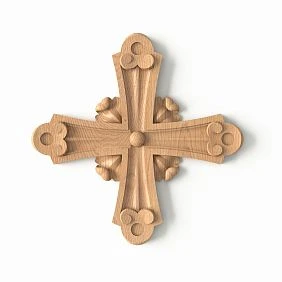
Carved icon combined with a carved wooden cross creates a complete wall composition. The cross and icon in the same carving style and wood tone form a finished ensemble that works as a single image.
A wooden icon case — a glazed frame for the icon — adds solemnity to the image and protects the carving surface. The icon case must match the icon in size, tone, and ornament style.
Carved icon for the home: what to consider when placing
Location in the room
The traditional place is the red corner: diagonally opposite the entrance door, at eye level or slightly higher. But a modern home iconostasis can also be placed on a wall — on a special shelf, in a niche, or on a separate partition.
Important: the icon should not be placed opposite a TV, above a bed at the headboard so that feet are directed towards it, or among decorative items without meaningful connection.
Lampada near the image
A lampada is a source of living warm light. Next to a carved wooden icon, the lampada works especially expressively: its flame reveals the relief of the carving, making the face 'emerge' in the moving light. However, the lampada must be securely fastened to avoid risk to the wooden item.
Combination with other icons
If there are several images in the home iconostasis, they should be consistent in style. A carved wooden icon next to a bright printed paper icon is a visual dissonance. It is better to assemble the iconostasis in a single material and execution style.
Surface care
The carved wooden surface requires careful maintenance: wipe with a soft dry or slightly damp cloth, avoid prolonged exposure to direct sunlight, and maintain stable humidity in the room.
Coordination with interior
The wood tone of the carved icon should harmonize with other wooden elements in the room. If the interior features Wooden moldings and a wooden baseboard of a warm honey tone, an icon in the same tint register looks organic. wooden patterns the ornamental frame of the icon can echo the ornamental elements of furniture or architraves.
Carved icon for a church or chapel: a professional approach
If a wooden carved icon is chosen for a public sacred space, the approach should be more strict and systematic.
Determine the installation location
Before choosing an image, you need to understand where exactly it will be placed: in the iconostasis (specific row and location), on the wall (dimensions of the pier or niche), in a case (size and type of case), or on a lectern.
Coordinate the subject
In a church space, choosing an image is not a personal decision. It must be coordinated with the rector or responsible persons. This applies to both the iconographic type and the execution style.
Stylistic unity
Wooden church decor must be stylistically consistent within the church. If the iconostasis is made in a strict classical style with geometric ornamentation, a new carved icon should maintain the same character. If the interior is more ornate, with rich floral carving, the image should also match.
Uniform material and tone
All wooden elements in the church space — crosses, Decorative Inserts, moldings, lecterns, iconostasis — must be in a consistent tone. A mismatch of shades disrupts the integrity of the sacred space.
Plan the mounting
A large carved icon made of solid wood has significant weight. The wall mounting must be professional, reliable, and designed for the specific weight of the product and the wall material.
Lighting
Carving lives in light. With side lighting, the relief works most expressively — creating shadows, depth, and volume. Direct frontal lighting "flattens" the carving. For backlighting a carved icon, side or soft directional lighting is optimal.
Coverage for stability
In temple spaces, especially unheated chapels, temperature and humidity fluctuations are significant. The coating of a carved icon must be durable: several layers of varnish or oil with a final wax layer.
Ornament and framing: the architecture of the image
The ornamental frame around the image is not a minor detail. It creates the "architecture" of the icon, completes it as an object, and connects the image with the interior space.
Traditional ornamental motifs in wooden icons:
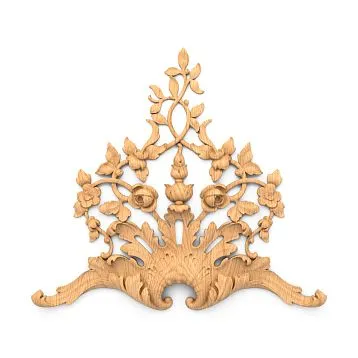
Floral ornament — vine, acanthus leaves, rosettes, floral scrolls. Rich, solemn character. Suitable for classical and temple style.
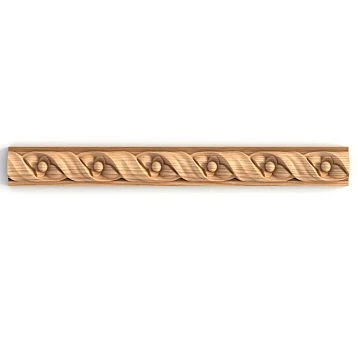
Geometric ornament — braiding, meander, diamond grids, symmetrical figures. More strict, ascetic character. Well-suited for icons in modern interiors or spaces with a calm aesthetic.
Combined ornament — a mix of floral motifs with a geometric structure. The most traditional choice for Orthodox icons in wooden execution.
More about ornamental systems in wood carving — in the material on wood ornament.
Mistakes when choosing a carved wooden icon
Let's be honest — what goes wrong most often.
-
Choosing only by photo without checking the size. The image on the screen does not convey the real scale or the tactile feel of the material. Always clarify the exact dimensions and consider them in relation to the actual location.
-
The placement location is not taken into account. An icon chosen 'in general' without a specific location often turns out to be the wrong size.
-
Too fine carving for a large space. Detailed fine carving of a small format in a large church or high room is completely lost.
-
The subject is not coordinated for church use. This should be done before purchase — especially for an iconostasis or altar area.
-
Mixing different wood tones without logic. Dark oak, light linden, and tinted beech next to each other without a unified color logic — this is not 'variety' but disorder.
-
No coordination with the cross, icon case, and other decor. The icon separately, the cross separately, in different styles and tones — this is not an ensemble.
-
Lighting is not taken into account. An icon that ends up in the shade or under unfavorable direct frontal lighting loses all the expressiveness of the carving.
-
Unsuitable coating for operating conditions — especially for unheated spaces.
-
Purchasing an icon separately from all other decor. A carved icon is most fully revealed in a system — with a cross, ornamental overlays, solid wood moldings and other elements carved decor elements.
What to buy together with a carved icon
A wooden carved icon is the central object around which the space is built. For a complete image, accompanying elements should be selected for it.
-
Carved wooden cross — to create a wall composition with an icon.
-
Wooden church decor — analogions, stands, ornamental elements for church interior.
-
Decorative wooden inlays — for decorating the icon case, iconostasis shelf, wall around the image.
-
Carved Decor — ornamental overlays, corner elements, rosettes for designing the sacred space.
-
Pogonazh iz massiva — slats and profiles for framing the iconostasis, icon case, prayer corner.
-
Solid Wood Items — full catalog of wooden products for Orthodox interior and decor.
Selection algorithm: how to buy a carved wooden icon without mistakes
1. Determine the purpose: home, red corner, church, chapel, gift.
2. Choose the subject — an image suitable for a specific person or place.
3. Determine the placement location: wall, shelf, iconostasis, icon case, lectern.
4. Measure the space: wall height, niche size, shelf or pier width.
5. Choose the format: small, medium, large — according to the viewing distance.
6. Determine the carving style: flat, relief, deep.
7. Choose the tone and wood species considering other wooden elements in the space.
8. Check the combination with the cross, icon case, ornamental overlays.
9. Ensure the quality of the coating — especially for unheated or humid spaces.
10. Go to the catalog of church decor made of wood STAVROS and choose an image for a specific location.
About the company STAVROS
A carved wooden icon is an item where a mistake in material quality or execution is unforgivable. This is not mass-produced — it is a unique piece with character. STAVROS has been producing Solid Wood Items from oak and beech since 2002, with its own production facility located in Saint Petersburg.
The STAVROS assortment includes — Wooden church decor: carved icons, crosses, decorative overlays, ornamental elements for iconostases and interiors of churches and chapels. All products are made from dried solid wood with precise milling and manual finishing. Coating — oil or varnish to choose from. Shipment from 1 piece. Custom production from 5 working days. Contact us to confirm shipping to your destination.
If you need a carved icon — for home, for a church, or as a memorable gift — STAVROS gives you the opportunity to choose or order a product with the right material, precise execution, and the living character of handcrafted work.
FAQ: Answers to popular questions
What is a carved wooden icon?
It is an icon where the image is created by carving into solid wood. Unlike a flat image, it has relief, volume, and the texture of natural material. A carved icon is suitable for a home iconostasis, church, chapel, and is a memorable gift for a significant occasion.
Where can a carved wooden icon be placed?
At home — in the red corner, in the home iconostasis, on a special shelf. In a church or chapel — in the iconostasis, in a shrine, on the wall. In a prayer room or any Orthodox space.
How to choose the size of a carved icon?
Based on placement and viewing distance. For a home shelf, a small or medium format is sufficient. For a church wall, a medium or large format is suitable. The main thing: the carving size should be readable from a normal viewing distance.
Can a carved icon be given as a gift?
Yes, it is an appropriate and meaningful gift for baptism, wedding, housewarming, anniversary, or home consecration. It is important to choose a suitable subject — a name-day icon or an image of a particularly revered saint.
What does a wooden carved icon pair with?
With a carved cross, a wooden icon case, ornamental overlays, iconostasis elements, wooden moldings, and trim. All these elements should be coordinated in wood tone and ornament style.
Which wood is best for a carved icon?
Oak — monumental, expressive, durable. Beech — dense, allows fine detailing. Linden — traditional material for icon work, soft to carve. Cedar — aromatic, warm in color, with special symbolic meaning.
Is special care needed?
Yes, simple care. Wipe with a soft cloth, avoid prolonged direct sunlight, maintain stable humidity in the room, and renew the oil coating every few years if necessary.