Article Contents:
- What is a carved wooden icon: not just decoration
- A three-dimensional image born from wood
- Handmade vs. machine processing
- Connection with the interior
- Where to place a carved icon: spaces and purpose
- Home iconostasis and red corner
- Home office and workspace
- Church and chapel
- Gift for an important occasion
- Country house with wooden decor
- How to choose an image for a carved icon
- Image of the Savior (Jesus Christ)
- Image of the Mother of God
- Image of the patron saint
- Family icon
- Church icon
- How to choose the size of a carved wooden icon
- Small icon (100–200 mm in height)
- Medium wall icon (200–400 mm)
- Large icon (400–700 mm and above)
- Size for a kiot or niche
- Size in a system with other elements
- Which type of wood is suitable for a carved icon
- Oak: strength and expressiveness
- Beech: precision of forms and uniformity
- Ash: lightness and natural tone
- Linden: traditional material of the icon painter
- Under varnish, under stain, or under oil?
- Carving style: from the strictness of the canon to decorative splendor
- Flat Relief Carving
- Deep carving
- Ornamental background
- Carved frame around the icon
- Strict church style
- Folk style and home tradition
- Carved icon as a gift: how to choose for an event
- For a wedding
- For a baptism
- For an anniversary
- For a housewarming
- For a clergy member
- For a church or chapel
- How to combine a carved icon: a unified system of spiritual decor
- Carved icon and carved cross
- Icon and wooden frames
- Icon and decorative overlays
- Icon in the system of carved home decor
- Icon and solid wood products
- Technical parameters and selection nuances
- How to assess the quality of carving
- Moisture and Drying
- Coating and care
- Icon lighting
- How to buy a carved wooden icon: what to look for
- Where to look
- What to look for when buying
- FAQ: answers to main questions about carved wooden icons
- How to choose a carved wooden icon?
- How is a carved icon different from a regular painted one?
- Can you give a wooden carved icon as a gift?
- Which type of wood is best for a carved icon?
- How to combine a carved icon with other wooden decor?
- Where to buy a carved wooden icon?
- About the Company STAVROS
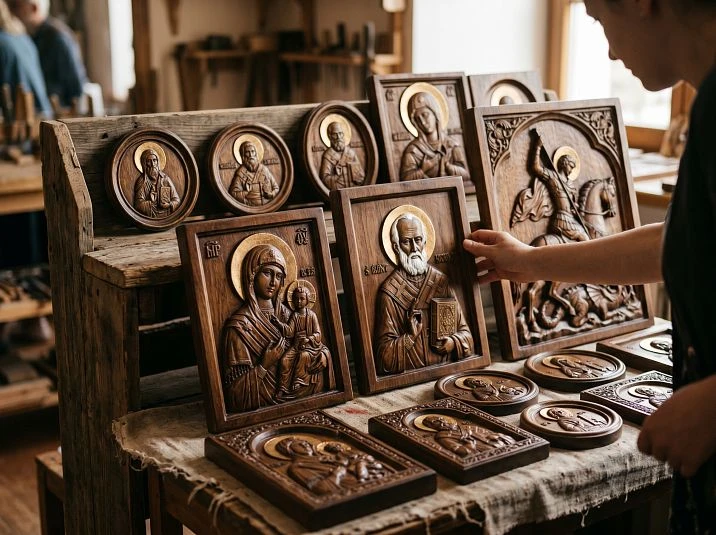
There are things that are chosen with the heart — and only then with the mind. A carved wooden icon belongs precisely to this category. It is not just a decorative object, not just a "wooden craft with a religious theme." It is a union of spiritual meaning with the carver's skill, where every line of the relief is the result of hours of focused manual work, and the type of wood from which the icon is made sets its character for decades to come.
The wooden icon existed in the Russian tradition long before painted images on a board with gesso. Carved relief in wood is one of the most ancient ways to create a sacred image. And today, when interest in natural materials, handmade items, and meaningful interiors grows year after year, it is precisely carved church decor from wood that is experiencing a true revival — both in home iconostases, in church decoration, and as a special gift for an important occasion.
But how to choose? By which image? What size? From which wood? With what carving style? This article is a detailed, honest, and practical answer to all these questions.
What is a carved wooden icon: not just a decoration
Before talking about choice, you need to clearly understand: what exactly are we choosing.




A three-dimensional image born from wood
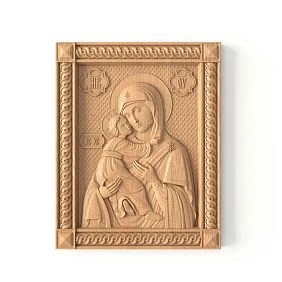
A carved wooden icon is an image embodied in relief: the figure, face, halo, ornament — all of this is formed directly in the structure of the wood mass using chisels, gouges, and milling tools.
Unlike a printed or painted icon, there is no flat image applied on top of a substrate. The image exists in three dimensions: it protrudes from the background, has depth, light falls on it differently depending on the angle — and this creates a living, changing perception.
That is why a carved Orthodox icon works differently in an interior than a painted one: it does not "hang on the wall," it "lives" in the space. In daylight, it is one thing; by candlelight or lamp light, it is completely different.
Our factory also produces:

Handcrafted vs. Machine Processing
Here it is important to be honest with ourselves: there are hand-carved icons and icons made using CNC (computer numerical control) machines. These are two fundamentally different products.
A handcrafted icon — each element is carved by the artisan by hand. The master makes decisions during the process: how to deepen the contour, where to enhance the relief, how to convey the volume of the face. Such an icon is unique — even within the same "model," two copies will differ in living nuances.
A machine-processed (CNC) icon — the relief is formed by a milling machine according to a set program. Geometric precision is high, reproducibility is absolute. This is not bad, it is different: a CNC icon can have high-quality finishing and expressive relief, but it does not bear the traces of the master's hand.
For a personal iconostasis, for a church, or as a gift for a significant event — handcrafted work is more valuable. For decorative use in an interior — CNC processing is quite appropriate.
Get Consultation
Connection with interior
A handcrafted wooden icon is an element that organically fits into any space with natural materials: in a country house with wooden beams, in an apartment with classic decor, in a study with dark wooden shelves. It does not compete with the interior — it becomes part of it, adding a spiritual dimension to the visual.
Where to Place a Carved Icon: Spaces and Purpose
A carved wooden icon is appropriate in a variety of contexts — and each of them imposes its own requirements on the choice.
Home Iconostasis and the Red Corner
The red corner is a traditional place for icons in a Russian Orthodox home. Usually, it is a corner of the room facing east or southeast, where icons are arranged in tiers on a special shelf or in an icon case.
For a home iconostasis, a carved wooden icon is ideal: it creates a visual center and gives the space spiritual weight. Important: if the iconostasis includes several images, they must be consistent in size, carving style, and wood tone — otherwise, it feels like a randomly assembled set.
Cabinet and Workspace
A wooden icon in a study is a common tradition, especially among people who value spiritual support in their professional activities. A small wall-mounted image on the work wall creates a meaningful accent without overloading the space.
Choice for a study: medium size (200–300 mm in height), calm carving style, dark wood or neutral tinting.
Temple and Chapel
For temple use, the requirements for a carved wooden icon are significantly higher. Here you need:
-
Large format (from 400 mm and above)
-
Expressive, detailed relief
-
High-quality wood species (oak, ash)
-
Durable coating designed for long-term use
-
Conformity to the iconographic canon
Wooden church decor for a temple — this is not just a single icon, but a system of elements: icons, Carved crosses, decorative overlays, icon cases, frames — everything must belong to a single style.
A gift for an important event
A carved wooden icon is one of the most significant gifts one can give. It is given for weddings, baptisms, anniversaries, the birth of a child, housewarming, retirement. It is not a consumable item, not a thing "for one season" — it is a thing that stays in the family and is passed down to the next generations.
Below we will discuss in detail which image and which size is appropriate for each occasion.
Country house with wooden decor
In a country house with wooden cladding, with house carving on the facade and natural materials in the interior — a wooden icon is as organic as in no other space. It is part of a single "wooden world" of the house. Here, more natural, lively, textured surfaces are appropriate — oak in oil, ash with stain.
How to choose an image for a carved icon
Choosing an image is the most personal step. There are no "right" or "wrong" answers here — there is tradition, there is meaning, there is the situation.
Image of the Savior (Jesus Christ)
The icon of the Savior is central in Orthodox tradition. In the home iconostasis, it occupies the right side from the center when looking at the iconostasis. In the carved version, the image of the Savior gains special solemnity: a three-dimensional halo, a relief background with ornamentation create a sense of monumentality even in a small format.
Image of the Mother of God
The icon of the Mother of God — in Orthodox tradition occupies the left side of the iconostasis. Icons of the Mother of God are numerous in their versions: "Vladimirskaya", "Kazanskaya", "Tikhvinskaya", "Znamenie", "Neochayannaya Radost" and many others. Each version carries its own prayerful meaning.
For a carved icon, the most "effective" versions in terms of relief are those where the image is strict, frontal, with pronounced contours: "Kazanskaya", "Znamenie".
Image of the patron saint
It is customary to have an icon of your heavenly patron (by name) in the home iconostasis. This also applies to the patron of the family, profession, place (patron of a city or region).
A carved icon with the image of a personal patron is a very personal gift: for name days, for baptisms, for an important life milestone.
Family icon
Family icons are images before which a family stands in prayer. Traditionally, these are the 'Holy Family,' the icon of 'Savior' and 'Theotokos' together, or an image especially venerated in the family.
Temple icon
For a church, the icon is chosen according to the dedication of the church or its side chapel: the image of a saint or feast in whose honor the church is consecrated.
How to choose the size of a carved wooden icon
Size is primarily a proportion to the space. An incorrectly chosen size ruins everything: an icon that is too small gets lost on a large wall, one that is too large overwhelms a small room.
Small icon (100–200 mm in height)
A compact format for a desk, small shelf, or travel iconostasis. It works well as a personal image—one that you take with you, place before you in prayer.
For a small format, clarity of relief is important: fine, detailed carving at 100 mm is hard to read—large, expressive lines are needed.
Medium wall icon (200–400 mm)
The most versatile format for home use. It is clearly visible on the wall, expressive, yet does not overwhelm the space. Suitable for the red corner, study, or bedroom above the headboard.
This format allows for detailed carving: a relief halo, an ornamental background, and refined facial features.
Large icon (400–700 mm and above)
For a church, chapel, large iconostasis, or spacious country house. The large format allows for maximum detail: deep multi-level carving, ornamental background, relief frame.
In a home space, a large carved icon becomes a central wall element — it requires appropriate space around it.
Size for a kiot or niche
If a kiot is planned for the icon wooden frame or a kiot — the icon size is determined by the kiot size, not the other way around. Important: leave a 10–15 mm gap around the perimeter between the icon and the inner walls of the kiot.
Size in a system with other elements
If the icon is placed next to a carved cross and others church decoration, — the sizes of elements must be proportionate. A cross that is three times smaller than the icon gets lost next to it; a cross that is twice as large overwhelms.
What type of wood is suitable for a carved icon
Choosing the type of wood is a choice between strength, tone, texture, and plasticity during carving.
Oak: strength and expressiveness
Oak is the most "masculine" wood for an icon. Large, expressive texture, dark golden tone in its natural state, ability to take deep staining. An oak carved icon, after treatment with stain and varnish, acquires a dark, solemn appearance that is especially appropriate in classic interiors and in a church.
Carving oak requires experience: the hardness of the wood is high, the tool must be sharp, the lines precise. However, the oak surface preserves the relief for decades without deformation.
for wooden products for responsible purposes — icons, crosses, church decor — oak remains the first choice.
Beech: precision of forms and uniformity
Beech is a homogeneous, dense wood with a fine texture. Carving on beech yields clear, precise lines, the relief comes out "sharpened." For an icon with fine ornamental details — plant curls, thin halos, complex background patterns — beech is preferable.
The natural tone is a warm beige. It accepts any tinting well. For white or neutral painting, it is an excellent choice.
Ash: lightness and natural tone
Ash in its natural state is light — almost white, with a slight yellowish tint and pronounced straight grain. For an icon in a light, natural tone, ash creates a special "purity" of the image. After oil treatment, the surface is matte and lively.
The expressive texture of ash can "compete" with the relief in some images — therefore, for very detailed carving with small elements, ash is less suitable than beech.
Linden: traditional material of the icon painter
Linden is a traditional wood species for icon boards in the Russian icon painting tradition. Soft, with a uniform structure, it accepts the chisel well. For hand carving, it is one of the best materials: the carver can work with fine details without the risk of chipping.
A carved linden icon in its natural tone is light and soft in color. For tinting, it accepts any shade.
Disadvantage of linden: less durable compared to oak or ash, more susceptible to mechanical damage.
Under varnish, under stain, or under oil?
Under varnish (transparent) — maximally reveals the texture of the wood, creating a glossy or matte protective surface. A classic option for church use.
Under stain + varnish — sets any tone, from light walnut to dark wenge. Allows matching the icon to the interior tone.
Under oil or oil-wax — matte, lively surface. Maximum naturalness. Requires periodic renewal.
Under paint (enamel) — opaque coating, hiding the texture. Rarely used for icons — except in white classic style.
Carving style: from canonical strictness to decorative splendor
Carving on an icon is not just 'decoration'. It is an artistic language, and the choice of this language should match the purpose and placement of the icon.
Flat relief carving
Low-relief carving — relief is shallow (2–5 mm), contours are clear, forms are concise. This is a strict, restrained option — closest to the traditional iconographic line. The image is recognizable, detailed, but without excessive 'sculpturalness'.
Works well on small and medium formats. In a small size, deep carving would be inappropriate — low-relief conveys the image more accurately within limited space.
Deep carving
Deep carving (10 mm or more) creates pronounced volume. The halo literally 'emerges' from the plane, the figure has tangible three-dimensionality. This is a more 'sculptural' approach — and more decorative.
Suitable for large formats, for temple icons, for an icon as the central element of an interior composition. In a small size, deep carving risks 'overloading' the image.
Ornamental background
The ornamental background around the image — plant or geometric patterns — transforms the icon from a simple relief image into a complex decorative work. This is a technique characteristic of the Russian tradition of carved church decor.
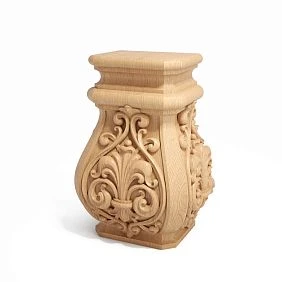
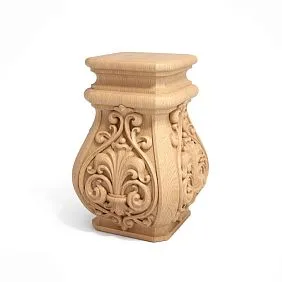
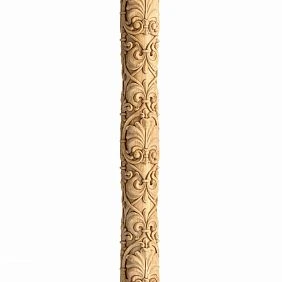
wooden ornament with plant motifs — grapevine, acanthus leaves, floral scrolls — carries symbolic meaning in a religious context. This is not just "decoration," but a language that is read by a trained eye.
Carved frame around the image
The separate relief decor of the frame is a separate artistic task. The frame can be more decoratively rich than the central image — and thereby "set" it, like a setting sets a stone.
Decorative wooden inlays with ornament can be used as framing elements of the icon — especially if the icon is placed on a wall without a separate icon case.
Strict church style
For temple images — the strictness of the iconographic canon is more important than decorative richness. The relief must accurately reproduce the iconographic type, without allowing deviations. Ornamental elements — in moderation, without overload, in accordance with tradition.
Folk style and home tradition
For a country house with house carving on the facade, an icon in a similar folk style looks organic: more lively, less "polished", with an ornament characteristic of folk carving. This is a unified decorative world where the icon is part of the house's overall "voice".
A carved icon as a gift: how to choose for the occasion
Giving a wooden carved icon is a completely different level of attention than buying a standard souvenir. It is a gift with content, with a thoughtful meaning.
For a wedding
Wedding icons are one of the main traditions of the Orthodox wedding ceremony. The classic choice: paired images of the Savior and the Mother of God, which are used to bless the newlyweds. In a carved version, this is a particularly significant gift: it will remain in the family forever and will be passed down from generation to generation.
Size for wedding icons: medium or above medium (300–500 mm). Style: solemn, expressive.
For a christening
An icon of the guardian angel or the child's heavenly patron (by name) is a traditional gift for a christening. In a carved wooden version, it is an item that the child will carry into adult life.
Size: small or medium (150–250 mm). Style: light, kind, without excessive severity.
For an anniversary
An icon of a beloved saint or an image especially revered in the birthday person's family. This is a gift that says: "I know you. I chose this especially for you."
A handmade wooden icon for an anniversary is something that won't be thrown away or forgotten in a drawer. It will take its place on the wall or in the iconostasis — and will remind you of the relationship every day.
For a housewarming
An icon of "Savior" or "Theotokos" as a blessing for a new home is a tradition hundreds of years old. In a carved wooden version, this is especially fitting: a new home, wood as a natural building material, an icon as the spiritual foundation of the home.
For a clergy member
If an icon is given to a priest or a monastic, the choice is stricter: the image must conform to the iconographic canon, the carving to church tradition. No decorative "liberties" — only dignity, strictness, and quality.
For a church or chapel
Giving a wooden icon to a church is an act of special significance. Here, the quality of the material, accuracy of iconography, and durability of execution are doubly important. See wooden church decor taking into account the needs of the specific church: the size, image, and style are coordinated with the clergy.
What to pair with a carved icon: a unified system of spiritual decor
An icon should not hang alone. In a well-thought-out spiritual space — a home iconostasis, a church chapel, a side-altar — it is part of a system. And this system requires consistency.
Carved icon and carved cross
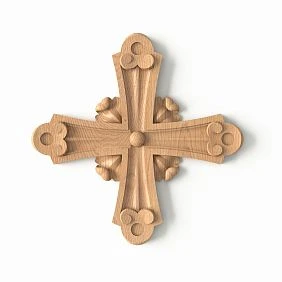
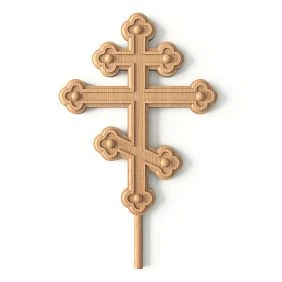
Carved cross — a natural 'partner' for an icon in a home or church space. They should belong to the same style: if the icon has a floral ornamental background, the cross should have similar ornamental motifs. If the icon is in a strict, laconic style, the cross should also be strict.
Size: the cross is typically more compact than the icon or comparable in scale — but does not overwhelm it.
Tone: unified. Oak with stain + a cross made of the same oak with the same tint.
Icon and wooden frames
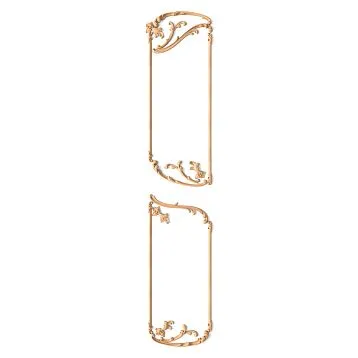
wooden frames can serve as framing for the icon or for additional images nearby. A frame in the same tone and style as the icon creates a unified decorative system.
Icon and decorative overlays
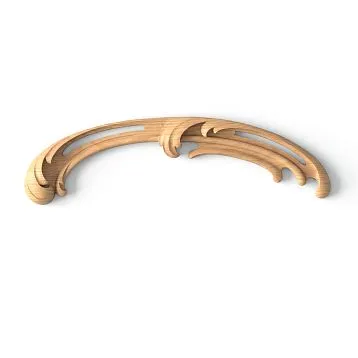
Decorative wooden inlays with floral ornament can organize the wall space around the icon: create a 'niche', frame the image with horizontal or vertical decorative strips.
This technique comes from classical church architecture — the iconostasis itself is nothing more than a system of decorative wooden elements that organize the space around the images.
Icon in the system of carved house decor
In a country house with carved wooden decor — window casings, pediment, house carving — a wooden icon continues a unified decorative language. The carving of the house and the carving of the icon must belong to the same tradition: folk style does not combine with classical church canon, and vice versa.
Icon and solid wood products
Wooden items — furniture parts, wooden shelves, frames, overlays — create a common "wooden background" of the space, against which the icon looks organic. The main rule: tonal unity. If most wooden elements are dark, a dark icon will fit naturally; a light one will be a contrasting but deliberate accent.
Technical parameters and selection nuances
How to evaluate the quality of carving
-
Clarity of contour lines — absence of blurred, "smudged" edges
-
Uniformity of relief depth — the background should be even, without differences
-
Sharpness of details — thin ornamental elements should not be chipped or crushed
-
Absence of cracks — splitting along the grain (especially on the ends) indicates raw wood
-
Uniformity of coating — without stains, drips, or unpainted areas
Moisture and Drying
A wooden icon made from raw wood — inevitable cracks and deformations. Only kiln drying to 8–10% moisture guarantees stability. Ask the seller — or check visually: cracks on the ends and along the grain are a sign of insufficient drying.
Coating and care
For a wooden icon with a lacquer coating, care is minimal: wipe with a dry or slightly damp cloth. Avoid direct contact with water. Do not hang near a radiator or on a wall facing the street (temperature changes are the enemy of wood).
For an icon with an oil coating: renew the oil layer every 3–5 years — the surface will come alive and shine again.
Icon lighting
A wooden carved icon reveals itself with side lighting: light falling at an angle brings out the relief, creates shadows in the recesses, and emphasizes volume. Direct frontal lighting "kills" the relief — the image becomes flat.
Traditional lighting — a lampada in front of the icon — works perfectly: the living, flickering light of a candle or lamp flame makes a relief wooden icon literally "alive".
How to buy a carved wooden icon: what to look for
Where to look
A handcrafted wooden icon or one made using professional tools can be purchased:
-
In specialized workshops for wooden decor
-
In online stores specializing in solid wood items
-
In the section church decor
Important: when buying a carved icon online — request real photos of the specific item, not "samples." Live carving always differs from studio shots.
What to look for when purchasing
| Parameter | What to Check |
|---|---|
| Wood Species | A specific wood species is indicated, not just "wood" or "solid" without specification |
| Processing | Type of coating (varnish, oil, stain), number of layers |
| Moisture | Availability of drying data, absence of cracks |
| Size | Exact dimensions (height × width × relief depth) |
| Manufacturing method | Hand carving or CNC processing |
| Iconographic correspondence | Correspondence of the image to Orthodox iconographic tradition |
FAQ: answers to main questions about carved wooden icons
How to choose a carved wooden icon?
Start with the image (who is depicted and for what occasion), then determine the size (for a specific placement location), choose the wood type (oak for solemnity and durability, beech for detailed carving, ash for light natural tones) and carving style (strict for a church, ornamental for a home iconostasis). See Wooden church decor.
How is a carved icon different from a regular painted one?
A carved wooden icon exists in volume: the image and ornament are formed in the relief of the wood block. It is perceived differently under different lighting, especially by candlelight or lamp light — the relief 'comes to life'. A painted icon is a flat color image on a prepared board.
Can a wooden carved icon be given as a gift?
Yes, and this is one of the most significant gifts: for a wedding — paired icons of the Savior and the Virgin Mary, for a christening — an icon of the child's heavenly patron, for an anniversary — an icon of a beloved saint, for a housewarming — a blessing for the new home. A carved wooden icon remains in the family for generations.
Which type of wood is best for a carved icon?
For a church and important home icons — oak: maximum hardness, durability, expressive texture. For fine ornamental carving — beech. For light natural interiors — ash. For traditional hand carving — linden.
How to combine a carved icon with other wooden decor?
A unified wood tone, a consistent carving style. Carved cross — in the same tone and style. wooden frames и Decorative Inserts — as a framing. Carved wooden decoration on the walls — in the same decorative system.
Where to buy a carved wooden icon?
In the Stavros catalog — carved church decor, Carved crosses и Solid Wood Items for home, church, and gift.
About the company STAVROS
A carved wooden icon is an heirloom for generations. And it deserves craftsmanship, material, and attitude that match it.
STAVROS creates wooden church decor, Carved crosses и Carved wooden items occupy a special place in this regard. Wood carving not only emphasizes the aesthetics of a room but also gives it warmth, lively energy, and uniqueness. In modern interiors, carved elements are widely used due to their unique properties and adaptability to any style—from classic to minimalism. for home, church, and chapel. In a single catalog — Decorative Inserts, wooden frames, House Carving and the entire range of solid wood — to create a space where every wooden detail speaks the same language.
Choose the image. Choose the wood. Choose STAVROS.