Article Contents:
- Slat panel PAN-007 1010×8 mm: what sizes are actually available today
- PAN-007 950 mm and reception desk 1100 mm: where the missing 150 mm come from
- Add a horizontal extension 150 mm
- Use a long PAN-007 and get a solid piece
- Change the rack architecture
- When the joint looks intentional
- When a 470 mm remainder is useful
- Why a 200 mm remainder is not necessarily worse
- PAN-007 950 mm
- PAN-007 MDF 2670 mm
- PAN-007 oak/beech 2400 mm
- Can the fourth PAN-007 blank be used on the side panel of a reception desk
- When PAN-007 740 mm makes sense on a reception counter
- Why you need to determine the front and both sides first, and only then buy PAN-007
- Where the vertical joint of PAN-007 should run on the stand front
- Boundary scenario: 4040×1100 mm front and four solid modules without width trimming
- How to account for reception desk maintainability when choosing the format
- Where to buy PAN-007 slat panels after calculating the stand
- Short conclusion
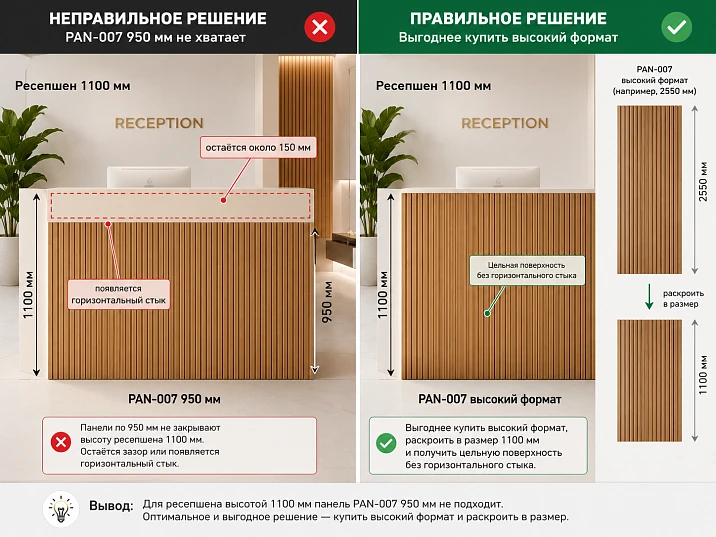
PAN‑007 has already been selected by pattern: large trapezoidal profile 23×8 mm, module width 1010 mm, flexible fabric base, and several material options. But the reception desk stand front has a height of 1100 mm, and the short furniture PAN‑007 is 950 mm. What is missing:
1100 − 950 = 150 mm.
This is a small number, but it is exactly what changes the purchase. The 950 mm panel cannot be turned into a solid vertical piece of 1100 mm without an additional solution: a horizontal extension, a separate plinth/top belt, or changing the stand architecture. The long PAN‑007 2400 and 2670 mm cost more per unit, but each can provide two solid blanks of 1100 mm height.
Therefore, the main question before payment is not “which PAN‑007 is cheaper per piece,” but:
which SKU will provide the required number of 1010×1100 mm parts without an accidental horizontal seam and with the least useless leftover for the specific front, side panels, and reception returns.
For a 3000×1100 mm counter, the calculation is especially clear. By width:
3000 / 1010 ≈ 2,97.
So, the front needs three modules by width. Three full widths give:
3 × 1010 = 3030 mm.
The nominal trimming across the entire width is only 30 mm. In height, short 950 mm panels do not cover the front, while one long 2400/2670 mm panel yields two 1100 mm blanks. Therefore, two long panels provide four full-size parts — three for the front and one potentially for a side panel or reserve.
Before ordering, it is reasonable to follow this procedure:
-
measure the finished height of the front, not the height of the body to the countertop “approximately”;
-
measure the width of the front and both side panels;
-
decide whether a horizontal belt at a height of 740 or 950 mm is acceptable;
-
determine the material — MDF, primed MDF, beech, or oak;
-
lay out parts along long PAN‑007 2400/2670 mm;
-
check whether the second blank from each long panel can be used;
-
determine vertical joints along the front;
-
design external corners;
-
only then fix the quantity of commercial panels.
If the project is still comparing models, you can buy slat panels for walls for interior finishing after checking the profile and format. If PAN‑007 is already approved, you need to count specific SKUs, not abstract square meters.
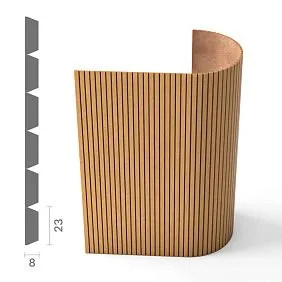
Slat panel PAN-007 1010×8 mm: what sizes are actually available today
The direct current card of PAN‑007 at the time of final check shows the following formats:
| Execution | Dimension A×C×L | Price at the time of check | Status at the time of check |
|---|---|---|---|
| MDF, Prestige | 1010×8×740 mm | 6,410 RUB | In stock |
| Primed MDF | 1010×8×740 mm | 11,170 RUB | Custom Order |
| MDF, Prestige | 1010×8×950 mm | 8,230 RUB | In stock |
| Primed MDF | 1010×8×950 mm | 14,340 RUB | Custom Order |
| Beech | 1010×8×950 mm | 14,410 RUB | In stock |
| Oak | 1010×8×950 mm | 23,890 RUB | In stock |
| MDF, Prestige | 1010×8×2670 mm | 20,180 RUB | In stock |
| Primed MDF | 1010×8×2670 mm | 37,470 RUB | Custom Order |
| Beech | 1010×8×2400 mm | 27,390 RUB | In stock |
| Oak | 1010×8×2400 mm | 43,790 RUB | In stock |
Prices, stock, and lead times change; they need to be re-checked before payment.
The card describes PAN-007 as a flexible slat panel on a fabric base with a trapezoidal profile of 23×8 mm and a module width of 1010 mm. The manufacturer directly lists reception desks and bar counters as application scenarios.
Slat panel PAN-007 It can be used for fronts, side panels, furniture facades, and other interior surfaces, but the specific layout must be built based on the actual dimensions of the counter.
Why the direct card should be placed above the old article
STAVROS has a fresh article about a 2550 mm wall published a few days earlier, stating that the 740 mm format is no longer used. However, the current direct card for PAN-007 again shows 740 mm as an active SKU.
For a procurement article, the primary product card takes priority. Therefore, 740 mm is included in the calculation, and the conflict is flagged for editorial self-audit.
Why the 1010 mm width matters more than the area
On a 3000 mm front, three panels give 3030 mm. This is an almost exact match, but it does not mean you can simply order "3 square meters".
The module width determines:
-
two vertical connections;
-
the position of the edge trims;
-
the phase of the battens at the external corners;
-
the location of the logo relative to the seams.
Why 8 mm needs to be checked on a real sample
The 8 mm depth affects:
-
shadow;
-
the front overhang;
-
the junction with the countertop;
-
an external corner;
-
adjacent furniture elements.
Useful before a large purchase buy OPAN-007 sample and attach it to the rack material.




PAN-007 950 mm and reception 1100 mm: where do the missing 150 mm come from
The calculation is simple:
1100 − 950 = 150 mm.
But further there are three completely different design scenarios.
Our factory also produces:
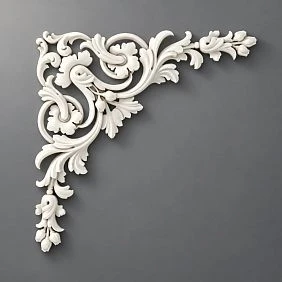
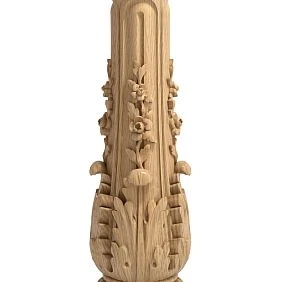
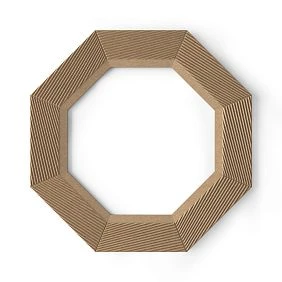

Add a horizontal extension of 150 mm
Short PAN-007 covers 950 mm of height, and the remaining 150 mm are assembled with a separate fragment.
Advantages:
-
you can use a cheaper short SKU;
-
the horizontal line can become a deliberate belt;
-
convenient if there is already a separate decorative zone above or below.
Disadvantages:
-
a horizontal joint appears;
-
need to precisely align the vertical pattern;
-
additional material is required;
-
the volume of trimming and finishing increases.
Get Consultation
Use a long PAN-007 and get a one-piece part
A 2400 or 2670 mm panel is cut crosswise into parts 1100 mm high.
From one:
1100 + 1100 = 2200 mm.
Remainder:
-
from 2670 — 470 mm nominal;
-
from 2400 — 200 mm nominal.
These values are before accounting for the saw kerf and final end trimming.
Change the rack architecture
If a 150 mm plinth is provided at the bottom or a separate 150 mm belt at the top, the PAN-007 950 mm already covers the entire slat section without an "extension".
Then the horizontal line becomes part of the project, not a way to save a short panel.
| Scheme | Horizontal seam | Main material | Waste | Front character |
|---|---|---|---|---|
| 950 + add-on 150 | Yes | short PAN-007 + add-on | Depends on the cutting | the belt needs to be designed |
| 2400/2670 → 1100 | No | long PAN-007 | 200/470 mm on the original panel | solid vertical rhythm |
| plinth/belt + 950 | deliberate architectural line | PAN‑007 950 | depends on the plinth | compositionally divided front |
Why the horizontal joint PAN-007 on the reception front needs to be designed
The reception is viewed from close range. The administrator and visitor constantly see:
-
front;
-
logo;
-
lighting;
-
angles;
-
seams.
If a horizontal line suddenly appears at a height of 950 mm, it is perceived either as an architectural belt or as a technical filler.
The difference is determined by the project.
When the joint looks deliberate
If it aligns:
-
with the bottom line of the logo;
-
with the top of the plinth;
-
with the color band;
-
with the horizontal backlight;
-
with the countertop line of the other part of the stand.
When the joint looks random
if:
-
not connected to any other line;
-
cuts the logo;
-
one corner goes higher, the other lower;
-
the batten pattern is out of phase.
Why is a horizontal seam harder than a vertical one
Vertical joints naturally continue the direction of the battens.
A horizontal joint cuts across the entire vertical rhythm at once.
Therefore, for a solid 1100 mm front, a long panel often gives a cleaner result, even if the retail price of one long PAN‑007 is higher.
PAN-007 made of MDF 2670 mm: two 1100 mm blanks from one panel
Main calculation:
2670 = 1100 + 1100 + 470 mm.
That is, from one long PAN-007 MDF geometrically obtained:
-
part 1010×1100 mm;
-
second part 1010×1100 mm;
-
nominal remainder 1010×470 mm.
Before actual cutting, consider:
-
the saw kerf width;
-
need to refresh the edge;
-
damaged factory end;
-
specific orientation of the slats.
When the 470 mm remainder is useful
It can be used for:
-
to the inner panel;
-
for a small refund;
-
to the technical door;
-
for trial finish;
-
for future repairs.
When the remainder is almost useless
If the rack has only:
-
front 3000×1100;
-
two tall side panels of 1100 mm each;
and all parts require a full height of 1100 mm, the 470 mm fragment does not replace another whole blank.
Why you should count blanks, not area
One long panel yields exactly two full-height blanks of 1100 mm. The remaining 470 mm may have a larger area, but it cannot become a third solid piece of 1100 mm.
Wooden PAN-007 2400 mm: two pieces of 1100 mm each and a remainder of about 200 mm
For beech and oak, the long format PAN‑007 has a length of 2400 mm.
Calculation:
2400 = 1100 + 1100 + 200 mm.
That is, geometrically, one long wooden panel also yields two solid blanks of 1010×1100 mm and a nominal remainder of 1010×200 mm.
Therefore, for a reception height of 1100 mm, the difference between 2400 and 2670 mm does not lie in the number of main parts: both lengths yield two. The remainder differs:
-
MDF 2670 → about 470 mm;
-
beech/oak 2400 → about 200 mm.
Why a 200 mm remainder is not necessarily worse
If the project needs:
-
narrow plinth;
-
upper decorative belt;
-
small internal section;
-
trial finish,
200 mm can be quite useful.
If the side requires 450 mm height, the remaining 470 mm of MDF potentially covers it, but 200 mm does not.
Therefore, "larger remainder = more waste" is incorrect. You need to check whether the remainder matches an actual part of the project.
Oak and beech: price of two long panels for a front 3000×1100 mm
For three full-size front parts, two long panels are needed, because two panels provide four blanks of 1100 mm.
Beech:
2 × 27,390 = 54,780 RUB.
Oak:
2 × 43,790 = 87,580 RUB
This is the product cost of long panels before delivery, cutting, finishing, and installation.
Comparison with short 950 mm panels
For a solid 1100 mm front, short panels require additional material for a 150 mm band. If three short full-size 950 mm panels are used for the main front, one additional 950 mm panel is sufficient to cut three horizontal strips of 150 mm, provided that the actual cutting and kerf allow it.
The minimum product quantity then is 4 panels of 950 mm.
Beech:
4 × 14,410 = 57,640 RUB
Long 2400 mm panels:
54,780 RUB
That is, at current prices, long beech is cheaper by:
57,640 − 54,780 = 2,860 RUB
and at the same time avoids an accidental horizontal seam.
For oak:
short 950:
4 × 23,890 = 95,560 RUB
long 2400:
87,580 RUB
The difference:
7,980 RUB
In this specific scenario, the long wooden PAN-007 is not only cleaner in geometry but also cheaper in product cost.
Why the conclusion cannot be applied to any reception desk
If the desk already has a 150 mm base, only three short 950 mm panels are needed:
Beech:
3 × 14,410 = 43,230 RUB
Oak:
3 × 23,890 = 71,670 RUB
Then 950 mm becomes cheaper again, and the horizontal line ceases to be a defect — it is already built into the architecture.
That is why the rack scheme is chosen first, and then the SKU.
Short or long slat panel: the price of one PAN-007 says nothing about the price of a finished reception desk
You should not compare:
8,230 RUB versus 20,180 RUB
but the full set of parts for a specific front.
For a reception desk 3000×1100 mm, consider MDF "Prestige".
Option 950 mm with horizontal extension
Main front:
-
3 panels 1010×950.
Extension 150 mm:
-
1 more panel 1010×950 potentially gives three strips 150×1010 mm.
Total:
4 × 8 230 = 32,920 RUB.
Advantages:
-
lower product price;
-
most of the fourth panel remains.
Disadvantages:
-
three horizontal seams;
-
additional operation;
-
need to match the rhythm;
-
more ends;
-
higher requirements for the joint finish.
Option 2670 mm without horizontal seam
Two long panels:
2 × 20 180 = 40 360 rub.
Product difference:
40 360 − 32 920 = 7 440 rub.
The buyer actually pays extra for:
-
full height of 1100 mm;
-
absence of horizontal seam;
-
four full-size blanks instead of three;
-
large useful remnants 470 mm.
When the expensive long option is more rational
If the fourth 1100-mm blank is used on the side, then two long PAN-007 cover the front + one side without an additional purchase.
The short scheme will already require a separate calculation of the side.
Therefore, comparing only the front may underestimate the value of the long panel.
Primed MDF
Current prices:
-
950 mm — 14,340 RUB;
-
2670 mm — 37,470 RUB.
Four short ones:
57,360 RUB.
Two long:
RUB 74,940
The difference:
RUB 17,580
But the primed version reduces some of the preparatory operations for the covering paint. The real savings need to be compared together with the painting estimate, not just by the cost of the panels.
Front 3000×1100 mm: how many PAN-007 to order
By width:
3000 / 1010 = 2,970...
Three modules are needed.
Three PAN‑007 across the width:
3030 mm.
Nominal total trimming:
30 mm.
This is a very convenient geometry, but you still need to decide where exactly to remove the 30 mm.
Option A. Trim one edge by 30 mm
Widths:
-
1010;
-
1010;
-
980 mm.
Plus — a simple map.
Minus — the outer margins may be asymmetric.
Option B. Distribute 15 mm to each of the two edges
Nominally:
-
the left edge is reduced by 15;
-
the right — by 15.
But PAN‑007 has a rack pattern. You can't just cut off 15 mm and assume the visual phase automatically becomes symmetric.
You need to see where the edge runs relative to the trapezoidal rack and the fabric base.
Option C. Shift the entire grid under the logo
If the logo is centered, the two vertical seams can be positioned symmetrically relative to it.
Then the extreme trimming may be asymmetric, but the central zone will look stronger.
PAN-007 950 mm
For a full front of 1100 mm:
-
3 main modules;
-
material for three strips of extension 150 mm.
Practically — a minimum of 4 short panels, if the extension is made from the same PAN-007 and the cutting allows obtaining three full-width strips.
PAN-007 MDF 2670 mm
One long panel gives two blanks.
For three front parts:
-
PAN-007 No. 1 → parts F1 and F2;
-
PAN-007 No.2 → F3 and spare F4.
Total:
2 long panels.
PAN-007 oak/beech 2400 mm
Same logic:
-
No.1 → two parts;
-
No.2 → two more.
Total:
2 long panels.
Comparison table for front 3000×1100 mm
| Option | Product panels | Solid parts 1100 mm | Horizontal joint | Nominal remainder |
|---|---|---|---|---|
| PAN‑007 950 | 4 | 0 without additional pieces | Yes | large remainder from the 4th panel |
| MDF 2670 | 2 | 4 | No | about 470 mm from each panel |
| beech/oak 2400 | 2 | 4 | No | about 200 mm from each panel |
Can the fourth blank PAN-007 be used on the reception side
This is one of the most useful questions when choosing a long SKU.
Two long PAN‑007 pieces yield four parts:
4 × 1010×1100 mm.
The 3000 mm front consumes three.
One full blank 1010×1100 mm remains.
If the side panel has dimensions, for example:
600×1100 mm,
from the fourth blank, you can get a side part 600×1100 mm.
Nominal width remainder:
1010 − 600 = 410 mm.
When the scheme works especially well
Front:
3000×1100.
One side panel:
up to 1010×1100.
Then two long panels can geometrically cover:
-
the entire front;
-
one side panel.
This sharply changes the comparison with short PAN-007.
If there are two side panels
For example:
-
left 600×1100;
-
right 600×1100.
After three front panels, two more full-height panels are needed.
In total, 5 blanks with a height of 1100 mm are required.
One long PAN-007 provides two.
Two long ones provide four.
Three long ones — six.
So, for the front + two side panels in this scenario, you will need:
3 long PAN‑007 2400/2670 mm.
Why can't you get two side panels of 600 mm from one quarter panel
Workpiece width:
1010 mm.
Two side panels:
600 + 600 = 1200 mm.
They don't fit.
The area may seem sufficient, but the specific part's width does not allow for cutting.
This is a good example of why geometry matters more than square meters.
When PAN-007 740 mm makes sense on a reception desk
The current card again shows PAN‑007 1010×8×740 mm in MDF.
For a 1100 mm front, it falls short by:
1100 − 740 = 360 mm.
Therefore, using 740 mm as the main solid cladding without an additional architectural line is not possible.
Scenario 1. High plinth 360 mm
If a separate base 360 mm high is already provided at the bottom, PAN‑007 740 covers the remaining vertical slat zone.
This can be a deliberate design.
Scenario 2. Upper belt
PAN‑007 740 goes at the bottom, with a separate panel/logo belt 360 mm at the top.
Scenario 3. Local door or insert
740 mm is suitable for:
-
inner door;
-
small facade;
-
area under the countertop;
-
side accent.
Scenario 4. Additional strip from the same panel
For three front modules of 740 mm, you need to add three strips of 360 mm each.
One additional 740 mm panel theoretically gives only two full-width strips of 360 mm:
360 + 360 = 720 mm.
For the third strip, you need another panel.
So, for a 3000×1100 mm front, the 740+360 scheme requires a minimum:
-
3 main PAN‑007 740;
-
2 additional panels for three extensions of 360 mm.
Total:
5 panels of 740 mm.
Cost of MDF 740 vs 950
5 panels of 740:
5 × 6,410 = 32,050 RUB.
4 panels of 950:
4 × 8 230 = 32,920 RUB.
Total difference:
870 RUB.
But the 740 mm scheme creates a horizontal joint at a height of 740 mm and requires more separate additional strips.
That is, the lowest price of one panel does not give a noticeable advantage in the finished front.
Slat MDF panels for commercial interiors: regular or primed PAN-007
After choosing the length, a second question arises: what surface is needed for finishing.
The current PAN-007 card offers for MDF:
-
"Prestige";
-
"Prestige primed."
These are not two different geometries. The cross-section remains 1010×8 mm, but the surface preparation changes.
Regular MDF
Suitable if:
-
the contractor has their own proven priming system;
-
the panel needs to be painted with a non-standard system;
-
the workshop itself is responsible for the full painting cycle.
Primed MDF
Rational if:
-
the reception must receive covering enamel;
-
it is necessary to reduce part of the preparatory operations;
-
it is important to standardize the surface of several modules in advance.
Why you can't compare only prices
For 2670 mm:
-
regular MDF — 20,180 RUB;
-
primed — 37,470 RUB.
The difference is significant.
But if a regular panel requires separate preparation:
-
sanding;
-
priming;
-
interlayer treatment;
-
additional painter visits,
the actual difference of the finished rack will be different.
What to ask the painter
Not "how much does painting cost".
But:
-
what is included in the preparation of regular MDF;
-
what remains to be done with the primed one;
-
how are fresh edges processed after cutting;
-
who is responsible for the joints;
-
is a test paint-out needed.
Why edges remain a separate task even for a primed panel
After a cross cut at 1100 mm, a fresh edge appears.
It is not automatically ready for finishing just because the face of the panel was factory-primed.
The fresh cut needs to be treated in a compatible system.
Oak or beech PAN-007: when natural texture matters more than additional waste
Beech and oak have a long format of 2400 mm and a short one of 950 mm.
In both cases, the long panel yields two blanks of 1100 mm.
Oak
Suitable if the reception desk should showcase natural wood grain as the main material.
The large trapezoidal profile PAN-007 emphasizes well:
-
texture;
-
shadow;
-
depth;
-
the direction of the fibers.
But oak requires more careful distribution of panels between:
-
fronts;
-
side panels;
-
corners.
Beech
Has a calmer texture and is often convenient for:
-
tints;
-
opaque painting;
-
projects where natural wood is needed structurally and tactilely, but not as a bold pattern.
Why it's better to sort the long wooden PAN-007 before cutting
For a 3000 mm front, three adjacent modules will be visible at once.
If one is noticeably darker than the other two, the central area may look random.
Before the first cut, it's useful to:
-
lay out the panels side by side;
-
select F1/F2/F3 order;
-
assign side blank separately;
-
save offcut for trial finish.
Why two long modules can be more profitable than four short ones
As already shown:
-
beech 2×2400 is cheaper than four 950 in the add-on scenario;
-
oak — too.
This is a rare but important example where a more expensive product unit gives a cheaper finished kit.
Why you first need to determine the front and both side panels, and only then buy PAN-007
It is a mistake to calculate:
-
first the front;
-
then separately the left side panel;
-
then separately the right one.
This loses the main advantage of the long panel: it yields two 1100 mm blanks.
It is more correct to compile a general list of all reception desk parts.
For example:
| Detail | Size, mm | Quantity |
|---|---|---|
| Front F1 | 1010×1100 | 1 |
| Front F2 | 1010×1100 | 1 |
| Front F3 | 980×1100 | 1 |
| Left side panel | 600×1100 | 1 |
| Right side panel | 600×1100 | 1 |
| Inner return | 300×1100 | 1 |
Now it is clear that you need not "3 panels for the front", but 6 vertical parts of full height, even if some of them are already 1010 mm.
How many long panels are needed for such a list
Each 2400/2670-mm PAN-007 yields two full-size blanks 1100 mm high.
Three long panels give:
3 × 2 = 6 blanks.
By the number of parts, this is sufficient.
Next, the width of each part is checked.
Why the area can deceive again
Total width of parts:
1010 + 1010 + 980 + 600 + 600 + 300 = 4500 mm.
Three long panels after cross-cutting yield six sheets 1010 mm wide. Their total potential width:
6060 mm.
In total, it seems like a huge stock.
But if a specific side panel should be 1100 mm wide, it no longer fits into one 1010 module and will require a joint.
This means the maximum width of each individual part is also included in the specification.
Cutting map PAN-007: how to distribute parts before purchasing
For the front 3000×1100 and one side panel 600×1100, consider two long MDF PAN-007 panels of 2670 mm.
Panel No. 1
By length:
-
F1 = 1100;
-
F2 = 1100;
-
Remainder ≈470 mm.
Panel No. 2
-
F3 = 1100;
-
Side-L = 1100;
-
Remainder ≈470 mm.
By width:
-
F1 and F2 use up to 1010 mm;
-
F3 is trimmed to approximately 980 mm;
-
Side-L — up to 600 mm.
Additional longitudinal strips remain:
-
about 30 mm from F3;
-
about 410 mm from the side panel.
They need to be considered separately from the transverse remainder of 470 mm.
Why the remainder cannot be written as a single figure "470 mm"
After cutting, the material may split into:
-
a rectangle 1010×470;
-
a strip 410×1100;
-
narrow remainder 30×1100.
Each one has different utility.
Map for PAN-007 2400 mm
Same logic, but transverse remainder after two parts:
≈200 mm.
For one side 600×1100, by the number of main blanks, two long wooden panels can still cover the front + side.
What to record in the map
| Original PAN‑007 | Part 1 | Part 2 | Transverse remainder | Longitudinal remainder | Purpose |
|---|---|---|---|---|---|
| №1 2670 | 1010×1100 | 1010×1100 | ~1010×470 | — | F1/F2 |
| №2 2670 | 980×1100 | 600×1100 | ~1010×470 | ~410×1100 + ~30×1100 | F3/Side |
Such a map is much more useful than "two panels, remainder 940 mm."
Why PAN-007 cannot be counted only in square meters
Let's consider the same front:
3000×1100 = 3.3 m².
One long PAN‑007 1010×2670 has an area:
1.01 × 2.67 ≈ 2.697 m².
By area:
3,3 / 2,697 ≈ 1,22.
Rounding gives 2 panels — and in this scenario the result matches the actual long cut.
But the coincidence is random.
Let's add two side panels of 600×1100
Area of the side panels:
2 × 0.6 × 1.1 = 1.32 m².
Total area:
4.62 m².
By area:
4.62 / 2.697 ≈ 1.71 → 2 panels.
But two long panels yield only four full-size blanks with a height of 1100 mm.
You need to:
-
3 front parts;
-
2 side panels.
Total 5 full-size parts.
Therefore, two panels are insufficient.
Need at least:
3 long PAN‑007.
Here is a specific case where the area says "two," but the practical cutting layout says "three."
Why this happens
The area does not know that each piece must have a height of 1100 mm.
Transverse remnants of 470 mm have area, but cannot be combined into a fifth piece with a height of 1100 mm.
Main rule
Parts → cutting map → quantity of PAN‑007.
Area is only a control.
Where the vertical joint of PAN-007 should be on the front of the stand
Three modules in width create two vertical joints.
On a front of 3000 mm, they cannot be left "as they happen."
Check the logo
If the logo is 800–1200 mm wide and centered, it is advisable to:
-
not place the seam directly under a letter;
-
not run the joint across the edge of the dimensional sign;
-
maintain symmetry relative to the central axis.
Check the administrator's workstation
The counter may have:
-
a monitor;
-
a niche;
-
a terminal;
-
the door;
-
cable entry.
It is better not to align the vertical seam with the edge of another technical element without a reason.
Check the backlight
Side or bottom lighting enhances the relief.
If one module is installed with a minimal step, the light will make it more noticeable.
Check the external corners
The last slat before the corner should look finished.
Sometimes it is better to shift the entire layout by a few millimeters than to get a cut half of a trapezoidal profile at the corner.
Symmetrical frontal scheme
With a front of 3000 mm, you can first lay out the central axis, and then assign two joints so that they look like part of the rhythm.
This may require not equal widths of the three original parts, but deliberate trimming of the outer modules.
How to finish the external corner PAN-007 at the reception desk
The external corner is the place where the flexible panel turns from flat cladding into a furniture unit.
There are several schemes.
Neat ending of the PAN-007 itself
The panel ends on one plane, the side panel starts separately.
Pros: simpler cutting.
Disadvantage — the end face is visible.
Transition with a separate batten
The edge is covered by an independent vertical element.
This can:
-
hide the end face;
-
form a strict line;
-
simplify the joint of two planes.
Wooden trim
For special frame or edge finishing, you can use Wooden trim.
But a specific profile cannot be invented just for an article: it is chosen after the side layout of the corner.
Wrapping a flexible panel around a radius
PAN-007 has a flexible base, but the allowable radius for a specific material and assembly must be confirmed.
Do not promise that the panel will freely wrap around any sharp 90-degree furniture corner.
What to check on a sample
-
thickness of 8 mm;
-
end view;
-
the depth of the shadow;
-
side color;
-
countertop line.
When is it better to use interior rail RK-002 instead of ready-made PAN-007
Ready-made PAN-007 is strong when a repeatable factory rhythm is needed on a large surface.
But the reception desk may have:
-
complex corners;
-
narrow inserts;
-
non-standard spacing;
-
many separate facades.
Then Interior Rail RK-002 becomes a real alternative.
What RK-002 provides
The current card offers several sections with a length of 2750 mm.
The piece-by-piece system allows:
-
set your own step;
-
finish the rail exactly at the corner;
-
change the gap;
-
go around the logo;
-
work with narrow side panels.
What it requires
-
more marking;
-
more installation operations;
-
control of each vertical;
-
separate calculation of the embedded part/base.
When PAN-007 is simpler
If a front of 3000×1100 fits almost perfectly into three 1010 mm modules, the finished PAN-007 gives a very strong advantage in speed and repeatability.
When RK-002 is stronger
If the rack has, for example:
-
front 2870 mm;
-
side panels of complex width;
-
several niches;
-
requirement of exact custom pitch,
the 1010 mm module can create too many inconvenient cuts.
Then they compare not the price of one rail and one panel, but the labor intensity of the finished rack.
Why you should buy OPAN-007 before a large counter
A full-size purchase for the reception can already mean two, three, four or more PAN-007. An error in the relief, material or color is detected too late if the decision was made only from a photo.
The current OPAN-007 card shows the size:
184×8×310 mm.
Materials:
-
MDF;
-
beech;
-
Oak.
Price at the time of check:
-
MDF — 550 RUB;
-
beech — 960 rub.;
-
oak — 1,600 rub.
It is reasonable to check the physical OPAN-007 before ordering several full-size modules.
What can really be checked with a sample at the reception
The depth of 8 mm.
Understand how much the relief protrudes relative to the smooth body, base and tabletop.
Trapezoidal profile.
The front render does not show side faces the way the real sample does under side lighting.
Color.
Check next to:
-
by the countertop;
-
logo;
-
floor covering;
-
wall;
-
metal hardware.
Tinting or enamel.
Make a test finish before the main batch.
Angle.
Apply the sample to the outer edge and decide whether an additional end piece is needed.
What OPAN-007 does not show
The sample does not replace:
-
full module 1010 mm;
-
vertical joint of two PAN‑007;
-
real cutting 1100+1100;
-
large wall 3000 mm.
Therefore, this is a material checking tool, not a replacement for the technical data sheet.
When PAN-007 950 mm is still more advantageous than the long one
The article should not automatically promote 2400/2670 mm just because they provide solid 1100 mm.
PAN‑007 950 can be better in several situations.
The rack height is indeed no more than 950 mm
For example, the total post is 1100 mm, but there is a plinth at the bottom:
150 mm.
The rack part:
1100 − 150 = 950 mm.
Then the short panel matches the project without an extension.
There is a separate belt on top
For example:
-
PAN‑007 950;
-
on top there is a 150 mm smooth area for the logo.
The horizontal line is part of the design.
The remainder of the long panel is not used anywhere
If two 2670 mm PAN-007 panels give a fourth blank of 1100 mm, but the post has no side panel or any other surface, the buyer pays for the excess that may remain unused.
A short game is cheaper according to the full estimate
For a regular MDF front 3000×1100:
-
MDF 2670 → two leftovers approximately 470 mm each;
-
beech/oak 2400 → two remnants of approximately 200 mm each.
-
4 main panels 950;
-
material for four strips of 150 mm.
-
shoe kicks;
-
contact with bags and suitcases;
-
cleaning equipment;
-
accidental scratches.
-
no horizontal seam;
-
cleaner appearance.
-
in case of serious local damage, replacement of the entire tall piece may be required.
-
from a more durable material;
-
in a darker color;
-
as a separate plinth.
Mistakes when ordering PAN-007 for a 1100 mm reception desk
Mistake 1. Buy PAN‑007 950 because it is called furniture-grade and almost fits
Reason: 150 mm is perceived as a trifle.
Consequence: a random horizontal extension piece.
Prevention: decide in advance whether the 150‑mm band is part of the design.
Mistake 2. Compare the price of one short and one long panel
Consequence: the long one seems unreasonably expensive.
Prevention: calculate the entire set of blanks.
Error 3. Counting only the area
Consequence: for the front plus two side panels, the area says "2 long ones", but actually 3 are needed.
Error 4. Not using the second 1100 mm blank for the long panel
The buyer orders panels for each surface separately and overpays.
Error 5. Automatically counting the 470 mm remainder as waste
It can cover a real small part.
Error 6. Counting the 470 mm remainder as a full third blank
A height of 1100 can no longer be obtained from it.
Error 7. Choosing 740 mm for the 1100 front only because of the low price
360 mm extensions and more separate strips will be required.
Error 8. Placing a horizontal joint without connection to the logo and architecture
It looks like a repair insert.
Error 9. Not designing vertical joints
The seam ends up under lighting or at an external corner.
Error 10. Ordering oak based on a single photo
On a large profile, the natural texture is clearly visible.
Error 11. Mixing batches of wood without sorting
The front gets a module of a different shade.
Error 12. Painting MDF before final cutting
After cutting, fresh edges still require local preparation.
Error 13. Not checking the side panels before ordering
The fourth blank can cover one side panel and change the entire project economics.
Error 14. Trying to cover two 600 mm side panels with one 1010 mm wide blank
600 + 600 = 1200 mm, which is more than 1010.
Error 15. Not considering RK-002 for complex individual geometry
A ready-made modular panel is not always the best tool.
When it's better not to buy PAN-007 for a specific reception desk
The 23 mm rhythm is too large
On a very small stand, the profile may look heavy.
An individual step is needed
If the logo, doors, and corners require each rail to have its own placement, RK‑002 may be more rational.
The rack has many narrow fragments.
A module 1010 mm wide creates a lot of waste.
The radius is too small for the selected system.
A flexible base does not mean a universal ability to bypass any radius. Confirmation on a specific material is needed.
The horizontal belt is already the main design.
Then the long 2670/2400 is not necessarily needed: 950 may be more logical.
The budget does not justify natural oak.
MDF under enamel can solve the same geometry much cheaper.
An expert choice is not "always buy the long PAN‑007," but choosing the format for the final construction.
Edge case: front 4040×1100 mm and four solid modules without width trimming
If the reception front has exactly the width:
4 × 1010 = 4040 mm,
four PAN‑007 panels across the width require no nominal side trimming.
For a height of 1100 mm, this creates a very clean purchasing task.
Long format
Need four pieces 1010×1100 mm.
One PAN‑007 2400/2670 provides two.
Total:
2 long panels.
Nominal leftovers:
Short format 950 mm
Required:
One additional PAN‑007 950 mm can geometrically yield six strips of 150 mm only without considering the saw kerf:
6 × 150 = 900 mm.
After accounting for the actual saw kerf, the quantity needs to be confirmed at production. For four strips, one additional panel usually has sufficient nominal margin, but the article does not present this as a ready-made cutting plan without a tool.
Thus, the short scheme approximately requires 5 commercial panels, and the long one — 2.
Why this example is needed
It shows that the advantage of the long PAN‑007 arises not only at the "inconvenient" width of 3000 mm. Even when the modules perfectly match in width, the 950 mm length still creates a horizontal operation, while 2400/2670 mm cover the height with solid pieces.
How to account for reception desk maintainability when choosing a format
A commercial counter is used more intensively than a home wall. The lower part of the front more often receives:
This does not mean that the short PAN-007 is automatically better. But the repair strategy should be clear before the finish.
Solid piece 1100 mm
Pros:
Cons:
Horizontal belt
If the lower 150–360 mm is deliberately made as a separate repairable zone, the damaged section can be replaced independently of the main PAN‑007.
This scenario is especially appropriate when the lower belt is made:
Order conclusion
If the stand is in a high-traffic area, choosing 950 mm may be justified not only by price, but also by a deliberate repair architecture. However, the horizontal belt must exist as an independent project detail, not as a forced 150‑mm extension.
What to send to the STAVROS manager before ordering PAN-007 for a reception desk
Don't just say "3-meter reception desk".
Required:
-
PAN‑007;
-
front height;
-
front width;
-
left side panel dimensions;
-
right side panel dimensions;
-
material;
-
plain/primed MDF or beech/oak;
-
expected format 740/950/2400/2670;
-
parts map;
-
location of vertical joints;
-
horizontal belt — yes/no;
-
position of the logo;
-
corner finishing method;
-
number of whole panels;
-
reserve;
-
finish.
Ready-made wording
"For a reception desk with a front of 3000×1100 mm, we are considering PAN‑007 1010×8 mm. Additionally, side panels: ___×1100 and ___×1100 mm. We want solid vertical parts without a horizontal joint / or a deliberate belt at a height of ___. According to the map, ___ PAN‑007 panels with a length of ___ mm are required. Please confirm the current price, availability/lead time, material, surface preparation, and ordering conditions."
After the final map, you can Buy PAN-007 already treat it as a calculated set.
Where to buy slat panels PAN-007 after calculating the reception desk
For a general commercial choice, you can Buy slatted panels for wall finishing and compare PAN‑007 with other profiles.
If a more general wording option for interior finishing is needed, the same catalog fits the task Buy decorative slatted panels.
After determining the length, material, and quantity, you can order PAN-007 for the reception desk in the specific specification.
Final decision tree: 950, 2400, or 2670 mm
Step 1. Is the slat zone really 1100 mm high?
-
no → calculate the actual height;
-
Yes → continue.
Step 2. Is there a design plinth/top belt of 150 mm?
-
yes → PAN‑007 950 mm may be optimal;
-
No → continue.
Step 3. Is a horizontal joint acceptable as a design element?
-
yes → compare the short scheme;
-
no → long panel.
Step 4. Is the material selected?
-
MDF → 2670 mm for long format;
-
beech/oak → 2400 mm.
Step 5. Are the front and sides counted together?
-
no → do not buy;
-
Yes → continue.
Step 6. How many full-size 1100 mm parts are needed?
-
3 → two long panels;
-
4 → two long;
-
5–6 → three long.
Step 7. Is the fourth/sixth blank useful?
-
yes → the long scheme becomes more profitable;
-
no → compare the full budget.
Step 8. Are vertical joints laid out relative to the logo and corners?
-
no → make a layout;
-
Yes → continue.
Step 9. Are the angle and profile checked on OPAN‑007?
-
no → order a sample;
-
Yes → continue.
Step 10. Only after this, fix the SKU and quantity.
FAQ
What profile does PAN‑007 have?
Trapezoidal profile 23×8 mm on a flexible fabric base.
What is the panel width?
1010 mm.
What lengths of PAN‑007 are currently available?
The direct card at the time of check shows MDF 740, 950, and 2670 mm; beech and oak — 950 and 2400 mm.
Will PAN-007 950 mm be enough for a reception desk 1100 mm high?
No, if the entire slat area really needs to be a solid 1100 mm high. 150 mm is missing.
Can a 150 mm extension piece be added?
Yes, if the horizontal line is approved as part of the design.
Will the horizontal joint be visible?
On a large vertical relief, it is usually noticeable, so its position needs to be designed.
How many 1100 mm pieces can be obtained from a 2670 mm MDF panel?
Two, plus a nominal remainder of about 470 mm before accounting for the saw cut and final trimming.
How many can be obtained from a 2400 mm panel?
Two pieces of 1100 mm and a nominal remainder of about 200 mm.
How much PAN-007 is needed for a front 3000×1100 mm?
Three modules in width. If using the long format, two source panels yield four blanks of 1010×1100 mm.
Can the fourth blank be used on the side panel?
Yes, if the side panel fits within a width of 1010 mm and has a height up to 1100 mm.
What if there are two side panels of 600 mm each?
For the front and two such side panels, five full-size pieces are needed. Two long panels yield only four, so three will be required.
When is it more advantageous to buy 950 mm?
When the slat zone is actually 950 mm, or a 150-mm plinth/belt is already part of the design.
What is PAN-007 740 mm suitable for?
For short facades, local inserts, or a stand with a deliberate additional 360-mm belt.
What to choose — MDF, beech, or oak?
By finish, budget, and visual task. MDF is convenient for painting, oak and beech — when natural wood is needed.
Why buy OPAN-007?
To check the real profile 23×8 mm, material, color, and finish before ordering a full-size batch.
When is RK-002 better?
When an individual slat pitch and complex geometry are needed, which is inconvenient to adjust to the 1010 mm module.
Can panels be counted by area?
Area is useful for control, but the final quantity is determined by the map of specific parts.
Where to buy PAN-007?
In the current product card after approving the length, material, and quantity.
How to order PAN-007 for the reception?
Pass the dimensions of all planes and the finished cutting map to the manager, then arrange the required SKUs.
Brief conclusion
For a reception desk 1100 mm high, PAN‑007 950 mm does not provide a solid vertical piece: 150 mm is missing. PAN‑007 740 mm is already missing 360 mm. These short formats are only rational when a horizontal plinth or belt is part of the design.
The long PAN‑007 works differently:
2670 = 1100 + 1100 + 470 mm;
2400 = 1100 + 1100 + 200 mm.
Therefore, one long panel gives two solid pieces, and two panels give four. For a front 3000×1100 mm, this is enough with one spare blank; for a front and one side panel, it is also enough. For a front and two side panels of 600 mm each, three long panels are already needed.
The most important conclusion is not to calculate the price of one PAN‑007 or square meters. You need to calculate:
front → side panels → number of solid 1100 mm pieces → 2400/2670 map → leftovers → vertical joints → corners → finish → final number of product panels.
Then a long panel may turn out to be more profitable than a short one even at a higher price per piece, and a short 950 mm one is better than a long one if a 150 mm belt is already built into the architecture. It is this calculation that allows you to order PAN‑007 without random horizontal seams and without buying excess material.