





























Article Contents:
- Why an architect needs a manufacturer, not just an online store
- When the choice of manufacturer should be made at the project stage
- Catalog and material system: what to check first
- The second criterion is the material system
- Polyurethane decor in an architect's project
- Wooden decor from the manufacturer
- Molding manufacturer as a project partner
- Manufacturer of architectural elements
- Why 3D models are needed
- Manufacturer and BIM
- How a manufacturer should work with a design sample library
- What to do if the selected SKU needs to be replaced
- Manufacturer and large-scale projects
- What to provide to the manufacturer for a custom element
- Why assortment alone is not the main criterion
- How to check the quality of a product page
- Why a URL is needed alongside the SKU
- How an architect can create a selection request
- Red flags before including a manufacturer in a project
- How is an architectural decor manufacturer different from a regular store?
- Should you choose a manufacturer before visualization?
- What matters more — a large assortment or technical files?
- Is a manufacturer required to have a BIM library?
- When is a sample needed?
- How to verify SKU stability?
- What to do if a SKU is discontinued?
- Can multiple manufacturers be mixed in one project?
- When is custom decor needed?
- What should be provided for a custom item?
- How to vet a manufacturer on a small project?
- How to handle repeat deliveries?
- What should a specification line include?
- Why is a URL not enough without a SKU?
- What to do if the website and DWG show different dimensions?
- How should an architect send a selection request?
- When is the manufacturer not needed as a separate partner?

For an architect, it is not enough to find a beautiful molding or a suitable pilaster. A serious project needs a partner who can take the selected product through the entire cycle: from the catalog and technical review to working documentation, specification, purchasing, and repeat supply.
That is why manufacturer of architectural decor for architects should not be evaluated as an ordinary online store. In project work, other questions matter:
- does the product have a stable item code;
- are the actual dimensions published;
- can DWG and 3D be obtained;
- are samples available;
- can several materials be combined into one system;
- what happens when a SKU is replaced;
- how non-standard elements are resolved;
- whether it is possible to return to the same position on the next order of the object.
The working logic looks like this:
architectural task → manufacturer verification → catalog → technical data → samples → SKU → DWG/3D → specification → calculation → order → repeat supply.
The architect's main task is to choose not just a product, but the production base of the project, which will not disrupt the solutions already approved at the specification stage.


Why an architect needs a manufacturer specifically, not just an online store
An online store answers primarily the question: what can be bought right now.
For a private purchase, this is often enough. For an architectural project, it is not.
A manufacturer or project supplier must make it possible to answer at least seven more questions:
- What specific product is this?
- What are its actual dimensions and profile?
- Are technical materials available?
- Can I get a sample?
- Can the same item be reordered?
- What should be done if the SKU changes or is temporarily unavailable?
- Can a custom solution be developed from a drawing or sketch?
Why this is critical
If a decorative profile exists only as a photograph on the website, the architect cannot reliably incorporate it into the working documentation.
Without a stable item code, it is difficult to maintain a single item across:
- visualization;
- DWG;
- specification;
- the estimate;
- procurement.
If the supplier cannot clearly confirm the geometry, the designer is forced to create a provisional equivalent and then adapt the project to the actual product.

When the manufacturer needs to be chosen already at the project stage
It is better to choose the manufacturer before the final working documentation is issued, not after the visualization is completed.
The following depend on the actual product range:
- profiles;
- dimensions;
- modules;
- commercial lengths;
- materials;
- available combinations;
- junction details.
Example with molding
The visualization may show a provisional profile 45 mm wide.
If the actual catalog offers only 35 and 55 mm, the designer will have to change:
- the frame width;
- the clearance to the door;
- bottom margin;
- position of furniture.
The later the difference is discovered, the more sheets will have to be revised.
Example with panel
If the project is built around a conventional module, but the actual wall system has a different width, the edge elements and outlets may shift.
Example with a portal
The capital, pilaster, and base must assemble into a real system.
If you first draw the perfect portal and then look for the details separately, the likelihood of incompatibility is high.
Our factory also produces:


Catalog and material system: what to check first
Each project item must have:
- SKU;
- size;
- the material;
- photographs;
- category;
- technical specifications;
- URL.
catalog of architectural decor is useful to the architect precisely as a base of real product units, not as a moodboard.
What to check in the catalog
A well-structured catalog lets you quickly answer:
- which group the item belongs to;
- whether there are adjacent sizes;
- what material it is made of;
- what the profile looks like;
- where to find the related technical file;
- what to replace the item with if it does not fit the dimensions.
What should raise concerns
- identical photos without dimensions;
- multiple names for the same product;
- missing SKU;
- unclear category separation;
- description without technical specifications;
- product without a clear URL.
Catalog — specification base
The final line of the project must come from a real catalog.
Not:
“classic cornice, white”.
But:
brand / SKU / size / material / quantity / URL.
Get Consultation
The second criterion is the materials system
For a large project, it is convenient to work with a manufacturer that allows covering several interrelated categories.
Architectural decor can simultaneously use:
- polyurethane molding;
- wooden decor;
- MDF;
- moulding;
- wall panels;
- architectural elements.
This does not mean that all items must necessarily be purchased from a single brand. But the fewer unrelated systems there are, the easier it is to coordinate:
- dimensions;
- stylistics;
- finish;
- logistics;
- repeat deliveries.
Why mixing suppliers increases risks
Each manufacturer uses its own nomenclature, its own profiles, and its own technical data.
If the portal is assembled from wood of one brand, the molding from polyurethane of another, and the panels from a third system, the architect has to manually check more transitions.
When multiple manufacturers are justified
- a unique category is available from only one supplier;
- a special material is required;
- one manufacturer cannot cover the required scale;
- a separate facade or furniture product is required.
The key is to consciously allocate areas of responsibility.
Polyurethane decor in an architect's project
Polyurethane moldings convenient for paintable architectural systems, where repeatable geometry, developed relief, and a large selection of profile elements are important.
An architect needs to check not only the overall style, but also:
- actual cross-sections;
- height and projection;
- length;
- compatible profiles;
- corners;
- position on the wall or ceiling.
Moldings
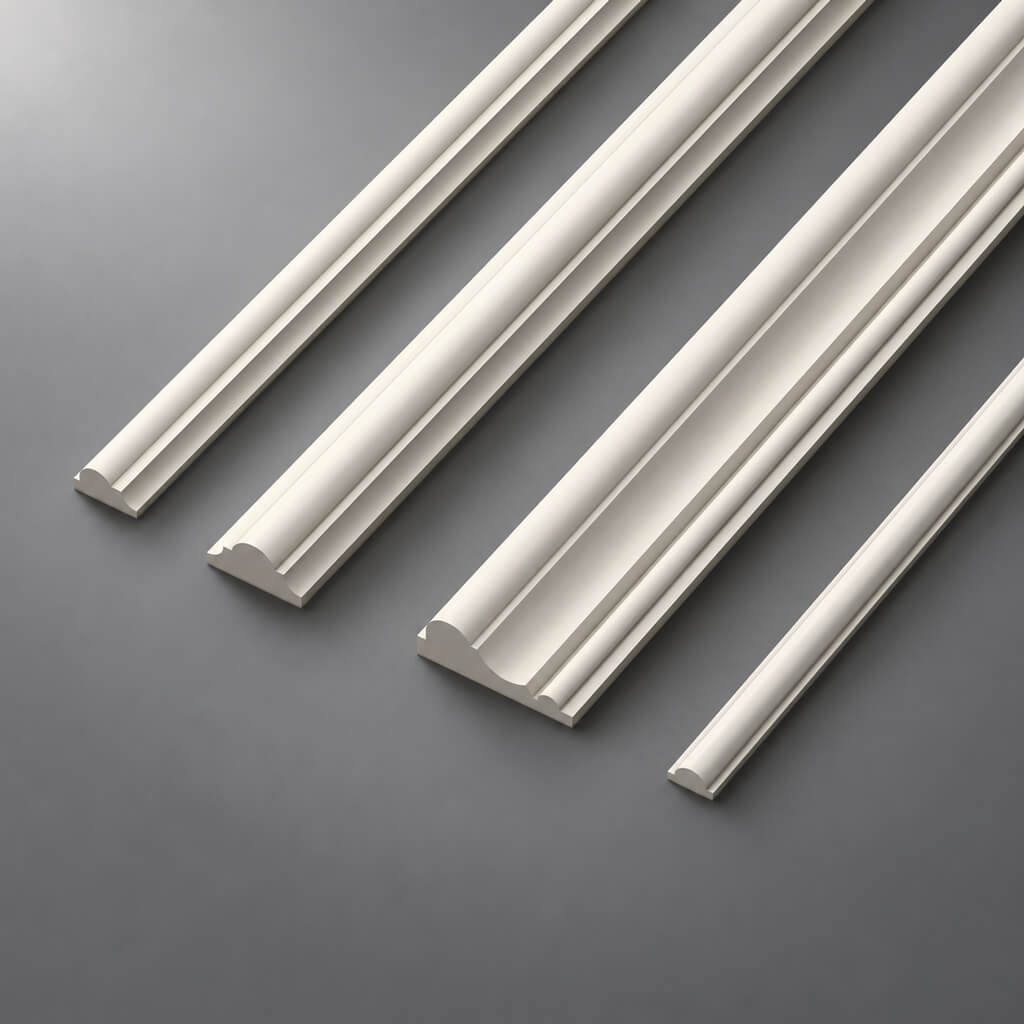
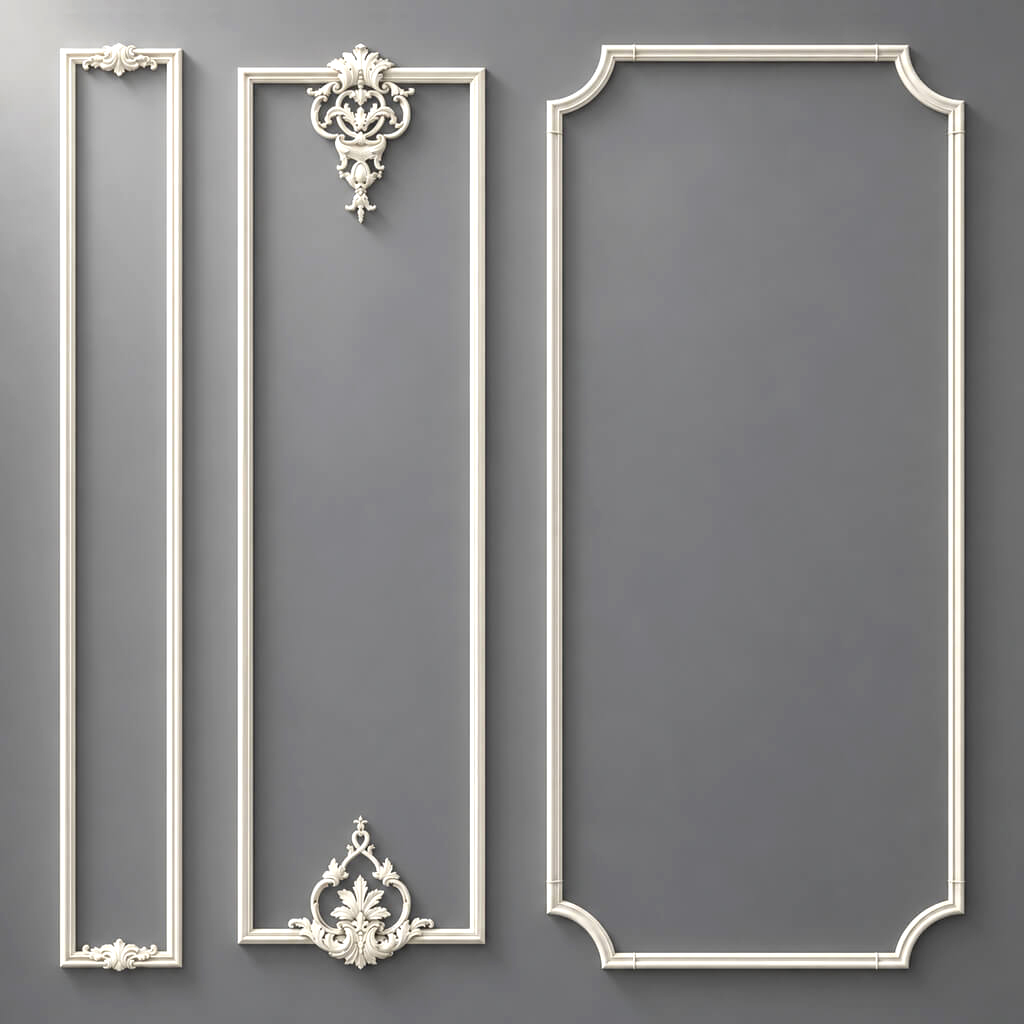
Moldings made of polyurethane form frames, verticals, and horizontal lines.
When choosing, the following are important:
- width;
- depth;
- relief;
- product length;
- junction with the architrave and skirting board.
Overlay decor
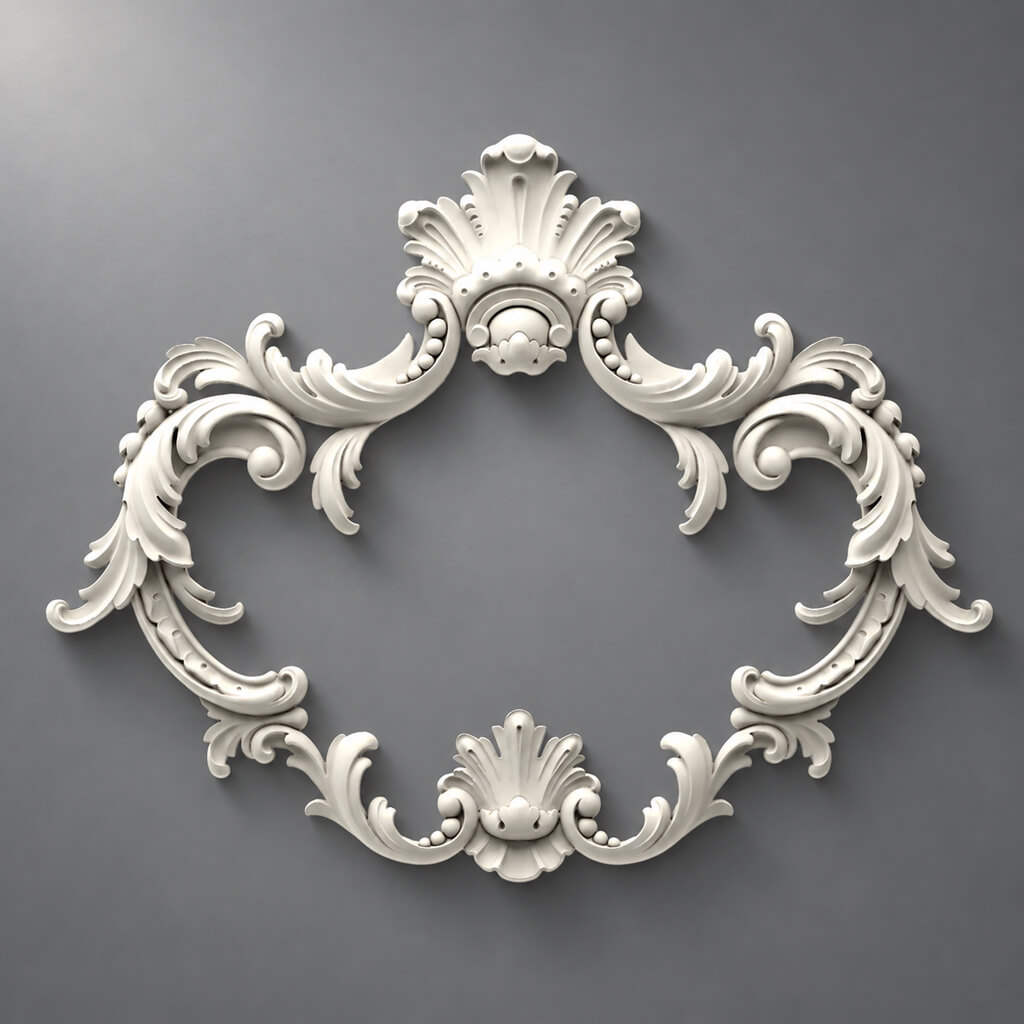
molded decoration made of polyurethane — a separate piece group.
Overlays cannot be hidden in the "molding" line. Each item gets its own SKU and quantity.
What to check with the manufacturer
If a project has a lot of polyurethane, it is important to understand:
- how well-structured the catalog is;
- whether technical files are available;
- whether a physical sample can be obtained;
- how the assortment changes;
- whether a repeat order can be placed.
Wooden decor from the manufacturer
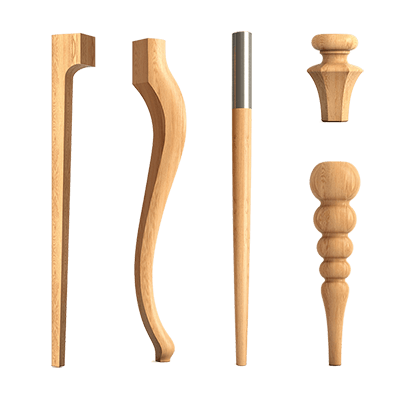
wooden decorative elements require different logic.
For an architect, the following are important:
- wood species;
- profile;
- quality of finishing;
- the actual size;
- the possibility of painting or tinting;
- repeatability;
- the connection with doors and furniture.
Oak and beech
If a transparent finish is used, the wood species becomes part of the visual concept.
The same stain on oak and beech does not produce the same result.
Painting
Under opaque enamel, the natural texture becomes secondary.
In this case, it is important to understand why the project specifically needs solid wood rather than another material.
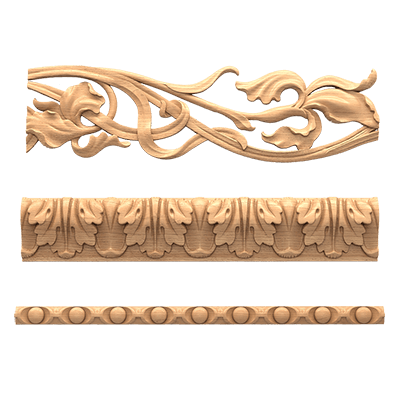
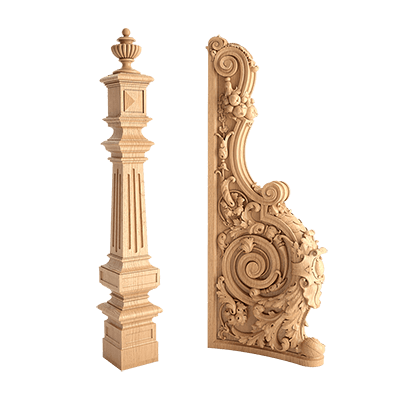
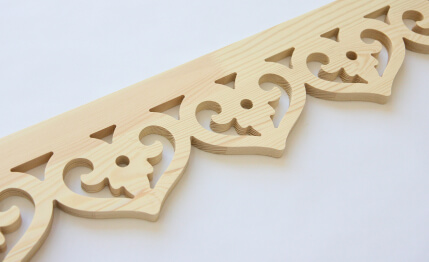
Carved system
Carved wooden decoration especially useful where the following are needed:
- capitals;
- Plates;
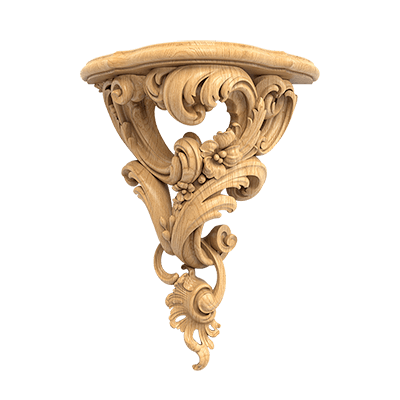
- Brackets;
- Outlets;
- classic compositions;
- furniture and architectural elements.
The main risk is assembling a beautiful ornament from individual cards without checking the overall system.
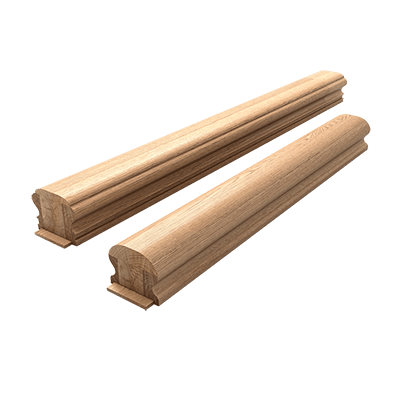
The moulding manufacturer as a design partner
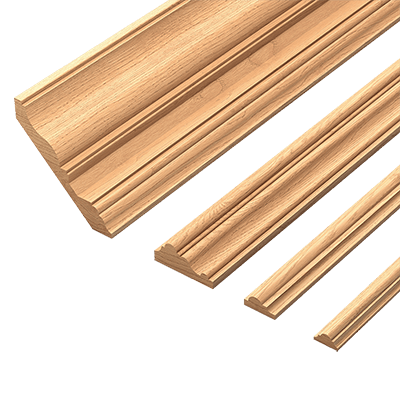
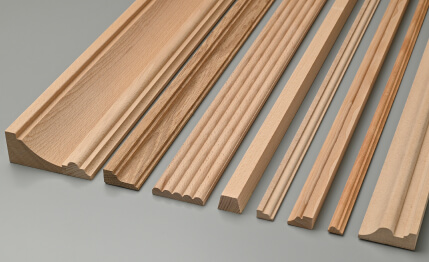
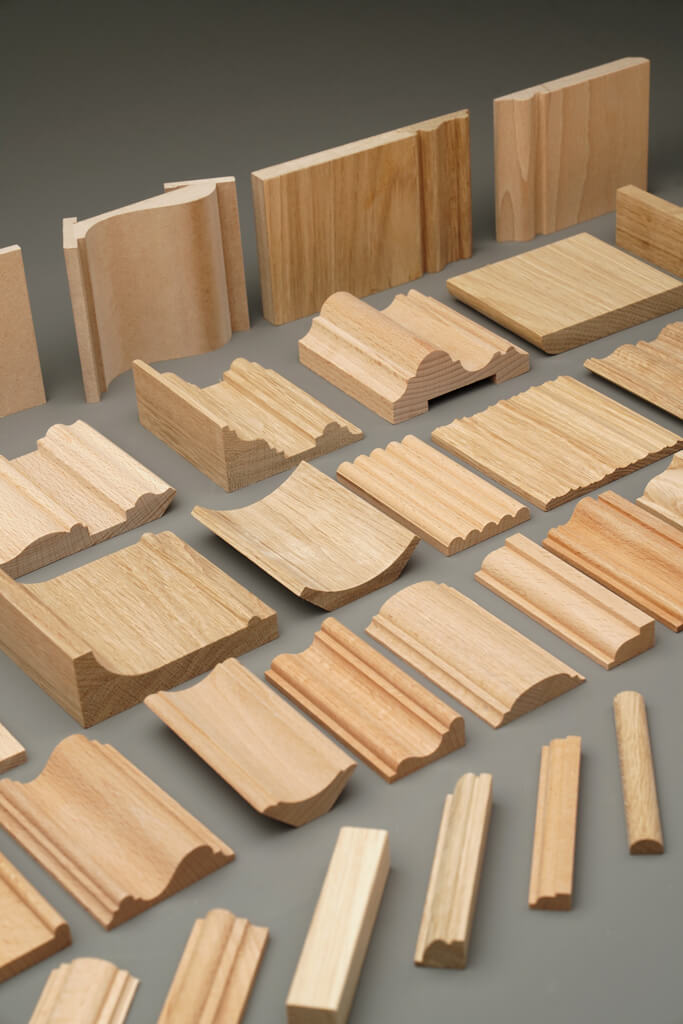
Moulding is not a single product item, but a system of long-length profiles.
This may include:
- Moldings;
- cornices;
- skirting boards;
- Baseboards;
- baguette;
- other profile elements.
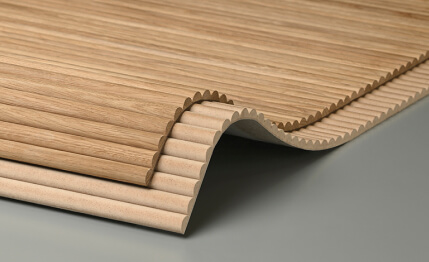
Wooden trim especially useful in projects where the architecture of walls, doors, and furniture must be tied together by a single material.
What to check
- height;
- thickness;
- cross-section;
- commercial length;
- the material;
- finish;
- compatibility of profiles.
Why this is important
If the skirting board, architrave, and moulding are designed independently, the following often appear at the junction point:
- steps;
- mismatched protrusions;
- non-matching bevels;
- random end faces.
wooden moldings, cornices, and baseboards it is more convenient to check as a connected system rather than as three independent categories.
Manufacturer of architectural elements
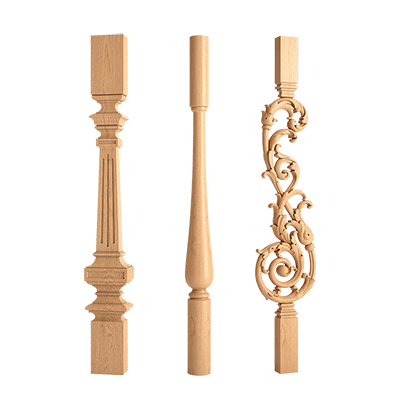
For complex interior assemblies, an architect needs not only moldings but also full-fledged architectural elements:
- pilasters;
- columns;
- capitals;
- base;
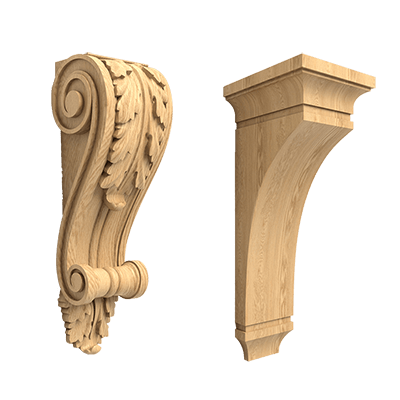
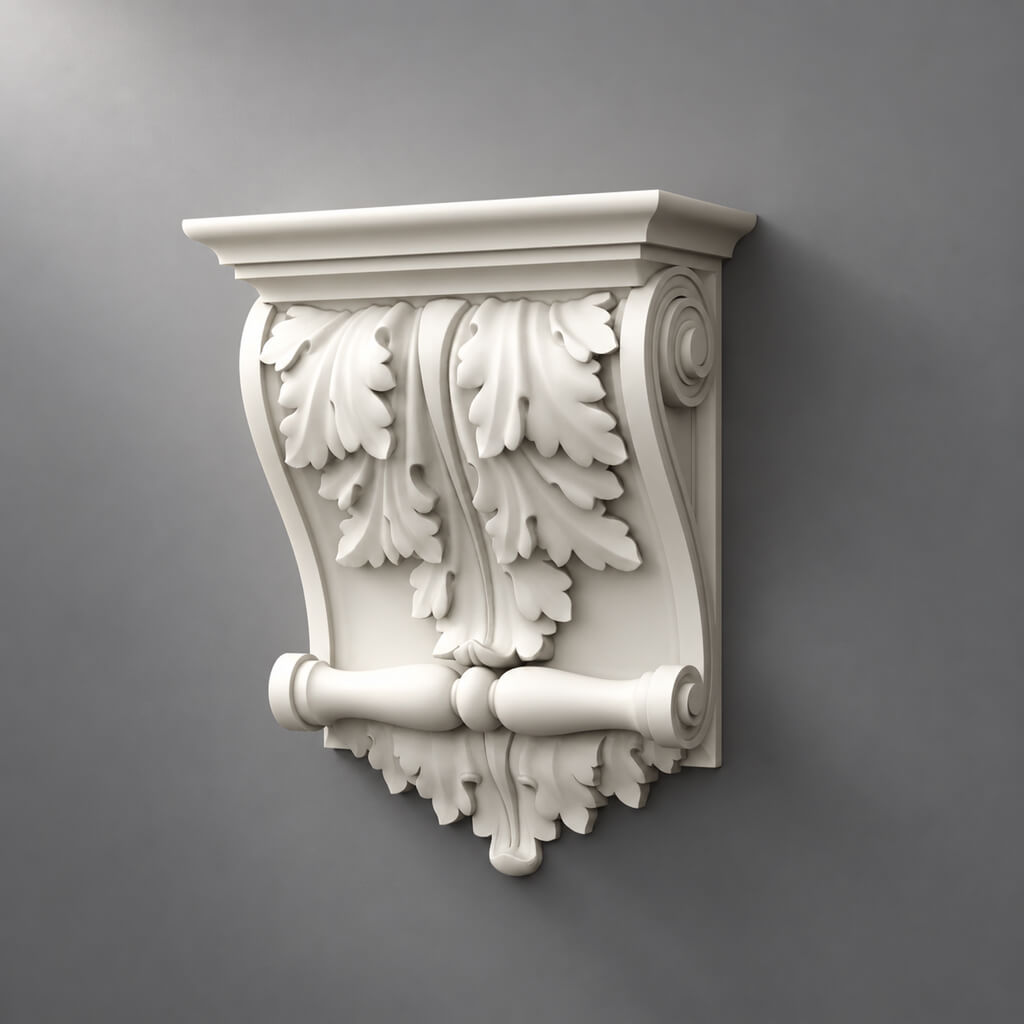
- Brackets;
- portal details.
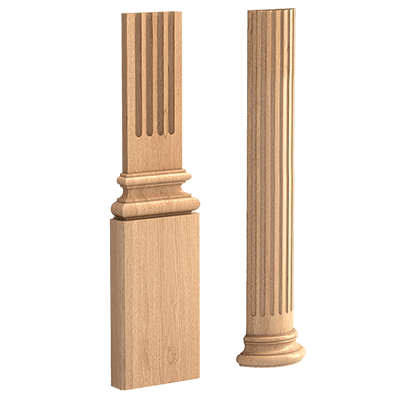
pilasters and columns should be considered as a system.
A pilaster does not exist on its own
Need to check:
- width of the wall section;
- overall height;
- base;
- capital;
- the upper termination.
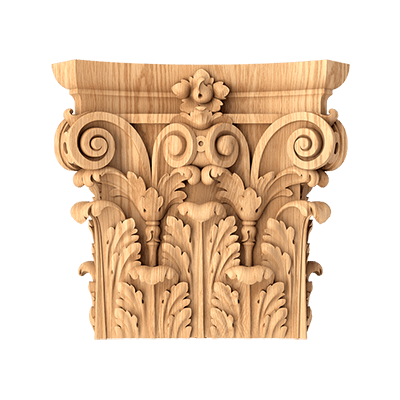
Capital
Capitals are selected after determining the vertical shaft.
If the capital is much wider than the pilaster, a sufficient pier and a clear upper assembly are needed.
Column
A column requires verification in plan.
It occupies real volume and affects passages, furniture, and the ceiling.
Manufacturer criterion
A good project partner should provide enough information so that the architect can assemble a single junction from individual SKUs, rather than guessing whether the parts fit together.
Manufacturer's technical base: DWG, 3D, and BIM
DWG allows the use of the actual product geometry in construction documentation.
DWG and 3D models of decor especially important where the profile affects the junction.
DWG helps verify:
- cross-section;
- outer dimension;
- overhang;
- the mounting plane;
- placement;
- the joint with the adjacent element.
Where DWG is critical
- molding at the door casing;
- cornice at the curtain niche;
- baseboard at the built-in wardrobe;
- pilaster on the furniture;
- panel at the baseboard;
- capital at the cornice.
What an architect should not do
You should not take a random CAD block, stretch it to the required size, and then try to find a similar product.
The correct sequence is:
SKU → DWG → working detail.
Why 3D models are needed
3D addresses a different layer of the task.
It allows you to check:
- scale;
- relief;
- chiaroscuro;
- interaction with furniture;
- perception from a real distance.
Working link:
SKU → 3D → DWG → specification.
3D and DWG do not replace each other
3D shows well how an element looks.
DWG shows how it occupies space.
Example
A cornice may look perfect in a render, but its actual projection overlaps with the curtain niche.
And vice versa: the profile technically fits in section, but visually it is too massive.
That is why a strong project needs both layers.
Manufacturer and BIM
There is no need to require every manufacturer to have a huge ready-made Revit library.
For an architect, it is more important that the product can be unambiguously linked to a real item.
Minimum data set:
- Manufacturer;
- Article/SKU;
- Material;
- dimensions;
- URL;
- category.
When a ready-made BIM family is useful
- large object;
- automatic schedules;
- coordination of multiple disciplines;
- repeating element types.
When DWG and parameters are enough
If a decorative element does not involve complex parametric logic, the architect can create a custom family or use 2D/3D geometry as a reference.
The main thing is to preserve the SKU identity.
Samples and material library of the design studio
Digital materials do not show everything.
Product samples allow you to check:
- the texture;
- real relief;
- surface quality;
- wood;
- color;
- profile scale.
What is a sample for?
For the designer — to compare the visual result.
For the architect — to check the actual scale.
For the client — to approve the materiality.
For the specifier — to record the approved option.
When a sample is especially important
- natural wood;
- deep relief;
- wall panels;
- large molding;
- complex finish;
- large production run.
How a manufacturer should work with a design sample library
For a design studio, it is useful to maintain a system:
SKU → sample → 3D → DWG → verification date.
This way, the next project doesn't start with searching all over again.
Practical sample card
BRAND: STAVROS
SKU: ___
MATERIAL: ___
SIZE: ___
FINISH: ___
3D: YES/NO
DWG: YES/NO
LAST VERIFIED: ___
Why the date matters
A year later, you need to know whether the range has changed and whether the item is still available.
Physical labeling
A sample without a SKU quickly turns into a nameless part.
Better to store:
- SKU;
- QR/URL;
- the material;
- the project where it was used.
SKU stability and managed replacements
If the architect specified a particular profile in:
- visualization;
- DWG;
- section;
- the specification;
and then the position was replaced without a trace by another, a project revision arises.
What actually changes when replacing
Even a "similar" product may have a different:
- width;
- the depth;
- commercial length;
- ornamental density;
- mounting surface.
What the manufacturer should do
Not promise absolute permanence of the SKU, but provide manageable information:
- position status;
- current data;
- a clear replacement;
- the differences of the new SKU.
For an architect, what matters is not magical immutability, but manageable nomenclature.
What to do if the selected SKU needs to be replaced
The manufacturer should not offer just “something similar.”
A replacement is needed with clear:
- dimensions;
- by material;
- profile;
- differences;
- available files.
Working sequence
new SKU → parameter comparison → 3D → DWG → recalculation → new specification.
Example with molding
Old profile:
- width 40 mm;
- depth 15 mm.
New:
- width 50 mm;
- depth 12 mm.
This is not a neutral replacement.
You will have to double-check:
- frames;
- indents;
- door;
- Furniture.
Example with panel
If the module has changed, the entire layout is recalculated.
Repeat deliveries and large-scale projects
For a hotel, restaurant, residential complex, or large house, procurement can be done in batches.
The architect needs to understand in advance:
- whether a reorder is possible;
- how the item is identified;
- how repeatable the geometry is;
- how the finish is specified;
- what happens when an SKU is discontinued.
Why the batch matters
For natural wood, the following may differ:
- shade;
- grain pattern;
- tone after finishing.
For painted decor, what matters is not the texture of the wood, but geometric repeatability and consistent surface preparation.
What to preserve
- SKU;
- the approved sample;
- finish;
- photo;
- date;
- order number.
Manufacturer and large-scale project
For a large project, the price of a single part is only part of the task.
Need to check:
- quantity;
- batch splitting;
- lead times;
- packaging;
- logistics;
- delivery sequence;
- on-site storage conditions.
Why you can't discuss only the discount
A missed batch on site can be more expensive than the price difference.
For the architect and specifier, predictability matters.
How to ask the manufacturer a question
Not:
"How much does the molding cost?"
But:
“The project requires 480 m of profile, delivery in three phases, with the first stage in November. Can you confirm the production schedule and SKU repeatability?”
This is how the request becomes professional.
Custom elements and non-standard tasks
The standard catalog covers most typical tasks, but not all.
Custom production may be needed if the project requires:
- a different size;
- a custom ornament;
- a unique profile;
- repetition of a historical detail;
- precise alignment with the existing architecture.
What to check before requesting
First, make sure that a similar ready-made SKU truly does not exist.
A ready-made product is usually simpler:
- approve;
- calculate;
- reorder;
- replace;
- integrate into the specification.
What to clarify with the manufacturer
- whether they accept non-standard tasks;
- which materials are available;
- whether a minimum order quantity is required;
- how technical approval is carried out;
- whether a prototype is required;
- which file formats are accepted;
- how the final geometry is locked in.
Custom manufacturing terms may vary by category and order quantity, so they cannot be carried over from one product to the entire range.
What to provide to the manufacturer for a non-standard element
The more accurate the source data, the fewer iterations.
Minimum:
- sketch;
- drawing;
- dimensions;
- scale;
- the material;
- quantity;
- application node.
For a complex project, the following are useful:
- DWG;
- 3D;
- photo of the existing element;
- section;
- unfolded view;
- finish description.
Example of a good brief
Not:
"Need a larger classic carved overlay."
But:
"Overlay for a portal, maximum field 420 × 260 mm, oak, clear finish, 16 identical elements, installation on a flat panel, preferably preserving a symmetrical floral motif."
Why quantity needs to be specified right away
The technology and economics of a single part and a series differ.
The manufacturer must understand the real volume before the calculation.
How to verify a manufacturer before including them in a project
A practical preflight can be done before the catalog becomes part of the working documentation.
1. Open the catalog
Check whether real categories can be found quickly.
2. Select several SKUs
Not just one attractive product, but 3–5 items from different groups.
3. Check the dimensions
Are there clear dimensions and cross-sections?
4. Check the technical materials
Are there working files for the required category?
5. Check samples
Can I get a physical check of the profile or material?
6. Check professional contact
STAVROS for designers and architects — an example of a separate B2B route where the project team gets access to digital materials and contact support.
7. Check the calculation
The manufacturer must understand the specification and quantity, not just individual product cards.
8. Check custom solutions
If the project has complex details, it is better to ask a question in advance rather than after approval.
Why the assortment alone is not the main criterion
A large catalog is useful only when it can be used as a project system.
Ten thousand products don't help if it's impossible to:
- unambiguously find the SKU;
- get the size;
- download the technical file;
- understand the material;
- reorder the item.
What matters more than the number of SKUs
- structure;
- filters;
- stable categories;
- technical specifications;
- clear URLs;
- working files;
- support for repeat purchasing.
An architect needs not maximum, but a manageable choice
Fifty well-described profiles can be more useful than five hundred without cross-sections and status.
How to check the quality of a product card
Minimum for a project item:
- article number;
- the material;
- size;
- photo;
- technical description;
- category membership.
Additionally useful:
- DWG;
- 3D;
- related products;
- material options;
- availability status;
- usage recommendations.
What to do in case of contradictions
If different pages of the site show different values for the same parameter, you cannot choose the convenient one.
You need to:
- identify the current product page;
- verify against the technical file;
- if necessary, confirm with the manufacturer;
- record the confirmed value in the project.
Project specification and product identification
Each item must resolve to a single unambiguous line.
| Code | SKU | Element | Size | Material | Quantity |
|---|---|---|---|---|---|
| ML-01 | ___ | Molding | ___ | PU | ___ m |
| CR-01 | ___ | Cornice | ___ | PU | ___ m |
| PIL-01 | ___ | Pilaster | ___ | Wood | ___ pcs. |
Additional Items:
- URL;
- room;
- DWG;
- 3D;
- finish;
- status;
- revision.
Why the manufacturer affects specification quality
If the product database is structured, the specifier does not need to reinterpret the architect's intent.
If not, a new search layer appears between design and procurement.
Code and SKU
ML-01 — project code.
SKU — the actual product.
They do not replace each other.
Why a URL is needed alongside the SKU
The item code remains the primary identifier.
But the URL allows you to:
- quickly open the product page;
- double-check the specifications;
- see the current status;
- proceed to purchase;
- verify the images.
URL should not be the only identifier
The site structure may change.
Therefore, the specification stores both fields:
SKU
и
URL.
Clean link
It is better to keep the address without UTM, advertising parameters, and internal tags.
The manufacturer must be linked to the specifier
The architect defines the solution.
The specifier turns it into an order.
There should be no new search between them using the wording "find something similar."
What the specifier receives
- SKU;
- quantity;
- the material;
- URL;
- revision;
- comment on the finish;
- approval status.
What the manufacturer receives
- structured order;
- clear product codes;
- quantity;
- lead times;
- phasing.
What is lost without the link
- designer's intent;
- precise geometry;
- replacement control;
- the ability to quickly verify a disputed item.
How to compare a manufacturer and a regular supplier
No rating or overall score is needed. A criteria matrix is needed.
| Criterion | What to Check |
|---|---|
| Catalog | real SKUs |
| Dimensions | precise and unambiguous |
| DWG | yes/no for the required category |
| 3D | yes/no |
| Samples | whether it can be obtained |
| Materials | PU / wood / MDF |
| Non-standard | whether it can be discussed |
| Specification | whether it supports project work |
| Repeat purchase | SKU manageability |
| Contact | separate B2B route |
How to use the matrix
Do not give a “10 out of 10.”
Instead, note:
YES
NO
CHECK
NOT NEEDED.
This shows whether the manufacturer is suitable for a specific project.
Why you can't have a universal winner
For a polyurethane project, some criteria matter.
For carved wood — others.
For a hotel with repeat orders — still others.
A strong choice depends on the task.
How to create a professional request to a manufacturer
For a serious request, it is useful to provide:
- plan;
- unfoldings;
- sections;
- visualizations;
- DWG;
- selected SKUs;
- quantity table.
Do not send message
"Need beautiful classic molding".
Such a request forces the manufacturer to redo part of the design work.
Better
"Living room 42 m², height 3.25 m, paneled walls, cornice and two pilasters. Need candidates matching the specified dimensions, DWG/3D files and samples before the final specification".
This reduces the number of clarifications.
How an architect can create a selection request
A good structure:
object → room → task → dimensions → material → required categories → timeline → files.
Example:
Apartment, living room. Need to select molding for frames and a cornice. Ceiling height 3.1 m. The molding must fit within a 45–55 mm range. The cornice — without conflict with a 160 mm curtain niche. Need SKUs, dimensions, DWG, and 3D. After the shortlist, we will order samples.
Why this request is stronger
The manufacturer receives the criteria and does not waste time on irrelevant assortment.
How to work with the manufacturer after approval
For a design bureau, these statuses are convenient:
CANDIDATE → APPROVED → SPECIFIED → QUANTITY CHECK → ORDERED
CANDIDATE
The product is technically suitable, but not yet approved.
APPROVED
The architect and the client have approved the item.
SPECIFIED
The SKU has been added to the working documentation.
QUANTITY CHECK
The procurement specialist has checked the linear meters and quantity.
ORDERED
The item has been sent to purchasing.
Why statuses matter to the manufacturer
On a long project, the manager and the specifier understand which items are being discussed and which can no longer be changed without a revision.
Red flags before adding the manufacturer to the project
There are signs that indicate it is better not to rush into locking the brand into the working documentation.
Product without a SKU
If an item can only be identified by a photo or name, it is poorly suited for a long project.
Dimensions are specified ambiguously
It is unclear which measurement is height, which is depth, and what counts as the external dimension.
No technical contact
All questions have to be asked through a general chat without someone who understands the project documentation.
The replacement is made without describing the differences
Phrase:
“take an equivalent”
insufficient.
You need to know how the new SKU differs geometrically.
A sample cannot be linked to a product
Without a product code, a sample quickly loses its identity.
There are many duplicates in the catalog
The same item appears under different names and URLs.
There is no clear reorder mechanism
For a serial project, this is a serious risk.
When a large manufacturer can be excessive
Not every project requires a complex B2B infrastructure.
One well-known product
If you need a single standard molding, its SKU is known, and all dimensions are published, a dedicated partnership may not add extra value.
Small private project
If there is no complex specification, repeat deliveries, or custom assemblies, a correct product page and consultation are sufficient.
Unique handcrafted work
Sometimes a project needs a one-off custom element that is more rationally entrusted to a specialized workshop.
Local material
If the main decor is made directly by a carpenter on site, the factory catalog may only be auxiliary.
The criterion is simple: a manufacturer is needed when their system reduces project risks, rather than simply adding another participant.
Commercial stage: buy from the manufacturer
A commercial request should arise after the SKU is finalized.
At this stage, the following phrasings naturally emerge:
- stucco manufacturer;
- stucco manufacturers;
- polyurethane decor manufacturer;
- stucco decor manufacturer;
- molding manufacturer;
- production of decorative elements;
- buy stucco from the manufacturer;
- buy polyurethane stucco;
- buy polyurethane moldings;
- buy polyurethane molding;
- order architectural decor;
- order decor according to the project;
- architectural decor from the manufacturer.
But a professional order should look not like a general request, but like a specification.
| SKU | Element | Material | Quantity | Room | Status |
|---|---|---|---|---|---|
| ___ | Molding | PU | ___ m | Living room | APPROVED |
| ___ | Cornice | PU | ___ m | Living room | APPROVED |
| ___ | Pilaster | Wood | 4 | Hall | APPROVED |
| ___ | Panel | MDF | ___ pcs. | Bedroom | APPROVED |
What to clarify before payment
- SKU availability;
- availability of the required quantity;
- lead times;
- breakdown of the delivery;
- packaging;
- reorder terms;
- finish;
- documents for a non-standard item.
The contact must be clear
STAVROS contacts allow the project team to use separate channels for St. Petersburg, Moscow, and the regions.
For a B2B project, what matters is not the mere presence of a phone number, but the ability to quickly link a request to a specific specification and project.
Final checklist for an architect before choosing a manufacturer
Catalog
- actual SKUs;
- clear categories;
- dimensions;
- materials;
- URL.
Technical base
- DWG for the required group;
- 3D for visualization;
- catalogs;
- clear file names.
Physical verification
- samples are available;
- sample is linked to SKU;
- you can check the material and texture.
Nomenclature
- the status of the item is clear;
- substitutions are explained;
- reordering is manageable.
Materials
- polyurethane;
- wood;
- MDF;
- the combinations required by the project.
Non-standard
- it is clear whether the manufacturer accepts such tasks;
- what source data is needed;
- whether there are restrictions on the run size;
- how approval is carried out.
Specification
- each item can be unambiguously entered into the list;
- URL and SKU do not conflict;
- dimensions match the technical files.
Delivery
- quantity is confirmed;
- phasing is clear;
- reordering is possible or an alternative is provided.
If these points are covered, the manufacturer becomes part of the project's working system, not just a source of goods.
FAQ
How does an architectural decor manufacturer differ from a regular store?
A store may be sufficient for a one-time purchase. In project work, a manufacturer is valuable for the ability to connect the catalog, real SKUs, technical data, samples, specifications, and repeat purchases.
Should a manufacturer be chosen before visualization?
Not always before the first sketch, but preferably before the final visualization and working documentation, if the actual dimensions of the decor affect the composition.
What is more important — a large assortment or technical files?
It depends on the project. For architectural work, a small but well-documented assortment is often more useful than a huge catalog without dimensions and DWG.
Is a manufacturer required to have a BIM library?
No. For many tasks, accurate dimensions, DWG, 3D, and an unambiguous SKU are sufficient. A BIM family can be built within the bureau.
When is a sample needed?
For wood, panels, large profiles, deep relief, and complex finishes. The higher the quantity and the cost of an error, the more useful a physical check is.
How to verify SKU stability?
Ask about the status of the item, reordering, and the replacement procedure. Absolute permanence of an article number cannot be guaranteed, but the process should be manageable.
What to do if a SKU is discontinued?
Get an alternative with exact dimensions, then update the 3D, DWG, calculation, and specification.
Can multiple manufacturers be mixed in one project?
Yes. The key is to check joints, materials, finish, and nomenclature management.
When is custom decor needed?
When the ready-made catalog does not cover the geometry, size, or bespoke motif, and this element is truly important for the project.
What should be provided for a custom product?
A sketch, drawing, dimensions, material, quantity, application detail, and for complex geometry — DWG or 3D.
How can a manufacturer be tested on a small project?
Select several SKUs, check the product pages, download technical materials, order a sample, and complete one full cycle through to the specification.
How should repeat deliveries be handled?
Keep the SKU, sample, finish, order number, and inspection date. For wood, record the approved finish separately.
What should be included in a specification line?
At minimum: brand, SKU, name, material, size, quantity, and URL.
Why is a URL not enough without a SKU?
A URL can change. The SKU remains the primary product identifier.
What should you do if the dimensions differ on the website and in the DWG?
Do not guess. You need to obtain confirmation of the current value from the manufacturer and record it in the project.
How should an architect send a sourcing request?
With a structure: project, room, task, dimensions, material, categories, deadline, and attached files.
When is a manufacturer not needed as a separate partner?
When the task comes down to a one-time purchase of a known product without complex assemblies, specifications, or repeat supplies.
Bottom line: an architect chooses not a catalog, but a system of project work
A strong manufacturer of architectural decor for an architect is not the one with the most beautiful images, and not the one who promises a universally “best” product.
Project work requires a system:
architectural task → real catalog → SKU → dimensions → sample → 3D/DWG → specification → calculation → order → repeat supply.
An architect needs to verify four levels.
Product: whether real items exist with article numbers and clear dimensions.
Technical: whether the products can be transferred into working documentation and visualization.
Material: whether the required materials and samples are available.
Operational: whether it is possible to order, repeat a batch, process a replacement, and resolve a non-standard assembly.
Then the manufacturer becomes part of the project infrastructure. The specifier no longer has to search for alternatives from scratch, the contractor receives clearly defined products, and the architect retains control over the geometry from concept to completion.