Article Contents:
- What to check before visiting a Moscow showroom
- How to put together a shortlist of profiles before your visit
- Why it is especially useful to choose wooden trim in person
- Wooden skirting board: what to bring with you for a proper comparison
- Why the same skirting board looks different in a showroom and in an apartment
- How to check a skirting board after visiting a showroom
- Wooden moulding: comparing profiles by actual width
- How to apply moulding to a real wall layout
- Wooden cornice: why you need the ceiling height before the visit
- Why you shouldn't guess the meaning of dimension letters for a cornice
- Building material suppliers in Moscow: a sample and product availability are different things
- Four product statuses a buyer must distinguish
- Sample available
- Small quantity available
- Full project volume available
- Made to order
- Pickup
- Delivery
- Where is the STAVROS Moscow showroom located?
- What are the current opening hours?
- Can I pick up the goods myself in Moscow?
- If a sample is available in the showroom, does that mean 500 m of the product is in stock?
- What should I bring with me when choosing a skirting board?
- What should I note down after choosing a moulding?
- Do I need to buy immediately after viewing a sample?
- What is more important for a repeat order?
- Where can I preview the assortment?

A Moscow procurement specialist, designer, or contractor needs wooden skirting boards, mouldings, and cornices for a large interior project. Several options have already been shortlisted in the online catalogue, but buying hundreds of metres based only on photos is risky: on screen the profile looks convincing, but at real scale it may turn out to be too small, too bulky, or a poor match for the doors and ceiling height.
If you are looking for Construction material suppliers Moscow, a practical route is best built like this:
online catalog → short list of SKUs → showroom visit → sample comparison → confirmation of exact dimensions and material → check of available volume → project calculation → reservation → order → delivery or pickup.
STAVROS has a Moscow showroom at Volokolamskoye Shosse, 3. The current contacts page lists working hours as Mon–Fri from 9:00 to 18:00. Pickup from Moscow is possible if the required item is available in the Moscow warehouse. Therefore, local selection here can be turned into working coordination: first see the profile in person, then return to the project, and only after calculation form a large batch.
It is convenient to preview the main assortment in the section wooden trim, and physical samples in the product sample catalog.
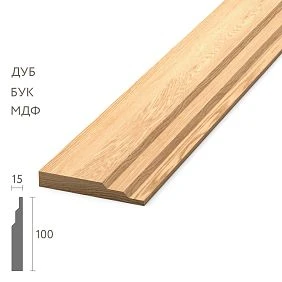
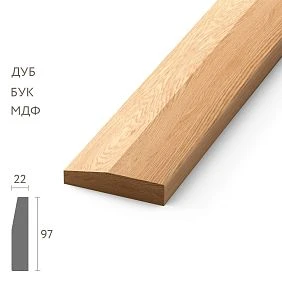
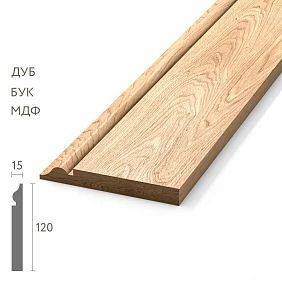
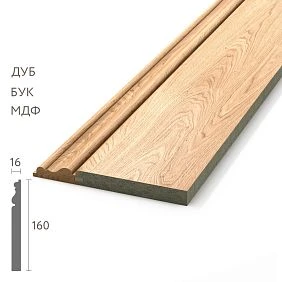
What to check before visiting the Moscow showroom
Going without a prepared project means wasting time on dozens of beautiful profiles with no selection criteria.
Before the visit, it is useful to gather:
- floor plan;
- approximate square footage;
- ceiling heights;
- dimensions of doors and casings;
- photos or visualizations;
- flooring sample, if already selected;
- wall color or paint swatch;
- list of pre-selected product codes;
- intended material: oak, beech, MDF;
- list of rooms where each profile will be used.
So the conversation starts not with the question “what beautiful things do you have?”, but with a specific task:
Need a skirting board for rooms with a 3.1 m ceiling, a molding for 1200×1800 mm frames, and a cornice for the upper contour; here are three candidate product codes.
As a result, the showroom becomes a place to test an already prepared hypothesis.




How to build a shortlist of profiles before the visit
The optimal preliminary list is not twenty random SKUs, but 3–5 candidates in each critical group.
For each one, it is enough to record:
| Field | What to record | | --- | --- | | Type | skirting board / moulding / cornice | | SKU | exact SKU | | Size | full size from the product page | | Material | oak / beech / MDF | | Length | specific product length | | Room | where it is being considered | | Status | main candidate / backup |
This way, in the showroom you can compare solutions in pairs: one skirting board with another, one moulding with another, one cornice with another. This is faster and more accurate than looking through the entire catalog again on site.
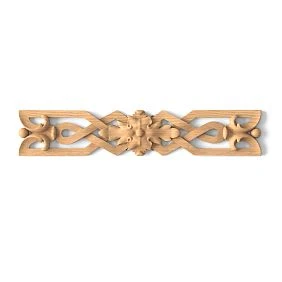
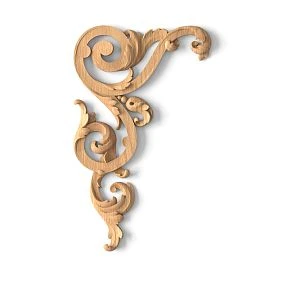
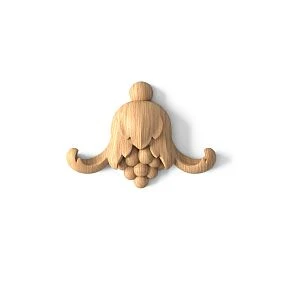
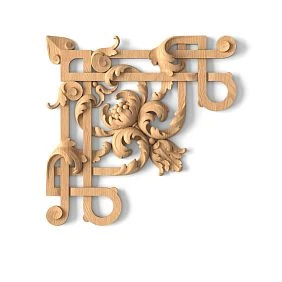
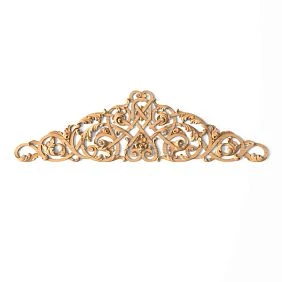
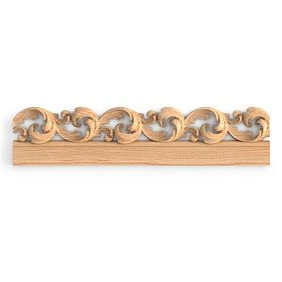
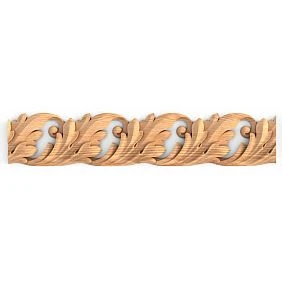
Our factory also produces:

Why wooden trim is especially useful to choose in person
A photograph conveys the pattern, but poorly conveys scale.
On screen, two mouldings can occupy the same 600 pixels, even though one actually has a cross-section of 10×6 mm, while the other is several times larger.
A physical sample allows you to evaluate:
- the actual width;
- depth of the relief;
- the texture of the wood;
- shadow on the raised areas;
- visual mass;
- relationship with the adjacent profile;
- the feel of the material in the hand.
For a large order, this is especially useful. An error over five meters is limited. An error over 500 meters of a single molding turns into a change in the entire wall composition.
Therefore, a sample is not a replacement for a drawing, but a second check after the technical data.
Get Consultation
Wooden skirting board: what to bring for a proper comparison
The skirting board is perceived relative to the elements that already exist.
If possible, it is useful to bring to the showroom:
- a small floor sample;
- wall paint swatch;
- full-length photo of the door;
- architrave size;
- photo of the lower part of the built-in furniture.
For example, a 100 mm high skirting board on a separate display stand may seem average. Next to a narrow door casing, it can become the visually dominant element of the lower zone.
So the question is not:
Is the skirting board beautiful?
The right question:
How does this particular profile look next to our door, floor, and wall?
Why the same skirting board looks different in a showroom and in an apartment
A showroom usually has a different scale, different lighting, and more samples around.
On site, everything is different:
- specific ceiling height;
- specific floor color;
- Doors;
- Furniture;
- wall length;
- natural light from specific windows.
Therefore, when choosing, it is useful to rely not only on the impression from the exhibition stand, but also on the profile size.
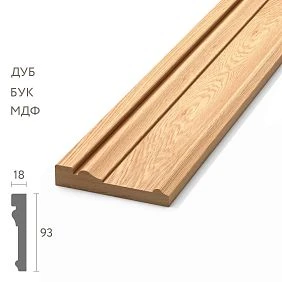
If PLT-006 is selected, the current versions show different geometry: beech and oak solid wood options — 100×15×2400 mm, MDF options — 100×16×2600 mm.
That is, a single SKU already requires precise specification of material and length.
How to check the skirting board after a trip to the showroom
After choosing, you do not need to immediately buy the entire volume.
First, return to the project and place the profile at real dimensions.
If a skirting board with a height of 100 mm is selected:
- mark a 100 mm line on the wall;
- place the architrave dimension next to it;
- check where the built-in furniture ends;
- check whether the height conflicts with sockets or other elements;
- recalculate the product length for the specific finish you have chosen.
This is how the emotional impression of the showroom turns into a design decision.
Wooden moulding: comparing profiles by actual width
With moulding, it is especially easy to make a mistake because of the scale of the photo.
The current MLD-001 has a cross-section of 10×6 mm. This is a compact profile. If a much larger moulding is viewed next to it, frontal photos can visually cancel out the difference.
Therefore, in the showroom it is useful to compare at least:
| Parameter | Profile A | Profile B | Profile C | | --- | --- | --- | --- | | Product code | ___ | ___ | ___ | | Width | ___ | ___ | ___ | | Second cross-section dimension | ___ | ___ | ___ | | Material | ___ | ___ | ___ | | Commercial length | ___ | ___ | ___ | | Planned frame | ___ | ___ | ___ |
The purpose of the table is not to determine the “best molding overall,” but to rule out an unsuitable scale.
How to apply molding to a real wall layout
If there is a visualization or drawing of the wall, you need to know:
- frame size;
- distance between frames;
- distance from the floor;
- distance from the doorway;
- wall height;
- the width of the molding itself.
Let’s imagine a frame of 1200×1800 mm.
A profile 10 mm wide occupies approximately:
10 / 1200 × 100% = 0,83%
the width of the frame on the short side.
Profile 65 mm wide:
65 / 1200 × 100% = 5,42%.
This is not a design rule or a standard. The calculation only shows how differently two profiles will be perceived within the same geometry.
Wooden cornice: why ceiling height is needed before the visit
The cornice is perceived relative to the upper zone of the wall.
Therefore, it is useful to inform the supplier right away of:
- the height of the room;
- wall lengths;
- ceiling type;
- intended skirting board;
- door dimensions;
- the interior style.
The current KZ-001 has a dimensional combination of 104×102×24×17 mm and several product lengths depending on the version — 2000, 2400, or 2600 mm.
A frontal photograph does not answer the question of how this volume will be perceived under the ceiling. You need to look at the section drawing and the real scale.
Why you cannot guess the meaning of dimensional letters for a cornice
If the product card lists A, C, D, E, and L, you cannot independently declare one parameter the "projection" and another the "wall height" unless this is confirmed by the manufacturer's drawing.
Correct order:
open the drawing → read the designations → transfer the section into the project → check the sample.
This is especially important in complex junctions:
- next to a concealed curtain cornice;
- near a built-in wardrobe;
- at the ventilation grille;
- when transitioning between different ceiling heights.
A showroom helps you see the product, but technical compatibility is still verified against the project.
Building material suppliers in Moscow: a sample and stock availability are two different things
If the buyer is looking for construction materials suppliers moscow, one of the main differences is that having a sample does not mean the required project volume is available.
The selected profile may physically be present in the showroom.
But this does not prove that the Moscow warehouse currently has 100, 400, 800, or 1000 m.
After the sample is approved, you need to separately request the available volume for the specific configuration.
For example:
MLD-___ / oak / 2400 mm / need a volume of 420 m. How much is available now, how much will need to be produced, and what is the lead time for full completion?
So the question becomes a procurement one.
Four product statuses a buyer must distinguish
The single word “in stock” is not enough.
It is more practical to separate:
A sample is available
The profile can be viewed physically.
A small quantity is available
Suitable for a test, reorder, or small space.
The full project volume is available
A confirmed specification can be fulfilled.
Made to order
An agreed production timeframe is required.
A particularly dangerous situation:
there is a sample in the showroom → so you can buy 600 m.
There must be a check of the actual volume between these actions.
Building materials supplier Moscow: what to ask after choosing a sample
If needed construction materials supplier Moscow, after making a visual selection, ask specific questions:
- What is the exact SKU?
- What material?
- What are the dimensions?
- What is the commercial length?
- What volume is available?
- What is available specifically in Moscow?
- What needs to be manufactured?
- What is the lead time if unavailable?
- Is it possible to reorder the same item?
- Can a specific batch be reserved?
- What delivery options are available?
- Is there an additional sample for approval with the customer?
Not all answers will necessarily be the same for each SKU. Therefore, it is better to record them line by line.
Why the item code needs to be recorded right in the showroom
Bad entry:
the second tall baseboard on the right.
In a week the stand may be rearranged, and a different employee will handle the purchase.
Good record:
PLT-___ / oak / size ___ / length ___
For molding:
MLD-___ / material ___ / size ___
For cornice:
KZ-___ / material ___ / size ___ / length ___
It is useful to photograph the profile and its marking at the same time. That way the photo stays linked to the SKU.
How to approve a sample with the client before reserving the batch
If the final decision is made not by the purchaser but by the designer or the property owner, this must be taken into account before reserving.
Working order:
- select 2–3 final candidates in the showroom;
- record the exact item codes;
- take photos of the labeling;
- if necessary, obtain a physical sample;
- attach it to the project materials;
- obtain approval for the specific SKU;
- only after that, reserve the project volume.
Bad scenario:
the buyer verbally selected a profile, reserved 500 m, and two days later the customer approved a different one.
The physical sample and the article number must link the visual decision to the product line before any commercial commitment.
One supplier — three elements: we check the set at the same time
The main advantage of physical selection is that you can place side by side:
skirting board + moulding + cornice.
Check:
- relative scale;
- relief density;
- the material;
- overall architectural character;
- whether the top and bottom of the wall compete;
- whether the thin molding between the large baseboard and the cornice gets lost.
The purpose of a physical comparison is to detect an incompatible scale before ordering hundreds of meters.
Why a Moscow project doesn't have to buy the material on the day of selection
The showroom creates the effect of a ready-made solution: the profile is already in hand, and the choice seems complete.
But a large order is better divided into two stages:
selected → noted the item codes → returned to the project → checked the dimensions → calculated the cutting plan → checked the volume → placed the order.
You shouldn't buy 300–500 m just because you liked the sample in person.
Physical coordination answers the question “what.”
Object calculation answers the question “how many.”
Warehouse and production answer the question “when.”
What to check at the Moscow warehouse before a large order
If an item is stated as in stock, the purchaser needs to clarify:
- exact article number;
- the material;
- commercial length;
- quantity;
- configuration consistency;
- the ability to reserve the volume;
- readiness for pickup or delivery.
On the STAVROS delivery page, it is separately stated that pickup from Moscow is available when the item is in stock at the Moscow warehouse.
This caveat is important: the company having the item overall and a specific configuration being available in Moscow are not the same thing.
What to do if only part of the volume is available in Moscow
Let's imagine:
the project needs 480 m of one molding.
160 m is available at the Moscow warehouse.
There is no need to automatically take 160 m and then decide where to get the remaining 320.
First, request a single fulfillment plan:
160 m — current Moscow stock; 320 m — production/supply; full batch ready date — ___
Then the project chooses:
- wait for the full volume;
- receive in two batches;
- use the first part on the finished area;
- select another profile.
The decision depends on the project timeline.
Reservation: what to confirm before payment
If a project volume exists, it is useful to separate actual availability from reservation status.
The buyer needs to clarify:
- for how long the selected volume can be held;
- what is considered confirmation of the reservation;
- whether a specific material and length are included in the reservation;
- whether the configuration changes upon partial payment;
- how the reservation relates to the pickup or delivery date.
You cannot write "reserve confirmed" in the project specification if all you have is a verbal phrase like "the item will most likely be available."
For a large project, the reserve must be tied to a specific product line and a deadline.
Moscow order card: what to capture in a single document
To avoid splitting information between chat, photos, and the invoice, it helps to create a single order card:
| Parameter | Value | | --- | --- | | Project | ___ | | Moscow address | ___ | | SKU | ___ | | Material | ___ | | Size | ___ | | Length | ___ | | Sample approved | yes / no | | Required by project | ___ m | | Available in Moscow | ___ | | Production required | ___ | | Reserve until | ___ | | Delivery method | delivery / pickup | | Responsible person | ___ |
Such a card is especially convenient for multiple SKUs. It separates product selection from logistics and shows which item is already ready for purchase and which is still awaiting confirmation.
If the sample, invoice, and actual item don't match
Before payment, you need to check that the same item appears across all documents.
Risk scenario:
- an oak MLD-___ was approved in the showroom;
- in the correspondence, the manager writes the same SKU;
- the material is not specified in the invoice;
- for pickup, the warehouse issues a different length of the same profile.
Each individual step may look “almost right,” but the project has already lost precision.
Therefore, before payment and receipt, it is useful to reconcile four fields:
SKU / material / full size / length.
If at least one does not match the approved sample and the project specification, you need to stop the issue and clarify the configuration.
How to split an order into delivery and pickup
Pickup and delivery solve different tasks.
Self-pickup
May be convenient for:
- samples;
- small additional orders;
- individual profiles;
- an urgent test item.
Delivery
Usually more logical for:
- hundreds of meters of long-length linear trim;
- several product groups;
- a large cornice;
- project-based fit-out by floor.
You cannot say in advance that delivery is always cheaper or that pickup is always faster. You need to compare the actual batch, transport, and the ability to safely transport long-length items.
Why 10 meters and 500 meters are different processes
A small reorder is determined primarily by current availability.
A large batch requires:
- full calculation;
- checking the required volume;
- possible production;
- coordination of timelines;
- packaging;
- delivery;
- acceptance;
- reservation.
Therefore, the scenario:
"I picked up 4 planks from the warehouse yesterday — so tomorrow I can pick up 200 of the same"
does not work without confirmation.
For a large order, the status needs to be checked again.
How to prepare a specification after visiting the showroom
After returning to the site or office, it is useful to put together a table:
| Zone | Product | Code | Material | Length | Quantity | Reserve | | --- | --- | --- | --- | ---: | ---: | ---: | | Living room | skirting board | PLT-___ | oak | 2400 | ___ | ___ | | Living room | moulding | MLD-___ | oak | 2400 | ___ | ___ | | Living room | cornice | KZ-___ | oak | 2400 | ___ | ___ | | Study | moulding | MLD-___ | beech | 2400 | ___ | ___ |
Only after that does it make sense to request the final calculation.
How to recalculate the quantity after choosing a specific length
Suppose that after the showroom, a profile with a length of 2400 mm was chosen.
Project requirement — 96 m.
Mathematical minimum:
96 / 2.4 = 40 strips.
If the 2600 mm option is selected instead:
96 / 2.6 = 36.92, meaning a minimum of 37 planks.
But these 37 and 40 are only a preliminary check. The actual wall and frame layout may change the quantity.
Therefore, the specific SKU length is fixed first, and then cutting is performed.
How to check the route for receiving long-length items in Moscow
Even if the item is in stock, you need to make sure that the selected pickup method is suitable for that specific batch.
For self-pickup, check in advance:
- the length of the vehicle;
- the ability to safely place the planks;
- protection of the ends;
- securing the cargo;
- the path from the vehicle to the site.
For delivery:
- address;
- time window;
- access for delivery;
- unloading location;
- readiness of the space for storing long-length linear profiles.
This is how logistics are verified before payment, not at the moment when the packages are already ready for dispatch.
How not to lose the selected profile after a few months
For a phased project, save:
- a photo of the sample;
- exact article number;
- the material;
- size;
- commercial length;
- link to the product card;
- the date of selection;
- order number;
- a photo of the label or marking.
If the physical fragment remains with the project, label it:
MLD-___ / oak / project ___ / approved ___
Six months later, a reorder starts not with searching for "that molding from the Moscow showroom," but with an exact line.
How to place a repeat order for the second phase
If the same profile is needed a few months later, do not use the previous quotation as the only source.
Check again:
- article number;
- the material;
- size;
- length;
- current status;
- volume;
- the deadline;
- delivery method.
The old price may change, but the technical line must remain identifiable.
A good request:
Repeat order for project: MLD- / oak / size ___ / length ___ / previous order No.___ / need ___ more pcs.
This way the manager sees the link to the previous purchase, and the project sees that it is the approved item being reordered.
If the selected profile later becomes unavailable
Do not agree to a substitution with the words “almost the same.”
You need to:
- obtain a new product code;
- compare dimensions;
- open the drawing;
- get a sample;
- place it next to the previously approved element;
- check the composition;
- only after that, change the specification.
This is especially important if the first phase has already been installed.
A new profile may be acceptable for another room, but not necessarily as a continuation of an existing line.
Red flags when choosing a supplier of trim and molding in Moscow
The check should be continued if:
- there is no exact SKU;
- dimensions are approximate;
- material is not confirmed;
- a sample exists, but the volume is unknown;
- availability in Moscow is not confirmed;
- the timeline for the full volume is unclear;
- a repeat order has not been discussed;
- a substitute is offered as an “almost the same profile”;
- the product length is missing from the invoice;
- pickup is planned without checking actual warehouse stock.
One such point does not necessarily mean rejecting the supplier.
But placing a large order before resolving the critical issue is premature.
Buyer's journey: from website to delivery at a Moscow site
The workflow can be reduced to nine steps:
- Select 3–5 profiles online.
- Record the item codes and dimensions.
- Prepare the site plan and finish samples.
- View the profiles in the Moscow showroom.
- Compare the skirting, moulding, and cornice at real scale.
- Return to the project and recalculate the quantity.
- Check the availability of the exact configuration and the full volume.
- Agree on the reserve, timeline, and delivery method.
- Arrange the supply according to the current specification.
Thus, the Moscow showroom is used not as a place for impulse purchases, but as part of the professional specification process.
When a visit to the showroom is not necessary
A physical visit may be unnecessary if:
- the same SKU has already been used in the first phase of the project;
- the project has an approved physical sample;
- dimensions and material have already been verified;
- this is a small repeat order;
- the client deliberately works only according to a previously approved specification.
In that case, it is more important to check the current volume and timeline.
A trip is useful where it reduces the risk of choice, not by itself.
Questions before ordering in Moscow
Where is the STAVROS Moscow showroom located?
Moscow, Volokolamskoye Highway, 3.
What opening hours are currently listed?
Monday–Friday, 9:00–18:00.
Can I pick up the item myself in Moscow?
Yes, if the required item is available in the Moscow warehouse.
If a sample is in the showroom, does that mean 500 m of the product is available?
No. Sample availability and availability of the full project volume must be checked separately.
What to bring when choosing a skirting board?
A floor sample, wall color, door photo, casing size, and room parameters.
What to record after choosing a molding?
Item code, material, size, length, and available volume status.
Should you buy immediately after viewing a sample?
For a large order, it is better to first return to the project, create a cutting plan, and only then place the batch.
What is more important for a repeat order?
Exact item code, material, size, length, and a saved link to the product page.
Where can you preview the assortment?
In the STAVROS molded products catalog, and physical samples are in a separate product samples section.