Article Contents:
- Wholesale building material suppliers: why a quotation alone is not enough
- What must remain unchanged in a wooden skirting board line item
- Wooden skirting board: why dimensions must not be rounded
- Wooden moulding: why a “similar profile” is risky
- What counts as an acceptable moulding substitution
- Wooden cornice: why an alternative must be checked against the full cross-section
- Wholesale building material suppliers: a request must contain a single version of the specification
- How to keep a change log
- What does “an equivalent is allowed” mean
- Why price should not automatically allow substitution
- Wholesale building material suppliers: how to request comparable quotes
- Which table to send to the supplier
- Wholesale building material supplier: what to do if an item is unavailable
- Substitution card: a simple way to avoid mistakes
- Why a supplier sample must be linked to a specific SKU
- One batch or several: when to record the batch number
- What to check on the first delivery
- Why starting installation before acceptance is dangerous
- How to record a partial delivery
- What to do in case of underdelivery
- How to handle mixed-up items
- Why documents are especially important for a wholesale order
- What to keep after delivery is completed
- When a strict specification should not turn into bureaucracy
- Final algorithm for working with a wholesale moulding supplier

With a large order, the mistake often occurs not at the stage of choosing a skirting board, moulding, or cornice, but later — when the already approved product goes through purchasing. The designer approved a specific profile, the order assembler transferred it to the schedule, the buyer requested a quote, and received in response: “This SKU is currently unavailable, we can supply practically the same one.” If such a substitution automatically enters the order, the difference is discovered only on site.
Therefore, when working with wholesale building material suppliers for wooden moulding, you need more than just price and lead time. You need a control line in the order that records the SKU, material, geometry, length, quantity, specific finish, and substitution rule. Any change to this line must be visible and approved before delivery.
For moulding, this is fundamental. With a skirting board, even a small difference in height can change the joint with the architrave. With a moulding, a similar width does not yet mean the same cross-section and light-and-shadow effect. With a cornice, an alternative profile may meet the wall and ceiling differently. Therefore, the wording “an analogue is allowed” without criteria is too weak for a serious purchase.
A working rule is better formulated unambiguously:
an unapproved substitution is prohibited.
The supplier may propose an alternative, the buyer may request its price and lead time, but the new item becomes part of the order only after verification and the release of a new version of the specification.
Wholesale building material suppliers: why a commercial offer is not enough
A commercial offer usually answers the buyer's three main questions: how much the goods cost, what quantity is available, and when they can be received. For a simple standard material, this is sometimes enough. For decorative wooden moulding, it is not.
Two offers may have the same product name and the same linear meterage, but in fact describe different items. For example, one specifies an approved oak profile in the required finish, while the second specifies a visually similar moulding made of a different material and with a different plank length. If you compare only the total amount, the second offer may look more advantageous, although it no longer corresponds to the project.
Therefore, a commercial offer must be checked not only by price, but by control attributes:
- article number;
- product type;
- the material;
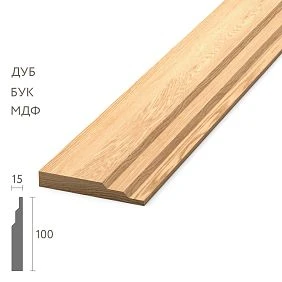
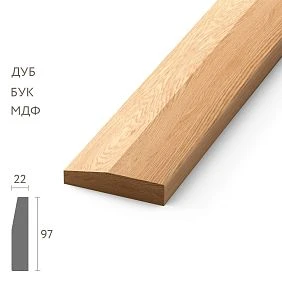
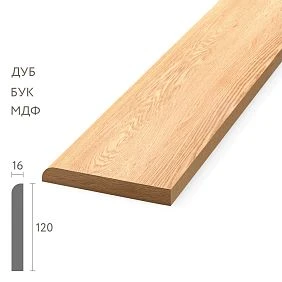
- cross-section and dimensions;
- length;
- version/design variant;
- quantity;
- link to the approved sample, if one was used;
- whether substitution is permitted or prohibited.
In an ideal scheme, the supplier's line should be comparable to the customer's original line without clarification by phone. If the specification states MLD-XXX / oak / finish A, the offer should not contain the impersonal “wooden molding — 200 m”.
Price is a procurement variable. SKU, material, and geometry are the product's identity. They must not be mixed.




What should be immutable in a wooden skirting board line
For skirting boards, it is useful to divide the data into two groups: immutable design parameters and procurement parameters that may be clarified.
The following must remain immutable until a new approval:
- article number;
- the material;
- profile geometry;
- main dimensions;
- version/design variant;
- application area.
The following may be clarified separately:
- final quantity;
- delivery time;
- price;
- batch number;
- shipment sequence.
A control line might look like this:
PLT-XXX / oak / profile per approved spec card / length per selected variant / quantity 84 pcs. / zone F01-F03 / substitution without written approval is prohibited
The point of such an entry is that the supplier understands: the absence of the required item is not automatic permission to supply something similar. The buyer also sees the boundary of their authority.
If the proposal contains a different skirting board, it must go through as an alternative, not as a corrected line of the original specification.
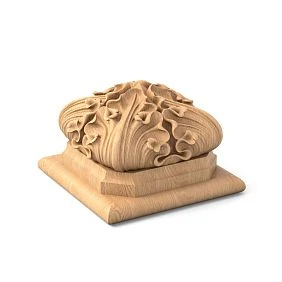
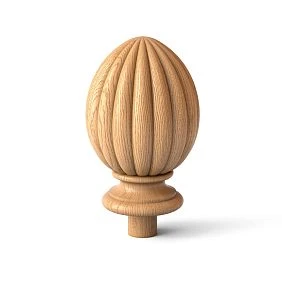
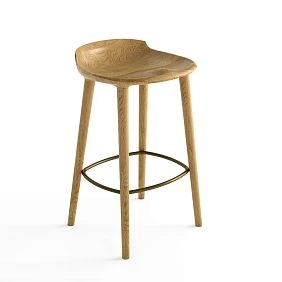
Our factory also produces:



Wooden skirting board: why the size cannot be rounded
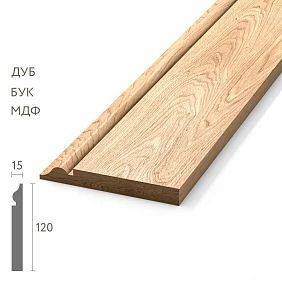
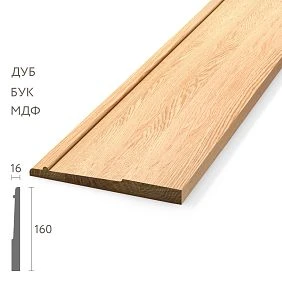
Wording such as “about 120 mm” or “approximately the same height” is convenient at the early selection stage, but unsuitable for the final order.
Let us imagine that the project approved a skirting board 120 mm high, and the supplier offers a 115 mm profile. The difference is only 5 mm. If you look only at the numerical deviation, it seems small. But in the interior, the change may affect several junctions at once.
The skirting board defines the lower architectural line of the wall. It may be connected:
- with the lower point of the door casing;
- with the start of the wall frame;
- with the height of the built-in plinth;
- with a decorative panel;
- with the overall scale of the room.
If the casing is designed for a specific joint, changing the height or thickness can create a step. If the bottom of the wall frames is tied to the top edge of the skirting board, the new height changes the entire rhythm of the wall.
Therefore, the size cannot be "rounded" in the procurement documentation. If a different size is required, this is already a new item that must undergo re-approval.
Get Consultation
Wooden moulding: why a "similar profile" is dangerous
For moulding, similarity in width does not yet mean interchangeability.
Two profiles 60 mm wide can have completely different geometry: one with a soft convex radius, the other with several grooves and ledges. In a frontal photo they may seem similar, but after installation they produce different light and shadow and read differently in the corners.
When comparing mouldings, you need to look not only at the outer size, but also at:
- thickness;
- the height of the relief;
- radii;
- grooves;
- shelves;
- shape of the edges;
- full cross-section.
Wall frames are especially sensitive. If the profile becomes wider while the outer dimensions remain the same, the inner field decreases. If the inner field is preserved, the frame itself increases. In both cases, the wall layout changes.
Therefore, a "similar molding" is a candidate for replacement, not a default replacement.
What counts as an acceptable molding replacement
There is no universal tolerance like "a difference of up to 5 mm is allowed." The same dimension may be irrelevant for a simple linear insert and critical for a complex frame layout.
Acceptability is determined by the project.
For a single composition, the following may be strictly fixed:
- outer width;
- cross-section;
- the material;
- nature of the texture.
And the length of an individual strip may be changed if the cutting plan and quantity are recalculated afterward.
For a different composition, a slight width offset is acceptable, but only after the drawing has been adjusted.
Correct procedure:
supplier proposes → purchaser creates a replacement card → designer or project engineer reviews → if necessary, the site foreman confirms installation compatibility → the specification receives a new revision.
Until the last step is completed, the order must remain on the original SKU or in the status of awaiting a decision.
Wooden cornice: why an alternative is checked against the full cross-section
A cornice interacts with both the wall and the ceiling. Therefore, it cannot be compared by the front pattern alone.
For an alternative, check:
- size along the wall;
- projection onto the ceiling;
- overall height;
- cross-section shape;
- support and fastening location;
- relief;
- compatibility with adjacent ceiling elements.
For example, a new cornice may look almost the same from the front but have a greater projection onto the ceiling. In an open room, this is not a problem. In the area of a curtain recess, built-in furniture, or a ventilation grille, a few extra millimeters can change the assembly.
Therefore, it is better to attach not only a photograph to the cornice replacement card, but also a drawing or a clear cross-section with dimensions.
Wholesale building material suppliers: the request must contain a single version of the specification
When working with wholesale building material suppliers the most banal file error quickly turns into an expensive purchasing error.
For example, there are:
spec_final.xlsx
spec_new.xlsx
spec_new2_final.xlsx
spec_corrected.xlsx
The designer opened one file, the purchaser sent a second, and the supplier calculated a third. Everyone is sure they are working with the final version.
A serious order requires a revision system. For example:
SPEC-PG-REV03 — APPROVED
Where:
SPEC-PG— a clear specification code for the moulding;REV03— revision number;APPROVED— status.
Only the current approved revision is sent in the request to suppliers. The version number is stated explicitly in the letter or request.
If one SKU changes after the request is sent, REV04 is created. The old proposal for REV03 cannot be transferred to the new table without verification.
How to keep a change log
A revision without a log shows that the file changed, but does not explain why. Therefore, it is useful to keep a short change log next to the master specification.
| Version | Was | Became | Reason | Who approved | Date |
|---|---|---|---|---|---|
| R0 | — | MLD-A | First approved version | Designer | … |
| R1 | MLD-A | MLD-B | Change in design decision | Designer / customer | … |
| R2 | Oak | Beech | Proposal rejected | — | … |
The last line shows an important principle: the log should record not only accepted changes but also significant proposed substitutions if they have gone through the review procedure. Then, a month later, it is clear that the beech was discussed but was not approved.
For each revision, it is useful to store the author of the change and the date. This allows the decision to be reconstructed without searching through messengers.
What “an analogue is permitted” means
The phrase “an analogue is permitted” without criteria effectively means that the decision about the product is handed over to the person placing the order. For decorative moulding, this is too broad a permission.
If the project really allows analogues, it is necessary to write in advance what is considered acceptable.
For example:
| Parameter | Rule |
|---|---|
| Geometry | No changes |
| Material | Oak only |
| Length | May differ after recalculating the quantity |
| Finish | only after approval |
| Price | Compared after technical compliance |
If the profile is part of a complex wall layout, it is more reasonable to prohibit any change of geometry without a new drawing.
The criteria for an analogue should answer three questions:
- What must match?
- What is allowed to change?
- Who approves the deviation?
Without this, the word "analog" creates more uncertainty than savings.
Why price should not automatically allow substitution
The supplier offers a different molding that is 12% cheaper. This is a strong commercial argument, but it does not answer the question about the total cost of the solution.
Suppose the new profile is wider. To preserve the design proportions, the designer needs to recalculate the frames. Then the kit specialist updates the linear footage, the foreman checks the layout, and the buyer requests the new quantity. If part of the walls has already been prepared, the change may affect the installation schedule.
Savings in the price per linear meter may disappear due to:
- repeated design work;
- recalculation of cutting;
- increase in quantity;
- order delays;
- of a new sample;
- risk of rework on site.
Therefore, one compares not "the old profile is more expensive — the new one is cheaper," but the cost of the entire change.
If the alternative profile fully meets the technical and visual requirements, the savings are real. If it requires reworking the project, it must first be calculated.
Wholesale building material suppliers: how to request comparable quotes
To wholesale building material suppliers to receive truly comparable quotes, each must be sent the same approved specification.
The wrong scenario:
- to supplier A — Excel;
- to supplier B — a shortened list in the email;
- to supplier C — photos and a comment “find something similar”.
After that, it is impossible to understand why the prices differ: because of commercial terms or because each one calculated their own set.
A correct request contains:
- one revision number;
- the same SKUs;
- same material;
- the same quantity;
- the same replacement requirements;
- a single delivery address;
- the same date for which the quote is needed.
If the supplier cannot offer the original item, they fill in a separate alternative line without changing the original specification.
Which table to send to the supplier
For wooden moulding, a compact but unambiguous structure is sufficient.
| Code | Article | Product | Material | Size / cross-section | Length | Quantity | Replacement |
|---|---|---|---|---|---|---|---|
| P01 | PLT-… | Baseboard | Oak | Per approved position | Per execution | … | No |
| M01 | MLD-… | Molding | Oak | Per approved position | Per execution | … | By agreement |
| K01 | KZ-… | Cornice | Oak | Per approved position | Per execution | … | No |
The item code is needed for communication. Instead of the long phrase "that moulding for the frames in the hallway", participants write M01. At the same time, the code is always linked to the full SKU.
It is better to keep size and length as separate fields. This reduces the risk that, with an alternative, the cross-section matches but the length of the strip changes and, consequently, so does the quantity.
In the source table, you should not leave an empty "analog" field. Either replacement is prohibited, or the procedure for approving it is described.
Wholesale building materials supplier: what to do if an item is unavailable
If building materials supplier wholesale cannot confirm the required SKU, the response must be structured.
For each item, there are effectively three states:
- Available. The supplier confirms the specified specification and quantity.
- Can be produced or prepared. The expected timeframe is specified.
- No. If a suitable alternative is available, it is offered as a separate card.
The fourth option, "we immediately replaced it with a similar one," must not be used without the customer's explicit permission.
If the original SKU is unavailable, the purchaser is not obliged to immediately look for another one. Sometimes it is better to wait for production, change the queue schedule, or ship the ready items separately. An alternative is only one of the options for solving an availability problem.
Replacement card: a simple way to avoid mistakes
When a different profile is offered, it is useful to combine the old and new items into a single table.
| Parameter | Approved | Proposed | Comment |
|---|---|---|---|
| Article number | MLD-A | MLD-B | Different items |
| Width | By card | By card | compare |
| Thickness | By card | By card | compare |
| Material | Oak | Oak | Matches |
| Cross-section | Photo / drawing | Photo / drawing | check geometry |
| Length | Per execution | Per execution | If there is a discrepancy, recalculate the quantity |
| Price | … | … | Compare after technical review |
| Lead time | … | … | Assess the impact on the object |
This way the designer does not look at the alternative abstractly. They see exactly what has changed.
If the differences affect only the length of the strip, the issue can be resolved by recalculation. If the cross-section changes, a design review is required. If the material differs, the finish and visual combination need to be assessed.
Why a supplier's sample must be linked to a specific item code
A physical sample is useful only as long as it is clear what it represents.
A month later, there may be three similar pieces of molding on the desk. If they have no labeling, no one is sure anymore which one was approved.
On the sample or in the accompanying card, the following should be recorded:
- article number;
- the material;
- receipt date;
- version of the specification;
- status — approved or still under review.
For example:
MLD-XXX / DUB / SPEC-PG-REV03 / APPROVED
On the STAVROS website, samples of moulded products are available that can be used for a preliminary check of the profile, material, and scale. For a procurement system, such a sample is better treated as a control reference tied to a specific item, rather than simply as a demonstration piece of material.
If the supplier subsequently offers a replacement, its sample must receive its own labeling. You cannot place the new fragment next to the old one without a label and consider the matter resolved.
One batch or several: when to record the batch number
On a large project, wooden moulding may arrive in stages. For example, the first phase — public areas, the second — residential, the third — additional zones.
In such a scheme, it is useful to record not only the order number, but also the batch number or designation, if the supplier uses one.
The reason is practical: natural wood has natural variability. If the same visible interior is assembled from parts at different times, it is useful for the team to understand the origin of each delivery and not mix up the data.
The master specification can include fields:
- queue;
- delivery number;
- date;
- received quantity;
- remaining balance on the order.
If a batch fully covers one room, it is easier to control both during acceptance and installation.
What to check on the first delivery
The first delivery is an important checkpoint. If there is a systemic error in it, it is better to detect it before the next shipments.
The following are cross-checked:
- article numbers;
- the material;
- profile;
- dimensions;
- quantity;
- marking;
- specification version;
- order or batch number.
If the first batch corresponds to REV03, but an item from the old REV02 suddenly appears on the packaging or in the documents, the delivery must be stopped for inspection.
You should not limit yourself to counting boxes. Ten correct packages and ten packages with a different SKU are completely different results.
Why starting installation before acceptance is dangerous
An error becomes more expensive at each subsequent stage.
If the wrong molding is found in a commercial proposal, it is enough to correct the line.
If it has already arrived at the site, you need to resolve the issue of return or replacement.
If 150 m of profile have already been distributed across floors, the task becomes more complicated.
If some of the packages have been opened, and the planks have been cut and installation has begun, the dispute already concerns the used goods and the completed work.
Therefore, the sequence must be strict:
acceptance → confirmation → installation.
Until acceptance is completed, the item is physically at the site, but is not yet considered approved for installation.
For disputed locations, it is convenient to use the status HOLD. It means: do not use the goods until clarification.
How to record partial delivery
Suppose 480 m of one molding is ordered. Deliveries occur in three stages:
| Position | Ordered | Delivery No. 1 | Delivery No. 2 | Remainder |
|---|---|---|---|---|
| MLD-XXX | 480 м | 160 м | 160 м | 160 м |
Stock is tracked by the specific SKU, not just by the total order amount.
If the second delivery contains a substitution or a mix-up, it cannot simply be counted toward closing out the original 160 m line item. The question of conformity must be resolved first.
For multiple materials, the table becomes even more important. For example, 300 m of oak and 180 m of beech cannot be combined into a single line of "480 m of moulding."
What to do in case of a short delivery
A short delivery must not be corrected by retroactively editing the original specification.
If 80 planks were ordered and 76 were received, the correct entry looks like this:
Ordered — 80
Received — 76
Shortfall — 4
Status — PARTIAL
Additional delivery deadline — …
The original quantity remains 80, because that is exactly how much was agreed upon and ordered.
When the four missing slats arrive, the item is closed. If you simply change “80” to “76,” in a month it will be impossible to tell whether the project volume decreased or a short delivery occurred.
How to handle a wrong item
A wrong item is not a type of acceptable equivalent.
Let's imagine:
Ordered:
MLD-021 — 40 pcs.
Received:
MLD-012 — 40 pcs.
Even if the profiles are similar and the quantity matches, this is a wrong item.
There are two possible paths from here:
- the supplier corrects the delivery;
- the project team separately considers MLD-012 as a potential replacement.
The second path does not retroactively turn the original error into a correct delivery. It means a new decision.
Before it is made, the packaging must be separated from the accepted material and have HOLD status.
Why documents are especially important for a wholesale order
In wholesale purchasing, documentation is not needed for the sake of an archive as such. It should make it possible, a month or a year later, to reconstruct a simple fact: which specific profile was agreed, ordered, and received.
For this, it is useful to keep a linked set:
specification version → commercial offer → order confirmation → delivery documents → replacement log → actual acceptance.
If the documents are not linked by item codes and revisions, over time it becomes difficult to understand why a specific profile ended up at the site.
This is especially important for partial delivery, additional orders, and operational reserve.
What to keep after delivery is completed
Once the trim is installed, the working documentation should not be discarded. The final archive significantly simplifies future repairs and reordering.
Save:
- the approved final specification;
- the article numbers actually delivered;
- drawings and layouts;
- photos or markings of approved samples;
- replacement log;
- invoices and order numbers;
- information about leftovers;
- the operational reserve and its marking.
If a section of molding gets damaged a few years later, saying “we need the same one” doesn’t work well. The item code and the saved reference sample let us restore the exact position much faster or correctly select a replacement if the original version has changed.
When a strict specification should not turn into bureaucracy
A small private order does not need a system of a dozen forms, five approvers, and a complex revision log. Control should match the scale of risk.
If the order consists of one baseboard for one room, the following is enough:
- an exact item code;
- material;
- size;
- quantities;
- a clear prohibition on unapproved substitution.
On a large project with dozens of profiles, several floors, and phased purchasing, the following are already justified:
- position codes;
- revisions;
- replacement log;
- batch;
- remainders;
- acceptance statuses.
The goal of the system is to reduce the likelihood of an expensive mistake, not to increase the number of files.
Final algorithm for working with a wholesale supplier of moulding
- Select specific profiles. Skirting, moulding, and cornice must have exact article numbers.
- Lock in the material and finish. The choice cannot be left to the supplier after the design has been approved.
- Check dimensions and cross-sections. For cornice and relief moulding, the full profile is especially important.
- Create a single approved version of the specification. It is assigned a clear revision.
- Send the same brief to all suppliers. This makes commercial proposals comparable.
- Consider any analogues separately. An alternative item does not automatically replace the original.
- Create a replacement card. Compare article number, material, dimensions, cross-section, length, price, and lead time.
- Obtain approval before ordering. If the geometry changes, the design side makes the decision.
- Link the sample to the article number and revision. The physical reference must not become an unnamed fragment.
- Track batches and partial deliveries. Stock is maintained per item.
- Check the first delivery especially carefully. A systemic error is better stopped before the next batches.
- Do not pass disputed items to installation. First acceptance and confirmation, then installation.
- Register mis-sorting as a non-conformity. A similar profile is not considered an acceptable substitute by itself.
- After completion, save the final archive. It will be useful for reordering, repairs, and operational reserve.
In wholesale purchasing of wooden mouldings, the supplier is responsible for fulfilling the order, but the accuracy of the specification itself lies with the customer. The more unambiguous the specification is, the less room there is for accidental interpretation.
The main rule can be stated in one line:
the approved profile changes only through a documented substitution, not through the phrase "we'll supply almost the same one."
This way, skirting, moulding, and cornice travel the entire path from design decision to the site without losing the article number, material, geometry, or meaning.