Article Contents:
- Wooden handrail PR-001: why we are considering exactly 4500 mm for the project
- 4500 mm is not just four and a half meters on a tape measure
- Mapping the route of PR-001 from the front door to the staircase
- Do not confuse room dimensions with turning capability
- The set is checked before payment, not during assembly
- If the finished length is 4200 mm, will PR-001 4500 mm definitely be enough?
- Can the possibility of carrying in be determined only by the width of the entrance door?
- Why must the layout be exactly 4500 mm?
- Do we need to make the layout with the same thickness as PR-001?
- Should we take 5000 mm instead of 4500 mm for extra margin?
- Can we replace one long handrail with two short ones?
- Is one PR-003 needed for one PR-001?
- What should be checked before arranging delivery?
The staircase project may already be almost complete: the handrail line is calculated, the railing is drawn, and the material is selected. For example, according to the working drawing, about 4200 mm of continuous handrail is required. The catalog has PR-001 with a length of 4500 mm — formally, the margin is 300 mm, and it seems the issue is resolved.
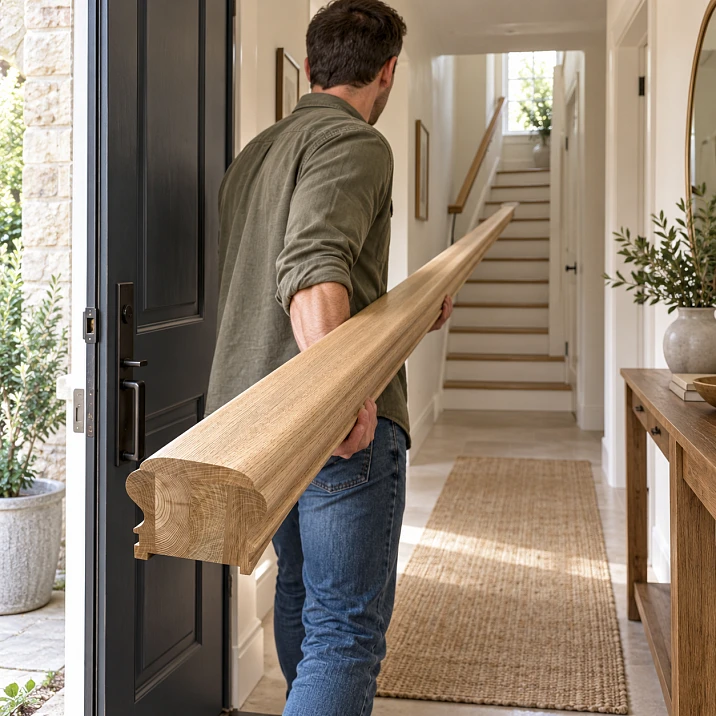
But for a finished private house, there is a second check that cannot be postponed until delivery: how to bring a 4.5-meter-long part from the vehicle to the installation site. The entrance door may be wide enough, but after it there may be a vestibule, a short corridor, a 90° turn, a flight of stairs, a landing, and already installed railing. At each section, both ends of the long workpiece move simultaneously.
Therefore, the correct sequence is as follows: first confirm the finished length and railing design, then plan the delivery route, check it with a layout, and only then place the long-length order. If the route does not work, it is wiser to change the scheme before payment than to receive an expensive handrail that is physically impossible to deliver to the staircase.
Wooden handrail PR-001: why we consider exactly 4500 mm for the project
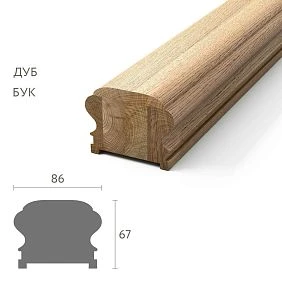
PR-001 — wooden handrail for stair railing made of beech or oak. The card includes lengths from 1500 to 5000 mm. For the project in question, it is important not to list the entire range, but to understand why the choice settled on 4500 mm.
| Parameter | What we consider in the project |
|---|---|
| Profile PR-001 | 86 × 67 × 60 mm |
| Material | Beech or oak |
| Sanding | «Prestige» |
| Length under consideration | 4500 мм |
| Price 4500 mm, beech | 57 410 ₽ |
| Price 4500 mm, oak | 71 060 ₽ |
| Next length | 5000 мм |
If the finished line of the handrail is a conditional 4200 mm, the 4000 mm position is already shorter than the project requirement. 4500 mm becomes the nearest blank under consideration. But it does not follow that the remaining 300 mm is guaranteed to suffice for all technological operations. Final trimming, end nodes, and the joining method must be defined by the stair project.
The formula here is simple only in form:
length of purchased workpiece ≥ finished length + technological allowance confirmed by the project.
The word "confirmed" matters more than the number itself. Buying 4500 mm just because it is the first size longer than 4200 mm is premature. First, the contractor must confirm that such a workpiece is indeed suitable for the selected end assemblies and future fitting.
If the profile and length are already agreed upon, you can buy the wooden handrail PR-001 specifically as a line item of the project, not as an abstract "handrail about four meters long."
There is another characteristic worth knowing in advance: sizes over 2500 mm are described by the manufacturer as made from a finger-jointed carpentry workpiece. For opaque finishing, this is one scenario; for a clear finish, it is a different visual result, so expectations regarding appearance should be agreed upon before ordering.




4500 mm is not just four and a half meters on a tape measure
The most common mistake when checking the carry-in is measuring only the width of the entrance door. For example, a person sees a clear opening of 900 mm and makes one of two opposite conclusions: "the part is wider than the door and won't fit through" or "the profile is only about 86 mm, so it will pass without issues."
Both lines of reasoning are incomplete. A long handrail is carried in at an angle. Through a separate doorway, its narrow cross-section may pass easily, but then the front end must go somewhere while the rear end is still outside. If the vestibule is short, the handrail will hit the wall with its end before it can be turned toward the corridor.
The same happens on the stairs. In a straight flight, the length may not pose a problem. On the landing, the front end begins to sweep a wide arc, the rear end simultaneously shifts in the opposite direction, and the ability to tilt the handrail is limited by the ceiling, the upper flight, a light fixture, or existing railings.
Therefore, the question "will PR-001 fit through the door at 4500 mm?" is better replaced with a more precise one:
is there a continuous spatial trajectory for the entire part from the unloading point to the installation site?
It is this trajectory that is checked before purchase.
Our factory also produces:

We draw the route for PR-001 from the front door to the stairs
The route must be walked literally point by point. It is useful to open the house plan and mark on it every place where the long part changes direction or height.
| Route point | What to measure and check |
|---|---|
| Unloading near the house | Is it possible to safely unload the long item and turn it toward the entrance |
| Front door | Clear width and height of the opening, handle protrusion, door closer |
| Vestibule | Depth, width, ability to move the other end |
| Corridor | Length of the straight section, minimum width, doors and furniture |
| Turn | Free diagonal and space for the arc of both ends |
| Staircase flight | Width, height above steps, existing railings |
| Platform | Rotation zone and ability to raise or lower one end |
| Final section | Can the handrail be positioned for convenient installation |
In practice, obstacles are not only walls. Along the path there may be a radiator, a tall cabinet, a pendant light, a decorative console, an opening door, a low beam, a windowsill, or a utility duct. Even an object protruding by 100–150 mm can change the movement of the part's end in the narrowest spot.
If you are just starting to choose a set for your home, it makes sense to first look at buy a wooden handrail for railings and match the product line with the project. For a private house, the same catalog is useful: request buy stair handrails for a private house makes sense only after checking not just one staircase, but also the actual path to it.
Get Consultation
Do not confuse room dimensions with turning capability
Even a spacious corridor five meters long does not guarantee success. If its entrance is at an angle and immediately hits a transverse wall, a 4.5-meter part may be impossible to turn around. Conversely, a relatively narrow straight passage can sometimes be convenient if the handrail can be run almost along the axis without turning.
Therefore, the size table is only the first filter. The final decision is best verified with a physical mock-up.
We check not only the handrail, but also the shipping packaging
The project features PR-001 with a length of 4500 mm, but the carrier and recipient work not with the "bare" product from the table, but with the shipping unit. Protective packaging can increase length, width, or height. The exact packaging dimensions for a specific order cannot be guessed from the product card — they must be requested from the seller.
Before paying for a long-length item, it is useful to add four questions to the request:
- what is the actual dimension of the packaged unit;
- how many shipping units will be in the order;
- what is the weight of each seat;
- at what point is it allowed to remove transport protection and who is responsible for the safety of the product after that.
The last point is especially important. Sometimes it seems obvious: "it doesn't fit in the packaging — we'll remove the film at the door." But if the packaging protects a long machined surface from impacts, and the delivery involves several turns, such a decision can create a new risk. It needs to be agreed upon, not made already during unloading.
On the page payment and delivery of the long handrail you can clarify general options for arrangement and delivery, but delivery to the address and bringing a 4.5-meter item inside the house are different services. Who unloads, who carries the item, whether lifting is included, and what happens on a complex route — it's better to specify separately.
A 4.5-meter mock-up before purchase: a cheap check for an expensive mistake
One of the most useful ways to check is to make a lightweight rigid mock-up exactly 4500 mm long. This could be several connected slats, a long plastic pipe, or another straight element that is convenient to carry together.
The task of the mock-up is not to imitate the strength and weight of the handrail. It is needed to check the geometry of movement.
Walk the same route with it:
- from the unloading point to the entrance;
- through the door and vestibule;
- along the corridor;
- through the first turn;
- onto the flight of stairs;
- onto the landing;
- to the installation site.
At each complex section, stop and look at where both ends go. If the front end passes through but the rear end hits the door jamb, the route is not confirmed. If the part can only be moved with the door removed or the light fixture dismantled, that is a separate operation that must be included in the work plan.
For PR-001, not only the longitudinal dimension matters. Its profile is specified in the card as 86 × 67 × 60 mm. Therefore, at the critical section, you can add a transverse template to the mock-up, approximately matching the maximum profile dimension. Such a template still does not replace the real packaging, but it helps avoid checking a 4.5-meter "thread" that passes where the volumetric handrail would already touch the wall.
The mock-up has another advantage: it shows the space for hands. If the rail geometrically passes only in tight contact with the walls, but people have nowhere to grip it before the turn, the actual maneuvering will be much more difficult.
Why the handrail passes straight but gets stuck at the turn
Imagine an L-shaped route. On the first straight section, the handrail moves along the wall. When the front end reaches the turn, it needs to be guided into the new corridor. At that moment, the middle of the part is still in the old direction, and the rear end is far behind.
The longer the element, the larger the area its ends occupy during rotation. Therefore, increasing the length from 4500 to 5000 mm affects not only the "trimming allowance": the entire maneuvering scenario changes.
Four situations are especially challenging:
Low ceiling above the landing. Raising the front end to reduce the horizontal reach is impossible.
Existing railing. The handrail could be tilted over the edge of the flight, but balusters and the active railing block the path.
Short vestibule. The item entered through the outer door, but its rear end is still outside while the front has already hit the opposite wall.
Turn immediately after the door. The doorway width is sufficient, but there is no space behind it to redirect the long element in a new direction.
There is no universal formula like "if the corridor is X wide, then 4500 mm will fit." The exact path depends on the geometry of several adjacent spaces and the ability to tilt the item vertically.
PR-001 4500 or 5000 mm: when an extra 500 mm already causes harm
If the designed finished length is about 4200 mm, a natural thought arises: take 5000 mm "with a good margin." But the extra 500 mm is not free insurance.
| Execution | 4500 мм | 5000 мм | Difference |
|---|---|---|---|
| Beech, "Prestige" | 57 410 ₽ | 63 440 ₽ | 6 030 ₽ |
| Oak, "Prestige" | 71 060 ₽ | 79 210 ₽ | 8 150 ₽ |
The price at the time of checking shows only the first difference. Another 500 mm:
- increase the transport dimensions;
- require more space when turning;
- complicate temporary storage before installation;
- provide more material that will need to be fitted and protected during work.
Therefore, the decision "I'll take 5000 mm to be sure it's enough" is rational only when the project truly requires such a technological allowance and the delivery route for a 5-meter piece has also been verified.
If 4500 mm has already been confirmed by the designer, and the 5000 mm mock-up does not pass the turn, purchasing the longer option will worsen the project instead of making it safer.
For a general selection, you can Buy a wooden handrail for stairs after the length is tied to both the staircase and the actual delivery route.
Or maybe order two short handrails instead of one long one?
If a single 4500-millimeter element does not fit into the house, the first common idea is to split it into two segments. Logistically, this may indeed be simpler. But structurally, a new joint appears, so the decision cannot be made based solely on ease of delivery.
The joint changes several things at once: the continuity of the hand grip, the appearance of the top line, the position relative to balusters and posts, the mounting method, the finish, and the precision requirements for installation.
One PR-001 with a length of 4500 mm is advantageous as a continuous line within the design section, but more complex in logistics. Two shorter elements are easier to move, but their connection must be provided for by the fence design.
If the designer confirms an acceptable joint at a specific point, the scheme can be revised. If not, dividing the handrail just because "two parts will fit in the elevator" is not allowed. In stair railings, logistics must not arbitrarily change the design.
What to buy together with PR-001
The PR-001 card indicates the under-rail strip PR-003 as an additional element of the corresponding system. But you cannot calculate based on the principle "one handrail — one strip": product lengths differ.
For PR-003 in STAVROS design materials, segments of 1500, 2000, and 2500 mm are specified with a cross-section of 60 × 6 mm. Therefore, for a PR-001 with a length of 4500 mm, the combination of PR-003 must be calculated by sections and joints. You do not need to independently assign the connection point of the strips.
If the chosen design actually uses this assembly, you can buy the under-handrail plank PR-003 after agreeing on its quantity and joint locations.
For a complete fence, you may need Buy wooden balusters и buy wooden stair posts, but their quantity cannot be derived from a single handrail length. The layout of balusters, starting and turning posts, end assemblies, and fasteners is specified by the design of the specific staircase.
The kit is checked before payment, not during assembly
It is convenient to create a list with four columns: "position", "article/size", "quantity", "who confirmed". Then the handrail, PR-003, balusters, posts, and fasteners do not mix into one vague line "stair kit".
This approach also helps to check the order and logistics: several short elements can be transported and carried in differently than one PR-001 4500 mm.
Temporary storage: the handrail must not only fit in but also wait for installation
Even a successfully completed route to the stairs does not complete the logistics. The long item may be delivered before the installation crew, which means the house will need a place where the 4.5-meter element can be left without forced bending, impacts, or constant repositioning.
It is necessary to check not only the length of the free wall. It is important to understand how the handrail will get to that area, whether it can be left in its transport protection, whether it will block the passage, and whether the part will have to be moved several times through already finished rooms. If the only storage location is on the second floor, the route there effectively becomes part of the delivery process even before installation begins.
Do not plan to "stand it vertically in a corner" until the acceptability of such storage for the specific packaged product and the ceiling height are known. Similarly, one cannot assume that a long handrail can be safely placed on two random supports: the temporary placement method should be coordinated with the contractor and seller, taking into account the packaging and finishing.
The practical result is that a separate line "storage location before installation" appears in the logistics list. For it, the room, the path to it, the free length, floor and wall protection, and the person responsible for moving the product are recorded. This is especially useful if stair work is done after final finishing: the cost of an accidental touch of a long part against a wall or furniture can be higher than the cost of simply organizing the space in advance.
Beech or oak for a long wooden handrail
The choice between beech and oak in this article should not be turned into a general reference on wood species. For a long PR-001, three practical questions matter more.
The first is coordination with the other wooden parts of the stairs. If the balusters, posts, and steps have already been chosen, the handrail is evaluated next to them, not separately from a product card photo.
Second — finish. "Prestige" describes the quality of sanding, not the final color. Before ordering, you need to determine whether the surface will be covered with opaque enamel, tinted, or receive another agreed finish.
Third — visibility of a long element. On a 4.5-meter line, differences in shade, texture, and character of the workpiece are more noticeable than on a small part. With a transparent coating, expectations regarding the appearance of a lengthwise finger-jointed workpiece are better discussed in advance.
For preparing the specification, it is useful to separately check quality of wood and sanding and agree on a finish sample with the actual batch.
Full estimate: the price of the handrail is only the first line
Price of PR-001 with a length of 4500 mm at the time of checking:
- beech — 57,410 ₽;
- oak — 71,060 ₽.
This is the cost of the handrail as a product item, not the cost of the finished railing section.
The full estimate may include PR-003, balusters, and posts per the project, fasteners, finishing materials, transport packaging, delivery, unloading, carrying in, temporary storage, final fitting, and installation.
Here it is especially easy to underestimate logistics. The phrase "delivery to the door" answers the question of how the cargo will get to the address. It does not answer the question of who and how will carry a four-meter part through the vestibule and stair landing.
Before paying, it is useful to request not only the delivery price, but also the terms of cargo transfer: where the carrier's responsibility ends, who performs unloading, whether separate personnel are needed for carrying in, and how to act if the packaging does not fit through the opening.
Errors that are detected too late
Only the front door was checked. Reason — it seems that the narrowest opening is the main limitation. Consequence — the handrail enters the house but gets blocked at the first turn. Prevention — check the entire route to the installation site.
Chose 5000 mm "just in case". Reason — the desire to get maximum margin. Consequence — more expensive product, larger transport dimensions, harder turns. Prevention — the length and technical margin are confirmed by the project, not intuition.
Did not ask for packaging dimensions. Reason — they focus on the clean 4500 mm of the product. Consequence — the transport unit may turn out to be more critical than the handrail itself. Prevention — request the dimensions of the unit ready for shipment.
They plan to remove the packaging at the door without coordination. Reason — an attempt to quickly reduce the dimensions. Consequence — the long treated surface remains unprotected on the most difficult section of carrying in. Prevention — coordinate the unloading and protection removal procedure in advance.
They divide the handrail after an identified problem with carrying in. Reason — logistics dictate the design. Consequence — an unplanned joint appears. Prevention — any division is returned to the stair railing designer.
When PR-001 4500 mm can already be paid for
The purchase becomes justified when not one, but several independent questions are closed.
The finished line of the handrail is calculated, and the contractor confirmed the length of 4500 mm. End nodes and trimming are defined. It is clear whether PR-003 is used and how its length is assembled. The wood species and finish are coordinated with other wooden parts.
Logistics have been separately confirmed: the transport dimensions are known, the mock-up has gone through the entire route, the number of people needed for carrying has been determined, turns and height above steps have been accounted for, and there is a temporary storage location before installation.
If at least the delivery route remains unknown, it is too early to pay for an expensive long-haul vehicle. In this case, it is better to first adjust the fencing layout, check a different size, or agree on a design joint.
Questions before ordering PR-001 4500 mm
If the finished length is 4200 mm, will PR-001 4500 mm definitely be enough?
Not necessarily. There is a formal margin of 300 mm, but sufficiency depends on the final joints and fitting technology. This must be confirmed by the staircase contractor.
Can the possibility of bringing the item in be determined only by the width of the entrance door?
No. The entire spatial route is needed: the vestibule, corridor, turns, stair flight, landing, and the final position of the part.
Why must the mock-up be exactly 4500 mm?
Because a shortened rod may pass a turn that the actual part will not. Critical geometry is related to the full length.
Is it necessary to make the mock-up with the same thickness as PR-001?
For the initial check, the full length is important. At critical points, it is useful to add a transverse profile template, but the exact fit is still confirmed separately.
Should we take 5000 mm instead of 4500 mm for extra margin?
Only if such a margin is required by the project and the five-meter part fits the route. The extra 500 mm increases both the price and the logistics footprint.
Can one long handrail be replaced with two short ones?
Only after the design joint is approved. Dividing affects the grip, appearance, and structure of the railing.
Is one PR-003 needed for one PR-001?
Not automatically. PR-003 has its own standard lengths, so the quantity and joints are calculated according to the railing layout.
What should be checked before arranging delivery?
The dimensions and number of shipping units, weight, unloading conditions, the possibility of carrying in, and the order of removing protective packaging. Before ordering, also check the current price and terms on the product page.