Article Contents:
- What is confirmed for KPU-062 and how to read the size 70 × 14 × 2000 mm
- Why this topic does not duplicate broad articles about slats and moldings in the bedroom
- First, determine what the horizontal line should repeat
- One KPU-062 plank: length, overhang, and the boundary 2000 mm
- Line across the headboard width — 1800 mm
- Line 2000 mm
- Line across the full width of 2300 mm
- Mistake 1. Equating bed width to KPU length without checking the headboard
- Mistake 2. Buying two planks just because the smooth field is wider than 2000 mm
- Mistake 3. Evaluating only the length and forgetting about the 70 mm profile height
- Mistake 4. Installing KPU exactly at 2000 mm without checking the ends
- Error 5. Place the joint of two KPUs exactly in the center automatically
- Error 6. Make the KPU in the color of the wood without staining
- Error 7. Secure the line until the final position of the bed
- Error 8. Add a KPU to an already saturated wall
- Bed / headboard about 1600 mm
- Headboard about 1800 mm
- Can KPU-062 be used shorter than the headboard width?
- If the headboard is 2000 mm, can one KPU-062 be left without trimming?
- Can KPU-062 be installed vertically between the slatted fields?
- Is a second piece of KPU needed for symmetry if the first plank is trimmed to 1800 mm?
- Can KPU-062 be placed directly on the slatted panels at the edges?
- What to do if the central field is 2100 mm?
- Can the remaining piece be used for a bedside table?
- Will KPU-062 fit above a very tall upholstered headboard?
- What matters more when choosing — the 2000 mm length or the 70 mm width?
- Where can I see a narrower trim if KPU-062 seems heavy?
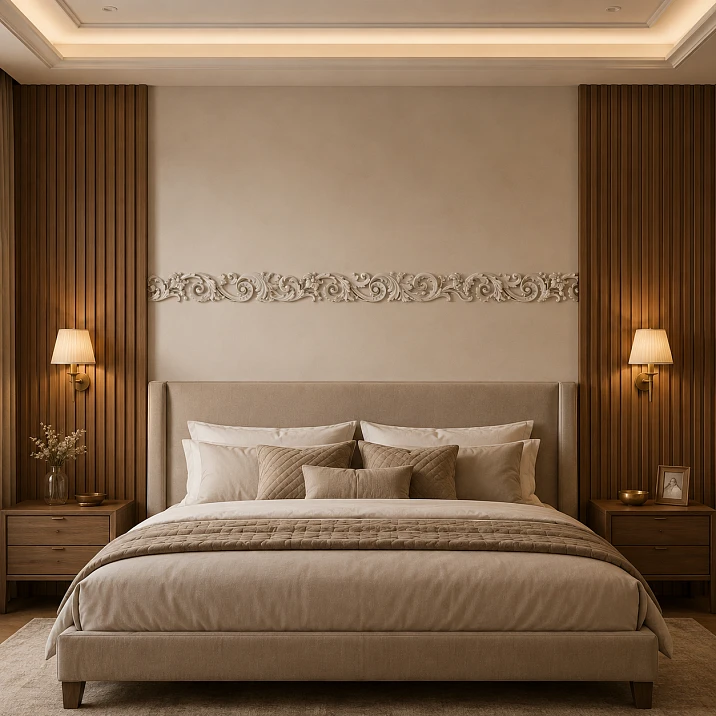
On the sides of the bed there are already two vertical fields of decorative slatted panels. They set the rhythm, texture, and visually bring together the sleeping area. The center above the headboard is left smooth. That is why a normal practical question arises: is another element needed there, or does the empty plane already do its job?
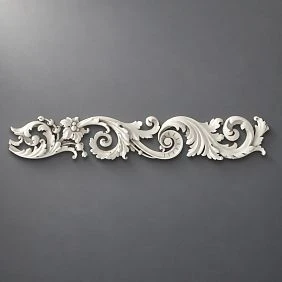
KPU-062 allows you to check not a frame, not a whole stucco composition, but a single horizontal carved line.
At STAVROS, this position belongs to polyurethane molding. The current product card confirms the dimensions A × C × L = 70 × 14 × 2000 mm, the material is polyurethane, and the current price is 14,540 ₽ per one two-meter strip. The official category filter decodes A as the profile width, C as the height/projection. When mounted horizontally, this means the decorative strip will occupy approximately 70 mm vertically on the wall, protrude 14 mm from it, and the maximum original length of one strip along the wall is 2000 mm.
Therefore, the main question of the article cannot be reduced to the phrase "a 1800 mm bed — a 2000 mm strip fits."
Five things need to be decided:
-
what exactly the length of KPU-062 should repeat — the width of the bed, the headboard, or the smooth field between the slatted zones;
-
whether an overhang beyond the edges of the headboard is needed;
-
whether the 70-millimeter carved strip will become too heavy next to the already active slats;
-
where the line will be positioned in height and how the 14 mm relief will be read;
-
whether it is worth moving to a second strip at all if the desired composition is longer than 2000 mm.
The direct answer is:
One KPU-062 is enough if the approved finished length of the horizontal line does not exceed 2000 mm and the pattern can be correctly completed at the ends. For a headboard width of 1600 mm, one plank allows a symmetrical overhang of up to 200 mm on each side; for 1800 mm — 100 mm on each side. With a length of exactly 2000 mm, there is no geometric margin left. If a contour longer than 2 m is needed, technically two planks will be required, but before spending 29,080 ₽ on two pieces, you need to decide whether a long carved belt is needed at all and where the joint will be located.
And even more importantly: a smooth field with a width of 2200–2400 mm does not oblige you to fill KPU from edge to edge. One centered plank of 1800–2000 mm may look calmer than two with a visible seam.
What is confirmed for KPU-062 and how to read the size 70 × 14 × 2000 mm
| Parameter | KPU-062 |
|---|---|
| Product type | carved molding / decorative stucco |
| Material | Polyurethane |
| A | 70 mm — profile width |
| C | 14 mm — profile height/protrusion |
| L | 2000 mm — plank length |
| Current price | 14,540 ₽/pc. |
| One plank | maximum 2000 mm of original length |
| Two slats | 29,080 ₽ before glue, painting, and labor |
After measuring the wall, you can buy carved polyurethane molding KPU-062.
For a horizontal line, it is especially important to correctly interpret parameter A. This is not 70 mm of length along the wall. This is the width of the face profile. When KPU-062 is positioned horizontally, it visually forms a decorative band about 70 mm high.
Parameter C = 14 mm shows the relief relative to the mounting plane. This is no longer an almost flat graphic strip. Under side light, 14 mm can create a noticeable shadow.
L = 2000 mm is the only dimension that answers the question "will one plank be enough in length".
That is why the article separately checks:
length;
visual height 70 mm;
relief 14 mm.
One number does not replace the other two.




Why this topic does not duplicate broad articles about slats and moldings in the bedroom
STAVROS already has materials on combining slat panels and polyurethane molding, including in the headboard area. They address broad questions:
-
how to combine two types of relief;
-
how to design an accent wall;
-
where to use slats;
-
how to distribute molding decor in the bedroom.
For example, in the article how to combine decorative slat panels and polyurethane molding the task is considered at the level of the entire interior system.
Here, the intent is significantly narrower.
The wall is already decided:
slats on the left → smooth center above the bed → slats on the right.
The product is also selected:
KPU-062 70 × 14 × 2000 mm.
The reader needs to determine the specific purchase:
0, 1, or 2 slats.
Therefore, the material does not retell 'why slats go well with molding,' but checks one horizontal decorative gesture by length, scale, height, light, joint, and cost.
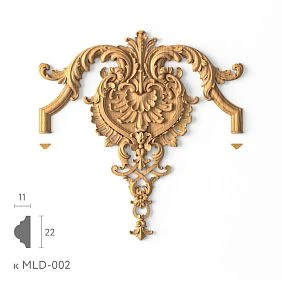
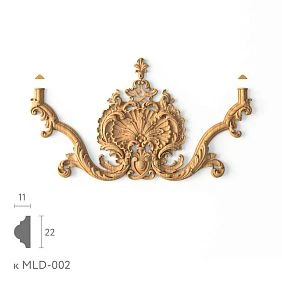
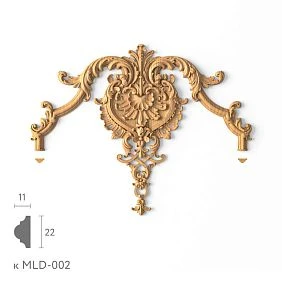
Our factory also produces:
First, determine what the horizontal line should repeat
There are three possible bases for the size.
Bed width.
Suitable if the headboard almost matches the mattress and the bed is the main object of the composition.
Width of the actual headboard.
For an upholstered bed, it may be wider than the mattress. Then the line calculated only by the size of 1600 or 1800 mm will be narrower than the visual base.
Width of the smooth central field between the slatted panels.
This option is needed if the KPU should complete the wall architecture rather than the furniture.
These three values must not be mixed.
For example:
-
mattress — 1800 mm;
-
upholstered headboard — 1900 mm;
-
smooth field between slats — 2300 mm.
One KPU 2000 mm long:
-
wider than the mattress by 200 mm;
-
wider than the headboard by only 100 mm;
-
narrower than the smooth field by 300 mm.
All three statements are true simultaneously.
Therefore, before ordering, the following must be signed on the wall elevation:
B — bed width;
H — headboard width;
S — width of the smooth central field;
K — desired KPU length.
Only after this is it decided what exactly should be equal to K.
Get Consultation
One KPU-062 plank: length, overhang, and boundary 2000 mm
If the horizontal line should be symmetrical relative to the headboard, the calculation is simple:
K = H + 2E,
Where:
-
K— the final length of the decorative line; -
H— headboard width; -
E— the overhang on each side.
For one KPU-062:
K ≤ 2000 mm.
Hence the maximum symmetrical overhang:
Emax = (2000 − H) / 2.
| Headboard width | Maximum symmetrical overhang with one strip |
| 1400 мм | 300 mm each |
| 1600 мм | 200 mm each |
| 1700 мм | by 150 mm |
| 1800 мм | by 100 mm |
| 1900 мм | 50 mm each |
| 2000 мм | 0 мм |
This table does not say that the maximum overhang is necessarily beautiful.
It only answers the question of geometric possibility.
For example, with a headboard of 1600 mm, one plank really allows you to make a line of 2000 mm and extend it by 200 mm on each side.
But compositionally, a line of 1700–1800 mm might be better.
Then a piece will remain from the two-meter blank.
For a headboard of 1800 mm, one KPU-062 allows:
-
finish the line strictly to the width of the headboard;
-
make a 50 mm overhang;
-
make 100 mm outlets and use the full 2000 mm length.
If you need 150 mm on each side:
1800 + 150 + 150 = 2100 mm.
One plank is no longer enough.
So the article leads not to a universal rule "for a 1800 bed take one," but to a specific formula for the chosen outlet.
Why a length of exactly 2000 mm is a borderline case, not an automatically ideal one
If the design line is calculated to be exactly 2000 mm, it seems that one KPU-062 fits without question.
But such a solution has no margin in length.
Any need:
-
trim the end;
-
remove the damaged edge;
-
change the position of the line;
-
shift the cut for the pattern;
-
compensate for the actual wall geometry,
may reduce the available finished length.
Therefore, the calculation cannot be turned into:
"need exactly 2000 — plank exactly 2000 — everything is perfect"
into a promise.
It is more correct to say:
one plank geometrically covers a 2000 mm line only when using the entire original length. Before ordering, you need to confirm the actual size, the condition of the ends, and the chosen method of completing the ornament.
This is especially important for carved profiles.
If the pattern at the edge should preferably be completed at a certain phase, the finishing line may require a shift in the cut.
The repeat value of KPU-062 is not confirmed in the available card specifications, so the article does not invent a number or promise a perfect fit without a sample.
A smooth field wider than two meters does not automatically mean buying a second slat.
Suppose:
-
smooth field between slats — 2300 mm;
-
headboard — 1800 mm;
-
KPU-062 — 2000 mm.
There are at least three solutions.
Line across the headboard width — 1800 mm
One slat.
250 mm of smooth wall remains from the ends of KPU to the borders of the two slat fields:
(2300 − 1800) / 2 = 250 mm.
This could be a good architectural pause.
Line 2000 mm
One full plank.
Remaining to the slat fields:
(2300 − 2000) / 2 = 150 mm.
The line more strongly connects the two side fields but does not touch them.
Line across the full width of 2300 mm
Two planks are required.
Cost of only the linear elements:
2 × 14 540 = 29 080 ₽.
A joint appears.
This leads to a key commercial conclusion:
The width of the central field determines the maximum space, but does not necessarily determine the length of the carved molding.
In the bedroom, an empty smooth field at the ends of the line can be an advantage.
When extending beyond the edges of the headboard is needed, and when it is better to end the line within its width
A horizontal line can work in different ways.
Match the width of the headboard.
This way KPU emphasizes the bed itself.
The solution is calm and logical.
Extend beyond the headboard.
Then the decor begins to connect the furniture with the side slatted fields.
The larger the release, the more the line is perceived not as a bed detail, but as an element of wall architecture.
Be narrower than the headboard.
This option is possible if the KPU works as a local ornamental accent, not as a "shelf" above the bed. But a carved line 70 mm wide may look too short if its ends randomly break off above a large soft headboard.
Therefore, it is useful to make the mockup in three lengths at once.
For example, for a headboard of 1800 mm:
-
1600 mm;
-
1800 mm;
-
2000 mm.
These are not three arithmetically identical examples.
They answer three different compositional tasks:
-
local accent;
-
coincidence with furniture;
-
extension of the line beyond the furniture.
KPU-062 scale next to the rails: 70 mm in height and 14 mm in relief
KPU-062 cannot be assessed only as a "thin line."
Parameter A = 70 mm with horizontal installation forms a strip of about 7 cm in height.
For a wall above the bed, this is a noticeable size.
If the headboard is soft, tall, and voluminous, 70 mm may look appropriate.
If the headboard is thin and the interior is minimalist, the carved profile may become too active.
For comparison, a simple paper test is useful:
-
cut out a long strip 70 mm high;
-
make it 1600, 1800, or 2000 mm long according to the chosen scheme;
-
temporarily attach it above the bed;
-
look from the door;
-
look from the bed;
-
turn on the evening light.
This way you can determine the line scale without buying KPU.
This is especially important at a price of 14,540 ₽ per plank.
Buying an expensive carved profile just to check that 70 mm is visually too much is not rational.
The 14 mm relief needs to be checked separately from the 70 mm width.
A flat paper mockup shows only the silhouette.
KPU-062 protrudes from the wall by about 14 mm according to parameter C.
This changes:
-
shadow;
-
the side view;
-
interaction with backlighting;
-
sense of massiveness;
-
visual depth compared to slats.
If the side panels have deep relief, 14 mm may look calm.
If the slats are thin and almost flat, a carved belt can become unexpectedly heavy.
Therefore, after a paper test, a physical check is especially useful if the interior relies on chiaroscuro.
If you have already seen KPU-062 in person and the relief is clear, an additional trial purchase for just one object may not be needed.
The horizontal line should work against the vertical rhythm, not argue with it
Side slatted panels set the verticals.
KPU-062 is horizontal.
It is precisely the contrast of directions that makes the idea interesting.
But the horizontal line should be one clear boundary.
If you add:
-
a second KPU lower;
-
a molding frame;
-
another shelf;
-
a horizontal LED line;
-
a wide decorative cornice nearby,
the center of the wall may get too many parallel bands.
In the original theme, the strength of the solution lies precisely in one gesture:
vertical slats on the edges → smooth center → one horizontal carved line.
If this gesture is not expressive enough, first check the scale and color of KPU-062, rather than automatically doubling the number of lines.
Where should the KPU end relative to the side slat panels
There are three basic positions.
The line does not reach the slats.
Between the end of the KPU and the slat zone, there remains a smooth pause.
This is usually the calmest option.
The line comes exactly to the inner edge of the slat field.
Thus, the horizontal connects the two side sections.
But the end of the carved profile becomes very noticeable next to the geometric vertical.
The line visually extends into the slat zone.
For the main theme, it is better not to use this scenario without separate design. Installation on relief panels is more complex, and the decorative profile loses its clear role.
Therefore, it is more logical to keep KPU-062 on the smooth central plane.
If the panel fields are not yet installed, it is useful to first determine their internal boundaries. For this, you can buy wall slat panels already after agreeing on the full wall layout.
Height of the line, sconces, and vertical alignment above the headboard
The smooth part of the wall above the bed can be tall.
If you simply place KPU-062 in the middle of the free height between the headboard and the ceiling, the line may end up detached from both the furniture and the slatted fields.
It is better to start with three reference points:
-
top of the headboard;
-
the top of bedside lamps, if any;
-
horizontal elements on adjacent walls or furniture.
The simplest first layout is a line above the headboard.
But the exact gap between the soft backrest and the KPU cannot be set universally.
It depends on:
-
headboard height;
-
ceiling height;
-
presence of wall sconces;
-
height of bedside tables;
-
visual weight of the molding itself.
A useful method is to make several options with painter's tape or a paper strip 70 mm high.
For example:
option A — closer to the headboard;
option B — medium height;
Option C — higher, closer to the center of the smooth field.
You should evaluate not standing by the wall, but from the point of entry into the bedroom.
The main criterion: the line should be perceived as part of the bed composition, not as a random frieze in the middle of the wall.
If there are sconces above the bed, KPU-062 should yield to the lights or go around them.
Sconces change the task for two reasons at once.
The first is geometric.
The horizontal line should not pass through the mounting bases of the lights, switches, or outlets.
The second is lighting.
Side light from sconces can sharply emphasize the 14-millimeter relief of KPU-062.
If the lights are at the edges of the headboard, there are three scenarios:
-
KPU passes above both sconces;
-
KPU passes below their housings;
-
KPU ends inside the central zone, not reaching the lights.
Breaking one carved line around each sconce without a special composition is usually more difficult: several short segments appear, and the original idea of a single horizontal line is lost.
Therefore, before purchasing, you need to mark not only the bed and slats on the wall layout, but also the electrical points.
If the sconces are already installed, a paper mockup of KPU-062 should pass between them at real scale.
When one slat is sufficient in length, but the composition still requires rejection
Geometric 'fits' is a weak criterion.
One KPU-062 up to 2000 mm long may be technically sufficient, but visually redundant.
For example:
-
slat panels are very wide and active;
-
the soft headboard has its own deep quilting;
-
there are already two sconces hanging above the bed;
-
there is a large painting;
-
the ceiling cornice is decorative;
-
the bed itself has a carved wooden headboard.
In such an interior, another carved line may add not incompleteness, but competition.
Therefore, in the article, option 0 KPU-062 is equal to one and two.
The right question:
if you remove the paper mockup, does the wall really become worse or just calmer?
If the latter, you don't need to buy the molding.
Two KPU-062: when a second plank is justified and how to design the joint
Suppose the approved line length is 2200 mm.
One KPU-062 is not enough.
Two provide 4000 mm of original length and cost 29,080 ₽.
Technically, the task is solvable.
But new conditions arise:
-
a transverse joint will be required;
-
its location needs to be chosen;
-
the ornament pattern will have to be aligned;
-
part of the second plank will remain;
-
The visual line will become longer and stronger.
That is, the decision to "take two" should be confirmed not only by length.
If expanding from 1900 to 2200 mm adds only 150 mm on each side, one should ask:
Are these additional 300 mm worth the second plank and the visible seam?
Sometimes the answer is no.
Then it is better to keep a solid line of 1900–2000 mm from a single plank.
This is one of the main commercial filters of the article.
If two planks are still needed, the seam does not have to be strictly above the center of the bed.
For lengths over 2000 mm, many automatically divide the line in half.
For example, 2200 mm:
1100 + 1100 mm.
The joint falls exactly on the central axis of the bed.
For a smooth molding, this may be logical.
For carved KPU-062, everything depends on the ornament.
If the pattern has a pronounced central motif, a transverse seam along the axis may be especially noticeable.
You can consider an asymmetrical cut:
-
1400 + 800 mm;
-
1500 + 700 mm;
-
1600 + 600 mm.
But such a shift also cannot be considered automatically better.
Need to check:
-
where the seam is visible from the entrance;
-
how the pattern repeats;
-
whether the rhythm is disrupted;
-
whether the profile can be neatly joined.
Since there is no confirmed repeat for KPU-062 in the main specifications, the joining point is chosen after viewing the actual pattern, not based on an abstract formula.
Why you cannot promise "the seam will be invisible after painting"
Painting can indeed visually unify two elements.
But the carved ornament remains embossed.
If the pattern does not match, paint will not fix the geometry.
Therefore, the quality of the seam depends on:
-
cutting accuracy;
-
profile matching;
-
ornament phase;
-
fitting quality;
-
lighting;
-
color.
Side light above the bed can emphasize the seam even more.
Therefore, for a line longer than 2000 mm, two scenarios should be compared:
two KPU-062 with a neatly designed joint;
one shorter solid line.
The second option is often stronger precisely because it remains solid.
A cut from one plank should not be considered a useful second decor in advance.
If one KPU-062 is used for a 1800 mm line, approximately 200 mm of original length remains.
For a 1600 mm line — 400 mm.
It seems logical to immediately think of a use for the remainder.
But with carved molding, this is not always useful.
The cut can:
-
start or end at an unfavorable phase of the ornament;
-
be too short for an independent composition;
-
be useful for color testing;
-
be useful for a test joint;
-
leave as reserve for local repair.
Therefore, it is better to save the remainder first.
There is no need to plan a new decorative element from it before the final cutting.
Commercial table: 0, 1, or 2 KPU-062
| Scenario | Quantity | Cost of linear footage | The main question |
| Leave a smooth wall | 0 | 0 ₽ | whether slats and a headboard without an additional line are enough |
| Line up to 2000 mm | 1 | 14 540 ₽ | whether the 70 mm scale and 14 mm relief are suitable |
| Line more than 2000 mm | 2 | 29 080 ₽ | whether the joint and additional length are justified |
| Fitting with a paper template | 0 | 0 ₽ | Is KPU needed at all |
This table intentionally does not include glue, painting, and installation.
Their cost depends on the specific substrate and the chosen finishing system.
Color KPU-062: monochrome, connection with slats, or contrast
A carved profile 70 mm wide is noticeable on its own.
If you make it contrasting, the line becomes even stronger.
Therefore, for a wall with slatted panels, it is reasonable to start with the calmest layout:
KPU-062 in the color of the smooth wall.
This way the profile is perceived through:
-
relief of 14 mm;
-
shadows;
-
pattern.
But it does not add another color band.
This is especially useful if the side panels are made to look like natural wood.
The visual system becomes clear:
wood on the edges → smooth painted wall → embossed polyurethane in the same color.
When painting to match the color of the slats can work
If KPU-062 is painted in a shade close to the slat panels, the horizontal line becomes an obvious bridge between the two side fields.
This is a strong technique.
But it has a risk.
Polyurethane does not automatically reproduce natural wood texture.
A solid brown or beige profile next to oak can look like imitation if the shade is poorly matched.
Therefore, it is better to compare a real sample next to an actual panel.
If the color match is unconvincing, a monochrome with the wall often looks cleaner.
If panels are still being selected, you can Buy decorative slatted wall panels after checking the real sample and shade.
Contrasting KPU-062 is needed only if this color is repeated in the bedroom
A black, graphite, bronze, or gold line above the bed quickly becomes a standalone accent.
It works better if the same color is already present:
-
on the brackets;
-
on the bed legs;
-
on the drawer handles;
-
mirror frame;
-
in luminaires;
-
on the cornice.
If the contrast is not repeated anywhere else, the KPU may look like a random stripe.
Especially at a length of 1800–2000 mm: this is already a major color statement.
Therefore, it is better to make a color mockup in full length rather than evaluate it from a small 20–30 cm sample.
Side angle and overall composition: depth, axes, light, and neighboring decor
The frontal mockup answers the question of length and height.
But a bedroom is rarely perceived strictly from the center of the bed. When entering, a person sees the wall at an angle.
Then three depths become noticeable:
-
the protrusion of the side slat panels;
-
the thickness of the soft or wooden headboard;
-
the protrusion of KPU-062 is 14 mm.
If the slat panels are very deep, the KPU may look more delicate than expected.
If the slats are thin and the smooth central wall is almost flat, the carved profile at 14 mm can become a standalone volume.
A useful test:
-
make a strip of the required length;
-
add to it a volumetric template about 14 mm deep;
-
look at the wall from the door;
-
view from the side of the room;
-
compare with the protrusion of the panels.
This test answers a new question: not how high the profile is, but how much it protrudes in real space.
The headboard can move, and KPU-062 is fixed to the wall
If the bed is freestanding, it can be accidentally moved during cleaning or rearranging.
A soft headboard sometimes tilts slightly during use.
Therefore, the KPU should not be in the zone of potential mechanical contact with the top of the bed.
The article does not specify a universal gap in millimeters.
You need to check the actual movement of the furniture.
The procedure is simple:
-
put the bed into the final position;
-
check whether it is fixed relative to the wall;
-
slightly load the headboard in the usual way;
-
check the maximum proximity to the KPU;
-
only after that secure the trim.
If the bed is attached to the wall and the geometry is unchanged, the task is simpler.
If the furniture is planned to be replaced, too precise binding of the KPU to the current headboard may reduce the flexibility of the interior.
If the bed is offset relative to the smooth field, you need to choose the main axis
The ideal visualization often shows:
slat field — bed — slat field
with full symmetry.
In a real bedroom, the position of the bed may be changed:
-
sockets;
-
switches;
-
door;
-
a window;
-
bedside furniture;
-
radiator;
-
passage.
Then a conflict of two centers arises:
-
center of the smooth field;
-
the center of the bed.
KPU-062 can be tied to only one of them or consciously take both into account.
If the line is intended specifically for the sleeping area, it is often more logical to check the axis of the bed and the headboard.
If the KPU completes the architectural rectangle of the wall, the center of the smooth field is more important.
For example:
-
smooth field 2400 mm;
-
The 1800 mm bed is shifted 100 mm to the right.
The 1800 mm line centered on the wall will be offset relative to the bed.
The line centered on the bed — relative to the slat panels.
There is no arithmetic solution here.
A mockup of both versions is needed.
If the asymmetry is noticeable and both alignments look bad, the horizontal trim may only emphasize the problem. In that case, the version without KPU is stronger.
A single horizontal line can visually lower the wall — and this is sometimes useful.
Vertical slats guide the eye upward.
The horizontal KPU-062 stops vertical movement and forms a belt.
In a room with a high ceiling, this can make the bed area more intimate.
In a low bedroom, the same line, especially a contrasting and wide 70 mm one, can visually divide the wall and make it appear lower.
This is not an absolute rule, but a directional effect.
Therefore, the height of the KPU should be checked together with the overall view of the wall from floor to ceiling.
If the horizontal line seems too heavy:
-
raise it;
-
make it the color of the wall;
-
shorten its length;
-
choose a narrower molding;
-
abandon the line.
Adding a second horizontal line in such a situation usually does not solve the problem.
A painting, poster, or panel above the headboard changes the meaning of KPU-062
If the smooth central wall is already occupied by an image, the horizontal carved molding can become:
-
the lower boundary of the composition;
-
the upper boundary;
-
a competitor.
The KPU must not be placed so that it accidentally "emphasizes" the picture at the wrong height.
If art is planned, the following are mocked up on the wall simultaneously:
-
the picture frame;
-
KPU;
-
the headboard;
-
the sconce.
Sometimes it turns out that the line works beautifully only with an empty wall.
Then you need to choose what is more important.
KPU-062 should not become a mandatory backdrop for any future decor.
LED backlighting near KPU-062 requires a shadow test, not just a brightness test.
A hidden strip behind the headboard or inside the side slat fields creates a light gradient.
The 14 mm relief falls into this gradient and casts a shadow.
If the light comes from bottom to top, the lower edge of the profile can become especially noticeable.
If the light comes from the side of the slat fields, the shadow at the ends of the KPU may differ from the center.
Therefore, the evening test should be done in the actual lighting configuration.
A paper strip will only show the color line.
For chiaroscuro, a physical fragment or the KPU itself is better.
If side lighting makes the ornament too "theatrical" for a calm bedroom, a color matching the wall can reduce the effect.
Base, painting, and installation order of two-meter carved molding
Carved molding 2000 mm long shows wall unevenness better than a short overlay.
If the base is wavy, the following may appear:
-
local gaps;
-
loose fit;
-
visually crooked horizontal line;
-
stress during gluing.
Before buying an expensive profile, it is useful to apply a long straightedge or check the wall using the method that the finisher uses.
This is especially important if the smooth field between the slats was formed separately and its plane differs from the side sections.
KPU-062 should not be used as a way to hide a curved wall.
First, the base is corrected.
Paint, wallpaper, and decorative plaster require different installation solutions.
In the bedroom, the central field may not only be painted.
Possible substrates:
-
paint;
-
wallpaper;
-
decorative plaster;
-
MDF;
-
furniture panel.
For each, the compatibility of the adhesive composition must be checked.
You cannot choose an adhesive based only on the wording "suitable for polyurethane."
It must also work with the substrate.
With wallpaper, there is a separate question: how reliably the coating itself is bonded to the wall. Even strong adhesive between KPU and wallpaper does not make a weak wallpaper layer stronger.
Therefore, the installation scheme is determined after identifying the surface.
In the general category, you can Buy polyurethane trim, but the specific adhesive is chosen based on the materials of the joint.
Paint KPU-062 before or after installation
Both methods have practical significance.
Before installation, it is convenient if:
-
KPU is contrasting;
-
natural slats are nearby;
-
the wall cannot be stained;
-
the product is painted with a complex system.
After installation, it is logical if:
-
the molding and the smooth wall are the same color;
-
it is necessary to visually merge the joint with the wall;
-
the final painting of the wall is not yet completed.
At a length of 1800–2000 mm, painting an individual plank requires space and careful support.
If the profile is painted before installation, local touch-up may be required after trimming the ends.
There is no universal method.
The main thing is to decide the sequence before gluing, not after the carved profile is already installed between finished panels.
Mistakes that most often turn one line into extra decor
Mistake 1. Equating the bed width to the KPU length without checking the headboard
Why it occurs: the mattress size is known.
Consequence: the line does not match the actual width of the soft headboard.
Check: measure the actual headboard.
How to avoid: use its actual dimension.
Error 2. Buying two planks just because the smooth field is wider than 2000 mm
Why it happens: you want to fill the entire central zone.
Consequence: an expensive and potentially noticeable seam appears, although a single 1800–2000 mm line could have looked better.
Check: mockup of a short one-piece version.
How to avoid: separate the field width from the decor length.
Error 3. Estimating only the length and forgetting about the 70 mm profile height
Why it happens: the word "molding" is associated with a thin line.
Consequence: after installation, the carved strip turns out to be visually heavier than expected.
Check: full-size paper strip 70 mm high.
How to avoid: scale the profile along two axes.
Error 4. Set KPU exactly at 2000 mm without checking the ends
Why it occurs: the lengths matched mathematically.
Consequence: no room for trimming and adjustment.
Check: actual plank, pattern, and final size.
How to avoid: treat 2000 mm as a borderline length.
Error 5. Place the joint of two KPU directly in the center automatically
Why it occurs: symmetry seems correct.
Consequence: the seam lands in the most visible spot.
Check: layout of the ornament and viewing from the entrance.
How to avoid: choose the joint location after checking the pattern.
Error 6. Make KPU in wood color without staining
Why it occurs: you want to connect the side rails.
Consequence: solid polyurethane looks like a weak imitation of wood.
Check: real sample next to the panel.
How to avoid: compare with the monochrome of the wall.
Error 7. Secure the line before the final position of the bed
Why it occurs: the wall is finished before the furniture.
Consequence: after installation, the headboard shifts, and the compositional axes diverge.
Check: final layout with furniture.
How to avoid: at least accurately record the dimensions and axis of the bed before installation.
Error 8. Adding KPU to an already saturated wall
Why it occurs: an empty center seems unfinished.
Consequence: the bedroom loses its calm pause.
Check: a photo of the wall with and without the mockup.
How to avoid: consider an empty smooth zone a full-fledged option.
Width of the side slat fields, the cabinet, and the future bed change
The two side fields can be:
-
narrow vertical strips;
-
wide panels;
-
almost half the wall each.
The wider and deeper the slat zones, the more strongly they frame the smooth center.
With very wide side fields, KPU-062 is often enough to make shorter — within the headboard area.
With narrow slats on the edges, the line may require more release to truly connect the two materials.
Therefore, the length of KPU should not be calculated separately from the width of the panels.
On the wall layout, it is useful to label:
RL — width of the left slat field;
RR — width of the right one;
S — smooth center;
H — headboard;
K — KPU.
If RL и RR different, a strict horizontal line can emphasize the asymmetry.
Then the layout is especially important.
Nightstands may protrude further than the KPU beyond the headboard.
Sometimes the 2000 mm line is calculated only for the bed.
But the composition includes two nightstands.
If they are placed inside the smooth central field, the horizontal line may be perceived not only above the headboard, but above the entire furniture group.
For example:
-
bed 1800 mm;
-
nightstands on the sides;
-
total furniture front 2600–3000 mm.
One KPU 2000 mm long clearly does not cover the entire group.
This does not mean that two are needed.
Perhaps the line should only emphasize the bed.
Or vice versa: if the task is to link the bed and both nightstands into one block, KPU-062 with a length of 2000 mm may be conceptually short.
Then it is better to choose a different approach than mechanically joining two carved strips.
The horizontal line should not interfere with changing the bed.
KPU-062 is mounted on the wall for a long time.
The bed may be replaced.
If the current model is 1600 mm, and 1800 mm is possible in the future, a 1600 mm line will be very rigidly tied to the old furniture.
A more universal option:
-
line 1800–2000 mm;
-
anchoring to the architectural axis of the wall;
-
sufficiently smooth field at the edges.
But if the bedroom is designed as a complete individual composition with a specific bed, such universality is not necessary.
This is a separate criterion for choosing the length.
Practical calculation for beds 1600 and 1800 mm
Two characteristic cases give different solutions.
Bed / headboard about 1600 mm
One KPU-062 allows:
-
1600 mm — line strictly along the furniture;
-
1800 mm — 100 mm overhang on each side;
-
2000 mm — 200 mm overhang on each side.
All three options fit within one plank.
The second one is only needed here if the line must be wider than 2000 mm.
Headboard about 1800 mm
One plank allows:
-
1800 mm — no overhang;
-
1900 mm — 50 mm each side;
-
2000 mm — 100 mm each side.
If you want 200 mm beyond the edges:
1800 + 400 = 2200 mm.
Two KPUs will be required.
This is exactly where you need to ask whether the extra 200 mm on each edge of the second slat and the joint are worth it.
The answer can often be obtained with a paper mockup without making a purchase.
Decision matrix: 0, 1, or 2 slats
| Condition | First option to check |
| Slat fields are already very active | 0 KPU |
| Headboard 1600 mm | 1 KPU |
| Headboard 1800 mm, overhang up to 100 mm on each side | 1 KPU |
| Required line exactly 2000 mm | 1 KPU, but check the finished edge |
| Smooth field 2300 mm, headboard 1800 mm | first 1 KPU 1800–2000 long |
| Required line 2100–2400 mm | compare 1 solid and 2 with a joint |
| There is a sconce on the line trajectory | change height/length or decline |
| 70 mm looks heavy | different molding |
| Wall is low | check a taller mockup or decline |
| Headboard can move | check physical clearance |
| The ornament joint is noticeable | A continuous line is preferable |
| A smooth wall already looks finished | 0 KPU |
Practical algorithm before ordering KPU-062
-
Measure the actual width of the headboard.
-
Measure the smooth field between the slat panels.
-
Separately record the mattress width if it differs from the headboard.
-
Mark the center of the bed and the center of the smooth field.
-
Check if they match.
-
Determine what the KPU length should correspond to — the bed, the headboard, or the wall architecture.
-
Make a paper strip 70 mm high.
-
Compare lengths of 1600/1800/2000 mm or your own real options.
-
Decide whether an overhang beyond the headboard edges is needed.
-
For one slat, check the formula K ≤ 2000 mm.
-
Do not consider a smooth field >2000 mm as an automatic reason for a second slat.
-
Check the installation height.
-
Place sconces, outlets, art, and lighting on the mockup.
-
Add a 14 mm volumetric mockup if relief is critical.
-
Look at the wall from the entrance and from a side angle.
-
Check the evening light.
-
Compare the option with KPU and without it.
-
If the line is longer than 2000 mm, design the joint separately.
-
Do not assume the pattern repeat without checking.
-
Determine the color.
-
Check the mounting base.
-
Make sure the headboard does not touch the future molding.
-
Calculate the cart: 0, 14,540 or 29,080 ₽ at the current price.
-
Only after that place the order.
If the solution is confirmed, you can order KPU-062 70 × 14 × 2000 mm in the required quantity.
Result: one KPU-062 is stronger than two if the line fits within 2 m and does not require a joint
KPU-062 is a carved polyurethane molding measuring 70 × 14 × 2000 mm. Current price is 14,540 ₽ per plank.
In the original composition, it has a clear role:
two vertical slatted zones on the edges and one horizontal carved line above the smooth center of the bed.
For a 1600 mm headboard, one slat allows an overhang of up to 200 mm on each side.
For 1800 mm — up to 100 mm on each side.
For 1900 mm — up to 50 mm.
For 2000 mm — there is no geometric overhang anymore.
But the maximum is not the goal.
Often, the 1800–1900 mm line looks better than the full two-meter one.
If the central field is wider than 2 m, it also doesn't mean you should automatically buy a second KPU-062.
A second slat is needed only when the approved decorative line must be longer than 2000 mm.
Then the price of the running meter rises from 14,540 to 29,080 ₽, and along with the length comes a new problem — the joint of the carved ornament.
Therefore, before the second plank, it is worth comparing:
a solid line up to 2000 mm
и
a longer line with a joint.
If the difference in composition is small, a solid profile is almost always simpler.
If 70 mm of carved pattern overloads the smooth center, you should not buy KPU-062 out of a feeling that "something is missing above the bed," but rather leave the wall calm or choose another polyurethane molding.
And if the entire wall is still being designed, you can compare the solution with the catalog of slatted panels and the general category moldings from polyurethane.
FAQ
Can KPU-062 be used shorter than the width of the headboard?
Yes, if it is a deliberate local accent. But a short line must have a clear axis and not look like a random cut-off piece. A mockup is especially important.
If the headboard is 2000 mm, can one KPU-062 be left without trimming?
Geometrically, the original length matches. But before ordering, you need to check the actual size, ends, and pattern: a finished part of exactly 2000 mm leaves no freedom in length.
Can KPU-062 be installed vertically between slatted fields?
Physically, the profile can be oriented differently, but that is a different compositional scenario. This article specifically considers a single horizontal line above the headboard.
Is a second piece of KPU needed for symmetry if the first slat is trimmed to 1800 mm?
No. Symmetry is determined by the position of one solid line relative to the headboard. There is no need to purchase a second slat for symmetry.
Can KPU-062 be placed directly on the slatted panels at the edges?
For the main scheme, it is better to keep the profile on a smooth surface. Installation on relief slats requires a separate check of the base and profile contact.
What to do if the central field is 2100 mm?
First, check the solid line of 1800–2000 mm. If the project requires exactly 2100 mm, two slats and a designed joint will be needed.
Can the remaining piece be used for a bedside table?
Only after actual cutting and checking the pattern. The remainder may be better kept for a test cut, trial joint, or repairs.
Will KPU-062 work above a very tall soft headboard?
The 70 mm size can work as a small carved belt, but the height and relief need to be assessed against the scale of the entire wall. The taller and more active the headboard, the more important it is not to overload the upper zone.
What matters more when choosing — the 2000 mm length or the 70 mm width?
Both dimensions answer different questions. 2000 mm determines whether one strip is enough horizontally. 70 mm determines the visual height of the decorative belt.
Where can I see narrower trim if KPU-062 seems too heavy?
In the section STAVROS polyurethane trim you can compare other profiles by width and pattern.