








































Article Contents:
- Baseboards for apartments in Moscow: which option to choose for your interior
- What baseboards for apartments can be bought in Moscow
- Wooden skirting boards made of oak and beech
- Paintable MDF skirting boards
- Moisture-resistant baseboards made of polystyrene and phytopolymer
- White and modern profiles
- What's better for an apartment: wood, MDF, or moisture-resistant profile
- When wood is better
- When MDF is better
- When a Moisture-Resistant Option is Needed
- Which material is better for a city apartment
- Baseboard for studio apartments and standard layouts
- For studio apartments
- For a one-room apartment
- For a two-room apartment
- For an apartment with a combined kitchen-living room
- How to choose baseboards for an apartment by room
- living room
- for the bedroom
- For the hallway
- For the corridor
- For Kitchen
- For children's room
- How to choose baseboards to match the floor covering in an apartment
- Under laminate
- Under parquet
- For engineered board
- For quartz vinyl
- For tile
- Under combined coverings
- How to choose baseboards for an apartment by height, shape, and color
- 60–80 mm for a compact apartment
- 100–120 mm for spacious rooms
- White baseboard
- Matching the floor color
- Matching the door color
- Straight or shaped profile
- What to buy together with baseboards for an apartment
- Moldings and Cornices
- Slatted panels
- Decor for moldings
- Moisture-resistant solutions for challenging areas
- Comparison table: baseboards for different rooms in an apartment
- Where to buy baseboards for an apartment in Moscow
- Common mistakes when choosing
- Too low profile
- Color error
- Different baseboards for rooms without logic
- Unsuitable material for kitchen and hallway
- Conclusion
- About the Company STAVROS
- Frequently Asked Questions

Apartment renovation is a marathon where the final stretch is the hardest. When the floor is laid, wallpaper is hung, doors are installed, and furniture is arranged, there's no mental energy left to think about details. Baseboards seem like a triviality where you can just take 'whatever fits.' This is precisely when most mistakes are made.
Because baseboards are not a triviality. They are an architectural line that runs along the entire perimeter of the apartment, literally 'drawing' its lower contour. When chosen correctly, they tie the interior together—connecting the floor with the walls, complementing the door color, and completing the style. When chosen incorrectly, they can ruin even an expensive renovation with one awkward decision.
If you are looking for wherebuy baseboards for an apartment in Moscowwith a guarantee of the right choice, this article is written specifically for you. There are no abstract 'choose according to your taste' tips here. There are concrete answers: which material for which room, which height for which ceilings, which color for which floor and doors. For every room—from the living room to the nursery. For every flooring—from laminate to tile.





Baseboards for an apartment in Moscow: which option to choose for your interior
An apartment isn't one scenario. It's several completely different zones under one roof: a living room with parquet and high ceilings, a kitchen with quartz vinyl and constant humidity, a bedroom with light laminate and a quiet mood, an entrance hall with intensive use. In each of these zones, the baseboard must work differently.
That's why choosing a floor baseboard for an apartment cannot be reduced to one universal answer. It's much more productive to start from a specific room: what kind of flooring is there, what are the ceilings like, what are the doors like, what style, is there increased humidity.
Best baseboards for apartments— are not the more expensive ones, and not those made of natural wood. They are the ones that solve a specific task in a specific place: suitable in material, height, color, and operating conditions.
In Moscow, the choice is especially rich — baseboards are sold everywhere, from construction hypermarkets to designer showrooms. But it is precisely this abundance that often leads to a stupor. For the choice to be precise, a system is needed — it's below.




What baseboards for an apartment can be bought in Moscow
The Moscow market is wide. But among the truly high-quality and functional options, four main categories stand out.
Our factory also produces:

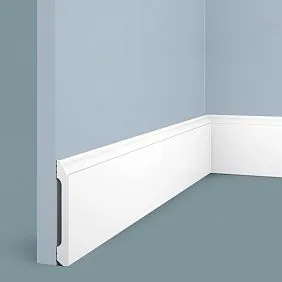
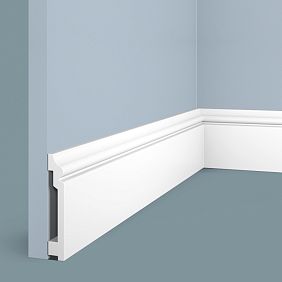
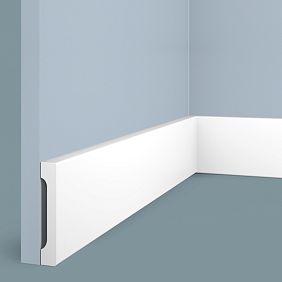
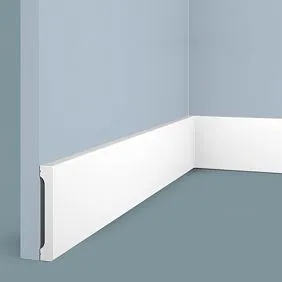
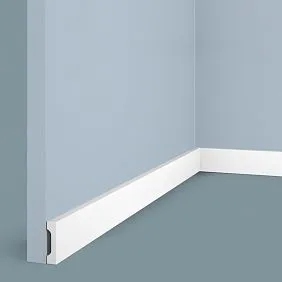
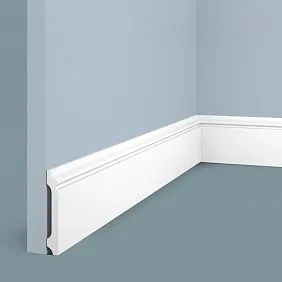
Wooden skirting boards made of oak and beech
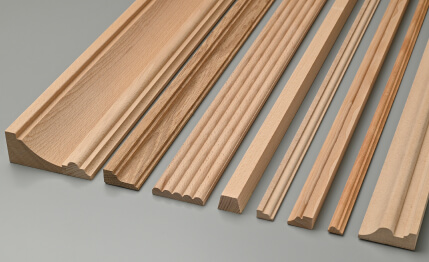
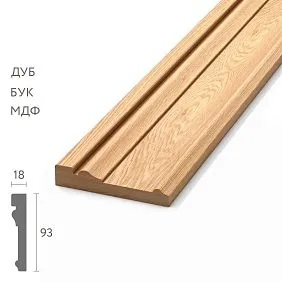
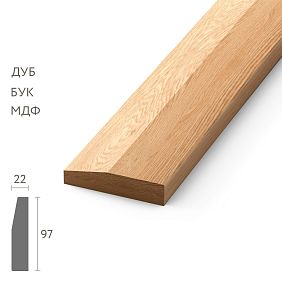
Natural wood in an apartment is always a special story. A baseboard made of solid oak or beech carries with it the warmth of a living material: a unique grain pattern, a weightiness that no polymer imitates, and a feeling of solidity that stays with you for decades.
solid wood baseboardOak — is the most in-demand option among Moscow buyers who value quality. Oak is dense, resistant to mechanical stress, easy to work with and paint. Beech baseboard is lighter and softer in tone — ideal for light Scandinavian interiors, under laminate in the color of bleached oak or milk ash.
Buying a wooden baseboard for an apartment is a conscious choice for those building an interior on natural materials: oak parquet, wooden doors, solid wood furniture. A baseboard made of the same wood continues this theme organically and completely.
The main limitation: wood does not tolerate systematic humidity. Living room, bedroom, study, children's room — excellent. Kitchen by the sink, toilet, bathroom — no. There, wood will eventually swell and darken even under varnish.
Get Consultation
Baseboard — it is a modest detail, often unnoticed, but plays a critical role in creating the completeness of the interior.
MDF is a material that excels where precision and predictability matter. Perfectly even cross-section along the entire length of the plank, stable geometry, smooth surface ready for painting in any color. It doesn't warp with humidity fluctuations (within reasonable limits), and it's easy to cut and install.
White MDF skirting boards for apartments are the absolute demand leader in Moscow. White works with any flooring, any wall color, and any doors. It's a neutral, modern, fail-safe choice that won't go out of style.
Buying MDF skirting boards for painting for an apartment is a smart solution when the final wall color is not yet determined or when you want to paint the skirting board to exactly match a specific shade: by RAL chart, by door color, by wallpaper color. No factory painting can provide the accuracy that custom tinting based on a ready-made sample does.
Full rangewooden and MDF skirting boards— height from 60 to 120 mm, straight and shaped profiles — all collected in a single catalog.
Moisture-resistant skirting boards made of polystyrene and phytopolymer
Moisture-resistant skirting board HI WOOD— this is a category that has changed the approach to finishing wet areas in Moscow apartments over several years. A high-density polymer material with an imitation of natural wood texture that does not absorb water under any conditions.
Neither steam, nor wet cleaning, nor condensation will leave a trace on it. The surface is easily cleaned with a regular damp cloth. The shape remains unchanged with any fluctuations in temperature and humidity. This is the only correct choice for the kitchen, bathroom, toilet, and hallway with intensive cleaning.
HI WOOD size range: from 58 to 140 mm. Technical feature: covers an expansion gap of up to 10–15 mm and hides wall-to-floor junction irregularities up to 5 mm — a crucial parameter for Moscow apartments in old buildings, where walls at the base are far from always perfect.
White and modern profiles
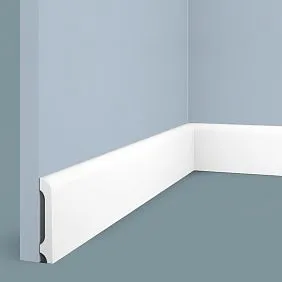
A separate category — not by material, but by aesthetics. The white straight profile today dominates Moscow apartments as a universal base: it works with any flooring, any style — from Scandinavian to neoclassical — and does not conflict with any interior design solution.
Buying a modern skirting board for an apartment means choosing a straight profile without excessive decorativeness, which does not age and does not 'fall out' of the interior when wallpaper or furniture is changed.
What is better for an apartment: wood, MDF, or a moisture-resistant profile?
This question comes up in every second consultation. The answer is always the same: there is no universal winner. There is the right material for a specific situation.
When wood is better
Wood — where naturalness is important and there is no systematic humidity. If your apartment has oak parquet, wooden doors, solid wood furniture — a wooden skirting board continues this aesthetic line. It is an honest material with character.
It is worth buying a solid wood skirting board for an apartment when you want a durable product that can be re-sanded and repainted after several years without replacement. Wood can be renewed — MDF and polymer cannot.
Ideal zones for wood: living room, bedroom, study, children's room, dining room. Ceilings of any height, flooring — parquet, engineered board, laminate.
When MDF is better
MDF wins where precise geometry is needed over long spans. A long corridor, a large living room with an open layout — in these cases, the straightness of the skirting board along the entire wall length is critically important. MDF provides it effortlessly.
Moreover, MDF is easier to process during installation: cuts in corners come out clean, without chips, which is especially important for DIY installation.
MDF skirting board for an apartment is the right choice for dry living spaces where precision, clean lines, and the ability to paint the skirting board any color are desired.
When a moisture-resistant option is needed
Moisture-resistant skirting board is mandatory in three scenarios: wet zones (kitchen, bathroom, toilet), rooms with unstable microclimate (first floors, apartments with poor thermal insulation), areas with intensive wet cleaning (entrance hall).
Installing wood or MDF in bathrooms or kitchens means planning to replace the baseboard in a few years. Moisture-resistant polymer profile where there's moisture is simply the right solution without compromise.
Which material is better for a city apartment
For a typical Moscow apartment, the optimal strategy is a combined one. In dry living areas: wood or MDF—your choice based on preference and budget. In the kitchen and bathrooms: moisture-resistant HI WOOD. In the hallway: oak or HI WOOD—depends on the frequency of wet cleaning.
Style unity is maintained: you choose one profile and one color in different material finishes. Visually—identical, functionally—each element in its place.
In-depth comparison of scenarios for different apartment types—in the articlewhat are the best baseboards for an apartment, where options are broken down by type of flooring, rooms, and style.
Baseboard for a studio apartment and typical layouts
The type of layout directly influences the strategy for choosing a baseboard. Not because the baseboard is physically different, but because the visual task is unique in each case.
For a studio apartment
A studio apartment is a space where everything is visible at once. The kitchen, living room, and sleeping area are all in a single volume. Here, the baseboard must function as a unified horizontal contour that does not divide the space but rather brings it together.
Buying a baseboard for a studio apartment means choosing the same profile, height, and color for the entire perimeter without exceptions. Any change to the baseboard in the 'kitchen area' will immediately disrupt the visual unity. Therefore, for a studio: white straight MDF or white moisture-resistant HI WOOD along the entire perimeter—depending on the flooring.
Height for a studio: 70–80 mm. Not too modest, but without unnecessary heaviness. A straight profile is maximally neutral.
For a one-bedroom apartment
In a one-bedroom apartment, there are usually one or two types of flooring: the living room-bedroom has laminate or parquet, while the kitchen and bathroom have quartz vinyl or tile. The strategy is the same: one profile and color for all rooms, but the material changes depending on the zone.
Additional note: in small one-bedroom apartments (up to 40–45 sq. m), it's not advisable to use a tall 100–120 mm baseboard—it visually lowers the ceilings. 70–80 mm is optimal.
For a two-bedroom apartment
A two-bedroom apartment already consists of several independent spaces with different functions. Here, you can allow for slight variation: in the living room—oak wooden baseboard to match the parquet, in the bedroom—white MDF to match the laminate, in the kitchen and hallway—HI WOOD. But with one mandatory condition: the profile and color must be the same in all rooms. Otherwise, the apartment will break up into disconnected fragments.
For an apartment with an open-plan kitchen-living room
An open-plan 'kitchen-living room' layout is one of the most popular requests in Moscow's new developments. Here, the kitchen area and living area are in a single space, and the baseboard must absolutely be the same. But the material again varies by zone: in the living area, MDF or wood; in the kitchen area (especially near the sink and stove)—moisture-resistant HI WOOD.
Visually, they look the same if you take one profile and one color. Functionally, each handles its own task.
How to choose a baseboard for an apartment by room
For the living room
The living room is the most representative room in the apartment. Here, the baseboard is always visible, examined up close by guests, and photographed in interior shoots. You cannot skimp on quality here.
For the living room: an oak wooden baseboard for parquet or engineered board is top class. A white MDF baseboard for laminate is a modern, clean, fail-safe pairing. Height 80–100 mm depending on ceiling height. Profile — straight for a modern style, with a molded edge for neoclassical.
In a living room with ceilings 3 meters and higher, a tall baseboard of 100–120 mm adds solemnity to the interior. In a living room with ceilings of 2.7 meters — 80 mm will be the ideal balance.
For the bedroom
In the bedroom, the baseboard should be an invisible helper — to close the gap, protect the wall, and not attract attention. Here, choose a baseboard based on the principle of 'maximum harmony': matching the walls or matching the floor, a calm color, a restrained profile.
To buy a baseboard for a bedroom in an apartment — opt for a white or pastel MDF profile for painting, or a wooden one matching the floor tone. Height 60–80 mm. Straight profile — in modern bedrooms, shaped — if the interior is built on classical details: wrought-iron chandeliers, patterned textiles, framed mirrors.
For the hallway
The hallway is the most heavily used area of the apartment. Daily impacts from shoes and bags, regular cleaning with water. An oak wooden baseboard with quality varnish or moisture-resistant HI WOOD are two correct options.
It's worth buying an oak baseboard for the apartment hallway when there is quality parquet or engineered board there and you want a unified 'expensive' look. HI WOOD — if cleaning is intensive and wet, and the hallway budget requires balance.
Height for the hallway: 70–80 mm. In a narrow hallway, a narrow baseboard preserves the sense of space.
For the corridor
The hallway in an apartment is a transit space. The main requirements are durability and ease of cleaning. White MDF or HI WOOD is a good choice. Height 70–80 mm. Straight profile.
In long hallways, the skirting board running the entire length of the wall must be geometrically precise — the slightest deviation from a straight line is immediately noticeable. Here, the advantage of MDF is obvious: stable geometry without deviations.
For Kitchen
The kitchen is a high-responsibility zone. Water from the sink, steam from the stove, grease from cooking, daily wet cleaning. The answer is clear: buying a moisture-resistant skirting board for the apartment kitchen is the only correct solution.
HI WOOD skirting board in the kitchen does not darken, swell, or deform. White or neutral color to match the cabinets. Height 60–80 mm. Installation is simple — using liquid nails or wall anchors.
No wood or MDF near the kitchen sink. In a year, you'll be replacing the skirting board. This is a predictable scenario.
For the children's room
In a child's room, the skirting board faces special aggression: toys, furniture, bicycle and scooter wheels, regular cleaning with disinfectants. Here, strength and surface resistance to chemicals are needed.
For a child's room, it's better to buy skirting board made of oak (maximum impact resistance) or moisture-resistant HI WOOD (not afraid of washing). MDF works here but requires careful handling — strong impacts may cause coating chips at the lower edge.
Color for a child's room: white or matching the walls. It's not worth making a bright contrasting skirting board — in a few years, the child's room design will change, but the skirting board will remain.
How to choose a skirting board to match the floor covering in an apartment
The type of floor covering is one of the key factors when choosing a skirting board. Not only by color but also technically.
Under laminate
Laminate is a floating floor covering. During installation, an 8–10 mm expansion gap is left along all walls. The skirting board is attached only to the wall, and its lower edge does not touch the laminate. The purpose of the skirting board is to cover this gap.
Buy skirting board for an apartment under laminate: white MDF profile is the most popular pair in Moscow. Height 70–80 mm. The profile width should overlap the gap with a margin.
Color strategy: white skirting board on dark laminate looks fresh and modern; skirting board matching the floor tone is neutral and spacious.
Under parquet
Parquet is a natural floor covering with expressive aesthetics. Next to it, a wooden skirting board made of oak or beech is organic: two natural materials create a cohesive look. White MDF skirting board for painting also works next to parquet — in modern interiors where a white skirting board is a deliberate design decision.
Buy beech skirting board for an apartment under light parquet — a classic combination for Scandinavian and light modern interiors.
For engineered board
Engineered board is a multi-layer product with a natural veneer. Aesthetically similar to parquet, it behaves more stably. For it, choose a skirting board matching the veneer tone (the rule 'slightly darker than the floor') or white for painting.
It is better to buy a wooden or MDF profile with a finish coordinated in tone with the veneer shade for an apartment under engineered board.
For quartz vinyl
Quartz vinyl is a floor covering with a huge selection of decors: gray concrete, light oak, dark stone. White skirting board works with most decors. For specific shades (warm beige, cool gray) — a skirting board for painting provides maximum color accuracy.
In the kitchen and bathroom under quartz vinyl — only moisture-resistant HI WOOD.
For tile
Tile in an apartment — kitchen, bathroom, toilet. Skirting board for tile: moisture-resistant HI WOOD profile or special ceramic skirting board. Wood and MDF next to tile in wet areas are a poor choice for the same reasons: swelling and deformation.
Under combined floorings
In apartments, it's common to combine several types of flooring: parquet in the living room, laminate in bedrooms, quartz vinyl in the kitchen and hallway. In this case, the baseboard is selected by zone, but always with the same profile and color. Changing the material is unnoticeable. Changing the profile or color is noticeable.
How to choose a baseboard for an apartment by height, shape, and color
60–80 mm for a compact apartment
Apartments with ceilings up to 2.7 meters — standard Moscow. Panel buildings, old housing stock, part of economy-class new builds. Here, a 70–80 mm baseboard is optimal.
60 mm — for very small rooms (bathroom, toilet, small corridor), where it's important not to 'eat up' space. 80 mm — for living rooms: noticeable enough, but not bulky.
Buying a narrow baseboard for an apartment is the right decision for compact spaces where every centimeter of visual height matters.
100–120 mm for spacious rooms
Apartments in buildings with ceilings of 2.9–3.5 meters: pre-revolutionary housing stock, Stalin-era buildings, part of modern business- and premium-class residential complexes. Here, a high 100–120 mm baseboard is not a whim but a proportional solution.
Buying a high baseboard for an apartment with a wide profile means adding scale and prestige to the interior. Paired with wall moldings and a cornice under the ceiling, a high baseboard becomes part of an architectural system that transforms the apartment into a cohesive work of art.
White baseboard
White is the most popular baseboard color in Moscow apartments. Universal, modern, safe. Works with any flooring, any wall color, and any doors.
Buying white skirting boards for an apartment is the most common solution among those who don't want to risk with color. And rightly so: white never goes out of style, is clearly visible in the space, and is easily refreshed with a new coat of paint.
Nuance: white comes in different shades. Warm and cool tones — always compare them with door frames.
Matching the floor color
A skirting board that matches the floor covering creates a 'continuous floor' effect — the wall seems to emerge directly from the flooring, without a visible boundary. This visually expands the space and makes the room more uniform.
Especially appropriate: in small rooms, hallways, apartments with dark or rich floor coverings, where a white skirting board would create too sharp a contrast.
In the color of the doors
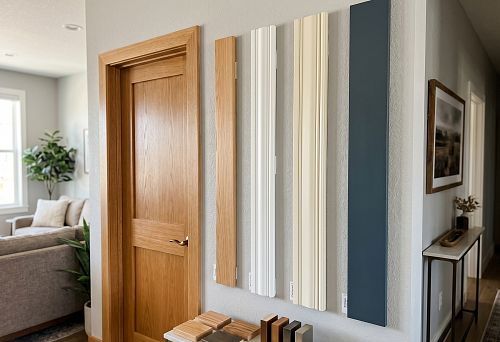
This is an architectural strategy: skirting boards, architraves, and doors of the same shade create a unified wooden system in the interior. The eye perceives it as a single whole — not as a 'door' and a 'skirting board,' but as the architectural outline of the room.
Buying skirting boards in the color of the doors in an apartment is a solution for those who build an interior systematically and think about architectural integrity, not just the color of the walls.
Straight or profiled molding
Straight profile: for modern, minimalist, Scandinavian, contemporary, loft interiors. A clean line without decorations — a timeless choice.
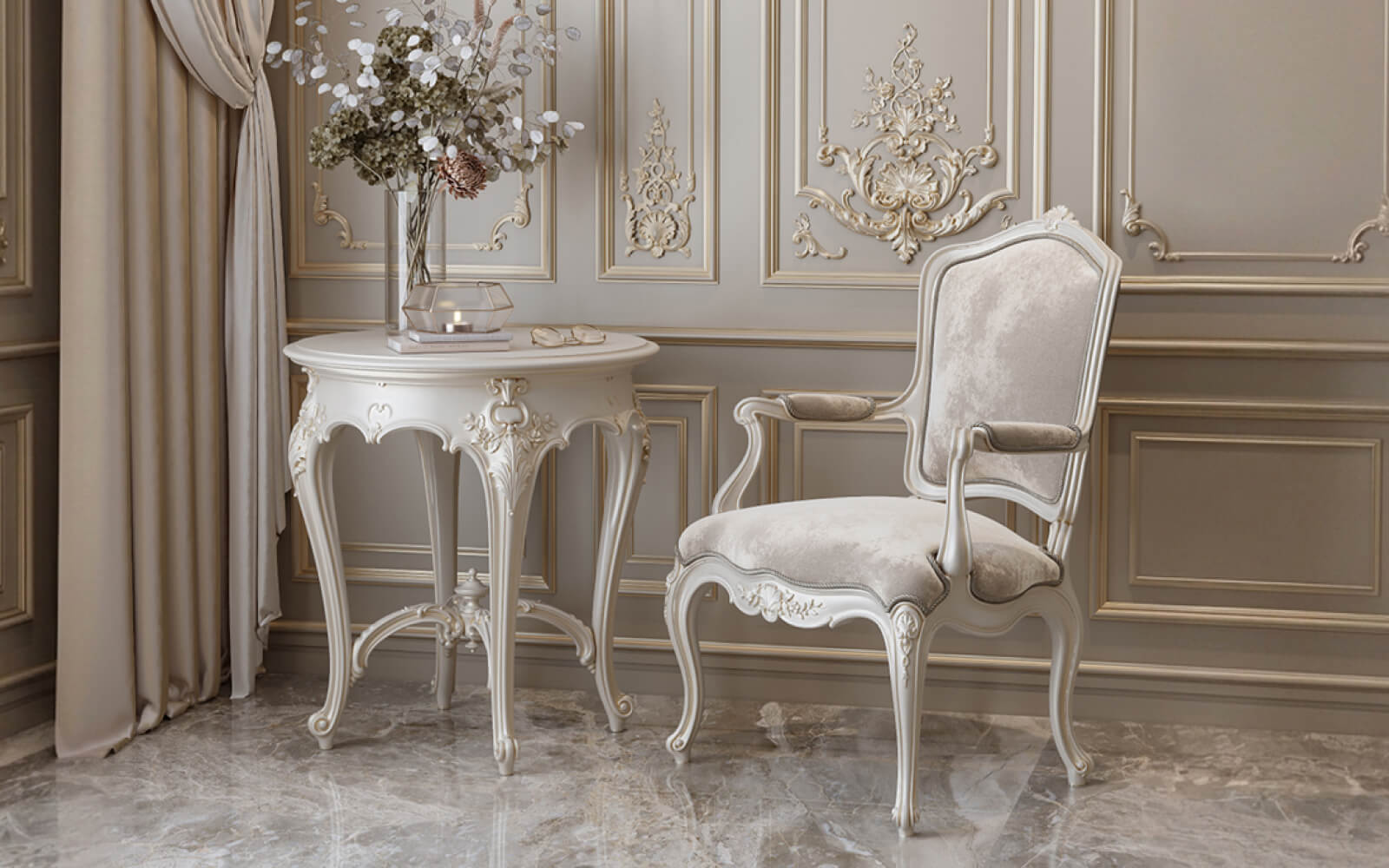
Profiled molding: for neoclassical, classic, Provence, traditional, and eclectic interiors. Beads, transitions, relief — where other architectural details (moldings, cornices, profiled architraves) create a rich decorative context.
Rule: a profiled skirting board without profiled architraves and moldings looks lonely. If you want a classic profile — take the whole system: skirting board, cornice, molding.
What to buy together with skirting boards for an apartment
A competent interior is a system. Skirting boards are one element. What else should be considered in the same purchase?
Moldings and cornices
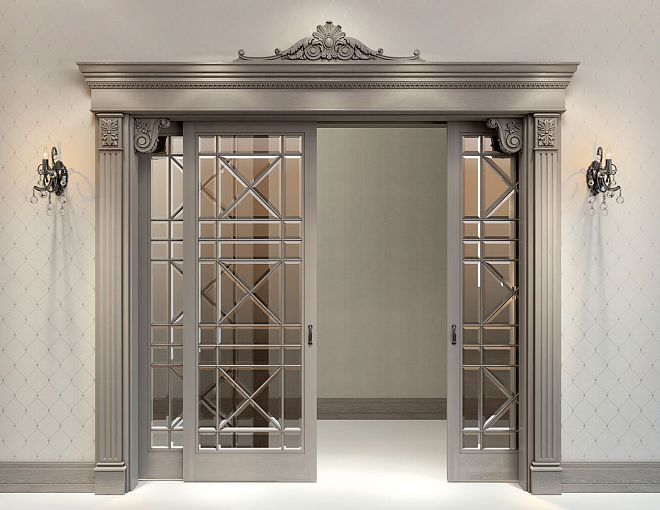
Wall moldings create frames, panels, belts — architectural elements that give depth to the interior. Cornices complete the system at the ceiling. Skirting boards complete it at the floor. Together — this is a full-fledged architectural story.
In the sectionMoldings and cornicesProfiles are presented that were developed in coordinated proportions with skirting boards. Choosing from one system guarantees unity of result.
Rack panels
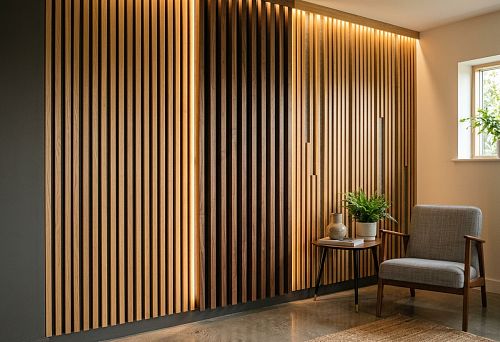
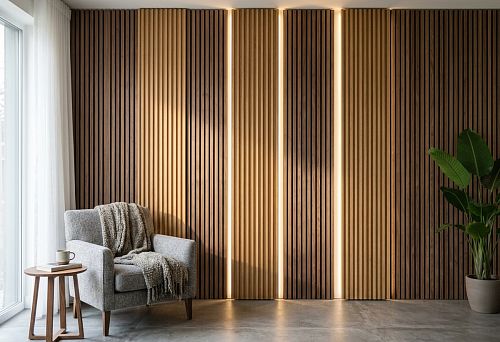
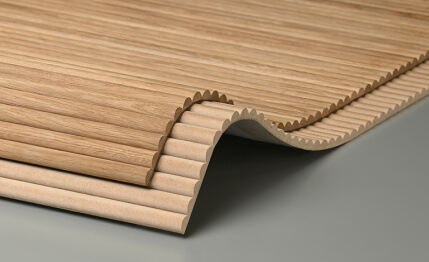
Wooden slatted panels on walls are one of the most expressive interior trends in recent years. Vertical slats create texture, depth, and a living texture that no paint or wallpaper can provide. Skirting boards in this system are the lower visual boundary: it is from them that the slats 'grow'.
Rafter panelsSTAVROS and the skirting board line are developed in a unified stylistic logic. Take skirting boards and slatted panels from one system — get an interior with an integral character from floor to ceiling.
Decor for moldings
Moldings turn into full-fledged architectural frames with the addition of decorative inserts: rosettes, ornaments, corner elements. Inmolding decor sectionDetails are collected that complement the skirting-molding system and elevate the interior from the level of 'good renovation' to the level of 'designer space'.
Moisture-resistant solutions for difficult areas
If you are getting wooden or MDF skirting boards for living rooms — simultaneously take care of the kitchen, bathroom, and hallway.Moisture-resistant skirting board HI WOOD— a solution for these areas, produced in the same profiles and colors as the main wooden line.
A unified profile throughout the apartment, different materials depending on conditions—this is the correct systematic approach.
Comparison table: baseboard for different rooms in the apartment
| Room | Recommended material | Height | Profile | Color |
|---|---|---|---|---|
| Living room | Wood or MDF | 80–100 mm | Straight / with a bead | White / to match the floor |
| Bedroom | MDF or wood | 60–80 mm | Straight | White / to match the walls |
| Hallway | Oak or HI WOOD | 70–80 mm | Straight | White / neutral |
| Corridor | MDF or HI WOOD | 70–80 mm | Straight | White |
| Kitchen | HI WOOD (moisture-resistant) | 60–80 mm | Straight | White / to match the furniture |
| Bathroom / toilet | HI WOOD (moisture-resistant) | 58–70 mm | Straight | White |
| Children's room | Oak or HI WOOD | 70–80 mm | Straight | White / to match the walls |
Where to buy skirting boards for an apartment in Moscow
The main practical question. Let's examine the criteria that distinguish the correct choice of supplier.
How to choose by material. A good supplier offers all three categories: wooden skirting boards made of oak and beech, MDF profiles in white and primed for painting, moisture-resistant polymer skirting boards HI WOOD. If the assortment includes only one type — you have to visit several places, which wastes time.
How to select by room and covering. An experienced seller or a showroom with samples allows you to compare the skirting board with a real sample of the floor, door casing, or wall finish in daylight. This is the only guaranteed way to match the color.
How to order with delivery. Skirting boards 2400–2800 mm long are inconvenient to transport yourself. Delivery in Moscow from a supplier with a real warehouse — within agreed timeframes, with professional packaging. Check the availability of the required items before placing your order.
Where to go to the catalog. The full assortmentwooden and MDF skirting boards— all heights, all profiles, all finishes — is available online. It's convenient to compile a list of needed items in advance, and then place an order or come for samples.
A detailed guide on choosing a floor skirting board with delivery in Moscow — in the articlebuy floor baseboards in MoscowAll current options from wood, MDF, and solid wood are covered there.
Common mistakes when choosing
After tens of thousands of Moscow apartment renovations, the pattern of mistakes is well known. Here are the four most costly ones.
Profile too low
They take 60 mm 'so it won't be noticeable,' and then discover that the baseboard doesn't cover the actual gap of the flooring against the wall. Or that in a spacious living room with 2.9-meter ceilings, a narrow baseboard looks random and insignificant.
Solution: before purchasing, measure the actual gap of the flooring against the wall. The baseboard should cover it with a 5–6 mm margin in width. And be sure to consider the ceiling height—the 1/30–1/35 rule of the room works flawlessly.
Color mistake
The 'white' baseboard on the screen turns out to be creamy next to cool white doors. Or 'oak' gives a different shade than the flooring. The result is a visual conflict that is constantly noticeable.
Solution: always view samples 'in person,' next to samples of the floor, door trim, and wall finish. In daylight. Order a trial plank or visit the showroom with fragments of materials.
Different baseboards in rooms without logic
They take a wooden baseboard for the living room, white MDF for the bedroom, plastic for the hallway—all in different profiles and heights. In the end, the apartment is assembled from incompatible fragments, each of which is fine on its own, but together they don't work.
Solution: determine one profile and one height for the entire apartment. The material may change depending on the zone, the color—depending on the flooring and doors. But the profile and height should be uniform throughout the apartment.
Unsuitable material for the kitchen and hallway
The most costly mistake. A wooden or MDF skirting board near the kitchen sink darkens and begins to swell at the bottom edge within a few months. After a year, it requires complete replacement.
Solution: kitchen, bathroom, toilet, hallway with active cleaning — only moisture-resistant HI WOOD skirting board. No exceptions or compromises. Saving on material here results in double the cost of replacement.
Conclusion
Skirting board for an apartment is a decision made once and stays with you for a long time. Give it the attention it deserves: choose the material for each zone, height for the ceilings, color for the floor and doors, profile for the interior style.
Want wooden — look at solid wood baseboard made of oak and beech. Need white MDF — full assortment in the catalog of wooden and MDF skirting boards. Wet zones — only Moisture-resistant skirting board HI WOOD. And for selection considering style and material — a detailed guide Buy floor skirting board.
About the company STAVROS
STAVROS is a Russian manufacturer of architectural decor for interiors. Specializes in producing floor skirting boards, moldings, cornices, trims, slatted panels, and decorative elements from natural wood (oak, beech), MDF, and high-density polymer HI WOOD.
All STAVROS products are developed as a unified architectural system: each profile is created considering adjacent elements — so that the skirting board, molding, cornice, and slatted panel form a cohesive ensemble. Production is equipped with modern machinery and multi-stage quality control.
STAVROS works with private clients, interior designers, architects, and construction companies. Delivery across Moscow and all of Russia — from the warehouse within agreed timeframes.
Frequently asked questions
Can the same baseboard be used throughout the entire apartment — in living rooms, kitchen, and bathroom?
One profile and color — yes, that's correct. But the material must suit the conditions of each zone. In living rooms — wood or MDF. In the kitchen and bathroom — moisture-resistant HI WOOD. Choose the same profile in different materials — they will look identical externally, each will functionally handle its task.
Which baseboard is best suited for an apartment in a panel building with 2.7-meter ceilings?
Height 80 mm — the optimum for standard Moscow apartments with ceilings of 2.6–2.9 meters. Straight white MDF profile or wooden oak — depending on the floor covering and interior style. In the bathroom and kitchen — moisture-resistant HI WOOD of the same height.
How to correctly calculate the amount of baseboard for an apartment?
Measure the perimeter of each room. Subtract the width of all door openings (0.9–1.0 m each). Sum the results. Add 10–15% for trimming in corners. Divide by the length of a standard plank (2400 mm). Round up.
Does the baseboard need to be attached to the floor?
No. The baseboard is attached only to the wall. Especially important with floating coverings (laminate, quartz vinyl, engineered board): the baseboard should not press down the covering; leave a 1–2 mm gap between the lower edge of the baseboard and the floor surface.
Which baseboard to choose for a studio apartment?
White straight MDF profile 70–80 mm around the entire perimeter, in the kitchen area — the same profile made of moisture-resistant HI WOOD. A uniform profile and color are mandatory: in a studio apartment, everything is visible at once, and any change will disrupt the visual unity.
Can you paint an MDF baseboard after installation?
Yes, this is standard practice. Primer is mandatory. Water-based paint, 2–3 coats applied with a thin brush or narrow roller. After installation and filling the joints with acrylic sealant — the skirting board is painted together with the wall finish or separately. The result is neat and durable.
Should I use one skirting board for the entire apartment or different ones for different rooms?
The profile and height — the same for the entire apartment. This creates visual integrity. The material — varies depending on operating conditions. The color — may vary slightly depending on the floor and door finishes in each room, but within a unified palette.