Article Contents:
- What exactly we are buying: PLT-005 120×16 mm
- Why the line “PLT-005 — 300 meters” is not yet an order
- First conversion: from linear meters to whole planks
- Control budget for 300 meters
- Which factors change the calculation of whole planks
- Why it's better to write the purpose directly in the packing list
- First phase
- Second phase
- Repair reserve
- Reorder
- 1. Ordering only linear meters
- 2. Not specifying the material
- 3. Not specifying the product length
- 4. Treating 2400 and 2600 mm as interchangeable
- 5. Converting meters to pieces using only one formula
- 6. Not requesting the packing list
- 7. Determining the number of planks in one frame yourself
- 8. Accepting the shipment by total quantity without checking the material and length
- 9. Labeling all packages with the word “skirting board”
- 10. Mix the reserve with the working batch
- 11. Do not split the shipment by queues
- 12. Write off a damaged long plank entirely without checking the cutting plan
- What is the size of PLT-005?
- What lengths are available for PLT-005?
- How many planks are needed for 100 linear meters?
- How do you convert 300 linear meters into pieces?
- Why can't you order only by meterage?
- How does a commercial plank differ from a transport unit?
- How many planks are in a PLT-005 package?
- Do I need to request a packing list?
- How should a wholesale batch be labeled?
- How do I receive PLT-005 on site?
- What should I do with a damaged plank?
- How should the reserve be stored?
- Can an order be split into multiple deliveries?
- How do I process a partial acceptance?
- How can I order PLT-005 wholesale without excess reserve?
- What should I send the supplier to calculate the batch?
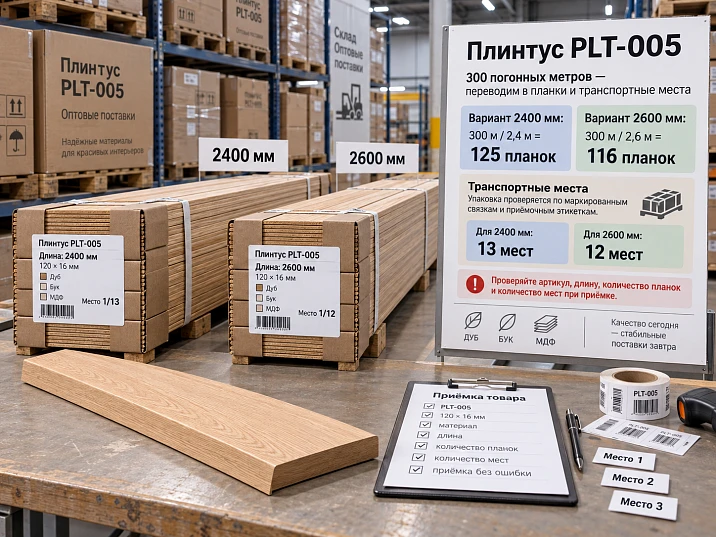
In the estimate for a large project, a short line easily appears: "PLT-005 — 300 linear m." For a preliminary budget this is sufficient, but for a real order it is not. The supplier ships not abstract meters, but specific whole planks of a certain material and length. These planks need to be packed, labeled, distributed across construction phases, delivered, and accepted. If all these transitions are not recorded before payment, a match in total meterage still does not mean that the correct batch arrived at the site.
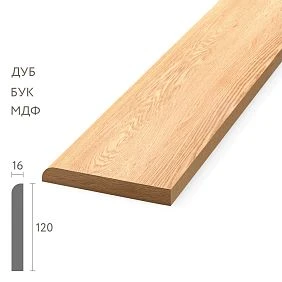
For PLT-005 the task is especially clear. The cross-section of the four current versions is the same — 120×16 mm, however MDF and moisture-resistant MDF have a commercial length of 2600 mm, while beech and oak have 2400 mm. This means the same 300 linear meters turn into a different minimum number of whole planks. Next, this quantity must be adjusted according to the cutting map, a reserve must be allocated, and after that the order is converted into transport units according to the supplier's packaging specification.
The practical result of the article: after calculation, you will be able to place a request not as "300 meters of skirting board," but as a physically verifiable delivery: PLT-005 → material → size → number of whole planks → reserve → transport units → labeling → acceptance. This is exactly the chain needed by procurement, the warehouse, and the installation crew.
What exactly we are buying: PLT-005 120×16 mm
Wooden Skirting / Door Trim PLT-005 is produced in several material versions. They share the same cross-sectional geometry, but differ in material, commercial length, cost, and availability status. For a wholesale request, an item code without material and length is insufficient: the line "PLT-005" does not yet fully identify the commercial unit.
| Execution | Dimension A×C×L | Price at the time of check | What to record in the order |
|---|---|---|---|
| MDF | 120×16×2600 mm | 2 050 ₽ | Material, 2600 mm, number of whole planks |
| Moisture-resistant MDF | 120×16×2600 mm | 2 550 ₽ | Separate commercial line, do not mix with regular MDF |
| Beech | 120×16×2400 mm | 5 140 ₽ | Material, 2400 mm, number of whole planks |
| Oak | 120×16×2400 mm | 7 030 ₽ | Material, 2400 mm, number of whole planks |
Prices are provided as a guide as of the date the material was prepared and may change. Before payment, you need to re-check the product page, availability, and the terms of the specific batch. The product page also indicates the "Prestige" sanding quality. Different surface preparation types are available for certain options; if a finish is specified in the project, it is also better to record it in the specification as a separate field rather than leaving it "by default".
What matters for this article is something else: we do not choose material by design and do not compare the aesthetic properties of oak, beech, and MDF. It is assumed that PLT-005 has already been selected by the project. The supply task is to turn the project's linear meters into an exact number of trade units and prepare a shipment that can be checked without guesswork.




Why the line "PLT-005 — 300 meters" is not yet an order
A linear meter is convenient for the designer: it is used to measure the total length of skirting along the walls. But procurement lives in a different system of units. First, the meters need to be broken down by section, then cutting to standard length needs to be selected, and after that you get the number of whole strips. Logistics adds another level — transport units. Receiving must check not only the meters, but also the contents of each unit.
A bad request looks like this:
PLT-005 — 300 m.
It does not answer at least five questions: what material the profile should be made of; what trade length should arrive; how many whole strips are ordered; what volume belongs to the working batch and what belongs to the reserve; how the batch will be packaged and labeled.
A working request structure looks different:
PLT-005 / MDF / 120×16×2600 mm / ___ pcs. / working batch ___ pcs. / reserve ___ pcs.
PLT-005 / beech / 120×16×2400 mm / ___ pcs. / working batch ___ pcs. / reserve ___ pcs.
If an item uses multiple variants, each one is listed on a separate line. Moisture-resistant MDF cannot be "hidden" inside a general MDF line just because the geometry is the same. The same applies to oak and beech: the same length of 2400 mm does not make them a single product group.
Our factory also produces:




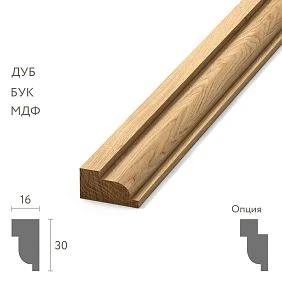
First conversion: from linear meters to whole planks
The simplest check calculation is to divide the total requirement by the length of the product plank and round the result up to a whole item. This is not the final order, but a theoretical minimum. It is needed to quickly verify the estimate, gauge the order of the budget, and immediately spot a gross error in quantity.
For a conditional 300 linear meters:
- with a length of 2600 mm: 300 / 2.6 = 115.38, so the mathematical minimum is 116 whole planks;
- with a length of 2400 mm: 300 / 2.4 = 125, so the mathematical minimum is 125 whole planks.
It is easy to draw the wrong conclusion here: that 2600 mm is "more advantageous" than 2400 mm because fewer planks are needed. For PLT-005, this comparison cannot be made. Moving from 2600 to 2400 mm simultaneously means switching to a different material. Length is not an independent option within the same variant that can be changed to save money. First, the required material version of the product is selected, and only then is the corresponding length used.
Get Consultation
Check budget for 300 meters
If you multiply only the theoretical minimum of whole planks by the current price of one plank, you can get the lower bound of the product budget before accounting for actual cutting, reserve, packaging, and delivery. Such a calculation is useful not as a commercial offer, but as a check on the order of magnitude.
| Execution | Theoretical minimum | Price of one plank | Checksum |
|---|---|---|---|
| MDF 2600 mm | 116 pcs. | 2 050 ₽ | 237 800 ₽ |
| Moisture-resistant MDF 2600 mm | 116 pcs. | 2 550 ₽ | 295 800 ₽ |
| Beech 2400 mm | 125 pcs. | 5 140 ₽ | 642 500 ₽ |
| Oak 2400 mm | 125 pcs. | 7 030 ₽ | 878 750 ₽ |
These totals cannot mechanically be used to decide on a purchase. They do not account for the wall map, cuts, angles, short returns, joint requirements, damage allowance, or possible additional services. However, they are convenient for checking that the purchasing list does not contain an arithmetic error by an order of magnitude.
Why 116 or 125 planks by formula still do not mean the final quantity
The total linear meterage answers only the question of how much material is needed along the walls in an ideal continuous line. On a real site, the line is divided into segments. Each segment has a length, orientation, angle, abutment, visible end, and joint requirements. A 600 mm remainder after one cut may be useful on a short return, or it may be useless if the nearest part requires 900 mm. That is why the arithmetic sum of lengths and the real cutting layout produce different results.
Before the final order, it is useful to have a map at least in this form:
| Zone | Section | Net length | Feature | Assigned plank |
|---|---|---|---|---|
| Building A, Floor 2 | A-01 | 4,180 mm | Joint needed | Determined by the cutting map |
| Building A, Floor 2 | A-02 | 2,320 mm | Whole part | 1×2400 or 1×2600 depending on the version |
| Building A, Floor 2 | A-03 | 1,060 mm | Short return | You can use a leftover piece of suitable length |
| Building A, Floor 2 | A-04 | 780 мм | at the door | Assign after long sections |
The point of the map is not to make cutting complex for the sake of precision. It prevents the opposite problem — buying extra planks "just in case" only because the leftovers were not distributed in advance. On a large project, even one extra percent with expensive solid wood turns into a noticeable sum, but excessive tightening of the cutting plan is also dangerous: if every plank is allocated without reserve down to the last centimeter, one damaged part can halt a section of installation.
Which factors change the calculation of whole planks
Lengths of individual walls. Two projects can have the same 300 linear meters and require a different number of planks. In one, long walls allow leftovers to be used well; in the other, many short segments create more offcuts and transitions.
Angles and cutting technology. With complex joints, the length of the workpiece must account for the actual cut, not just the linear dimension of the wall. If the project requires a certain joint pattern, one cannot assume that the entire remainder after the cut is automatically suitable.
Door openings and returns. Short parts are a good consumer of leftovers. They should be planned after assigning long sections, rather than ordering separate full planks for each small area.
Visible joints. Mathematically, a long line can be assembled from several pieces, but the project may limit the number of joints or prohibit them on a specific wall. This changes the cutting plan.
Reserve. It cannot be chosen as one universal figure for any project. The required margin depends on the complexity of the geometry, the stability of the initial dimensions, the number of phases, the remoteness of the site, the possibility of a quick reorder, and the cost of stopping installation.
The estimate counts meters, the order counts pieces, logistics counts places
For a large purchase, it is useful to separate four levels of accounting. The design or estimate model works in linear meters. The purchasing specification — in whole planks. The logistics statement — in transport places. Acceptance checks each place and the product items within it. If these levels are mixed, one figure begins to substitute for another.
| Stage | Main unit | What answers the question |
|---|---|---|
| Project / estimate | linear meter | What total length does the object need |
| Order | full plank | How many physical items are we purchasing |
| Shipping | transport unit | How the cargo is physically formed |
| Acceptance | location + SKU + piece | What exactly arrived and in what condition |
That is exactly why commercial requests like Wooden baseboard or "floor skirting wholesale" should end not with the choice of a beautiful profile, but with a correct specification. For a private order, an error in a single plank is unpleasant. For a wholesale batch, an error in the unit of measurement can affect dozens of rooms at once.
Transport unit: the unit that is invisible in the project estimate
Even after the buyer has received the final number of planks, the batch is not yet fully described. One hundred twenty planks may arrive not as "one order" but as several physical units. For long-length linear mouldings this is fundamental: the warehouse receives not a virtual line in the invoice, but specific packaging units, each of which must be identifiable.
The PLT-005 card at the time of checking indicates the addition of a rigid packaging frame costing 390 ₽ for safe transportation. It also contains a separate wording about the norms for solid wood and the assembly of MDF. This information is important, but it must not be turned into a homemade universal rule of "there are always this many planks in one unit." For a large order, a packaging specification is required specifically for your shipment.
Before payment or at least before the actual handover of the cargo to the carrier, it is useful for procurement to obtain:
- number of transport units;
- number of each unit;
- SKU and material inside the unit;
- commercial length of the planks;
- number of items in each unit;
- external packaging dimensions, if they are needed for the truck, elevator, or warehouse;
- the weight of each place, if it is involved in loading planning;
- the purpose of each place: building, floor, queue, or reserve;
- a note about partial delivery, if the order is not shipped in full.
Until the supplier confirms the actual packaging, the buyer must treat the number of places as an unknown quantity. The formula for recalculation is simple only after the initial parameter is received. If the supplier has confirmed the same number of planks in one place, the number of places is determined by rounding up. If the packaging is not uniform, the calculation must be based on the actual packing list, not on an average norm.
Why you should not guess how many planks will be in the packaging
For long-length items, packaging depends not only on quantity. The material, stacking method, protective frame, carrier restrictions, and the assembly of a specific order can change the physical configuration of the cargo. Even if a previous delivery of the same SKU had a certain number of items per place, this does not guarantee the same layout in a new batch.
An error here is especially unpleasant because it shows up late. Procurement calculates the truck for a conditional ten places, the warehouse reserves an area for them, but in reality a different number arrives. Or the opposite: the total number of places matches, but the purpose inside is mixed up. Formally, the cargo is accepted, and then on the third floor a place is opened that was intended for another building.
The right approach is not to argue about how many items “usually” fit in a frame, but to request the final packing list. For a wholesale batch, such a list is more useful than verbal confirmation. It creates a single document that the supplier’s manager, the forwarder, the warehouse keeper, and the installation supervisor can all work from.
What the packing list for batch PLT-005 should look like
There is no universal mandatory template here, but a practical document should make it possible to find a specific trim piece via the transport package. A few fields are enough for this. The larger the site and the more queues there are, the more important it is not to reduce them to a single "skirting" column.
| Package No. | SKU | Material | Size | Quantity | Purpose | Status |
|---|---|---|---|---|---|---|
| 01 | PLT-005 | MDF | 120×16×2600 | As per actual | Building A, floors 2–3 | Main batch |
| 02 | PLT-005 | MDF | 120×16×2600 | As per actual | Building A, floors 4–5 | Main batch |
| 03 | PLT-005 | Beech | 120×16×2400 | As per actual | Building B | Main batch |
| 04 | PLT-005 | Oak | 120×16×2400 | As per actual | Site warehouse | Reserved — do not open without approval |
The phrase "as actually shipped" in the example means that the number is filled in by the supplier before shipment. One should not pre-fill it with the expected norm. If a single transport frame contains a mixed composition, this must also be broken down line by line: one package number may have several item lines, but each must be unambiguously identified.
Why it is better to write the destination directly in the packing list
On a construction site, skirting is rarely all consumed in a single day. The first crew works in one building, another queue is not ready yet, and common areas are started later. If the destination is known only in a separate procurement table, the warehouse has to constantly cross-reference documents. When it is duplicated on the package and in the list, the likelihood of accidental opening or handing over the wrong batch is reduced.
For long-length material, labeling that can be read without removing the protective packaging is especially useful. A person should not have to open the frame just to answer the question "what is inside." Labeling is not a decorative sticker but an interface between the supplier and the site.
Why checking only the total linear meters is not enough during acceptance
Let's imagine the delivery note specifies exactly 300 linear meters. At first glance, the task is solved. But the same total meterage can be assembled from different physical configurations. You could end up with a different number of planks, a different length, a different material, or an incorrect distribution across batches. In that case, the figure "300" matches, but the order does not.
For PLT-005, checking only by profile name is especially risky. The correct article 120×16 mm may arrive at the site, but instead of the agreed MDF, a different specification may be supplied, or some units may be 2400 mm instead of 2600 mm. The cross-section geometry will remain the same, so a quick visual check may not notice the error. The problem will only be discovered during cutting or finishing.
Acceptance is best carried out in the following order:
- check the total number of transport units against the documents;
- verify the number and marking of each unit;
- confirm the SKU;
- confirm the material;
- confirm the size and commercial length;
- verify the number of planks inside the unit against the packing list;
- record the visible condition of the packaging and products;
- assign the place to the corresponding storage zone or installation queue.
Such an algorithm turns acceptance from "roughly everything arrived" into a verifiable procedure. If a discrepancy arises, you can point to a specific place and a specific line rather than an abstract shortage.
How to label transport places before dispatch
The label "SKIRTING" is useful only as long as the site has one type of skirting, one queue, and one warehouse. On a real construction site, different profiles, materials, and batches may lie next to each other. Therefore, the labeling must answer the storekeeper's questions without contacting the manager.
A working format might look like this:
PLT-005 / MDF / 120×16×2600 / BODY A / FLOORS 3–4 / PLACE 04 OF 12 / MAIN BATCH.
For the reserve, it is worth adding a noticeable feature:
PLT-005 / OAK / 120×16×2400 / RESERVE / DO NOT OPEN WITHOUT APPROVAL.
The place number "04 of 12" is also useful as a quick check of the vehicle's completeness. If eleven places out of twelve are unloaded, the absence is detected before the transport leaves the site. But such numbering must correspond to the packing list; it cannot be printed in advance if the actual number of places has not yet been confirmed.
Why link packaging to the installation queue
A wholesale order is often placed once, while installation stretches over weeks or months. Without splitting into phases, the entire batch turns into general warehouse stock. Workers open the nearest frame, some planks end up in the wrong zone, the leftovers get mixed together, and the reserve quietly becomes current consumption. By the end of the project, it is impossible to reconstruct how much material was intended for each phase.
It is useful to split before shipment:
First phase
It includes only the volume that is actually needed by the nearest work front. If building A is ready for installation, its items should be accessible first and should not force the warehouse to move cargo from the second phase.
Second phase
It can be stored separately and not opened until the rooms are ready. This reduces the number of repeated moves and the risk of damaging long planks during warehouse operations.
Repair reserve
The reserve is physically and documentarily separated from the working batch. Its purpose is to cover real losses, damage, or local rework, not to compensate for a lack of accounting.
Re-order
If part of the volume remains uncertain due to unfinished measurements, it is wiser to formalize it as a separate managed additional order than to artificially inflate the first delivery. This is especially relevant if the cost of storage and the risk of damage on site are higher than the organizational cost of a second shipment.
Why the reserve cannot be dissolved within the general batch
The entry “125 pcs., including reserve” looks compact, but after a few weeks it becomes a source of disputes. The installer sees 125 planks and considers them available. The storekeeper issues material on request. Procurement is sure that part of the volume is untouchable. As long as everything goes according to plan, the conflict is invisible. It shows up at the end, when the last rooms are left without stock.
In the specification, it is better to separate at least two lines:
| Group | Quantity | Usage rule |
|---|---|---|
| Working batch | According to the cutting map | Issued for approved installation zones |
| Reserve | based on the risks of a specific site | Issued only when the reason is documented |
The reserve percentage cannot be assigned automatically using a single number for all sites. For repetitive standard rooms with a proven cutting plan, it can be lower than for a renovation with complex geometry. If the site is remote and a reorder takes a long time, the cost of missing one plank is higher. If production and the warehouse are nearby, excessive stock, on the contrary, may be economically pointless.
How to accept a partial delivery
A large batch does not always arrive all at once. Some items may be in stock, some may still be in production; the site itself may request delivery in stages. In this case, the “ordered” field in the documents is not enough. A history of quantity movement is needed.
| Position | Ordered | Shipped now | Remaining to ship | Accepted | Damaged |
|---|---|---|---|---|---|
| PLT-005 / MDF / 2600 | ___ | ___ | ___ | ___ | ___ |
| PLT-005 / beech / 2400 | ___ | ___ | ___ | ___ | ___ |
After each delivery, the remaining to ship must be recalculated from the actually accepted quantity, not from what was listed on the original invoice. If one plank is damaged and subject to replacement, it cannot simultaneously be counted as accepted as a full-quality item and left in the remainder as a shortfall — the status must be unambiguous.
How to account for a damaged plank
The entry “minus one piece” is too crude. For long-length moulding, damage may be local. If the defect is at the end, and the cutting map contains short parts, part of the product is potentially usable. If the profile surface is damaged in the central zone, the possibilities are different. The decision should not be made by the warehouse “by eye,” but by the responsible person according to the cutting map and the requirements for visible surfaces.
In the report or internal statement, it is useful to record:
- transport place number;
- PLT-005 and the specific material;
- plank length;
- location and type of damage;
- photo before and after unpacking;
- decision: full replacement, use after trimming, transfer to technological offcut;
- which batch the plank belonged to;
- whether the reserve needs to be used up or a replacement needs to be arranged.
Such accounting does not mean that damaged goods must necessarily be used. It is needed for an accurate picture. If the product does not meet the requirements, it should be processed according to the agreed claim procedure. But with local damage, all 2400 or 2600 mm cannot automatically be considered lost if the project and quality allow the undamaged part to be legally used.
How to reconcile the project, specification, invoice, and packing list
A large order goes through several documents. An error often appears not within a single file, but when data is transferred between them. The designer handed over 300 linear meters, procurement recalculated them into 118 planks taking cutting into account, the supplier's manager issued an invoice for 118, but before shipment the packing list actually describes 115. If the documents are checked separately, each of them may look plausible. Comparing the chain immediately reveals the gap.
It is convenient to check four levels:
- Project requirement. Which zones and what total length must be covered.
- Procurement specification. What this linear footage is turned into after cutting: material, length, number of whole planks, reserve.
- Invoice. Whether the line items, quantities, price, preparation, and additional services match.
- Packing list. Whether the entire paid batch is physically distributed across transport units.
For each item, the total quantity across all transport units must correspond to the quantity that should be shipped in this specific delivery. If the shipment is partial, the comparison is not against the full order but against the confirmed current batch. This is a simple check, but it is precisely what catches situations where "everything is in the invoice" but the physical assembly is not yet complete.
What to request from the supplier along with the invoice
A request for a wholesale batch is best structured so that two different suppliers can respond with comparable data. The wording "calculate 300 meters of PLT-005" leaves too many decisions on the seller's side. One manager will convert meters into planks by length, another will add their own reserve, and a third will clarify the material. As a result, the offers cannot be compared line by line.
To calculate PLT-005, provide at least the following set:
- item code PLT-005;
- the material;
- cross-section 120×16 mm;
- the commercial length corresponding to the selected variant;
- the number of full boards according to the cutting map;
- the working batch and the reserve separately;
- preparation/finishing requirements, if they are part of the order;
- separation by buildings, floors, or phases;
- the required completion date for each phase;
- delivery address and terms;
- a request to provide the quantity and composition of transport units;
- the procedure for recording shortages or damage upon acceptance.
If the request is built around a category finishing material suppliers, this format is useful precisely because it shifts the conversation from a general price "per meter" to a comparable set of obligations. A commercial proposal without a specified product length and number of full boards cannot be correctly compared with a proposal where these parameters have already been calculated.
How to compare supplier offers for PLT-005
The most noticeable figure in a commercial offer is the price. But for long-length moulding, it only makes sense when the basis of comparison is the same. The cost per linear meter may look lower, while the final order turns out to be more expensive due to a different number of whole planks, packaging, delivery, or additional processing. Therefore, comparison is made using an identical specification.
| Comparison parameter | Offer A | Offer B | What must match |
|---|---|---|---|
| Article number | PLT-005 | PLT-005 | The same profile |
| Material | for example, MDF | for example, MDF | Different materials cannot be compared as one item |
| Size | 120×16×2600 | 120×16×2600 | The same product unit |
| Quantity | ___ pcs. | ___ pcs. | The same requirements list |
| Reserve | highlighted | highlighted | Compare working volume separately |
| Packaging | described | described | Additional costs are clear |
| Delivery | Conditions | Conditions | Same address and delivery window |
| Lead time | Date | Date | Readiness of the required queue is compared |
When a company compares offers for a request Wholesale building material suppliers, it is useful to separate the price of the goods from the full cost of delivery to the site right away. If one tender participant is given an exact map, while another receives only the total area, the final figures answer different questions.
Finishing material suppliers: what to send for a wholesale batch calculation
In construction finishing procurement, the opposite problem often occurs: the supplier is sent too large a file with all the project documentation, but is not given a short procurement summary. The manager has to independently search the drawings for the required item code, material, and volume. This increases the calculation time and the risk that different participants will understand the task differently.
For PLT-005, it is enough to attach three related documents: a brief specification, a cutting map or at least a list of sections, and shipping requirements. The full project can be left as reference material. The procurement specification should be the main source of quantities.
If you need large supplier of building materials for project-based supply, it is useful to state right in the request who approves changes. For example: "Any change to material, length, quantity, or packaging structure must be agreed with the responsible procurement specialist before shipment." This line does not replace the contract, but it prevents work communication from turning into a chain of verbal assumptions.
When comparing by request building material suppliers it makes sense to attach a table in a form that can be returned filled in. Then, instead of a free-form letter, you will get a comparable response: price per plank, quantity, cost of the working batch, cost of the reserve, packaging, lead times, delivery, number of packages.
Construction materials Moscow wholesale: why a precise specification is needed in a price request
A geographic query does not cancel out product precision. When a buyer searches building materials Moscow wholesale, there is a strong temptation to start with the overall price and only then clarify the details. For PLT-005, it is better to reverse the order: first fix the finish and quantity, then compare commercial terms. Otherwise, a low starting price may refer to a different material or fail to account for the required configuration.
The same rule works when comparing Construction material suppliers Moscow. The request must contain the same set of source data. You cannot give one supplier 300 linear meters and another 118 calculated planks with reserve, and then draw a conclusion based only on the total amount. First align the specification, then compare the price.
If you are selecting construction materials suppliers moscow, request the logistics part separately. A long plank of 2400 or 2600 mm places demands on transportation and storage. You need not a general phrase like "delivery is available," but an understanding of who is responsible for packaging, how many packages will be in the batch, how they are labeled, and at what stage the documents are handed over.
For the request «construction materials supplier Moscow» it is also useful to check the possibility of partial shipment. If the site is not ready to accept the entire volume, one large delivery can create more risks than two manageable batches. The decision depends on production timelines, transportation cost, warehouse space, and the installation schedule.
Wholesale purchasing does not end with paying the invoice
From an accounting perspective, payment may look like the end of the procurement procedure. On site, it is only the middle. After payment, you need to ensure manufacturing or reservation of the goods, confirm readiness, obtain the packing list, agree on the delivery window, organize unloading, and accept each package. The earlier these actions are recorded, the fewer urgent decisions there will be on the day the truck arrives.
Therefore wholesale building material suppliers are useful to the site not only for their price but also for their ability to provide transparent information about the configuration. For PLT-005, the transition from the number of planks to physical packages is especially important: this is usually missing from the project estimate.
For the request Building materials suppliers wholesale determine in advance which document is the “source of truth” on the day of acceptance. If the driver brings a delivery note, procurement brings its own specification, and the warehouse brings an old version of the packing list, the discrepancy will become an organizational problem. The approved version must have a date or revision number.
Finally, if selected construction materials supplier for repeat purchases, keep the actual data from the previous batch: how many planks were ordered, how many packages were formed, what leftovers remained, and whether there was any damage. The next calculation will be more accurate, but this data should be used as history, not as an unchanging packaging standard.
What the final request for PLT-005 should look like
A good request is short, but it has no critical gaps. It does not have to repeat the entire project. Its task is to unambiguously describe what needs to be produced, packed, and delivered.
Example: Please calculate a wholesale batch of PLT-005 skirting board 120×16 mm. Material — MDF. Commercial length — 2600 mm. According to the approved cutting plan, ___ whole strips are required, of which ___ pcs. are the working batch and ___ pcs. are the reserve. Divide the working batch into building A and building B according to the attached schedule. Please separately specify the price of one strip, the cost of the batch, the cost of packaging, the number of transport units, the contents of each unit, external dimensions and marking, readiness date, cost and delivery terms. Before shipment, please send the packing list for approval.
For beech or oak, the material line and commercial length change to 2400 mm; you cannot leave 2600 mm in the template just because the request was copied from MDF. For moisture-resistant MDF, you must explicitly write “moisture-resistant MDF” so that it is not shortened to general MDF in correspondence.
If the requirement is currently known only as 300 linear meters, do not automatically substitute 116 or 125 pieces into the order. First complete the cutting plan. The theoretical minimum can be indicated in a note as a reference figure, but the commercial quantity must be the result of the actual cutting plan.
When you do not need to buy the entire calculated batch at once
A wholesale price by itself does not make the maximum one-time volume the best solution. There are situations when splitting the order reduces overall risk.
Measurements are not complete. If some rooms do not yet have final dimensions, buying skirting board “according to the project” for the entire site is risky. In the first batch, you can cover areas with confirmed geometry, and clarify the remaining part after measurements.
No safe storage location. Long-length products occupy a separate warehouse area and can be damaged when other materials are constantly moved. If the site cannot store the full volume without unnecessary handling, delivery in stages may be more rational.
Material or finish has not yet been approved. It is not worth turning an early order into a way to “lock in the price” if the specification may change. A mistake in material is usually more expensive than the potential savings.
Different stages are spaced far apart in time. If the second building starts several months later, its batch may only occupy the warehouse and create a risk of mixing with the first.
There is also the opposite situation: if reordering takes a long time, the color or finish must be stable within a single batch, and storage is well organized, a single purchase may be more advantageous. The decision is made based on a combination of lead times, logistics, and risk, not on the size of the discount alone.
How to determine the reserve without a universal 'just in case' percentage
The weakest reservation scheme is to automatically add 5 or 10 percent to any order. Sometimes such a reserve turns out to be insufficient, sometimes it becomes an expensive leftover. For PLT-005, it is better to calculate the reserve from specific causes of possible loss. Then procurement understands not only the quantity, but also why this plank is sitting in the warehouse.
Divide the risks into four groups. The first is cutting: complex angles, visible joints, areas where a short offcut cannot be used. The second
This approach offers another advantage: the reserve is easier to control after the work is completed. If the underlying cause did not materialize, the plank remains a full-fledged leftover, and its status is clear. If the reserve was used, the specific cause can be recorded and taken into account in the next similar project. Gradually, the company builds its own loss statistics based specifically on its technologies, routes, and crews, without presenting it as a universal characteristic of the product.
Practical example: how to move from segments to whole planks, rather than from a total sum to a guess
Suppose a single queue of a project has a repeating set of sections: 2,320, 1,840, 1,060, 780, and 520 mm. Their sum is 6,520 mm. If PLT-005 made of MDF with a length of 2,600 mm is chosen, a simple division of 6.52/2.6 gives 2.51, that is, mathematically a minimum of three planks. But the cutting task answers a different question: can all five parts actually be placed within three planks of 2,600 mm.
One possible layout: from the first plank, obtain 2,320 mm and a remainder of about 280 mm; from the second, 1,840 mm and 520 mm, leaving a technological remainder of about 240 mm; from the third, 1,060 mm and 780 mm, leaving about 760 mm. By length, three planks are indeed sufficient. But if the 2,320 mm section requires an additional allowance for actual trimming, or if one of the short parts must have a special profile orientation, the layout changes. Therefore, the work card records not only the arithmetic length, but also the purpose of the parts.
Now let us imagine another set with the same total meterage of 6,520 mm: 2,550, 2,550, 710, and 710 mm. The sum is the same, and the theoretical minimum is again three planks. With a length of 2,600 mm, the two long parts almost completely occupy two planks, and both 710 mm parts fit into the third. Everything works. But if the long sections actually become 2,610 mm after verification measurement, a standard 2,600 mm plank no longer covers them entirely. The total meterage changed by only 120 mm, but the structural logic of the order became different: joints will be required, or the solution will need to be revised.
This example shows why the purchaser should not assess sufficiency by the sum alone. Two schedules with the same 6.52 m can have different risk and different installation requirements. On a batch of 300 m, this difference is repeated many times. The more typical rooms there are, the more useful it is to first optimize one typical module, and then multiply its confirmed set of components by the number of repetitions. Non-standard rooms are counted as a separate group so as not to contaminate the typical norm.
After cutting, each strip receives a function: a long part, a combination of short parts, a reserve, or an offcut. Only then is the quantity transferred to the purchasing specification. If this logic yields 119 MDF strips, there is no need to go back to the theoretical 116 just because they look more economical. The difference of three strips must be explained by the map. And vice versa: if procurement suggests 130, the map must show why the additional eleven are needed. This way the calculation becomes verifiable, and the argument of "too many or too few" is replaced by specific segments.
12 mistakes when buying PLT-005 wholesale
1. Ordering only linear meters
Why it happens: the estimate already contains meters, so it seems that this is enough. Consequence: the supplier's manager is forced to convert the meterage into product units on their own or return the request for clarification. If they recalculate independently, the parties may end up with different quantities. How to prevent it: use the meterage as the initial requirement, and transfer the number of whole strips after cutting into the order.
2. Not specifying the material
PLT-005 has one cross-section of 120×16 mm available in MDF, moisture-resistant MDF, beech, and oak. The item code does not cancel out the differences between product versions. If the material is not fixed, the purchase remains ambiguous. In the specification, the material must be on the same line as the item code and size.
3. Not specifying the product length
MDF versions are 2600 mm, beech and oak are 2400 mm. A length error changes the number of whole strips and the cutting plan. Even if the material has already been chosen, it is better to repeat the length in the request: this way the document can be checked without referring to the product page.
4. Treating 2400 and 2600 mm as interchangeable
For PLT-005, these lengths are tied to different materials. You cannot replace 2400 with 2600 or vice versa just to reduce the number of strips. If the project changes the material, this is a separate decision with verification of the finish, cost, and project requirements.
5. Convert meters to pieces with a single formula
Dividing 300 m by the length of a plank gives the minimum mathematical quantity, but it does not account for cutting. If you immediately order 116 MDF planks just because 300/2.6=115.38, you may end up short on real segments. After the control formula, you need a cutting map.
6. Not requesting the packing list
The invoice confirms the sale, but it does not show how the batch is physically assembled for shipment. Without a packing list, the warehouse does not know the contents of each package and cannot quickly locate a shortage. Before shipping a large batch, request a list of packages with the quantity of items and their purpose.
7. Independently assigning the number of planks in one frame
Even if the product card contains general packaging information, it cannot be turned into a guaranteed standard for a specific delivery. The actual contents are confirmed by the supplier. Otherwise, the calculated number of transport packages may not match reality.
8. Accepting cargo by total quantity without checking material and length
Matching 300 meters does not prove the batch is correct. The error may be hidden in the material, length, or distribution. Acceptance must go through the package number, SKU, material, size, and number of planks.
9. Labeling all packages with the word "skirting"
On site, such a label quickly stops being useful. The body, floor, material, and reservation status are lost. Labeling should allow a package to be sent to the right zone without opening it or making phone calls for clarification.
10. Mixing the reserve with the working batch
If the stock is in a common pile, it starts being consumed like regular material. By the time of actual damage, the reserve is already gone. Physically separate the stock, reflect it as a separate line, and set an issue rule.
11. Not splitting the shipment by queues
The batch for a later cabinet takes up space, moves together with current materials, and gets extra damage risks. If the site schedule allows, form places by queues and store the unclaimed part separately.
12. Writing off a damaged long plank entirely without checking the cutting plan
A full replacement may be mandatory if the damage affects quality or project requirements. But a local defect at the end sometimes leaves usable length for a short part. First record the condition, then check against the cutting map and quality rules. The decision should not be made arbitrarily by the storekeeper.
Checklist before paying for a batch
Before sending the payment order, it is useful to go through one table. It does not replace the contract and project, but it catches most organizational omissions.
| Check | Yes / no | What should be recorded |
|---|---|---|
| SKU PLT-005 | The item code is recorded identically in all documents | |
| Material selected | MDF / moisture-resistant MDF / beech / oak | |
| Section confirmed | 120×16 mm | |
| Commercial length confirmed | 2600 or 2400 mm depending on the version | |
| Footage verified | Design requirement not lost during transfer | |
| Number of whole planks calculated | Not just a theoretical formula, but also a cutting map | |
| Reserve allocated separately | Quantity and usage rule | |
| Price is up to date | Verified for the specific version | |
| Packaging agreed | Additional costs and type of protection are clear | |
| Number of packages confirmed | According to the actual packing list | |
| Contents of each package are known | SKU, material, length, quantity | |
| Marking approved | Building/floor/phase/reserve | |
| Delivery schedule defined | One or more phases | |
| Acceptance report prepared | Who accepts the cargo and under which document |
Where to buy PLT-005 skirting board wholesale
If the project has already approved PLT-005, go to the PLT-005 skirting board product page 120×16 mm and choose the required version. At the time this article was prepared, the product page lists standard and moisture-resistant MDF with a length of 2600 mm, as well as beech and oak with a length of 2400 mm. You should also double-check the current price, lead time, and availability there before placing an order.
For project procurement, the query “buy PLT-005 skirting board wholesale” is best accompanied by a ready specification. If you are just starting your selection and comparing wooden skirting boards and moulded timber products, first determine the profile and material, and only then move on to calculating whole lengths. This article follows the reverse logic: PLT-005 has already been chosen, so its task is not to advertise the range, but to make a large supply manageable.
For batches of hundreds of linear meters, the accuracy of the specification is more useful than the wording “buy skirting board wholesale at the best price.” Price matters, but it should be compared only after both parties understand the material, length, number of lengths, reserve, packaging, and delivery in the same way.
Frequently Asked Questions
What is the size of PLT-005?
The confirmed cross-section of the current versions is 120×16 mm. In the procurement list, it is better to record it together with the full length of the specific material, for example 120×16×2600 mm for MDF.
What lengths are available for PLT-005?
MDF and moisture-resistant MDF are available in lengths of 2600 mm, beech and oak — 2400 mm. Before paying, check the current product card: the purchasing document must reflect the actual specification, not an old template.
How many planks are needed for 100 linear meters?
Theoretically, for 2600 mm the minimum is 39 planks, because 100/2.6≈38.46; for 2400 mm — 42 planks, because 100/2.4≈41.67. This is only a reference lower bound. The final quantity depends on the cutting layout of specific segments.
How do you convert 300 linear meters into pieces?
For 2600 mm, the mathematical minimum is 116 planks, for 2400 mm — 125. After that, lay out the actual walls and short parts across whole planks, check the leftovers, and separately add a justified reserve.
Why can't you order just the linear meters?
Because the physical quantity of whole items is what gets supplied. The same linear meters may require a different number of planks with a different commercial length and a different cutting layout. Receiving also counts actual items and places, not an abstract sum of meters.
How does a commercial plank differ from a transport place?
A plank is a separate item with a length of 2400 or 2600 mm. A transport place is a packaging unit in which one or more planks are transported. Exactly how many items will be in a place is confirmed by the packing list of the specific shipment.
How many planks are in package PLT-005?
For a large order, you should not use a self-invented universal figure. The product page contains information about the packaging frame and assembly specifics, but the actual number of items in each package must be requested from the supplier before shipment.
Should I request a packing list?
For a small purchase this may be excessive, but for a project batch the packing list greatly simplifies receiving. It links the package number to the SKU, material, length, quantity, and purpose, and allows you to quickly find a discrepancy.
How should a wholesale batch be labeled?
The minimum useful labeling includes PLT-005, material, length, package number, and purpose. For a large project, add the building, floor, phase, and "reserved" status. The label must be readable without opening the packaging.
How should PLT-005 be received on site?
First, verify the number of packages, then check each package against the labeling and packing list. After that, confirm the material, length, number of planks, and condition. Record any damage and shortages found by the specific package number.
What should be done with a damaged plank?
Record the damage before any further movement, determine its location, and agree on the status. If the quality does not meet the requirements, arrange a replacement or file a claim. The possibility of using the undamaged part is assessed only according to the cutting plan and project requirements.
How should the reserve be stored?
Separately from the current working batch, with clear labeling and a limited issuance rule. The records must show how many reserve planks remain and the reason each one was used.
Can an order be split into multiple deliveries?
Yes, if this is agreed upon in terms of timing and supplier conditions. Such a split can be useful when the site is ready in stages or warehouse space is limited. The documents must show what has already been shipped and what remains to be delivered.
How should partial acceptance be documented?
For each product line, record the ordered quantity, the quantity in the current shipment, the accepted quantity, the damaged quantity, and the remaining balance. The next batch should be calculated from the actually accepted and agreed remaining balance, not only from the original invoice.
How can PLT-005 be ordered wholesale without excess reserve?
Do not assign stock “by eye” before cutting. First distribute the long sections, then the short parts according to the remnants, check the problematic joints, and only after that assess the project risk. The reserve must compensate for specific risks, not for a poor cutting map.
What should be sent to the supplier for batch calculation?
Item code, material, size, quantity of whole planks, separation of the working batch and reserve, preparation requirements, delivery address and deadlines, as well as a request to provide a packing list. If the quantity has not yet been calculated, attach a segment list so the calculation can be verified.
Summary: a correct wholesale request ends with a physically verifiable delivery
A large PLT-005 order has a clear sequence. First, the project creates the need in linear meters. Then those meters are converted into a specific material specification and commercial length. The theoretical minimum verifies the arithmetic, the cutting plan determines the actual number of whole strips, and the reserve is allocated separately. After that, the supplier creates transport units and a packing list, and the site receives the shipment by unit number, SKU, material, size, and quantity.
For a conditional 300 linear meters, the control math yields 116 strips at a length of 2600 mm and 125 strips at a length of 2400 mm. But these figures are the beginning of the procurement calculation, not its end. The final request must answer the practical question: which exact strips, in what quantity, in which transport units, and for which phase must physically arrive at the site.
When this chain is locked in before payment, acceptance no longer depends on the memory of the participants and verbal agreements. The estimator, procurement specialist, supplier, carrier, and warehouse work with the same product units. This is the main criterion of a well-prepared PLT-005 wholesale batch.