Article Contents:
- What exactly is being purchased: HIWOOD B80A as a separate line item
- Why the B80A code must remain the primary identifier
- Which dimensions to record in the specification
- Why the 2000 mm length must be specified separately
- Why you shouldn't order “white 80 mm skirting board”
- The same height does not mean the same profile
- Why mix-ups are discovered only after distribution across floors
- What happens if the warehouse shortens the name to "skirting 80 mm"
- Why a profile photo does not replace the product code
- Product code and manufacturer
- Size
- Number of whole planks
- Building, floor, and queue
- Package number
- Separate statement for each building
- Marking by floors
- Separate cargo unit for each zone
- Why you shouldn't ship all B80A in one bulk lot
- How to keep the reserve separate from the installation batch
- SKU
- Quantity
- Length
- Profile
- Surface condition
- Packaging and site marking
- Do not combine items by 80 mm height
- Do not relabel the factory marking with a single common label
- Separate SKUs into individual pallets or cargo units
- Record B80A and B80C as separate lines in the statement
- Check the profile before distributing by floor
- Can B80A be purchased wholesale?
- What is the length of one B80A plank?
- How does B80A differ from B80C?
- Can B80A and B80C be combined in one specification?
- How to calculate the number of two-meter strips?
- What reserve should be allowed for?
- How to label skirting by cabinet?
- What should be specified in the request besides the item code?
- Can one purchase be split into several deliveries?
- How to check B80A upon acceptance?
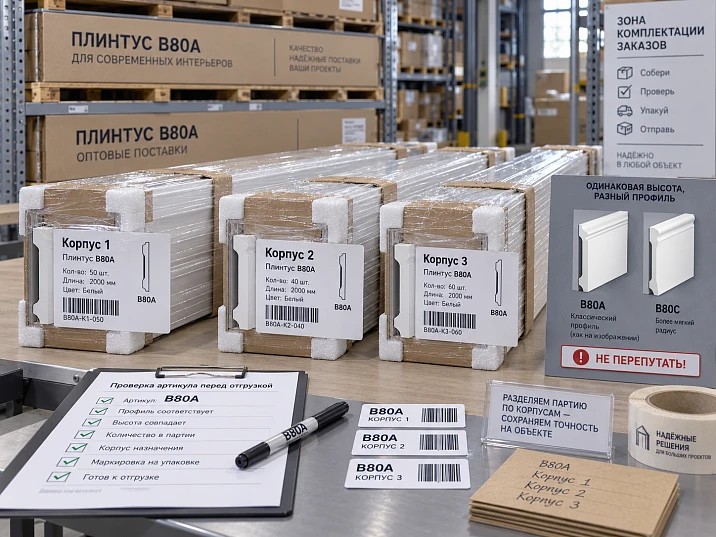
In a large skirting board purchase for a residential complex, the error often appears not in the calculation of the total linear meters, but at the moment when a specific product turns into an overly general name. The designer specifies HIWOOD B80A, the estimate shortens the item to “80 mm skirting board,” the warehouse receives several similar packages, and then the material is distributed across buildings and floors without the full SKU. If B80C with the same 80 mm height and the same 2000 mm product length is present nearby in the order or in the warehouse, such shortening becomes a direct cause of mis-sorting.
Therefore, the request to buy B80A skirting board wholesale for a construction project must not be handled as an ordinary purchase of linear material. An integrated system is needed: exact SKU → confirmed geometry → calculation of two-meter planks → breakdown by buildings → package labeling → acceptance → separate warehouse zones → issue to contractors → reserve → reorder specifically B80A.
B80A has another reason not to simplify the specification. In the current card data, there is a discrepancy in thickness: the name and catalog display show one value, while the specifications block shows another. Until this contradiction is confirmed by the manufacturer or supplier, the disputed thickness must not be turned into a fixed characteristic of the article or purchasing documentation. The 80 mm height and 2000 mm length are confirmed, but the thickness must be verified before ordering against the current card, drawing, and supplier response.
That is why in this article B80A is considered a specific SKU, not “any white 80 mm skirting board.” The main principle is simple: the same height does not mean the same profile, and total linear meters do not replace a cutting plan and distribution sheet for the project.

What exactly is being purchased: HIWOOD B80A as a separate line item
In the master specification, the item must remain identifiable at any stage. The minimum stable data set:
| Field | What to fix |
|---|---|
| Manufacturer | HIWOOD |
| Article number | B80A |
| Product type | Floor skirting board |
| Height | 80 мм |
| Length | 2000 мм |
| Material | Polystyrene |
| Thickness | confirm against the current product card/drawing due to a data discrepancy |
| Quantity | ___ pcs. |
| Body / queue | ___ |
Product card: skirting board HIWOOD B80A.




Why the B80A code must remain the primary identifier
A height of 80 mm is too generic. Even within a single line, different profiles can exist with the same nominal height dimension. The B80A code pins down the specific model, so it must not be removed in favor of a shorter warehouse or accounting name.
Our factory also produces:






Which dimensions to record in the specification
Height and length can be specified right away: 80 mm and 2000 mm. Thickness must not be silently chosen between conflicting values. In a working document, it is better to write “thickness — per the confirmed product card/drawing” until the discrepancy is resolved. Once confirmed, the value is added to the master line and propagated to all subsequent documents.
Get Consultation
Why the 2000 mm length must be specified separately
Length determines the actual purchasing and cutting unit. Linear meters are useful for budgeting, but deliveries arrive as whole planks. If length is removed from the line, a reorder months later again turns into a search for a "similar 80 mm skirting board."
Why you can't order "white 80 mm skirting board"
Such an entry contains neither the manufacturer, nor the article number, nor the profile. It describes a group of products, not a single item. For a large batch, this is a direct path to mixing up B80A and B80C.
Why B80A and B80C are easy to mix up in a large delivery
The danger arises because visual and warehouse checks often start with the simplest attributes: height, color, length. For B80A and B80C, the height is 80 mm and the commercial length is 2000 mm. If the packages stand next to each other and the internal label is shortened to "80 mm skirting board," the system no longer protects against mispicking.
The same height does not yet mean the same profile
Height describes only one dimensional characteristic. The shape of the front surface, the depth, and the overall geometry may differ. Therefore, a check that "80 mm matched" does not confirm that this is B80A.
Why mispicks are discovered only after distribution across floors
At the central warehouse, packages can still be compared and relabeled. After being distributed across buildings, the context is lost. The installer receives several packs of the same height, opens the packaging, and only then notices a different profile. At that point, the material has already been moved, accounting is harder to restore, and some packages may have been opened.
What happens if the warehouse shortens the name to "80 mm skirting board"
Both SKUs become a single warehouse group. Returns, reservations, and stock are also mixed. After a few weeks, it becomes impossible to tell exactly how much B80A remains and which cut lengths belong to B80C.
Why a profile photo does not replace the SKU
A photo is useful as an additional check, but not as the primary identifier. Scale, perspective, and lighting can hide the difference. The B80A SKU and the confirmed drawing remain primary.
How to draft a B80A wholesale specification without ambiguity
The working line must be short enough for procurement and precise enough for the warehouse. For example:
B80A / HIWOOD / skirting board / height 80 mm / length 2000 mm / thickness per confirmed drawing / quantity ___ pcs. / building ___ / floor ___ / phase ___
After the 12/12.5 mm discrepancy is resolved, the confirmed thickness is added to this line.
SKU and manufacturer
B80A without HIWOOD in an external request may be ambiguous, while HIWOOD without B80A is too broad. Therefore, both fields are used in the supplier inquiry.
Size
The height of 80 mm and length of 2000 mm are recorded as confirmed. The disputed thickness is not "guessed." This is especially important because the article should not lock in for years a characteristic that already contradicts another block of the product page.
Number of whole strips
The final order is placed in units. The total linear meters are used as an intermediate check, not as the sole purchasing figure.
Building, floor, and phase
These fields are not part of the product specification for B80A, but they are critical for site logistics. They help prevent a large delivery from turning into an undifferentiated bulk.
Package number
If the supplier or internal warehouse can number the packages, this simplifies receiving and identifying mixed-up items. It is not necessary to change the factory labeling — an additional site tag is enough.
How to calculate the quantity of B80A for wholesale purchasing
The calculation should not look like “total perimeter ÷ 2 m.” The correct sequence is:
room perimeter → exclude areas without skirting → account for doorways and furniture per the project → create finished parts → build a cutting plan → count full 2000 mm strips → account for usable offcuts → add a justified reserve.
For example, the clean perimeter of one apartment type requires 28.4 m of B80A. Theoretically:
28,4 ÷ 2 = 14,2
That is, at least 15 full strips. But if the apartment has many lengths of 1.70–1.90 m, the offcuts may be poorly utilized. The actual requirement will be higher. If there are many short sections of 600–900 mm, offcuts from adjacent parts may cover them better.
Why does the same total linear footage yield a different number of two-meter strips
Imagine two apartments with 20 m of net skirting. In the first, most walls produce pieces around 1.9 m. The second consists of short segments of 0.6–0.9 m. The theoretical minimum in both cases is 10 two-meter strips. But the actual cutting layout differs.
In the first apartment, after each 1.9 m piece, about 0.1 m remains, which is almost never usable. In the second, one strip can yield two or even several short pieces. So the total linear footage is the same, but the number of whole items to order differs.
For supply, this is one of the most important practical conclusions: meters show the scale, the cutting map shows the actual purchase.
How to split batch B80A between buildings
If the site consists of several buildings, the batch must be divided on paper before unloading.
Separate statement for each building
Each building receives its own quantity of B80A, reserve, and queue. The site total remains the same, but the distribution is transparent.
Marking by floor
If installation is done floor by floor, the packages receive an additional code. For example:
B80A / building 2 / floor 7 / 36 pcs.
Separate cargo unit for each zone
It is not necessary to use a separate pallet for each floor, but the cargo units must allow the destination to be reconstructed. Otherwise, all material gets mixed during unloading.
Why you cannot ship all B80A as one bulk pile
The total quantity is convenient only on paper. On site, it turns into manual redistribution, issuing errors, and loss of the reserve.
How to keep the reserve separate from the installation batch
It is better not to spread the reserve across floors. It is allocated as a separate project item so that it is not accidentally used in the current installation.
How to receive B80A on site
Acceptance begins not with the total number of boxes, but with checking the specific item. The documents must include B80A, not just “80 mm skirting.” Then the quantity, length, packaging, external profile, and condition of the products are verified.
If the delivery is distributed across buildings, the receiver must have a distribution sheet. For example, out of 600 planks, 240 belong to building A, 210 to building B, 120 to common areas, and 30 to the general reserve. If all 600 units arrive as one line, unloading becomes a place where the project structure is easily lost.
In large supply of finishing materials it is useful to separate two levels of control: product and logistics. Product control answers the question "did B80A arrive". Logistics control answers "is it assigned to the right place and in the right quantity".
SKU
B80A must be readable on the packaging, in the delivery note, and in the order. If the supplier uses an internal code, it may appear alongside, but must not replace the original item number.
Quantity
Quantity is checked in pieces. If a package contains several strips, the number of packages alone is not the total.
Length
2000 mm is the reference product length. If a different length appears in the documents, clarification is needed before distribution to the site.
Profile
A height of 80 mm does not confirm B80A. Therefore, the profile shape is selectively verified against the current card or a reference sample.
Surface condition
Visible damage, chips, and deformations are checked. This article does not define a separate regulatory quality control procedure — it only requires not conflating the question "which SKU arrived" with the question "what condition it is in".
Packaging and site marking
If the batch has already been split into housings, the site tag must be retained until handover to the contractor. Otherwise, the logistics performed at the supplier's warehouse are lost after the first unloading.
What to do if B80A and B80C are present in the same batch at the same time
This is the central risk of the article. Products of similar height must not be combined into one line, one pallet without dividers, or one warehouse bin. Even if both profiles are needed for the same project, they remain different SKUs.
Do not combine items by height of 80 mm
The wording “80 mm skirting boards — 900 pcs.” is acceptable only as an aggregated analytical total. For purchasing and warehousing, it is necessary to see how many B80A and how many B80C.
Do not relabel the factory marking with one common label
If the project uses its own barcodes, they must supplement, not destroy, the original item code. A “80 mm skirting board” label on both items effectively creates mis-sorting artificially.
Separate the item codes onto separate pallets or cargo units
Physical separation reduces risk better than any instruction. If B80A is in one zone and B80C is in another, accidental issue becomes less likely.
Record B80A and B80C as separate lines in the statement
Even if both products go into the same cabinet, each has its own line, quantity, and storage location.
Verify the profile before distributing by floor
After distribution, correcting mis-sorting is more expensive: you will have to search for packages across the entire site. Therefore, control is carried out at the central receiving point.
How to assemble skirting boards for several contractors
Suppose building A is installed by one contractor, building B by another, and common areas by a third. You cannot simply divide the total batch "approximately into three parts." Each contractor receives the quantity according to their own schedule and a specific SKU.
The worksheet might look like this:
| Contractor | Zone | Article | Quantity | Reserve |
|---|---|---|---|---|
| №1 | Building A | B80A | ___ pcs. | ___ pcs. |
| №2 | Building B | B80A | ___ pcs. | ___ pcs. |
| №3 | Common areas | B80A | ___ pcs. | ___ pcs. |
If the contractor also uses B80C, they receive a separate line. Shared responsibility for the site does not cancel separate accounting of product items.
When to purchase the entire batch of B80A at once, and when to split the delivery
There is no single answer. The decision depends on the readiness of the premises, storage capabilities, installation schedule, supplier terms, and the risk of damage during long-term storage.
Purchasing the entire batch may be convenient if:
- the volume is finally confirmed;
- there is organized storage;
- several cabinets are installed almost simultaneously;
- the batch will be used within the forecasted timeframe;
- delivery conditions make a single order rational.
Splitting the delivery is better if:
- the cabinets are ready at different times;
- storage at the site is limited;
- there is a risk of damaging long-length material;
- the final dimensions are still being clarified;
- the first batch needs to be checked before scaling.
When working through wholesale building material suppliers or with a combined purchase building materials at wholesale prices it is important to agree in advance whether the order is legally a single order but split into physical shipments, or whether each batch is processed separately.
How to arrange a reorder and not receive a different profile instead of B80A
A reorder is one of the riskiest stages. The first batch is often processed by the project team, while the additional one is handled by a procurement specialist who sees only the old invoice or warehouse stock. If "80 mm skirting" remains in memory, the nearby B80C becomes an obvious source of error.
Correct reorder line:
HIWOOD B80A / skirting / height 80 mm / length 2000 mm / geometry confirmed against the current product page / ___ pcs.
If the thickness has already been confirmed by this point and the product page has been corrected, it is included in the line. If the contradiction remains, it must not be hidden.
Why the disputed thickness of 12 or 12.5 mm requires separate control
This is not a minor editorial inaccuracy. For a wholesale article, a conflict in specifications is a signal that data must not be automatically transferred to SEO text, an estimate, and a warehouse reference. One block of the page may show 12 mm, while another shows 12.5 mm. Even if the physical difference is small, procurement documentation must have one confirmed value.
Until confirmed, it is better to use:
B80A / HIWOOD / 80 mm / 2000 mm / thickness according to the current confirmed drawing
Once confirmed, the value is updated immediately across all systems: the product card, master specification, ERP, BIM, procurement template, and article.
How to prevent a card discrepancy from becoming a permanent error
If one employee selects 12.5 mm from the card title, while another selects 12 mm from the specifications block, the company ends up with two internal reference guides. Within a month, both will appear “official.”
Therefore, the discrepancy is recorded as an open question, a person responsible for confirmation is assigned, and no final product record is created until a response is received. This is much safer than choosing one number on the assumption that “this one is probably correct.”
How to work with the specification before the contradiction is resolved
You cannot halt all preparation for the project just because of one disputed field if the item code B80A, height 80 mm, and length 2000 mm are confirmed. Quantity calculation, distribution across cabinets, and the acceptance plan can continue to be developed.
However, before payment and final ordering, the master specification must receive the confirmed geometry.
How to verify B80A against the actual profile
After receiving the reference sample, it is useful to save:
- photo of the front surface;
- a photo of the end cross-section;
- full SKU;
- confirmed size;
- link to the current product page or drawing.
So during receiving, a large batch is compared not with memory, but with a reference sample.
Why measuring only the 80 mm height is not enough
Height is the first filter, but not an identifier. If B80C is also 80 mm, a tape measure will confirm both options. That is why after the size, the SKU and profile are checked.
This differs from a situation where neighboring products have different heights. Here, simple dimensional control cannot fully protect against error.
How to organize warehouse bins
The correct principle:
HIWOOD B80A / building A / reserve
HIWOOD B80A / building B / installation
HIWOOD B80C / building A / installation
Incorrect:
skirting boards 80 mm
The warehouse structure must reflect both the SKU and the object purpose.
Opened packages are especially dangerous
As long as the factory packaging is intact, the item code is easier to verify. After opening, individual planks lose their context. That is why internal labeling is applied immediately, and not after the material has already been mixed.
The one remaining intact plank must be stored as B80A, and not as “white skirting board 2 m”.
How to label usable B80A remnants
If the offcut can realistically be used further:
B80A / 870 mm
B80A / 620 mm
If there are multiple cabinets, the cabinet code can be added. The B80C balance cannot be transferred to the B80A bank just because of the same height.
Why the shared reserve of "80 mm skirting boards" does not work
The reserve must be tied to a specific SKU. If a B80A part is damaged at the site, having several intact B80C units does not mean the requirement is covered.
Therefore, the balance shows:
| Status | B80A | B80C |
|---|---|---|
| Main batch | ___ pcs. | ___ pcs. |
| Full reserve | ___ pcs. | ___ pcs. |
| Useful leftovers | ___ | ___ |
How to issue B80A to the contractor
The issue is documented specifically:
B80A / cabinet A / floor 5 / 28 pcs.
Not:
28 skirting boards 80 mm.
If the contractor returns the material, the return is also processed under B80A.
How to conduct an interim audit after the first building
After installing the first phase, it is useful to compare plan versus actual: how much B80A was issued, how many intact planks remain, which offcuts are actually being used, whether there were any mix-ups with B80C, and whether the current reserve is sufficient.
If the distribution scheme works, it is scaled to the next building. If not, it is corrected before the second phase.
Why the first building should become a logistics test, not just an installation test
Even if the profile itself is installed without problems, the site may reveal weaknesses in labeling: packages get lost between floors, the reserve goes into current installation, and B80A and B80C are placed next to each other. These process defects are better fixed after the first phase, not at the end of the entire complex.
How to maintain versioning of the distribution sheet
If the quantity by building changes, the sheet gets a new version. For example:
B80A-distribution-v1
B80A-distribution-v2
The old version remains in the archive but is not used for issuing. This protects against a situation where the warehouse and procurement work from different quantities.
When you do not need to purchase all of B80A in advance
If the thickness has not yet been confirmed, the site specification is changing, or the first phase has not been checked, a bulk order may be premature. In such conditions, you can limit yourself to a control volume.
The wholesale price alone should not force a purchase before its identity and quantity are confirmed.
When a single purchase is rational
If B80A is definitively approved, the geometry is confirmed, the cutting plan is calculated, the distribution across buildings is ready, and there is a proper warehouse, a single contract for a large batch can be convenient. Physical deliveries can still be split by phases.
How to link B80A to a comprehensive purchase of building materials
If a developer simultaneously purchases dozens of items through wholesale supplies of building materials, B80A must remain a separate line rather than dissolve within the general category of "skirting boards".
Generic anchors such as building materials Moscow wholesale, wholesale purchase of building materials or finishing materials wholesale moscow are appropriate only as navigation to the STAVROS homepage. They do not replace a product link.
Practical scenario: three buildings, one shared purchase, and two similar SKUs
Let's imagine a residential complex consisting of three buildings. In buildings A and B, the project specifies B80A, while B80C is used in some common areas. Both profiles are 80 mm high and 2000 mm long. Procurement wants to arrange one large purchase to simplify the contract and delivery.
On paper, this looks convenient. In reality, several risk points emerge. In the request, the two SKUs can accidentally be combined into one line. The supplier may assemble pallets without object labeling. On site, unloaders will place everything in one area. Then one contractor will take the wrong package and discover the error only after opening it.
To prevent this, a matrix is created before ordering:
| Body / zone | SKU | Quantity | Reserve | Cargo group |
|---|---|---|---|---|
| Building A | B80A | ___ pcs. | ___ pcs. | A-B80A |
| Building B | B80A | ___ pcs. | ___ pcs. | B-B80A |
| Common areas | B80C | ___ pcs. | ___ pcs. | MOP-B80C |
This table solves three tasks at once: it prevents SKU mixing, helps logistics, and shows where the reserve is located.
How to place one combined order without losing separate accounting
The contract and invoice can be shared if each item has a separate line in the appendix or specification. There is no need to split documents just for warehouse order. The main thing is that the commercial document preserves the SKU and distribution.
For example:
HIWOOD B80A — body A — 240 pcs.
HIWOOD B80A — body B — 210 pcs.
HIWOOD B80C — MOP — 130 pcs.
If the supplier is not ready to indicate the body on the invoice, the site can keep the distribution in an internal statement, but the B80A and B80C SKUs must be separated in the order itself.
How to work with a supplier who only writes "skirting board HIWOOD 80 mm"
Such a quotation should be sent back for clarification. The wording does not make it possible to understand which profile is being quoted. If the supplier confirms B80A in correspondence, it is better to ask them to correct the document itself so that the exact item code is preserved through to the invoice and shipment.
The longer the document chain, the less one should rely on verbal context.
How to check the invoice before payment
An invoice is not checked only by price and total amount. You need to make sure it includes:
- HIWOOD;
- B80A;
- confirmed size;
- quantity;
- absence of an unapproved substitution with B80C;
- match with the current specification.
If the invoice again contains only "skirting board 80 mm", precision is lost at the last step before payment.
Why B80C cannot be considered an acceptable substitution just because of its height
The same height of 80 mm does not make the profiles interchangeable. Even if both fit the overall architectural line, their cross-section and appearance differ. A substitution may require project approval.
Therefore, B80C is not an emergency stock substitute for B80A by default. It remains a separate product.
When replacement can actually be considered
If B80A is temporarily unavailable, the project timeline is critical, and the project is ready to consider an alternative, the supplier may offer B80C or another profile. But this is already a new procedure: comparison of geometry, appearance, and components, followed by written approval.
Until such a decision is made, the procurement item remains B80A.
How to maintain the B80A reference sample
For a large project, it is useful to have one signed sample. It should retain:
- item code B80A;
- a photo of the end cross-section;
- photo of the front side;
- confirmed size;
- link to the current product page or drawing;
- date of record.
When a new batch arrives, the sample allows you to quickly verify the profile before distributing it to the project.
Why a visual reference is especially useful with opened packaging
Factory marking may be present only on the pack. After opening, individual planks look visually similar. A reference sample and internal labels reduce the risk of confusing B80A with B80C.
How to calculate B80A for several apartment types
If a building has different layouts, it is better to calculate the quantity by type and then sum them up. For example:
| Apartment type | Number of apartments | Clean route B80A | Planks by cutting plan |
|---|---|---|---|
| А | 24 | ___ m | ___ pcs. |
| A-mirrored | 24 | ___ m | ___ pcs. |
| Б | 18 | ___ m | ___ pcs. |
| В | 12 | ___ m | ___ pcs. |
Calculating by type makes it possible to see where repeating short parts appear and how to use leftover offcuts between apartments.
Why a mirrored apartment does not require a separate SKU
If the project specifies B80A in both mirrored layouts, the item code remains the same. The cutting plan and the sequence of parts change, but not the product item. This is convenient for a shared reserve of whole planks.
How to account for carryover remnants
If after one apartment there remains a piece of B80A of a length suitable for the next one, it should not be written off just because the set for the first apartment is already closed. The remnant is marked and transferred to the common bank of the series.
But only if it is confirmed that it is indeed B80A.
Why the total footage of remnants does not show the real value
Ten meters of remnants may consist of five whole planks or of twenty pieces of 500 mm each. These options are not equivalent. To place a reorder, you need to know the structure of the remnant.
How to maintain the object balance of B80A
| Indicator | Quantity |
|---|---|
| Ordered | ___ pcs. |
| Received | ___ pcs. |
| Issued to building A | ___ pcs. |
| Issued to building B | ___ pcs. |
| Full reserve | ___ pcs. |
| Useful leftovers | ___ |
| For additional order | ___ pcs. |
Such a balance allows you to understand the real requirement without a repeated full recalculation of the entire object.
How to organize a reorder by building rather than for the entire object
If the shortage occurred only in building B, the additional order should not automatically replenish the other buildings. The request specifies B80A, the quantity, and the object zone. The reserve of other buildings remains a separate decision.
How to work with a contractor who purchases the missing material themselves
If the contract allows the contractor to place a local additional order, they must receive the same master specification. You cannot pass along only the phrase "buy 20 skirting boards 80 mm."
Otherwise, the object-based precision system ends at the boundary of supply responsibility.
When the warehouse can combine B80A from different buildings
Whole unallocated planks of the same B80A can be stored in a common reserve zone if the accounting allows them to later be issued to the required building. But installation batches already assigned by floor should preferably not be mixed.
That is, the product identity is the same, but the logistics status may differ.
Why the reserve is better divided into object and building reserves
Some whole planks can be assigned to a specific building, while a small portion can be left as a common object reserve. This scheme helps cover an unexpected shortage where it occurred without completely disassembling the other sets.
How to determine the reserve without a universal percentage
There is no basis for automatically adding 5%, 10%, or 15% without a connection to the cutting plan and the object. The size of the reserve depends on the number of buildings, the repeatability of apartments, the possibility of additional ordering, the risk of damage, and the installation schedule.
First, the working requirement is obtained, then a full reserve is approved separately.
Why the reserve should be kept as whole planks
A whole B80A with a length of 2000 mm can replace a long damaged part. Several short offcuts do not provide such flexibility. Therefore, a box of leftovers does not replace a whole reserve.
How to account for damaged planks
A damaged plank should not continue to be counted as a full reserve. If short parts can be obtained from it, it is transferred to useful leftovers with the available length indicated. If not, it is written off according to the site rules.
Why mismatched items are better identified before painting
If the profiles are painted after installation or beforehand, the similarity in color becomes even higher. Therefore, the article and geometry are checked before finishing visually unifies the material.
How to handle returns from the floor
A returned whole plank should be re-entered into accounting as B80A. An offcut — as B80A with a length. Returns of B80A and B80C must not be placed in the same box labeled “80 mm skirting leftovers.”
How to localize mismatched items if they have already been detected
If the installer finds B80C in B80A packaging, use of that batch is stopped. Then the following are checked:
- pack number;
- warehouse bin;
- neighboring packs;
- delivery note;
- already issued material;
- returns from floors.
The goal is to determine the boundaries of the mixed stock, not just replace one found plank.
How to record a mixed-stock incident
The work record must be specific:
Building B / floor 6 / package 14: a B80C profile was found in batch B80A. Issue stopped, neighboring packages under inspection.
This is how procurement and the warehouse understand the scale of the problem.
Why you cannot "hide" the wrong profile in an inconspicuous area
If B80A is approved by the project, using B80C behind a cabinet or in a technical room without approval breaks the records and creates a hidden SKU mix. Later repairs or reorders will be more difficult.
The wrong item must be returned to the correct warehouse group or officially approved as a replacement.
How to work with delivery queues
If the total order is split into three shipments, each queue gets its own number. For example:
B80A / batch 01 / building A
B80A / batch 02 / building B
B80A / batch 03 / reserve and common areas
This makes it easier to investigate the problem if the mix-up relates to only one delivery.
Why each new queue undergoes repeated acceptance
A correct first batch does not guarantee a correct second one. The supplier could have assembled it from another warehouse or changed the internal labeling. That is why the verification algorithm is repeated.
Buyer's checklist before paying for batch B80A
| Control point | Status |
|---|---|
| Manufacturer HIWOOD is specified | ___ |
| Article B80A specified | ___ |
| Height 80 mm confirmed | ___ |
| Length 2000 mm confirmed | ___ |
| Thickness confirmed per current drawing | ___ |
| Quantity calculated in pieces | ___ |
| Cutting plan taken into account | ___ |
| Reserve allocated separately | ___ |
| Bodies and floors distributed | ___ |
| B80C listed as a separate line | ___ |
| Cargo units marked | ___ |
| Delivery terms by phases agreed | ___ |
| Acceptance procedure assigned | ___ |
| Responsible person identified | ___ |
| The additional order will be placed under B80A | ___ |
How to read the discrepancy between B80A and B80C in a single table
For the project, it is useful to have a comparison table, but not to turn the article into a regular model overview. Its task is to show why a height of 80 mm is insufficient for identification.
| Position | Height | Length | What to check additionally |
|---|---|---|---|
| B80A | 80 мм | 2000 мм | item code, profile, confirmed thickness |
| B80C | 80 мм | 2000 мм | item code, profile, own cross-section |
A match in height and length only indicates a similar dimensional class. It does not prove interchangeability.
How to check B80A before distribution across floors
After central acceptance, closed packages should not be sent immediately to different floors if a B80C batch was nearby. First, each cargo group is checked against the distribution sheet.
Useful order:
- Check the external marking.
- Verify B80A against the delivery note.
- Selectively open several packages from different parts of the batch.
- Compare the profile with the reference sample.
- Mark the body and floor.
- Only after that, transfer to local logistics.
The article does not establish a universal statistical sampling norm. The scope of control depends on the facility's quality system and delivery conditions.
How to divide responsibility between procurement, warehouse, and contractor
Procurement is responsible for the accuracy of the ordered item and commercial documents. The central warehouse is responsible for acceptance, identification, and distribution. The contractor is responsible for receiving exactly the item specified in its sheet and for returning leftovers while preserving the article number.
If one of these boundaries is blurred, mis-sorting becomes a "no one's" problem. For example, the warehouse believes the contractor will sort out the profiles themselves, while the contractor is sure everything has already been checked at acceptance.
Why a package number is useful when investigating an error
If each pack or cargo group has a number, it is possible to determine where the incorrect profile came from and which neighboring packages require checking. Without a number, the entire warehouse has to be checked.
Therefore, even simple internal marking such as A-B80A-014 provides practical value.
How to handle material after removing the factory packaging
After opening a pack, the factory label may remain on the film, while individual planks become anonymous. Before distribution, it is better to transfer the internal code to the remaining intact items or to a warehouse tag next to them.
This is especially importan
What to do if card B80A has already been corrected by the time of reorder
If the 12/12.5 mm discrepancy has been resolved, the new card becomes the basis for the current master specification. Historical documents are not rewritten retroactively, but the confirmed value is used in the new order.
It is useful to leave a note that an earlier version of the card contained a discrepancy. This will explain why different figures could appear in old files.
What to do if the discrepancy on the card persists
In that case, the request to the supplier should explicitly ask to confirm the geometry of B80A before payment. You must not choose 12 or 12.5 mm on your own just because one value appears in the title and the other in the specifications.
Actual accuracy is more important than formally filling in all fields of the article.
How to prevent ERP from rounding or changing the geometry
An internal system sometimes stores dimensions as numbers with limited precision. If 12.5 mm is rounded to 12 mm or to 13 mm, the card becomes less accurate. Before confirming the thickness, you need to make sure that ERP can store a decimal value correctly at all.
After confirmation, the same value must be used in purchasing, warehouse, and reorder.
Why an internal code should not be built from dimensions alone
A code like PL-80-2000 again merges different profiles. It is better for the internal nomenclature to retain B80A. Dimensions can be additional attributes.
How to work with the general product group "HIWOOD skirting boards"
The group is useful for analytics, but within it B80A and B80C must exist as separate items. The aggregated category must not determine material output.
Why price does not help distinguish B80A and B80C
Even if, at the time of checking, neighboring products cost the same or similarly, price is a variable commercial parameter. It is not a SKU identifier. Therefore the warehouse must not use the price tag as a hint for "which of the two profiles is in front of us."
How to check the contractor before issuing the first batch
Before installation begins, a short introductory check is enough: show B80A, B80C, the labeling, and the return rules. The contractor must understand that "80 mm" is not the product name.
If employees distinguish items only visually, they still need to be linked to SKUs in the documents.
How to prepare an installation schedule
| Body | Floor | Apartment/zone | SKU | Quantity | Status |
|---|---|---|---|---|---|
| А | 5 | 501–510 | B80A | ___ pcs. | ISSUED |
| А | 5 | Common areas | B80C | ___ pcs. | ISSUED |
Such a schedule eliminates the phrase "on the fifth floor everything is 80-millimeter."
How to separate the repair reserve from the technological reserve
The technological reserve compensates for cutting and production specifics. The repair reserve is needed for possible replacement of damaged elements after installation. Depending on the project, these may be different material groups.
If all spare planks are sent straight to installation, no repair reserve will remain.
Why you should not keep a B80C reserve instead of B80A
Even with the same height, a repair replacement must preserve the profile. Otherwise, one local element will look visually different from the already installed line.
How to hand over the reserve to operations after construction is completed
If part of the intact B80A is handed over to the management company or the customer, the exact article number, confirmed size, and a link to the product card must be handed over along with them. Then future repairs will not start with a visual search for an analogue.
What to keep in the facility archive
After completion, it is useful to keep:
- master specification of B80A;
- confirmed geometry;
- control photo of the profile;
- distribution sheet;
- latest warehouse balance;
- last order number.
This is enough to restore product identity within a few years.
Typical mistakes when placing a wholesale order for B80A
Mistake 1. Ordering by height only. B80A turns into an "80 mm skirting board," and B80C becomes potentially acceptable by mistake.
Mistake 2. Losing the item code in Excel. When rows are manually shortened, different SKUs get merged.
Mistake 3. Merging B80A and B80C. Matching height does not make them the same item.
Mistake 4. Counting only linear meters. Actual purchasing is determined by two-meter planks and cutting layout.
Mistake 5. Not building a cutting map. The theoretical minimum turns out to be lower than the actual requirement.
Mistake 6. Sending skirting to several units as a total quantity. The logistics structure is lost.
Mistake 7. Not setting aside a whole reserve. All planks are used for the current installation.
Mistake 8. Not checking the goods before distribution. Mixed grades are discovered already on the floors.
Mistake 9. Using abbreviated warehouse names. “White skirting 80 mm” is not an SKU.
Mistake 10. Reordering “the same 80 mm” without B80A. A few months later the context is already lost.
Mistake 11. Choosing a thickness of 12 or 12.5 mm without confirmation. The internal system locks in the disputed value.
Mistake 12. Treating B80C as an emergency reserve for B80A. Profiles are not identical just because they are the same height.
Mistake 13. Mixing returns. Leftovers become unidentifiable.
Mistake 14. Not checking the second and third deliveries. A correct first batch creates false trust.
Mistake 15. Using wood or MDF semantics for the polystyrene HIWOOD B80A. This is a different product intent.
Where to buy B80A skirting board wholesale
Once the geometry, quantity, cutting, distribution across cases, and reserve are confirmed, purchasing becomes an ordinary commercial operation. The main product transition should lead to a specific product page: buy B80A skirting board wholesale.
For a complex project, links to the homepage for general queries are also appropriate: buy finishing materials wholesale, building materials supplier и wholesale sale of construction materials. These anchors should not lead to the B80A product page.
Frequently asked questions about wholesale purchasing of B80A
Can B80A be bought wholesale?
Yes, for a large purchase you need to specify the exact item code B80A, confirm the current geometry, calculate the number of whole two-meter planks and the distribution across the project.
What is the length of one B80A plank?
The planned specification uses a confirmed product length of 2000 mm.
How does B80A differ from B80C?
These are different SKUs. They may match in height of 80 mm and length of 2000 mm, but they differ in profile and should not be combined into a single warehouse item.
Can B80A and B80C be combined in one specification?
They can be included in one common order, but only as separate lines with their own quantity and purpose.
How do you calculate the quantity of two-meter planks?
You need to move from the pure perimeter to actual parts, build a cutting plan, account for usable offcuts, and only then obtain the quantity of whole items.
What reserve should be allowed?
There is no universal percentage. The reserve is determined by the cutting plan, the number of cabinets, the availability of reordering, and the risk of damage. Whole planks are counted separately from short offcuts.
How to label skirting boards by building blocks?
Minimum: B80A, building block, floor or phase, and quantity. If B80C is nearby, the article number must be especially visible.
What should be specified in the request besides the article number?
HIWOOD, confirmed dimensions, quantity, project zone, and, if necessary, delivery phase. Disputed thickness is confirmed before ordering.
Can one purchase be split into several deliveries?
Yes. This is often convenient if the building blocks are ready at different times. Each delivery undergoes separate acceptance.
How to check B80A upon acceptance?
Verify the article number, confirmed geometry, length, quantity, profile, condition, and project labeling before distribution by floors.
Final workflow for B80A
B80A approved → thickness discrepancy checked → master specification recorded → rooms counted → cutting map built → number of planks determined → building blocks and floors distributed → B80A and B80C separated into distinct lines → delivery labeled → goods accepted at the central warehouse → profile checked → batch issued to contractors → leftovers returned with article numbers → reserve preserved → reorder placed specifically as HIWOOD B80A.
A strong wholesale article on B80A is needed not because the skirting is hard to buy. What is hard is maintaining exact identity and the correct quantity on a large project where similar products pass through many people and warehouse operations. The 80 mm height helps convey the scale of the profile, but it does not replace the SKU. The total linear meterage helps estimate the budget, but it does not replace the cutting plan. The bulk delivery helps logistics, but it does not replace the distribution schedule.
If this system is set up in advance, B80A can be purchased in a large batch without chaos: each building gets its own volume, B80C is not mixed with the target SKU, disputed thickness is not locked in without confirmation, and leftovers and reserve remain usable for the next phase and future repairs.
How to create a master schedule for B80A for the entire project
To avoid creating dozens of separate Excel files, it is useful to have one master schedule for B80A and use it to generate issue lists by building. It stores the confirmed product line, the total for each zone, the reserve, and the delivery status. Then changing the quantity in one building does not force you to manually recheck all the others.
| Zone | Requirement | Whole reserve | Received | Issued | Remainder |
|---|---|---|---|---|---|
| Building A | ___ pcs. | ___ pcs. | ___ | ___ | ___ |
| Building B | ___ pcs. | ___ pcs. | ___ | ___ | ___ |
| Common areas | ___ pcs. | ___ pcs. | ___ | ___ | ___ |
| Total reserve | — | ___ pcs. | ___ | ___ | ___ |
If B80C is present on the project, it is tracked in a different master schedule. You cannot simply add an “80 mm” column and combine both profiles.
How to check order readiness before sending it to the supplier
Before sending, it is enough to go through a short sequence. First, B80A is confirmed. Then the current dimensions are checked, and disputed thickness must be closed with official confirmation. After that, the quantity, cutting plan, distribution by building, and reserve are checked. Only at the last stage are price, lead time, and logistics compared.
This way, commercial terms do not obscure the main question: is the supplier actually counting the exact product the project needs.
How to prevent mixing during internal transfers between buildings
Sometimes the central warehouse transfers surplus planks from building A to building B. For the same B80A this is acceptable if the transfer is recorded. But if B80C is stored nearby, the internal transfer must again be based on the article number, not on the height.
Entry transfer: B80A / 12 pcs. / building A → building B much more reliable than skirting board 80 mm / 12 pcs..
How to handle an emergency replacement of one damaged plank
Even for a single urgent replacement, you cannot take the first 80 mm profile you come across. First, the B80A warehouse reserve is checked. If there is none, an exact reorder is placed. Using B80C just because it is nearby is acceptable only after a separate project decision.
It is precisely on single urgent replacements that the system most often breaks down: it seems that for the sake of one plank the rules can be simplified. But after installation, such a “temporary” element remains in the project forever and complicates further repairs.
Why the B80A problem is not just warehouse mis-sorting
Mis-sorting begins even earlier. If the estimator wrote “skirting board 80 mm,” the purchaser sent a request without an article number, and the supplier chose B80C on their own, the warehouse will no longer be able to correct the error through simple packaging control. That is why protection is built along the entire chain: project → specification → request → quotation → invoice → delivery → warehouse → installation.
Each stage must keep B80A as a separate line item. The earlier the SKU is lost, the more expensive it is to restore accuracy.
Final check before publication and purchasing
This article has one mandatory constraint: it must not lock in the disputed thickness of B80A until the discrepancy in the product card is resolved. Until confirmation, it is correct to refer to B80A, height 80 mm, length 2000 mm, and the need to verify the full geometry against the current drawing. After the product card is corrected, the confirmed thickness must also be entered into the purchasing master line.
Otherwise, the logic is already ready for use: an exact SKU, separate accounting for B80A and B80C, calculation of whole planks via the cutting map, distribution across cabinets, object labeling, separate reservation, and precise reordering. It is this system that makes wholesale purchasing manageable even with multiple contractors and multiple construction phases.
How to verify that the article does not substitute the purchasing process with a simple comparison of B80A and B80C
The comparison with the neighboring B80C is needed here only to explain the risk of mixing up items. The purpose of the material is not to choose “which of the two is better” and not to turn the page into a comparative catalog. If the project has approved B80A, the article helps preserve exactly that throughout the entire chain and avoid losing the SKU because of the identical height of 80 mm.
Therefore, with any mention of B80C, the conclusion is the same: it is a separate SKU. It may be present at the same site, in the same delivery, and even on the same floor, but always as a separate line, in a separate warehouse group, and with a separate stock balance.
What result the purchaser should get after reading
The purchaser should be able to perform five practical actions: create an exact B80A line, verify the disputed geometry before payment, convert linear meters into the number of whole planks using the cutting map, distribute the batch across cabinets, and place a reorder without losing the SKU. The warehouse, in turn, must maintain separate accounting for B80A and B80C even after packages are opened.
If these actions are performed, the batch stops depending on employees’ memory and visual similarity. B80A remains B80A from the first request to the last reserve plank.
Why precise labeling is especially important for last remaining stock
At the start of a project, packaging is intact, documents are at hand, and employees clearly remember the differences between items. By the end of construction, only individual planks and short offcuts without factory film remain. That is exactly when the risk of confusing B80A and B80C becomes greatest. Therefore, labeling for leftover stock must be no weaker, but more precise than the original warehouse label.
For a whole plank, it is enough HIWOOD B80A / 2000 mm. For an offcut — B80A / actual length. If the remaining stock is transferred to another building, the movement is recorded. This preserves product identity until the very completion of the project.