Article Contents:
- What HI WOOD B70 is
- Why the 10 vs 10.5 mm debate is useful for the scenario itself
- Neighboring models that create a real risk of picking the wrong item
- Why price is not an identifier either
- Why the SKU matters more than the common name
- Why it helps to attach a drawing or cross-section profile to the specification
- Why a photo of the front side is weaker than an end cross-section
- What to do about a 10 mm vs 10.5 mm discrepancy in old data
- Why an old Excel spreadsheet should not be the only source
- One master SKU for the entire project
- How to structure a schedule for 120 apartments
- Why this article does not turn into yet another piece about cutting
- Stage 1 — design
- Stage 2 — procurement request
- Stage 3 — commercial proposal
- Stage 4 — invoice
- Stage 5 — warehouse picking
- Stage 6 — site acceptance
- Stage 7 — internal warehouse
- Stage 8 — issue
- Stage 9 — return of leftovers
- Stage 10 — reorder
- Error at the request stage
- We check the commercial proposal, not just the price
- Why the total amount proves nothing
- The item code must be on the invoice
- Why an old invoice is useful, but not absolute
- Why you can't accept based on height alone
- Why a reference is needed if there is a product card
- A photo of the front side is not enough
- How to label a warehouse cell
- What to do if several HI WOOD items are used on the site at the same time
- Why opening the packaging is especially dangerous
- The installer must not independently choose a "similar"
- What to do when B70 is in short supply
- Why reordering through another employee is especially dangerous
- How to process a B70 reorder
- What to do if the B70 card has changed
- Old and new stock must not be mixed without verification
- Why mirrored types cannot always be combined
- Why the B70 quantity and product identification should live in the same ledger
- Why the internal apartment code should not replace the product code
- How to control B70 in BIM, ERP, or Excel
- Why the old name cannot be used as master data
- Cell B70
- Cell B70V1
- Cell B70V1L
- Cell B70V2
- Why color coding is useful but does not replace the SKU
- How to accept returns from installers
- What to do with short B70 leftovers
- Why the usable leftover of a neighboring model is not B70 stock
- Installation reserve
- Operational reserve
- Queue reserve
- Why the reserve of a neighboring model does not cover the deficit
- How to calculate reserve without a universal 10%
- How to conduct the first acceptance as a reference
- Why the reference benchmark should not be consumed
- How to check the second and third deliveries
- What to do if B70V1 is found in a B70 batch
- How to draw up a mis-shipment report
- Why similar profiles cannot be used in "invisible places"
- How to check a warehouse bin selectively
- Why mixed sorting often appears after a return
- How to separate stock of different SKUs
- Case 1
- Case 2
- Why a delivery queue should store the SKU in its name
- How to maintain the B70 balance after each floor
- Why reordering by photo is especially risky
- What to attach to a reorder
- What to do if the supplier offers a "full equivalent"
- Why an equivalent in a new batch may be especially noticeable
- 14. General reserve of "HI WOOD skirting boards"
- 15. Use wooden keys and properties for B70
- What material is B70 made of?
- What is the length of B70?
- What is the height?
- What is the thickness?
- Can B70 simply be called a "70 mm skirting board"?
- How does B70 differ from B70V1?
- Can B70V1 be considered a spare for B70?
- Can B70V2 be used instead of B70 in a hidden area?
- What is more important in a request — the size or the product code?
- Should the old invoice be checked when reordering?
- What should be done if the quotation only says "HI WOOD 70 mm"?
- What should be done if part of the batch is B70V1?
- Is a reference sample needed in the warehouse?
- How to label a cell?
- How to label a reserve?
- How to process the return of offcuts?
- Can B70 and B70V1 offcuts be mixed if the length is the same?
- When is a reorder needed?
- How to place an additional order?
- Where to buy B70?
- Second control table: similar models
- How to verify procurement readiness before payment
- Final matrix of the B70 project
- What a supplier request should look like
- Why it is better to state the replacement prohibition explicitly
- How to use requests from the shared table without spamming
- How to verify the first delivery in practice
- How to check the second batch
- Why the quarantine zone is useful
- How to conduct a spot audit of the warehouse
- How to finish the project without a mixed repair stock
- Scenario 1 — there is general skirting board stock, but B70 is out of stock
- Scenario 2 — B70 is in stock, but the geometry of the new batch has not been confirmed
- Scenario 3 — the reorder is placed by a new procurement specialist
- How to verify the B70 material balance after a queue
- How to distinguish a shortage from a mispick
- Why one control SKU file is better than a dozen photos
- How to conduct a final audit before closing the site
- What the reader should be able to do after the article
- How to verify that the commercial chain has not lost B70 after approval
- How to act if B70 and the neighboring model are already mixed in the internal warehouse
- How to check the reserve before handing over the building
- Why this system is useful even with a perfect supplier
- What to hand over to the installation crew along with the first B70 issue
- What to hand over to technical supervision or the quality manager
- How to verify identification integrity at the end of each queue
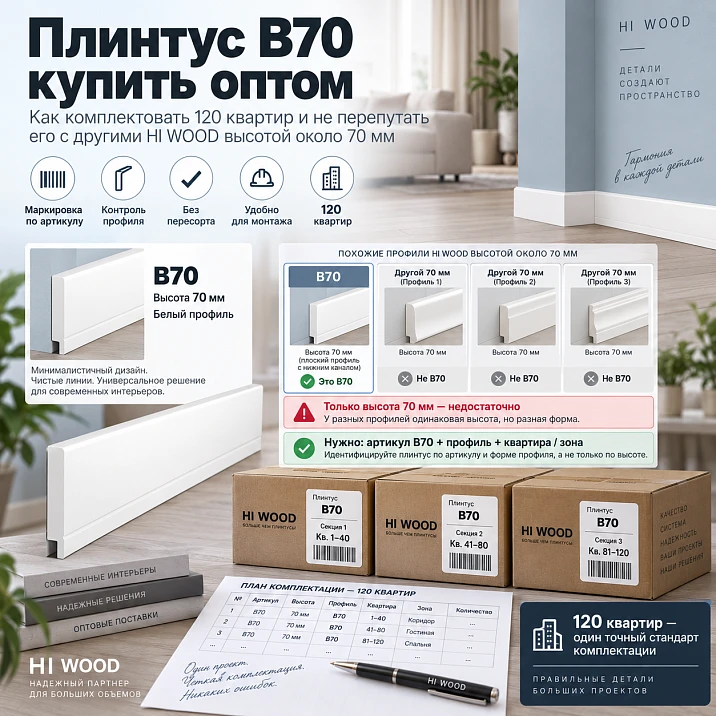
On a large residential project, skirting board mix-ups rarely start with a gross error like "they delivered the wrong material." A far more dangerous situation is when a specific HI WOOD B70 is selected in the project, and then down the chain it starts being referred to with everyday wording: "white skirting board 70 mm," "thin HI WOOD," "the one with the stripe," "the same as in the first phase." While the batch is small and everyone involved remembers the product by sight, the system can still work. On a project with 120 apartments, this approach becomes a source of substitution.
In the HI WOOD line, several polystyrene skirting boards of similar height exist simultaneously. B70 has a height of 70 mm and a length of 2000 mm. Nearby there is B70V1 with a height of 70 mm and a thickness of 12 mm, B70V1L with the same nominal height and a thickness of 12 mm, B70V2 with a height of about 69 mm and a thickness of 14 mm. There is also B70N. From a distance, in closed packaging, or after painting, such profiles are easily described with the same words. But for the project, these are different SKUs.
Therefore, to buy B70 skirting board wholesale for 120 apartments, you need to do it not by an everyday name, but by a continuous identification chain:
project → HI WOOD B70 → current drawing → exact specification → request → commercial proposal → invoice → acceptance → separate warehouse bin → issue → return → B70 reserve → reorder only B70.
Main rule of the article:
height 70 mm is a characteristic, but not a product identifier. The identifier remains the article number B70 together with the confirmed geometry and length of 2000 mm.
If the request only contains:
skirting board 70 mm — 500 pcs.,
the procurement is not ready yet.
If the invoice only contains:
HI WOOD 70 mm,
as well.
If the warehouse cell is labeled:
skirting board 70,
the risk of mis-picking has already been created.
The goal of the entire system is that the same B70 can be unambiguously identified at every stage, even if the project is handed over to another procurement specialist, a new installation crew arrives, or a follow-up order is placed several months later.

What HI WOOD B70 is
B70 is a HI WOOD floor skirting board made of polystyrene. The commercial length is 2000 mm, and the nominal height is 70 mm.
Product card: skirting board B70 on STAVROS.
The current product page has an important internal discrepancy that cannot be hidden in a technical article:
-
In the title and text description, B70 appears as 70×10.5×2000 mm;
-
in the specifications block of the current product page, 70×10×2000 mm is displayed.
Therefore, for a wholesale purchase of 120 apartments in the master specification, one should not arbitrarily choose 10 or 10.5 mm. Before placing the order, you need to:
-
open the current product page;
-
check the available drawing or 3D materials;
-
if necessary, request confirmation from the supplier;
-
record one confirmed size in the project line;
-
use it in all subsequent documents.
Further in the article, you can write:
HI WOOD B70 / 70 mm / 2000 mm / exact cross-section according to the current drawing.
This is more honest than pretending there is no contradiction.




Why the 10 vs 10.5 mm dispute is useful for the scenario itself
At first glance, a 0.5 mm difference seems too small to affect purchasing.
But this is not about whether half a millimeter will change the appearance of the room. The point is different: if even within one current page there are two variants of the entry, then the purchasing chain should not rely on a shortened everyday name.
This is exactly what the SKU is for.
SKU B70 preserves the identity of the product even when:
-
the marketing headline uses 10.5 mm;
-
the table rounds to 10 mm;
-
the old Excel table stores a different variant;
-
the manager writes a short description;
-
the warehouse only sees a height of 70 mm.
Our factory also produces:






Why a similar height does not make skirting boards interchangeable
Height is only one parameter of the profile.
Even if two products have 70 mm, they may differ in:
-
thickness;
-
shape of the front surface;
-
decorative strip;
-
radii;
-
geometry of the top edge;
-
bottom junction;
-
visual shadow;
-
with the protrusion depth from the wall.
Therefore, the entry:
70 mm,
does not fully describe B70.
Get Consultation
Similar models that create a real risk of mis-picking
In the current catalog, the following are present nearby:
| Model | Nominal height | Thickness/protrusion | Length | Why this is a different product |
|---|---|---|---|---|
| B70 | 70 мм | verify the current drawing: 10/10.5 mm in the current data | 2000 мм | target SKU |
| B70V1 | 70 мм | 12 мм | 2000 мм | a different cross-section and profile |
| B70V1L | 70 мм | 12 мм | 2000 мм | Different geometry |
| B70V2 | 69 мм | 14 мм | 2000 мм | a different model and a different offset |
This table does not turn the article into "B70 versus B70V1."
It solves one task:
to show why the warehouse has no right to identify the target profile by height alone.
Why price is also not an identifier
For neighboring models, the price may be close or even identical.
If the commercial offer states:
HI WOOD 70 mm — 900 ₽,
the price itself does not prove that we are dealing with B70.
The price changes.
Promotions change.
Several SKUs may cost the same.
Therefore, the following is checked:
-
B70;
-
size;
-
length;
-
Quantity.
And only after that — the cost.
B70 must have its own purchase line
Minimum working form:
HI WOOD / B70 / polystyrene / 70 mm / exact cross-section according to the current drawing / 2000 mm / quantity ___ pcs.
For the project:
HI WOOD B70 / building 1 / phase 2 / 2000 mm / ___ pcs.
If the final drawing confirms 10.5 mm:
B70 / 70×10.5×2000 mm.
If the supplier officially confirms 10 mm as the current geometry:
B70 / 70×10×2000 mm.
But a project chooses not “what seems more logical,” but the confirmed value.
Why the SKU matters more than the everyday name
On a construction site, names arise:
-
is tall;
-
white;
-
thin;
-
smooth;
-
with a stripe;
-
Korean;
-
70-millimeter.
Such words are acceptable in conversation.
They should not become a purchasing specification.
A household description answers:
how does a person visually distinguish the product?
The SKU answers:
which exact product should arrive?
For 120 apartments, a second level is needed.
What should be in the project specification
For B70, the following fields are required:
-
manufacturer/line: HI WOOD;
-
item code: B70;
-
material: polystyrene;
-
exact confirmed cross-section;
-
length 2000 mm;
-
quantity;
-
zone/cabinet;
-
delivery queue;
-
reserve;
-
specification revision.
If a finish is applied, its code may be stored separately as a project attribute.
But the internal color code does not replace B70.
Why it is useful to attach a drawing or section profile to the specification
A text string may contain an error.
For example:
B70 / 70×12×2000.
The article number says B70, but the size was accidentally taken from B70V1.
If the request has an attached up-to-date drawing, the discrepancy can be noticed before payment.
For a large series, it is useful to keep nearby:
-
a text specification;
-
current drawing;
-
a photograph of the end cross-section;
-
a link to the product page.
This creates several independent ways of verification.
Why a photograph of the front side is weaker than the end cross-section
After white painting or in protective film, similar profiles can look almost identical.
The end cross-section shows:
-
thickness;
-
bend;
-
steps;
-
radii;
-
the nature of the front geometry.
Therefore, for a warehouse reference, it is more useful to have not only a photo of the long plank, but a photo of the end face next to a caption:
HI WOOD B70.
What to do about the discrepancy between 10 and 10.5 mm in old data
Prohibited:
well, the difference is small, let's round to 10.
The reverse is also not allowed:
the old card had 10.5, so it will always be 10.5.
Working algorithm:
-
check the current card;
-
open the drawing;
-
verify the commercial proposal;
-
if in doubt, request confirmation from the supplier;
-
enter the confirmed value into the master specification;
-
assign a revision.
After that, this specific version is used for the current batch.
Why the old Excel spreadsheet should not be the only source
A project can run for a year.
During this time:
-
the card changes;
-
the description is refined;
-
new variants appear;
-
the account manager changes;
-
the catalog structure changes.
The old table is useful as a history.
But before the actual order, the product line is updated.
Especially if a size discrepancy has already been detected within the project.
One master SKU for the entire project
You can create an internal code:
B70-PROJECT
Or:
P-BASE-01.
But in the master card, it must always reference:
HI WOOD B70.
The internal code is convenient for BIM, ERP, or a warehouse system.
It does not replace the factory SKU.
Otherwise, after a few months, no one remembers what is hidden behind P-BASE-01.
How to organize a schedule of 120 apartments
There is no need to create 120 different product lines.
First, the floor plans are typed.
For example:
-
A — 40 apartments;
-
AR — 40 mirrored;
-
B — 32;
-
NT — 8 non-standard.
For each type, the B70 requirement is calculated.
And only then the total batch.
Why this article does not turn into yet another piece about cutting
Cutting here is auxiliary.
The central theme is different:
how to preserve B70 identity throughout the entire large supply chain.
You can calculate the meters perfectly and still end up with the wrong item if, at the second stage, a B70V1 arrived instead of a B70.
Therefore, the main control is product identity.
Where B70 mix-ups occur most often
Mix-ups rarely appear in one place. It is a chain of risks.
Stage 1 — design
The architect writes:
Baseboard 70 mm.
The item code is already lost here.
Stage 2 — procurement request
The supplier writes:
HI WOOD white 70 mm, 300 pcs.
Freedom of interpretation emerges.
Stage 3 — commercial proposal
The manager selects B70V1 because it is also 70 mm.
Stage 4 — invoice
The invoice retains the abbreviated name.
Stage 5 — warehouse picking
The warehouse sees several similar HI WOOD items.
Stage 6 — site acceptance
Only the number of packs is checked.
Stage 7 — internal warehouse
All 70 mm profiles are placed in a single cell.
Stage 8 — issuing
The installer receives:
take 25 strips of 70 mm.
Stage 9 — returning leftovers
B70 and B70V1 offcuts are mixed together.
Stage 10 — reorder
A new employee asks:
the same skirting board as before.
Each individual step seems insignificant.
But that is exactly how a target SKU gradually turns into a generic description.
Error at the request stage
Bad request:
300 pcs. of HI WOOD skirting board, 70 mm.
Why it is dangerous:
-
B70V1 is also 70 mm;
-
B70V1L is also 70 mm;
-
B70V2 is close in height;
-
B70N is also nearby in the assortment.
Even if the manager understood the product correctly this time, the document remains weak.
Stronger:
HI WOOD B70 / polystyrene / 70 mm / exact cross-section according to the current drawing / 2000 mm / 300 pcs.
What a correct request should look like
Minimum line:
Skirting board HI WOOD B70 / polystyrene / size according to the current drawing / length 2000 mm / quantity ___ pcs.
For a large project, the following are added:
-
body;
-
a queue;
-
reserve;
-
specification number;
-
revision.
For example:
HI WOOD B70 / 2000 mm / building 2 / phase 3 / main volume 420 pcs. / reserve 20 pcs. / specification R2.
We check the commercial proposal, not just the price
The response commercial proposal must match:
-
B70;
-
HI WOOD;
-
polystyrene;
-
confirmed size;
-
2000 mm;
-
Quantity.
If instead of B70 there appeared:
B70V1
Or:
B70N
or simply:
skirting board 70 mm,
The CP is returned for clarification.
Why the total amount proves nothing
A neighboring model may cost:
-
the same;
-
slightly less;
-
slightly more.
Therefore, a financial match does not confirm a product match.
Identity first.
Then the price.
The item code must be on the invoice
An invoice is no longer a draft.
This is the document according to which the goods will be:
-
paid for;
-
assembled;
-
shipped;
-
received.
If the invoice says:
polystyrene skirting board HI WOOD 70 mm,
it is better to ask to clarify the line before payment.
Stronger:
HI WOOD B70 / ××2000 mm.
Why an old invoice is useful, but not absolute
For a reorder, it is useful to attach:
-
old invoice;
-
the old specification;
-
a photo of the label;
-
drawing.
But you still need to check the current product page.
Reason:
-
the description may have been updated;
-
the size may have been clarified;
-
the supplier's internal product page may have changed;
-
new similar models may have appeared.
History helps with identification.
It does not replace the current check.
Acceptance of delivery B70
At the site, it is not only the quantity that is checked.
Minimum checklist:
-
B70;
-
HI WOOD;
-
polystyrene;
-
2000 mm;
-
marking;
-
quantity;
-
packaging;
-
external profile;
-
end section;
-
compliance with the order.
If the batch is large, it is enough to organize control so that the packing specification and marking allow reliable confirmation of the entire delivery.
It is not necessary to open every plank.
But accepting "by number of places" without identification is dangerous.
Why you cannot accept by height only
During receiving, the employee measures:
approximately 70 mm.
And decides:
everything is correct.
this is not enough.
B70V1:
-
also 70 mm.
B70V1L:
-
also 70 mm.
B70V2:
-
about 69 mm and visually close.
Therefore, the height confirms only one parameter.
Not SKU.
Reference sample B70 in stock
Before mass distribution, it is useful to create a physical reference.
This could be:
-
one whole signed plank;
-
short end-grain section;
-
photograph;
-
current drawing;
-
label.
Close-up on the sample:
HI WOOD B70.
It is not stored as a consumable.
But as a control reference.
Why a reference sample is needed when there is a product card
In stock:
-
dirty;
-
no access to the website;
-
multiple shifts are working;
-
labels may be damaged.
A physical sample allows for a quick comparison with a new batch.
A photograph of the front side is insufficient
The white polystyrene profiles in the photo look similar.
Especially:
-
on a phone;
-
in poor lighting;
-
after painting;
-
if the photo was taken from a distance.
The end face shows the geometry better.
Therefore, both images are useful for inspection:
-
front;
-
end face.
How to label a warehouse bin
Not:
skirting board 70.
Not:
HI WOOD.
Stronger:
HIWOOD / B70 / 2000
Or:
HI WOOD B70 / main volume
And separately:
HI WOOD B70 / reserve
If the site has multiple buildings:
B70 / building 1.
B70 / building 2.
What to do if multiple HI WOOD models are used simultaneously on the site
For example:
-
B70;
-
B70V1;
-
B70V2.
Each model gets:
-
a separate cell;
-
a separate label;
-
a separate internal code;
-
its own reserve.
All the "seventies" must not be stored in one open stack.
Why opening the packaging is especially dangerous
As long as the factory packaging is intact, the labeling remains.
After opening, the strips become visually similar.
If B70V1 is lying nearby, and the remaining B70 are already without a label, there is a risk of accidental substitution.
Therefore, after opening, the internal warehouse code must appear immediately.
How to issue B70 to the installation crew
Not:
take 30 sticks.
But:
building 1 / floor 5 / apartments 51–58 / HI WOOD B70 / 30 pcs.
Even if the project does not track exact consumption per apartment, the item code in the issue remains mandatory.
The installer must not independently choose a “similar” one
If B70 is out of stock on the floor, B70V1 is nearby.
The installer may decide:
the height is the same, we're painting it anyway, I'll take this one.
This is unacceptable without approval.
The reason is not only aesthetics.
Changes:
-
depth;
-
profile;
-
abutment;
-
shadow;
-
the geometry of the joint.
Therefore, the neighboring SKU is not an emergency reserve.
What to do when B70 is in short supply
Procedure:
-
check the actual B70 stock;
-
check for intact planks on the floors;
-
check unissued sets;
-
check reserve B70;
-
check suitable remaining stock B70;
-
only after that, place the additional order.
You don't need to take B70V1 right away.
You don't need to order "any 70 mm" right away.
Why an additional order through another employee is especially risky
The first manager already knows the project.
The second one only sees:
HI WOOD / white / 70 mm / 50 pcs.
If the specification is weak, they may choose the neighboring model.
Therefore, the additional order must be a self-contained document.
It should not require the memory of a specific person.
How to place an additional order for B70
Bad:
another 50 skirting boards 70 mm.
Stronger:
HI WOOD B70 / polystyrene / 2000 mm / exact confirmed cross-section / 50 pcs. / project ___ / phase ___ / specification R___.
If there is an old invoice — attach it.
If there is a photo of the label — attach it.
But B70 remains the main one.
What to do if the B70 card has changed
The project runs in phases.
The first delivery was in January.
The reorder is in September.
The product page looks slightly different.
You shouldn't silently assume the item is the same or different.
You need to determine:
-
has only the description changed?
-
has the size chart changed?
-
has the drawing changed?
-
has the geometry changed?
-
is the new release compatible with what's already installed?
If necessary, request from the supplier.
After that, update the specification revision.
The old and new remaining stock must not be mixed without verification
If the batch geometry was clarified, the old remaining stock B70.R1 and the new delivery B70.R2 are compared first.
If it is confirmed that this is the same profile:
-
they are merged.
If there is a change:
-
they are stored separately.
This protects subsequent construction from hidden mixing.
How to calculate B70 by apartment types
Even an article about protection against misgrading should bring the reader to the quantity.
Let's imagine a project:
-
type A — 40 apartments;
-
type AR — 40 mirrored;
-
type B — 32;
-
non-standard — 8.
For each type, the number of whole B70 is determined first.
For example:
| Type | Apartments | B70 per apartment | Total |
|---|---|---|---|
| А | 40 | 14 | 560 |
| AR | 40 | 14 | 560 |
| Б | 32 | 16 | 512 |
| NT | 8 | As per actual | Separately |
The numbers are illustrative.
Their task is to show the structure:
B70 is counted not as a single sum per building, but through stable apartment types.
Why the mirrored type cannot always be combined
If A and AR have:
-
the same perimeter;
-
the same lengths;
-
the same door arrangement;
-
the same number of corners,
the requirement may match.
But this needs to be verified.
It is not assumed automatically.
Why the B70 quantity and product identification should live in the same record
Bad table:
| Type | Skirting board |
|---|---|
| А | 14 |
| Б | 16 |
Unclear:
which skirting board exactly?
Stronger:
| Type | Article | Length | Quantity |
|---|---|---|---|
| А | HI WOOD B70 | 2000 | 14 |
| Б | HI WOOD B70 | 2000 | 16 |
So when copying a row, the article number is not lost.
Why the internal apartment code should not replace the product code
You can write:
PL-01.
This is convenient.
But the reference book should contain:
PL-01 = HI WOOD B70 / confirmed size / 2000 mm.
Otherwise, in a year PL-01 becomes a mystery.
How to control B70 in BIM, ERP or Excel
Minimum fields:
-
internal_code;
-
brand;
-
sku;
-
material;
-
confirmed_section;
-
length;
-
revision;
-
quantity;
-
reserve;
-
warehouse_location.
Even if the project is managed in an ordinary Excel spreadsheet, such a structure sharply reduces the risk of substitution.
Why the old name cannot be used as master data
Old line:
B70 70×10,5×2000.
New card:
70×10×2000 in the table.
If Excel is automatically considered the main source, the discrepancy will never be noticed.
Therefore, the master card needs a status:
size confirmed by drawing dated ..____.
Then it is clear where the value came from.
How to store B70 and neighboring SKUs in one warehouse
Ideal logic:
Cell B70
B70 only.
Cell B70V1
B70V1 only.
Cell B70V1L
separately.
Cell B70V2
separately.
If space is limited, a single shelving unit can be used.
But the zones are physically separated:
-
by a partition;
-
by a separate shelf;
-
by color coding;
-
with a large label.
Why color coding is useful but does not replace the SKU
You can assign:
-
B70 — green;
-
B70V1 — blue;
-
B70V2 — yellow.
This speeds up the work.
But if the sticker is lost, the text must remain:
B70.
Color is a secondary check.
Not the primary one.
How to accept returns from installers
A returned intact plank must undergo re-identification.
Not just:
one white two-meter one.
But:
-
B70;
-
intact;
-
has no damage;
-
returned to cell B70.
If the SKU is not confirmed:
quarantine/inspection.
It must not be automatically added to general stock.
What to do with short remnants of B70
The remainder receives:
-
code B70;
-
length;
-
condition;
-
purpose.
For example:
B70 / 820 mm / valid / free.
If there is a similar piece B70V1 nearby, they do not merge.
Even if the length is the same.
Why the usable remainder of a neighboring model is not B70 stock
Available:
B70V1 / 900 mm.
A part B70 / 850 mm is needed.
Fits by length.
By SKU — no.
Therefore:
functional value for B70 = 0.
This is the key principle of the entire article.
How to maintain B70 reserve
Reserve line:
HI WOOD B70 / ___ pcs. / RESERVED.
Not:
reserve of HI WOOD skirting boards — 50 pcs.
A shared reserve for the family is meaningless if the models are not interchangeable.
Installation reserve
For defects and damage before handover.
Operational reserve
Remains after handover.
Queue reserve
It may be a temporary stock for a specific cabinet.
All three are specifically B70.
Why the reserve of a neighboring model does not cover the shortage
Let:
-
B70 is out of stock;
-
B70V1 has 20 pcs. left.
Formally, skirting boards exist.
But B70V1 is a different profile.
Therefore, supply has no right to say:
there is a reserve.
Correct:
B70 reserve = 0.
This is much more honest for the project.
How to calculate the reserve without a universal 10%
Factors:
-
number of apartments;
-
number of corners;
-
stability of measurements;
-
number of installation crews;
-
damage frequency;
-
reorder lead time;
-
phasing of construction.
If the supplier is nearby and reordering is fast, the reserve can be smaller.
If the queue is built far away and the profile is needed in six months, the reserve may be higher.
The percentage is derived from risk.
Not from habit.
How to conduct the first acceptance as a benchmark
The first delivery is especially important.
From it, you can create:
-
reference sample;
-
photo of the end;
-
archive label;
-
PDF/screenshot of the drawing;
-
reference invoice line.
All subsequent batches are compared against this set.
If anything has changed, it is visible.
Why the reference sample does not need to be used up
One signed sample or a short control cut can save far more than it costs.
On a project with 120 apartments, the reference sample helps:
-
to the warehouse;
-
to supply;
-
installers;
-
technical supervision.
It is not part of the standard installation balance.
How to check the second and third deliveries
For each new batch:
-
check B70;
-
compare the packaging markings;
-
compare the end face;
-
verify the current size;
-
to check the quantity;
-
confirm compatibility with the previous batch.
There is no need to re-inspect the entire product.
But the identity is confirmed.
What to do if B70V1 is found in a B70 batch
Scenario:
Ordered:
B70 — 300 pcs.
Upon acceptance, the following was found:
280 B70;
20 B70V1.
Do not accept as:
300 total, the quantity matches.
You need to:
-
record 20 incorrect SKUs;
-
separate them;
-
file a discrepancy;
-
receive the correct B70.
Otherwise, the mix-up will carry over into installation.
How to draw up a mis-shipment report
Not:
20 skirting boards are the wrong ones.
Stronger:
per order HI WOOD B70 — 300 pcs.;
actually B70 — 280 pcs.;
actually B70V1 — 20 pcs.;
shortage B70 — 20 pcs.;
surplus/incorrect delivery B70V1 — 20 pcs.
So the error is unambiguous.
Why similar profiles cannot be used in “invisible places”
Sometimes a suggestion comes up:
We'll put B70V1 behind the cabinet, it won't be visible anyway.
This solution changes the project.
Even if the area is hidden right now:
-
the cabinet may be dismantled;
-
the profile is part of the line;
-
the repair stock becomes non-uniform.
Any such replacement is subject to approval.
Not the installer's decision.
How to spot-check a warehouse bin
Once a week or before issuing a large batch:
-
take a few random planks;
-
check the marking;
-
compare the end section;
-
make sure there is no foreign SKU in the bin.
This is a simple safeguard against gradual contamination of the bin.
Why mis-sorting often appears after a return
The installer returns:
-
B70;
-
B70V1;
-
offcuts.
The warehouse is in a hurry and puts everything “with the 70-millimeter ones.”
A week later, bin B70 is already mixed.
Therefore, a return is just as much a control point as receiving from a supplier.
How to split stock across different SKUs
Example:
| Article | Length | Status |
|---|---|---|
| B70 | 840 | suitable |
| B70V1 | 840 | suitable |
| B70 | 610 | suitable |
| B70V2 | 610 | suitable |
Identical lengths are not merged.
SKU remains the first field.
How to organize B70 by buildings and queues
If 120 apartments are distributed across several buildings, a single shared warehouse without internal structure increases the risk of mis-picking.
Practical scheme:
Building 1
-
B70 / queue 1;
-
B70 / queue 2;
-
B70 / reserve.
Building 2
Same separately.
If one warehouse serves both buildings, the internal code can be:
B70 / K1 / O1.
B70 / K2 / O1.
These are not new SKUs.
These are logistics statuses.
Why the supply queue should store the SKU in the name
Bad code:
QUEUE 3 / PLINTH.
Stronger:
QUEUE 3 / HI WOOD B70.
This way the file does not lose product identity during export, printing, or forwarding.
How to keep the B70 balance after each floor
Minimum table:
| Floor | Issued B70 | Used | Return of whole items | B70 remaining stock | Defects | Reserve used |
|---|---|---|---|---|---|---|
| 2 | ___ | ___ | ___ | ___ | ___ | ___ |
| 3 | ___ | ___ | ___ | ___ | ___ | ___ |
The goal is not to repeat the article about A53 warehouse logistics.
For B70, this table is needed primarily as protection against substitution:
all returned and written-off items must retain the B70 SKU.
How to determine the real B70 shortage
Before reordering, check:
-
central warehouse;
-
floor cells;
-
undelivered kits;
-
full reserve B70;
-
usable remnants B70;
-
material in apartments that has not yet been installed.
Not counted as a replacement:
-
B70V1;
-
B70V1L;
-
B70V2;
-
B70N;
-
other HI WOOD of similar height.
Shortage is counted only within the target SKU.
Why reordering by photo is especially risky
An employee photographs the installed profile and writes to the manager:
need the same one.
In the photo:
-
no exact scale;
-
thickness is not visible;
-
profile is hard to read;
-
no end cross-section nearby;
-
white paint hides the differences.
For B70, the photo can be used as a reference.
But reorders are placed by SKU and documents.
What to attach to a reorder
A useful package:
-
line from the original invoice;
-
HI WOOD B70;
-
current size;
-
2000 mm;
-
quantity;
-
photo of the factory label;
-
drawing if necessary.
If the manager has changed, this is sufficient for unambiguous communication.
What to do if the supplier offers a "full equivalent"
Proposal:
B70 is temporarily unavailable, take B70V1 — almost the same.
For the buyer, this is not an automatic replacement.
You need to:
-
record the proposed SKU;
-
compare the geometry;
-
show to the project engineer/designer;
-
check the joint with the already installed one;
-
obtain approval;
-
issue a revision.
If there is no approval — we wait for B70 or look specifically for B70.
Why an analogue in the new phase can be especially noticeable
In one building, the first 60 apartments already have B70.
In the next one, B70V1 was installed.
Even if each apartment looks fine on its own, the property loses its standard identity.
Appear:
-
different shadows;
-
different protrusion;
-
different line at the wall;
-
different repair parts.
Therefore, replacement in the middle of a series is more expensive than it seems.
How to maintain a repair fund after handover
For operation, keep:
-
intact B70;
-
useful remnants of B70;
-
reference segment;
-
a drawing;
-
B70;
-
length;
-
condition.
-
Is B70 approved?
-
Is HI WOOD specified?
-
Is polystyrene specified?
-
Is the length 2000 mm specified?
-
Has the current size been confirmed?
-
Has the drawing been saved?
-
Have the apartment types been counted?
-
Is the quantity of whole B70 known?
-
Is the B70 reserve allocated separately?
-
Does the commercial proposal include B70?
-
Does the invoice include B70?
-
Is the warehouse bin ready?
-
Are adjacent SKUs separated?
-
is the reference created?
-
is the issue based on the SKU?
-
are returns marked?
-
is the reorder placed as a full line?
14. General reserve of "HI WOOD skirting boards"
Why it arises: convenient for accounting.
Consequence: the neighboring SKU is mistakenly considered stock.
How to prevent: reserve B70 separately.
15. Use wooden keys and properties for B70
Why it happens: a series of articles about skirting boards gets mixed up.
Consequence: incorrect material and intent.
How to prevent: polystyrene terminology.
Practical questions before payment
What material is B70?
polystyrene.
What is the length of B70?
2000 mm.
What is the height?
70 mm.
What is the thickness?
The current product page contains a discrepancy: the title and description state 10.5 mm, while the specifications table shows 10 mm. Before ordering, the current drawing and supplier confirmation must be verified.
Can B70 simply be called "70 mm skirting"?
For conversation — yes.
For purchasing — no.
Such a description does not sufficiently distinguish B70 from B70V1, B70V1L, and other similar models.
How does B70 differ from B70V1?
B70V1 has a different cross-section of 70×12×2000 mm and a different profile geometry. It is a different SKU.
Can B70V1 be considered a stock item for B70?
No.
Can B70V2 be used instead of B70 in a hidden area?
Only after project approval. An independent substitution changes the SKU and geometry.
What is more important in a request — the size or the item code?
Both are needed.
Article B70 retains its identity.
The size helps verify that there are no contradictions in the document.
Should the old invoice be checked for a reorder?
Yes, the old invoice is useful as a reference document. But the current product card and size should also be double-checked.
What should be done if the commercial proposal only states “HI WOOD 70 mm”?
Ask for the line to be clarified before payment.
What should be done if part of the batch is B70V1?
Separate it, record the mixed assortment, and request the correct quantity of B70.
Is a reference sample needed in the warehouse?
For a large project, it is very useful. It is better to have a signed end sample, photo, and drawing.
How to label a cell?
For example:
HIWOOD / B70 / 2000.
How to label a reserve?
HIWOOD / B70 / RESERVE.
How to process the return of offcuts?
Specify at minimum:
Can B70 and B70V1 offcuts be mixed if the length is the same?
No.
When is a reorder needed?
After reconciling the central warehouse, floors, reserve, unissued kits, and usable B70 remnants.
How to place an additional order?
HI WOOD B70 / polystyrene / 2000 mm / confirmed cross-section / ___ pcs.
Where to buy B70?
After updating the geometry, you can order B70 in the required quantity.
Central table: how to write B70 at each stage
| Stage | Do not write | Correct |
|---|---|---|
| Project | skirting board 70 mm | HI WOOD B70 |
| statement | white polystyrene skirting board | B70 + confirmed size |
| Request | HI WOOD 70 mm | HI WOOD B70 / 2000 mm |
| Commercial proposal | skirting board 70 | B70 / size / quantity |
| Count | polystyrene skirting board | HI WOOD B70 |
| Warehouse | skirting board 70 | HIWOOD/B70/2000 |
| Issuance | 30 pieces | B70 / 30 pcs. |
| Return | white offcuts | B70 / length / status |
| Reserve | HI WOOD reserve | B70 reserve |
| Reorder | same as before | B70 + size + 2000 mm |
This table is the practical core of the article.
It shows how a single product can lose its identity if the documentation is gradually reduced.
Second control table: similar models
| Model | Height | Thickness/protrusion | Length | Status for project B70 |
|---|---|---|---|---|
| B70 | 70 мм | Check the current drawing | 2000 мм | target SKU |
| B70V1 | 70 мм | 12 мм | 2000 мм | different SKU |
| B70V1L | 70 мм | 12 мм | 2000 мм | different SKU |
| B70V2 | 69 мм | 14 мм | 2000 мм | different SKU |
The table is needed only to prevent mix-ups.
It does not claim that one model is better than another.
How to verify purchase readiness before payment
You need to answer "yes" to the questions:
If several items remain "no", the wholesale order is not yet protected from mis-picking.
Final matrix of project B70
| Check | Status |
|---|---|
| HI WOOD B70 locked in | Yes/No |
| Material — polystyrene | Yes/No |
| 2000 mm confirmed | Yes/No |
| Thickness confirmed against the current source | Yes/No |
| Drawing saved | Yes/No |
| Internal code linked to B70 | Yes/No |
| Quotation checked | Yes/No |
| Invoice checked | Yes/No |
| B70V1/V1L/V2 separated | Yes/No |
| Warehouse bin labeled | Yes/No |
| B70 reference available | Yes/No |
| B70 reserve separate | Yes/No |
| B70 return controlled | Yes/No |
| Stock labeled by SKU | Yes/No |
| Reorder format approved | Yes/No |
| Repair passport is ready | Yes/No |
What a supplier request should look like
Please calculate a wholesale batch of HI WOOD B70 polystyrene floor skirting for a residential project of 120 apartments. Product length — 2000 mm. Please confirm the exact cross-section according to the current B70 drawing and reflect it in the commercial offer and invoice. Main volume — ___ pcs., installation reserve B70 — ___ pcs., operational reserve B70 — ___ pcs. Delivery — ___ phases. Please do not substitute B70 with B70V1, B70V1L, B70V2 or another similar profile without separate written approval.
Such a request immediately blocks the most dangerous ambiguity.
Why it is better to state the substitution prohibition directly
One might hope that the supplier already understands the specification.
But on a project with a large number of similar models, it is better to state explicitly:
SKU substitution without approval is not allowed.
This is not distrust.
This is risk management.
How to use requests from the shared table without spamming
The user can search large building material suppliers or building materials supplier companies.
But in the article, these anchors should appear naturally in a commercial context.
For example:
when choosing a supplier for a large queue, it is important that the product line retains B70 from the quote to the invoice.
The same applies to to material suppliers и buy building materials wholesale.
All broad queries lead to the supplier.
The B70 card receives only product anchors.
How to check the first delivery in practice
Before mass output:
-
accept the first batch;
-
choose one bar;
-
verify the article number;
-
measure the control parameters according to the drawing;
-
photograph the end face;
-
save the label;
-
create a reference sample;
-
label the warehouse bin.
After that, only open the issue to installers.
How to check the second batch
Compare the new batch with the reference sample:
-
article number;
-
end;
-
cross-section;
-
length;
-
marking.
If everything matches — the batch is merged.
If not — quarantine until clarification.
Why the quarantine zone is useful
Sometimes an employee is unsure:
is this B70 or B70V1?
The worst thing is to put a questionable item aside as "for now, with B70".
Stronger:
QUARANTINE / identification.
after checking:
-
B70 → bin B70;
-
B70V1 → its own;
-
unknown → do not issue.
How to conduct a spot audit of the warehouse
Before every large issue:
-
take 3–5 random planks from cell B70;
-
check the end face;
-
verify the marking;
-
make sure there are no foreign SKUs.
This takes minutes.
Mis-sorting across hundreds of apartments takes days to fix.
How to finish a project without a mixed renovation stock
After installation:
-
B70 remains B70;
-
B70V1 remains B70V1;
-
B70V2 remains B70V2.
No need to hand over to operations:
remaining white HI WOOD skirting boards.
This nullifies all the control that existed on the construction site.
The repair fund inherits the same SKU discipline.
Three diagnostic scenarios before reordering B70
Scenario 1 — there is general skirting board stock, but B70 has run out
In stock:
-
B70 — 0;
-
B70V1 — 18;
-
B70V2 — 12;
-
several short remnants of different models.
Formally, HI WOOD skirting boards are still available.
Functionally, the B70 stock is zero.
The correct solution:
place a reorder for B70.
Incorrect:
take the neighboring model, because the height is similar.
Scenario 2 — B70 is in stock, but the geometry of the new batch is not confirmed
The first batch followed specification R1.
The new batch has the same B70 label, but the product card shows a different size.
Before issuing:
-
compare the end profile;
-
verify the drawing;
-
request confirmation;
-
create R2 if necessary.
Until compatibility is confirmed, the batch is not mixed with the old one.
Scenario 3 — the reorder is placed by a new procurement specialist
He sees the old file:
Baseboard 70 mm.
If the master specification is built correctly, the new employee will find:
HI WOOD B70 / 2000 mm / confirmed cross-section / link / reference.
The reorder remains accurate regardless of staff changes.
This is the indicator of a sustainable procurement system.
How to verify the B70 material balance after a queue
After each delivery queue, it is useful to reconcile:
received → issued → installed → returned intact → B70 remaining → damaged → reserved.
For example:
received B70 — 420 pcs.;
issued — 380;
returned intact — 12;
damaged — 3;
reserved — 25;
remaining — by lengths.
All figures must have an explanation.
If 8 planks are “missing,” it is too early to place a reorder.
First, it is determined where they are.
How to distinguish a shortage from a mix-up
Shortage:
B70 is physically missing.
Mis-shipment:
a different SKU is present instead of part of B70.
These are different problems.
For a shortage, a reorder is needed.
For a mis-shipment, a return/replacement and correction of the warehouse system are needed.
If these causes are mixed up, the site will purchase extra material and leave the wrong item in the warehouse.
Why one master SKU file is better than a dozen photos
A messenger may contain:
-
photo of the skirting board;
-
photo of the pack;
-
photo of the end;
-
old account.
But after six months, finding what you need is difficult.
It is better to have one file/card B70:
-
article number;
-
size;
-
a drawing;
-
photo of the end;
-
URL;
-
revision;
-
stock code;
-
current supplier.
All photos become attachments to a single entity.
How to conduct a final audit before closing the site
Before handover to operation, check:
-
whether all installed areas belong to B70;
-
whether there are confirmed sections with B70V1/V2;
-
how many whole B70 units are left;
-
which remaining stock is usable;
-
which size is confirmed for the project;
-
which revision was in effect in the last batch;
-
where the reference sample is stored.
If an approved substitution was nevertheless made on site, it is recorded separately.
You must not give the repair department a false picture:
B70 everywhere,
if part of the carcass is made with a different SKU.
What the reader should be able to do after the article
After the material, the purchaser must be able to:
-
create an accurate request;
-
check the quotation;
-
spot a weak line in an invoice;
-
receive a delivery by SKU;
-
tell B70 from B70V1;
-
organize a bin;
-
control returns;
-
count the reserve as B70 specifically;
-
place an accurate reorder;
-
maintain the repair stock.
The warehouse must be able to:
-
not mix up similar profiles;
-
send questionable items to quarantine;
-
return remaining stock by SKU.
The installer must know:
if B70 is out of stock, the neighboring model is not an automatic replacement.
How to verify that the commercial chain did not lose B70 after approval
After the project specification is approved, it is useful to go through the documents in reverse order:
invoice → commercial proposal → request → master specification → reference.
The same item code must exist at all five points.
If the master specification says:
HI WOOD B70,
but the commercial proposal already has only:
polystyrene skirting board 70 mm,
further payment creates unnecessary risk.
If B70 appears on the invoice again, but the size differs from the approved drawing, the line still needs to be clarified.
Such a cross-check takes a few minutes and works well specifically on large batches, where one inaccurate line can scale to hundreds of items.
What to do if B70 and the neighboring model are already mixed in the internal warehouse
Do not try to quickly sort only "by appearance."
Correct procedure:
-
stop issuing from the mixed cell;
-
bring up the B70 reference sample;
-
check the factory marking on the remaining packages;
-
compare the end sections;
-
separate confirmed SKUs;
-
send questionable profiles to quarantine;
-
resume issuing only after complete sorting.
If the origin of some strips cannot be confirmed, they must not be automatically considered B70 to save time.
The cost of an error is higher than the value of a few disputed items: an accidental substitution can pass through an entire queue of apartments and only be discovered after painting.
How to verify the reserve before handing over the cabinet
The final B70 reserve must be physically confirmed.
A record is not enough:
reserve — 20 pcs.
Need to ensure:
-
all 20 are indeed B70;
-
they are intact;
-
are located in the specified cell;
-
are not listed simultaneously in the current output;
-
are not mixed with B70V1/V2;
-
the current revision is linked to them.
After such a check, operations receives a real service stock, not an accounting figure.
Why this system is useful even with a perfect supplier
Mis-sorting may occur not at the supplier, but later:
-
during movement between buildings;
-
after opening the packaging;
-
upon return by installers;
-
in remaining stock;
-
when reordering through a new employee.
Therefore, an accurate product line is needed throughout the entire B70 lifecycle, not just in the first invoice.
This is exactly what distinguishes a sustainable wholesale system from a one-time lucky purchase.
What to hand over to the installation crew along with the first B70 issue
A single warehouse invoice is not enough. For the first issue, a short set is useful:
-
HI WOOD B70;
-
photo of the end cross-section;
-
current drawing;
-
internal cell code;
-
types of apartments covered by the batch;
-
rule: adjacent B70V1/B70V1L/B70V2 must not be used without approval;
-
procedure for returning full planks and leftovers.
This is especially useful when several crews are working in parallel.
The installer does not need to study the HI WOOD catalog. They need to clearly understand which profile is the correct one for the given project and what to do if there is not enough material.
What to hand over to technical supervision or the quality manager
The control package may include:
-
B70 reference sample;
-
master specification;
-
confirmed size;
-
the current revision;
-
list of adjacent SKUs that cannot be considered a substitute;
-
mis-sort report form;
-
list of apartments/phases where B70 has already been installed.
Then, in a dispute at the site, the decision is made not based on words:
looks almost identical,
but based on the recorded product item.
How to verify identification integrity at the end of each queue
After the queue is completed, four questions are asked:
-
whether all installed profile belongs to B70;
-
whether any mixed cells remain;
-
whether the physical reserve matches the inventory list;
-
whether the current revision is preserved for the next order.
If the answers are positive, the next queue inherits a clean system. If not, the error is eliminated before the next delivery, rather than carried further through the site.
Final wholesale purchase sequence B70
HI WOOD B70
→ CURRENT DRAWING
→ CONFIRMED SECTION
→ 2000 MM
→ TYPES OF 120 APARTMENTS
→ quantity calculation
→ SEPARATE RESERVE B70
→ EXACT REQUEST
→ QUOTE VERIFICATION
→ B70 IN INVOICE
→ ACCEPTANCE BY SKU
→ REFERENCE
→ SEPARATE WAREHOUSE BIN
→ ISSUE B70
→ RETURN B70
→ BALANCES WITH B70 MARKING
→ QUARANTINE OF SUSPICIOUS PROFILES
→ ACTUAL BALANCE
→ REORDER ONLY B70
→ REPAIR FUND B70
The main question of this wholesale article is not:
how much 70 mm high skirting board is needed for 120 apartments?
But:
How can you ensure that a specific HI WOOD B70 retains its identity at every step of a large delivery, and that neither B70V1, nor B70V1L, nor B70V2, nor any other similar profile ends up in the project simply because it looks similar or has the same height?
Once this issue is resolved, a large batch becomes manageable. The project, procurement, supplier, warehouse, installation, and maintenance teams are all talking about the same product — B70, not a vague "70 mm skirting board."
The final principle is simple: if any participant in the chain cannot answer without guessing how B70 differs from the profile lying next to it and where this is confirmed by a document, then batch identification is still insufficient. A wholesale system is considered complete only when the item code B70 reads the same in the project, on the invoice, in the warehouse, for the installer, and in the repair stock.