





























































Article Contents:
- Oval wooden rosette R-038: what sizes does the card offer
- What changes with height A
- The actual flat area matters more than the nominal width
- Selection matrix based on actual flat width
- How to choose the minimum desired margin
- How to choose between 80 and 90 mm if both fit
- Narrow furniture vertical
- When 80 mm is preferable to 65
- Where 8.5 mm is sufficient
- When 120 × 70 is still justified
- Why parts of a symmetrical pair are better received simultaneously
- How to compile a list
- Beech for opaque finish
- Oak with visible texture
- When the "Standard" is reasonable
- When the "Prestige" is more convenient
- How to build a composition without a random set of carvings
- R-038 + K-029 on a pilaster
- R‑038 + N‑213
- Checklist before ordering
- How to choose glue for R-038 without a universal recommendation
- Four ready-made selection scenarios for a 70 mm pilaster
- Final specification
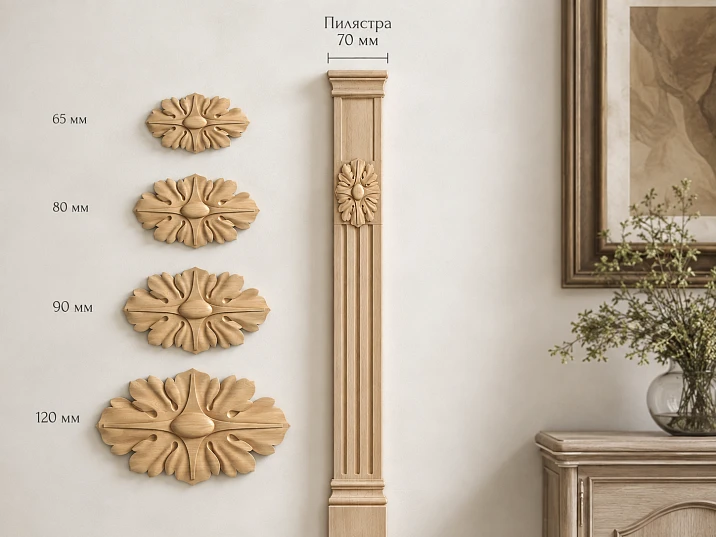
A pilaster, casing, or furniture vertical has a face width of 70 mm. You want to place a single carved accent on it — an oval R‑038 with a symmetrical acanthus leaf. The card shows four sizes, and at first glance the choice seems simple: the largest option, 120 × 70 × 12 mm, matches the 70 mm base exactly in width B. So, does it "fit perfectly"? Not always.
For such a vertical, it is more useful to consider not the height of the rosette A, but the actual width B, because it is this that must fit on the face plane. When centered on a 70 mm base, four different scenarios result:
-
R‑038 65 × 38 × 7 mm → 16 mm of free margin on each side;
-
80 × 47 × 8 mm → 11.5 mm on each side;
-
90 × 53 × 9 mm → 8.5 mm on each side;
-
120 × 70 × 12 mm → formally 0 mm of free margin.
Therefore buy wooden carved rosettes For a 70 mm pilaster, it is not about the principle "the larger, the more expressive." First, measure not the nominal width of the pilaster, but the actual flat area onto which the decor will be glued. If the vertical has chamfers, rounded edges, grooves, decorative edging, or noticeable unevenness, the useful width may be less than 70 mm.
This is especially critical for R‑038 120 × 70 × 12 mm. Mathematically, it fits exactly. Practically, any edge bevel, marking deviation, or protruding carved relief ends up not "inside the field" but on the boundary. For a calm installation on a 70 mm plane, 80 × 47 or 90 × 53 mm are often more convenient: they leave a visible and technological margin while still appearing as a noticeable center of the composition.
The most compact 65 × 38 mm provides maximum margin at the edges and is useful if the pilaster is visually light, there is other ornamentation nearby, or the decor should not dominate. The 120 × 70 mm size, on the contrary, should be considered a full-width accent that requires the most rigorous check of the base.
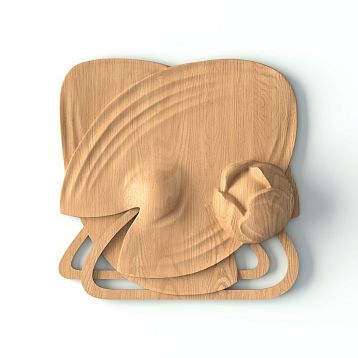
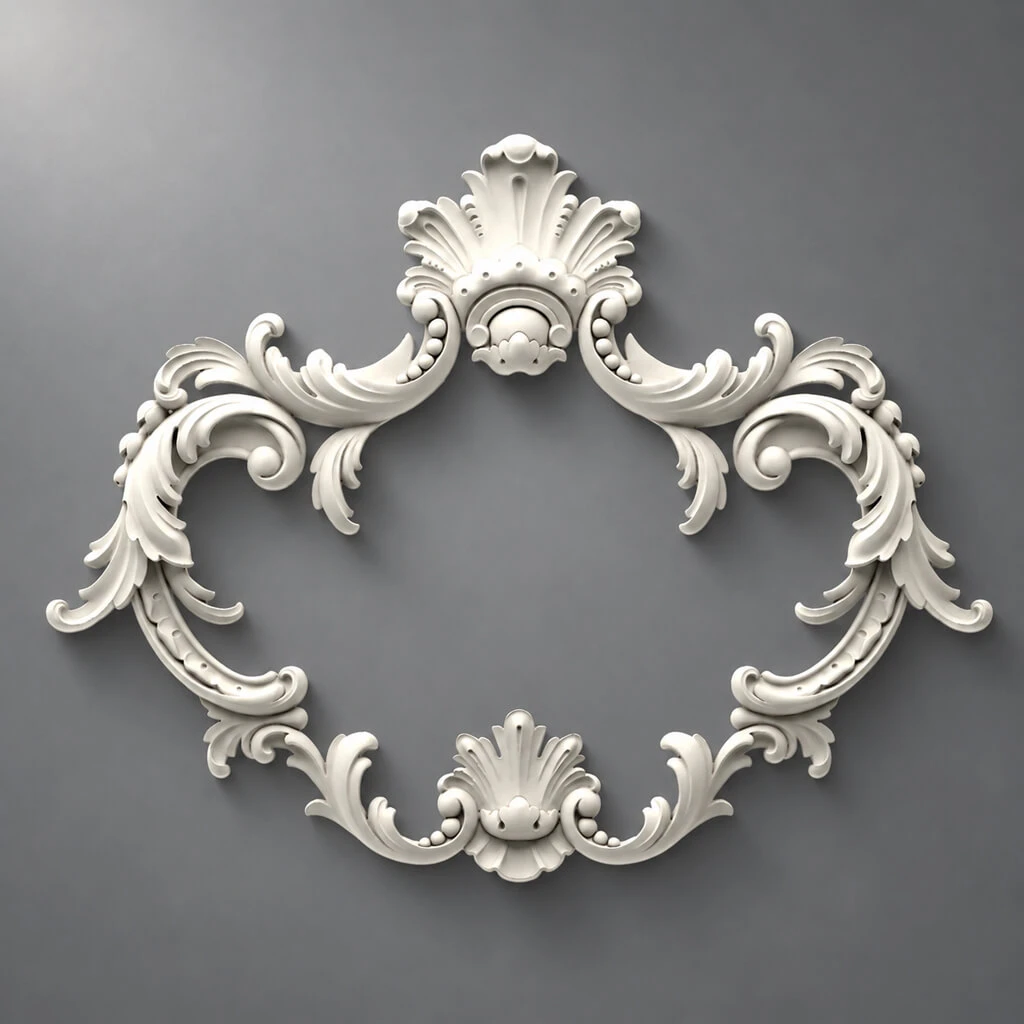
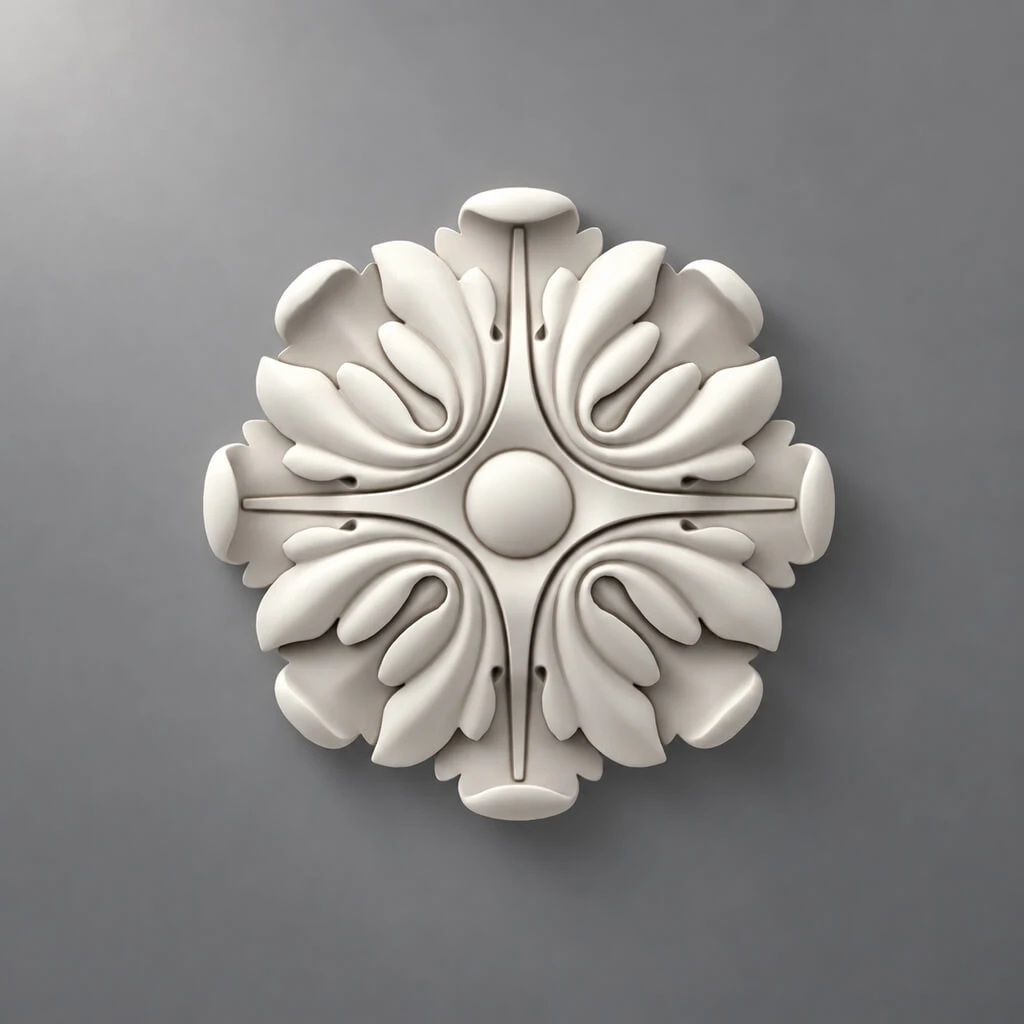
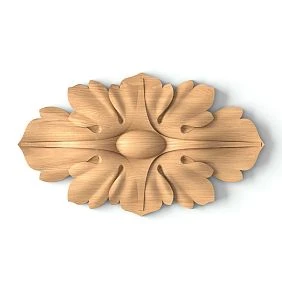
The R‑038 card confirms four sizes, beech and oak, "Standard"/"Prestige", and options for re-gluing under enamel and under tinting. R‑038 is described as an oval rosette in a classic style with a symmetrical acanthus pattern; it is offered for pilasters, casings, panels, and stair posts, including as an independent center of a carved composition.
The direct selection algorithm for a 70 mm base is as follows:
-
measure the actual flat width at the installation location;
-
compare it specifically with size B;
-
calculate the side margins;
-
apply the full-size template;
-
check chamfers, rounded edges, handles, and adjacent decor;
-
select not only the size but also depth C;
-
determine beech or oak;
-
choose "Standard"/"Prestige";
-
link the re-gluing to the future finish;
-
only after this count the quantity and place the order.
Oval wooden rosette R‑038: what sizes does the card offer
R‑038 has four standard dimensions. In the STAVROS catalog, the size is specified as A × B × C. For this task, it is convenient to treat A as the height of the oval, B as the width across the face, and C as the depth of the relief.
| R‑038, A × B × C | Width B | Depth C | Materials | Sanding | Re-gluing |
|---|---|---|---|---|---|
| 65 × 38 × 7 mm | 38 мм | 7 мм | Beech / Oak | Standard / Prestige | For enamel / for tinting |
| 80 × 47 × 8 mm | 47 мм | 8 мм | Beech / Oak | Standard / Prestige | For enamel / for tinting |
| 90 × 53 × 9 mm | 53 мм | 9 мм | Beech / Oak | Standard / Prestige | For enamel / for tinting |
| 120 × 70 × 12 mm | 70 мм | 12 мм | Beech / Oak | Standard / Prestige | For enamel / for tinting |
The current card also reports the average production time for an out-of-stock item as 5–10 working days. It is better not to fix prices and stock balances in the publication article: they change, and the task of the material is to help choose a configuration.


What changes with height A
Not only the height of the oval increases:
-
B grows from 38 to 70 mm;
-
C — from 7 to 12 mm;
-
the ornament gains a larger visual scale;
-
the proximity of the carved edge to the boundaries of the 70-mm base increases.
Therefore, one cannot look only at A = 65/80/90/120.
For example, a customer might say: “A pilaster is 70 mm, so a rosette of 65 mm is needed — it is smaller than 70.” But A = 65 is the height of the oval, while the width B of such a product is only 38 mm. This is a completely different result in scale.
Why depth C also matters in the selection
In the frontal view, the dimensions 80 × 47 and 90 × 53 differ moderately. In profile, the relief increases from 8 to 9 mm. For the largest R‑038, C = 12 mm.
For a pilaster next to an opening door, handle, or adjacent facade, the extra millimeters of protrusion can matter. The decor must not only fit in width but also not interfere with the trajectory of the neighboring element.
A rosette is not electrical hardware
The commercial query "buy wooden rosette" is mixed in search with electrical installation products for wooden houses. Therefore, the article uses precise terminology:
-
decorative wooden rosette;
-
carved wooden rosette;
-
oval wooden decor;
-
carved element for a pilaster.
R‑038 has nothing to do with electrical wiring, socket boxes, or surface-mounted wiring.
After selecting the size, you can buy an oval wooden rosette R‑038 in the desired material, sanding, and gluing option.
Our factory also produces:
Will the carved rosette R‑038 fit on a pilaster 70 mm wide?
For central placement, a simple formula is used:
P = (W − B) / 2,
Where:
-
P — side space;
-
W — useful width of the base;
-
B — width of the rosette.
If W = 70 mm:
| Size R‑038 | B | Calculation | Field P |
| 65 × 38 × 7 | 38 | (70 − 38) / 2 | 16 мм |
| 80 × 47 × 8 | 47 | (70 − 47) / 2 | 11.5 mm |
| 90 × 53 × 9 | 53 | (70 − 53) / 2 | 8.5 mm |
| 120 × 70 × 12 | 70 | (70 − 70) / 2 | 0 мм |
Purely mathematically, all four options fit. In practice, they have different margins for error.
16 mm on each side — the calmest installation scenario
R-038 with a width of 38 mm leaves a total of 32 mm of free surface. A slight shift of 1–2 mm is visually less critical because the borders do not come close to the edge.
This is useful on:
-
a narrow casing;
-
a furniture vertical;
-
a pilaster with a decorative frame;
-
a surface where another carved motif is already nearby.
11.5 mm is a noticeable but comfortable margin
R-038 80 × 47 mm occupies about 67% of the width of a 70-millimeter base:
47 / 70 × 100 ≈ 67,1%.
The decor is already perceived as substantial, but the field remains readable.
8.5 mm is a large accent
8.5 mm remains on each side. On a flat pilaster, this can look expressive. But if the edge has a 4–5 mm chamfer, the actual flat area decreases, and the visual margin becomes much smaller.
53 / 70 × 100 ≈ 75,7%.
8.5 mm remains. On a flat pilaster, this can look expressive. But if the edge has a 4–5 mm chamfer, the actual flat area is reduced, and the visual margin becomes much smaller.
Zero margin — only nominal compatibility
R‑038 120 × 70 mm occupies 100% of the nominal width.
This requires checking:
-
chamfers;
-
corner radius;
-
surface level difference;
-
edge;
-
axis accuracy;
-
adhesive joint;
-
the geometry of the base itself.
If the useful plane is not 70 but 66 mm, the size 120 × 70 already extends beyond it by 2 mm on each side.
Get Consultation
The actual flat area is more important than the nominal width.
Let's imagine a pilaster with a total width of 70 mm and chamfers of 4 mm each.
Conventionally flat center:
70 − 4 − 4 = 62 mm.
Then the margins change:
-
B 38 → 12 mm each;
-
B 47 → 7.5 mm each;
-
B 53 → 4.5 mm each;
-
B 70 → no longer fits in the flat zone.
That's why the formula should use W not from the pilaster's name, but from the actual measurement of the gluing spot.
Make a paper template
Cut out oval or rectangular overall templates:
-
65 × 38;
-
80 × 47;
-
90 × 53;
-
120 × 70 mm.
Attach them to the pilaster at the actual height.
This makes it immediately visible:
-
scale;
-
margins;
-
proximity to the chamfer;
-
conflict with adjacent decor;
-
the required height of the composition.
A paper template does not convey the depth of the relief, but it solves most of the dimensional task before ordering.
Selection matrix by actual flat width
Nominal 70 mm is useful only as a first step. For a real order, it is more convenient to consider several possible W values in advance.
| Useful plane W | R-038 38 mm | R-038 47 mm | R-038 53 mm | R-038 70 mm |
| 70 мм | by 16 mm | by 11.5 mm | by 8.5 mm | 0 мм |
| 68 мм | 15 mm each | by 10.5 mm | 7.5 mm each | does not fit into the plane |
| 66 мм | 14 mm each | 9.5 mm each | by 6.5 mm | does not fit |
| 64 мм | by 13 mm | by 8.5 mm | by 5.5 mm | does not fit |
| 62 мм | 12 mm each | 7.5 mm each | 4.5 mm each | does not fit |
| 60 мм | 11 mm each | by 6.5 mm | 3.5 mm each | does not fit |
This table shows an important thing: 90 × 53 mm remains physically compatible even with a flat zone of 60 mm, but the visual and mounting margin decreases to 3.5 mm. Therefore, the question of "does it fit" and the question of "is it convenient to mount" are different.
How to choose the minimum desired margin
You can go the other way around.
Suppose the designer wants to leave at least 8 mm of visible plane on each side.
Then the required usable width is:
Wmin = B + 2P.
For R-038 65 × 38:
38 + 2 × 8 = 54 mm.
For 80 × 47:
47 + 16 = 63 mm.
For 90 × 53:
53 + 16 = 69 mm.
For 120 × 70:
70 + 16 = 86 mm.
So: if the project requires a minimum of 8 mm margin, R-038 90 × 53 practically uses the entire nominal 70-millimeter width, while R-038 120 × 70 already requires a base wider than 70 mm.
This is not a building code. It is a design tool: the designer sets the desired margin themselves, and the formula shows what plane is needed.
Why an 8 mm margin and a 16 mm margin create a different impression
At 16 mm, the socket is perceived as a separate medallion on the plane.
At 8 mm, it appears as a large element, almost filling the vertical.
At 0 mm, it looks like an ornament coinciding with the boundaries of the base.
No option is inherently 'more correct.' The choice depends on whether the pilaster should remain visible around the decor.
How to account for an asymmetrical plane
The pilaster may have a bevel on only one side or adjoin the wall.
Then the symmetric field formula no longer describes the installation.
For example, the useful plane is 66 mm, but the socket needs to be shifted 2 mm to the left due to the right chamfer.
For R‑038 B = 53:
total free remainder:
66 − 53 = 13 mm.
If shifted by 2 mm:
-
field on the left 8.5 mm;
-
on the right 4.5 mm.
This option may be technically acceptable, but visually the asymmetry on a symmetric acanthus can be noticeable.
Therefore, R‑038 is better placed on a geometrically clear axis rather than compensating for a poor base with a shift.
Height A and the distance between several R‑038
If two sockets are placed on one pilaster instead of one, A becomes critical.
Suppose two R‑038 80 × 47 are used.
Their total height:
80 + 80 = 160 mm.
If a design gap of 200 mm is left between them, the total occupied zone will be:
80 + 200 + 80 = 360 mm.
For R‑038 120:
120 + 200 + 120 = 440 mm.
This shows why switching to a larger size changes not only the width but also the vertical rhythm of the entire pilaster.
The specific 200 mm interval here is a calculation example, not a recommendation.
How to center one R-038 vertically within a given zone
If the decor should stand in the center of an area with height Hzone:
top margin = (Hzone − A) / 2.
For example, a decorative zone of 300 mm and R-038 A = 90:
(300 − 90) / 2 = 105 mm.
That gives 105 mm at the top and bottom.
For R-038 A = 120:
(300 − 120) / 2 = 90 mm.
This way, you can compare four sizes in advance not only by width but also by vertical scale.
Why the axis of the acanthus leaf must coincide with the axis of the pilaster
R‑038 has a symmetrical ornament. Even if the overall rectangle fits, an axis shifted by a few millimeters can be perceived more strongly than on an asymmetric overlay.
Therefore, before installation, mark:
-
the axis of the pilaster;
-
the axis of R‑038;
-
top/bottom;
-
control side margins.
Especially for 120 × 70 mm, where there are no side margins and the edge itself becomes an indicator of accuracy.
How to check the pilaster after painting
If the decor is mounted on an already painted pilaster, it is better to repeat the measurement after the finish.
Causes:
-
paint layers slightly change the edge;
-
putty can smooth the chamfer;
-
decorative profile can be installed later;
-
adjacent part can reduce the usable area.
One cannot assume that the size from the rough drawing is perfectly equal to the finished surface.
How to choose between 80 and 90 mm if both fit
This is the most real fork for a 70 mm pilaster.
Compare four parameters:
| Criterion | 80 × 47 | 90 × 53 |
| Field at 70 mm | 11.5 mm | 8.5 mm |
| Height A | 80 мм | 90 мм |
| Depth C | 8 мм | 9 мм |
| Visual effect | Calmer | Larger |
If the pilaster is narrow but tall and almost empty, 90 may hold the scale better.
If there is already molding or a handle nearby, 80 often leaves a calmer composition.
It is better to make the decision based on a full-size mockup, because a difference of 10 mm in height and 6 mm in width seems small on screen, but is noticeable on the actual vertical surface.
Wooden rosette 65 × 38 mm: neat decor with margins along the edges
The most compact R‑038 has A = 65 mm, B = 38 mm, C = 7 mm. On a pilaster 70 mm wide, it leaves 16 mm on each side.
This is the best option if you need not a full-width center, but a small carved sign.
Narrow furniture vertical
On a cabinet facade, there may be vertical stiles 70 mm wide. If a panel frame runs nearby, a large rosette can visually merge with it and overload the stile.
R‑038 65 × 38 leaves breathing room.
It is suitable for the scenario:
-
the vertical is decorative on its own;
-
the rosette only marks the center;
-
there is a handle nearby;
-
Another ornament is located above or below.
Casing
On a 70 mm casing, it's important not only to place the decor but also to preserve the feel of the profile itself. R‑038, 38 mm wide, takes up just over half:
38 / 70 × 100 ≈ 54,3%.
Therefore, the casing remains readable as an independent plane.
Small panel
On the central panel of a furniture facade, a size of 65 × 38 mm can work as a single accent, especially if the facade already has a complex frame.
If you use 120 × 70, the decor will dominate.
When 65 mm looks too small
On a tall, massive pilaster of 70 × 1500 mm, a small rosette can get lost, especially if it's the only carved element.
Here, it makes sense to try 80 or 90 mm in height.
Error: choosing 65 just because it is "safer"
Size allowance should not destroy the composition.
If R‑038 65 looks like a random point on a large architectural vertical, it is better to switch to a larger one.
The size is chosen in two dimensions simultaneously:
fits technically + matches the scale.
Carved rosette 80 × 47 mm: when a noticeable but not overloaded accent is needed
R‑038 80 × 47 × 8 mm — the middle option between the most compact and the larger 90‑millimeter modification.
On a 70 mm base, the side margin:
(70 − 47) / 2 = 11.5 mm.
The rosette occupies about two-thirds of the width, so it already looks like a clearly intentional center, but does not come close to the edges.
Why 11.5 mm is often more convenient than 8.5 mm
The difference between 47 and 53 mm in width is only 6 mm. On a 70 mm pilaster, this means the field decreases by 3 mm on each side.
On paper, the difference is small.
In the actual product, these 3 mm can be useful if:
-
there is a chamfer;
-
the edge is slightly rounded;
-
the surface is not perfectly flat;
-
a thin molding runs nearby;
-
you want to leave visual breathing room.
On a pilaster with a framed profile
If there are narrow decorative strips along the edges of the pilasters, the clean central zone may be smaller than the overall width.
Suppose the decorative edge takes up 6 mm on each side:
70 − 6 − 6 = 58 mm.
R‑038 B = 47 mm leaves:
(58 − 47) / 2 = 5.5 mm
of clean zone.
R‑038 B = 53 mm would leave only 2.5 mm.
In that case, 80 × 47 becomes noticeably calmer.
On paired pilasters
If the portal has left and right pilasters, the two R‑038 must be identical in:
-
by size;
-
by material;
-
by sanding;
-
by re-gluing;
-
by placement height;
-
by orientation.
Even a difference of 80 and 90 mm on symmetrical elements will be noticeable immediately.
When 80 mm is preferable to 65
If the pilaster is tall and the rosette should be visible from a distance, 80 mm holds the scale better.
Especially if nearby:
-
large cornice;
-
massive architrave;
-
decorative capital;
-
noticeable handle;
-
large panel.
When 80 mm is still small
On wide furniture, where a 70 mm vertical is part of a very large facade, R‑038 80 may look neat but not central.
Then it's worth trying 90 mm.
Oval decor R‑038 90 × 53 mm: how close the ornament comes to the edges
R‑038 90 × 53 × 9 mm is the largest option, which on a 70 mm base still leaves an obvious side margin.
Calculation:
(70 − 53) / 2 = 8.5 mm.
This is already a large accent: the rosette occupies approximately 75.7% of the width.
Where 8.5 mm is enough
If the pilaster:
-
flat;
-
without chamfers;
-
has a stable width;
-
well marked;
-
located away from moving hardware,
8.5 mm can be a quite comfortable margin.
Where 8.5 mm turns into 3–4 mm
If the base has 5 mm chamfers:
70 − 5 − 5 = 60 mm.
Then the actual field:
(60 − 53) / 2 = 3.5 mm.
Visually, the socket almost touches the plane transition.
Such a result can be beautiful if the project wants it, but installation becomes more demanding.
Why you need to measure more than one point
A long pilaster may have a slight width deviation.
Measure at the installation location:
-
from the top;
-
in the center;
-
from the bottom.
If the decor is installed at a height of 1000 mm, the local width there determines the choice.
Don't rely only on the size at the floor.
On a 70 mm casing
For the platband R-038, 90 × 53 already looks large.
If there is a door handle or lock nearby, check the vertical distance. The rosette should act as a decorative center, not interfere with functional hardware.
On a furniture stand
A height of 90 mm allows the acanthus leaf to be read better from a distance.
For a classic wardrobe, console, or chest of drawers with a noticeable carved composition, this is often a more expressive option than 65/80.
How to check 90 mm next to a handle
The handle and rosette can compete.
Make a front mock-up of the facade at 1:1 scale on paper or at least in CAD:
-
facade;
-
handle;
-
R‑038;
-
frame;
-
pilaster.
If two accents are too close, reducing the rosette to 80 mm can solve the problem without changing the entire composition.
Wooden rosette 120 × 70 mm: why exact size matching is not always convenient
R‑038 120 × 70 × 12 mm — the most striking and at the same time the most demanding option for a 70 mm pilaster.
By math:
B = 70 mm = width of the base.
Side margin:
0 mm.
This means that the decorative rosette occupies the entire nominal width.
Why zero millimeters is not an "ideal match"
For installation, zero margin means:
-
cannot shift to the right;
-
cannot shift left;
-
the chamfer immediately affects the support;
-
the rounding immediately reduces the flat zone;
-
the uneven edge becomes noticeable;
-
excess glue may reach the very edge.
With a base width of 70 mm, even a 1 mm error becomes visually noticeable.
Actual flat surface 68 mm
Let's imagine that the pilaster is formally 70 mm, but after painting and finishing, one side has a slight radius, so the flat section is 68 mm.
R‑038 B = 70 mm will extend beyond the flat zone:
70 − 68 = 2 mm total, that is, about 1 mm per side with ideal centering.
Maybe it's visually acceptable. Maybe not. Without a mockup, it can't be decided.
3 mm chamfers
If the chamfers are 3 mm:
70 − 3 − 3 = 64 mm of flat area.
R‑038 120 × 70 already extends into the 3 mm chamfers on each side.
This could break the contact on the back side and create a gap.
When 120 × 70 is still justified
A full-width option makes sense if:
-
the base is truly flat;
-
the width is stable;
-
the decor should look monumental;
-
the edge of the rosette should architecturally align with the edges of the pilaster;
-
the craftsman can mark it precisely;
-
there is no conflicting hardware nearby.
Why 12 mm depth also matters
R-038 120 × 70 protrudes by 12 mm.
This is the deepest option.
On a furniture facade near an adjacent door or on a casing next to an opening panel, the side trajectory needs to be checked.
Can the 70 mm width be "slightly sanded down"
This should not be relied upon as a standard method of adjustment.
R-038 — carved ornament. Reducing the width may affect the edges of the pattern and disrupt symmetry.
If 70 mm does not fit into the usable plane, it is better to switch to 90 × 53 or 80 × 47.
Why a full-width rosette requires better marking
For 65 × 38, a 1 mm offset is almost unnoticeable in a 16 mm field.
For 120 × 70, a 1 mm offset results in:
-
on one side, +1 mm protrusion;
-
on the other, 1 mm indentation.
This is noticeable on a symmetrical acanthus ornament.
Practical conclusion
On a 70 mm pilaster, the 120 × 70 size should be chosen not because it mathematically aligns, but because the project deliberately requires a full-width accent and the actual surface allows it.
How many carved rosettes to order for paired pilasters and furniture facades
The quantity depends not on the room area, but on the number of identical decorative points.
One pilaster — one central rosette
If R‑038 is used as a single center, 1 piece is needed.
But before ordering, you need to decide the exact installation height.
Paired portal
The left and right pilasters should receive two identical R‑038.
2 pilasters = 2 rosettes.
It is especially important to order:
-
one size;
-
one breed;
-
one sanding;
-
one re-gluing.
Two-door wardrobe
Options:
-
one R-038 per door → 2 pcs.;
-
two per door → 4 pcs.
But the quantity is determined by the composition, not by the "wardrobe rule."
Series of identical doors
If there are 6 identical trims in the room and each has one R-038:
6 pcs.
If the decoration is only on the main door, the rest do not need to be counted.
Should you take a spare?
For a small batch of a home project — not automatically.
A spare part is useful if:
-
the object is far away;
-
the batch is finished with complex tinting;
-
there is a risk of damage during installation;
-
the decor is used in a commercial interior;
-
it is difficult to repeat the shade later.
But "+10%" works poorly for piece decor.
For 2 sockets, 10% = 0.2 pieces, it is impossible to buy such a quantity.
Therefore, the reserve is counted individually and by reason.
Why it's better to get parts of a symmetrical pair at the same time
Natural wood may have tonal differences.
Even in the "for tinting" category, STAVROS warns of possible differences between items from the same batch.
For a paired composition, it's better:
-
order together;
-
finish together;
-
make a color sample with one system;
-
mark the left/right position after selection.
Different sizes in one composition
R-038 65 and 90 can be used on different elements of the same interior if the scale is deliberately varied.
But on paired pilasters of the same portal, it is better not to mix them.
How to compile a list
| Position | Base | Plane width | R‑038 | Material | Sanding | Re-gluing | Quantity |
| P‑01 | left pilaster | 70 мм | 90 × 53 × 9 | Oak | Prestige | For tinting | 1 |
| P‑02 | right pilaster | 70 мм | 90 × 53 × 9 | Oak | Prestige | For tinting | 1 |
Such a table prevents mixing sizes during installation.
Beech or oak: which material to order a decorative rosette from
R-038 is available in beech and oak.
One cannot say that one material is “better in general.” The choice depends on the future finish.
Beech for opaque finish
Beech is a dense, non-porous wood. In opaque enamel, the natural grain is hidden, so beech is often a rational choice for painted pilasters, trim, and furniture.
if:
-
the entire pilaster is white;
-
R‑038 is painted together with it;
-
the texture should not be visible,
beech is a logical candidate.
Oak for visible texture
Oak is a dense, porous wood with an expressive grain.
If R‑038 should be:
-
tinted;
-
coated with clear oil;
-
under varnish;
-
visually connected to the oak pilaster,
oak is usually more interesting.
But the wood species is only half the choice
You also need to choose the quality of the lamination.
Under enamel:
-
lamellas without mandatory matching by color and texture;
-
contrasting differences are acceptable;
-
intended for dense tinting and enamel.
Under tinting:
-
Slats are matched by color and texture;
-
Minor tonal differences are possible;
-
Intended for semi-transparent finishing.
Error: oak "under enamel" and clear varnish
The customer sees beautiful oak and decides to preserve the wood, although they ordered re-gluing under enamel.
The texture of the slats may be uneven.
Therefore, the order is:
finish → re-gluing → wood species.
Coordination with the base
If the pilaster is oak, oak R‑038 looks logical under a transparent finish.
If the pilaster is MDF under enamel, beech may be easier to integrate visually.
But this is not a technical rule, but a choice of the finishing system.
"Standard" or "Prestige": which wood decor finish to buy
R-038 is available in two sanding qualities.
"Standard" — milling and machine sanding. STAVROS allows slight traces of the cutter, roughness, and fuzz within a set proportion of the surface.
"Prestige" — milling, machine and detailed hand sanding. The manufacturer describes this surface as better prepared for applying paint and varnish materials, especially in hard-to-reach areas of the relief.
Why a small size does not mean simple sanding
R-038 may be only 65 mm in height, but the acanthus leaf ornament has:
-
recesses;
-
thin transitions;
-
convex edges;
-
symmetrical curls.
Manual finishing of a small carved element requires care. If too much material is removed, the shape can be softened and symmetry disrupted.
When "Standard" is reasonable
The "Standard" is suitable if:
-
the project has a professional finisher;
-
manual finishing is included in the estimate;
-
the product will be under dense enamel;
-
the craftsman is used to preparing carved decor himself;
-
the order is large and savings on preparation are significant.
In this case, the buyer does not save "on the quality of the result," but transfers part of the work to the workshop.
When "Prestige" is more convenient
"Prestige" is useful if:
-
manual finishing needs to be reduced;
-
the decor will be tinted;
-
the relief is clearly visible in side light;
-
R-038 is installed on finished furniture;
-
the customer does not have a separate cutter/grinder;
-
finishing deadlines are tight.
Why all parts of a paired composition must have the same level of preparation
If the left R-038 is "Standard" and the right is "Prestige", after manual finishing the result may still match. But the amount of work and risk differ.
For paired pilasters, it is easier to order one level.
Sanding does not replace finishing
Even "Prestige" is not varnish, oil, or enamel.
After receiving, you need to:
-
clean the surface;
-
prepare using the LKM system;
-
prime if necessary;
-
apply the final coating.
Detailed criteria can be checked on the page choose the sanding quality for wooden decor.
What to choose for R‑038 120 × 70
In the full-width version, the relief is larger and deeper — C = 12 mm.
If the decor will be close to the eye and painted with a complex semi-transparent system, "Prestige" reduces the amount of manual work in the recesses.
But if the entire project is under dense enamel and the craftsman has a technological finishing cycle, "Standard" remains a working option.
How to connect R‑038 with carved moldings and overlays
R-038 can be a standalone accent, but the card allows its use in a more complex carved composition. This does not mean that any neighboring products automatically form a factory set with it.
For design purposes, one can consider, for example:
But K-029 and N-213 are independent products with their own dimensions and patterns. They are not declared as a set "for R-038."
How to build a composition without a random set of carvings
First, set the hierarchy:
-
what is the main center;
-
what is the vertical rhythm;
-
what is the frame;
-
that secondary accent.
For example:
R-038 → central oval rosette.
K-029 → extended plant molding.
N-213 → independent overlay of a different scale.
If all three elements are equally active, the composition becomes overloaded.
R-038 + K-029 on the pilaster
Suppose R-038 is placed in the center of the upper part, and K-029 runs as a vertical frieze.
Need to check:
-
width of K-029;
-
distance between it and R-038;
-
match of leaf styling;
-
ornament direction;
-
relief thickness;
-
total overhang from the plane.
K‑029 has its own size range, so it cannot be assumed that it automatically fits on a 70‑millimeter pilaster. It needs to be measured separately.
R‑038 + N‑213
N‑213 has square dimensions from 80 × 80 mm and above according to the current card, so for the 70 mm pilaster itself, it is no longer a direct candidate for the same plane.
But N‑213 can be used:
-
on a wide panel nearby;
-
on the central facade;
-
on another furniture element.
This is a good example of why links to related products should lead to a compositional choice, not create a false promise of compatibility on the same surface.
The same finish unites, but does not fix the scale
Painting R-038 and K-029 with the same enamel is useful for unity.
But if the ornaments are too close or the sizes conflict, the same color won't solve the problem.
First geometry, then finish.
Full-size layout of the composition
For a complex pilaster, it's better to assemble it on a sheet or directly on the part:
-
contour 70 mm;
-
R‑038;
-
K‑029;
-
adjacent capital;
-
lower decor;
-
handle/lock.
This way you can see if the vertical has turned into a continuous ornament without calm intervals.
Mistakes when ordering an oval wooden rosette
Error 1. Comparing A with the width of the pilaster.
Why it occurs: the first size in the name seems to be the "width."
Consequence: the buyer chooses R‑038 65 mm, thinking that 5 mm remains, although the actual width B = 38 mm and 16 mm remains on each side.
How to prevent: for a 70 mm pilaster, compare W with B.
Error 2. Not looking at the drawing.
Reason: the size table seems sufficient.
Consequence: the A/B orientation is interpreted incorrectly.
Prevention: before ordering, open the drawing and check which side runs along the pilaster.
Error 3. Ordering 120 × 70 without checking the chamfers.
Reason: 70 = 70.
Consequence: the decor partially hangs on the rounding or chamfer.
Prevention: measure the flat surface.
Error 4. Mixing sizes on paired pilasters.
Reason: one size was out of stock.
Consequence: the portal loses symmetry.
Prevention
Where to buy the wooden rosette R-038 and what to check in the order
By the time the order is placed, the buyer should know not just "I like 90 mm." A full specification line is needed that links the size to the base, finish, and installation.
Good record:
R-038 / 90 × 53 × 9 mm / oak / Prestige / for tinting / 2 pcs. / pilasters 70 mm / useful surface 64 mm / installation after painting.
Bad:
"two oval rosettes on pilasters"
The first line allows you to check the entire project before payment. The second leaves too much uncertainty.
Checklist before ordering
1. Size A × B × C
A specific modification is selected:
-
65 × 38 × 7;
-
80 × 47 × 8;
-
90 × 53 × 9;
-
120 × 70 × 12 mm.
2. Actual base width
Not just "70 mm pilaster", but the actual flat area.
3. Side margin
Calculated by the formula:
(W − B) / 2.
4. Chamfers and roundings
Verified that the socket does not lie on the plane transition.
5. Depth C
Decor does not conflict with the door, handle, or adjacent part.
6. Material
Beech or oak.
7. Sanding quality
"Standard" or "Prestige".
8. Regluing
For enamel or for tinting.
9. Quantity
By the number of actual decorative points.
10. Pairing
Symmetric elements are ordered identically.
11. Finish
It is determined who paints and with what system.
12. Installation
The adhesive is selected based on the condition of the decor and the substrate, not just "for wood."
13. Timeline
If the item is not listed, the stated average production time of 5–10 business days is considered.
14. Delivery
Current terms are checked before payment.
After this check, you can place the order and verify payment and delivery terms for STAVROS.
How to choose glue for R-038 without a universal recommendation
The TYTAN card confirms the composition is suitable for wood and its derivatives. But this does not mean that TYTAN is the right choice for any R-038 and any surface.
STAVROS divides the installation of wooden decor by two parameters:
-
size;
-
the condition of the surface.
For unpainted solid wood on an unpainted surface, the table recommends PVA Kleiberit 303.0 D3 for both small and large decor.
For primed/painted decor on a primed/painted surface:
-
small decor → SUPERGEL;
-
large, if one dimension is more than 100 mm → TYTAN Professional Classic Fix.
Now let's apply this to R-038.
65 × 38 × 7 mm — small decor.
80 × 47 × 8 mm — small.
90 × 53 × 9 mm — small.
120 × 70 × 12 mm — large by the STAVROS rule, because A = 120 mm is more than 100 mm.
Hence the exact logic follows:
-
raw R‑038 90 mm on a raw wooden pilaster → refer to PVA in the STAVROS table;
-
painted R‑038 90 mm on a painted surface → SUPERGEL is indicated in the table;
-
painted R‑038 120 × 70 on a painted pilaster → can be considered buy TYTAN Prof. Classic Fix mounting adhesive.
Thus the reference to a specific adhesive matches the real scenario, rather than turning into an advertising insert.
Why the large R‑038 120 mm is more demanding to install
It has:
-
zero side margin at 70 mm;
-
maximum depth 12 mm;
-
largest relief;
-
increased sensitivity to positioning accuracy.
On a painted surface, excess transparent glue still needs to be controlled: if it comes out at the edge, removing it from the carved contour can be difficult.
Marking before applying glue
Official STAVROS recommendations start with positioning the decor and marking.
For a 70 mm pilaster, it is convenient to:
-
draw a central vertical axis;
-
mark the horizontal axis R-038;
-
apply the part without glue;
-
check the fields on the left/right;
-
outline the control points with painter's tape or a pencil;
-
step back a few meters again and assess the symmetry;
-
only then apply the glue.
For a paired portal, first mark both pilasters. Do not glue the left one and then try to repeat the right one "by eye" based on it.
How to check the height of two paired rosettes
Suppose the pilaster height is 1800 mm, and the centers of R‑038 should be at the same mark.
Measure from one baseline — for example, from the floor or the top edge of the portal.
Do not measure:
-
the left one from the floor;
-
to the right of the decorative base;
if these bases themselves differ.
One base reduces error accumulation.
Installation on a furniture facade
If R-038 is installed not on an architectural pilaster but on a furniture vertical, before gluing you need to check:
-
hinges;
-
guides;
-
handles;
-
movement of the adjacent facade;
-
panel thickness;
-
possibility of finishing.
If the panel opens, depth C is included in the movement dimension.
Painting before or after installation
Both scenarios are possible.
Before installation, it is convenient if R‑038 is contrasting and the pilaster is already ready.
Advantages:
-
easier to paint the edges;
-
the base does not get dirty;
-
convenient to work with the relief on the table.
But after gluing, the joint along the edge may require local correction.
After installation, it is convenient if the entire pilaster and R‑038 become one painted surface.
Then:
-
easier to merge the edge;
-
the micro-gap can be treated;
-
the finish is applied as a single system.
But painting a deep relief on a vertical surface is more difficult.
The overall sequence can be checked against recommendations for installing wooden decor.
Why a test coat is needed before the entire batch
If 8 identical R-038 items are ordered for tinting, do not start painting all eight at once.
First:
-
select a control part or sample;
-
apply the system;
-
dry it;
-
evaluate the color under real light;
-
approve it;
-
only then process the batch.
This is especially important for oak.
How to include R-038 in a furniture project
If the decor is used on a wardrobe, dresser, or kitchen, you can go to the section buy wooden decor for furniture and check other types of elements.
But R-038 should not be replaced with a random overlay just because it is in the same category. First, preserve the original task:
oval acanthus center on a 70 mm vertical.
Four ready-made selection scenarios for a 70 mm pilaster
Scenario A: narrow classic pilaster with noticeable bevels
Total width — 70 mm.
Bevels — 6 mm each.
Flat zone:
70 − 12 = 58 mm.
Comparison:
-
B 38 → 10 mm margins each;
-
B 47 → 5.5 mm each;
-
B 53 → 2.5 mm each;
-
B 70 → does not fit on the plane.
The rational choice is usually between 65 × 38 and 80 × 47.
Scenario B: perfectly flat furniture stand 70 mm
No chamfers.
No handles nearby.
Need an expressive accent.
You can compare 90 × 53 and 120 × 70.
If the full-width effect looks too heavy, 90 leaves 8.5 mm on each side and feels calmer.
Scenario C: paired portal with oak tinting
Pilasters 70 mm.
The actual plane is 66 mm.
Need two identical rosettes.
R‑038 90 × 53 leaves:
(66 − 53) / 2 = 6.5 mm.
Order:
R‑038 90 × 53 × 9 / oak / Prestige / for tinting / 2 pcs.
This is already a full commercial specification.
Scenario D: white painted furniture vertical
Usable area 70 mm.
the decor should be noticeable but not dominate.
You can take 80 × 47 in beech under enamel, paint it together with the facade.
Margins — 11.5 mm each.
Quick selection by priority
If you need maximum edge clearance → 65 × 38.
If you need a balanced medium accent → 80 × 47.
If you need an expressive large accent with a margin → 90 × 53.
If you need a full-width center and the surface is truly 70 mm → 120 × 70.
This is not a ranking from worst to best, but four different scales.
Frequently asked questions before ordering
Which size R-038 is better for a 70 mm pilaster?
Without additional conditions, the most versatile for comparison are 80 × 47 and 90 × 53 mm: they leave a margin and are still noticeable. But the final decision depends on the actual surface and scale.
Can I install 120 × 70 mm?
Yes, if the useful flat area is indeed at least 70 mm and the project deliberately requires zero margin.
Why 65 × 38 if the pilaster is 70?
Because A = 65 is the height of the oval, B = 38 is its width. There is 16 mm left on each side.
Which size is better for a 70 mm casing?
It is often better to start with 65 × 38 or 80 × 47, because the casing itself should remain readable. But this depends on the profile.
What size is better for a tall cabinet?
90 × 53 often holds scale better than 65, but you need to see the entire facade.
What to choose for white enamel?
Often beech + "under enamel". Sanding — "Standard" or "Prestige" depending on the finisher's capabilities.
What to choose for transparent tinting?
Usually oak + "under tinting", especially if texture matters.
Do I need to buy "Prestige"?
Not necessarily. If the craftsman is ready to finish "Standard", it works. "Prestige" reduces the amount of manual preparation.
Can I mix 80 and 90 on two identical pilasters?
Better not. Paired elements should be identical.
How many to order for the portal?
If one R-038 on each of the two pilasters — that's two pieces.
Do we need to take a third spare one?
Only for a specific reason: complex tinting, remote object, risk of damage.
Can TYTAN be used for 90 × 53?
Not as a universal recommendation. For painted small decor, the STAVROS table indicates SUPERGEL. TYTAN in the table refers to large painted decor, and from R-038, 120 × 70 × 12 mm falls under this criterion.
When to order R-038?
After final marking of the pilaster, handles, frames, and adjacent decor. Not earlier.
Check the product card immediately before payment
Even if the project is ready, on the day of purchase, open the R-038 card again and verify the selected combination. For one size, availability of beech and oak, "Standard"/"Prestige", and the status of a specific item may differ. If the required configuration is not available, the average production time on the page is indicated as 5–10 business days, so this needs to be included in the finishing schedule.
Do not replace a missing R-038 90 mm with 80 or 120 just for faster shipping if the paired composition is already marked. First, return to the template and re-check the margins, height, and adjacent ornament.
For two or four symmetrical parts, it is useful to ask for the entire set to be shipped at once. After receiving, before painting, lay out the rosettes side by side, check the size, material, workmanship quality, and orientation of the acanthus motif. Only after that, hand them over to the finisher.
Final specification
Before payment, you can fill in the line:
R‑038 / size ___ × ___ × ___ / base ___ mm / flat zone ___ mm / field ___ mm / beech or oak / Standard or Prestige / for enamel or for tinting / quantity ___ / mounting surface ___ / adhesive per STAVROS table / finish ___ .
If all fields are filled in, the probability of error sharply decreases.
For a 70 mm pilaster, the main principle remains simple: choose R‑038 by width B and the actual flat area, not by height A and not by the nominal match of "70 by 70."
The 120 × 70 mm size indeed fits mathematically, but requires a perfect flat area. 90 × 53 leaves 8.5 mm on each side, 80 × 47 — 11.5 mm, 65 × 38 — 16 mm. These fields determine the real installation freedom.
After choosing the size, material, and finish, you can go to the R‑038 card and check current availability, lead time, and cost directly before ordering.