








































































Article Contents:
- Wooden capital KL-061: why external 180 mm fit a 100 mm pilaster
- How to choose a capital for a pilaster by size G
- Wooden pilaster PLM-021 and capital KL-061: ready-made size pairs
- When a wooden capital with the correct G still won't fit
- A cornice already runs above the pilaster
- The pilaster stands next to a door casing
- A tall cabinet stands nearby
- The capital hits a socket, switch, or sconce
- Two pilasters are too close together
- The wall is noticeably uneven
- The actual width of the pilaster differs from the design 100 mm
- 1. Dry fitting
- 2. Marking the outer contour
- 3. Checking the base
- 4. Choosing glue based on surface condition
- 5. Temporary fixation
- 6. Post-fixation control
- Mistake 1. Choosing only by outer width
- Mistake 2. Considering 180 mm as the mounting size
- Mistake 3. Measuring the pilaster from a photo
- Mistake 4. Not checking the side 40 mm
- Mistake 5. Ordering one capital for a paired composition without checking the other side
- Mistake 6. Mixing oak and beech without a design intent
- Mistake 7. Painting parts at different times without a control sample
- Mistake 8. Buying a capital before determining the width of the pilaster body
- Mistake 9. Trying to file down the exterior decor to fit an adjacent cabinet
- Mistake 10. Assuming G is a universal designation for the same meaning across all products
- Mistake 11. Using a decorative capital as a load-bearing element
- Mistake 12. Not accounting for the already applied wall finish
- Which KL-061 fits a pilaster 100 mm wide?
- What does size G mean for a capital?
- Why is the capital 180 mm wider than the pilaster 100 mm?
- How much does KL-061 180 mm protrude on the sides of a 100 mm pilaster?
- Can KL-061 be installed on another pilaster, not PLM-021?
- What to choose for enamel — beech or oak?
- Do I need to order two capitals at the same time for a door portal?
- Can KL-061 be trimmed on site if 10-15 mm is missing?
- What should be used to glue a wooden capital?
- Is KL-061 a load-bearing element?
- Can a smaller KL-061 be chosen if 180 mm visually seems large?
- What to do if the actual pilaster has a width of 105 mm?
- Should the BS-001 base be selected based on the same G = 100 mm?
- Can KL-061 be used on a furniture facade or cabinet vertical?
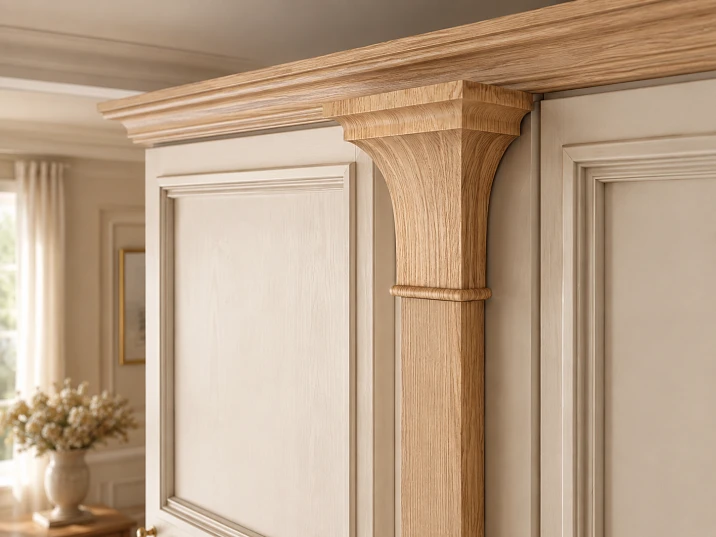
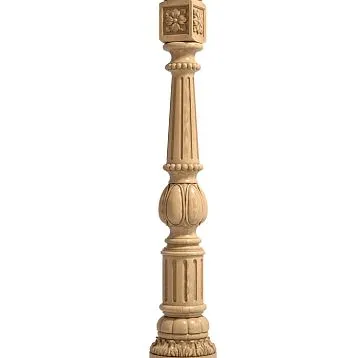
If the pilaster body has a width of 100 mm, you don't need to look for a capital with an outer width of also 100 mm. For the wooden capital KL‑061, the dimension responsible for mating with the pilaster body is denoted by parameter G. For the KL‑061 size with outer dimensions of 180 × 180 mm, the G value is 100 mm. That is why a capital that appears significantly wider on the facade than the installed pilaster is the standard matching option in this size pair.
The main mistake arises from mixing two different values. The outer dimension of 180 mm shows how widely the decorative part of the capital opens. The dimension G = 100 mm shows the pilaster body width it is matched to in terms of mounting geometry. If a buyer compares 180 mm directly with 100 mm, they see an "extra" 80 mm and try to choose a smaller capital. But reducing the outer dimension simultaneously changes G. For example, for KL‑061 126 × 126 mm, parameter G is 70 mm, so this option already belongs to a different pilaster width.
For an installed vertical of 100 mm, the initial check looks like this: actual pilaster body width — 100 mm; suitable G size — 100 mm; corresponding KL‑061 size — 180 × 180 × 57 mm with F = 16 mm. If the surrounding space allows for the outer decorative projection, you can buy wooden capital KL-061 for 100 mm pilaster specifically in this dimensional configuration. Before placing an order, you need to check not the fit on G — it is clear here — but the free space around the already installed pilaster, the material, the quality of sanding, and the future finishing.
For a symmetrically installed pilaster 100 mm wide, the outer capital of 180 mm protrudes approximately 40 mm on each side: (180 − 100) ÷ 2 = 40 mm. This protrusion is part of the composition. It forms the upper decorative expansion, visually completes the vertical, and does not mean that the capital is "too large." But the same 40 mm can become a problem if there is a door casing, cabinet, cornice, wall corner, or another pilaster nearby. Therefore, the correct choice consists of two independent checks: first, compatibility on G, then — the overall compatibility of the outer part with the actual interior.
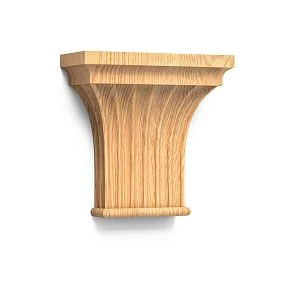
Wooden capital KL-061: why the outer 180 mm fits a 100 mm pilaster
In the KL-061 card, the dimensions are given not as a single number, but as a set of parameters A, B, C, F, and G. For a buyer who already has a finished pilaster, these designations cannot be read as interchangeable. A and B describe the outer dimension of the decorative part in two directions; C shows the depth or height of the corresponding part according to the drawing; F refers to an additional profile dimension; G — to the joint dimension. For selection by the width of the pilaster body, G becomes the main one.
For the size type for a 100 mm pilaster, the values are as follows:
| Parameter KL-061 | Value | What it means for selection |
|---|---|---|
| A | 180 мм | Outer dimension of the decorative part |
| B | 180 мм | Second outer dimension |
| C | 57 мм | Depth/profile dimension according to the drawing |
| F | 16 мм | Additional profile dimension according to the drawing |
| G | 100 мм | Mating dimension to be matched with the pilaster body width |
Imagine that a decorative cap is installed above a vertical board 100 mm wide. If this cap is also only 100 mm on the outer facade, virtually no visual expansion will remain. A capital is by nature wider than the pilaster body: the upper part should create a stepped or plastic widening. Therefore, the outer width and the mating width serve different functions.
It is most useful to read the KL-061 card not from left to right by the principle of "which dimension is smaller," but from the already known pilaster width. If the pilaster is 100 mm, look for the row where G = 100 mm. In this row, you automatically get the outer dimension of 180 × 180 mm. If the pilaster is 130 mm, choose G = 130 mm and the outer dimension becomes 234 × 234 mm. This logic eliminates random selection based only on a photo or the first digit in the card.
After understanding this scheme, the section buy wooden capital is useful to use as a catalog of elements of a specific dimensional system, rather than as an independent decorative object. The category is useful for comparing models, but within the selected model, you must always return to the drawing and the dimension table.




How to select a capital for a pilaster by size G
KL-061 has six sizes. Their outer dimensions grow together with parameter G. This allows using the same ornament model for pilasters of different widths, maintaining the proportionality of the composition. For practical work, it is convenient to keep in front of you not the entire original parameter table, but a correspondence table "pilaster width → G → outer dimension."
| Pilaster body width | Required G for KL-061 | External dimension A × B | C | F |
|---|---|---|---|---|
| 50 мм | 50 мм | 90 × 90 mm | 36 мм | 16 мм |
| 70 мм | 70 мм | 126 × 126 mm | 45 мм | 16 мм |
| 100 мм | 100 мм | 180 × 180 mm | 57 мм | 16 мм |
| 130 мм | 130 мм | 234 × 234 mm | 72 мм | 20 мм |
| 150 мм | 150 мм | 270 × 270 mm | 80 мм | 20 мм |
| 170 мм | 170 мм | 306 × 306 mm | 98 мм | 30 мм |
This table shows an important pattern: you cannot reduce the capital "by one size" to make it look visually more compact without checking G. For a 100 mm pilaster, the nearest smaller KL-061 has an external dimension of 126 × 126 mm, but its G is only 70 mm. The nearest larger one has an external dimension of 234 × 234 mm and G = 130 mm. Neither is a simple decorative duplicate of the 180 × 180 mm option. These are different size pairs.
Selection algorithm for an already installed pilaster:
- Measure the actual width of the vertical part with a caliper, metal ruler, or quality tape measure at several points.
- Do not rely only on the design name "100 mm" if the product has already been processed, sheathed, or supplemented with overlays.
- Find the G value in the KL-061 table that equals the actual width of the pilaster body.
- Record the corresponding external dimension A × B.
- Mark this external dimension on the wall or furniture with painter's tape.
- Check side, top, and front conflicts.
- Only after this, choose the material, sanding, and preparation for finishing.
If the actual width turned out to be 99–101 mm due to finishing, first you need to understand the cause of the discrepancy and assess the actual mating surface. You cannot automatically assume that any size "around a hundred" is safely suitable. This is especially important with an already painted pilaster, in the presence of veneer, additional profiles, or manual refinement.
If the width does not fall into the size range of 50, 70, 100, 130, 150, or 170 mm, you should stop at the selection stage and not try to compensate for the discrepancy with glue, putty, or arbitrary trimming of the capital. In such a situation, it is wiser to clarify the possibility of another solution or custom manufacturing than to turn a serial carved element into an unstable modification on site.
Our factory also produces:
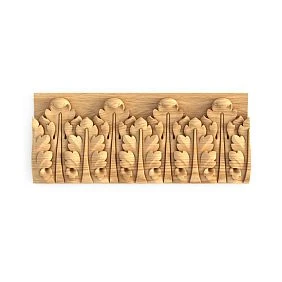

Wooden pilaster PLM‑021 and capital KL‑061: ready-made size pairs
The associated wooden pilaster PLM‑021 is produced in widths of 50, 70, 100, 130, 150, and 170 mm. This size range exactly matches the G values of KL‑061. This match gives the buyer a clear system: each body width of PLM‑021 finds a corresponding fit in one of the six KL‑061 capitals.
| PLM‑021: width B | KL‑061: G | KL‑061: outer dimension | Result |
|---|---|---|---|
| 50 мм | 50 мм | 90 × 90 mm | Size pair |
| 70 мм | 70 мм | 126 × 126 mm | Size pair |
| 100 мм | 100 мм | 180 × 180 mm | Size pair for the scenario under consideration |
| 130 мм | 130 мм | 234 × 234 mm | Size pair |
| 150 мм | 150 мм | 270 × 270 mm | Size pair |
| 170 мм | 170 мм | 306 × 306 mm | Size pair |
If the pilaster is not yet installed and the project is only being assembled, you can buy a wooden pilaster PLM-021 with a width of 100 mm together with KL-061 of the required G. This is easier than first ordering the vertical, and then after some time restoring the dimensions and finish for the upper element again.
A joint order provides not only dimensional convenience. In one composition, wood should behave as a single material. If the capital is made of oak and the pilaster of beech, after transparent or semi-transparent finishing, the differences in structure will be obvious. If one element is ordered for enamel and another for tinting, they may have a different principle of lamella selection. If one element has "Prestige" and another "Standard", the amount of manual preparation before final finishing will also differ.
Therefore, for a new set, it is useful to first open the section where you can Buy wooden pilaster, select the width of the vertical, and then determine the G of the capital based on the same width. For an already installed PLM-021, the order is reversed: we measure the actual width of the existing pilaster and select KL-061 to match it.
There is another practical advantage of matching rows: it is easier to design paired portals. If two PLM-021 of 100 mm each are used on the left and right of the door, the same KL-061 180 × 180 mm can be planned for both. On the plan, it is immediately clear that each capital will add approximately 40 mm of external projection on each side relative to the pilaster body. This allows you to check the overall external dimension of the portal in advance.
Get Consultation
When a wooden capital with the correct G still does not fit
Matching G with the pilaster width solves only one task — the alignment of elements by dimensional series. It does not guarantee that the external volume of the capital will physically fit in the finished interior. It is at this point that a new buyer's mistake can replace the old one: a person finally correctly chooses G = 100 mm, but forgets that the capital 180 × 180 mm must occupy real space around the installed vertical.
A cornice already runs above the pilaster
If the top of the pilaster almost touches the ceiling or furniture cornice, you need to check not only the width but also the vertical dimension of the capital. For the considered size, C = 57 mm, but the actual installation scheme is determined by the drawing and the orientation of the part. Mark out the full profile in place. If the cornice passes through the future zone of the capital, you cannot simply "slide" the carved element under it without a design solution: the proportion and joint may turn out to be incorrect.
The pilaster stands next to the door casing
With a body width of 100 mm and an outer capital width of 180 mm, central placement gives 40 mm of overhang on each side. If there is only 20 mm between the edge of the pilaster and the casing, the capital will overlap it by about 20 mm. This is not a flaw in the KL-061 itself — it is simply that there is not enough lateral space for such a layout. Possible solutions need to be decided at the level of the entire portal: shift the pilaster, change the capital model, reassemble the casing, or abandon symmetrical centering only if the design allows it.
A tall cabinet stands nearby
Furniture bodies often adjoin the decorative vertical almost flush. A 100 mm pilaster fits, but a 180 mm capital already extends onto the facade or side panel of the cabinet. Hinged doors are especially risky: even if the capital does not visually overlap the facade when closed, it may end up in the door's opening path.
The capital hits a socket, switch, or wall lamp
Electrical fixtures are usually placed below the top of the pilaster, but in furniture portals and complex wall compositions, non-standard heights occur. You need to check not only the frontal overlap but also access to the switch plate or the wall lamp's mounting. Carved decor should not turn maintenance of adjacent equipment into disassembly.
Two pilasters are too close together
If the distance between the axes of two pilasters is 240 mm, two capitals 180 mm wide theoretically require 360 mm of total width, but what matters more is not the sum but the position relative to the axes. With parallel pilasters of 100 mm each, each capital protrudes inward by about 40 mm. This means the clear space between the bodies will be reduced by another 80 mm. Before ordering two pieces, you need to mark out both simultaneously.
The wall is noticeably uneven
Dimension G corresponds to the pilaster, but the back plane of the capital must sit properly against the base. If the wall is out of plumb, has a plaster protrusion, or the pilaster is installed out of plane, a gap will appear between the carved element and the wall. Trimming an expensive part "by eye" after purchase is a bad strategy. First, check the flatness with a long straightedge or level.
The actual width of the pilaster differs from the design 100 mm
The drawing may have specified PLM‑021 100 mm, but after finishing, additional profiles, inserts, or a layer of material appeared on the sides. If the junction area has actually become wider, one design designation is not enough. You need to measure exactly the part to which the capital fits.
These checks answer the question of why a pilaster capital that is correct according to the table sometimes still cannot be installed. Element compatibility and node compatibility are different levels of design.
How much free space is required for the KL‑061 capital 180 × 180 mm
For a 100 mm pilaster, the calculation of the side overhang is simple: (180 − 100) ÷ 2 = 40 mm. With strictly central installation, the outer edge of the capital extends approximately 40 mm beyond the left side of the pilaster body and 40 mm beyond the right side. This is the minimum geometric information that should be transferred to the wall before purchase.
However, free space must be calculated not from the pilaster axis, but from the actual neighboring objects. If there is 55 mm to the left to the trim and 35 mm to the right to the cabinet, the symmetrical KL‑061 passes on the left with a margin of about 15 mm, but on the right it intersects the cabinet area by about 5 mm. Therefore, "there is enough space on average" is an incorrect conclusion. Both sides are checked separately.
For a paired portal, another formula is useful. Let the distance between the inner edges of two pilasters be 500 mm. Each capital extends inward by 40 mm. The clear distance between the capitals will be approximately 500 − 40 − 40 = 420 mm. If a central decorative element 450 mm wide must pass between them, a conflict will arise, even though the pilasters themselves were installed with sufficient clearance.
If the pilaster is located at an internal corner of the wall, check the direction of the overhang. From the axis, the outer width of KL‑061 occupies 90 mm on each side, and the pilaster body occupies 50 mm. Therefore, from the side edge of the pilaster to the corner, you need about 40 mm if the capital is to open without trimming. If the actual margin is 25 mm, do not hope that the remaining 15 mm will "go away" into the unevenness of the wall.
The vertical margin is checked separately. Do not confuse the outer size 180 × 180 mm with the installation height. Parameters C and F must be read from the product drawing and applied to the specific orientation. On site, it is useful to print the drawing or open it next to the layout and transfer all control points.
For a door portal, make a full-size template from cardboard 180 × 180 mm. Mark the central 100 mm zone on it, align it with the pilaster, and look at the actual intersections. Such a template immediately shows how much the carved capital will overlap the trim, wall panel, or adjacent molding. This method is especially useful if you need pilaster capital buy already after the completed renovation.
Beech or oak wooden capital: what to buy for enamel and tinting
KL-061 is available in beech and oak. But the question "which is better" without specifying the finish is posed incorrectly. The wood species must work together with the type of lamination, the future coating, and the material of the adjacent pilaster.
Beech is a dense wood with a calmer, less porous visual structure. The manufacturer notes that beech is often used for products coated with enamel. If KL-061 and PLM-021 will be painted with an opaque paint, choosing beech may be logical, especially when the wood texture is not part of the design concept.
Oak has a pronounced natural texture and porosity. It is especially appropriate when the wood grain should remain visible under a translucent coating. But if the capital is ordered in the "for enamel" preparation category, you should not expect the same selection of lamella color and texture from the blank that is used for "for tinting" products. On the STAVROS quality page, these options are separated precisely by the principle of future finishing.
For a set, a simple rule applies: if the visible wood should be perceived as a single architectural vertical, the capital, pilaster, and lower finish should preferably be selected from the same wood species and with a consistent preparation type. An oak capital on a beech pilaster can be a design technique, but it should not become a random result of separate orders.
With opaque enamel, texture differences will be hidden more, but this does not mean that preparation can be ignored. The "for enamel" blank is produced without selecting lamellas by color and texture, because the surface is designed for dense tinting or enamel painting. For translucent finishing, the corresponding blank category is chosen if it is available in the required configuration.
If you are assembling a door portal and want to buy a wooden capital for the door, the material must be matched not only with the door leaf, but also with the casings, pilasters, and upper decor. The error is most noticeable in a portal made of natural wood, where adjacent parts are in the same lighting and compared directly.
Sanding of a wooden capital: "Standard" or "Prestige"
The KL-061 card offers two grinding qualities — "Standard" and "Prestige". On the manufacturer's page grinding quality of a wooden capital described quite specifically. "Standard" includes milling and machine sanding; slight traces of processing, roughness, and lint are allowed within the level set by the manufacturer. "Prestige" adds detailed manual sanding of hard-to-reach areas and provides a higher degree of surface readiness for applying paint and varnish materials.
For a smooth straight part, preparation differences are often corrected by additional manual work by the finisher. For a carved capital, the situation is more complex: the ornament has transitions, recesses, and profiles that are harder to reach with abrasive without risking softening the pattern. Therefore, the choice of quality should be linked to who will perform the subsequent preparation and how.
"Standard" makes sense if the project has professional painting and joinery preparation and the estimate already includes surface finishing. "Prestige" is more logical where higher factory readiness of the carved element is required and the volume of manual refinement on site is reduced. But neither option eliminates the need to follow priming and painting technology.
For paired capitals, it is advisable to choose the same grinding quality. If one KL-061 is prepared as "Prestige" and the second as "Standard" and then both are quickly painted without leveling the process, the difference in surface may appear after the finish. The stronger the side light, the more noticeable the uneven preparation of the carved relief.
How to order the KL-061 capital, PLM-021 pilaster, and BS-001 base as one set
For a classic vertical composition, the buyer needs not just one decorative element but a coordinated unit: the top capital, the pilaster body, and the bottom finish. In the considered combination, the top is formed by KL-061, the vertical by PLM-021, and as the associated lower element, the manufacturer's card offers base for wooden pilaster BS-001.
But here there is a fundamental nuance. The size range of BS-001 does not mirror the widths of PLM-021 and the G values of KL-061. Therefore, you cannot take the rule "pilaster 100 mm → G 100 mm" and mechanically transfer it to the base. BS-001 has its own table of A, B, C, F, and G, and the specific variant of the bottom finish must be checked against its drawing and the actual connection scheme. Otherwise, the article itself would create the same error it tries to prevent regarding the capital.
Use the checklist to order the kit:
| What to Check | KL‑061 | PLM‑021 | BS‑001 |
|---|---|---|---|
| Wood Species | Beech or oak | Same material for uniform finish | Match with the kit |
| Connection size | For 100 mm pilaster — G = 100 mm | Actual width B = 100 mm | Check separately against the base drawing |
| Sanding | Standard/Prestige | Approve | Confirm available configuration |
| Preparation for finishing | Check selected configuration | Check selected configuration | Check selected configuration |
| Quantity | By number of top finials | By the number of verticals | By the number of lower endings |
| Dimensions around | Check external 180 × 180 mm | Check length and thickness | Check external base overhang |
If the portal consists of two verticals, two matching upper elements and two lower endings are usually required, but the quantity is always determined by the actual composition. For example, one pilaster may adjoin the wall and have a different node at the top, while the second remains fully visible. You cannot order a "paired quantity" just because the portal looks symmetrical in the sketch.
Also check the height of PLM‑021. The card contains length options of 1000 and 2000 mm for the corresponding widths. If the pilaster is already installed, this issue is closed. If the set is only being ordered, the length of the vertical affects the overall height of the composition together with the capital and base. You cannot first order a pilaster "approximately to the opening" and then hope that the upper and lower parts will automatically fit into the remaining space.
For a door portal, the formula for the total design height is useful:
total composition height = height of the lower ending + actual height of the pilaster body + height of the upper node per the drawing.
You cannot substitute 180 mm as the "capital height" in this formula just because the external size A × B is 180 × 180 mm. The orientation and vertical component must be taken from drawing KL‑061. This is another example of why the first digit of the card does not replace reading the entire dimension scheme.
When finishing one set, it is advisable to make a single control sample of color and gloss. This is especially important for oak under a translucent coating. Wood has natural variability, and the complex relief of the capital reflects light differently than the flat part of the pilaster. Matching cans of stain or enamel does not guarantee identical visual perception on different profiles.
Installation of the carved capital KL‑061 above a wooden pilaster
KL‑061 is a decorative carved element. It cannot be considered a load-bearing architectural detail or have the functions of a support for a ceiling, shelf, beam, or heavy structure transferred to it. Installation must ensure reliable fixation of the decor itself and correspond to the base, finish, and the adhesive manufacturer's recommendations.
It is convenient to divide the work into a dry fit and final fixation.
1. Dry fit
Before applying the adhesive, align the central zone G = 100 mm with the body of the 100 mm pilaster. Check the visual axis. If the pilaster has a carved pattern or central ornament, the capital's axis should continue it, not just coincide with the geometric edges.
2. Marking the outer contour
Mark the capital's dimensions on the wall or furniture. For central installation on a 100 mm pilaster, the approximate side overhang is 40 mm on each side. Painter's tape is more convenient than a pencil on finished surfaces because it allows you to see the full contour and then remove the marking.
3. Checking the base
The surface must be suitable for the chosen bonding method. Old peeling paint, dust, grease, and weak coatings cannot be considered a reliable base. If the capital is fixed to a painted wall, the strength of the joint is limited not only by the adhesive but also by the adhesion of the paint itself to the wall.
4. Choosing glue based on surface conditions
Section Tips for installing wooden decor Contains manufacturer recommendations: it separates recommendations by element size and surface condition. For large solid wood decor, when one dimension exceeds 100 mm, on unpainted wood/mineral substrates, PVA Kleiberit 303.0 D3 is specified, and for primed or painted surfaces, a mounting compound like Fixit/Tytan Professional Classic Fix. The choice should be made not by the universal rule "any wood glue," but by the specific substrate.
The catalog also includes assembly glue for wooden decor TYTAN Prof. Classic Fix. Its applicability to a specific joint should be checked based on surface conditions and the compound's instructions.
5. Temporary fixation
A large carved element may shift before initial setting. The manufacturer's recommendations allow temporary fixation with a manual pinner if necessary. On finished painted decor, mechanical fixation points should be planned in advance to avoid damaging the face surface.
6. Control after fixation
While the compound has not reached final strength, re-check the axis and uniformity of side overhangs. Correcting misalignment on fresh glue is easier than after full curing. Excess compound is removed according to the specific glue's instructions and finishing technology, without smearing it into the carving.
If the wall is uneven and a noticeable gap remains between the capital and the base, do not turn the glue into a thick leveling pad without confirming the allowable layer thickness. First, determine the cause of poor fit: wall lean, plaster protrusion, pilaster misalignment, or incorrect seating.
Mistakes when buying a wooden capital
Error 1. Choosing only by external width
The buyer sees a 100 mm pilaster and assumes the capital should also be close to 100 mm. As a result, they choose KL‑061 126 × 126 mm because it visually seems "more reasonable." But its G is 70 mm. Prevention: first look for G = 100 mm in the table, then accept the external 180 mm as a consequence of proper fit.
Error 2. Assuming 180 mm is the mounting size
The reverse error is deciding that KL‑061 180 × 180 requires a 180 mm pilaster. The PLM‑021 line has no such width, and the corresponding mounting for this capital is 100 mm. Prevention: distinguish between A/B and G.
Error 3. Measuring the pilaster from a photo
A photo does not provide an accurate scale. Even if a door or outlet is visible nearby, perspective distortion makes the conclusion unreliable. Prevention: physically measure the installed element or work from the manufacturer's drawing if the product is not yet mounted.
Error 4. Not checking the side 40 mm
G matches, but one edge of the capital hits a cabinet or trim. Prevention: full-size layout of 180 × 180 mm around the pilaster axis before placing the order.
Error 5. Ordering one capital for a paired composition without checking the other side
Sometimes the buyer measures the left pilaster and assumes the right one is completely identical. On the finished site, the right side may have a different distance to the wall, cabinet, or cornice. Prevention: measure both positions separately, even if the project is intended to be symmetrical.
Error 6. Mixing oak and beech without a designer's intent
Under opaque enamel, the difference can be hidden more, but under tinting, the structure of the species will differ. Prevention: determine in advance whether the wood will be visible, and order a set from an agreed material.
Error 7. Painting parts at different times without a control sample
Different batches of coating, application conditions, preparation, and sanding degree can change the shade and gloss. Prevention: a unified process chart and a test sample for the set.
Error 8. Buying a capital before determining the width of the pilaster body
First, they choose a preferred size KL-061, then try to 'fit' the vertical to it. If the pilaster already exists, the order should be the opposite. Prevention: the size of the existing body is the initial value.
Error 9. Trying to file down the exterior decor for the sake of a neighboring cabinet
The carved capital is designed for a specific profile composition. Removing 10-20 mm from one side can disrupt symmetry, ornament, and edge. Prevention: resolve the conflict before ordering—by choosing another model, changing the neighboring node, or adjusting the placement.
Error 10. Considering G a universal designation of the same meaning across all products
Even if KL-061 and BS-001 have a G parameter, you cannot automatically assume that both parts are matched to PLM-021 by the same number. Drawings of different products have their own geometry. Prevention: read the table and diagram for each item separately.
Error 11. Using a decorative capital as a load-bearing element
In this product context, the pilaster and capital serve a decorative function. Shelves, beams, mezzanines, or other loads cannot be supported on them without an engineering calculation. Prevention: design the load-bearing structure separately, and mount the decor on top of or next to it.
Error 12. Not accounting for the already applied wall finish
Adhesive suitable for untreated wood and mineral surfaces may require a different approach on paint, varnish, or wallpaper. Prevention: choose the mounting compound based on the actual condition of both surfaces, not just the capital's material.
Who should buy the wooden capital KL‑061, and who should choose a different model
KL‑061 makes sense when a carved top finish is needed for a pilaster from a compatible size range and there is space for its external expansion. For an already installed 100 mm vertical, the most straightforward scenario is the 180 × 180 × 57 mm size with G = 100 mm.
This option is suitable for:
- for PLM‑021 with a width of 100 mm;
- for another decorative vertical, if its actual junction area truly corresponds to 100 mm and the node geometry is confirmed;
- for a door portal, where there is approximately 40 mm of side space around each pilaster for the external projection;
- for a furniture vertical, if the mounting and proportions are calculated as a decorative node;
- for a decorative column or flat architectural composition, where KL-061 does not perform a load-bearing function.
It is better to choose another model or rework the node if the actual width does not match the size range of KL-061; if the capital intersects a casing, cabinet, or cornice; if a smaller outer projection is required at the same pilaster width; if the carving style does not match the rest of the decor; if a structural rather than decorative element is needed.
A special case is a 100 mm pilaster located in a narrow niche, where the outer limit of the element cannot exceed, for example, 150 mm. In this case, the smaller KL-061 126 × 126 mm does not become the correct solution, because its G = 70 mm. You need to look for a capital of a different geometry, where the fit corresponds to 100 mm with a smaller outer opening, or change the architectural node.
This is an important principle of commercial choice: if a specific KL-061 does not fit, you should not buy a smaller size of the same model contrary to the G dimension. Correctly rejecting an unsuitable product is better than subsequent rework.
Where to buy a KL-061 pilaster capital with a suitable fit
For an installed 100 mm pilaster, the solution can be formulated without ambiguity: in the KL-061 size range, a row with G = 100 mm is required, and it corresponds to an outer size of 180 × 180 mm, C = 57 mm, and F = 16 mm. After that, check the side projection, material, sanding, and surface preparation.
If you need to compare KL-061 with other models, you can buy a pilaster capital through the general section of capitals, preliminarily comparing not only outer dimensions but also fit drawings. For assembling a vertical architectural composition, separately check the pilaster section and the associated base.
Do not carry the price from the article into the budget calculation for a long time: the cost changes depending on the size, material, and quality of processing. Before placing an order, refer to the current card of the selected configuration. For KL-061, at the time of checking, beech and oak are available, with "Standard" and "Prestige" options, and the configuration selected on the page shows preparation for enamel; items are displayed to order with an average production time of 5–10 days.
If several identical elements are required at once, first complete a dimensional audit of each location. For two 100 mm pilasters, two KL-061 with G = 100 mm are usually chosen, but only if both positions have the same surrounding space. After checking, you can Buy wooden capitals as a set with the same specification for material and sanding.
How to measure an already installed 100 mm pilaster without dismantling
When the pilaster is already fixed and painted, the task differs from selecting based on a new product card. You cannot remove the part and calmly measure it on a workbench, and the project documentation may be unavailable. At the same time, it is the actual size in the capital installation area that determines whether the standard G = 100 mm fits. Therefore, the measurement must be performed so as not to damage the finish and at the same time eliminate an error of several millimeters due to an uneven wall or decorative overhangs.
Start with the upper part of the pilaster, because that is where the capital will interface. If the vertical has the same width along its entire height, it is still useful to take measurements at at least three points: approximately 50–100 mm below the upper end, in the middle, and closer to the lower part. This allows you to detect taper, installation deviation, or decorative expansion that is not visible to the eye.
If the tape measure has a movable hook, do not use it as the only tool for a short size of 100 mm: the error from the angle of application can be noticeable. It is better to apply a metal ruler or a small square directly to the edges. If access allows, a caliper gives an even clearer width value, but its jaws should not scratch the painted surface.
The situation is more complicated when the edges of the pilaster are covered by adjacent moldings. For example, the actual body of PLM-021 is 100 mm, but thin profiles are glued on the sides and the overall visual dimension has become 124 mm. To select KL-061, you cannot automatically substitute 124 mm. You need to determine which plane the capital should sit on: the body with a width of 100 mm or the entire assembled package. If the capital structurally interfaces with the central body, the starting point remains G = 100 mm, and the side profiles become part of checking the external projection.
Another scenario - a wall panel covers one side edge of the pilaster. The visually visible width may be only 92-95 mm, although the part itself is 100 mm. Measuring 'between visible edges'
If three measurements yield, for example, 100, 100, and 99 mm, this is not yet a reason to look for another size. The accuracy of the tool, paint layer, and actual geometry of the upper zone should be assessed. But if the top measures 106 mm and below 100 mm, it is necessary to understand what exactly created the expansion. Ordering KL-061 with G = 100 mm without figuring it out is risky.
A useful technique for a finished interior is to make a paper template not only for the outer 180 × 180 mm, but also for the central 100 mm strip. By applying such a template to the pilaster, you simultaneously check centering and overhangs. On a complex portal, you can make two identical templates and install them on the left and right verticals. This immediately reveals asymmetry in the room that is not visible in the project visualization.
Door portal with two 100 mm pilasters: how to calculate the outer width of the capitals
A request for a wooden capital is often associated not with a single vertical, but with a door portal. Here, one incorrect capital affects the symmetry of the entire composition. For two pilasters 100 mm wide and two KL‑061 180 × 180 mm, it is useful to calculate not only each side separately, but also the full outer dimension of the portal.
Suppose the door opening together with the architraves occupies 1000 mm along the outer edges. On both sides, 100 mm pilasters are installed adjacent to the architraves. Without capitals, the total decorative width is about 1200 mm: 100 mm pilaster + 1000 mm central part + 100 mm pilaster. After installing two KL‑061, each capital adds approximately 40 mm outward and approximately 40 mm inward toward the opening relative to its pilaster.
The outer limit of the entire composition becomes approximately 1280 mm, if calculated by the outermost capitals: 40 + 100 + 1000 + 100 + 40. But inside the upper part, the two capitals also extend toward the central field. This is important if a sandrik, frieze, cornice, or central carved element has already been designed above the door.
For example, the distance between the inner edges of the pilasters is 1000 mm. After the capitals extend inward by 40 mm, the free zone between their inner edges is about 920 mm. If the upper frieze is 950 mm wide and must fit strictly between the capitals, it no longer fits without intersection. At the level of the pilaster bodies, there was enough space; the conflict only appeared after accounting for the outward opening of the upper parts.
Another typical scenario is a portal located between two perpendicular walls. To the left of the pilaster body to the corner there is 60 mm, to the right only 32 mm. The pilaster itself at 100 mm fits symmetrically relative to the opening, but the capital with an overhang of about 40 mm on the right will extend beyond the available zone by about 8 mm. This problem cannot be solved by ordering KL‑061 126 mm: it has G = 70 mm. The capital model or the entire assembly needs to be reconsidered.
For a paired composition, it is convenient to use four control lines:
- axes of the left and right pilasters;
- outer edges of the pilaster bodies;
- outer edges of future capitals;
- boundaries of the central upper decor.
If these lines are applied to the wall before ordering, it becomes clear what exactly conflicts: the seating, the external projection, or the adjacent decor. This allows you not to change the correct size KL-061 due to a problem that actually relates to the overall composition.
For a door portal, it is useful to check the visual height as well. Two capitals should have the same mark for the top and bottom lines. If the left pilaster is installed 5–7 mm higher than the right one due to an uneven floor or different base, identical capitals will emphasize this difference. Before installing the upper elements, measure not only the distance from the floor but also the horizontal between two points with a laser level.
If the portal is placed around a double door and the central part is wide, a 40-mm internal projection on each side rarely creates tightness. In narrow openings, furniture portals, or near wall panels, the same projection becomes critical. Therefore, the size of 40 mm itself cannot be assessed as "small" or "large" outside the specific distance to adjacent details.
What to check upon receiving KL-061 before painting and installation
The capital is a carved element, so the acceptance moment is especially important. After priming, sanding, or touch-up painting, it becomes harder to distinguish a transport defect from traces of subsequent work. If the order arrives as a set with pilasters and bases, all elements should be checked before mixing parts and starting finishing.
The first check is the article and size. For the task in question, the documents should list KL-061 with dimensions 180 × 180 × 57 × 16 × 100 mm. The last digit G = 100 mm is crucial. If the packaging or accompanying data indicates a different size, you should not rely on the fact that it is "visually almost the same."
The second check is quantity. For a paired portal, verify the presence of two identical capitals if the project truly requires two. Compare them side by side on a flat surface. The carving, overall dimensions, and visible orientation should match the order.
The third check is material and preparation. If oak is ordered and the pilaster is already oak under a translucent finish, a discrepancy in wood species cannot be corrected by painting without changing the design intent. If the set is planned for enamel, check that the selected preparation category matches the agreed specification.
The fourth check is geometric fitting. Even if the product is not yet painted, place the capital on the top of the pilaster without glue. Do not press it forcefully or trim it. The purpose of a dry fit is to confirm the center, the G position, and the external projections. If a problem is found, it is better to resolve it before any irreversible treatment.
The fifth check is the condition of the relief. Inspect the corners, protruding parts of the carving, edges, and the back plane. Under side lighting, it is easier to see chips, strong dents, or damage that may be invisible under frontal lighting. For "Standard" quality, the manufacturer allows certain processing marks and roughness, so the condition should be assessed considering the selected category, not by an abstract expectation of a perfect lacquered surface.
The sixth control is humidity and temperature adaptation before finishing. Wooden decor should not be coated with paint and varnish materials immediately after delivery from a cold environment without considering storage conditions and the instructions of the finishing system. The specific mode depends on the material and technology, so there is no need to invent a universal number of hours. The main thing is to let the product work under conditions recommended by the material manufacturer and not to start finishing during an obvious temperature difference or condensation.
If KL-061 is ordered together with PLM-021, lay out the elements of one portal side by side and label the positions "left" and "right" before painting. This is useful if the natural oak texture will be visible: the finisher will be able to select the most harmonious orientation of the parts. After mixing several sets in a large batch, it is more difficult to restore the original selection.
How to coordinate the capital, pilaster, and finish if the pilaster is already painted
A special situation arises when the 100 mm pilaster is already installed and fully painted, and the capital is decided to be added later. Size G is easy to select, but matching the existing finish is more difficult. The paint color number is only part of the task. The visual result also depends on the primer, number of coats, application method, gloss, and surface preparation.
If the original enamel and process records are preserved, they should be used as a starting point. If there is no information, it is safer to do a test on a separate piece of wood or an inconspicuous sample part. Applying paint directly to KL-061 "to check the shade" eliminates the possibility of returning the surface to its original state without additional treatment.
For white and light enamels, the difference in gloss level is especially noticeable. Two elements of the same nominal RAL can be perceived differently if the pilaster is matte and the capital is semi-matte or satin. On carved relief, highlights enhance this difference. Therefore, the specification should include not only the color but also the type of finish.
If the existing pilaster is made of oak for tinting, it is more difficult to replicate the shade on the new capital due to the natural variability of wood. In this case, absolute identity should not be promised. A reasonable goal is a coordinated composition where the shade and saturation are close, and the natural wood grain allows for differences.
For two new capitals above two old pilasters, it is better to finish both capitals simultaneously with one material system. This reduces the risk that the left and right sides will differ more than each of them differs from the old vertical.
If the pilaster is coated with an unknown composition, the compatibility of the mounting adhesive with that coating must be checked separately before gluing. The strength of the joint is determined not only by the adhesion of the adhesive to the capital but also by how firmly the old coating holds to the pilaster or wall. An adhesive that adheres perfectly to paint will not help if the paint itself is peeling from the substrate.
FAQ about the wooden capital KL-061
Which KL-061 fits a pilaster 100 mm wide?
In the KL-061 size range for a 100 mm pilaster body, the option where parameter G equals 100 mm is selected. For this capital, the outer dimension A × B is 180 × 180 mm, C = 57 mm, F = 16 mm. It is G, not the outer 180 mm, that is the initial mating dimension in this scenario.
What does dimension G mean for a capital?
In the context of KL-061, G is the dimension to be matched with the pilaster body width. In the range, G values of 50, 70, 100, 130, 150, and 170 mm coincide with the widths of the associated PLM-021. For other models, the same logic cannot be automatically applied without reading their drawings.
Why is the capital 180 mm wider than the pilaster 100 mm?
Because the capital serves as the upper decorative extension. It has an outer dimension and a mating zone. For KL-061 180 × 180 mm, the mating zone G is 100 mm, so the width difference is intended geometry, not a size error.
How much does KL-061 180 mm protrude on the sides of a 100 mm pilaster?
With central symmetrical installation, the approximate protrusion is 40 mm on each side: (180 − 100) ÷ 2. This value should be verified against the actual drawing and marked on site, especially near trim, cabinets, or wall corners.
Can KL-061 be installed on another pilaster, not PLM-021?
Theoretically, it is possible to use it in another decorative system if the actual mating geometry matches and installation is provided for in the project. But matching the nominal width alone is not enough: thickness, profile, contact surface, and mounting method need to be checked.
What to choose under enamel — beech or oak?
For an opaque enamel, beech is often a logical choice due to its calm grain, but the final decision depends on the entire set and finish. If the pilaster is already oak and the wood should remain visible, an oak capital will help maintain material integrity. In any case, check the gluing category and preparation of the selected configuration.
Do I need to order two capitals at the same time for a door portal?
If the portal indeed has two identical decorative verticals, a paired top finish is usually required. But first measure both sides separately. On the left, there may be enough space for a 40 mm projection, while on the right, the capital may conflict with a wall or furniture.
Can KL-061 be trimmed on site if 10-15 mm is missing?
Trimming should not be considered a standard fitting method. Removing part of the outer edge may disrupt the ornament, symmetry, and profile. If space is insufficient, first look for another model or adjust the joint. Any non-standard modification should be evaluated before purchase.
What adhesive should be used to glue a wooden capital?
The method depends on the size of the decor and the condition of the bases. In STAVROS recommendations for large solid wood decor on unpainted bases, PVA Kleiberit 303.0 D3 is specified, while for primed or painted surfaces, a mounting compound like Fixit/Tytan Professional Classic Fix is used. Always check the instructions of the specific adhesive and the actual surface materials.
Is KL-061 a load-bearing element?
No, in this system it is considered a decorative carved capital. It should not replace structural support. If there is load above the portal, furniture, or column, the load-bearing scheme is designed separately.
Can a smaller KL-061 be chosen if 180 mm visually seems large?
For a 100 mm pilaster, the smaller KL-061 126 × 126 mm has G = 70 mm, so this is already a different mating size. If the external dimension of 180 mm really does not fit, you need to look for another model with a suitable fit, rather than reducing the size within KL-061 contrary to G.
What to do if the actual pilaster has a width of 105 mm?
Do not automatically consider it "almost 100 mm." You need to understand where exactly the 105 mm was measured: along the body, along the paint, along an additional overlay, or along the protruding profile. After that, compare the actual mating plane with the drawing. If the standard size G does not match, it is better to resolve the issue before ordering.
Is it necessary to select the BS-001 base according to the same G = 100 mm?
No, such a rule cannot be transferred automatically. The BS-001 has its own dimensional table and its own geometry. The base must be separately matched with the pilaster and the project according to its drawing. The fact that both cards use letter designations for dimensions does not mean an identical selection principle.
Can KL-061 be used on a furniture facade or a cabinet vertical?
It can be considered as a decorative element if the dimensions, base, and mounting method allow it, and the proportions match the project. For furniture installation, especially carefully check the opening of doors, drawers, and gaps to the cornice.
Summary: for a 100 mm pilaster, look not for a 100 mm capital, but for KL-061 with G = 100 mm
In the situation under consideration, the correct size is chosen unambiguously: the installed pilaster with a width of 100 mm corresponds to the KL-061 size with parameter G = 100 mm. This capital has external dimensions of 180 × 180 mm, C = 57 mm, F = 16 mm. The external 180 mm does not contradict the 100 mm pilaster, because it describes the decorative spread, not the mating width.
After selecting by G, a second check must be performed: is there space around the pilaster for the external dimension. With central installation, the approximate lateral overhang is 40 mm on each side. These 40 mm need to be checked on the left and right separately, and also ensure that the capital does not conflict with the ceiling cornice, trim, cabinet, adjacent pilaster, and the wall plane.
If the geometry passes, the next step is to choose beech or oak, the quality of sanding, and preparation for future finishing. For a new set, it is useful to order KL‑061 and PLM‑021 synchronously in the same wood species and with a coordinated finishing technology. Base BS‑001 can be included in the same composition, but its specific size is checked separately according to your own drawing, not by the G rule of the capital.
The main rule of this purchase can be formulated in one line: the outer dimension determines how much space the decor takes up; G determines which pilaster width the specific size of KL‑061 corresponds to. If you keep these two parameters separate, the risk of ordering a beautiful but incompatible capital is sharply reduced.