Article Contents:
- Why a single central overlay can work without a frame at all
- Size 303 × 127 × 25 mm: how to check the scale on the partition, not on the catalog page
- What makes a single decor cohesive, and what turns it into a "detached fragment"
- It has a clear axis
- There is enough calm space around it
- It has a connection with repetition
- The finish supports the architecture, not the objectness
- The scale of neighboring furniture does not overwhelm the element
- Geometric center
- Slightly raised visual center
- Tying to the overall horizontal line of the interior
- The partition itself already resembles a panel
- The restaurant needs a repeatable sign, not a classic paneled system
- Surfaces are already painted with high quality
- The sections are relatively compact
- There are already many other lines in the interior
- Matching the partition color
- Soft tonal shift
- Contrasting Accent
- Step 1. Fix the size and material
- Step 2. Make a template 303 × 127 mm
- Step 3. Check three adjacent partitions
- Step 4. Look from working points
- Step 5. Check the evening light
- Step 6. Determine the finish
- Step 7. Check the base
- Step 8. Make one test section
- Step 9. Compare with a framed alternative
- Step 10. Order the series
- Mistake: buying eight pieces right away based on a photo
- Mistake: centering each overlay separately
- Mistake: considering an empty field a sign of incompleteness
- Error: making NPU-434.1 too contrasty across the entire series at once
- Error: ignoring furniture
- Error: confusing NPU-434.1 with N-434.1
- Need a frame around the same central element
- Need a different scale or a different pattern
- Need a broader decorative language for the entire hall
- Can you install NPU-434.1 only on some partitions, not all?
- What to do if both sides of the partition are visible to guests?
- Can the NPU-434.1 be installed vertically?
- Are side decorative elements needed if there is no frame?
- Can the overlay be left white on a colored partition?
- How to tell if the NPU-434.1 is installed too low?
- What matters more for the series: the same distance from the top edge or a single line across the room?
- Can the overlays be installed first and then decide whether moldings are needed?
- Is it necessary to use the same color of NPU-434.1 on all partitions?
- What to do if one overlay gets damaged after a year?
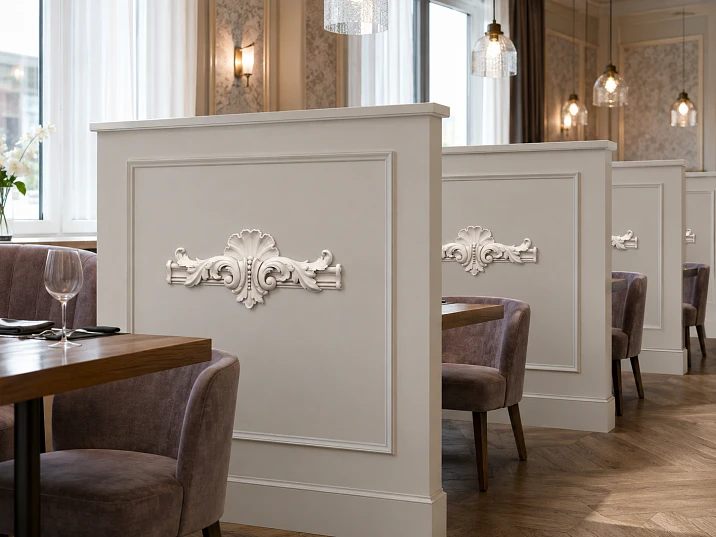
Smooth partitions between tables are already installed and painted. There is no desire to redo them, mark out a full molding frame for each section, and go through the entire volume of painting work again. At the same time, the interior lacks one repeating decorative motif that would make the partitions part of the restaurant's overall style, rather than just functional surfaces. In this situation, it makes sense to consider one central decorative overlay NPU-434.1 made of polyurethane for each section.
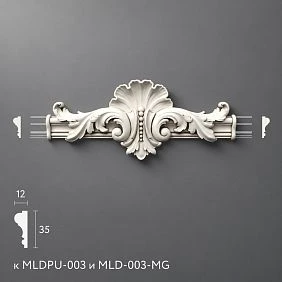
For this task, we are interested in a specific size of 303 × 127 × 25 mm at a cost of 6,250 ₽ per piece. This is not a molding, not a ceiling rosette, and not a universal "stucco detail" whose name can be changed for the sake of text variety. NPU-434.1 is a central decorative element from the decor section for moldings. The manufacturer explicitly states that it can also work independently on a smooth surface, although in a system with molding, the composition turns out more complete.
Hence the main answer: yes, NPU-434.1 303 × 127 × 25 mm can be installed on already painted restaurant partitions without a molding frame. But this does not mean that any smooth section will automatically become better from one overlay. Independent use is technically permissible; compositional appropriateness needs to be checked on a real object. In a restaurant, not only the beauty of a single element matters, but also what happens when the same ornament is repeated eight, ten, or twelve times in a row.
If the hall has eight identical partitions, purchasing the large version of NPU-434.1 is already 8 × 6,250 = 50,000 ₽ just for decorative elements. Therefore, a reasonable sequence is the opposite of an impulsive purchase: first one full-size mockup or a trial overlay on one section, then an assessment of several adjacent partitions at once, and only after that—ordering the entire quantity. If the test shows that a single relief confidently holds the center of the plane, leaves enough smooth field around it, and does not look like a fragment of an unassembled frame, the molding can indeed be omitted.
If you are already at the stage of selecting a specific product, the current dimensions and the 303 × 127 × 25 mm option can be checked in the product card and buy the central decorative overlay NPU-434.1 made of polyurethane. But before ordering the entire series, it is worth solving many more questions than "does 303 mm fit on the partition." Below is exactly such a pre-order analysis.
Why one central overlay can work without a frame at all
The origin of NPU-434.1 from the molding system can easily mislead. The buyer sees the word "for moldings" and concludes: without a frame, the element will be incomplete. This is not entirely true. The frame and the central overlay perform different compositional functions.
The molding organizes the boundary of the field. It outlines a rectangle, sets the inner and outer plane, connects the corners, and tells the eye where the decorative zone begins and ends. The central overlay does something else: it creates a point of attraction within the field. If the partition itself is already perceived as a separate finished section—for example, it has clear edges, the same size, its own paint, and rhythmically repeats between tables—the role of the boundary is already partially fulfilled by the architecture of the partition itself.
That is why a smooth stationary section can accept central decor without an additional rectangular outline. In this case, the boundary of the composition becomes not the molding, but the perimeter of the partition itself. NPU-434.1 works as an accent within an already existing architectural "frame."
This technique is especially convincing when the partitions:
-
are identical in width and height;
-
are perceived as independent panels;
-
have a calm, solid-color surface;
-
stand in a repeating rhythm;
-
are not overloaded with plaques, sconces, outlets, logos, or other graphics;
-
are located in an area where a single relief motif is readable from a distance.
Under these conditions, the large smooth area around the overlay is not a drawback but part of the composition. The empty field allows the relief to breathe. Conversely, if the central element is surrounded by a frame that is too close, a small partition can become heavy and visually fragmented.
But there is also the opposite scenario. If the edges of the section are not discernible at all, the partition is part of a long endless wall, or the plane itself is too large for a single local accent, a single NPU-434.1 can indeed look like a detail torn from its original system. Then Decor for polyurethane moldings it should be considered not as a set of separate overlays but as a constructor for a more complex panel.
The main criterion here is not "whether a molding is provided nearby in the catalog," but whether the partition itself has its own visual boundary. If it does, the central overlay can be self-sufficient. If not, the frame helps create that boundary.




Size 303 × 127 × 25 mm: how to check the scale on the partition, not on the catalog page
The numbers only give the initial geometry. The real impression depends on the area of the partition and on how much the free field around the ornament supports or weakens it.
Let's take the given example: a section of approximately 700 × 1200 mm. If NPU-434.1 is installed with its long side of 303 mm horizontally, it will occupy about 43% of the partition's width:
303 / 700 × 100 ≈ 43,3%.
This is no longer a tiny icon on a large plane. Almost half of the section's width is occupied by the central relief motif, so the product will be perceived as a deliberate decorative center. At the same time, enough smooth field remains on the sides so that the overlay does not look cramped.
In height, the ornament itself is significantly more compact. This is useful: the element can be placed in a visually important zone without turning the entire partition into a solid stucco panel. But the vertical position requires a separate solution. The geometric center of the section does not always coincide with the best visual center in a restaurant.
For example, the lower part of the partition may be partially covered by:
-
chair backs;
-
the edge of a sofa seating area;
-
the countertop;
-
guests' bags;
-
decorative planters;
-
shadow from furniture.
Therefore, it is sometimes more advantageous to raise the overlay above the mathematical midpoint. But raising it "by eye" is not acceptable: a series of eight partitions instantly reveals the slightest difference in marks. It is more correct to define one horizontal line across the hall and tie the centers of all elements to it.
A thickness of 25 mm also affects the scale. On a flat frontal drawing, 303 × 127 mm may seem moderate. In reality, the relief casts a shadow, and the element is perceived as more voluminous. Under side restaurant lighting, the depth of the pattern becomes even more noticeable. Therefore, a cardboard rectangle of 303 × 127 mm is a good first size test, but it does not replace a trial of the actual volume. If possible, it is better to make the final decision after fitting one real overlay or at least a mock-up with conditional volume.
There is no need to mathematically adjust the section size to the overlay down to the millimeter. What matters is different: the central element should be noticeable, but not turn into a coat of arms, medallion, or visual sign that the interior did not ask for. On a 700 mm wide partition, the large NPU-434.1 already has sufficient scale to work on its own. On a significantly wider surface, the same element will require a more careful assessment of the free margins.
Our factory also produces:

What makes a single decor piece cohesive, and what turns it into a "detached fragment"
The problem of using a central overlay independently is solved not by the number of details, but by the connections between them. The same NPU-434.1 on two partitions of identical size can look completely different depending on the layout, color, lighting, and surrounding objects.
There are five signs by which a single element begins to be perceived as cohesive.
Get Consultation
It has a clear axis
The overlay should be placed not approximately in the center, but along the axis of the section. The symmetrical plant ornament is especially sensitive to displacement. In a single partition, an error of a few millimeters may not be noticeable. In a series of identical sections, the accumulated inaccuracy becomes obvious: the elements seem to "float" across the hall.
Around it there is enough calm field
An empty surface is not an unfinished frame. If the overlay is large-scale and central, the free field works as a background. Standalone decor loses its persuasiveness not from the absence of molding, but from the absence of air: nearby sconces, inscriptions, switches, finish joints, and other competing details.
It has a connection with repetition
One overlay on one random partition can look like a decorative patch. Eight identically placed elements create rhythm. It is the series that can replace part of the work of a molding system: the eye understands that this is not a random detail, but a deliberate interior motif.
The finish supports the architecture, not the objectness
If the overlay is painted in the same color as the partition, the relief is read through light and shadow. Then it is perceived as part of the surface. If it is sharply highlighted with contrasting gold, bronze, or black, it becomes a separate object. This can be intentional, but the risk of a "stuck-on decoration" effect increases noticeably.
The scale of neighboring furniture does not overwhelm the element
High upholstered backs, massive tables, large lamps, and active upholstery can visually "eat up" even a 303-millimeter overlay. In such a case, molding will not necessarily save the composition. Sometimes it is more correct to change the installation height, the contrast of the relief, or the level of decorative saturation itself.
Hence an important conclusion: the independence of NPU-434.1 is determined not by the presence or absence of MLDPU-002/003, but by whether it forms a complete system of "field — axis — accent — repetition" with the partition itself. If this system exists, the frame is optional.
Eight identical partitions: why a series should be evaluated differently than a single section
Restaurant interior differs from an apartment precisely in repetition. In a living room, one decorative panel can be a unique gesture. In a restaurant hall, identical partitions form a row, and each new section reinforces the solution of the previous one.
This offers both an advantage and a risk.
The advantage is that the same NPU-434.1 on each partition creates a visual rhythm. Even without molding, guests perceive the common language of the space. The relief repeats like an ornamental refrain and helps connect different groups of tables into one interior.
The risk is overabundance. An element that seems delicate on one section can become the main motif of the entire hall with eight repetitions. If the pattern is expressive enough, the series turns almost into a signature pattern. This is good if the restaurant needs exactly that character, and bad if the overlays were only meant to "slightly decorate" the partitions.
Therefore, you need to evaluate not one mock-up in the workshop, but at least three adjacent sections in the field of view. Even if you physically have only one sample, its position can be duplicated with paper templates on neighboring partitions. Then it becomes visible:
-
whether the ornament repeats too often;
-
whether the row creates the effect of a decorative lattice;
-
whether the centers of the elements align on one horizontal line;
-
whether the rhythm of the overlays conflicts with the rhythm of the tables and lights;
-
whether a different accent or pause is needed through one section.
For eight partitions, the base cost of the large version is 50,000 ₽. This is a significant enough amount that a trial section is not "extra work" but a normal part of the purchase. If the restaurant is already operating, mistakes will later have to be corrected in the finished hall: removing elements, restoring paint, changing the composition, and refinishing surfaces.
If the layout on three adjacent sections shows a calm, confident rhythm, you can order NPU-434.1 303 × 127 × 25 mm for the entire calculated volume. If the repetition looks too ceremonial, that is a signal not to "add another frame," but first to reduce the decorative load.
Where to place the overlay vertically on the partition between tables
The horizontal center relative to the width is usually obvious. With the vertical, it is more complicated because the partition does not exist on its own, but alongside seated people, furniture, and the line of sight.
There are three main strategies.
Geometric center
This works if the partition is perceived as a whole, its lower part is not blocked by furniture, and there is a clear view from both sides. This option is the most formal and symmetrical. It is especially appropriate in classical or neoclassical interiors.
Slightly raised visual center
This often works better in a real restaurant. The lower zone of the partition is almost always visually heavier: there are tables, seats, furniture legs, and shadows. If the central decor is raised above the mathematical middle, it falls into a cleaner field and is better read from the aisle. But the amount of the raise should be determined by the layout, not by a universal number.
Binding to the common horizontal line of the interior
Sometimes the strongest point is not the center of the partition, but a line connected to other elements: the top of sofa backs, the lower edge of wall sconces, a decorative shelf, a frieze, or wall panels. Then NPU-434.1 becomes part of the restaurant's overall architectural grid.
Which option to choose is decided by the view. For a visitor, at least three points matter:
-
the passage between tables;
-
the entrance to the hall or the far perspective;
-
the seating place at the neighboring table.
If the ornament is fully visible from the passage, but from behind the table it is half-covered by a chair back, this may be normal: the accent primarily works for the overall perspective of the hall. If half of the partitions are constantly blocked by furniture, the height needs to be reconsidered.
A critical mistake is marking each section separately from its top or bottom edge. Small height deviations are especially noticeable in a long row. For a series, it is better to set one laser or measuring horizontal line and from it mark the position of each center.
When a molding frame is truly not needed
Abandoning molding is not a compromise or a "lightweight version" of a full composition. In some restaurant interiors, it yields a stronger result precisely because it preserves the calmness of the surface.
The partition itself already resembles a panel.
If the section has a distinct rectangular outline, edges, its own thickness, and is separated from adjacent structures, an additional frame may simply duplicate an existing boundary.
The restaurant needs a repeatable sign, not a classic paneled system.
NPU-434.1 can serve as a repeating ornamental motif. In this case, a frame will only complicate the message. This is especially noticeable in modern classics, where decor should be readable but not heavy.
The surfaces are already painted with high quality.
If the partitions are ready, the entire molding system means more joints, more layout, more local preparation, and likely a more extensive finish update. A single overlay reduces the scope of intervention. However, this does not eliminate preparation directly in the bonding area.
The sections are relatively compact.
On a partition about 700 mm wide, a large NPU-434.1 already occupies a significant portion of the field. Adding a frame may make the composition too cramped, especially if the molding has noticeable width and relief.
There are already many other lines in the interior.
Cornices, panels, furniture fronts, vertical slats, light tracks, partition profiles — all of this creates geometry. Sometimes a central overlay is needed precisely as a counterpoint to the lines, and a new frame would only add another rectangle.
In such cases, the absence of molding is a full-fledged design solution. If after the layout it is clear that the standalone NPU-434.1 holds the plane, there is no need to add a frame just because the product belongs to the molding decor category.
When it is better not to leave it without a frame: signs of an unfinished composition
There are situations where the central overlay itself looks weaker than a system with molding. It is important to see them before purchasing the entire batch.
The first sign is a too large and empty plane. If the partition is significantly wider and taller than the example given, NPU-434.1 may lose connection with the edges. Then the frame returns structure and explains where the decorative field is.
The second is the inexpressive boundaries of the partition itself. For example, several sections visually merge into a long wall. One ornament on each part without visible division can be perceived as chaotic. Molding frames help divide the plane into understandable modules.
The third is very classical styling. If the hall already has paneled doors, active cornices, capitals, baguette frames, and other systematic classics, a single central decor may look unfinished precisely because the rest of the interior is built on frame logic.
The fourth is weak visibility of the element from the main viewpoint. If the overlay gets lost, the frame can increase not the physical size of the relief, but the area that is read as a single decorative composition.
The fifth is the need to connect NPU-434.1 with other details. Sometimes the designer wants not a separate motif, but a full-fledged panel on each partition. Then it is already logical Buy polyurethane wall moldings to build the system deliberately, rather than adding two random strips around the overlay.
At the same time, the frame should not appear as a way to "save" an unsuccessful size or incorrect height. First, check the NPU-434.1 itself. If the element is too large, too active, or stylistically unsuitable, molding will not fix the problem—it will amplify it.
How to compare two solutions on the same object: without a frame and with a frame
The best way to make a decision is to place two options side by side, rather than arguing abstractly.
On one partition, attach a full-size template of NPU-434.1 or a test element without additional lines. On the adjacent one, mark the intended frame with painter's tape. This won't give the exact depth of the molding, but it will show the overall area and geometry.
Compare not by "which is richer," but by specific questions.
| Question | One NPU-434.1 | NPU-434.1 with a frame |
|---|---|---|
| Does the section read as finished? | It should work through the field and the central axis | The boundary is set by the molding |
| How quickly is the series installed? | Fewer details and joints | More operations and markings |
| How active is the decor? | Local accent | Full-fledged panel |
| What happens to an already painted surface? | Local intervention | Significantly larger work area |
| What does repeating eight sections look like? | Calmer, more air | Rhythm is stronger and more classic |
| What is easier to repair locally? | One single element | Element plus frame joints |
| What is better for a very large partition? | May get lost | The frame helps organize the field |
Such a test is more useful than a dozen visualizations. A real hall has its own lighting, paint texture, furniture color, and specific distances. The mockup shows all of this at once.
If a single overlay looks confident, the frame does not add fundamentally new value. If with painter's marking the surface suddenly looks assembled, and without it the element 'hangs in the air', this is an argument in favor of molding.
Already painted partition: what changes in installation
The phrase 'partitions are already painted' is fundamental. In a new product, you can design the decor in advance, glue elements, seal joints, and paint the entire system as a whole. On a finished surface, the task is different: you need to add relief with minimal interference with the existing finish.
Therefore, before installation, you need to check not only the geometry but also the condition of the paint.
The surface in the installation area must be durable. If the paint is peeling, chalking, poorly adhering to the substrate, or has a contaminated layer, the overlay will effectively be glued not to the partition but to a weak coating. In this case, the problem is not with the polyurethane or the adhesive—the weak link becomes the paint itself.
For glossy or very smooth surfaces, adhesion may require preparation. The manufacturer, in materials for NPU-434.1, recommends a preliminary fitting, cleaning of the area, and, if necessary, matting the surface. The exact preparation method must be coordinated with the paint system and the chosen mounting adhesive, because there is no universal recipe for all coatings.
On the finished object, the question of the final transition also arises. There are two different approaches:
-
the overlay is pre-painted in the desired color and installed as a separate element;
-
the overlay is installed, after which the area is locally finished and painted so that the relief is perceived as part of the partition.
The second approach usually hides the boundary better but requires more careful painting work. The first is simpler organizationally, but even a slight difference in shade or gloss level can emphasize the "glued-on" nature of the element.
For an operating restaurant, technological discipline is also important: installation must not leave traces of adhesive, masking tape, or touch-up paint on high-traffic surfaces. Therefore, a test section is needed not only for design but also to refine the entire operation—from marking to finishing.
25 mm relief and restaurant lighting: why the overlay looks different in the evening
The depth of the central overlay is 25 mm. On a vertical partition, this is not just a technical dimension but a source of shadow patterns. In a restaurant, where evening light is often more important than daylight, the relief can look significantly more pronounced than in a showroom or against a white catalog background.
With frontal diffused light, shadows are soft, and NPU-434.1 is perceived as a calm volume. With side light from sconces, directed spots, or pendants, the pattern becomes more contrasting: leaves and curls gain their own chiaroscuro. It is then that a single overlay without a frame can reveal itself particularly well—the relief already provides enough visual complexity, and the smooth field around it serves as a calm background.
But the opposite effect is also possible. If a hard shadow appears on each of the eight partitions, the repetition becomes too active. Visually, the hall begins to break up into a series of dark spots. Therefore, the mockup should be tested not only during the day, but also in the working evening scenario.
It is useful to check three modes:
-
general hall lighting;
-
evening seating with dimmed lighting;
-
local light directly at the tables.
If the relief shows beautifully in all three modes, the color of the overlay can be left close to the color of the partition. If the pattern almost disappears, you should not automatically make it contrasting: first, it is worth understanding whether more directional light is needed, or whether the calmness of the surface itself is an advantage.
Color: matching the partition, soft contrast, or a separate decorative accent
Color most strongly determines whether NPU-434.1 will be perceived as part of the architecture or as an attached decoration.
Matching the partition color
For a scenario without moldings, this is the most reliable option. A single color unites the relief with the background, and decorativeness is revealed through light and shadow. This technique is especially good if you want to keep the existing partitions calm and add depth to them without the feeling that "decor was glued on later."
The match must be not only in shade, but also in the degree of gloss. A matte partition and a more glossy overlay of the same color will still read as two materials.
Soft tonal shift
The overlay can be made slightly lighter or darker than the background. Then the ornament reads faster, but does not turn into a standalone emblem. This is a good compromise for halls with dim lighting.
Contrast accent
Gold, bronze, dark color on a light partition, or vice versa, sharply increase the visibility of the element. Eight contrasting overlays are already a very strong solution. It needs to be checked not on one section, but specifically in the perspective of the entire row.
If the restaurant builds its image around decorative classicism, contrast is possible. If the task is simply to make the partitions less empty, it is better to start with a monochrome solution. If necessary, decorativeness can always be enhanced later; removing the visual heaviness of eight contrasting elements is significantly more difficult.
How not to turn a row of partitions into an overly "palatial" interior
The fear of "will it become too palatial" cannot be resolved by the number of classical details using a formula. The same floral ornament in different interiors is perceived completely differently. The result is influenced by color, furniture, light, the distance between repeats, and whether there are other historical motifs nearby.
The standalone NPU-434.1 without a frame just allows the use of a classical ornament more restrainedly. The frame system enhances architecturality: rectangular fields, corners, and repeating contours appear. This is good for pronounced classicism, but in a modern restaurant it sometimes creates too formal a tone. One central overlay leaves a large area of clean surface around it, so the historical motif is perceived more as a quote than as a reconstruction of a classical panel.
To maintain this balance, it is useful to control four things.
First is the number of other ornaments. If the hall already has a complex ceiling cornice, carved table legs, decorative mirrors, and active lighting fixtures, eight NPU-434.1s can become the last detail after which the interior transitions from rich to overloaded. If the furniture and walls are laconic, the same repetition looks significantly calmer.
Second — color. An ornament in the color of the partition is almost always perceived as more architectural and modern than contrasting gilding. This is especially important in a series. One gold detail is an accent; eight identical gold details are already the theme of the entire hall.
Third — frames. Abandoning molding reduces the number of classical features at once. That is why the scenario of "one overlay on a smooth field" can be good for a restaurant that wants a hint of neoclassicism but does not want to turn every partition into a paneled wall.
Fourth — distance. From a close distance, the guest sees the pattern of leaves and relief. From the far end of the hall, he perceives primarily the repetition of light or dark spots. Therefore, a solution that looks elegant at a specific table must be evaluated in the overall perspective.
There is a simple test. Mentally remove furniture, textiles, and lighting from the composition and look only at the row of partitions. If the partitions themselves already resemble the decoration of a historical hall, adding frames will almost certainly enhance that character. If the clean planes remain modern, single NPU-434.1 units can provide exactly the level of decorativeness that was missing.
That is, the danger of "palatialness" is associated not with the article itself, but with the sum of techniques. One central overlay without molding is one way to reduce that sum while preserving the recognizable carved motif.
Repetition and brand image: can NPU-434.1 become part of a restaurant's recognizability
When the same ornament repeats between tables, it ceases to be just stucco decor. It becomes part of the visual identity of the space. The guest may not know the article number and may not even realize they notice the repetition, but it is precisely such motifs that create a sense of cohesion.
This is especially useful if the restaurant uses plant motifs in the menu, textiles, lighting, tableware, or graphics. Then NPU-434.1 can tie the interior to the overall theme. But there is no need to artificially turn the overlay into a logo. If you additionally apply initials, inscriptions, emblems, or contrasting gilding to it, the load will sharply increase.
Repetition works better when there are pauses. The smooth surface around the element is one such pause. That is why abandoning the frame can make a series more modern and rhythmic: each accent has air, and clean planes remain between them.
If you are designing not only partitions but the entire hall, it is useful to look at broader material on how to use stucco decor for restaurant and cafeA narrow task with NPU-434.1 should not duplicate the overall hall design, but it must align with it: one ornament on partitions will not save the interior if other decorative solutions speak a different language.
Operation in a restaurant: decor must withstand not only the gaze but also the daily work of the hall
A partition between tables is not a museum wall panel. Waitstaff approach it, chairs are moved nearby, guests touch the surface, and it is wiped during cleaning. Therefore, the installation location of NPU-434.1 should be chosen with operation in mind.
The first rule is not to place the relief in an area of constant mechanical contact if this can be avoided. If a chair back regularly touches the partition when pulled out, the decorative element is better raised higher. The same applies to places where guests usually put bags or outerwear.
The second is to account for cleaning. Relief is harder to wipe than a flat surface: dust can accumulate in the recesses. This is not a reason to refuse the product, but with eight repeating elements, maintenance becomes a systematic task. Staff must understand a safe way to clean the specific finish paint. One should not claim compatibility with any restaurant cleaning agents in advance: the chosen coating determines this.
The third is repairability. A standalone overlay has one practical advantage over a complex frame: in case of local damage, the system is simpler. Fewer joints, fewer long molding sections, fewer areas to restore. However, if all eight elements are painted together with the partitions, when replacing one, it is important to match the shade exactly.
The fourth is passages and edges. If the overlay is placed close to the edge of a section, the protruding relief may end up in an area of accidental contact. Central placement is not only more beautiful but also usually safer for operation.
Do not confuse NPU-434.1 with the wooden N-434.1
The similarity of article numbers is a real cause of ordering errors. NPU-434.1 and N-434.1 are not two spellings of the same product.
Our article refers to the polyurethane NPU-434.1, specifically the large size 303 × 127 × 25 mm. When purchasing a series for a restaurant, this must be fully specified in the specification: article number, material, size, quantity.
Why is this important? Because replacing the material changes not only the price. The character of the surface, the method of preparation and finishing, the weight of the product, the appearance of the relief, and the installation logic all change. You cannot read an article about the wooden N-434.1 and automatically transfer all conclusions to the polyurethane NPU-434.1 just because of a similar number.
In a commercial project, it is better to avoid the abbreviated notation "434.1" altogether. In the estimate and order, write the full designation. This is a simple administrative measure that protects against costly confusion in a batch.
How many to buy: one overlay per section, two sides, or with a reserve
The phrase "eight partitions" does not always mean "eight overlays." First, you need to determine how many decorative faces are actually visible to guests.
If each partition has one main front side, and it is this side that works for the perspective of the hall, the basic calculation will indeed be 8 pieces.
If a partition stands between two tables and both sides are equally open to view, another question arises: is decor needed on both sides? Then the quantity may double. But doing this automatically is not worth it. Sometimes one side faces a passage and is constantly visible, while the second is almost completely closed by a high sofa back. In such a case, symmetrical purchasing does not provide symmetrical visual value.
For each section, it is useful to compile a simple list:
| Section | Visible side A | Visible side B | Need NPU-434.1 |
| 1 | Yes | No/closed | 1 pc. |
| 2 | Yes | Yes | 1 or 2 pcs. after checking |
| 3 | Yes | No/closed | 1 pc. |
Such a table is more accurate than the formula "number of partitions = number of elements." It is especially important in commercial interiors, where identical structures can be placed in different parts of the hall.
Is a spare needed? For a small series, this depends on operation and reorder conditions. If downtime of a restaurant area due to a damaged overlay is critical, a spare element may be justified. But this is already a separate management decision, not a mandatory part of the product package.
The basic user scenario — eight visible faces and eight items — remains simple: 50,000 ₽ for NPU-434.1, excluding the cost of glue, preparation, painting, and labor.
Partition, table, and seating: decor should be tied not only to the plane
Even a perfectly centered overlay can be out of place if it was chosen without considering the table and seating. In a restaurant, a partition almost always works in conjunction with furniture: it separates one group of guests from another, forms a backdrop for a seating spot, and comes into the field of view of a person sitting opposite.
Therefore, it is useful to analyze not only the partition rectangle itself, but also the seating module. Conventionally, it consists of a tabletop, two or four seats, chair or sofa backs, a pendant light, and the dividing plane itself. NPU-434.1 should occupy a position where it does not conflict with any of these lines.
If the tabletop is noticeably lower than the center of the partition, the central decor is usually best kept above its level. Then it is visible in the overall perspective and does not intersect with the active horizontal line of the table. If the overlay falls exactly on the tabletop line, part of the ornament may be visually "cut" by the furniture, even if there is physically a distance between them.
The situation with chair backs is even more important. Tall upholstered chairs and sofa backs can cover the lower half of the partition. In an empty hall, the center of a 1200-mm section seems ideal, but with full seating, the decor disappears. Therefore, a full-size mockup should be evaluated with the working furniture arrangement, not after the chairs have been specially moved aside for wall access.
There is also the opposite mistake—raising the NPU-434.1 too high to ensure it is visible. Then the ornament ceases to belong to the seating area and starts to "fly away" toward the upper edge of the partition. This is especially noticeable when sections are placed in a long row: the decorative line ends up above the visual center of the interior and competes with light fixtures or ceiling details.
It is useful to do a simple check.
If the partitions are not all the same: where a single article number starts to create a problem
On the restaurant floor plan, partitions often look the same, but on site exceptions appear: one section is narrower due to a column, another is wider near a sofa group, a third has a technical cutout, a fourth ends at a wall. This needs to be checked before the quantity of NPU-434.1 is multiplied by the number of sections.
For the same ornament, what matters is not the absolute identity of the structures, but the similarity of the visual field. If seven partitions are about 700 mm wide, and the eighth is 1000 mm, the same 303-mm overlay will occupy a different proportion of the plane. On seven sections, it may look like a full center, but on the wide one, it may appear unexpectedly small.
There is no need to automatically solve this problem by adding a second overlay. Two identical central elements change the very compositional mechanics: instead of one center, a pair appears, and the section starts to work differently. It is much more reasonable to check three options:
-
leave the NPU-434.1 as the single center and accept a larger free field;
-
organize the wide section with a molding frame, keeping one central overlay;
-
choose a different solution for the exceptional section if it truly is a separate architectural module.
The same applies to height. If several partitions have an upper glass insert or another upper fragment, centering the overlay by the full construction height may be a mistake. It is necessary to determine the working continuous field on which the decor is located. The visual center of an opaque panel and the geometric center of the entire structure are not the same thing.
On site, it is useful to create not only a quantity schedule, but also a simple type map:
| Section type | Condition | How to check NPU-434.1 |
| Type A | Standard identical partition | Common template and unified marking |
| Type B | Wider section | Separate check of free fields |
| Type B | Partially covered by furniture | Height check when seated at work |
| Type D | Visible from both sides | Separate count calculation for each person |
| Type E | Has a different material or insert | Assessment of the work area, not the total height |
This classification is more useful than ordering "one piece per partition" without exceptions. It does not complicate the project for bureaucracy, but helps maintain a single visual standard in a truly heterogeneous hall.
If after classification it turns out that some sections do not support an independent central accent at all, this is not a reason to abandon NPU-434.1 everywhere. It can be left on standard partitions, and exceptional modules can be resolved differently — provided that such a difference is perceived as zoning, not as a configuration error.
Control of production installation: the first finished section should become the reference standard
For a single decorative overlay, installation quality is assessed locally. For eight, twelve, or twenty — it is already assessed by repeatability. Even a good craftsman can install each element neatly, but small differences in height, shade, or the amount of sealant along the edge will ruin the sense of a series.
Therefore, after the design is approved, it is useful to make one fully completed reference section. Not just attach the overlay, but bring it to the state in which it will remain in the restaurant: prepare the base, secure the element, complete the joints, painting, and surface cleaning.
After acceptance of this section, several parameters are recorded:
-
distance from the selected baseline to the center of NPU-434.1;
-
position relative to the side edges;
-
grain orientation;
-
color and degree of gloss;
-
nature of the joint with the plane;
-
acceptability of a visible seam along the edge;
-
method of temporary fixation before the adhesive sets;
-
procedure for cleaning installation marks.
This turns "do the same on the rest" into a concrete technical specification. For a restaurant project, this approach is especially useful: work is often done quickly, within limited hours, and different sections may be installed on different days.
After installing the first three elements, you need to step back to a distant point and check not each one individually, but the overall line. Laser marking may be technically correct, but the actual structure sometimes has slight deviations. It is important that the eye sees an even rhythm, not just that the tape measure shows the same numbers.
The finish is also evaluated as a series. If one trim is slightly more glossy, it may go unnoticed. Eight elements with varying degrees of gloss already create a spotted row. Therefore, it is better to prepare paint for decor using a single system, rather than mixing small portions independently for each section.
Another useful check is a photograph of a long perspective. The camera sometimes shows "floating" centers, differences in height, and too frequent ornamental repetition faster than the eye. This is not a replacement for live viewing, but it is a good acceptance tool.
If the first section shows that without the NPU-434.1 frame it looks exactly as needed, further installation becomes a repeatable operation. If on the reference sample you already have to explain to yourself why the element "seems to look okay," it is better not to rush the purchase of the entire batch. The reference sample exists precisely to stop an erroneous decision before it is replicated.
What to check before ordering the entire batch
Before buying eight or more elements, it is useful to go through one full pilot cycle.
Step 1. Fix the size and material
For this project — NPU-434.1, polyurethane, 303 × 127 × 25 mm. Do not substitute with a smaller version during prototyping and do not mix with wooden N-434.1.
Step 2. Make a template 303 × 127 mm
The template is needed for initial area check. Draw central horizontal and vertical axes on it.
Step 3. Check three adjacent partitions
One template will assess scale, three — rhythm. If physically there is only one template, mark its position on adjacent sections with painter's tape or paper copies.
Step 4. Look from working points
Not only stand directly in front of the partition. Walk the guest route from the entrance, look from the aisle, sit at the table, assess the distant perspective.
Step 5. Check evening light
The 25 mm relief should be evaluated under actual restaurant lighting.
Step 6. Determine finish
In the color of the partition, soft contrast, or accent. Preferably test on a real sample.
Step 7. Check the base
The paint must adhere firmly. The surface preparation and adhesive system must be compatible with the existing finish.
Step 8. Make one test section
This is simultaneously a design, installation, and operational test. After full drying and final finishing, assess how much the element truly looks like part of the partition.
Step 9. Compare with a framed alternative
Mark the intended perimeter with painter's tape. If the frame does not improve the composition, do not complicate the system.
Step 10. Order the series
After a successful test, you can purchase the full quantity. If NPU-434.1 does not suit you in scale, it is better to choose a different decor for polyurethane moldingsthan trying to compensate for an unsuitable element with additional details.
Mistakes that are especially costly on a series of partitions
Mistake: buying eight pieces at once based on a photo
Why it happens: the size is known, the product is liked, the sections are identical — it seems there is no risk.
Consequence: after installation, it turns out that the repetition is too active or the element looks small in the overall perspective. The mistake is multiplied across the entire batch.
How to avoid: first a template, then one real test section.
Mistake: centering each overlay separately
Why it happens: the craftsman thinks it's enough to measure half the width of each partition.
Consequence: small discrepancies in sizes and markings create a "floating" horizontal line.
How to avoid: in addition to the center of each section, set a single height line for the entire row.
Error: treating an empty field as a sign of incompleteness
Why it happens: the product is habitually seen within frames.
Consequence: a molding is added to a good, calm composition, and a small section becomes overloaded.
How to avoid: evaluate the field as an independent design resource. Add a frame only if structure is truly lacking without it.
Error: making NPU-434.1 too contrasting across the entire series at once
Why it happens: there is a desire for expensive decor to be noticeable.
Consequence: eight repetitions create a stronger effect than expected, and the ornament begins to dominate the guest area.
How to avoid: first test in the partition color or in a soft tonal difference.
Error: ignoring furniture
Why it happens: the partition is measured empty, before arrangement, or with chairs pushed away.
Consequence: real furniture covers part of the relief or regularly touches it.
How to avoid: try on the overlay with the working hall layout.
Mistake: confusing NPU-434.1 and N-434.1
Why it happens: similar article number.
Consequence: a different material or a different product system ends up in the order.
How to avoid: full specification — NPU-434.1, polyurethane, 303 × 127 × 25 mm.
When it is better to abandon NPU-434.1 altogether
Good pre-order material should show not only the path to purchase, but also situations where purchase is not needed.
Abandon the idea if the partitions themselves are already saturated: they have logos, sconces, decorative inserts, wood texture, active upholstery, or other large elements. NPU-434.1 in such a field can become superfluous.
Do not buy the series if the restaurant is extremely minimalist in style and the only reason for the stucco ornament is the desire to "fill an empty surface with something." Emptiness in minimalism can be more valuable than decor.
An overlay is not needed if furniture almost completely covers it. Decor that is only visible during hall cleaning does not solve the commercial task of the interior.
Refusal is also reasonable when the existing paint or substrate does not allow for reliable and neat installation without extensive rework. In such a case, the technical problem of the surface is solved first.
Finally, NPU-434.1 should not be used just because it allows self-installation. Permission is an opportunity, not an obligation. If a full-size mockup shows that a smooth partition looks better without any accent, leaving it clean is a professional decision.
If one overlay is not enough: what alternatives to consider
There are three logical directions, and each addresses a different problem.
A frame around the same central element is needed
Then keep NPU-434.1, but add a molding system. The manufacturer links it with the MLDPU-002 and MLDPU-003 series. This option is reasonable if the central ornament itself fits, but the large surface requires a border.
A different scale or a different pattern is needed
Then there is no point in forcibly keeping NPU-434.1. You can look at decorative elements for polyurethane moldings and choose a solution that best aligns with the width of the section and the restaurant's style.
A broader decorative language is needed for the entire hall.
If the task extends beyond the partitions—requiring cornices, wall panels, moldings, ceiling and wall decor—it's better to move from a single product to a comprehensive system and You can buy ready-made stucco matching the Baroque style. Calculate the quantity: linear meters of cornices and moldings, number of rosettes, pilasters, consoles, corner elements. Add a ten to fifteen percent allowance for trimming. within a unified project specification.
The point of alternatives is not to increase the basket. They are needed to avoid trying to force one central element to solve tasks it wasn't designed for.
Conclusion: can one NPU-434.1 be installed on each painted partition without a molding?
Yes, it can. For NPU-434.1, standalone use on a smooth surface is permitted by the manufacturer, and in a restaurant scenario it may be especially appropriate. An already painted stationary partition has its own boundaries, so it doesn't always need an additional molding frame.
The large version, 303 × 127 × 25 mm, on a section about 700 mm wide with the long side oriented horizontally, occupies about 43% of the width. This is a sufficient scale for an independent central accent. But the final decision depends on installation height, free space, furniture, lighting, and repetition throughout the hall.
For eight visible sections, the base purchase is 8 items × 6,250 ₽ = 50,000 ₽. Before such an order, it's reasonable to test one pilot unit and simultaneously mark the positions of elements on at least three adjacent partitions. This will reveal what isn't visible from a single product card: whether the repetition becomes too frequent and whether the surface requires additional framing structure.
The molding is needed not because NPU-434.1 "can't do without it," but only if it solves a specific problem: organizing too large a surface, creating a missing boundary, or supporting the classical system of the entire interior. If the smooth section already looks like a finished panel and one central overlay confidently holds its composition, the frame may be unnecessary.
After such a check, you can make a conscious decision Buy Polyurethane Molded Decoration in the required configuration: only NPU-434.1 for independent accents, or central overlays together with moldings, if the test showed the need for a frame.
FAQ
Can NPU-434.1 be installed only on some of the partitions, and not on all?
Yes, if the choice follows a clear logic: for example, only sections in the central part of the hall, the VIP area, or along one perspective receive the decor. Random alternation of "here it is, here it isn't" looks like a shortage of configuration. Before such a decision, you need to view the hall as a whole and understand whether the partial repetition forms a separate zone.
What to do if both sides of the partition are visible to guests?
Evaluate each side as a separate decorative face. If both sides are equally open and important, two overlays per section may be needed. If one side is almost completely covered by furniture, duplication is not necessary. The quantity is calculated based on actually working surfaces, not just the number of partitions.
Can NPU-434.1 be installed vertically?
The physical possibility of rotating a decorative element does not mean that a vertical composition will be successful. NPU-434.1 reads as a central symmetrical ornament, and for our task, horizontal installation with the long side of 303 mm is considered. Any other rotation needs to be separately checked against the pattern and overall composition, and should not be automatically considered equivalent.
Are side decorative elements needed if there is no frame?
No, they are not required. If a single central NPU-434.1 already provides a complete accent, additional details can only overload a compact partition. Side elements are needed only when you are consciously building a more complex ornamental system.
Can the overlay be left white on a colored partition?
It can be done as a design technique, but it sharply increases contrast and makes the repetition of eight elements much more active. For a finished restaurant, it is safer to first check one white mockup under evening lighting. If it is perceived as a foreign applique, it is better to paint the decor in a matching tone or a close shade.
How can you tell that NPU-434.1 is installed too low?
If it is regularly blocked by chair backs, guests touch the relief with clothing or bags, and only the upper part of the ornament is visible from the aisle, the height should be reconsidered. The central mark should be determined not only by the geometry of the panel, but also by the working furniture layout.
What is more important for the series: the same distance from the top edge or a single line across the hall?
If the partitions are truly identical and installed strictly at the same mark, both approaches will coincide. On a real site, minor installation discrepancies are possible, so visually a single horizontal line of centers is usually more important. It is better to check it with a laser level along the entire row.
Can the overlays be installed first and then decide whether moldings are needed?
Yes, this is a reasonable sequence if the surface and finish allow for subsequent refinement. Moreover, for finished partitions, this approach reduces risk: minimal intervention is checked first. If a single element does not organize the plane, the frame can be designed based on the actual result.
Is it necessary to use the same color NPU-434.1 on all partitions?
If the goal is a unified rhythm of the hall, identical finishing is usually stronger. Different colors make sense only as part of deliberate zoning. Otherwise, the differences will look like a mismatch of batches or a local repair.
What to do if one overlay gets damaged after a year?
Keep the exact specification: NPU-434.1, polyurethane material, size 303 × 127 × 25 mm, as well as finish paint data. This simplifies reordering and local restoration. If fast service is critical for the restaurant, the spare part issue can be resolved during the initial purchase.