Article Contents:
- Wooden leg MN-234: one version for a low table
- The word "oval" can hide different contours
- The center of the leg is placed under the tabletop — but what about its entire diameter?
- Round leg and square mount: checking both contours
- Moving legs inward: where geometry ends and table testing begins
- Full-size template: checking the layout before drilling
- When MN-234 is better not to order for the chosen oval
- Same wood in tabletop and legs — or intentional contrast
- How much does the MN-234 set for an oval table cost?
- Order wooden supports according to the agreed specification
- Questions before purchasing legs for an oval tabletop
- Can an oval tabletop be marked out as a rectangle of the same dimensions?
- Why is it not enough to check only the centers of the four supports?
- Are an ellipse and a tabletop with semicircular ends checked the same way?
- Why does an 80 × 80 mm plate require checking near a leg with a diameter of 86 mm?
- Can the legs simply be moved closer to the center?
- Are four MN-234 units mandatory for an oval coffee table?
- What is included in the calculated 12,000 or 16,920 rubles?
- What data should be ready before ordering?
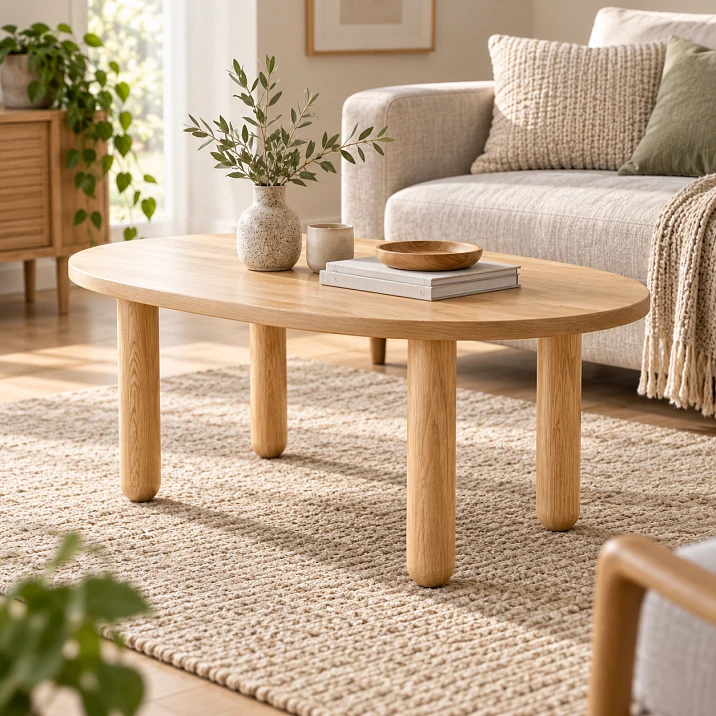
An oval tabletop looks softer than a rectangular one, but it is the rounded edge that makes the leg layout less obvious. For a round support, it is not enough to place a point of its center inside the outline and decide that the spot is found. The leg itself, the selected mounting assembly, and the fastening zone must fit completely under the tabletop, and the resulting arrangement must be suitable for the specific table.
Let's examine a hypothetical project for a low coffee table. The MN-234 shape is already appealing, the 350 × 86 × 86 mm version is chosen, and four supports are considered as the initial layout. This is not a rule for any oval table: the number and placement of supports are determined by the design of the specific piece.
The order of work here matters more than a pretty picture. First, the actual outline of the underside of the tabletop is recorded, then the full outline of the legs and fasteners is drawn, several placement options are checked, and only after that is the order placed. This approach is especially useful if you want to buy legs for a coffee table, without deferring the geometry decision to the time of assembly.
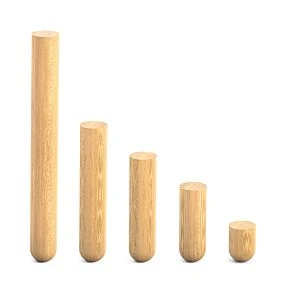
Wooden leg MN-234: one version for a low table
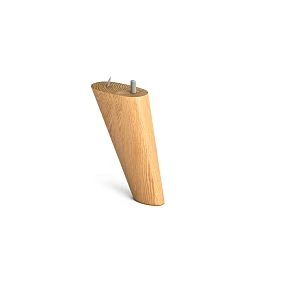
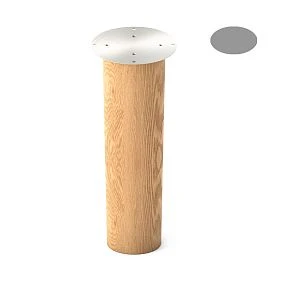
For this task, the turned furniture leg MN-234 with a height of 350 mm is considered. The selected version has an external dimension B × C of 86 × 86 mm; the shape is cylindrical, so for the plan check it is convenient to work with a diameter of 86 mm and a radius of 43 mm. Materials are beech or oak, sanding quality is "Prestige".
| Parameter | Selected execution |
|---|---|
| Model | MN-234 |
| Size A × B × C | 350 × 86 × 86 mm |
| Shape | Cylindrical |
| Diameter | 86 мм |
| Material | Beech or oak |
| Sanding | «Prestige» |
| Beech, price per leg | 3 000 ₽ |
| Oak, price per leg | 4 230 ₽ |
Prices refer to the card as of September 6, 2026. This is the price of a single leg, not a finished table or a complete mounting assembly.
Before buy wooden legs MN-234, specify the exact selected size in the specification. Writing "four round legs" is insufficient: MN-234 has other heights, and the same article number without a size does not describe the finished furniture.
The height of the table is calculated along the entire dimensional chain. If the tabletop has its own thickness, and the mounting unit actually changes the final height, these values are taken into account according to the real structure. This article does not need to re-compare the entire MN-234 size range: for an oval coffee table, it is more important to check the position of the already selected 350-millimeter support.
There is no need to plan arbitrary shortening of the part in advance if the finished item turns out taller than desired. First, change the specification or design and re-check the connection. The catalog size is the initial condition of the project, not a blank that can necessarily be trimmed on site without consequences.




The word "oval" can hide different contours
The main mistake in marking begins even before the legs: the word "oval" is often used for tabletops of different geometries. Their maximum length and width may match, but the edge near the ends will run differently.
The first option is a mathematical ellipse. Its curvature changes continuously along the entire perimeter. The second is a rectangular middle part and two semicircular ends: such a contour is closer to a "capsule". The third is a free designer shape, where radii, straight sections, and transitions are defined by a drawing or template. For placing legs, these three shapes cannot be considered interchangeable.
Let's imagine two tabletops 1000 × 600 mm. In an ellipse, the side line begins to curve inward immediately after the central zone. In a "capsule", the long sides can remain straight almost to the start of the semicircular end. A point that is safe for a round support on the second tabletop may be too close to the edge on the first. Therefore, the rectangle 1000 × 600 mm shows only the external dimension, but not the working area for fasteners.
The actual contour of the bottom surface is needed. If the tabletop already exists, it can be transferred to paper, cardboard, or a sheet template at a 1:1 scale. If it is being designed, the workshop must provide an accurate drawing, not just two external dimensions.
The underside is examined separately. From above, the edge may look wide, but from below it may have a bevel, radius, undercut, technological groove, or another area that the fastener must not hit. The top view does not show the material thickness at the screw location and does not indicate where inserts are provided.
A practical layout must include at least three boundaries: the outer contour of the tabletop, the actually usable mounting area, and zones occupied by other elements. Only after this do the center points of the supports appear. If the contour has not yet been obtained, it is too early to choose the final arrangement, even when four legs visually look good on the render.
Our factory also produces:

The center of the leg is placed under the tabletop—but what about its entire diameter?
For the round MN-234, it is useful to distinguish between the center point and the area occupied by the support. The radius of the selected leg is 43 mm. Therefore, after assigning the center, a circle with a diameter of 86 mm must fit entirely around it, if this particular outer contour defines the part of the assembly closest to the edge.
Consider a training counterexample. Let the tabletop be a mathematical ellipse of 1000 × 600 mm. Its semi-axes are 500 and 300 mm. The origin of coordinates is at the center of the tabletop, and the trial center of the leg is chosen at the point (350; 200).
For a point inside the ellipse, the following check is performed:
(x / 500)² + (y / 300)² < 1.
Let's substitute the center:
(350 / 500)² + (200 / 300)² ≈ 0,934 < 1.
It turns out that the center is indeed inside the tabletop. If only a cross is marked on the diagram, everything looks correct.
Now let's check at least one point on the outer circle of the leg. Moving up from the center by its radius of 43 mm, we get the coordinate (350; 243):
(350 / 500)² + (243 / 300)² = 1,1461 > 1.
This point is already outside the ellipse. That is, the condition "center inside" is satisfied, but the condition "entire leg inside" is not.
In the same section, the upper boundary of the ellipse at x = 350 is approximately at y = 214 mm. Between the test center y = 200 and the boundary vertically, only about 14 mm remains, while the leg radius is 43 mm. This is another simple way to see the problem specifically in this educational example.
| What is being checked | Result for the example |
|---|---|
| Center (350; 200) | Inside the ellipse |
| Radius MN-234 | 43 мм |
| Circle point (350; 243) | Outside the ellipse |
| Conclusion | Center fits, full contour does not |
These coordinates are deliberately chosen as unfavorable and should not be transferred to a real project. The formula also does not define strength, stability, allowable overhang, or fasteners. It only shows geometric error.
For practical marking, it is not necessary to calculate the equation of each tabletop. On a full-size template, you can cut a circle with a diameter of 86 mm and move it along the bottom contour. In CAD, it is more convenient to build the actual silhouette of the support and check intersections. If the tabletop shape is free-form, this method is more reliable than trying to replace it with an "approximate oval."
It is useful to create an internal boundary of permissible centers as well. It is not derived from an arbitrary "by eye" offset, but from the actual contour of the part that needs to be placed. For a round leg in the simple case, this means that the center must be far enough from the edge so that the entire circle remains inside. For a mounting plate, the shape of this safe zone will be different.
Get Consultation
Round leg and square mounting: checking both contours
Even when the circle MN-234 fits completely under the tabletop, the marking is not finished yet. In the recommended hardware, next to the model, there is a square mounting plate FUR-044. Its card indicates dimensions 80 × 80 × 15 mm, rounded corners, and M8 thread. In the description of the metal support element, a thickness of 2 mm is separately specified, so dimension C = 15 mm cannot automatically be called the sheet thickness.
FUR-044 should be considered as a candidate for the assembly, not as an automatically mandatory part of every MN-234. The compatibility of the entire assembly, the fastening to a specific tabletop, and the number of elements must be confirmed by the installer.
Here an interesting geometry appears. The plate side of 80 mm is smaller than the leg diameter of 86 mm, but it does not follow that the square will completely hide inside the circular projection. For a perfect 80 × 80 mm square, the diagonal is:
√(80² + 80²) ≈ 113.1 mm.
From the center to its corner is about 56.6 mm. The leg radius is 43 mm. If the plate contour were an ordinary sharp square and the centers coincided, its corners would protrude beyond the leg circle by about 13.6 mm. FUR-044 has rounded corners, so the actual silhouette must be taken from the real part or an accurate drawing; the given calculation only shows why comparing just '80 versus 86' is not possible.
When placing near an oval edge on the same diagram, both contours must appear: the leg and the selected mounting. Then check the holes, the working material thickness under them, and the distance to areas where the underside of the tabletop is weakened by a chamfer, groove, or other structural element.
If the installer has approved this particular hardware, it is possible buy the mounting plate FUR-044 only after checking the assembly. There is no need to reduce the number of fasteners, move holes closer to the edge of the plate, or rotate it just so that the picture "fits": any changes to the connection require separate approval.
Move the legs inward: where geometry ends and table verification begins
If a circle or plate crosses the edge, the first obvious move is to shift the support closer to the center. Geometrically, this may solve the problem. Structurally and visually, the new layout still requires a separate check.
Make two or three versions on one contour. For example, in the first, the legs are closer to the ends and are more prominent from the sofa side; in the second, they are shifted inward enough so that the entire mounting assembly confidently sits in the usable zone; in the third, not only the offset changes, but also the distance between pairs of supports. You need to compare not only the front top view, but also the side projection of the finished table.
An excessive shift may raise new questions. The supports visually move closer together, the free overhang of the tabletop increases, and the position of the legs relative to a seated person and the walkway changes. This does not mean that a particular layout is bad; it means that eliminating one intersection is not automatic confirmation of the entire structure.
Do not derive the load capacity of the finished table by simply adding up the ratings of individual legs. The tabletop, connections, distances between supports, and lateral forces are all involved. Likewise, you cannot assign four legs just because four are conveniently symmetrical to draw on an oval. In this article, the four is needed for purchase calculations, not as a universal furniture standard.
The useful result of this stage is a bottom layout approved by the manufacturer. It shows the actual tabletop contour, support axes, outer leg contours, mounting elements, and necessary clearance zones. If such a layout cannot be obtained, it is better to first choose a different placement or configuration rather than buy parts with the mindset of "we'll figure it out during assembly."
If after checking it turns out that MN-234 does not fit the specific geometry, this is a normal design outcome. You can return to the section where Wooden furniture legssupports with a different outer contour or mounting logic are collected, and look for one. Buying an unsuitable model to preserve the original sketch usually creates more constraints than changing the decision before drilling.
Full-size template: checking the layout before drilling
When the tabletop is already manufactured, the most straightforward way to check is to transfer its bottom contour at a 1:1 scale. For this, you do not necessarily need to drill test holes right away. On paper, cardboard, or thin sheet material, mark the outer boundary, chamfer and undercut areas, existing inserts, and then mark the proposed support centers.
For MN-234, it is convenient to make a separate round template with a diameter of 86 mm. It shows the outer projection of the leg. If FUR-044 is being considered, a second template of 80 × 80 mm is made with actual rounding based on the real part or drawing. These contours should not be combined into one conditional circle: they have different shapes, and near the oval edge, it is precisely the difference in shape that can determine the outcome of the inspection.
The working sequence is simple. First, the craftsman places the centers where the overall composition requires them. Then he applies the circles of the legs and the templates of the mounting elements. After that, he checks that no working area falls into the bevel zone, cutout, or too-thin edge. Only as the last step is symmetry and appearance compared from several directions.
If the tabletop is symmetrical, it is convenient to draw two axes and set positions relative to them. But mirror placement does not eliminate a separate check of each spot: the underside may have a local recess, knot, insert, or another structural element. For a new serial tabletop, these features should be reflected in the documentation; for an existing one, they should be recorded during inspection.
It is useful to keep the approved template until assembly is complete. On it, you can mark positions H1–H4, the material of each leg, and the orientation of the visible side. Then, during finishing and installation, the parts will not be mixed up. If one support was previously used as a coating sample, it is immediately included in the same marking.
The template does not replace the engineering check of the structure. It solves a specific task: it shows whether the real geometric contours fit within the intended area. After that, the contractor confirms the tabletop material, fastening, sufficiency of connections, and suitability of the entire layout.
When MN-234 is better not to order for the selected oval
Rejecting a specific model is a normal result of the check. MN-234 should not be purchased just because its cylindrical shape beautifully repeats the rounded tabletop.
It is reasonable to change the decision if the full contour of the leg or approved fastening does not fit without undesirable shifting; if after moving the supports they end up in a compositionally or structurally poor place; if the underside of the tabletop does not provide a suitable mounting zone; if the chosen height does not match the design height of the table.
Such contradictions should not be fixed by reducing fasteners, randomly trimming supports, or installing a mounting plate partially over a void. In such a case, it is better to return to wooden furniture legs and choose a different outer contour or reconsider the base design before purchasing.
One wood in the tabletop and legs — or an intentional contrast
After geometry, the appearance can be coordinated. Beech and oak are two available materials for MN-234, but choosing the wood species does not replace the finish specification. "Prestige" indicates the quality of sanding, not a ready color, varnish, or enamel.
If the tabletop is also wooden, it is not necessary to aim for a literal match of the texture of every part. Natural wood has a variable grain pattern. For the project, it is more important to decide in advance whether a close tone, lighter legs, dark contrast, or opaque painting is needed.
Samples are viewed together: the tabletop, one leg, and the chosen coating system. For semi-transparent finishes, the suitability of a specific blank is confirmed separately. For opaque enamel, the color and gloss level are also recorded, not just limited to the word "white."
A detailed understanding of the differences in preparation can be found in the section quality of wood and sanding. At the same time, the finish should be coordinated before final installation: a trial assembly should confirm the geometry, and finishing operations should not hide an unresolved fastening issue.
Four legs do not have to look like four copies of one wood grain pattern. If natural differences are critical to the composition, the set is accepted and laid out by position before finishing: front left, front right, back left, back right. This simplifies the coordination of visible sides and avoids having to swap parts after the coating is already applied.
How much does the MN-234 set for an oval table cost
For the arithmetic, let's leave a hypothetical project with four supports 350 mm high. The price of one beech MN-234 is 3,000 ₽, and oak — 4,230 ₽.
| Material | One leg | Four legs |
|---|---|---|
| Beech | 3 000 ₽ | 12 000 ₽ |
| Oak | 4 230 ₽ | 16 920 ₽ |
The difference between four beech and four oak parts is 4,920 ₽.
If the manufacturer approved four FUR-044 at 490 ₽ each, the cost of the plates will be:
4 × 490 = 1 960 ₽.
Then the intermediate sum of "legs + these four plates" will be 13,960 ₽ for the beech option and 18,880 ₽ for the oak one. This is still not the price of the finished table or the full mounting kit.
In the estimate, the tabletop, other parts of the confirmed joint, support feet if needed, finishing, assembly, packaging, and delivery remain separate. If a trial MN-234 is purchased first and then included in the final kit, it should not be counted twice.
Price is not a reason to choose beech over oak or vice versa if the material is already set by the design and finishing method. But calculating four items allows you to see the real difference before payment, not after the cost of one leg was mentally taken as the cost of the entire base.
Before placing an order, it is worth checking current prices and payment and delivery terms for the legs, because the cost of the product and logistics are different order lines.
Order wooden supports according to the agreed specification
A good request starts not with quantity, but with an already proven scheme. The seller needs to be given a specific product item, material, finish, and number of parts. For the table manufacturer, a completely different set is needed: the contour of the underside, the location of joints, the tabletop cut, the finish, and operating conditions.
For a conditional project, the order line might look like this:
MN-234 / 350 × 86 × 86 mm / beech / "Prestige" / confirm blank quality / 4 pcs. according to the agreed scheme.
If oak is selected, a different quantity, or different preparation, the line is changed. The training coordinates (350; 200) from the calculation above are not transferred into it: they specifically showed an unsuccessful location.
By the time of payment, four independent issues must be resolved. First, the selected height provides the required height of the finished item. Second, the entire contour of the legs fits on the usable part of the tabletop. Third, the mounting assembly is approved separately from the decorative geometry. Fourth, the composition of costs is clear.
After that, you can order legs MN-234 already as part of a specific project, rather than as four identical items whose place will be sought after delivery.
Questions before purchasing legs for an oval tabletop
Can an oval tabletop be marked out as a rectangle of the same dimensions?
No, if the legs are near the rounded edge. The rectangle shows the maximum length and width, but not the actual edge line. For an ellipse, a "capsule," and a custom oval, the free zone near the ends differs. For marking, the actual contour of the underside is needed.
Why is it not enough to check only the centers of the four supports?
The center is a point without size, while MN-234 occupies a circle with a diameter of 86 mm. Even if the center is inside the oval, it can be so close to the edge that part of the leg extends beyond it. Additionally, the mounting element is checked, which may have a different outer contour.
Are an ellipse and a tabletop with semicircular ends checked the same way?
Principle one: compare the actual countertop contour with the full contours of the parts. But the geometry itself is different. For a mathematical ellipse, an equation can be used; for straight sides with semicircles, it is more convenient to work with the actual drawing; for free-form shapes, use a CAD contour or a full-size template.
Why does an 80 × 80 mm plate require checking next to a leg with a diameter of 86 mm?
Because comparing one side of a square with the diameter of a circle does not describe the corners. For an ideal 80 mm square, the distance from the center to the corner is about 56.6 mm — greater than the leg radius of 43 mm. In FUR-044, the corners are rounded, so the actual overlap is checked against the real geometry, not just two numbers.
Can the legs simply be moved closer to the center?
This can eliminate the intersection with the edge, but then the entire table needs to be re-evaluated. The distances between supports, overhangs, appearance, and joint performance will change. Geometrically "it fits" is only one stage; the design is approved separately.
Are four MN-234 legs the required quantity for an oval coffee table?
No. Four supports are used here as a conditional project and a convenient cost example. The actual quantity, positions, and the need for additional structural elements are determined by the specific table's construction.
What is included in the calculated 12,000 or 16,920 rubles?
Only four MN-234 legs of the selected height at the price as of the check date. The tabletop, mounting elements, other fasteners, finishing, assembly, delivery, and other work are not included in these amounts. Even adding four FUR-044 units does not turn the calculation into the price of a finished table.
What data should be ready before ordering?
The selected version MN-234, the actual contour of the underside of the tabletop, agreed support positions, confirmed mounting assembly, material and finish, and the actual number of parts are needed. If at least the fastening or geometry is not yet approved, it is wiser to close this issue before payment than to postpone the decision until installation.