Article Contents:
- Why you shouldn't choose trim based on a photo alone
- Size first, design second: what to look for in a profile product page
- Cross-sectional dimension
- Product length
- Material and workmanship
- Can you choose wooden molding from a photo alone?
- Which matters more — the photo or the size?
- Why can't MLD-001 and MLD-050 be compared visually alone?
- Should you look at the cornice drawing?
- Where to order physical samples?
- Can you calculate the quantity before choosing the material?
- What should you keep after ordering?
- Where to compare skirting boards, mouldings, and cornices?

In an online catalog, two wooden mouldings can look almost identical: both are shown up close, both take up the same area in the photo, both have a similar wood color. But one profile might be 10×6 mm, and the other — 65×18 mm. On screen, the difference is smoothed over by the image scale; on the wall, it changes the entire composition.
That's why a large order of skirting boards, mouldings, and cornices cannot be put together from photos alone. A project purchase requires a different sequence:
product page → SKU → full size → cross-section → material → commercial length → physical sample if needed → check in the interior → specification → quantity → order.
So wholesale building store becomes not just a showcase with images, but a project specification tool.
The STAVROS catalog currently features 92 molding and trim items. There are filters by purpose, material, and dimensions, and physical samples and display stands are available for preliminary approval. This is convenient, but the buyer still needs to correctly read the card of each selected SKU.
For an initial selection, you can open the section Wooden trim, and then compare specific profiles using technical data.
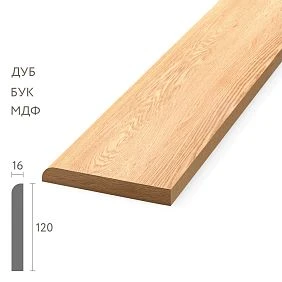
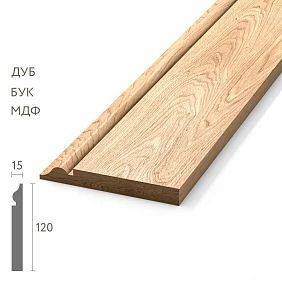
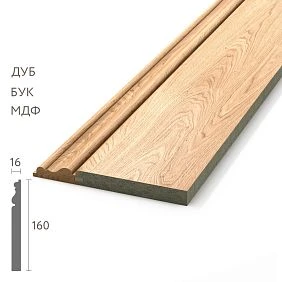
Why molding and trim cannot be selected by photo alone
A photo shows the overall pattern, the shape of the face, the character of the relief, and the visual style well. But a photo poorly conveys the real scale.
In online store product cards, small and large profiles can be displayed at the same image width. The buyer subconsciously compares the shape but forgets to compare the millimeters.
Working rule:
the photo shows the design; the size shows the scale; the cross-section shows the actual geometry.
If 4–6 meters are purchased for a small part, the error is still limited. If the specification calls for 300–500 meters of one profile, the wrong scale already turns into an expensive rework.




Size first, design second: what to look for in a product page
Moulding requires at least three groups of data.
Our factory also produces:

Cross-sectional dimension
It determines the actual scale of the product on a wall, furniture, or door portal.
Get Consultation
Product length
It is needed to calculate the quantity, cutting, and number of joints.
Material and workmanship
A single SKU can exist in beech, oak, and MDF, and individual versions may differ not only in price but also in length or thickness.
Therefore, the line "moulding MLD-" is not a complete specification. Better: **MLD- / A×C×L / oak / version ___ / quantity ___**.
How to read a product page without assumptions
A moulding product page contains letter dimensions and a drawing. You cannot automatically assume that any parameter A always means the same thing for all products unless this is confirmed by the diagram on the specific product page.
Correct sequence:
- open the product card;
- open the drawing;
- verify the size designations;
- transfer the actual combination into the project;
- do not replace it with the words "approximately wide" or "almost the same."
If the designer works in CAD, it is useful to add the profile cross-section to the model at a 1:1 scale. If there is no CAD, print the drawing at full size and place it against the wall or furniture.
Wooden molding MLD-001 and MLD-050: two profiles that a photo can visually make look equal
The current product cards provide a good example.
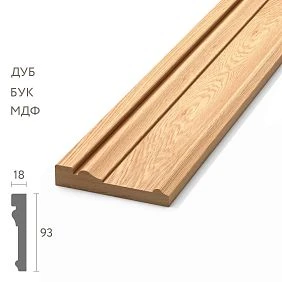
MLD-001 has a cross-section of 10×6 mm. MLD-050 — 65×18 mm.
For parameter A, the difference is 65 / 10 = 6.5 times. For parameter C — 18 / 6 = 3 times.
If both products are shown close-up without a ruler, the small MLD-001 is easily perceived as a regular wall profile, and MLD-050 — simply as a slightly more textured version. In a real composition, these are completely different scales.
For comparison, you can open Wooden Moulding MLD-001 и Wooden molding MLD-050.
How to compare two similar moldings before ordering
| Parameter | MLD-001 | MLD-050 | | --- | ---: | ---: | | A | 10 mm | 65 mm | | C | 6 mm | 18 mm | | Solid wood length | 1000/2400 mm | 2400 mm | | MDF length | 2600 mm | 2600 mm | | Materials | beech, oak, MDF | beech, oak, MDF |
The price per single plank should not be the first criterion. First, the role of the profile in the composition is determined, then the material and length, and only then the cost.
Wooden skirting board: a photograph does not show its real height in the room
The skirting board is perceived relative to the door, wall height, flooring, furniture, and adjacent moulding.
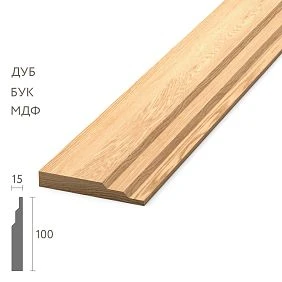
For example, PLT-006 has an A parameter of 100 mm. For solid wood, its product page shows the configuration 100×15×2400 mm; for MDF, 100×16×2600 mm.
In a separate photograph, these versions look like a single profile. In purchasing, they are already different line items: the material, thickness, and commercial length differ.
You can check the example on the product page wooden skirting board PLT-006.
Why it is better to check skirting board height next to a door
A door provides a clear scale reference. If the skirting board is lying on a table, 100 mm may seem a moderate size. If the same profile is placed at a doorway, it becomes clear how high it raises the lower architectural line, how it relates to the door casing, and whether it looks too massive.
In a showroom, a skirting board sample is best displayed in a position close to real installation.
Wooden cornice: the frontal photo shows only part of the geometry
For a cornice, a cross-section drawing is especially important.
The current KZ-001 has a dimensional combination of 104×102×24×17 mm, and the length depends on the version — 2000, 2400, or 2600 mm.
A single frontal image does not allow you to reliably understand how the profile occupies the space between the wall and the ceiling.
Therefore, before ordering the wooden cornice KZ-001 you need to open the drawing and read the parameters specifically from it.
You must not independently assign installation meaning to the letters A, C, D, and E if it is not confirmed by the official diagram.
Why a large cornice can look small in a photo
The product card scales the image to fit the screen. A profile about 100 mm wide and a thin molding can occupy the same 600 pixels across the width of the photo.
In interior design, scale returns to real millimeters.
For a large cornice, it is useful to print the cross-section at 1:1 scale, make a cardboard template, or order a physical sample if available.
Building materials wholesale stores: what data should accompany a project product
Phrase building materials wholesale stores sounds unusual in everyday speech, but the task behind it is clear: the buyer needs a catalog from which an accurate specification can be assembled.
For a project SKU, the following must be available or confirmed: item code, name, material, full size, length, finish options, photo, drawing, availability or order status, and the price of the selected configuration.
If one of the critical parameters is missing, it is better to clarify it before payment rather than substitute a guess.
Why the name “wooden molding” is not enough for a specification
For a private buyer, the phrase “that wide oak molding” can work while the tab is open in the browser. For a B2B order, it cannot.
Four months later, the repeat purchase may be made by a different person. They must receive: item code → size → material → length → finish.
A photograph helps with selection, but a repeat order must be reconstructed from documents.
Oak, beech, or MDF: one profile can correspond to several product lines
PLT-006 already shows this problem: solid wood and MDF differ in length and thickness.
MLD-001 also has several variants: beech and oak 1000 mm, beech and oak 2400 mm, MDF 2600 mm.
This means the entry MLD-001 — 50 pcs. is insufficient. The full configuration must be recorded, otherwise during cutting calculation the purchaser may count 2400 mm, while a different length ends up in the order.
When a physical sample is really needed
A sample is especially useful if a large volume is being purchased, the profile is complex, two candidates are close in pattern, the project has an expensive finish, the product must join with another profile, the designer needs to approve the real scale, or the decision is being made for a series of rooms.
STAVROS has a separate section product samples, where wooden baguette samples, molding sets, and display stands are presented.
When a sample may be skipped
A physical sample should not become a mandatory ritual for every item.
It may be unnecessary if the same profile has already been used on the project, there is a saved approved fragment, a small quantity of a familiar SKU is being purchased, the geometry and finish have already been verified in a previous batch, or the decision does not affect adjacent elements.
The criterion is simple: a sample is needed when it genuinely reduces the risk of making the wrong choice.
How to check a sample directly in the room
The sample should be placed where it will actually be used.
Baseboard — against the floor and wall.
Molding — at the intended frame height.
Cornice — in the upper area of the wall.
Door casing — next to the door.
After that, look from a distance of 2–4 m, under daylight and evening lighting, next to the furniture and adjacent profiles.
This is how you check not the beauty of an individual piece of wood, but its real scale.
Why samples are better compared simultaneously
If you look at the skirting board today, the moulding tomorrow, and the cornice a week later, memory begins to replace real comparison.
It is better to place several candidates side by side: PLT-A + MLD-A + KZ-A and PLT-B + MLD-B + KZ-B.
Then you can see which profile is too small, which one draws all the attention, and which one works as a background.
Wholesale building material stores: a sample does not replace an exact specification
wholesale building materials stores may show physical stands and samples, but a piece of profile by itself is not yet an order.
Next to the sample there must be the article number, size, material, available length, a link or QR to the product page, and the number of the approved option.
Bad note: “wide moulding”.
Good: MLD-050 / 65×18×2400 / oak / quantity after cutting.
How to use a display stand in a showroom
A stand is useful when it helps to understand scale, not just stores samples.
A good display shows the profile vertically and horizontally, the adjacent skirting board, the moulding at wall level, the cornice in the upper zone, a label with the article number and size, and a QR code to the product card.
STAVROS sells individual display stands and sample sets. For a store, this makes it possible to physically compare several profiles without having to keep the full length of each SKU in the sales area.
How to check the profile if the site is not ready yet
If the walls have not yet been painted and the doors have not been installed, but the trim needs to be chosen now, you can assemble a control plane:
- a fragment of the wall color;
- a floor sample;
- a door casing or its template;
- molding;
- plinth;
- cornice or its cross-section.
Even a temporary stand gives more information about scale than individual browser cards.
What to do if the card and the sample are perceived differently
The screen depends on the scale of the photo, the lighting during shooting, the monitor's color rendering, the angle of the image, and the background.
Therefore, the priority is as follows:
SKU and drawing → physical size → sample → photo as a visual supplement.
If the sample does not match the expected geometry according to the card, you should first verify the SKU and dimensions, rather than explaining the difference as a "photo feature."
How to calculate the quantity after the final profile selection
First the SKU is approved, then meters and pieces are calculated.
Suppose you need 41.4 m of skirting board.
For PLT-006 with a length of 2400 mm:
41.4 / 2.4 = 17.25, meaning a minimum of 18 planks.
For the 2600 mm version:
41.4 / 2.6 = 15.92, meaning a minimum of 16 planks.
The same net linear meters yield different quantities of product. Therefore, you cannot first calculate “18 PLT-006” and then choose the material and length afterward.
Why quantity cannot be calculated before the length is approved
Let's assume a requirement of 96 m.
2400 mm plank:
96 / 2.4 = 40 pcs.
2600 mm plank:
96 / 2.6 = 36.92, meaning a minimum of 37 pcs.
The difference is three product units even before accounting for cutting.
If the project has many short sections, the final difference may be different. The calculation in pieces should always be done after selecting a specific configuration.
How to check the real scale of a profile without a physical sample
If a sample cannot be obtained quickly, an intermediate check is still possible.
The simplest method is to print the cross-section of the profile at a 1:1 scale. Before printing, you need to make sure that the program has not enabled automatic "fit to page." After printing, the control length on the sheet is checked with an ordinary ruler.
Then the template is placed where the profile will be used.
For a baseboard, against the wall at the floor. For a molding, on the intended frame line. For a cornice, against the upper area of the wall or against a corner mockup.
Such a paper template does not show the wood texture and the actual depth of surface treatment, but it answers the question of scale well.
This method is especially useful if you need to quickly narrow down two options: for example, one that is too large and one that is too small. After that, a physical sample is ordered only for one or two final candidates, rather than for ten profiles in a row.
What to check in the product card before requesting a quote
Before sending the list to the manager for calculation, it is better to do your own initial check.
For each item, the buyer should see:
- exact article number;
- current size;
- the material;
- commercial length;
- selected finish;
- quantity after cutting;
- link to the product card;
- note whether a sample is needed.
Then the request does not look like this:
Need skirting boards and moldings for a house, calculate wholesale.
But like this:
PLT-006 / oak / 100×15×2400 / 18 pcs.; MLD-050 / oak / 65×18×2400 / 24 pcs.; samples MLD-050 and KZ-001 are needed before confirming the main order.
This way the manager counts a specific set instead of trying to redo the designer's work.
How not to confuse visually similar SKUs after several days of selection
When 15–20 tabs are open, the names quickly blur together. Especially if several products have similar photos.
A practical approach is to assign each candidate a temporary code:
M1 — MLD-001
M2 — MLD-050
P1 — PLT-006
K1 — KZ-001
And keep a short table:
| Code | SKU | Size | Material | Status | | --- | --- | --- | --- | --- | | M1 | MLD-001 | 10×6 | oak | too small | | M2 | MLD-050 | 65×18 | oak | finalist | | P1 | PLT-006 | 100×15 | oak | approved | | K1 | KZ-001 | 104×102×24×17 | oak | sample needed |
After approval, the temporary code is no longer needed, and only the official SKU goes into the final list.
This method is especially useful when the decision is made not by one person, but by the designer, the client, and the procurement specialist.
Why a physical material sample does not always equal a sample of the finished finish
An oak or beech fragment helps evaluate the wood, but it does not guarantee the future appearance after painting, tinting, or lacquer.
The result can be influenced by the preparation system, primer, tinting composition, number of coats, gloss level, and room lighting.
Therefore, for a project where a specific color matters, it is better to distinguish two stages:
geometry sample — confirms the profile and scale;
control drawdown — confirms the finish.
If an opaque enamel is required, the texture of the original wood may be secondary for visual evaluation, but the material still remains part of the product specification.
When you can buy from the product page without additional matching
Sometimes a lengthy verification process is excessive.
An additional sample or template may not be needed if:
- a SKU already used on the project is being purchased;
- there is a saved physical reference;
- the item goes into a hidden or inconspicuous area;
- the size and drawing fully match the previously approved project;
- the batch is small, and the cost of an error is acceptable;
- the customer consciously makes a choice based on the card.
The goal is not to make the purchase more complicated. Verification is needed where the cost of a wrong decision is truly high.
How to formalize the final decision between two profiles
After comparing the candidates, it is useful to record not only the winner but also the reason for rejecting the second one.
For example:
MLD-001 — rejected: too small a scale for the selected wall composition.
MLD-050 — approved: size and relief verified on the wall template.
A month later, such a record helps avoid revisiting a choice that has already been closed.
If the project has changed, the decision can be revisited, but then a new revision appears, not a verbal “it seems we actually wanted a different molding.”
How to compare two store offers when the prices are different
You need to compare identical product lines.
Bad comparison:
MLD-050 from seller A is cheaper than MLD-050 from seller B.
Until the material, length, and finish have been checked, this may be a comparison of different configurations.
Working table:
| Parameter | Offer A | Offer B | | --- | --- | --- | | SKU | MLD-050 | MLD-050 | | Material | ___ | ___ | | Size | ___ | ___ | | Length | ___ | ___ | | Finish | ___ | ___ | | Quantity | ___ | ___ | | Price | ___ | ___ |
Only after all rows are filled in can you see whether one offer is actually cheaper.
Why an online store cart should not replace a project specification
The cart shows what the buyer intends to pay for. The specification explains why and for where it is being purchased.
| Room | SKU | Material | Size | Length | Quantity | Reserve | | --- | --- | --- | --- | ---: | ---: | ---: | | Living room | PLT-___ | oak | ___ | 2400 | ___ | ___ | | Hallway | MLD-___ | beech | ___ | 2400 | ___ | ___ | | Study | KZ-___ | MDF | ___ | 2600 | ___ | ___ |
If there are 70 identical planks in the cart, without a list you can forget within a week how many belong to each room.
What to do if the finish changed after adding to the cart
Sometimes the buyer first chose beech, then switched to oak or MDF, but the quantity stayed the same.
Before payment, you need to recheck the material, size, length, quantity, price, and lead time.
If the product length changed along with the material, the calculation in pieces is recalculated.
What to check before paying for a large order
Final checklist:
- SKUs match the project;
- material is selected for each SKU;
- full size is checked;
- the length of each plank is known;
- the sample is approved where it is needed;
- the commercial product matches the sample;
- footage converted to whole items;
- the cutting is checked;
- the reserve is calculated separately;
- the lead times and availability are confirmed;
- delivery is agreed;
- the statement has the current revision.
How to save selected products for repeat purchase
After ordering, it is useful to save more than just the invoice.
For each critical profile: SKU / material / size / length / photo / link / order number / sample.
If the project is large, you can create a molding passport.
It is especially useful to keep a signed physical fragment: MLD-050 / oak / 65×18 / project ___.
When a large order does not need to be placed yet
It is better to pause the purchase if the profile was chosen only from a beautiful photo, the size was not read, there is no drawing of a complex cornice, the material is still changing, the length is unknown, a sample is needed but has not been checked, prices for different configurations are being compared, or the list exists only as a shopping cart.
A pause at these stages is cheaper than replacing dozens or hundreds of meters of molding.
Mistakes when choosing molding in an online store
Mistake: comparing the size in a photo. Product cards scale the image. Solution — compare millimeters and cross-section.
Mistake: choosing molding by width only. The relief and the second dimension change the actual geometry. Solution — look at the full profile.
Mistake: treating one SKU as one order line. Material and length may differ. Solution — record the full configuration.
Mistake: choosing a curtain rod from a front-facing photo. The full geometry of the junction is not visible. Solution — open the drawing.
Mistake: ordering a large volume without a sample when the scale is uncertain. The mistake becomes expensive. Solution — physical verification before the batch.
Mistake: keeping your selection only in the cart. There is no link to rooms and the project. Solution — a working schedule.
Questions before a large order
Can you choose a wooden moulding from a photo alone?
For a small, simple order this is sometimes enough, but for project procurement it is better to check the full size and, if necessary, a sample.
What matters more — the photo or the size?
The photo shows the external character of the profile, the size shows the real scale. You need both.
Why can't MLD-001 and MLD-050 be compared visually alone?
Their cross-sections differ significantly: 10×6 mm versus 65×18 mm.
Do I need to look at the cornice drawing?
Yes, if the fit against the wall, ceiling, or furniture depends on the geometry.
Where can I order physical samples?
In a separate section for STAVROS product samples.
Can I calculate the quantity before choosing the material?
Not advisable. For a single SKU, different materials may have different commercial lengths.
What should I keep after ordering?
SKU, size, material, length, photo, link, order number, and the approved sample, if one was used.
Where can I compare skirting boards, moldings, and cornices?
In the general STAVROS catalog of moulded products with subsequent navigation to specific SKU cards.