Article Contents:
- Furniture pull handle Plane HL-011: one shape and ten standard lengths
- Why a long row is convenient not only for the designer
- What remains unified
- Why caution here is more useful than confident assumption
- Each length has its own template
- Short handles on cabinets
- Medium handles on main cabinets
- Long handles for cabinets
- What to compare
- A 1800 mm handle does not mean a 1800 mm facade
- From the lower zone of the facade
- Centered
- With reference to adjacent handles
- Horizontal Plane on a wide cabinet
- Vertical Plane on a tall cabinet
- Mixed system
- If handles are painted with opaque enamel
- If handles are tinted
- The material is entered into each line of the specification
- Handle in the color of the facade
- Contrast handle
- Natural Wood
- When HL-011 is more logical
- When HL-011M is more logical
- Don't drill new holes near old ones without assessment
- Why one card table is not enough
- Step one: determine the role of the facade
- Step two: assess the available length
- Step three: apply several standard Planes
- Step four: check adjacent facades
- Step five: choose a size system
- Bad specification
- Good one
- SKU
- Length A
- Quantity
- Material
- Finish
- Condition of wood and surface
- Fasteners
- D
- Order one length for the entire kitchen
- Consider D as the same
- Call D the center distance without a drawing
- Drill before receiving handles and documentation
- Choose ten lengths just because they exist
- Buy 1800 and cut it
- Do not specify beech or oak
- Mix HL-011 and HL-011M
- Order ready white without comparing to the facade
- Do not make a sample of individual coating
- Do not check the thickness of the facade
- Use a template of a different length
- Measure D from a photo
- Do not number the facades
- Do not check the mirror symmetry of paired doors
- Consider total length as the only criterion
- Choose 1800 for a door that is too low
- Place a small handle on a huge cabinet without checking the scale
- Place each handle independently
- Paint before acceptance
- Do not separate sizes after painting
- What lengths does Plane HL-011 have?
- What is the shortest Plane?
- Which is the longest?
- Can one series be installed for the entire kitchen?
- Is the layout the same for all lengths?
- What is D?
- Can D be considered the center-to-center distance?
- What is the D of Plane 180?
- What is the D of Plane 260?
- What is the D of Plane 400?
- What is the D of Plane 500?
- What is the D of Plane 600?
- What is the D of Plane 700?
- What is the D of Plane 900?
- What is the D of Plane 1200?
- What is the D of Plane 1500?
- What is the D of Plane 1800?
- Do B and C change?
- What wood is HL-011 made from?
- Is Plane HL-011 painted?
- Where can I see other unpainted pens?
- Is there a Plane with a ready-made coating?
- What coatings does HL-011M have?
- Where to buy a ready-made Plane?
- Can HL-011 be painted to match the kitchen color?
- Which is better — beech or oak?
- Is the mounting bracket included?
- Can Plane be used on an existing facade with old holes?
- Can new holes be drilled next to old ones?
- Can Plane 1800 be shortened?
- Is there a 1000 mm Plane?
- Which option is closest to 1000 mm?
- Is a 1800 handle needed for a 1800 cabinet?
- How to choose the length for a drawer?
- How to choose for a pencil case?
- Can a long Plane be placed horizontally?
- How to achieve a unified look across the entire kitchen?
- Do I need to use all Plane sizes?
- How not to mix up handles after delivery?
- Do I need to try on handles before drilling?
- Where can I see kitchen solutions?
- Where can I see wardrobe solutions?
- Can I order a design project?
- Where can I see the full range of handles?
- Do I need to calculate delivery separately?
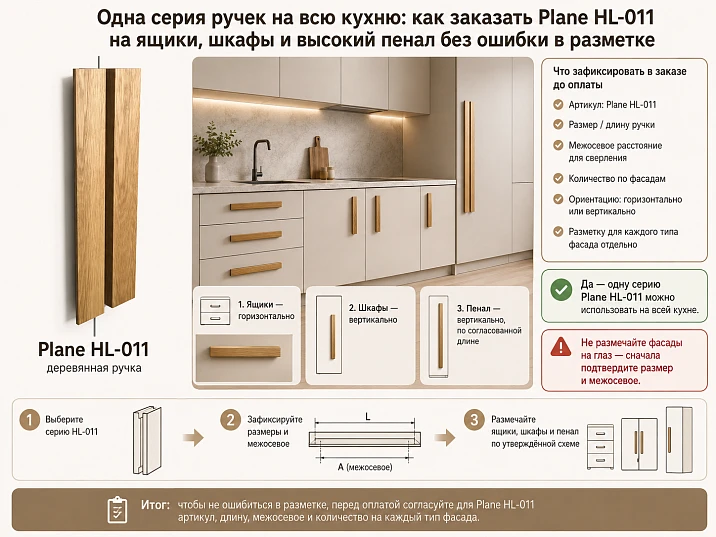
One handle on a sample looks convincing. It is much harder to assemble a whole kitchen, wardrobe, or cabinet wall so that a small drawer, a wide base module, and a tall tall cabinet belong to one visual system. This is where the Plane HL-011 series reveals itself much more interestingly than when buying a single part: the model has ten standard lengths — from 180 to 1800 mm. A short one can be placed on a compact drawer, a medium one on a hinged facade, a long one on a tall cabinet or high wardrobe. The shape remains common, and the scale changes along with the furniture.
But the wide size range also creates the main risk. You cannot choose Plane by external length, send facades for drilling, and assume that the mounting points are the same for all ten variants. In the card, along with size A, parameter D changes: for handles with lengths of 180, 260, 400, 500, 600, 700, 900, 1200, 1500, and 1800 mm, different D values are specified — from 128 to 1728 mm. Therefore, a furniture maker needs not the phrase "Plane handles for the whole kitchen," but a line-by-line list for each facade.
If the task is already formed and required buy the Plane HL-011 handle, first gather all the furniture into one table: facade, handle position, length A, size D from the card, material, quantity, and future finish. Then, for each selected length, verify D against the current drawing. Only after this can you give the coordinates to production.
This is the main point of the article. It is not about "which long handle is prettier," but about how to assemble one series from Plane HL-011 for facades of different scales, maintain a unified rhythm of the kitchen or wardrobe, and not end up with ten beautiful handles next to already incorrectly drilled doors.
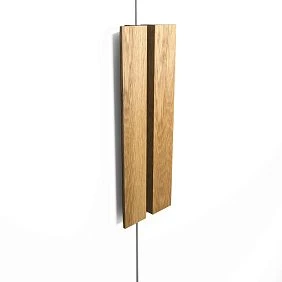
Furniture surface-mounted handle Plane HL-011: one shape and ten standard lengths
Plane HL-011 is interesting not just for its size, but for its range. Within a single model, you can move from compact 180 mm to expressive 1800 mm without switching to a different series each time.
For a project, this is a powerful tool. Instead of looking for one handle for drawers, a second for lower cabinets, and a third for tall units, the designer can simply change the scale of Plane.
The confirmed dimension grid looks like this:
| Length A, mm | B, mm | C, mm | D, mm |
|---|---|---|---|
| 180 | 40 | 25 | 128 |
| 260 | 40 | 25 | 192 |
| 400 | 40 | 25 | 320 |
| 500 | 40 | 25 | 384 |
| 600 | 40 | 25 | 512 |
| 700 | 40 | 25 | 576 |
| 900 | 40 | 25 | 768 |
| 1200 | 40 | 25 | 1120 |
| 1500 | 40 | 25 | 1440 |
| 1800 | 40 | 25 | 1728 |
Two parameters remain stable across the entire line: B=40 mm and C=25 mm. A and D vary.
This table should be placed next to the furniture specification when the facades are not yet drilled.




Why a long series is convenient not only for the designer
The furniture factory gets one clear family form. The finisher works with one wood species and one finishing logic. The client sees a repeating motif across all furniture, not a random collection of hardware.
This works especially well in a large kitchen where the following are present simultaneously:
-
narrow upper facades;
-
wide pull-out drawers;
-
tall lower doors;
-
refrigerator cabinet;
-
appliance cabinet;
-
utility cabinet;
-
sideboard or display case.
Each zone has different proportions. The same 180 mm handle on all doors would destroy the scale of a tall cabinet, while a 1200 mm one on a small drawer would be physically and visually disproportionate. Plane allows you to preserve the shape by changing the size.
Our factory also produces:
What remains unified
With proper configuration, the following are repeated:
-
profile character;
-
wood material;
-
processing logic;
-
stylistics;
-
finish direction;
-
visual thickness of the series.
This is exactly what the eye reads as a system.
Get Consultation
Surface-mounted handle on a kitchen front: you need to start not with the basket, but with the front map
Imagine a kitchen with twenty doors and drawers. The user opens the Plane card, selects several sizes "approximately matching the fronts," adds the quantity, and pays for the order.
He will see the error later — when the technologist asks: "What size do we set for each specific front and where do we drill?"
At this point, you cannot answer from memory.
Need a map.
Example of a work sheet:
| Furniture | Front size | Plane | D per card | Quantity |
|---|---|---|---|---|
| Compact upper drawers | As per project | 180 мм | 128 мм | As per project |
| Larger drawers | As per project | 260 мм | 192 мм | As per project |
| Wide pull-out drawers | As per project | 400 мм | 320 мм | As per project |
| lower cabinets | As per project | 500 мм | 384 мм | As per project |
| Wide facade | As per project | 600 мм | 512 мм | As per project |
| Swing-door wardrobe | As per project | 700 мм | 576 мм | As per project |
| Tall door | As per project | 900 мм | 768 мм | As per project |
| Pencil case | As per project | 1200 мм | 1120 мм | As per project |
| Tall cabinet | As per project | 1500 мм | 1440 мм | As per project |
| Very tall front | As per project | 1800 мм | 1728 мм | As per project |
The quantity in the actual order is determined by your furniture. The table is fundamentally different: each length is written as a separate line.
This eliminates the dangerous phrase "same handles, just longer."
No. The series article number is the same, but the size position is different.
Why D cannot automatically be called the center distance
In practice, the D sequence closely resembles a mounting parameter: 128, 192, 320, 384, 512, and so on. Such numbers are familiar to furniture makers.
But the similarity is not technical proof.
In the card, the dimension is marked with the letter D, and for each length there is a separate row. Before drilling, you need to open the current drawing and see between which points the dimension line D is drawn.
Until this check, there is only one correct formulation:
D is the dimension D specified in the card Plane HL-011.
Not "exact center distance," not "distance between screws," not "fit" without a drawing.
Why caution here is more useful than confident assumption
The author's mistake will remain on the internet.
The furniture maker's mistake will remain in the facade.
If an expensive painted door is already drilled, moving the hole by a few millimeters means:
-
filling the old hole;
-
surface restoration;
-
repainting;
-
risk of visible repair;
-
relocating production.
For a wooden handle, a correct drawing is cheaper than any rework.
Do not copy the layout from Plane 180 to Plane 400
The simplest error scenario looks almost harmless.
The cabinetmaker receives the first Plane 180 handle, makes a template, and uses it for subsequent fronts, assuming that longer versions have the same mounting points.
The card immediately shows why this cannot be done.
Plane 180 — D=128.
Plane 400 — D=320.
Plane 900 — D=768.
Plane 1800 — D=1728.
The short handle template does not carry over to the long one.
Each length gets its own template
Even if the drawing confirms that D refers specifically to the mounting centers, for ten lengths you'll still get ten different installation schemes.
In production, it's more convenient to label them by length:
-
HL-011 / 180;
-
HL-011 / 260;
-
HL-011 / 400;
-
HL-011 / 500;
-
HL-011 / 600;
-
HL-011 / 700;
-
HL-011 / 900;
-
HL-011 / 1200;
-
HL-011 / 1500;
-
HL-011 / 1800.
Then the technologist doesn't confuse the "short Plane" with the "medium Plane."
A small box should not dictate the handle for the entire kitchen set
There's a common habit: pick one comfortable handle on a sample, then put it on the whole kitchen.
For a small kitchen, this sometimes looks fine.
For a set with cabinets up to the ceiling, the scale quickly breaks down.
A 180 mm handle on a tall cabinet over two meters high turns into a small line in the middle of a huge surface. The tall door starts to seem even more massive, and the hardware—random.
The Plane series offers a different path: one model is kept, but the size evolves along with the facade.
Short Plane on boxes
180 and 260 mm can be considered for compact facades after checking their actual width and mounting scheme.
Medium on main cabinets
400, 500, 600, and 700 mm provide more options for wide and tall doors.
Long handles for cabinet
900, 1200, 1500, and 1800 mm already work on a different scale. They can be perceived almost as a vertical architectural line.
That is why the request buy long handles for cabinet better to consider together with the actual proportions of the facade, rather than in isolation from the furniture.
Long handles for cabinet: 900, 1200, 1500, or 1800 mm — not a competition of length
The longest handle is not automatically the most effective.
Plane 1800 can be magnificent on a very tall calm facade and excessive on an ordinary door.
What to compare
Four sizes are needed:
-
facade height;
-
facade width;
-
handle length;
-
handle position relative to the edges.
If the handle almost matches the door height, it becomes one of the main lines of the composition.
If it takes up about half, it is perceived as large hardware.
If it is noticeably shorter, it works locally.
No single option is universal.
A 1800 mm handle does not mean a 1800 mm facade.
You cannot match them one-to-one.
Installation requires gaps and a real mounting zone. Before choosing, check the door dimensions and the handle drawing.
A handle almost the full height of the tall cabinet: the effect is built on the vertical line.
A tall kitchen cabinet is an ideal area where a regular small handle often looks weaker than the furniture itself.
Plane 1200, 1500, or 1800 can enhance the vertical.
But first answer the question: where should the line start?
From the lower zone of the facade.
The handle extends upward and visually connects the door with the lower modules.
In the center
This results in a more symmetrical pattern.
With alignment to adjacent handles
In a kitchen, what usually matters is not the absolute center of one cabinet, but the overall horizontal or vertical rhythm.
For example, the bottom point of a long Plane can align in height with the handles of neighboring cabinets.
Then the whole composition becomes more cohesive.
Vertically or horizontally: one series can work in two directions, but the project makes the decision.
Short Planes on drawers are naturally viewed horizontally.
Long ones on tall cabinets are viewed vertically.
And here, a single series gets a particularly interesting rhythm: one profile changes direction but remains recognizable.
However, the installation of each specific length must correspond to the handle design and the drawing.
There is no need to turn a stylistic idea into a universal technical solution.
Horizontal Plane on a wide drawer
It emphasizes the width.
Vertical Plane on a tall cabinet
Emphasizes the height.
Mixed system
Works if the rules are repeated.
For example:
-
all drawers — horizontally;
-
all tall hinged fronts — vertically;
-
Pencil cases are long and vertical.
Chaotic rotation of each handle depending on circumstances will destroy the system.
Wooden handle for a cabinet: beech or oak should be chosen for the entire series, not for individual doors.
Plane HL-011 is confirmed in beech and oak.
This is not just two material options. With an open wood finish, the wood species participates in the interior design.
If the handles are painted with opaque enamel
The natural texture may be visually hidden.
The choice of material is still recorded in the order, but the design role of the wood species decreases.
If the handles are tinted
The difference becomes more noticeable.
Then the kitchen should receive a single material or a deliberately designed combination.
Ordering some short handles in beech and a long one for the pencil case in oak by chance is a bad idea if they all need to look the same after a clear finish.
The material is entered in each line of the specification.
Do not write:
Plane HL-011 — 18 pcs.
Write:
Plane HL-011, 400 mm, oak — 4 pcs.
Plane HL-011, 700 mm, oak — 6 pcs.
Plane HL-011, 1500 mm, oak — 1 pc.
And so on throughout the entire list.
Unpainted Plane HL-011: freedom of finishing and additional responsibility
HL-011 refers to handles without coating.
For the project, this makes it possible to match the hardware with the furniture by color.
But "without coating" does not mean "you can install it any way you like and then paint something later."
The finish requires its own plan.
In the catalog you can buy unpainted furniture handles specifically for projects where color and finish are created together with the furniture.
Handle in the color of the facade
A very cohesive approach.
On a white kitchen, a wooden Plane after appropriate professional finishing can visually almost blend into the facade, leaving only the relief and shadow.
Contrast handle
For example, dark on a light door.
Then the profile becomes a graphic accent.
Natural wood
With a transparent finish, the material works on its own.
First a finish sample, then the entire batch
When a project has twenty handles of different lengths, a color error is multiplied by twenty.
Before full finishing, it is reasonable to make a control sample.
Check:
-
color;
-
gloss level;
-
behavior on the selected wood species;
-
combination with the facade;
-
appearance in daylight;
-
appearance under artificial lighting.
If the result is accepted, the technology is fixed for the entire batch.
To prepare the project, you can buy materials for finishing wooden handles, but the specific composition must match the material and the chosen finishing technology.
Plane HL-011 or ready-made Plane HL-011M
Not every customer needs to do the finishing themselves.
For this, there is Plane HL-011M with a ready-made coating.
Confirmed options:
-
black;
-
transparent;
-
brown;
-
white.
If the finish already suits the project, you can buy Plane HL-011M with a ready-made coating.
When HL-011 is more logical
-
furniture is painted individually;
-
a custom shade is required;
-
the handles must match the facade color exactly;
-
the finisher works with a single set.
When HL-011M is more logical
-
a confirmed ready color is needed;
-
separate painting of handles is not included in the project;
-
a ready clear finish is required;
-
the buyer does not want to create their own finish system.
| Situation | Option |
|---|---|
| Custom enamel | HL-011 |
| Custom tinting | HL-011 |
| Handle matching furniture color | HL-011 |
| Ready black | HL-011M |
| Ready white | HL-011M |
| Ready brown | HL-011M |
| Ready transparent | HL-011M |
To review finished hardware, you can buy furniture handles with coating.
Why you cannot buy Plane 1800 and cut it to any size
It seems tempting: one long wooden handle, so you can cut 1370 mm or 1650 mm for a specific cabinet.
Without direct confirmation from the manufacturer, you cannot make such a conclusion.
The standard size range already includes ten positions. Each has its own A and D specified.
After unauthorized shortening, the following may change:
-
the position of the mounting zones;
-
symmetry of the ends;
-
profile proportions;
-
distance between mounting points;
-
appearance.
The fact that the material is wooden does not turn a finished furniture handle into a universal trim.
If a non-standard size is needed, its feasibility is agreed upon separately.
The standard length is almost always safer than a homemade modification.
Is there a 1370-millimeter facade in the project?
This does not mean that a 1370 mm handle is needed.
First, they look at the available 1200 and 1500, apply them to the facade at scale, and evaluate the offsets.
Standard positions have a confirmed dimension line.
A homemade one does not.
A finished kitchen is already drilled: the selection algorithm changes completely
Before production, the scheme is as follows:
handle → drawing → holes.
After production:
holes → precise measurements → search for a compatible handle.
If there are already two holes in the facade, you cannot choose Plane based only on the total length.
You need to measure:
-
distance between existing holes;
-
their diameter;
-
position relative to edges;
-
facade thickness;
-
area that the handle will cover;
-
condition of the surface around.
After that, the data is compared with the current drawing of the specific Plane.
Do not drill new holes near old ones without assessment
On the finished facade, this can:
-
weaken the material;
-
leave the old hole visible;
-
get into milling;
-
damage the finish.
If the Plane does not fit in terms of installation, first decide the fate of the old holes.
First handles — then drilling of the new kitchen
For new furniture, it is much easier to avoid the problem.
Before sending facades to the machine, you need to approve:
-
article number;
-
material;
-
length A;
-
D per card;
-
value of D per drawing;
-
orientation;
-
installation coordinates;
-
fasteners;
-
Quantity.
Only after this does the manufacturer create the drilling pattern.
Why one card table is not enough
It says what sizes exist.
But it doesn't say where exactly on your door the handle should be.
This is already a design coordinate.
How to assign Plane to different kitchen facades
There is no table "facade 600 — handle strictly 400".
But you can use a sequential method.
Step one: determine the role of the facade
Drawer, door, pencil case, display case.
Step two: assess the free length
The frame and milling are taken into account.
Step three: attach several standard Planes
On the visualization or full-size template.
Step four: check adjacent facades
Handles rarely exist alone.
Step five: choose a dimension system
For example:
-
short;
-
medium;
-
long.
The number of standard sizes should be reasonably limited so that the kitchen does not turn into a display stand of all ten options.
Do you need to use all ten sizes
No.
A wide range doesn't mean that all ten should appear in one kitchen.
Often three or four are enough:
-
one for small facades;
-
one for main ones;
-
one for wide ones;
-
one for tall cabinets.
This preserves the rhythm.
Ten lengths are needed for freedom of choice between projects, not for mandatory simultaneous use.
Example of a kitchen configuration in three sizes
Suppose there are:
-
upper facades;
-
lower wide drawers;
-
tall cabinet.
Consider:
-
Plane 260;
-
Plane 500;
-
Plane 1200.
Why these? Only as an example of logic, not a ready-made standard.
Each real project has its own facades.
The main idea is that one size repeats within one functional group.
Example of configuration in four sizes
Larger set:
-
180 mm — compact drawers;
-
400 mm — standard facades;
-
700 mm — wide doors;
-
1500 mm — tall cabinet.
The sizes exist in reality, but applicability is determined by your project.
Rhythm matters more than arithmetic proportion
Sometimes a buyer tries to calculate the handle length as a percentage of the facade width.
For example: "let it be 60%."
This approach can help for a first sketch, but should not become a rule.
On adjacent doors of different widths, you will get many different handles.
The eye will see a restless row.
Sometimes it's better to repeat one Plane 400 on several facades of different widths than to mathematically select 400, 500, 600, and 700.
Identical handles on adjacent identical facades
This is a simple but powerful principle.
If four drawers are identical, the handles should also be the same length, unless the designer specifically intended otherwise.
There's no need to choose a size separately for each drawer.
Handles on symmetrical facades
The two cabinet doors on either side of the central display case must receive mirror-consistent markings.
Check:
-
distance to the outer edge;
-
distance to the inner one;
-
height;
-
direction;
-
length.
Plane on the double cabinet door
Here, two long verticals can work as a pair.
Handles can be placed closer to the central joint.
But a visually normal gap must remain between them.
The exact offset is determined by the facade drawing.
Wooden handle for a ceiling-height cabinet
A tall built-in cabinet differs from a regular kitchen in scale.
The fronts can go almost from floor to ceiling.
Small hardware on such a surface often looks lost.
Plane 1200–1800 allows you to consider a different scale.
For a broader design context, it is useful to choose handles for a tall cabinet together with the overall architecture of the cabinet.
Is a 1800 mm handle needed on a 2400 mm door
It may suit visually, or it may turn out to be excessive.
It is necessary to make a sketch to scale.
At a length of 1800 mm, the handle becomes a dominant vertical.
On a 2400 mm facade, zones remain at the top and bottom, and their proportion greatly affects the result.
Shift the handle on the drawing by 50–100 mm — the composition is already perceived differently.
Therefore, buying based on a single ratio of 1800/2400 is not enough.
Tall handle and hand position
Aesthetics should not interfere with daily opening.
A very long Plane provides a large vertical contact zone, but the place where a person actually grips must be comfortable.
For a cabinet with multiple users, this can be an advantage: a child and an adult can grab the handle at different heights.
But the ergonomics of a specific facade need to be checked on a mockup.
A full-size paper mockup is cheaper than a mistake
Cut out a strip with the width and length of the selected Plane.
Attach it with masking tape to the facade or its cardboard mockup.
Step back a few meters.
Take a photo.
Try opening the door, simulating a real grip.
This simple check quickly shows whether 1200 is really better than 900 or vice versa.
Why B=40 and C=25 also cannot be discarded from the specification
The buyer usually only looks at A and D.
But the card also contains B=40 mm and C=25 mm for each position.
Even if they are constant, these parameters relate to the product geometry and must be preserved in the technical drawing.
There is no need to independently assign what B and C mean without looking at the diagram.
In work correspondence, it is more correct to refer to the full drawing Plane HL-011.
What is included in the cost of Plane HL-011
The diagram confirms that the mounting kit is included in the cost.
This is useful for the estimate: the fastening kit should not be automatically considered missing.
But the composition of the fasteners cannot be made up.
Before installation, you still need to check:
-
which parts are actually included;
-
for what facade thickness they are designed;
-
whether the kit matches the selected item;
-
Is different fastening required for specific furniture?
The phrase "mounting kit included in price" does not equal "fits any facade."
Facade thickness and fastening
Kitchen facades differ.
Even if the handle is the same, furniture can be made from different materials and thicknesses.
Before assembly, the technologist checks:
-
panel thickness;
-
thread connection depth;
-
length of the fasteners;
-
presence of milling;
-
hole location.
Exact parameters are taken from the documentation of the specific order.
How not to confuse Plane HL-011 with HL-011M in the specification
The article numbers are similar.
One letter M is easily lost in the table.
And the meaning of the order is already different: HL-011 without coating and HL-011M with ready-made coating.
Bad specification
Plane 400 — 6 pcs.
Plane 1200 — 2 pcs.
Good
Plane HL-011, 400 mm, oak, without coating — 6 pcs.
Plane HL-011, 1200 mm, oak, without coating — 2 pcs.
Or:
Plane HL-011M, 400 mm, ready white coating — 6 pcs.
This way, the buyer does not interpret the order on their own.
The kitchen is white, the handles are also white: HL-011 or HL-011M?
It depends on whether you need the ready white version HL-011M or an individual match to the facade shade.
White is not just one color.
The facade can be:
-
cold;
-
warm;
-
milky;
-
grayish;
-
creamy.
The ready white coating HL-011M needs to be compared with the furniture.
If precise painting in an individual color is required, the unpainted HL-011 may be more convenient as a base for agreed finishing.
Black Plane handles on a light kitchen
Contrasting long handles become very noticeable.
Then the inconsistency of lengths is especially visible.
If one cabinet gets 900 mm, the neighboring one 1200, and the third 700 without a clear reason, black graphics will emphasize the chaos.
A repeat is needed.
Clear coating and oak
If a natural wood look is needed, the finished HL-011M with a clear coating can be considered as an alternative to finishing it yourself.
But be sure to cross-check the material of the selected card and the actual sample.
Wood color cannot be assessed only by screen.
Brown coating and furniture in walnut style
The label "brown" does not guarantee a match with specific furniture.
There are hundreds of brown shades.
Therefore, the finished HL-011M needs to be visually matched with the facade.
Where to use Plane besides the kitchen
One series can continue in other interior items.
For example:
-
walk-in closet;
-
built-in wardrobe;
-
a dresser;
-
sideboard;
-
office furniture;
-
entryway.
If the rooms are connected, repeating Plane creates a recognizable detail.
But the number of sizes in each item is still calculated separately.
One series for the kitchen and entryway
This is an interesting technique for an open-plan apartment.
In the kitchen, Plane 260 and 500 are used, and on the tall wardrobe in the hallway — 1500.
A person doesn't think: "this is one article."
They simply feel a visual connection.
One series in the dressing room
There are especially many different fronts here:
-
drawers;
-
low cabinets;
-
tall doors;
-
mezzanines.
Plane offers a wide range, but on mezzanines, a too-long handle may be inconvenient.
The scale and height of the grip need to be checked.
Mezzanine and long handle
Sometimes a long vertical handle allows you to reach a high door below its center.
But it cannot be claimed that any size automatically makes the mezzanine more convenient.
The position of the handle and the door mechanism determine ergonomics.
Plane on a dresser
For a dresser, long horizontal Planes can emphasize the width of the drawers.
If a dresser and a tall cabinet stand side by side, one series in two directions creates a beautiful connection.
How to combine Plane with other handles
Sometimes one series is not enough: for example, a glass display case requires a different construction.
Then the second handle is chosen so that it does not conflict with Plane.
Compare:
-
material;
-
color;
-
thickness;
-
geometry;
-
Scale.
But mixing series without a reason is not worth it.
When Plane HL-011 may not be suitable
The series is strong precisely because of its wide range, but there are no universal products.
You need to look for another solution if:
-
the existing additive does not match;
-
the facade is too small for the minimum Plane 180;
-
an unconfirmed non-standard length is required;
-
the door design does not allow an overlay handle of this profile;
-
a different material is needed;
-
Ready-made finishes HL-011M are not suitable, and custom finishing is not possible;
-
The designer needs a completely different geometry.
What to buy together with Plane HL-011
Ordering handles is related to finishing, design, and furniture layout.
| Position or section | Why |
|---|---|
| buy the Plane HL-011 handle | Main unpainted series |
| buy Plane HL-011M with a ready-made coating | Ready color version |
| buy long handles for cabinet | Compare other furniture handles |
| buy unpainted furniture handles | View models for custom finishing |
| buy furniture handles with coating | Compare ready options |
| buy materials for finishing wooden handles | Prepare a custom finish |
| to choose handles for a tall cabinet | Coordinate hardware with the cabinet |
| order handles for kitchen facades | View handles in the kitchen context |
| order a design project for furniture facades | Work out the rhythm and dimensions |
| calculate the delivery of the handle set | Check the conditions for receiving the order |
Such a list does not mean you must purchase all items. It shows the path from choosing a handle to a finished furniture project.
How to create a proper specification on Plane
Instead of one total quantity, create a table.
| № | Room | Furniture | Facade | Article | A | D | Material | Finish | Quantity |
|---|---|---|---|---|---|---|---|---|---|
| 1 | Kitchen | Upper drawer | №… | HL-011 | 180 | 128 | Oak/beech | As per project | … |
| 2 | Kitchen | Wide drawer | №… | HL-011 | 400 | 320 | Oak/beech | As per project | … |
| 3 | Kitchen | Lower cabinet | №… | HL-011 | 500 | 384 | Oak/beech | As per project | … |
| 4 | Kitchen | Pencil case | №… | HL-011 | 1200 | 1120 | Oak/beech | As per project | … |
| 5 | Hallway | Tall cabinet | №… | HL-011 | 1800 | 1728 | Oak/beech | As per project | … |
After filling in, add a status next to it:
drawing checked / not checked.
Until marked as "checked", the line does not go to drilling.
Why facades need numbers
On a complex kitchen, names quickly repeat.
"Bottom left drawer" can be understood differently by a craftsman and a designer.
Numbering according to the project eliminates the dispute:
-
F01;
-
F02;
-
F03.
In the table, Plane is linked to the number.
A separate drilling map
The specification answers the question "what to buy."
The drilling map answers "where to install."
Do not mix them into one unreadable document.
For each group of facades, coordinates are indicated according to the drawing.
Test assembly of one handle of each size
If the project is large, before drilling the entire batch it is useful to check one Plane of each selected size.
Not ten, but only those that are actually included in the order.
For example:
-
260;
-
500;
-
Compare the physical part with the drawing and template.
After that, start the series.
Why a short Plane sample does not confirm a long one
This is still the same scale error.
The designer is shown a Plane 260 and told: "The 1500 will be the same."
In shape — yes.
In impression — absolutely not.
A long handle takes up most of the door and shows more strongly
But a unified series does not mean the same length
These are two different concepts.
A unified series is one design.
The same length is one size.
For a complex set, the first is useful, the second is not always.
How to choose the minimum number of standard sizes
Start by grouping facades.
For example:
Group A: small.
Group B: medium.
Group C: tall.
Select one Plane for each group.
Only if some facade clearly stands out, add a fourth size.
This makes the kitchen look more cohesive.
Example of a bad specification
180 — 2 pcs.
260 — 3 pcs.
400 — 1 pc.
500 — 2 pcs.
600 — 1 pc.
700 — 1 pc.
900 — 1 pc.
1200 — 1 pc.
1500 — 1 pc.
For a small kitchen, this may mean that the size was chosen for each door individually without a common rhythm.
Example of a calmer logic
260 — all small facades.
500 — all main ones.
1200 — all tall cabinets.
Three repeating scales.
Of course, this is only an illustration of the compositional approach.
Acceptance of order Plane HL-011
When the handles arrive, do not send the boxes to the paint shop immediately.
First, verification.
SKU
HL-011 or HL-011M.
Length A
Each group is measured.
Quantity
According to the specification.
Material
Beech or oak according to the order.
Coating
For HL-011M — the selected option.
Condition of the wood and surface
There should be no damage that interferes with use and finishing.
Fastening
The actual set is checked.
D
The physical part is compared with the current drawing.
Batch layout before finishing
Sort the handles by length.
Do not mix 400 and 500 in the same stack.
Label the groups.
If different facades are painted in different colors, also separate by finish.
Marking after painting
After finishing, the size is not always obvious to the eye, especially for close 500 and 600.
Use tags or safe packaging labeling.
Do not write on the finished face surface with a marker.
Protection of long Planes during transportation
Handles 1200–1800 mm require careful handling.
A long part may get hit or bent if stacked incorrectly.
The packaging and transportation scheme is determined by the supplier, and at the site you need to prepare a safe storage place.
Before ordering, you can calculate the delivery of the handle set.
Mistakes that most often break a Plane project
Ordering one length for the entire kitchen
The series allows you to change the scale — use this wisely.
Assuming D is the same
It differs for each length.
Call D center distance without a drawing
The technical value needs to be checked.
Drill until handles and documentation are obtained
Risk of redoing the facade.
Choose ten lengths just because they exist
The composition becomes restless.
Buy 1800 and cut it
Unconfirmed method.
Do not specify beech or oak
The supply becomes ambiguous.
Mix HL-011 and HL-011M
Different finishing stages are obtained.
Order ready white without comparing to the facade
Shades may differ.
Do not make a sample of individual coating
The error repeats across the entire batch.
Not checking the facade thickness
The mounting must match the furniture.
Use a template of a different length
The holes will not align.
Measure D from the photo
The image is not a drawing.
Do not number the facades
The installer confuses the dimensions.
Not checking the mirror symmetry of paired doors
Handles end up at different heights.
Considering the total length as the only criterion
You need to see the handle on the facade.
Select 1800 for a door that is too low
The offsets turn out to be inconvenient.
Place a small handle on a huge cabinet without checking the scale
It can visually get lost.
Place each handle independently
The overall rhythm disappears.
Paint before acceptance
After identifying the incorrect length, the finishing has already been done.
Do not separate dimensions after painting
Installation becomes a lottery.
Who the Plane HL-011 is especially suitable for
The series is interesting for projects where there are several sizes of furniture facades at the same time and you want to maintain a single geometry of handles.
For example:
- large kitchen;
- wall of cabinets;
- walk-in closet;
- kitchen with tall cabinets;
- built-in furniture;
- combination of dressers and tall cabinets.
When the advantage of the series is not fully used
If you need one handle for one cabinet, the wide range remains just an additional option.
The true power of Plane is revealed in the set.
What to check before final payment
Consolidate your order into one document.
For each row:
- HL-011 or HL-011M;
- length A;
- B;
- C;
- D;
- the material;
- coating or finishing plan;
- quantity;
- facade number;
- orientation;
- drawing status.
At the end of the table, add:
Total number of handles: ___ pcs.
And compare with the number of furniture facades where they are provided.
Sum quantity check
A common mistake is that the specification is correct by standard sizes, but the sum does not match the furniture.
For example:
- 6 short;
- 8 medium;
- 2 long;
total 16.
And facades with handles — 17.
One item is lost.
Cross-check two independent values.
Spare handles
Whether a reserve beyond the number of facades is needed is decided separately for each project.
A universal percentage cannot be automatically assigned.
For a large batch, the customer may decide to purchase a spare unit of specific lengths, but this is a commercial decision, not a confirmed product standard.
FAQ about Plane HL-011
What lengths are available for Plane HL-011?
180, 260, 400, 500, 600, 700, 900, 1200, 1500, and 1800 mm are confirmed.
What is the shortest Plane?
180 mm.
What is the longest?
1800 mm.
Can one series be installed across the entire kitchen?
Yes, it is precisely the wide range of sizes that allows Plane to be considered for different facades of one project. The size of each item is selected individually.
Is the layout the same for all lengths?
No. In the card, the D parameter changes for each length.
What is D?
This is size D according to the card. Its exact mounting value needs to be checked against the current drawing of the selected item.
Can D be considered the center distance?
Without checking the drawing, it should not be stated categorically.
What is D for Plane 180?
128 mm.
What is the D of Plane 260?
192 mm.
What is the D of Plane 400?
320 mm.
What is the D of Plane 500?
384 mm.
What is the D of Plane 600?
512 mm.
What is the D of Plane 700?
576 mm.
What is the D of Plane 900?
768 mm.
What is the D of Plane 1200?
1120 mm.
What is the D of Plane 1500?
1440 mm.
What is the D of Plane 1800?
1728 mm.
Do B and C change?
In the confirmed table, for all ten variants, B=40 mm and C=25 mm.
What wood is HL-011 made of?
Beech and oak are confirmed in the diagram.
Is Plane HL-011 painted?
HL-011 belongs to the unpainted version.
Where can I see other unpainted handles?
You can buy unpainted furniture handles in the corresponding section of the catalog.
Is there a Plane with a ready-made coating?
Yes, Plane HL-011M is provided for this.
What coatings does HL-011M have?
Black, transparent, brown, and white are confirmed.
Where can I buy a ready-made Plane?
You can buy Plane HL-011M with a ready-made coating.
Can HL-011 be painted to match the kitchen color?
The unpainted version is specifically designed for a project with subsequent finishing, but the specific technology and coating need to be coordinated with the finisher.
Which is better — beech or oak?
It depends on the future coating and the visual goal. With exposed wood, the material is especially noticeable; with an opaque enamel, its decorative role is less.
Is the mounting included?
According to confirmed data, the mounting kit is included in the price. The specific composition and compatibility with your facade are checked before installation.
Can Plane be used on an existing facade with old holes?
Only if the drawing of the selected length is compatible with the existing layout. First, measure the holes.
Can new holes be drilled next to the old ones?
Such a solution should be evaluated by a furniture maker, taking into account the material and condition of the facade.
Can Plane 1800 be shortened?
Without separate confirmation from the manufacturer, this should not be done. You need to choose a standard length.
Is there a Plane 1000 mm?
There is no such position in the confirmed HL-011 series.
Which option is closer to 1000 mm?
The assortment includes 900 and 1200 mm. Which one to choose is decided based on the facade.
Is a 1800 handle needed for a 1800 cabinet?
Matching numbers guarantee nothing. The handle must have proper indents and correspond to the door drawing.
How to choose the length for a drawer?
Compare several standard Plane handles on a real facade or template, then check the drawing.
How to choose for a pencil case?
Start with the proportion of the facade height and the desired vertical line. Usually long positions are considered, but there is no ready-made universal size.
Can a long Plane be installed horizontally?
The orientation of the selected model should be coordinated with the project and technical documentation. Visually, a horizontal long handle emphasizes the width of the facade.
How to achieve a uniform look across the entire kitchen?
Use a limited number of lengths from one series, one material, and consistent finishing, and repeat placement rules.
Do I need to use all Plane sizes?
No. In one project, a few are often enough.
How not to mix up handles after delivery?
Sort by length, check labeling, and store groups separately.
Is it necessary to try on handles before drilling?
For a responsible project, it is advisable, especially if multiple lengths are used.
Where can I see kitchen solutions?
You can order handles for kitchen facades in the context of ready-made furniture solutions.
Where can I see solutions for a wardrobe?
In this section you can to choose handles for a tall cabinet together with other elements of the furniture project.
Can I order a design project?
Yes, for a complex facade system you can order a design project for furniture facades.
Where can I see the entire range of handles?
In the general section, you can order wooden handles for the kitchen and compare Plane with other series.
Do I need to calculate delivery separately?
It is better to check the order pickup conditions before payment, especially for a batch of long handles. For this, you can calculate the delivery of the handle set.
Final list before drilling facades
Before sending the kitchen to production, the table must be fully filled out.
| Control | Status |
| All facades are numbered | Yes / no |
| An article is selected for each | Yes / no |
| HL-011 and HL-011M are not mixed accidentally | Yes / no |
| Length A is recorded | Yes / no |
| B and C are accounted for per the drawing | Yes / no |
| D is recorded | Yes / no |
| Purpose of D verified per the drawing | Yes / no |
| Material is specified | Yes / no |
| Future coverage specified | Yes / no |
| Quantity verified | Yes / no |
| Position on facade approved | Yes / no |
| Orientation approved | Yes / no |
| Mounting verified | Yes / no |
| Test position checked | Yes / no |
| Production allowed | Yes / no |
The last line is placed last not by chance.
As long as one of the technical values is unknown, starting drilling is premature.
Plane HL-011 turns different facades into one system — if the dimensions are ordered as a system
In the Plane HL-011, the value lies not in the 1800 mm record or the very possibility of choosing a short wooden handle. The model's strength is the full range from 180 to 1800 mm within a single visual family.
That is why a short Plane can be placed on a small drawer, a medium one on the main facade, and a long one on a tall cabinet, without turning the kitchen into a collection of unrelated handles.
But freedom of size requires discipline.
For 180 mm, the card specifies D=128 mm. For 260 — 192. For 400 — 320. For 500 — 384. For 600 — 512. For 700 — 576. For 900 — 768. For 1200 — 1120. For 1500 — 1440. For 1800 — 1728 mm. Therefore, you cannot create one mounting template and scale it "approximately." Each selected length must be checked against your own current drawing.
The same principle applies at the level of the entire order. Do not write "Plane — 20 pieces." Specify separately the lengths, material, quantity, finish, and purpose by facades. The unpainted HL-011 allows coordinating an individual finish with the furniture; the finished HL-011M offers a choice between confirmed black, white, brown, and transparent coatings. These two articles are similar in name but lead to different production routes.
STAVROS allows you to assemble such a project sequentially: choose Plane HL-011 in the required lengths, compare other furniture handles, select an unpainted or finished version, view solutions for kitchens and tall cabinets, coordinate finishing materials, and check delivery in advance. The buyer is left with the most important thing — not to consider each handle separately. Plane works more powerfully when all the furniture is first compiled into a single list, and only then the cart turns into a precise order.