










































































Article Contents:
- On a wide front, the problem is not the size of one overlay, but the empty space around it
- NPU-505 and NPU-506: characteristics that create different visual roles
- What to buy for one wide furniture front
- List for several identical fronts
- Three possible ways of vertical alignment
- First mark the forbidden zones, then look for a beautiful position
- Check at three distances
- One facade is not the whole furniture
- How to make a specification photo
- When facade dimensions are similar, but the layout still needs to differ
- The commercial meaning of such a map is very simple

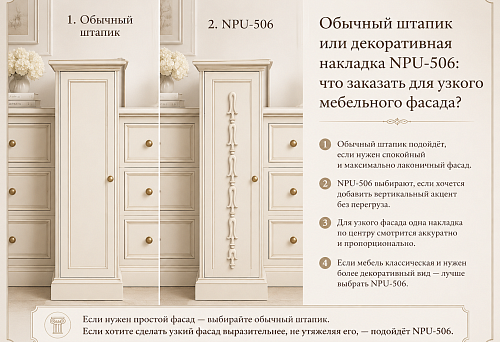
The wide cabinet door is already ready, the color is chosen, the handle is in place — but the central overlay still seems too lonely. It is not small in itself, but a large calm surface remains around it, and the eye perceives the decor as a separate spot rather than a finished composition. In such a situation, there is no need to immediately complicate the facade with moldings, frames, and a dozen different details. STAVROS has a more precise layout: one NPU-505 in the center and two narrow NPU-506 on the sides.
This combination is particularly interesting because the roles of the items are different. The NPU-505, measuring 50 × 228 × 10 mm, is a wider and deeper central accent. The NPU-506, measuring 12 × 205 × 5 mm, is a thin supporting element. The NPU-506 card directly suggests placing a larger overlay in the center on wide facades, and using NPU-506 on the sides with equal spacing. This means the buyer doesn't have to invent a composition from random articles: the logic of NPU-506 + NPU-505 + NPU-506 is already built into the product system itself.
But even a good scheme is easy to ruin with incorrect marking. You can't just find the center of the door, glue on the NPU-505, and place two NPU-506s "roughly nearby." On a wide facade, uneven gaps, misalignment relative to the handle, unequal heights of the side elements, and a broken overall axis are especially noticeable. Therefore, before ordering, it's useful to make three paper templates, lay them out on the facade, and only then calculate the quantity for the entire cabinet or kitchen set.
If such a three-part scheme fits the scale, you can buy the molded decor NPU-505 for the central position and separately select the side elements NPU-506. But first, let's figure out why this particular pair works and when three parts are truly better than one.


On a wide facade, the problem is not the size of one overlay, but the emptiness around it
Single decor works well when the facade itself is relatively narrow or when the central element occupies a convincing share of the free field. On a wide door, the proportions change. The same 50 mm width of the NPU-505 is no longer perceived as an independent system, but as a central point within a large plane.
This doesn't mean the NPU-505 was chosen incorrectly. On the contrary, the central role suits it. The problem arises in the transition from the center to the edges of the facade: large empty zones without rhythm remain between the ornament and the side boundaries.
The NPU-506 solves exactly this task. At 12 mm wide, it doesn't compete with the central piece, but creates two side verticals. As a result, the eye sees not "one element in the middle," but three parts of a single composition.
This way, the wide door gets a hierarchy:
-
main accent;
-
left support;
-
right support.
This is significantly more accurate than simply adding two more identical large overlays.




NPU-505 and NPU-506: characteristics that create different visual roles
| Parameter | NPU-505 | NPU-506 | What changes on the facade |
|---|---|---|---|
| Size | 50 × 228 × 10 mm | 12 × 205 × 5 mm | The central part is wider, taller, and deeper |
| Material | Polyurethane | Polyurethane | The material can be combined with one finish |
| Width | 50 мм | 12 мм | NPU-505 is noticeable almost 4.2 times wider |
| Height | 228 мм | 205 мм | The central element is 23 mm higher |
| Relief | 10 мм | 5 мм | The central overlay is twice as deep |
| Role in the scheme | Main vertical accent | Side support | A visual hierarchy is formed |
| Price at the time of writing the article | 890 ₽ | 420 ₽ | Set 1 + 2 costs 1,730 ₽ excluding installation materials |
Here it is especially useful to compare not only the height, but also the depth of the relief. NPU-505 protrudes by 10 mm, NPU-506 by 5 mm. The central element physically gets more volume and more pronounced chiaroscuro. The side parts remain thinner.
Therefore, the composition works not just through quantity. It is built on the difference in scale.
NPU-505 speaks, NPU-506 supports
This phrase only needs to be said once to understand the principle.
NPU-505 should remain the main element. It is wider, taller, and deeper. NPU-506 should not be turned into a second center. Its function is to mark the side positions and connect the central ornament with the width of the facade.
This leads to an important rule: the distances to NPU-506 can be adjusted for a specific facade, but the symmetry between the left and right sides must be preserved.
If the left side overlay is closer to the center than the right one, the composition looks random, even if the difference is small.
Our factory also produces:



What to buy for one wide furniture facade
The basic list is simple:
-
1 × NPU-505 — central position;
-
2 × NPU-506 — left and right side positions.
That is, one facade is three items, but only two SKUs.
If side support is specifically needed, you can buy the molded decor NPU-506 in pairs and immediately count the quantity as a multiple of two for each identically finished facade.
Get Consultation
List for several identical facades
| Number of wide facades | NPU-505 | NPU-506 | Total parts | Cost of decor at current prices* |
| 1 | 1 pc. | 2 pcs. | 3 pcs. | 1 730 ₽ |
| 2 | 2 pcs. | 4 pcs. | 6 pcs. | 3 460 ₽ |
| 3 | 3 pcs. | 6 pcs. | 9 pcs. | 5 190 ₽ |
| 4 | 4 pcs. | 8 pcs. | 12 pcs. | 6 920 ₽ |
| 6 | 6 pcs. | 12 pcs. | 18 pcs. | 10 380 ₽ |
*The calculation is based on a price of 890 ₽ for NPU-505 and 420 ₽ for NPU-506 at the time of writing the article. Before payment, the price should be checked in the product cards.
The formula for the quantity is even simpler:
NPU-505 = F
NPU-506 = 2 × F
where F is the number of facades styled according to the 1 + 2 scheme.
Such arithmetic seems obvious, but it is precisely this that saves from a typical mistake: putting four central elements in the cart for four doors and only four side ones, forgetting that NPU-506 is needed in pairs for each facade.
Why NPU-506 should not be placed in the center instead of NPU-505
At first glance, one might think: if the NPU-506 is cheaper and narrower, why not place one in the center?
Because the compositional task is different.
The NPU-506 is only 12 mm wide and 5 mm deep. It is a thin vertical module. On a wide facade, a single such piece in the center will further emphasize the emptiness on the sides.
NPU-505, with a width of 50 mm and a depth of 10 mm, has sufficient decorative mass for a central position. It is perceived as the main accent, and two NPU-506 support it with rhythm.
If the roles were swapped, the buyer would lose the hierarchy.
When a single NPU-505 is still better than a three-part scheme
Three pieces do not need to be sold to everyone.
If the facade is narrow, the NPU-505 can confidently work on its own. The product card allows for single central placement. Therefore, the buyer should evaluate not only the product itself, but also the amount of free surface around it.
A single NPU-505 is appropriate if:
-
the door is relatively narrow;
-
side margins look proportional even without additional decor;
-
there is a handle or panel nearby that already creates structure;
-
the facade is part of a series of narrow identical doors;
-
the interior requires calmer decorativeness.
Two additional NPU-506 are needed not because "a set is always more beautiful," but because a wide surface requires a connection between the center and the edges.
First, determine whether the facade is truly wide
There is no universal boundary in millimeters.
Width alone says nothing without height, panel, handle, and internal free margin. A 600 mm facade can be visually wide in one cabinet and quite compact in another.
Therefore, instead of the abstract rule "after 500 mm we place three overlays," use a paper mock-up.
Cut out:
-
one rectangle 50 × 228 mm;
-
two rectangles 12 × 205 mm.
Place the NPU-505 in the center.
Look at the facade from a distance of two to three meters.
If the central point is lost in a large plane, add side NPU-506s.
Paper templates are more important than the drawing on the screen.
The product photo shows the ornament.
The template shows the scale.
The buyer needs exactly the scale before ordering.
Even a simple rectangle without a pattern allows you to understand:
-
how much the NPU-505 occupies the center;
-
whether there is enough air around;
-
are the side elements too close to the edges;
-
do they intersect with the handles;
-
whether the height is sufficient;
-
how much the whole set balances the wide door.
Once the geometry is confirmed, you can move on to the aesthetics of the ornament.
The NPU-505 and NPU-506 have different heights — and this needs to be resolved before installation
The NPU-505 has a height of 228 mm.
The NPU-506 is 205 mm.
The difference is 23 mm.
If all three elements are centered on a common horizontal axis, the NPU-505 will protrude relative to the NPU-506 by approximately 11.5 mm at the top and 11.5 mm at the bottom.
This is not a defect.
This is a natural result of the different heights of the products.
Three possible ways of vertical alignment
Centered.
All elements share a common horizontal axis. The central NPU-505 protrudes at the top and bottom.
along the top edge.
The top points align, and the NPU-505 extends below the NPU-506 by 23 mm.
Along the bottom edge.
The bottom points coincide, and NPU-505 rises 23 mm higher.
For a symmetrical three-part composition, it usually makes sense to first try centering along the common horizontal axis, because it supports NPU-505's role as the central accent. But there is no universal rule for any furniture: the handle, panel, and existing routing may change the decision.
Why top alignment can look accidental
Imagine that all three elements start at the same height.
Then the bottom edge of NPU-505 will be 23 mm lower.
The eye may perceive this as an error if there is no other horizontal reference in the facade.
Centering is usually perceived more calmly because the difference is distributed evenly.
But that is exactly why the template is needed before purchase, not after.
The main axis of the facade is determined before the position of the side parts
The marking order cannot be changed.
First, find the vertical axis of the door.
Place the NPU-505 on it.
Only after this, relative to the central overlay, is the NPU-506 marked out.
If you start with the side elements, the central position will depend on two already selected points, and the slightest error will accumulate.
Equal indents are the basis of the three-part scheme
Let us denote:
G — the distance from the edge of NPU-505 to the nearest edge of NPU-506.
In a symmetrical scheme, the same value of G should be on the left and right.
That is:
Gₗ = Gᵣ
But the value of G itself is not set by a single universal number.
On one facade, a denser group looks good.
On another, the side elements need to be spread wider.
The correct distance is determined by the free field and the scale of the door leaf.
How to find a good interval without an invented norm
Start with three templates.
Place the NPU-506 close enough to the center so they read as a single group.
Then gradually spread them symmetrically.
At some point, the composition will stop being a "triple" and turn into three separate spots.
Go back one step.
This will be the working range for further precise marking.
The edges of the facade should remain calm
There is no need to spread the NPU-506 so wide that they almost stick to the side edges.
There should be a free margin between the decor and the edge of the facade.
Otherwise, the central system turns into an imitation of a frame, although the parts themselves are not intended for this.
If you want to frame the perimeter, it is better to consider the molding composition separately.
A handle can ruin perfect symmetry on paper.
On real furniture, the handle is often in the same plane as the decor.
If it is central, the NPU-505 may be too close to it vertically.
If the handle is side-mounted, one NPU-506 may conflict with the grip area.
Before ordering, you need to check not only the geometry of the facade, but also the working area of the hand.
Do not place a decorative element where fingers constantly land
Polyurethane molding is a decorative surface.
If the NPU-506 is positioned in an area that a person touches every day, the composition becomes uncomfortable.
Shifting the side overlay by a few centimeters can solve the issue, but then the other side must also be symmetrically reconsidered.
The panel and milling set a second coordinate system.
A smooth facade is the simplest case.
On a paneled facade, there is already an inner frame.
Then the decor should be centered not necessarily on the outer width of the door, but on the actual decorative field inside the panel, if that is where the composition is located.
This is a fundamental difference.
The outer door can be wide, but the inner plane can be significantly narrower.
The NPU-505 cannot be placed on the axis of one system, and the NPU-506 on another.
If the central overlay is centered within the panel, and the side ones are aligned relative to the outer edges of the door, the entire trio will fall apart.
All three elements must follow one chosen geometry:
-
either the external facade;
-
either the internal field;
-
or a specially designed frame.
Mixing systems is not allowed.
The deeper the relief, the stronger it works under side lighting
NPU-505 protrudes by 10 mm, NPU-506 by 5 mm.
Under soft frontal lighting, this difference is perceived calmly.
Under side light, the central detail will cast a more pronounced shadow.
This is what enhances the hierarchy: the center becomes more voluminous, while the side lines remain thin.
Therefore, before the final layout, it is useful to look at the facade under normal room lighting, not just under a bright work lamp.
The color should unify the three pieces, not turn them into three different objects.
NPU-505 and NPU-506 are made from the same material — polyurethane. This allows them to be considered as a single decorative system and painted in the same logic.
The calmest option is all three elements in the color of the facade.
Then the composition is read through relief and chiaroscuro.
A more expressive option is a common contrasting color relative to the door.
But painting NPU-505 in one color and NPU-506 in another without a clear design reason is usually unnecessary: the hierarchy is already created by size and depth.
When contrast enhances the composition
If the facade is light and the overlays are darker, NPU-505 becomes even more noticeable.
On a wide facade, this can work well, but the side NPU-506 will also gain greater visual activity.
Therefore, the stronger the contrast, the more carefully you need to choose the distance G between the center and side elements.
When it's better to paint to match the facade
If the furniture is already complex in shape.
If the door has a panel.
If there is an expressive handle nearby.
If the entire interior is restrained.
Then the relief decorative molding can be noticeable without a contrasting color.
NPU-505 and NPU-506 on one door is not a frame
Three vertical elements create a rhythm but do not outline the facade around the perimeter.
There is no need to try to make them imitate a molding frame by spreading NPU-506 almost to the very edges.
If the task is specifically frame design, it is worth looking at moldings separately and calculating a different type of composition.
When a molding can be added to the 1 + 2 scheme
Sometimes a wide facade really requires another level of structure.
For example, NPU-505 and two NPU-506 are inside a large rectangular frame.
Then the molding works as an outer contour, and the three overlays as an inner ornament.
But this is already a more saturated composition.
If a frame isn't needed, adding it just for the sake of the number of details isn't worth it.
Polyurethane stucco on furniture should be subordinated to functionality
A furniture facade opens, closes, is wiped, and is grabbed by hand.
Therefore, the beautiful placement needs to be checked in practice.
Make a temporary layout of templates.
Open the door.
Close it.
Grab the handle several times.
Check whether your fingers hit the side NPU-506.
Such a check is more useful than any abstract advice.
A wide hinged door and a wide pull-out facade are not the same thing.
On a hinged door, the entire vertical line reads as a whole.
On a wide drawer, the height can be significantly less.
An NPU-505 with a height of 228 mm may simply not fit there.
Therefore, the 1 + 2 scheme is especially natural for tall, wide furniture fronts, not for any rectangle of large width.
For a wide drawer, first check the height.
If the drawer front has a height less than 228 mm, NPU-505 is not suitable in the stated vertical position without separate reworking, which the card does not confirm.
It cannot be assumed that the overlay can be arbitrarily trimmed in height.
In such a situation, a different article number or a different composition is needed.
Cabinet with two wide doors: the set must be calculated for each door leaf.
If both doors are identical and each is designed with the 1 + 2 scheme:
-
NPU-505 — 2 pcs.;
-
NPU-506 — 4 pcs.
There is no need to consider the entire cabinet as one giant facade and place one central NPU-505 at the junction of the doors.
Each opening door leaf has its own axis and its own composition.
When the entire wardrobe can still be perceived as one system
If decorative elements are located on fixed panels or the facades do not separate the pattern when opening.
But for ordinary separate doors, it is safer to design each door independently, and then check the rhythm of the entire wardrobe.
Three identical wide doors give a beautiful 3 × 3 repetition
If the wardrobe consists of three identical facades, the same three-part scheme is repeated on each.
It turns out:
-
3 NPU-505;
-
6 NPU-506.
The entire furniture acquires a rhythm: a large center — two thin supports, and so on three times.
This is much calmer than inventing a new pattern on each door.
If the facades are of different widths, the same interval G is not mandatory
Let's imagine the central door is wider than the side ones.
We want to keep NPU-505 and NPU-506 on all three.
If you mechanically repeat the same distance between parts, on a wide door the edges will remain too empty, and on a narrow one the composition may feel cramped.
You can keep the 1 + 2 principle, but adapt the intervals to each type of facade.
The main thing is that the side elements remain symmetrical within a single door.
How to maintain a unified pattern on a cabinet with facades of different widths
Define two or three standard facade sizes.
Create a separate template for each one.
For example:
-
Type A — wide facade, full set 1 + 2;
-
Type B — medium facade, NPU-505 one;
-
Type C — narrow facade, without this set or with different decor.
This way the furniture remains stylistically unified but not overloaded.
It is not necessary to place the same number of details on each door.
The unity of furniture is created not by arithmetic, but by repeating the ornamental language.
The wide central door can get NPU-505 plus two NPU-506.
Narrower side doors — only NPU-505.
If the pattern and color are the same, the set is still perceived as cohesive.
When it's better to leave NPU-506 only on the central facade
If the wardrobe has one wide central door and two narrower side doors.
A full three-part scheme in the center creates hierarchy for the cabinet itself.
Single NPU-505 on the sides support the style, but do not compete with the main facade.
This is a good way to make the central section more noticeable without introducing a third article.
How to calculate an order for a mixed cabinet
For example:
-
2 wide facades get 1 + 2;
-
4 narrow fronts get only NPU-505.
Then:
for wide ones, you need 2 NPU-505 and 4 NPU-506;
for narrow ones — 4 more NPU-505.
Total:
-
NPU-505 — 6 pcs.;
-
NPU-506 — 4 pcs.
That's why it's better to compile the list by facade types, not just by the number of doors.
Table for mixed layout
| Facade type | Diagram | Number of facades | NPU-505 | NPU-506 |
| Wide | 1 + 2 | 2 | 2 | 4 |
| Medium | Only NPU-505 | 2 | 2 | 0 |
| Narrow | Without this combination | 2 | 0 | 0 |
| TOTAL | — | 6 | 4 | 4 |
Such a table is already a proper specification for the cart.
What to buy together with NPU-505 and NPU-506
| What to add | Why | When needed |
| NPU-505 | Main central accent | For each wide facade |
| NPU-506 | Two side supports | For scheme 1 + 2 |
| Mounting compound | Mounting of overlays | After checking the base |
| Painter's tape and marking materials | Precise temporary fixation | During fitting and installation |
| Finish paint | Combine decor with the facade | If provided by the project |
| Molding | Additional frame | Only if an outer contour is needed |
If the project requires viewing the entire group, you can buy vertical polyurethane overlays and compare NPU-505 and NPU-506 with other formats before making a final decision.
Mounting materials cannot be selected separately from the facade surface
MDF with enamel.
Wood.
Laminated board.
Painted furniture panel.
These are different substrates.
Therefore, the universal advice "take any glue" is incorrect.
If you need buy materials for installing moldings, first you need to know the facade material and the finish coating.
Why marking is more important than the amount of glue
Even a perfectly glued NPU-506 looks bad if it is shifted by 4–5 mm relative to the second side panel.
In a symmetrical composition, the eye easily notices the mistake.
Therefore, installation begins not with glue, but with axes and control lines.
How to make markings without risking damage to the facade
Use painter's tape as a temporary surface for marks.
Apply the central vertical axis.
Mark the overall horizontal center of the composition.
Attach the NPU-505 template.
After it, place two NPU-506s.
Only when the entire group looks correct, transfer the control points to the mounting diagram.
Do not mark along one edge of the door.
If the facade has even a slight production or installation deviation, measuring only from the left edge can cause a center offset.
It is better to find the actual middle of the width.
For a symmetrical layout, this is the base point.
Center formula
If the width of the clean decorative field is W, its vertical axis is at:
C = W / 2
NPU-505 is placed with its center on C.
Two NPU-506 units are positioned symmetrically relative to this line.
The formula is simple, but it disciplines the marking.
How to calculate coordinates of side elements
Let:
-
width of NPU-505 = 50 mm;
-
width of NPU-506 = 12 mm;
-
selected gap between element edges = G.
Then the distance from the facade axis to the center of each NPU-506 will be:
X = 25 + G + 6
Or:
X = G + 31 mm.
This is pure geometry.
For example, if after a template fitting G = 60 mm is chosen, the center of each NPU-506 will be 91 mm to the left and right of the central axis.
But 60 mm here is not a standard — it is only an example of calculation after visually selecting the gap.
Why it's more convenient to mark centers rather than edges
Each part has its own width.
If you mark only the nearest edges, you can lose accuracy when replacing the template with the actual product.
Center lines provide a stable system:
-
center of the facade;
-
center of NPU-505;
-
center of the left NPU-506;
-
center of the right NPU-506.
Horizontal axis of the entire trio
If height centering is selected, the horizontal centers of all three products must align.
The height of NPU-505 is 228 mm, so half is 114 mm.
The height of NPU-506 is 205 mm, half is 102.5 mm.
With a common central line, the top and bottom edges of the side parts will be 11.5 mm closer to the center than the edges of NPU-505.
This difference must be accounted for in the layout in advance.
How to check the composition without measurement overload
After calculations, forget about numbers for a minute.
Step back.
Look at the facade as an ordinary person.
Do you see one central accent and two supports?
Or three equally loud details?
Doesn't the group seem too cramped?
Isn't NPU-506 hanging separately from the center?
If the geometry is correct but it looks bad visually, you need to change the G distance.
On a very wide facade, the side NPU-506 units should not go too far apart
There's a temptation to spread them almost to the edges to "fill the entire width."
But then the connection with NPU-505 disappears.
The three elements should remain one group.
If the door is so wide that filling it requires breaking the group, a more complex composition with a molding or other elements may be needed.
When two NPU-506 units on the sides look too close
The opposite problem is a group that is too dense.
If the side elements almost touch the central ornament, they do not support it but create visual mass.
Gradually increase G on the template until there is air.
NPU-506 should not be perceived as a decorative "filler strip"
Its function is more precise.
It sets the vertical rhythm.
Therefore, the position of the side elements must be meaningful.
If they are simply placed in empty spots, the composition will lose its system.
Why NPU-505 is better left alone on the axis
The central position must have clarity.
Two NPU-505s on either side of the center is already a different scheme, a paired one.
It can be beautiful, but it solves the wrong problem.
In our article, the central hierarchy is built precisely as one main element and two thin supports.
If the central handle already occupies the axis
On a dresser or cabinet, the handle can be positioned exactly in the center.
Then the NPU-505 cannot be mechanically applied to the same point.
Options are possible:
-
raise the decorative group higher;
-
lower it;
-
choose a different handle;
-
abandon the central scheme.
First the function, then the decor.
If the handle is vertical and long
It itself becomes a strong line.
NPU-505 nearby can compete.
Before ordering, you need to try on not only the overlays, but also the actual handle on a photo or mockup.
If the facade is without a handle
The push-to-open system or a hidden handle leaves more freedom.
Then NPU-505 and NPU-506 can occupy the central zone without conflicting with the hardware.
But you still need to take into account the opening of adjacent doors.
The decor should not extend into the joint area of two facades
If the NPU-506 is too close to the edge of the door, when the cabinet is closed it may almost touch the decor of the adjacent door.
Instead of a beautiful pair, you'll get a cramped vertical "fence."
Check the entire cabinet in the closed state.
One door can be beautiful on its own but work poorly in a series.
This is a typical design mistake.
On a separate facade, the 1 + 2 group looks good.
After repeating on four doors, the interior becomes overloaded with vertical lines.
Therefore, before ordering a batch, it is useful to make a general sketch of the cabinet.
One control facade reduces the risk of a large batch.
If many identical doors are being fitted, it is reasonable to first approve one layout.
This can be a paper mockup or a control fitting of real products without final installation.
After approval, the dimensions and intervals are transferred to the remaining facades.
Serial installation requires a template-jig.
For four, six, or ten identical doors, it is more convenient to make a reusable marking template.
It should fix:
-
axis;
-
the height of the center;
-
the position of the NPU-505;
-
the position of two NPU-506;
-
the G interval.
This way the series will truly be identical.
When the 1 + 2 scheme is especially advantageous compositionally
On wide cabinet facades.
On tall buffet doors.
On the central sections of the dressing room.
On decorative end panels of furniture.
On large doors of a built-in wardrobe, where one vertical overlay is too small.
When the 1 + 2 scheme is rather redundant.
On a narrow front.
On a small drawer.
On a door with already rich carving.
On a front with a large contrasting handle.
On furniture of a modern minimalist character, where the classic ornament is not supported by other details.
On a leaf where side elements fall into the hand's working area.
How not to confuse NPU-505 and NPU-506 in an order
The article numbers differ by just one digit.
Therefore, in the list, always write both the article number and the size:
NPU-505 — 50 × 228 × 10 mm — 1 pc. per wide facade.
NPU-506 — 12 × 205 × 5 mm — 2 pcs. per wide front.
This way, the picker immediately sees which item is central and which is side.
Do not order "three door overlays" without article numbers
The phrase is insufficient.
For one front, you need not three identical parts, but one NPU-505 and two NPU-506.
In the commercial list, these should be two separate lines.
What a correct order line looks like
| Article number | Size | Role | Quantity per 1 facade |
| NPU-505 | 50 × 228 × 10 mm | Central accent | 1 |
| NPU-506 | 12 × 205 × 5 mm | Side decor | 2 |
If four identical facades are being ordered, multiply each line separately.
What to check before clicking "place order"
Number of facades.
Type of each facade.
Presence of handles.
Height of the free field.
Width of the free field.
Layout of three templates.
Selected interval G.
Vertical alignment method.
Color.
Mounting base.
Only after this does the cart become not a set of beautiful parts, but a project specification.
If the central composition does not solve the task, the catalog is needed with ready-made measurements.
Sometimes a paper mock-up shows: NPU-505 in the center and two NPU-506 on the sides do create a beautiful hierarchy, but the facade itself requires a different scale. In such a situation, there is no need to stretch the distances or add more NPU-506 just to fill the area.
It is much more useful to open the general section and Buy molding already with a precise understanding:
-
what height the free field is;
-
what width the facade is;
-
What depth of relief is acceptable;
-
whether one main accent or a system is needed;
-
Is there room for a frame;
-
where the handle is located.
After such preparation, the choice becomes substantive.
Stucco decor should be chosen not by photo, but by its role in the composition.
In the stucco decor section, there may be many attractive overlays. But for a wide furniture facade, what matters is not the beauty of each detail individually, but its function.
NPU-505 needs a central role.
NPU-506 — a side one.
This is how polyurethane furniture decor becomes a system, not a set of random overlays. For the interior, this is fundamental: polyurethane decor for the interior should support the proportions of the furniture, and polyurethane products of different scales should perform different visual tasks.
Another product may be good in itself, but it can destroy this hierarchy if it turns out to be too massive.
That is why you should not mix random items from one category without a layout.
When a molding frame is better than two more overlays
There are facades where three vertical elements still leave too much empty space.
For example, a very wide door with a large inner field.
In that case, if needed for the outer frame You can buy ready-made stucco matching the Baroque style. Calculate the quantity: linear meters of cornices and moldings, number of rosettes, pilasters, consoles, corner elements. Add a ten to fifteen percent allowance for trimming., the profile is calculated separately, and NPU-505 and NPU-506 are left inside as a central group.
But this option is already more complex.
It requires a separate calculation of the molding, corners, offsets, and profile depth.
Decorative polyurethane elements are only needed where they have a function.
In the category decorative polyurethane elements you can find parts that work together with frame compositions.
But adding them to NPU-505 and NPU-506 automatically is not necessary.
A wide door has a limit to decorative density.
If the main center, two side lines, handle, and frame already form a complete facade, another ornament will not complement but overload it.
Stucco for furniture should look like part of the facade, not a glued-on decoration
When Moldings for Furniture chosen correctly, the eye first sees the facade itself, its proportions, and overall style, and only then the individual overlays.
A bad result looks the opposite: first you notice three glued parts, and only then the furniture.
Four things help achieve cohesion:
-
symmetry;
-
single color;
-
a consistent scale;
-
clear hierarchy.
Polyurethane decor should not mask facade damage
If there is a chip, swelling, crack, or coating defect on the door, do not use NPU-506 as a strip that simply covers the problem area.
First, the condition of the base is addressed.
The decorative element must be attached to a stable surface.
The surface under NPU-506 is especially critical due to its small width
The width of NPU-506 is only 12 mm.
Its contact area is narrower than that of NPU-505.
Therefore, the accuracy of preparation and marking
Wide facade map: four zones to see before purchasing
A wide door is not perceived as an empty rectangle. It has a central zone, side fields, a handle working area, and an edge beyond which the adjacent facade or cabinet begins. If these four areas are marked in advance, it becomes clearer where exactly the three-part composition of NPU-505 + NPU-506 will work, and where it will start to interfere with the furniture.
The central zone is responsible for NPU-505. Its axis must coincide with the chosen axis of the decorative field.
The side decorative zones are responsible for the two NPU-506 units. Their position is set by an equal interval relative to the central overlay, not by a random distance to the edge.
The working area is the place where the handle is located and where the hand regularly reaches. The decor should not turn opening the door into an inconvenient movement.
Edge fields leave air in the composition. It is they that prevent two NPU-506 from turning into random vertical stripes pressed against the edges.
First mark the forbidden zones, then look for a beautiful position
On a paper diagram or photo of the facade, it is useful to first mark the places where overlays cannot or should not be placed:
-
the handle and the space around it;
-
technological seam of the panels;
-
the panel and its borders;
-
decorative milling;
-
lock, button, mechanism, or other functional element;
-
narrow areas near the edge.
After this, the free decorative field becomes real, not imaginary.
This order is much more precise than the approach of "let's put the NPU-505 in the center, and then see where the side panels fit."
Check at three distances
From a close distance, the relief and quality of the ornament are visible.
From two to three meters, the composition of 1 + 2 itself is visible.
From the point where the cabinet is usually perceived as a whole, it becomes clear whether the repeat on several doors is too active.
All three distances provide different information.
If everything looks neat up close, but from across the room the three elements merge into one dark spot, you need to increase the intervals or make the finish calmer.
If from afar the NPU-506 disappears entirely, and the NPU-505 again looks lonely, the side elements can be brought slightly closer to the central group or enhanced with finish—but only after the mockup.
One facade is not the whole furniture
After approving one door, be sure to look at the entire cabinet.
A scheme perfectly balanced on one wide facade, when repeated six times, can create too dense a vertical rhythm. Therefore, the decision on quantity should be made in two stages:
-
approve the composition of an individual facade;
-
approve the repeat of the entire furniture.
Only after the second stage does it make sense to multiply the number of NPU-505 and NPU-506 by the number of doors.
How to take a specification photo
Place or temporarily secure three templates.
Photograph the facade strictly from the front.
Label the photo with:
-
NPU-505 axis;
-
interval G;
-
horizontal axis;
-
handle position;
-
clear field size;
-
facade type number, if there are several.
Such an image can be used next to the order table. For a cabinet with different doors, you will get not one abstract diagram, but several clear types: "wide A", "wide B", "medium".
When the sizes of the facades are close, but the scheme should still differ
Two doors can differ in width by just a few centimeters, but one can have a central handle, and the other a side one. Or one can be smooth, and the second with a panel.
Therefore, the type of facade is determined not only by the number of millimeters.
Type is a combination of:
-
width;
-
height;
-
free decorative field;
-
handles;
-
existing relief;
-
adjacent doors.
It is by types that the basket is then calculated.
The commercial meaning of such a card is very simple
After it, the buyer can say not "I need some beautiful overlays," but:
"For three facades of type A — three NPU-505 and six NPU-506. For two facades of type B — two NPU-505 without side elements."
This is already a specification that is hard to misunderstand.
Errors due to which the NPU-505 + NPU-506 scheme stops working
Mistake 1. Placing NPU-506 in the center of a wide facade.
Its width of 12 mm and depth of 5 mm are designed for a supporting role. On a large surface, a single narrow overlay looks too weak.
Mistake 2. Placing three NPU-505 instead of one NPU-505 and two NPU-506.
Three large elements create a different pattern and deprive the composition of hierarchy.
Mistake 3. Placing the side NPU-506 at different distances.
On a symmetrical facade, even a small difference is noticeable.
Mistake 4. Not accounting for the height difference of 23 mm.
If elements are centered by height, the NPU-505 naturally protrudes 11.5 mm from the top and bottom.
Error 5. Aligning one side element to the handle and the other to the edge.
Both NPU-506 units must follow the same coordinate system.
Mistake 6. Considering the external size of the door as the only reference.
On a paneled facade, the inner field may be more important.
Error 7. Pressing the NPU-506 too close to the edges.
The trio turns into a stretched frame and loses its connection.
Error 8. Placing the side parts too tightly against the NPU-505.
Instead of hierarchy, you get one heavy decorative mass.
Mistake 9. Not checking the handle's working area.
Beautiful decor starts to interfere with opening.
Mistake 10. Ordering two NPU-506 for the whole cabinet instead of one for each wide facade.
The formula is simple: 2 × number of facades.
Mistake 11. Ordering the same pattern for facades of different widths without a mockup.
Intervals may require adaptation.
Mistake 12. Trying to fill the entire width of a large facade with NPU-506.
If the three-part group gets lost, a different compositional level is needed.
Error 13. Add molding and corner decor automatically.
The kit becomes overloaded.
Error 14. First glue NPU-505, and figure out the position of NPU-506 later.
The entire trio must be approved before installing the first part.
Error 15. Start with glue, not with axes.
Symmetry is more important than speed.
Error 16. Not checking the color on the actual facade.
Contrast can visually change the scale of the entire composition.
Error 17. Placing NPU-505 at one height and NPU-506 at another without a meaningful rule.
The eye perceives this as an error.
Error 18. Considering the 1 + 2 scheme mandatory for any facade.
A narrow door may look better with one NPU-505.
When the 1 + 2 scheme suits the customer
It is especially appropriate when:
-
the facade is wide and tall;
-
one NPU-505 seems visually lonely;
-
there is enough space on the sides;
-
the handle does not conflict with the overlays;
-
the interior allows for a classic ornament;
-
a symmetrical composition is required;
-
the same pattern is repeated on several facades.
When it is better to buy only the NPU-505
When the door is medium or narrow.
When the side fields are small.
When the facade already has a panel and a handle.
When the furniture should remain calm.
When two NPU-506 create unnecessary density.
In that case, you can order NPU-505 for a furniture facade as an independent central accent.
When NPU-506 may be needed without NPU-505
NPU-506 is an independent thin module.
It can be used in other projects as a vertical line or part of a rhythmic system.
But that is a different scenario.
In our scheme, the NPU-506 works precisely as lateral support for a larger center. If a project requires this role, you can order the NPU-506 for side decor in quantities of two pieces for each wide facade.
For a bedroom wardrobe
On tall bedroom doors, the scheme can work subtly, especially if all overlays are painted in the facade color.
The central NPU-505 adds relief, two NPU-506s expand the composition, but do not turn the cabinet into a heavy decorative object.
For a walk-in closet
If there are many facades, repetition becomes the main concern.
It is better to choose one approved pattern and make a marking template.
Even a slight variation in intervals across ten doors will be more noticeable than on one.
For the hallway
Here it is especially important to check the grip zone and the coating's resistance to daily contact.
If NPU-506 falls under the hand, the decor should be moved or reconsidered.
For the sideboard and display cabinet
The wide door of the sideboard often has a more ceremonial role.
The 1 + 2 system helps make the central part more expressive without heavy frame carving.
But if there is glass, you need to work only on the available opaque field.
For the kitchen facade
Height and working operation are more important than the beauty of the layout.
On upper cabinets and tall wardrobes, such a scheme may be appropriate if it does not fall into frequently touched areas and matches the kitchen style.
On small drawers NPU-505 with a height of 228 mm, it most often simply does not fit the available field.
For a large central cabinet panel
This is one of the most logical scenarios.
If the central door is wider than the side ones, the full set 1 + 2 can be used only on it, and the side facades can be designed more calmly.
This way the cabinet gets its own hierarchy.
For four identical wide doors
The layout repeats four times:
-
NPU-505 — 4 pcs.;
-
NPU-506 — 8 pcs.
At current prices, the decor itself will be 6,920 ₽ without installation and finishing materials.
But more important than the amount is to make one template in advance so that all four groups are identical.
For six identical facades
You will need:
-
6 NPU-505;
-
12 NPU-506.
18 elements in total.
In such a series, manual marking of each facade "from scratch" is no longer justified. A repeatable template is needed.
The price of one composition helps compare options, not just calculate the budget
Based on current cards:
NPU-505 — 890 ₽.
Two NPU-506 — 840 ₽.
Total decor for one facade — 1,730 ₽.
It's useful to compare this with an alternative: for example, one central NPU-505 for 890 RUB.
If the side elements do not improve the composition, paying extra for them is pointless.
If they turn a lonely center into a complete system, the extra expense has a clear purpose.
Do not buy a set just because the price difference seems small
A commercial article should help not only add an item to the cart, but also remove an unnecessary one.
First, the layout.
Then, the decision.
If two NPU-506 are really needed — we buy them.
If not — we leave just one NPU-505.
It is better to buy polyurethane decor after compiling the list
Once it is decided which facades get the full scheme and which get a single one, you can buy polyurethane decor according to a specific project, rather than "just in case."
For NPU-505 and NPU-506, it is especially convenient to split the order into lines by item numbers.
Ready list for ordering
Example for a cabinet:
-
3 wide facades — scheme 1 + 2;
-
2 medium facades — only NPU-505.
Calculation:
Wide facades:
-
NPU-505 — 3;
-
NPU-506 — 6.
medium facades:
-
NPU-505 — 2.
Total:
-
NPU-505 — 5 pcs.;
-
NPU-506 — 6 pcs.
This entry can be immediately moved to the cart.
Checklist before purchase
| Question | Yes | No — what to do |
| Does NPU-505 fit in height 228 mm? | Moving on | Choosing a different product |
| Do two NPU-506 fit on the sides? | Checking intervals | Keep the center or change the layout |
| Does the handle not conflict? | Moving on | Shifting the group or changing the solution |
| Is there a common axis? | Marking up | First, define the field |
| Are the side intervals equal? | We assert | We fix the template |
| Does the composition look cohesive from a distance? | We count the quantity | Changing G or composition |
| Is the base suitable for installation? | We select materials | First, we handle preparation |
| Is the quantity calculated for each facade? | Placing an order | We are compiling the statement |
FAQ: NPU-505 and NPU-506 on a wide furniture facade
What is the size of NPU-505?
50 × 228 × 10 mm.
What is the size of NPU-506?
12 × 205 × 5 mm.
What material are both pads made of?
made of polyurethane.
Which part should be placed in the center?
In the basic three-part scheme, the central role is played by NPU-505.
How many NPU-506 are needed for one wide facade?
Two: one on the left and one on the right of NPU-505.
What to buy for one facade?
1 NPU-505 and 2 NPU-506.
What to buy for four identical facades?
4 NPU-505 and 8 NPU-506.
How to calculate the quantity for any number of facades?
NPU-505 is taken one per facade, NPU-506 — two per facade. That is, with F facades, the quantity is F and 2F.
Is it mandatory to install three pieces on each door?
No. On a narrower facade, one NPU-505 may be sufficient.
Why is NPU-506 not placed as the main one in the center of a wide facade?
It is significantly narrower and less embossed: 12 mm wide and 5 mm deep versus 50 mm and 10 mm for NPU-505.
Do I need to make the same indentation on the left and right?
For a symmetrical layout, yes. The side NPU-506 pieces should be positioned at equal distances from the central NPU-505.
What is the correct distance between NPU-505 and NPU-506?
There is no universal number. The interval is chosen based on the patterns and the width of the specific decorative field.
Do we need to align the top edges of all three elements?
Not necessarily. Since the heights differ, you can consider centering along a common horizontal axis. The final decision depends on the facade.
If centered by height, what will be the difference?
The NPU-505 is 23 mm taller than the NPU-506. With a common central axis, it will protrude approximately 11.5 mm at the top and bottom.
Do we need to take the handle into account?
Definitely. The decor must not fall into the working area of the hand or conflict with the hardware.
On a paneled facade, what should be used as the center?
Most often, it's the decorative field within which the composition is placed, rather than automatically the outer edges of the door.
Can the pattern be used on a drawer?
Only if there is enough height and width. The NPU-505 has a height of 228 mm, so it may not fit on a low drawer.
Can the NPU-505 or NPU-506 be arbitrarily trimmed in height?
This option is not confirmed. If the item does not fit in height, it's better to choose a different format.
Can two NPU-505s be placed instead of the side NPU-506s?
You can create a different composition, but it would no longer be a pattern with one main center and two thin supports.
Is a molding around it needed?
No. Molding is added only if the project really requires a frame.
Can one NPU-505 be used without NPU-506?
Yes. For a narrower facade, a single central accent may be sufficient.
Can NPU-506 be used separately?
Yes, it has standalone scenarios, but in this article it is considered as a side element to NPU-505.
Which set is cheaper: one NPU-505 or 1 + 2?
At current prices, one NPU-505 costs 890 ₽, and the NPU-505 + two NPU-506 set costs 1,730 ₽.
Is it necessary to take a quantity reserve?
There is no universal mandatory reserve. The quantity is calculated based on facades, and the decision on additional reserve is made separately.
When is it better to make one control facade?
Before arranging a series of several identical doors, especially if the layout is complex or the color is contrasting.
What to do if the facades have different widths?
Divide them into types and make a separate layout for each type.
Is it necessary to have the same distance between elements on facades of different widths?
Not necessarily. Symmetry is mandatory within each door, but the G interval can be adapted to the scale of the specific facade.
What to do if two NPU-506 look too far from the center?
Move them symmetrically closer on the template and evaluate the composition again.
And what if they are too close?
Increase the G interval, maintaining the same distance on the left and right.
What is the first step before purchasing?
Cut out three templates: 50 × 228 mm and two 12 × 205 mm, then lay them out on the actual facade.
What should you check right before checking out?
SKUs, dimensions, number of facades, quantity of each item, current price, and selected mounting materials.
A wide facade needs not "one more decor," but a clear hierarchy.
The NPU-505 + two NPU-506 scheme is good not because it has three parts instead of one.
Its strength lies in the distribution of roles.
NPU-505 50 × 228 × 10 mm becomes the main vertical accent. It is wider and deeper.
NPU-506 12 × 205 × 5 mm remains a thin side support. Two identical parts connect the center with the width of the facade and create symmetry.
For one wide facade, the buyer needs a clear set:
1 × NPU-505 + 2 × NPU-506.
For four — 4 + 8.
For six — 6 + 12.
But this arithmetic only works after a visual check. A narrow door may not need two additional overlays. A very wide facade of a three-part group, on the contrary, may not have enough.
Therefore, before ordering, make three templates, find the axis of the facade, determine a single horizontal center, set equal side intervals, check the handle, and look at the furniture from a normal distance.
If the group looks cohesive, the order becomes simple: Buy Polyurethane Molded Decoration you can proceed with the ready-made list without assembling the basket by eye.
STAVROS company offers particularly convenient product logic here: two different SKUs do not compete for attention but perform different tasks within one composition. NPU-505 forms the center, NPU-506 supports it from both sides. When dimensions, distances, and quantities are checked in advance, a wide furniture facade gets a complete pattern without unnecessary decorative noise.