










































































Article Contents:
- Short answer: when to order NPU-506, and when to use a glazing bead
- What is NPU-506 and why it is incorrectly considered a glazing bead
- Confirmed characteristics of NPU-506
- 12 mm is not just a small size
- A height of 205 mm sets a local accent
- What sizes to write down
- One overlay — a precise central stroke
- A pair of overlays — rhythm and symmetry
- Two doors are not the same as two overlays on one door
- Central placement
- Offset from the center
- Paired placement
- Repeat on adjacent doors
- Neoclassicism
- Classic facade
- Contemporary furniture
- Eclectic interior
- Practical kit table
- First: article number
- Second: product type
- Third: size
- Fourth: task
- Mistake 1. Buying from a photo without checking 12 × 205 × 5 mm
- Mistake 2. Considering NPU-506 a long glazing bead
- Error 3. Evaluating only the 12 mm width
- Error 4. Placing two parts where one is enough
- Mistake 5. Ignoring the handle
- Error 6. Buying an overlay for a frame task
- Error 7. Choosing material after design
- Error 8. Assembling a composition from too many elements
- Error 9. Ordering the entire set without a trial layout
- "I have a tall narrow pencil case, I want one beautiful vertical detail"
- "I want to outline the panel with a thin profile"
- "The facade is small, and a regular carved overlay is too large"
- "I just need a thin strip without a pattern"
- "I want a frame and a small carved element inside"
- Option 1. Minimal
- Option 2. Symmetrical furniture
- Option 3. Frame plus ornament
- Is NPU-506 a glazing bead?
- Is NPU-506 a molding?
- What is the exact size of NPU-506?
- Will NPU-506 fit on a narrow cabinet door?
- What is better for a pencil case: NPU-506 or glazing bead?
- Can two NPU-506 be installed on one door?
- Is it better to have one NPU-506 in the center or two on the sides?
- Will NPU-506 fit a kitchen cabinet front?
- Can a frame be made from the NPU-506?
- How is NPU-506 different from MLDPU-001?
- What should you choose if you need a decor about 10–12 mm wide?
- What should I do if NPU-506 looks too small?
- What to do if NPU-506 looks too short on a tall cabinet door?
- Can NPU-506 be combined with a molding?
- Where can I see other decorative overlays?
- What should you choose for a natural wood cabinet door?
- How to check the scale of NPU-506 before purchasing?
- Do I need to buy NPU-506 with a reserve?
- Where can I see the installation materials?
- Can I order NPU-506 separately, without the molding?
- Which option looks more expensive — glazing bead or NPU-506?

A narrow furniture facade leaves little room for decorative maneuver. A wide carved composition on it begins to conflict with the proportions of the door, a large molding takes up too much free surface, and a completely smooth surface sometimes looks unfinished. It is in this situation that a practical question arises: install a regular glazing bead, run a thin profile line, or use polyurethane decor for furniture in the form of a ready-made relief element?
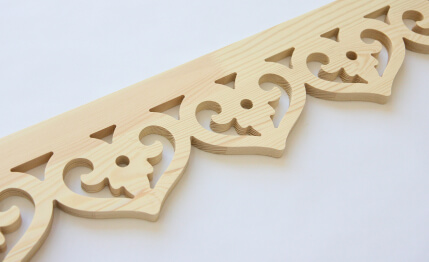
For such a task, especially interesting is the decorative overlay NPU-506. Its size is only 12 × 205 × 5 mm. This is fundamentally important: we are not dealing with a molding several meters long, nor a glazing bead used to form a continuous frame. NPU-506 is a compact decorative polyurethane overlay that creates a very narrow but already ornamented relief strip on the facade.
In other words, the choice between a glazing bead and NPU-506 cannot be reduced to the question of "which is prettier." These parts solve different tasks. A glazing bead draws a line. NPU-506 provides a line with a ready-made ornament. A glazing bead can be run along the perimeter, trimmed to the required length, and assembled into a frame. NPU-506 works as a finished decorative accent of a specific size.
Therefore, the buyer first needs to answer not the question "which element is thinner," but another one: what should appear on the facade — profile geometry or an ornamental accent?

Short answer: when to order NPU-506, and when to use a glazing bead
If the task is to run a long straight line across the facade, frame a panel, assemble a rectangular frame, or trace the contour of a door, a linear profile is needed. You can browse the catalog Moldings made of polyurethane and choose the width to match the specific furniture.
If, on a narrow cabinet door, pencil case, nightstand, or kitchen unit, what is required is not just a strip but a fine decorative ornament, NPU-506 solves the task differently. It takes up only 12 mm in width, but thanks to its relief, it does not look like an ordinary batten.
Hence the simple principle:
-
a continuous line of any required length is needed — choose a glazing bead or molding;
-
a compact vertical ornament is needed — look at NPU-506;
-
a frame plus a decorative accent is needed — the molding and the overlay can be used in one composition if their proportions suit the specific facade.
The meaning of this choice is clearly visible precisely on narrow furniture. On a large door, many decorative solutions can exist simultaneously. On a facade several tens of centimeters wide, every millimeter is visually noticeable, so decor that is unsuitable in scale immediately makes the composition heavy.




What is NPU-506 and why it is incorrect to consider it a glazing bead
The name "thin strip" involuntarily prompts a comparison with a glazing bead. The size indeed lends itself to this: the width of NPU-506 is only 12 mm. But structurally and decoratively, we are dealing with a different type of product.
NPU-506 made of polyurethane — a ready-made decorative overlay. Its width, height, and relief are predetermined. It is not purchased by linear meters for arbitrary contour formation. It works as an independent ornamental fragment.
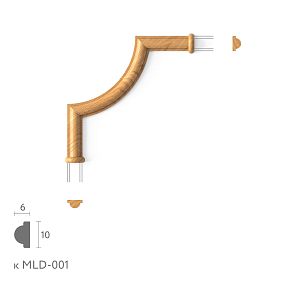
The glazing bead has the opposite logic. The main thing in it is the profile that continues along its entire length. From it, you can obtain a line of the required size, and the length of the final decorative section is determined by cutting. That is why, for example, Polyurethane molding MLDPU-001 with a profile size of 10 × 6 mm, it has a length of 2600 mm: its task is to work as an extended linear element.
NPU-506 has a different geometry: 12 × 205 × 5 mm. Here, 205 mm is not the transport length of the workpiece intended to be shortened to any size, but one of the main proportions of the decorative pattern itself.
Our factory also produces:

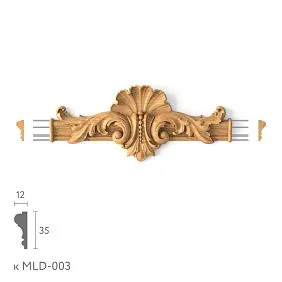
Confirmed characteristics of NPU-506
| Parameter | NPU-506 |
|---|---|
| Article number | NPU-506 |
| Product type | Decorative overlay |
| Material | Polyurethane |
| Size | 12 × 205 × 5 mm |
| Width | 12 мм |
| Height of the decorative element | 205 мм |
| Thickness / depth | 5 мм |
| Main decorative role | narrow relief ornamental accent |
| Suitable task within this article | design of a narrow furniture facade |
| Product card | buy decorative overlay NPU-506 |
The most important figure here is not even 205 mm, but 12 mm of width. It is this that makes NPU-506 interesting for those facades where a regular decorative overlay already seems too massive.
At the same time, one should not confuse a "narrow element" with a "neutral element." The overlay is narrow in geometry, but the relief makes it noticeable. It can occupy very little space while forming a pronounced vertical line.
Get Consultation
Bead and NPU-506: the external similarity ends at the small width
Imagine a simple door of a tall cabinet. On its surface, a thin vertical detail is required.
By installing a regular smooth or profiled bead, we get a long architectural line. It can run almost the entire height of the facade. The eye primarily reads the direction, straightness, and proportion.
NPU-506 works differently. The length of its decorative field is 205 mm. Therefore, the eye first notices not an endless line, but a local elongated ornament. It can be placed in the center, above or below the center, used symmetrically in a pair — the specific position depends on the overall composition of the furniture door.
This difference is especially important when buying online. In an enlarged photo, both parts may seem like "thin decorations." In real size, the difference is fundamental:
-
glazing bead — linear;
-
molding — linear profile;
-
NPU-506 — a finished overlay;
-
wide furniture overlay — independent central decor of larger area.
Therefore, looking for NPU-506 as a replacement for any glazing bead is incorrect. It replaces a glazing bead only in one sense: when the buyer needs a thin decorative vertical, but a simple profile strip seems too neutral.
NPU-506 or MLDPU-001: two similar sizes, two different tasks
For a clear comparison, it is useful to take not an abstract "some glazing bead," but a real item from the same catalog. MLDPU-001 has a profile of 10 × 6 mm and a length of 2600 mm. In width, it is even slightly narrower than NPU-506, but visually and structurally it works completely differently.
| Criterion | NPU-506 | MLDPU-001 |
|---|---|---|
| Type | Decorative overlay | linear molding / decorative bead |
| Material | Polyurethane | Polyurethane |
| Main size | 12 × 205 × 5 mm | 10 × 6 × 2600 mm |
| Character of the Decoration | Ornamental | Profile |
| Can a long continuous line be created | not the main task | yes, that's exactly why the linear format is more convenient |
| Good for a local vertical accent | Yes | can be used, but the visual effect is different |
| Good for a frame around a panel | not the main task | Yes |
| Requires trimming to fit the frame geometry | usually the task is different | when used as a frame — yes |
| Provides a ready-made ornament without assembling a complex composition | Yes | No, the profile remains a profile line |
| What to choose for a narrow door | When a relief decorative accent is needed | When a long geometric line is needed |
This table clears up the main confusion. 12 mm for NPU-506 and 10 mm for MLDPU-001 do not mean the items are interchangeable. Width is just one parameter. The character of the element matters much more.
A buyer who wants to run a frame along all four sides of a facade will likely be disappointed trying to solve the task with just NPU-506. A buyer who wants a narrow carved accent and instead takes a smooth glazing bead will get neat geometry, but not the ornamental effect for which the decoration was undertaken in the first place.
Why the difference becomes especially noticeable on a narrow facade
A large surface forgives scale. On a wide cabinet, you can place a large central overlay, add a molding frame, leave an open field, and still maintain a normal composition.
A narrow furniture front does not allow such liberties.
Imagine a pencil case with an elongated door. The more you expand the decorative element, the less free space remains on the right and left. At some point, the furniture starts to look as if the ornament simply did not fit on the plane intended for it.
NPU-506 is interesting because at a width of 12 mm it leaves the front room to "breathe." It does not require a wide central zone. Therefore, thin decor for a cabinet can be added even where a large overlay would visually capture almost the entire door.
12 mm is not just a small size
The width of a decorative detail affects the perception of the front more than it seems.
Thin vertical:
-
emphasizes the height of the door;
-
does not split it into massive zones;
-
leaves a calm field around itself;
-
can support other thin lines of furniture;
-
allows using ornament where a large carved overlay would be excessive.
But this delicacy has a downside. If the facade is huge and there are no other elements around the NPU-506, the overlay may turn out to be too small relative to the overall plane. That is why the right question is not "will the NPU-506 fit furniture in general," but "does its scale match the specific facade and the chosen composition."
The height of 205 mm sets a local accent
The glazing bead can be continued up and down to the required distance. The NPU-506 has a specific height — 205 mm.
This immediately suggests one of the most natural scenarios: the overlay does not have to divide the facade from edge to edge. It can work within a free plane as an independent decorative sign.
On a low door, these 205 mm can occupy a noticeable part of the central zone. On a tall cabinet, the same element will become a small accent within an elongated surface.
The result is an interesting effect: the same detail, with an unchanged size, can look different simply due to the proportions of the furniture.
First measure not the overlay, but the free field of the facade
One common mistake is to open the decor card, see the width of 12 mm, and immediately decide: "It's small, it will definitely fit."
Physically — possibly. Compositionally — not necessarily.
The facade is rarely a completely free rectangle. It may have:
-
handle;
-
technological gaps;
-
milling;
-
a panel;
-
an existing frame;
-
several decorative fields;
-
adjacent door with which symmetry must be maintained;
-
a hand-grip zone;
-
visible edge of the countertop or cabinet body.
Therefore, before order an NPU-506 polyurethane overlay, it is useful to determine the working decorative field.
This is not the overall width of the door, but the part where decor can actually be placed without conflicting with hardware, frames, and adjacent elements.
What dimensions to record
For one facade, it is enough to prepare several values:
-
the full width of the door;
-
full height;
-
the width of the free field between existing profiles or edges;
-
height of the free field;
-
the distance to the handle and other hardware;
-
position of existing decorative axes;
-
distances to the edges, if strict symmetry is required.
After that, compare the working area with the size of the NPU-506 — 12 × 205 × 5 mm.
The thickness of 5 mm also cannot be ignored. In the photo, the ornament may appear almost flat, but on the facade it has a real relief. If there is a protruding handle, frame, or other decor nearby, it is useful to imagine their mutual position in advance not only on the plane, but also in height.
A simple mockup measuring 12 × 205 mm solves more than ten photographs
There is a practical way to check the scale before ordering: cut a strip of 12 × 205 mm from plain paper or cardboard and apply it to the facade.
Of course, flat paper will not convey the relief of the NPU-506. But it will immediately answer several important questions:
-
does the element seem too short;
-
does it get lost on the door;
-
is it too close to the handle;
-
does one vertical line look better or two;
-
where is the visual center;
-
is an additional frame required;
-
is there enough calm space around it.
For a narrow furniture facade, this is especially useful because even a difference of a few centimeters in position noticeably changes the impression.
Place the paper template first strictly along the central axis. Then shift it higher. After that, try paired placement of two templates. Photograph each option from the distance at which the furniture is usually seen in the room.
On the phone, it quickly becomes clear which scenario looks more convincing.
One NPU-506 or two overlays: the choice depends not on quantity, but on composition
The buyer sees a small overlay and often thinks: "One won't be enough, so two are needed." This is too straightforward an approach.
One NPU-506 and two NPU-506 create different types of composition.
One overlay is a precise central accent
Single placement is appropriate when the door itself is narrow and should maintain a calm vertical plane.
In this case, the overlay works almost like a jewelry detail: it does not divide the facade into several zones, but emphasizes the axis. The contrast between a large smooth surface and a small relief fragment is clearly readable.
This option can be considered:
-
on a narrow cabinet;
-
on a tall pencil case;
-
on a small cabinet door;
-
on a single facade panel;
-
where there is already expressive hardware nearby.
A pair of overlays — rhythm and symmetry
Two NPU-506 give a different character. Now the composition is built not around one central axis, but around two parallel verticals.
The paired option requires more careful marking. On a very narrow facade, it may be excessive: little free surface will remain between the overlays, and the main advantage of thin decor will disappear.
But on a wider facade, a pair helps maintain symmetry. Especially if all the furniture is built on repeating vertical divisions.
Two doors are not the same as two overlays on one door
Sometimes the best way to achieve symmetry is to install one NPU-506 on each of two adjacent doors.
Then each door retains its independence, and the whole cabinet gets a rhythm.
This principle is especially useful for furniture with several identical facades. Instead of overloading each of them with multiple elements, you can repeat one detail on each door.
Cabinet: when NPU-506 works better than a regular profile line
There are two opposite scenarios for cabinets.
The first is that the front clearly lacks structure. It is a large smooth surface. In this case, a long frame made of glazing bead or molding is often more useful, because it truly organizes the surface.
The second is that structure already exists: the door is narrow, its proportion is vertical by itself, possibly there are body lines nearby or there is frame milling. Another solid line will add geometry, but will not necessarily make the front more interesting.
Here, NPU-506 can provide exactly what is missing: ornament.
If the task is formulated as "how to decorate a narrow furniture front without making another frame," such a decorative overlay looks more logical than glazing bead.
At the same time, you should not try to force the small NPU-506 to act as a large central cartouche. If the cabinet is wide and the decorative field is large, it is better to open the section polyurethane decorative overlays and compare products of different sizes.
Pencil case: a narrow vertical for the most natural proportion
A tall furniture pencil case is one of the most understandable scenarios for thin vertical decor.
The object itself is already elongated upward. Therefore, a narrow overlay does not break the geometry but emphasizes it.
However, here the difference between NPU-506 and molding is especially visible.
If you want to make a long line almost the height of the pencil case, it is more reasonable to look at thin molding MLDPU-001Its length of 2600 mm exactly matches the logic of an extended profile.
If you need a small ornamental insert on a smooth door, NPU-506 provides a more complex pattern at a very small width.
It is the pencil case that shows why these products should not be declared competitors. They are two different tools for the same decorative task.
Dresser: a small element is easier to keep in scale
With a dresser, everything changes. Its fronts are usually lower than cabinet or pencil case doors. Therefore, the height of NPU-506 at 205 mm is perceived much more actively.
On a relatively compact facade, the overlay can become a noticeable vertical accent. Here it is especially dangerous to automatically place two pieces just because they are narrow.
It is better to check first:
-
the height of the door or drawer;
-
handle position;
-
the distance between the handle and the intended decor;
-
the repetition of the pattern on adjacent facades.
If the dresser consists of several identical doors, a beautiful rhythm is sometimes achieved by repeating one NPU-506 on each facade.
If the furniture has wide pull-out drawers, the vertical overlay may not match their horizontal logic. In such a situation, it is more useful to either change the orientation of the composition with another decor, or choose a linear profile.
You cannot force a product to fit the furniture just because its size seems convenient.
Kitchen facade: ergonomics first, then ornament
In the kitchen, the decorative task always coexists with the functional one. The facade is constantly opened, with handles, edges, adjacent doors, drawers, and appliances nearby.
Therefore, decor for a narrow kitchen facade should be evaluated not only while standing in front of a closed cabinet.
Open the door. Grasp the handle with your usual motion. See where your fingers and palm land. The overlay should not accidentally end up in the constant grip zone if such placement makes using the furniture inconvenient.
Then check the adjacent facades. If NPU-506 is installed on several identical doors, any height discrepancy will be immediately noticeable. Here, it is better to carefully mark a common horizontal line once than to adjust each door by eye.
Kitchens have another feature: there are many facades. A single decorative detail on one cabinet is perceived calmly, but the same detail repeated twenty times creates a completely different visual rhythm.
Therefore, for the kitchen, it is useful to first create a trial composition at least on a photo or a paper mockup.
Narrow facade in a bathroom or hallway: size matters more than the room's name
Decor is often chosen by the principle 'this is for the kitchen', 'this is for the bedroom', 'this is for the hallway'. For NPU-506, it's more useful to think in terms of geometry.
The main questions are the same:
-
what is the width of the decorative field;
-
how tall is the facade;
-
is there a handle;
-
is there a frame;
-
what is the scale of adjacent elements;
-
is an ornament needed or just a profile.
If these parameters match, the same narrow overlay can work on furniture of different purposes.
Conversely, two doors in the same room may require completely different solutions if one is 300 mm wide and the other is 700 mm.
When a glazing bead is objectively more convenient
The article is dedicated to NPU-506, but a good choice starts with recognizing situations when you don't need to buy it.
A glazing bead or linear molding is more convenient if you need to:
-
draw a line over a significant length;
-
frame a rectangular panel;
-
repeat the contour of a door;
-
connect several facades with the same frame system;
-
independently determine the length of each segment;
-
get a calm profile without a standalone ornament;
-
create geometry rather than a local decorative insert.
For such tasks, it is worth looking at polyurethane moldings, rather than trying to assemble a frame from elements that are not intended for this purpose.
MLDPU-001 is especially illustrative. The 10 × 6 mm profile is close to NPU-506 in cross-sectional scale, but the 2600 mm length completely changes how it is used.
When NPU-506 is more interesting than a glazing bead
Now the reverse situation.
NPU-506 should be considered when the customer says:
“A smooth strip is too simple.”
“I don’t need a frame around the entire facade.”
"The door is narrow, you can't put a large overlay there."
"I want a thin vertical relief."
"I need a small decorative detail that won't take up half the facade."
This is where it truly comes to life Polyurethane decor for furniture as a separate product group. The buyer doesn't have to choose between a completely empty surface and a massive carved composition. There are intermediate scales.
NPU-506 is one of the most illustrative examples of this approach.
Ready-made overlay or a line of molding: compare not the price per piece, but the result
When buying decorative elements, it's easy to fall into the trap of direct price comparison. One product is sold as a separate overlay, another as a long profile. The buyer looks at the cost of one item and concludes that one option is "cheaper."
But different units of the decorative solution are being compared.
For a frame, you’ll need a certain total length of molding, cutting, and forming corners.
For a local accent, NPU-506 is used as a ready-made part of a fixed size.
Therefore, it’s more correct to first draw the final facade layout, then determine the number of elements, and only after that compare the cost of the entire concept.
Otherwise, you can buy a long profile for the sake of one short decorative section or, conversely, try to assemble a long line from parts created for a local ornament.
Wooden glazing bead or polyurethane decor: the material also changes the task
There is another fork. Sometimes the word "glazing bead" for a buyer means not just a shape, but specifically wood.
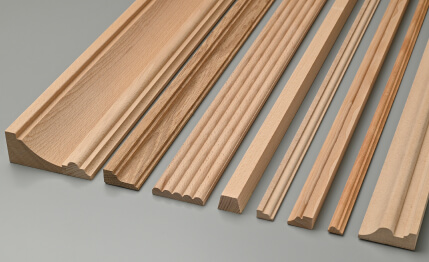
If natural wooden trim is fundamentally needed, it makes sense to immediately go to the section where you can select wooden trim and compare elements already within the desired material.
NPU-506 is made of polyurethane. Therefore, buying it as a replacement for a wooden part makes sense only when the material is not the main criterion, and the shape and decorative relief are in the first place.
This is especially important for furniture, where open wooden elements may be present nearby. Sometimes the customer needs a unified wood texture. In another project, the entire facade is painted in one color, and the character of the relief is much more important than the original material of the decorative part.
There is no universal answer "wood is better than polyurethane" or vice versa. They offer different possibilities. The choice should follow the project.
Why NPU-506 should not be called a molding
In everyday speech, the word "molding" is often used for almost any narrow decorative detail. This approach is inconvenient for purchasing.
Molding implies an extended profile. That is why in in the molding catalog the buyer sees long-length elements that are convenient for creating frames and lines.
NPU-506 falls within the logic of decorative overlays. Its ornament has a beginning, development, and completion within an element 205 mm high.
If you keep this difference in mind, it becomes much easier to navigate the catalog:
a molding is chosen by its profile and the required line length; an overlay is chosen by the size of the entire composition and the character of the ornament.
How to position NPU-506 on a facade without turning the decor into a random strip
Even a suitably sized element can be placed unsuccessfully.
The main mistake is choosing a position without connection to the geometry of the furniture.
Find the main axes on the facade. A rectangular door has a vertical center line. A framed facade has an inner field. A facade with a handle introduces an additional visual element that also affects balance.
Central placement
The calmest scheme is one NPU-506 along the vertical axis.
It is especially clear on symmetrical facades without complex hardware. The decor emphasizes the elongated shape and does not create unnecessary focal points.
Offset from the center
This option is possible but requires a reason.
For example, the decor may be related to the position of the handle or to the asymmetric composition of the entire piece of furniture. A randomly shifted overlay almost always looks like a marking error.
Paired placement
Two vertical overlays are perceived better when clear, repeating intervals are maintained between them and the edges of the facade.
It is not necessary to make all distances mathematically equal. But the composition should look intentional.
Repetition on adjacent doors
For a wardrobe or kitchen with multiple doors, this is often more convincing than two or three plates on one narrow facade.
One element on each door creates rhythm, and the furniture does not become overloaded.
Is a frame needed around NPU-506
Not necessarily.
On a smooth painted facade, one narrow relief overlay can be sufficient decor. It is the free plane around it that emphasizes the small size.
But if the furniture is built in a classical or neoclassical logic, NPU-506 can be considered as an internal accent of a frame composition.
Then the frame is selected first, then the size of the free field is checked, and only after that — the overlay.
For a thin frame, you can consider MLDPU-001. If a more noticeable profile is required, the category also presents other moldings for decorative frames.
The key principle here is simple: the frame should not narrow the inner field so much that NPU-506 ends up squeezed between the profiles.
First, the entire composition is laid out to scale. Then its parts are purchased.
Can NPU-506 be used together with larger decor
Yes, the logic itself polyurethane decorative overlays allows selecting elements of different sizes for the overall composition. But details should be combined not by the principle of "the more decor, the richer the facade."
NPU-506 works well as a secondary thin element.
If there is already a large ornament in the center, NPU-506 can support it with a vertical rhythm.
If the facade itself is narrow, a large central overlay and two NPU-506 on the sides may be excessive. In such a case, it is better to keep only one level of decor.
Furniture has an unpleasant property: extra ornament is hard to "ignore." What seems like a rich composition on the table before installation can turn into too dense relief after painting and mounting.
Therefore, when working with multiple elements, it is useful to first lay them out on the facade without fixing.
How to assemble a decorative system, not a set of random details
A buyer often starts with one beautiful overlay, then finds another molding they like, then adds a third ornament. Individually, everything is fine. Together — no.
The reason is simple: decorative furniture is built hierarchically.
There is a main element.
There are supporting lines.
There is a free background.
If NPU-506 becomes the main accent on a very narrow facade, it doesn't need five more competitors.
If the main accent is larger, NPU-506 should remain secondary.
If the main decorative technique is a frame, the overlay works inside it, rather than conflicting with its profile.
В the catalog of polyurethane molding You can look at different types of elements and combine them into one stylistic system, but the number of items in the cart should not become a goal in itself.
Facade style: the ornament should be coordinated with the furniture, not just with the room.
The phrase "I need classic decor" is too general.
Two classic facades can differ greatly. One is almost smooth, with a very thin frame. The other has a deep panel, a pronounced cornice, a complex handle, and several levels of profile.
On the first one, NPU-506 can become the main decorative event.
On the second one, it risks getting lost among more powerful elements.
Neoclassicism
Here, a narrow decorative overlay is especially clear: the geometry remains strict, but a small ornament appears on the facade.
A good principle is not to fill the entire surface. The free surface left around the overlay makes the relief more noticeable.
Classic facade
A more complex composition can be used, but you need to watch the scale of existing elements. If the door itself already has developed milling, the additional ornament should be subordinate to it.
Modern furniture
On an absolutely minimalist facade, NPU-506 creates a strong stylistic contrast. This can be a deliberate technique, but it cannot automatically be considered universal.
If the interior is built on smooth surfaces without ornament, a regular profile line may turn out to be more natural.
Eclectic interior
Here, point decorative interventions are just what's interesting. One small ornamental overlay can be a link between the modern form of furniture and the classic details of the room.
Paint to match the facade or highlight the decor
Polyurethane decor allows you to build a composition around the relief, and the specific finishing option must be coordinated with the furniture surface and the materials of the finishing system.
The calmest visual scenario is a single color for the facade and overlay. Then the eye sees not a separate "glued-on detail," but the play of light on the relief.
Contrast highlighting makes NPU-506 more noticeable. On a narrow facade, this is a particularly strong technique: a width of just 12 mm no longer seems small if the color differs sharply from the background.
Therefore, the more active the contrast, the more careful you need to be with the number of overlays.
Before final finishing, it is useful to check the compatibility of the selected materials and their application technology. And suitable items for preparation and assembly can be found in the section materials for installation and finishing.
What to order together with NPU-506
Purchasing decor rarely ends with a single line in the cart. But you don't need to automatically add related products either.
First, determine the type of composition.
If it is a single NPU-506 on a smooth facade, the set will be minimal.
If it's a frame plus an overlay, you'll need a linear profile.
If several doors are being designed, first calculate the number of overlays according to the approved scheme.
If the project is entirely based on polyurethane decor, it is useful to look at adjacent product groups, and then select only elements compatible in scale.
Practical kit table
| What to consider | Why | For which scenario | What to Check |
|---|---|---|---|
| NPU-506 | main narrow ornament | single or repeating accent | quantity and position on the facade |
| Polyurethane decorative appliques | choose a different scale or additional element | if NPU-506 is small or a composite composition is needed | dimensions of adjacent parts |
| MLDPU-001 | thin long profile line | frame, long vertical, edging | length and cutting scheme |
| Moldings made of polyurethane | choose a different frame profile | more complex furniture decor | width and depth of the profile |
| Wooden trim | alternative when wood is fundamentally needed | natural wooden facade or wooden decor system | material, profile, dimensions |
| Mounting and finishing materials | preparation for fixing and finishing | self-assembly or workshop assembly | compatibility of a specific composition with the base and decor |
| polyurethane molding catalog | assemble the overall decor system | furniture plus interior elements | stylistic and dimensional correspondence |
This approach helps avoid one of the most expensive design mistakes: ordering several beautiful pieces, and only after delivery discovering that they do not form a cohesive composition on one facade.
How to calculate the quantity of NPU-506
The calculation for the overlay is simpler than for linear molding: here you count not meters, but the number of installation points.
If one NPU-506 is installed on one door, the number of elements corresponds to the number of selected fronts.
If a symmetrical pair is planned on each door, the number is doubled.
But before placing an order, it is useful to make a small list.
For example:
| Facade | Scheme | Quantity NPU-506 |
|---|---|---|
| Left pencil case | one in the center | 1 |
| Right pencil case | one in the center | 1 |
| Two cabinet doors | One for each | 2 |
| Commode |
without NPWhat to do if 12 mm seems too narrowAgain, don't rush to refuse the product. Make a full-size mockup and look at the facade not from a distance of 20 centimeters, but from the usual point of view of furniture perception. The decor exists not in the product card photo, but in the room. Upon closer inspection, 12 mm really does seem like a very thin format. But on a narrow facade, such a proportion might be just right. If after trying it on the line is still lost, there are three possible solutions:
This is exactly why the general Catalog of Polyurethane Decorative Moldingis useful: you don't have to try to adapt a single model to any piece of furniture. How not to confuse NPU-506 with similar productsBefore ordering, check four signs. First: article numberIt needs to be exactly NPU-506. Models with similar names may differ in size, shape, and relief pattern. Second: product typeNPU-506 is a decorative overlay. Not a long molding. Third: size12 × 205 × 5 mm. One photo is not enough. On a white background, a small detail may appear larger than in reality. Fourth: taskThe overlay is needed for a local ornamental accent. If the project requires a continuous line, look for a linear profile. These four checks take less than a minute but prevent most errors specifically in the comparison of 'glazing bead or decorative overlay'. Preparation for installation: the main work happens before the glueA small part width does not mean it can be attached without marking. On the contrary: with a thin vertical, any deviation is more noticeable. If a wide ornament partially masks a small error with its complex shape, a narrow element immediately shows where the vertical axis is. Before fixing, it is useful to:
The choice of a specific adhesive composition depends on the base, its finish, and the requirements of the material itself. Suitable products can be found in the section of materials for furniture installation and finishing, after first checking the compatibility of the selected composition. Why "by eye" installation is especially dangerous on paired facadesOne slightly shifted overlay on a separate dresser may go unnoticed. Two adjacent doors act as a ruler. If one NPU-506 is positioned 10 mm higher, the eye instantly detects the mismatch. Therefore, when installing multiple panels, first mark a single horizontal line for the entire group of facades, and then mark individual vertical axes. The point here is not construction pedantry. It's simply that repeating decor turns a small mistake into a systemic one. Nine mistakes when choosing NPU-506 for a furniture facadeMistake 1. Buying from a photo without checking 12 × 205 × 5 mmThe product card shows an image, but it doesn't always give an intuitive sense of scale. Before ordering, transfer the size onto the facade itself, even with a paper template. Mistake 2. Thinking NPU-506 is a long glazing beadIf you need a line of 800 mm, 1200 mm, or almost the entire door, it's better to consider a molding. Mistake 3. Evaluating only the width of 12 mmThe height of 205 mm and thickness of 5 mm are equally important. The decor may fit perfectly in width, but not match the proportion of the free field in height. Mistake 4. Placing two pieces where one is enoughQuantity does not compensate for the wrong scale. Sometimes it is precisely a single overlay that looks more expensive and calmer, because air remains around it. Mistake 5. Ignoring the handleThe handle is also a compositional element. Two independent accents can be too close to each other. Mistake 6. Buying an overlay for a framing taskFor frame-style design, it is better to first study Polyurethane moldings. Mistake 7. Choosing the material after the designIf natural wood is essential, the comparison should start with wooden trim, not with a polyurethane overlay. Error 8. Assembling a composition from too many elementsOn a narrow facade, it is especially easy to cross the line between detail and overload. Error 9. Ordering the entire set without a trial layoutLaying out real dimensions on the facade is significantly cheaper than changing the concept after purchase. Who NPU-506 is really suitable forIt is worth taking a closer look at NPU-506 if you have:
The logic of the product is especially clear when the client says: "I want a carved detail, but everything I look at is too wide." Here, 12 mm becomes an advantage, not a limitation. It's better for someone to choose a different optionNPU-506 may not be suitable if:
Rejecting an unsuitable model is not a lost sale, but a normal result of proper selection. Practical choice for five typical tasks“I have a tall narrow pencil case, I want one beautiful vertical detail”Start with NPU-506. Make a template of 12 × 205 mm and check the central placement. If the element looks too short and the task is actually to create a long line, compare it with MLDPU-001. "I want to outline the panel with a thin profile"NPU-506 is not the main tool here. See MLDPU-001 or other moldings. "The facade is small, and a regular carved overlay is too large"This is exactly a strong scenario for NPU-506. A width of 12 mm allows you to get an ornament without turning it into a large central panel. "I just need a thin strip without a pattern"Then there is no point in buying an ornamental overlay just because of a similar width. Choose a profile line. "I want a frame and a small carved element inside."First, select the molding and calculate the inner field of the frame. Then check whether there is enough space left for the NPU-506. How to understand that the composition is already overloadedThere is a simple test. Close the cabinet and step back to the usual viewing distance. First, look at the furniture as a whole, without trying to examine the ornament. If the eye immediately catches on many small details and cannot grasp the overall shape of the facade, there is probably too much decor. On a good narrow facade, NPU-506 should help read the shape of the door, not destroy it. The second test is to remove one element from the layout. If the composition becomes clearer, then the removed detail was indeed superfluous. This technique is especially useful when combining NPU-506 with moldings and larger overlays. Polyurethane decor for furniture: why small elements deserve a separate choice at allAccording to the confirmed semantic cluster, the query "polyurethane decor for furniture" has independent demand. This is natural: the buyer does not always need architectural stucco for a wall or ceiling. Often, he is solving a very specific furniture task. You need to update the door. Need to give character to a smooth cabinet. Need to design a new facade without complex milling. Need to support the classic kitchen style. Need to find a small ornament for a narrow detail. That is why Polyurethane overlays for furniture It is logical to consider separately from large interior compositions. Furniture has a different scale. What looks thin on a three-meter wall may seem massive on a door 300–400 mm wide. NPU-506 works precisely within this furniture coordinate system. Polyurethane ornament: when relief matters more than sizeThere is an interesting paradox. A small smooth strip can almost disappear on a painted surface. A small ornament of the same width is perceived much more actively. The reason is chiaroscuro. The relief creates its own structure of highlights and shadows. Therefore, polyurethane ornament cannot be evaluated only by the area it occupies. On NPU-506, it is clearly visible how a 12-millimeter width can remain decoratively noticeable. This allows the use of a small element without the need to increase its scale. That is why a buyer who is looking for Polyurethane ornamentshould look not only at the width and height, but also at the relief pattern. Why the query "buy polyurethane decor for furniture" should not lead to a random overlayA commercial query means that a person is already close to making a purchase. But at this stage, it is especially easy to make a mistake: you want to quickly choose a beautiful item and put it in the cart. It is much more useful to use the catalog as a task filtering system. First, the type of product. Then, the dimensions. Then shape. Then, the specific facade. Then the quantity. Only after that — the order. If you need exactly a narrow relief element, you can immediately buy NPU-506 after checking the dimensions. If it turns out that a different scale is needed, open decorative appliqués section. If it turns out that you need not an ornament but a long line, proceed to moldings. Thus, a search query turns not into a random purchase, but into a sequential selection. Ready cart: three design optionsOption 1. MinimalFor one narrow door where only a relief accent is needed:
This is the cleanest scenario. Option 2. Symmetrical furnitureFor example, two identical cabinet doors:
Here the key task is not the number of details, but the identical position. Option 3. Frame plus ornamentFor a more developed classical facade:
In this option, the frame is calculated first, and only then the position of the overlay is finally determined. Where to buy polyurethane decor for furnitureIf you have already decided on the format, the commercial route becomes short. For a specific thin overlay, open the card and order NPU-506. If NPU-506 fits the idea but not the size or ornament style, compare Polyurethane decorative appliques. If after measuring it turns out that the facade needs not a separate overlay but a long profile line, see Moldings made of polyurethane. If the project involves natural wood, proceed to wooden trim. If not only furniture but the entire interior composition is being styled, it is convenient to start with the general polyurethane moldings catalog. Before placing the order, double-check the article number, size, and required quantity. FAQ: answers to questions about NPU-506 and thin decor for furniture facadesIs NPU-506 a glazing bead?No. NPU-506 is a decorative polyurethane overlay measuring 12 × 205 × 5 mm. A glazing bead or molding is a linear profile convenient for creating long lines and frames. NPU-506 has a different function: a ready-made local ornamental accent. Is NPU-506 a molding?No, by product logic it is an overlay, not a long molding. If you need a profile line of arbitrary length, it's better to look at Moldings made of polyurethane. What is the exact size of NPU-506?The size is 12 × 205 × 5 mm. Before ordering, it is advisable to transfer these dimensions to the actual facade to assess the scale. Will NPU-506 fit on a narrow cabinet door?It may fit very well precisely due to its 12 mm width, but the decision depends on the width and height of the free decorative field, the position of the handle, and other elements. Make a template of 12 × 205 mm and apply it to the facade. What is better for a pencil case: NPU-506 or a glazing bead?If you need a long vertical line almost the full height of the pencil case, a linear molding is more practical. If a small ornamental accent is required, NPU-506 fits the task better. Can two NPU-506 be installed on one door?A paired composition can be considered if the facade width allows enough free space. On a very narrow door, two overlays can create visual overload. Is it better to have one NPU-506 in the center or two on the sides?For narrow facades, one central overlay often looks calmer. Two create a more active symmetrical rhythm. The final decision is best made after a full-size mockup. Will NPU-506 be suitable for a kitchen facade?In terms of size and decorative purpose, it can be used on a furniture facade, but before installation, you need to check the handle position, grip area, adjacent doors, and the overall layout of the cabinet set. Can a frame be made from NPU-506?This is not the main purpose of the model. For a frame, it is better to use a linear profile, for example MLDPU-001 or another suitable molding. How is NPU-506 different from MLDPU-001?NPU-506 is an ornamental overlay 12 × 205 × 5 mm. MLDPU-001 is a linear profile 10 × 6 × 2600 mm. The first creates a ready-made decorative fragment, the second creates a long profile line. What to choose if you need decor about 10–12 mm wide?First, determine the function. Similar width does not make products analogs. For an ornamental accent, the NPU-506 logic is suitable; for a long line, MLDPU-001 or another molding. What to do if NPU-506 looks too small?Do not increase the quantity automatically. First, look at larger Polyurethane overlays for furniture and compare the scale. What to do if NPU-506 looks too short on a tall facade?If a continuous vertical is required, it is better to switch to a molding. NPU-506 should be perceived as a local decorative element 205 mm high, not as a linear strip. Can NPU-506 be combined with molding?Yes, if the composition is planned in advance. The molding can form a frame, and the NPU-506 can serve as an internal ornamental accent. The main thing is that after installing the frame, enough free space remains inside. Where can I see other decorative overlays?In the section polyurethane decorative overlays you can compare other sizes and shapes. What to choose for a natural wooden facade?If a wooden decorative profile is strictly required, it is worth studying wooden trim items and then selecting a suitable option within that group. How to check the scale of NPU-506 before purchasing?Make a paper rectangle 12 × 205 mm, place it in the intended installation spot, and photograph the furniture from a normal distance. This won't convey the relief, but it will clearly show the size and position of the element. Do I need to buy NPU-506 with a reserve?The quantity is best calculated based on the approved facade layout. If one overlay is planned for every four doors, the basic calculation is four elements. Don't buy a random quantity without understanding the future arrangement. Where can I see the materials for installation?Suitable products are collected in the section materials for installation and finishing. Before applying a specific composition, you need to check its compatibility with polyurethane and the facade surface. Can I order NPU-506 separately, without the molding?If the composition implies one independent overlay, there is no need to buy molding just "for the set." First, the facade design is determined, then the basket composition. Which option looks more expensive — glazing bead or NPU-506?The type of part itself does not determine the quality of the composition. A well-calculated thin profile frame can look more convincing than an overloaded ornamented facade, and one neatly placed NPU-506 can be more interesting than a random line. What matters is the match of size, pattern, and overall geometry of the furniture. NPU-506 or glazing bead: the final choice is made by functionThis task has a very simple conclusion. If the furniture facade needs a line, choose a linear profile. If the facade needs an ornament, but there is not enough space for a large decorative overlay, NPU-506 becomes much more interesting. The size of 12 × 205 × 5 mm makes it not a universal decor "just in case," but a specialized tool for neat work on a small scale. It can decorate a narrow cabinet, a pencil case, a small door, a separate kitchen facade, or become a secondary part of a more complex composition. The main thing is not to buy it as a "small molding." This is a different product and a different decorative logic. Before ordering, transfer the size to the front, check the handle position, determine whether one overlay is needed or a repeat on several doors, and decide whether a frame profile is required nearby. After that, you can buy decorative overlay NPU-506 or go to the catalog and choose a different scale. STAVROS company allows solving such a task not with a random set of parts, but with a system: in one catalog you can compare Decorative Inserts, Polyurethane moldings, Wooden trim и Mounting and finishing materials. Therefore, the choice begins not with the word "glazing bead" or "overlay," but with the actual geometry of your front. And if after measuring it becomes clear that a thin ornamental strip is needed, rather than a regular profile line, NPU-506 gives a quite specific answer to this question. |


