Article Contents:
- Round wooden handrail PR-004: what we replace and what we keep
- Old brackets before purchase: gathering a measurement map
- 50 mm diameter and old fit: why one match is not enough
- New handrail by the wall: recalculating space for the hand
- Keeping brackets doesn't automatically mean keeping the old anchors
- What length of PR-004 to order with existing supports
- Beech or oak: ordering a handrail to match the previous interior
- Replacement cost: comparing two full sets
- How to order PR-004 for a finished staircase
- Questions before purchasing a round wooden handrail
- Can the holders be left without markings and documents?
- Is it acceptable to keep two supports and replace the third one?
- What to do if the hidden connection cannot be photographed?
- Can I order holes exactly like on the old handrail?
- Do I need to buy a separate part for the cutout?
- When to remove the old wooden part?
- Can I first update the handrail on only one flight of stairs?
- Is it mandatory to repaint the preserved holders?
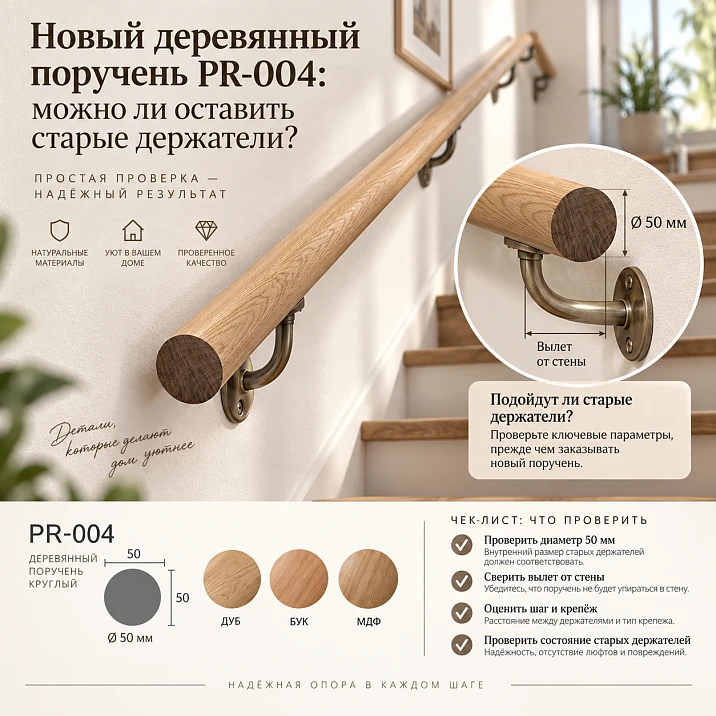
The wooden part of the wall-mounted handrail has darkened, become covered with scratches, or no longer matches the interior. The metal brackets look serviceable, and the wall was recently painted. You want to replace only the wood: without new holes, repositioning the supports, or refinishing the stair flight.
You can keep the brackets if their condition, compatibility with the new profile, connections, and anchoring to the wall have been checked. Matching diameter alone does not prove this. If the previous handrail was loose, replacing the wooden part should not mask the fault: first, you need to determine which component requires repair.
Before buy the round wooden handrail PR-004, prepare a map of existing supports, and agree on the finished length and finish. Then two clear options emerge: a new handrail on confirmed brackets, or replacement together with the necessary mounting kit. They should be compared by the cost of the completed work.
Round wooden handrail PR-004: what we replace and what we keep
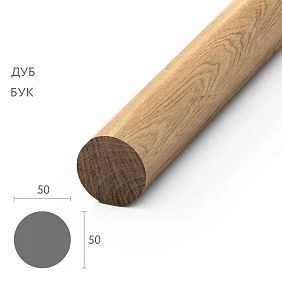
PR-004 is a wooden component with a round cross-section. For the order in question, the trade table shows a version with a length of 2400 mm and a diameter of 50 mm. It is not a ready-made wall-mounted railing kit.
| Parameter | Version PR-004 |
|---|---|
| Factory size A × B | 2400 × 50 mm |
| Cross-section shape | Round, diameter 50 mm |
| Wood | Beech or oak |
| Sanding | «Prestige» |
| Lamination grade | Specify and confirm for the selected finish |
| Holders and finished trim | Do not consider included without confirmation of configuration |
The general description mentions a length range of 2–4 m, but this is not a list of options available for purchase for PR-004. Transfer the specific product line 2400 × 50 mm to the request. Another length cannot be considered available at the same price without a separate seller offer.
For a wall-mounted handrail, check the entire sequence of connections: wooden part, attachment to the holder, the holder itself, wall fastener, and wall base. A nice metal finish indicates the appearance of the support but does not confirm the condition of the hidden fastening. Likewise, a new oak handrail does not fix an unsuitable joint in the partition.
First, determine the reason for the purchase. For an aesthetic update, the task is to preserve functional elements. In case of cracks, handrail twisting, or movement of supports, an inspection is necessary. Do not transfer the baluster calculation here: this article discusses a standalone wall-mounted handrail, not the top part of a railing on posts.
Check the 50 mm diameter separately for grip comfort for those who use the stairs. Trying a sample or a similarly cross-sectioned securely fastened handrail helps assess the feel in the hand but does not replace checking the future installation.




Old holders before purchase: creating a measurement map
Label the supports in order: H1, H2, H3, and so on. The numbering in the overall photo must match the labels in the table. Otherwise, the master's remark "the middle holder needs to be replaced" can easily turn into an ambiguous task when transferring the order to another contractor.
For each support, record the model, mounting shape, location of available holes, and position relative to the wall. Write dimensions with units of measurement. If a parameter is hidden or unknown, leave a note "to clarify" rather than an assumed number.
| Support | Manufacturer and model | Landing shape | Mounting holes | Wall — handrail axis | Solution |
|---|---|---|---|---|---|
| D1 | By marking or documents | Photo, description | Dimensions of available elements | By measurement, mm | Save / replace / clarify |
| D2 | Fill separately | Do not copy automatically | By own support | By measurement, mm | Installer's decision |
| D3 and following | Add necessary lines | By inspection | Hidden places — clarify | By measurement, mm | Specify responsible person |
Attach measurements to one clear reference point on the sketch: for example, to the agreed lower end of the future part. For each support, indicate the position along the railing line and the seating angle, if it matters for the structure. Such coordinates allow comparing all holders with each other. Several independent photos with a tape measure do not show whether the mounting points form one required line.
Take a general shot of the line, a side view, and a photo of the accessible lower part of the connection. Place a ruler next to the measured spot. A perspective shot without a scale is suitable for discussing shape, but not for determining the seating diameter with millimeter accuracy.
For the previous round railing, measure the diameter in several accessible places, not only where the wood is noticeably worn. Record what exactly was measured: the finished surface with coating or exposed wood. For a profiled part, do not substitute the diameter with the maximum width: its seating may be arranged differently.
The buyer gathers available information without weakening the system. The installer determines what will need to be opened, checked, or disassembled. There is no need to remove a support just for a photo and leave a handrail inadequately secured. The absence of noticeable play during normal use is an observation, not a conclusion about permissible load.
The seller of a wooden part is primarily given the required profile, length, and questions about product preparation. The condition of a specific wall and old anchors is assessed by the contractor on site: such a conclusion cannot be drawn from a product article number.
Our factory also produces:
Diameter 50 mm and an old fit: why one match alone is not enough
The phrase "holder for a round handrail" is not precise enough. An old system may contain a wrap-around element, a contoured saddle, a platform, or a concealed connector. These are different methods of contact and fixation, not interchangeable options by default.
For a wrap-around part, check the intended size range, assembly method, and operation with a fully finished surface. For a saddle, check the shape of contact with the circle and the permissible position on an inclined section. For a platform, check the allowed profile and connection to the wood. For a concealed joint, information about its internal part is needed: the external appearance does not reveal the entire structure.
The holder documentation must contain the basis for use with the selected handrail. The installer compares them with the actual condition of the joint and the task of the facility. New holes in the wood cannot be assumed in advance to match the old ones: their position is determined by the agreed assembly, not copied by eye.
A typical mistake is to buy PR-004, discover incomplete contact, and then adjust the wood to fit the old metal. Sanding down the round profile, widening the ring, or using random shims changes the connection conditions. If the standard fit is not suitable, it is wiser to reconsider the holders before paying for the handrail than to turn a finished product into an experimental blank.
Before payment, request the necessary diameter tolerances for the fit and straightness requirements of the selected version. This information may not be present in a brief product line; the absence of a number cannot be interpreted as a zero tolerance. If the holder has a limited fit size, the installer must compare the requirements of both parts. The final coating is also taken into account in the agreement, not compensated for its thickness by arbitrarily loosening the connection.
Matching the nominal diameter also does not answer the question of assembly. In a closed holder, the part sometimes needs to be inserted from the end; the possibility of such movement is checked against the specific design. A wall, a stair turn, or adjacent furniture may restrict access. This question should be asked to the craftsman in advance, even when the handrail geometrically fits in its final position.
The result of the check is formulated specifically: which holders are allowed for reinstallation, with which connection, and under what conditions. The answer "it seems it will fit" does not yet allow approving the purchase composition.
Get Consultation
New handrail at the wall: recalculating the space for the hand
For a round profile, the distance to the wall depends on the diameter and the position of the axis. For a straight cylindrical section whose axis is parallel to the wall plane, the geometric gap is calculated as follows:
Gap = distance from the finished wall to the axis − diameter / 2.
If you replace a conventional handrail Ø40 mm with Ø50 mm while keeping the axis position unchanged, the radius increases from 20 to 25 mm. The free space on the wall side decreases by 5 mm. This is a consequence of dimensions, not a conclusion about the acceptability of the resulting gap.
| Training scenario | Distance from wall to axis | Calculated gap |
|---|---|---|
| Old handrail Ø40 mm | 70 мм | 70 − 20 = 50 mm |
| New Ø50 mm, axis preserved | 70 мм | 70 − 25 = 45 mm |
| New Ø50 mm, the axis turned out to be closer to the wall | 65 мм | 65 − 25 = 40 mm |
All distances in the table are conditional. They do not set a regulatory minimum and do not confirm installation safety. The third option shows why you cannot always subtract only 5 mm: a changed fit or a new holder can shift the axis itself. Even keeping the wall-mounted part of the support does not guarantee the previous position of the center of another profile.
For measurement, use the surface of the finished wall, including existing cladding. Check the line near each holder, near protrusions, and at junctions with other elements. A convenient grip in the middle of the span does not prove that the hand passes freely near the support.
On the diagram, mark the positions of the beginning and end of the handrail, nearby furniture, door handles, and other obstacles. The suitability of distances for a specific staircase and its users is confirmed by the design solution and fitting, not by a single successful calculation line.
Keeping the holders does not automatically mean keeping the previous anchors
For each support, divide the decision into three parts: connection to the new wood, condition of the metal holder, and fastening in the wall. Opposite each, mark "keep," "replace," or "insufficient data," and the surname or name of the contractor who confirmed the decision.
This may reveal that the holder is suitable, but the screws connecting to the wood need replacement. Or the external part is intact, but the wall fastening requires rework. The opposite case is also possible: the base and fastening are suitable, but the fit does not comply with PR-004. These situations result in different scopes of work and different costs.
If there are finish cracks, signs of movement, metal damage, or unknown modifications near the support, report observations to the installer. Self-testing by jerking does not establish load-bearing capacity and may worsen the condition of the joint. You cannot assign a test load for the entire system knowing only the wood species and diameter of the wooden part.
Special attention is required if the supports are in different planes or have mismatched mounting elements after a previous repair. Do not assume in advance that a new handrail can be pulled to all points and thereby level the system. Before purchasing, the technician determines whether the layout is preserved, whether adjustment is needed by the intended method, or whether replacement of some components will be required. This decision is recorded for specific numbers D1, D2, and so on.
The purchase should be postponed when there is no confirmed way to secure the chosen handrail, the base requires repair, or the new geometry interferes with using the stairs. First, change the mounting solution, then return to the product specification.
When discussing new brackets, compare the wood seating and the wall part separately. A matching handrail diameter does not mean the holes in the wall will match. A decorative cup of a different shape may not cover the trace of the previous support, even if the new fastener is placed close to the old one. Therefore, the promise to preserve the finish is checked by the dimensions of the wall elements and the surface condition, not by a photo of the handrail.
Existing holes should also not dictate the solution at any cost. Ask the contractor a specific question: can the previous mounting points be used with the chosen system, and what will need to be restored around them. Include the answer in the task before finishing the new wood. If local restoration cannot be done invisibly, define the boundaries of wall painting in advance and compare this cost with the original idea of replacement without repair.
Also discuss the work period: who dismantles the old part, how access to the unfinished section is restricted, and when the stairs can be used again in the normal manner. Do not leave the new handrail "on two screws until tomorrow" as a temporary support. If local wall repair is necessary, its scope, finishing material, and contractor should appear in the estimate in advance.
What length of PR-004 to order with existing supports
The distance between the outermost brackets is only part of the finished length. Agreed start and end points of the handrail, end finishing, and allowances for processing are also needed. The measurement is taken along the future part; the horizontal projection of an inclined section is not suitable for this task.
First, mark the end points on the sketch. Then indicate the position of the outermost and intermediate supports. The old layout is checked, not accepted as a template just because it already exists: previous endings may have been inconvenient, and the bracket arrangement may require reconsideration.
Training example. Between the axes of the outermost supports along the handrail, 1920 mm is obtained. In the conditional scheme, sections of 140 and 160 mm from these axes to the finished ends are provided. Then the part length is:
1920 + 140 + 160 = 2220 mm.
Suppose the craftsman added another 20 mm total for end preparation and processing losses. Workpiece check:
2220 + 20 = 2240 mm ≤ 2400 mm.
160 mm remains along the length. This is a calculation under the given assumptions, not a recommendation for overhang sizes, number of supports, or a universal allowance. The presence of intermediate holders and the suitability of the entire scheme are confirmed separately.
Edge case: a finished part of 2390 mm is formally shorter than the factory workpiece. But with the same conditional losses, the requirement would be 2410 mm — the workpiece would fall short by 10 mm. You cannot "forget" the processing to get the desired answer or arbitrarily reduce the intended allowance.
If the size does not fit, agree on a different length or a different design solution. Before Buy a wooden handrail for stairs, approve the updated list. A random joint of two offcuts is not a substitute for a calculated connection. STAVROS does not provide the cutting to size itself: this work must be coordinated with the contractor separately.
Beech or oak: we order a handrail for the previous interior
The material is chosen together with the finish, not after receiving the workpiece. For an opaque color, consider beech or oak with suitable preparation; for a visible wood grain, separately agree on the lamination grade and sample. Oak wood itself does not mean that a specific workpiece is matched for a translucent finish.
"Prestige" is the quality of sanding, not a ready-made paint. The designations "under enamel" and "under tinting" refer to lamination grades. In the first case, the color and texture of the lamellas are not selected as for visible wood; in the second, selection is provided, but natural differences remain. Before ordering, you should choose the wood and preparation for the finish, and then record both characteristics in the application.
Compare the sample with steps, a door, or another surface to which the handrail is being matched, under normal staircase lighting. Specify a concrete reference point: "to match the door trim color," not "like all the wood in the house." The color and degree of gloss are approved together. A photograph helps start the conversation with the finisher but does not replace physical comparison.
For old wrap-around brackets, the fit is additionally checked after the agreed finish. Fitting unfinished wood does not guarantee the final result if the coating changes contact with the metal. A single finish thickness cannot be assigned for all materials and application methods.
Pass to the craftsman Tips for finishing wooden products as general information about surface preparation. The specific coating system, its suitability for the handrail, and the time until ready for assembly are determined by him based on the selected materials. The decorative finish memo does not replace documentation for load-bearing connections.
Replacement cost: comparing two complete sets
As of the check on September 6, 2026, PR-004 sized 2400 × 50 mm with "Prestige" sanding costs 5960 ₽ in beech and 8440 ₽ in oak per item. The difference is 2480 ₽. It applies only to wood versions, not to two repair options.
For comparing the preservation and replacement of brackets, record the same finished length, wood type, and finish requirements. Otherwise, a lower amount may be explained by a different coating or an incomplete scope of work.
| Expense | Option A: we preserve the confirmed brackets | Option B: we install new brackets |
|---|---|---|
| One PR-004 of the selected breed | Beech 5960 ₽ or oak 8440 ₽ | Same finish at the same price |
| Inspection of the existing system | At the contractor's proposal | At the contractor's proposal |
| Holders | Only necessary replacements | Agreed new set |
| Wood connections and wall mounting hardware | Based on inspection results | According to the accepted installation solution |
| Trimming and finishing of ends | By the same finished length | By the same finished length |
| Preparation and coating | Per approved sample | According to the same sample |
| Dismantling, installation, acceptance | Individual works | Individual works |
| Local wall repair | If required | If required |
| Packaging and transportation | By invoice and address | By invoice and address |
The card recommends a paid pine transport backing. Its cost for this order needs to be requested: you cannot transfer the packaging price from another product or consider the backing covered by delivery. Also coordinate the delivery address — either the site itself or the workshop, if finishing is done before installation.
Ask to separate confirmed and conditional costs. For example, the need for local wall repair may only become clear after an agreed opening. In the contractor's proposal, it should be stated which work is already included, what circumstance triggers an additional charge, and who approves it before continuing installation. Then the two proposals are compared on the same basis, and the absence of an amount does not look like a promise of free rework.
Retained brackets do not guarantee cheaper repairs. Option A may require additional work for inspection and restoration, while Option B may require a new kit and finishing over traces of the previous mounting. Comparison is possible after filling in all lines, not based on a single metal price.
If only the color is unsatisfactory, discuss with the craftsman restoring the existing wooden part. When its condition and structure allow limiting to finishing, purchasing a new PR-004 may not be needed at all.
How to order PR-004 for a finished staircase
To order a wooden handrail without confusion, create two separate tasks: one for the seller — for the product, and one for the installer — for the finished system. In the product request, do not hide important parameters inside a long repair description.
Please calculate PR-004, factory size 2400 × 50 mm, wood ______, sanding "Prestige", glue-lamination grade ______, quantity ______ pcs. Intended coating ______. Please confirm the selected version, configuration, packaging and its cost, readiness time, and delivery to address ______. Recipient ______. Finishing and installation are performed by ______.
Provide the installer with map D1–D3 and other supports, a list of retained elements, confirmed connections, finished lengths, and end solutions. Separately record who is responsible for the wall base, cutting, coating application, and final acceptance. The phrase "install as it was" does not replace this task.
After finishing is agreed, you can buy materials for handrail finishing According to the artist's list. This section should not be perceived as a ready-made set of compatible wall brackets.
Upon receipt, check the article number, material, size, quantity, and visible condition of the product before cutting and irreversible finishing. Keep part markings if the order is intended for multiple areas. If there is a discrepancy with the order, first agree on a solution with the seller, rather than trying to fix the mismatch by processing.
During final acceptance, not only the color is checked. Verify the agreed start and end of the part, position relative to the wall and obstacles, finishing of ends, and absence of accessible sharp protrusions. The installer confirms completed connections and readiness of the entire system for operation in the intended manner. Keep the final map: it will show during the next maintenance which elements remained unchanged and which were replaced.
Before payment, clarify payment and delivery terms for the handrail and the current price. Tie the installation date to receipt of the product, fitting, readiness of the coating and base, not just to the end of production. If inspection excluded old brackets, first update the kit and estimate.
Choose PR-004 and agree on the replacement composition.
Questions before purchasing a round wooden handrail
Can brackets without markings and documents be left?
Lack of markings does not automatically mean a ban, but it complicates confirmation of the structure. Provide the installer with available measurements and photos. If it is not possible to reliably establish the characteristics and suitability of the support, do not consider it suitable based on external similarity: a different confirmed solution is required.
Is it acceptable to keep two supports and replace the third?
This option is considered separately. The seating, axis position, and operation of all connections in one system need to be coordinated. A new support, similar in color, may have different geometry. In the list, specify the replaced holder by number, not by the general quantity of "one piece."
What to do if a hidden connection cannot be photographed?
Start with the general view, available angles, and preserved documents. Do not loosen a working handrail for the sake of a photo. The need for disassembly and the safe sequence is determined by the contractor; until inspection, the hidden joint remains unconfirmed, not automatically functional.
Can holes be ordered exactly as on the old handrail?
The availability of such processing from the seller is not confirmed by the PR-004 configuration. Clarify the possibility of the service separately. The craftsman must check the correspondence of the holes to the new part and the connection; a photo of the old layout is not a ready drilling task.
Is it necessary to buy a separate part for color sampling?
Not necessarily a whole additional handrail. First, coordinate the method of obtaining a suitable sample with the seller and finisher. If using the remainder of the main workpiece is intended, its length and suitability need to be included in the cutting plan. A free sample or guaranteed remainder is not assumed in advance.
When to remove the old wooden part?
The sequence depends on the inspection. For a regular replacement, it is convenient to have the accepted new material and agreed contractors in advance. But a faulty system cannot continue to be used just because the order has not arrived yet: safe access to the staircase is organized separately.
Can we first replace the handrail on only one flight of stairs?
Yes, as a separate approved stage. Sign off on the section, its dimensions, and the coating sample. For the next flight, a separate check of the brackets and length will be required: the same appearance of the staircase does not prove that all its components have the same construction.
Is it mandatory to repaint the preserved brackets?
No, that is a separate decision based on the surface condition and appearance. If the metal coating requires restoration, include the work in the estimate and coordinate assembly after it is completed. New paint does not eliminate bracket damage and does not confirm the suitability of its connections.