Article Contents:
- What exactly is selected in the Jupiter HL-064M card
- Why the letter M matters
- Color is only the first level of comparison
- The wood species name is not a color code
- Lighting
- Part surface area
- Adjacent metal
- Fiber direction
- Facade shine
- Wenge tone-on-tone
- Wenge on light facade
- Wenge on black furniture
- When wenge may not fit
- On a solid-color facade
- On a facade with wood grain pattern
- Size 29 mm for zebrano
- Size 36 mm for zebrano
- When zebrano is better to order first in a single piece
- Walnut on light furniture
- Walnut next to walnut veneer
- Walnut on colored facades
- 29 or 36 mm for walnut
- Rosewood on a solid surface
- Rosewood on active wood texture
- Rosewood and 36 mm size
- When rosewood is better replaced with a calmer option
- 29 mm: when a small handle looks more precise
- 36 mm: when the facade needs a more confident point
- Protrusion 45 or 49 mm
- Small facade
- Medium facade
- Tall door leaf
- Wide box
- Wenge
- Zebrano
- Walnut
- Rosewood
- Top row
- Bottom row
- Drawers
- Pencil cases
- Dishwasher and refrigerator
- Corner modules
- Two hinged doors
- Three or four panels
- Upper mezzanine shelves
- Cabinet next to the wall
- Walk-in closet
- One central element
- Two handles
- Mixing sizes
- Example of kitchen calculation
- Replacing an old handle
- New facade
- Paneled door
- What it can be paired with
- Mixing with brass
- Mixing with black hardware
- Mixing sizes
- FUR-032
- FUR-033
- How many plugs to put in the cart
- When a pull handle is needed
- When a button handle is suitable
- When a recessed model is needed
- Three ways to assemble a wood palette
- Mistake 1. Ordering "any brown one"
- Mistake 2. Assuming the facade name guarantees a match
- Mistake 3. Choosing only by screen
- Mistake 4. Not ordering a sample before a large batch
- Mistake 5. Not considering the metal base
- Mistake 6. Considering 29 and 36 mm sizes almost identical
- Mistake 7. Looking only at width
- Mistake 8. Installing 36 mm on a very small drawer without a template
- Mistake 9. Installing 29 mm on a large cabinet just to save money
- Mistake 10. Accidentally mixing sizes
- Mistake 11. Mixing wood within one kitchen set
- Error 12. Consider all natural handles identical
- Error 13. Order in parts without necessity
- Error 14. Count only kitchen doors
- Error 15. Not separate facades with one and two handles
- Error 16. Order reserve before exact calculation
- Error 17. Not check facade thickness
- Error 18. Ignore old holes
- Error 19. Drill before size approval
- Error 20. Not check corner doors
- Error 21. Not check distance to wall
- Error 22. Consider plugs as included
- Error 23. Select plug only by color
- Error 24. Mix FUR-032 and FUR-033 without a system
- Error 25. Not include delivery in budget
- Error 26. Not check stock of selected modification
- Error 27. Order one species in different sizes without checking availability
- Error 28. Expect full pattern identity
- Error 29. Overloading the facade with active zebrano
- Error 30. Losing dark wenge on a poorly lit facade
- Error 31. Using rosewood in an already saturated composition
- Error 32. Considering walnut universally calm
- Error 33. Not matching handles with the plinth and doors
- Error 34. Wiping wood with aggressive agents
- Error 35. Pulling a heavy drawer by the edge of the handle
- Step 1. Choose furniture
- Step 2. Create a facade list
- Step 3. Determine the number of handles on each facade
- Step 4. Select size
- Step 5. Check protrusion
- Step 6. Choose wood
- Step 7. Check metal
- Step 8. Order sample
- Step 9. Check balance
- Step 10. Add plugs
- Step 11. Check fasteners
- Step 12. Calculate cost
- Step 13. Arrange pickup
- Step 14. Recheck the cart
- What sizes are available for Jupiter HL-064M?
- What do the three sizes mean?
- Which size should I choose for a small cabinet?
- What should I choose for a tall cabinet door?
- Will 29 mm work for the kitchen?
- Can I put 29 mm on top and 36 mm on the bottom?
- Which option is the darkest?
- Which material has the most noticeable pattern?
- Which option should I choose for a white facade?
- What is better for a walnut facade?
- Will wenge suit black furniture?
- Can zebrano be combined with a wood facade?
- Won't rosewood look too bright?
- Is there an oak Jupiter HL-064M?
- What is the base made of?
- Can I order just one handle?
- Should I buy a sample first?
- Will all handles be absolutely identical?
- How to calculate handles for a kitchen?
- How many handles are needed for a dresser?
- Is a spare needed?
- Can I order one handle later?
- Is the mounting hardware included in the price?
- Are FUR-032 and FUR-033 included?
- What is the plug for?
- What is the difference between FUR-032 and FUR-033?
- Can I replace an old pull handle with Jupiter?
- Where should the handle be installed on the facade?
- Can Jupiter be installed on a paneled facade?
- What should be checked in a corner kitchen?
- Can handles be used on built-in appliances?
- How to care for the coating?
- Can the handle be washed with a large amount of water?
- Where can I see alternatives?
- Can Jupiter be combined with steel lighting fixtures?
- What to do if brass is used in the interior?
- How to check the color without visiting the showroom?
- Is the price of Jupiter the same for all options?
- How to find out the final cost of the set?
- Is there Contact us to confirm shipping to your destination.?
- Can I place a quick order?
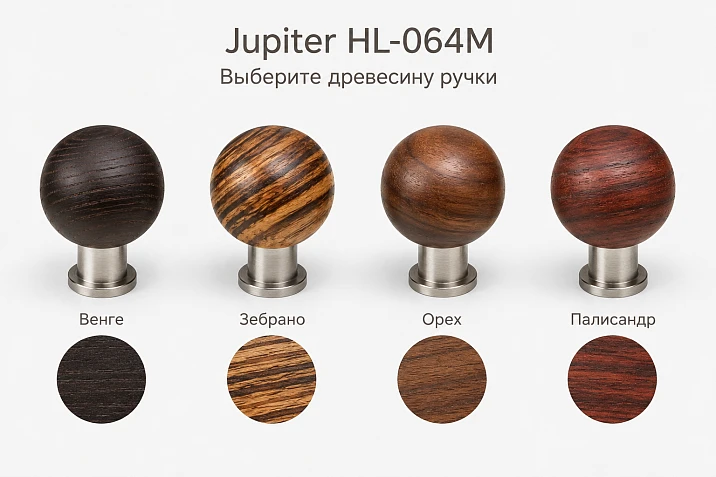
The query "buy wooden handles" seems simple only until wenge, zebrano, walnut, and rosewood appear in the card of one model. In a small image, all four finishes may look dark or brown. On a real furniture facade, the difference becomes more obvious: the wood grain pattern, tone depth, fiber visibility, the nature of contrast, and how much the handle clashes with the surface or calmly supports it all change.
With Jupiter HL-064M, a second choice also arises. The model is available in two sizes: 29 × 29 × 45 mm and 36 × 36 × 49 mm. The difference between 29 and 36 mm on screen seems small. On the front of a narrow cabinet and on a tall wardrobe door, these options are perceived differently. The smaller handle works more delicately, while the larger one stands out more in the composition and provides a more pronounced grip point.
There is also a third question that is often postponed until the cart: how many handles to order? For a kitchen, it is not enough to mentally count only the upper cabinets. The kitchen unit has drawers, lower doors, tall cabinets, hidden sections, and possibly a separate sideboard. In a wardrobe, each door is counted separately. In a dresser, one wide drawer may get one handle, or it may get two, if that is how the facade is designed. An order of "about ten pieces" easily ends up short by one item, and by that time, the needed wood or size option may already belong to a different batch.
Therefore buy Jupiter HL-064M handle better not as a conditional brown button, but as a precisely selected element of a furniture series. Before adding the product to the cart, you need to determine five parameters: size, wood finish, quantity, combination with the facade, and the composition of the mounting kit.
Jupiter HL-064M belongs to the Esthete collection. The wooden part is combined with a stainless steel metal base. The card offers options that can be added to the cart or ordered via quick order, and delivery is available across Russia. However, availability and the current price depend on the specific combination of size and material, so you need to check not the general "in stock" label, but the selected specification line.
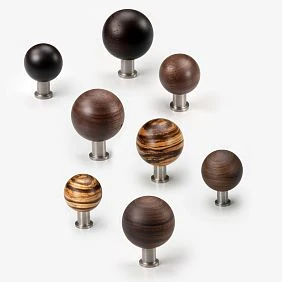
What exactly is selected in the Jupiter HL-064M card
Jupiter HL-064M is not a single handle in one fixed finish. Under the common article number, options are combined that differ in sizes and wood. It is the selected combination that determines the appearance, price, and available stock.
| Parameter | Available options | What to check before ordering |
|---|---|---|
| Model | Jupiter HL-064M | Not to be confused with unpainted Jupiter HL-064 |
| Type | Furniture knob handle | Does a single-point handle suit the facade project |
| Size | 29 × 29 × 45 mm; 36 × 36 × 49 mm | Facade scale, grip comfort, protrusion |
| Main wood options | Wenge, zebrano, walnut, rosewood | Actual shade and pattern next to the facade |
| Additional option | Oak is available for some modifications | Check specific combination in the card |
| Metal part | Stainless steel | Combination with other hardware in the room |
| Quantity | From 1 pcs. | Calculate each facade and determine the reserve |
| Purchase | Cart or quick order | Verify selected characteristics before sending |
| Receiving | Contact us to confirm shipping to your destination. | Calculate together with the entire set |
| Related items | FUR-032 and FUR-033 | Do not count as automatically included in the price |
The table shows the main thing: it is not enough to open the page and click "Add to cart". First, you need to select a specific row. Jupiter HL-064M in wenge, size 29 mm, and Jupiter HL-064M in rosewood, size 36 mm, are visually and commercially different items, although the model article remains common.




Why the letter M matters
STAVROS has a similarly named Jupiter HL-064 without the letter M. This is not a reason to consider the two cards duplicates. The model with the designation HL-064M refers to pens with a ready-made decorative combination of wooden and metal parts. The unpainted Jupiter HL-064 is intended for a different scenario: the buyer selects a blank and independently decides on the finishing.
If you need a ready-made version in wenge, zebrano, walnut, or rosewood with a metal base, you should look at Jupiter HL-064M. If the project requires a custom color, individual tinting, or matching a non-standard sample, the unpainted Jupiter HL-064 handle may be considered unpainted Jupiter HL-064 handle. Mixing these two scenarios in one order without a design intent is not advisable.
Our factory also produces:
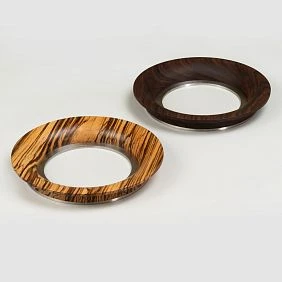
The word "brown" hides too many differences
A buyer often describes the task in one phrase: "We need brown wooden handles." This is enough for an initial search. For ordering a set, it is not.
Brown can be:
-
almost black wenge;
-
contrasting striped zebrano;
-
calm warm walnut;
-
rich rosewood;
-
painted MDF with wood finish;
-
film with printed texture;
-
veneer under dark lacquer;
-
natural wood after tinting.
All these surfaces can be in the same color group and still not match each other. One option looks cohesive, another creates too sharp a pattern, a third gets lost on the facade, and a fourth seems randomly chosen.
Get Consultation
Color is only the first level of comparison
A handle should be evaluated by at least four characteristics:
-
Overall tone. How much lighter or darker the handle is compared to the facade.
-
Shade temperature. Whether the surface leans warm reddish, neutral, or cool.
-
Pattern activity. How noticeable are stripes, transitions, and contrast between areas.
-
Texture scale. Is the pattern of a small handle comparable to that of a large facade.
Two materials can be almost identical in average darkness but completely different in pattern. For example, a calm facade surface and an active striped handle create a clear accent. If both the facade and the hardware have strong texture, the composition can become overloaded.
The wood species name is not a color code
A "wenge" facade from a furniture board catalog and a wenge handle do not have to match. The reasons are obvious:
-
the facade may not be natural wood but film;
-
the texture image could have been created from a different sample;
-
The shade changes depending on the coating;
-
the depth of the pattern differs between natural material and printed surface;
-
the screen and lighting distort the color;
-
Wood has natural variability.
The same applies to walnut, rosewood, and zebrano. The name helps narrow down the choice, but does not replace a visual try-on.
What the actual appearance of a wooden handle depends on
The photo in the product card shows the model, but the finished furniture is perceived under different conditions. The same Jupiter HL-064M changes next to white, gray, black, or wood-colored facades.
Lighting
Under cold light, warm walnut may seem calmer and grayer. Under warm light, it appears deeper and richer. Rosewood can reveal reddish undertones. Wenge on a dimly lit facade is sometimes perceived as almost black.
It is better to check the combination:
-
in daylight;
-
under the main evening lighting;
-
near the kitchen lighting turned on;
-
in the vertical position of the facade;
-
from the distance from which furniture is usually viewed.
Part area
A small sample and a large surface read differently. The handle occupies a few centimeters, so the wood grain is concentrated in a small area. The contrasting zebrano stripe may be more noticeable than on a large sample.
Adjacent metal
The Jupiter HL-064M base is made of stainless steel. It creates a second visual layer. Even if the wood almost matches the front, the metal part separates the handle from the surface and emphasizes its shape.
Therefore, you need to compare not a separate wooden fragment, but the entire handle:
-
the wood;
-
the steel base;
-
the shadow under the protruding part;
-
the mounting point;
-
the surrounding hardware.
Grain direction
On the handle-button, the pattern reads compactly. One piece may have a more noticeable stripe running through the center, another closer to the edge. For natural material, slight differences are natural. In a set of twenty handles, you should not expect printed identity of each pattern.
Facade gloss
On a matte facade, wood is perceived softer. On a glossy one, reflections and contrast between the natural texture and the smooth painted surface are more noticeable. The metal base also interacts with the gloss.
Wenge: a dark handle is not only for dark furniture
Jupiter HL-064M in wenge finish is often chosen first when a dark wooden handle is needed. But the word "wenge" does not answer the main question: should the hardware blend into the facade or stand out on it?
Wenge tone-on-tone
On a dark wood or solid-color facade, wenge can work discreetly. The handle does not become a separate color spot, but is read through:
-
volumetric shape;
-
texture;
-
metal base;
-
shadows;
-
slight difference in shades.
This approach suits furniture where the facade is already expressive enough and additional contrast is not needed.
But matching "tone on tone" cannot be assumed just by name. A dark wenge facade may have cool gray stripes, while the handle may have a warmer wood grain pattern. Sometimes this combination looks lively, sometimes like an imprecise match.
Wenge on a light facade
On a white, milky, beige, or light gray background, wenge becomes a graphic accent. Each handle creates a separate dark point. In a kitchen with many doors, these points form a rhythm.
Size is especially important here:
-
29 mm creates a more delicate pattern;
-
36 mm breaks up the light surface more strongly;
-
a large set of 20–30 handles is more noticeable than two handles on a dresser.
If the facade is minimalist, dark handles can add the needed depth. If it already has panels, frames, or decorative overlays, the contrast may be excessive.
Wenge on black furniture
Black and wenge are not equal to each other. A black facade is usually perceived as a flat plane, while wenge retains its wooden nature. This combination is built on the closeness of tone and the difference in texture.
A stainless steel metal base makes the handle more noticeable. It can support:
-
steel legs;
-
kitchen appliances;
-
lighting fixtures;
-
frames;
-
other furniture hardware.
If the other metal parts are golden, brass, or bronze, the steel base of Jupiter needs to be evaluated separately. The wood may fit, but the metal may disrupt the chosen system.
When wenge may not be suitable
-
the facade already has a very active dark texture;
-
there are no other dark accents in the interior;
-
the steel base conflicts with warm metal hardware;
-
on a small cabinet, a large handle looks heavy;
-
the client expects an exact match with the 'wenge' film without a sample;
-
the room is not sufficiently lit, and the handle loses its wood grain pattern.
Zebrano: a handle whose pattern cannot be considered neutral
Zebrano is chosen not only for its brown shade. Its character is defined by the contrasting striped pattern. On the compact Jupiter HL-064M, such a texture can become a standalone detail.
On a solid-color facade
White, gray, graphite, sand, or deep colored facades create a calm background. Zebrano adds natural graphics without a large decorative element.
In this scenario, the handle can serve as a connecting link between:
-
solid-color furniture;
-
wooden countertop;
-
parquet;
-
wall panels;
-
doors;
-
other wooden items.
However, the connection should be based on a common palette, not on mandatory matching of each stripe.
On a facade with a wood grain pattern
Care is needed here. Two textures can:
-
support each other;
-
be sufficiently different and create a deliberate contrast;
-
conflict due to a similar but mismatched pattern;
-
merge into visual noise.
Facades with an active linear texture are especially tricky. If the stripes on the facade run vertically, and the handle pattern is perceived differently, a small detail can look random.
Size 29 mm for zebrano
The smaller handle shows less material area. The pattern is perceived as a short accent. This is convenient for:
-
small drawers;
-
bedside tables;
-
narrow doors;
-
furniture where hardware should not dominate.
But on a very large facade, 29 mm can get lost, especially if the color is close to the surface.
Size 36 mm for zebrano
A large area makes the pattern more noticeable. This option is suitable for:
-
tall doors;
-
wide drawers;
-
in large cabinets;
-
in sideboards;
-
on furniture panels, where the handle serves as part of the composition.
With a large number of handles, the zebrano activity multiplies. One sample in the palm and twenty identical points in the kitchen are different visual situations.
When it is better to order zebrano first in a single piece
-
the facade has its own wood grain pattern;
-
the color is selected from the screen;
-
the furniture is already installed;
-
the order is needed for the entire kitchen;
-
the handles will be located close to each other;
-
Several breeds are mixed in the room;
-
The buyer is hesitating between 29 and 36 mm.
Buying one handle for a trial is not an extra expense when it comes to a set for dozens of facades. A mistake in the entire order costs more.
Walnut: a calm wood connection with a warm palette
Walnut is often perceived as the most understandable brown option. That is why it is easy to make a mistake with it: to decide that it automatically suits everything beige, brown, or wooden.
Walnut on light furniture
On cream, beige, milky, or warm gray facades, walnut creates a soft contrast. It usually does not look as graphic as dark wenge, nor does it give as active striping as zebrano.
This combination is suitable for:
-
calm kitchens;
-
bedroom dressers;
-
nightstands;
-
cabinets with warm finishes;
-
of furniture in interiors with natural fabrics and wood.
But "calm" does not mean unnoticeable. The metal base keeps a modern touch and separates the wooden part from the facade.
Walnut next to walnut veneer
Here the name is especially misleading. Veneer, solid wood, film, and laminated board imitating walnut can have different shades — from light honey to rich chocolate.
You need to compare:
-
the average tone;
-
the presence of a reddish tint;
-
the contrast of the pattern;
-
direction of fibers;
-
shine;
-
neighboring with a steel base.
Sometimes close but not matching "nuts" look worse than an intentional contrast with wenge. Therefore, the task is not always about maximum matching.
Walnut on colored facades
It reveals itself well next to muted natural colors:
-
olive;
-
gray-green;
-
deep blue;
-
terracotta;
-
warm gray;
-
dusty beige.
This is not a universal list of ready-made combinations. The specific shade of the facade needs to be compared with an actual handle.
29 or 36 mm for walnut
The 29 mm size preserves delicacy and suits small facades. The 36 mm option shows more visible wood, so the connection with a wooden countertop, floor, or doors becomes more noticeable.
On a large cabinet, a walnut handle of 29 mm may look too cautious. On a narrow nightstand, 36 mm could draw too much attention. The decision is made based on the scale of the specific door.
Rosewood: rich pattern requires free background
Rosewood is chosen when depth, not neutrality, is expected from a wooden handle. Its shade and pattern can be perceived as more active than those of calm walnut.
Rosewood on a solid-color surface
On a flat facade, it gets enough visual space. The handle becomes a small decorative insert, and stainless steel emphasizes the transition from the facade to the wood.
Suitable options may include:
-
light neutral facades;
-
deep matte colors;
-
dark solid-color surfaces;
-
furniture without additional carved decor;
-
Laconic doors with simple geometry.
Rosewood on an active wood texture
Here the risk is higher. If the facade already contains pronounced contrasts, rosewood can compete with it. The composition begins to consist of several small but loud patterns.
Sometimes a designer deliberately combines different wood species. But for this you need:
-
repetition of the shade in other details;
-
controlled contrast;
-
a limited number of materials;
-
samples;
-
unified metal system.
A random combination of several "expensive" textures does not automatically make furniture more expressive.
Rosewood and 36 mm size
The larger option shows the pattern more clearly. On a large door, this can be an advantage. On a small surface, the handle becomes dominant.
Before ordering, you should evaluate not just one handle, but the intended rhythm:
-
two on a nightstand;
-
six on a dresser;
-
twelve on a cabinet group;
-
twenty-five in the kitchen.
The greater the quantity, the stronger the chosen wood manifests.
When rosewood is better replaced with a calmer option
-
the facade has an active pattern;
-
several wood species are already present nearby;
-
the interior is filled with decorative details;
-
the customer wants an almost invisible handle;
-
a large size is installed on a small drawer;
-
the color is selected without a real sample;
-
the metal part does not match the rest of the hardware.
Oak: an additional option that needs to be checked in a specific modification
For some variants of Jupiter HL-064M, oak may be available in the card. It cannot be automatically included in both size groups and any availability status. You need to select a specific row and check the parameters directly before ordering.
Oak is interesting if:
-
the facades or countertop are made in an oak palette;
-
the interior already contains oak doors or panels;
-
a more familiar wood grain pattern is needed;
-
handles should complement natural furniture;
-
the client compares the finished coating with unpainted Jupiter HL-064.
At the same time, the word "oak" again does not guarantee a match. Bleached, natural, smoked, tinted, and printed oak look different.
Wenge, zebrano, walnut, or rosewood: comparison table
| Option | Character of the pattern | On a calm, solid-color facade | On a wood-look facade | Main risk |
|---|---|---|---|---|
| Wenge | Dark, restrained, or graphic depending on the batch | Creates contrast on a light background, subtle difference on a dark one | May blend in or differ in shade | Accepting the name "wenge" as an exact color match |
| Zebrawood | More noticeable striped pattern | Works as a natural accent | May clash with another active texture | Overload the facade with multiple patterns |
| Walnut | Warm and relatively calm | Gives a soft woody accent | Easy to get a close but imprecise match | Treat all 'walnut' options as the same |
| Padauk | Rich shade and active texture | Reads well on a plain background | Requires especially careful comparison | Get competition between the handle and the facade |
| Oak | Depends on the specific execution | Supports a natural palette | Can be combined with oak furniture after checking | Cannot find the required size or stock in the selected version |
This table does not designate one option as correct. It helps formulate the task. Need a handle that disappears on the facade? Then consider tone proximity and a calmer pattern. Need an accent? Compare contrast and texture activity. Need a connection with other wooden elements? Check samples, not just names.
Why the 29 mm size cannot be considered a reduced copy of the 36 mm
The difference between 29 and 36 mm is 7 mm in the width and height of the wooden part. In percentage terms, this is a noticeable change in scale. Additionally, the protrusion increases from 45 to 49 mm.
| Characteristic | Jupiter 29 mm | Jupiter 36 mm |
|---|---|---|
| Dimension | 29 × 29 × 45 mm | 36 × 36 × 49 mm |
| Visual scale | Delicate | More pronounced |
| Visible wood area | Smaller | Larger |
| Protrusion | 45 мм | 49 мм |
| Typical scenario | Small boxes, cabinets, narrow doors | Large doors, wardrobes, wide facades |
| Risk | Get lost on a large surface | Look heavy on a small facade |
29 mm: when a small handle looks more precise
A smaller size is suitable when the handle should complete the facade rather than become its central decor. It is appropriate for:
-
bedside tables;
-
small dressers;
-
upper kitchen cabinets;
-
narrow drawers;
-
display cases;
-
compact furniture;
-
facades with decorative frames.
A small handle leaves more free surface around it. This is especially useful if the facade has a panel, milling, or insert.
But 29 mm cannot be chosen automatically for the entire kitchen just because the option looks neater. On a tall cabinet door, it may appear visually insufficient or less convenient for a specific user.
36 mm: when the facade needs a more confident point
A large size is suitable for:
-
tall cabinet doors;
-
wide kitchen doors;
-
large drawers;
-
sideboards;
-
large dressers;
-
furniture with smooth fronts;
-
projects where the wood should be clearly visible.
A 36 mm handle has a stronger impact on the overall look. On a light kitchen, twenty such details will create a noticeable rhythm. On a dark cabinet, they will be read through the volume, steel base, and shadow contour.
Protrusion of 45 or 49 mm
The handle protrusion affects not only the grip. It determines how far the piece extends beyond the facade plane.
Need to check:
-
whether the handle hits the adjacent wall;
-
whether it intersects with another door;
-
whether it obstructs the drawer;
-
whether it catches clothing in a narrow passage;
-
whether it collides with the handle of the adjacent facade;
-
whether access to the corner cabinet remains;
-
whether there is enough space between the furniture and the door trim.
A difference of 4 mm may seem insignificant. In a corner kitchen or a dense cabinet composition, it can affect opening.
The scale of the handle should be compared with the facade, not with the palm.
In a store or on a screen, the handle is often evaluated separately. But after installation, it becomes part of the door rectangle.
It is useful to make a paper template:
-
Draw a square of 29 × 29 mm.
-
Make a second template of 36 × 36 mm.
-
Cut out both.
-
Attach to the facade.
-
Step back two to three meters.
-
Photograph the furniture as a whole.
-
Repeat the check on the upper and lower doors.
-
Take into account the steel base and the protrusion.
Paper does not show the wood grain and depth, but it conveys the scale well.
Small facade
On a door 250–300 mm wide, a large handle can take up too much visual space. Especially if the facade has a frame.
Medium facade
Both sizes can look appropriate. The decision depends on the wood grain pattern, installation height, and overall style.
Tall door
A 29 mm handle creates a thin point. The 36 mm option holds the door's scale more confidently. But convenience also depends on the opening method.
Wide drawer
One handle in the center should be noticeable and comfortable. On a very wide drawer, the designer may provide two handles, but such a solution cannot be made just for symmetry: the mechanism and opening force must be considered.
On one kitchen unit, you should not accidentally mix 29 and 36 mm
Mixing sizes is acceptable when it follows a system. For example:
-
29 mm on small upper fronts;
-
36 mm on tall tall cabinets;
-
one size for drawers;
-
another for hinged doors.
But such a system must be visible and repeated. If a large handle appears on one random door just because a smaller option ran out, the furniture loses its integrity.
Before ordering, you need to make a list:
| Group of fronts | Quantity | Handle size | Wood |
|---|---|---|---|
| Upper kitchen cabinets | ___ | 29 or 36 mm | ___ |
| Lower doors | ___ | 29 or 36 mm | ___ |
| Drawers | ___ | 29 or 36 mm | ___ |
| Tall cabinets | ___ | 29 or 36 mm | ___ |
| Separate sideboard | ___ | 29 or 36 mm | ___ |
If there is no clear pattern in the table, it is better to return to a uniform size.
Jupiter HL-064M on white facade
A white background enhances any wood. The handles do not blend in but form a grid of accents.
Wenge
Creates the most graphic scenario. Suitable when the interior already has dark lines: lamps, frames, chairs, appliances, or a countertop.
Zebrano
Adds a pattern. On a smooth white facade, each handle looks like a small wood inlay.
Walnut
Softens white furniture and adds a warm tone.
Rosewood
Creates a rich decorative accent. On a large number of facades, it can become the main motif.
White can be cold, neutral, or warm. That's why even here, a fitting is needed.
Jupiter HL-064M on a gray facade
A gray background is not neutral. It can be cold bluish, warm beige, green, or graphite.
-
Wenge supports graphite and creates contrast with light gray.
-
Zebrano enlivens a smooth matte surface.
-
Walnut warms up cold gray.
-
Rosewood adds richness.
-
Oak can support a more natural, calm palette.
A stainless steel base is especially noticeable next to gray. If the kitchen already contains steel appliances, the connection can be organic.
Jupiter HL-064M on a black or graphite facade
On very dark furniture, wood is expressed not so much by color as by texture.
Wenge creates a restrained closeness of tone. Zebrano and rosewood are more noticeable. Walnut forms a warmer contrast. Stainless steel separates the handle from the background.
On a black facade, lighting is especially important. Without directed light, dark wood can lose its pattern.
Jupiter HL-064M on a green kitchen
Green facades are often combined with natural wood, but shades of green vary.
-
Warm olive supports walnut.
-
Cool dark green can be expressively combined with rosewood.
-
Light sage allows contrast with wenge.
-
Zebrano adds active graphics.
These are not ready-made recipes. The same paint color changes under different lighting.
Jupiter HL-064M on a blue facade
Deep blue creates a backdrop for warm wood. Walnut and rosewood become noticeable, wenge supports a strict character, zebrano adds pattern.
The steel base logically connects with the cool palette, but may conflict with brass fixtures. In such an interior, you need to decide whether mixing metals is acceptable.
Jupiter HL-064M on a wood-look facade
This is the most complex scenario.
Check:
-
whether the directions of the pattern match;
-
how close the shades are;
-
whether the contrast is the same;
-
whether the handle looks like a random offcut of another wood species;
-
is a connection or intentional contrast needed;
-
how the steel base separates the materials.
Sometimes the best choice is not the closest wood species, but a distinctly different wenge or rosewood. Intentional contrast reads more confidently than an almost matching walnut.
Kitchen cabinet set: how to choose handles for kitchen cabinet fronts
A buyer who plans buy handles for kitchen cabinet fronts, you need to evaluate not just one door, but the entire cabinet set.
Top row
Small fronts may pair better with a size of 29 mm. But if the upper cabinets are tall, 36 mm can also look appropriate.
Bottom row
Bottom facades are perceived closer to a person and are used more often. Here, ease of grip and protrusion are important.
Drawers
Each pull-out facade is counted separately. Internal drawers behind a common door may not require handles — this depends on the design.
Tall cabinets
Tall facades may require a more noticeable handle, but a size of 36 mm should not be considered mandatory. The opening force and scale need to be checked.
Dishwasher and refrigerator
Facades of built-in appliances are accounted for separately in the list. Handle compatibility with the specific mechanism and opening force must be verified by the kitchen designer.
Corner modules
A protrusion of 45 or 49 mm may affect collision of adjacent doors. Checking trajectories is mandatory before drilling.
Cabinet: where the handle should be noticeable but not obstructive
To buy handles for cabinet without error, you need to count each individual door and check the installation height.
Two hinged doors
Usually two handles are installed. They form a pair, so the wood and size must match.
Three or four doors
The rhythm becomes more noticeable. Differences in natural wood shades are acceptable, but random mixing of materials is not.
Upper mezzanine compartments
The handle should be accessible. A small size at a great height may be less convenient.
Cabinet next to the wall
Check the protrusion and opening angle. Jupiter should not hit the wall or trim.
Wardrobe
On a row of identical facades, one batch and a uniform orientation of handles are especially important.
Dresser: one handle per drawer or two
The query "buy handles for a dresser" does not answer the question of quantity. You need to look at the width of each drawer and the existing mounting scheme.
One central element
Suitable for compact and medium drawers if the mechanism opens without excessive effort. The handle becomes the center of the facade.
Two handles
Used on wide drawers or in compositions where two points are needed. But the distance between them must be the same on all facades.
Mixing sizes
On small upper drawers, you can use 29 mm, on large lower ones — 36 mm. This scheme requires repeatability and a careful drawing.
Nightstand: small furniture increases the importance of every detail
On a bedside or side table, there are only one or two handles. Therefore, each is more noticeable than in a kitchen set.
The 29 mm size usually maintains a delicate scale. The 36 mm option can become a standalone accent, especially in rosewood or zebrano.
Need to check:
-
does the handle not extend beyond the visual boundaries of the small box;
-
is it convenient to grab it from a lying position;
-
whether clothing gets caught;
-
does the metal match the lamp legs;
-
is the wood repeated in the headboard, floor, or other furniture.
How many handles to order: each facade needs to be counted
The formula is simple:
Number of handles = number of facades with one handle + doubled number of facades with two handles + reserve, if justified.
But first, a list is compiled.
| Furniture | What to count |
|---|---|
| Kitchen | Each swing door, each external drawer, facades of built-in appliances, tall cabinets |
| Cabinet | Each separate leaf, mezzanine shelves, external pull-out sections |
| Commode | Each drawer considering one or two handles |
| Cabinet | Doors and drawers separately |
| Buffet | Upper display cabinets, lower leaves, drawers |
| Furniture series | All facades of each item with breakdown by sizes |
Example of kitchen calculation
Suppose the set contains:
-
8 upper doors;
-
6 lower doors;
-
5 drawers;
-
2 tall cabinets;
-
1 dishwasher front.
If one handle is installed on each facade:
8 + 6 + 5 + 2 + 1 = 22 pens.
replacing an old handle
Single-point Jupiter can fit into one of the old holes from a pull handle, but the second hole will remain open. Therefore, replacing a two-point model with a knob requires a separate solution for the facade.
New front panel
Marking is done after all dimensions are approved. You cannot first drill twenty doors and then decide to switch from 29 to 36 mm and change the position.
Paneled door
The handle should be placed on a stable area, not on a thin or complex transition. The geometry is checked against the facade design.
Steel base: another material in the interior palette
The buyer focuses on wood and sometimes notices the metal only after installation. At Jupiter, the base is made of stainless steel, so it should be included in the selection.
What it can be paired with
- household appliances;
- sink;
- faucet;
- furniture legs;
- lighting fixtures;
- frames;
- other handles;
- profiles;
- Decorative inserts.
Mixing with brass
Combining different metals works if it's a repeating system. A single steel piece among many brass ones can look random.
Mixing with black hardware
A steel base creates a lighter outline. This is especially noticeable on a black facade.
Mixing sizes
For the 29 and 36 mm options, not only the volume of wood changes. The overall proportion of the wooden and metal parts is also perceived differently.
FUR-032 and FUR-033: check, not assume they are included automatically
The Jupiter HL-064M card recommends decorative metal caps FUR-032 and FUR-033. Their purpose is to cover the visible head of the mounting screw and to finish the inner side of the facade more neatly.
However, a recommendation in the related products block does not mean that both caps are automatically included in the price of each handle. Before ordering, you need to check:
- which cap is needed;
- how many pieces are required;
- is the color suitable;
- is the size suitable;
- does the screw used match;
- is a plug needed on each facade;
- is the fastener included in the selected configuration.
FUR-032
Decorative metal cap FUR-032 designed to hide the head of an M4 screw on the inner side of the facade. It is made in antique bronze color.
This color should be evaluated separately. From the front side, Jupiter has a stainless steel base, and the plug is on the inner side. Matching these two metals in color is not mandatory, but the inner surface of the furniture should look intentional.
FUR-033
Decorative metal cap FUR-033 also designed to hide the head of an M4 screw, but has a nickel finish and a different size.
It can be perceived as closer to stainless steel in the overall cold metallic palette. However, selection should be based on compatibility, not just color.
How many plugs to put in the cart
If each handle requires one plug, the quantity corresponds to the number of handles. For 24 handles — 24 plugs. But the exact mounting scheme and order composition should be checked in the product card or coordinated with a STAVROS manager.
What to add to the Jupiter HL-064M order
| Position | Why it's needed | Quantity | What to check |
| Jupiter HL-064M | Facade opening | According to the list | Size, wood, remainder |
| Fastening screw | Handle fixation | By the number of handles | Diameter, length, facade thickness |
| FUR-032 or FUR-033 | Screw head closure | Usually by number of handles | Compatibility and color |
| One trial handle | Checking the combination | 1 pc. before the main order | Light, facade, grip, protrusion |
| Reserve | Replacement or series expansion | Per project decision | Do not replace with reserve count |
| Associated hardware | Unified furniture system | As per project | Metal, color, style |
| Delivery | Order fulfillment | 1 departure | Address, quantity, deadlines |
Handles with ready-made coating or self-finishing
Jupiter HL-064M is chosen when a ready-made wood option is needed. The buyer does not have to create the wenge, zebrano, walnut, or rosewood effect themselves.
This is convenient if:
- the color fits without modification;
- you need to quickly furnish the furniture;
- one finished series is required;
- there is no finishing workshop;
- handles are installed on already finished facades.
If the finished shade is not suitable, you should not repaint the set without understanding the compatibility of the coating. It is more reasonable to consider an unpainted model.
To compare other finished options, you can buy wooden handles with coating, filter the models by shape, size, and available materials.
How not to confuse Jupiter with other knob handles
The general section features different models. A similar mounting type doesn't mean the same result.
Compare:
- diameter;
- protrusion;
- shape;
- tree area;
- base material;
- pattern;
- grip method;
- compatible fittings;
- availability of the required quantity.
If Jupiter is not suitable in scale or material, you can buy furniture handles of a different shape. But the replacement should be sought for a specific reason, not just for a lower price.
When a pull handle is needed
- heavy drawer;
- wide grip area;
- two holes already exist;
- the project requires a horizontal line.
When a knob handle fits
- The facade is designed for a single point;
- Compact hardware is needed;
- the wood grain is important;
- the handle should work as a separate accent.
When a recessed model is needed
- protruding hardware obstructs the passage;
- the project allows for facade routing;
- Jupiter cannot be considered a universal replacement for any handle.
Matching handle wood with other interior details
When furniture handles, facades, doors, and floor trim are part of the same interior palette, you can simultaneously
in a coordinated shade. But matching is checked against real samples, not by species names. buy wooden skirting board Three ways to build a wood palette
Exact matching. Handles and other elements are as close as possible in tone.
Contrast. Light oak pairs with dark wenge.
Connection through an intermediate shade. A walnut handle supports part of the floor pattern, although it does not fully match it.
In a room, it is better to limit the number of active wood patterns. Wenge, walnut, rosewood, and zebrano together rarely look cohesive without a professional color scheme.
In a room, it's better to limit the number of active wood patterns. Wenge, walnut, rosewood, and zebrano rarely look cohesive together without a professional color scheme.
Mistakes when choosing Jupiter HL-064M
Mistake 1. Ordering "any brown one"
Wenge, walnut, zebrano, and rosewood differ not only in shade.
Mistake 2. Assuming the facade name guarantees a match
The "walnut" film does not have to match a real walnut handle.
Mistake 3. Choosing only by screen
Monitor and phone color reproduction distorts the tone.
Mistake 4. Not ordering a sample before a large batch
The risk is especially high for kitchens and walk-in closets.
Mistake 5. Not considering the metal base
Wood may be suitable, while steel may argue with other metals.
Mistake 6. Considering sizes 29 and 36 mm as almost identical
The difference is clearly visible on the facade.
Error 7. Looking only at the width
The protrusion is 45 or 49 mm and affects the opening.
Error 8. Installing 36 mm on a very small drawer without a template
The handle can visually overload the facade.
Mistake 9. Installing 29 mm on a large cabinet just to save money
The smaller variant may get lost.
Error 10. Accidentally mixing sizes
The system must be repeatable.
Error 11. Mixing wood within a single set
One walnut handle among wenge looks like a replacement, not a design.
Error 12. Considering all natural handles identical
The pattern of each part has slight differences.
Error 13. Ordering in parts without necessity
Later, the batch or remainder may differ.
Error 14. Counting only kitchen doors
Boxes and built-in appliances will remain without fittings.
Error 15. Do not separate facades with one and two handles
The quantity will be incorrect.
Error 16. Order reserve before exact calculation
The reserve does not fix an erroneous list.
Error 17. Do not check the facade thickness
The fasteners may turn out to be unsuitable.
Error 18. Ignore old holes
Jupiter does not always cover traces from a handle-bracket.
Error 19. Drill before size approval
After switching from 29 to 36 mm, the position may need to be changed.
Error 20. Not checking corner doors
Handles may collide.
Error 21. Not checking distance to wall
A protruding part will limit opening.
Error 22. Counting caps as included
FUR-032 and FUR-033 need to be checked as separate items.
Error 23. Choosing a cap only by color
The main thing is compatibility with the screw and mounting scheme.
Error 24. Mixing FUR-032 and FUR-033 without a system
The inner side of the furniture will turn out uneven.
Error 25. Not including delivery in the budget
The total cost of an order consists not only of handles.
Error 26. Not checking the stock of the selected modification
The general card may be active, but the desired combination is limited.
Error 27. Ordering one breed in different sizes without checking availability
One size may be available, another may not.
Error 28. Expecting complete identity of the pattern
Natural wood has variability.
Error 29. Overloading the facade with active zebrano
On textured furniture, patterns may conflict.
Error 30. Losing dark wenge on a poorly lit facade
The wood texture will become almost invisible.
Error 31. Using rosewood in an already saturated composition
The handle will start competing with the facade.
Error 32. Considering walnut universally calm
On some surfaces, it creates a noticeable warm contrast.
Error 33. Not coordinating handles with the baseboard and doors
The interior gets too many different wood shades.
Error 34. Wiping wood with aggressive products
The coating requires gentle care.
Error 35. Pulling a heavy box by the edge of the handle
The force should match the design of the attachment.
Care for a wooden handle with coating
For regular care, a soft slightly damp cloth is usually sufficient, after which the surface is wiped dry.
Do not:
- use abrasive sponges;
- use stiff brushes;
- leave moisture for a long time;
- clean with aggressive solvents;
- rub the wood with powder;
- allow constant contact with hot steam;
- use the pen as a hook.
In the kitchen, dirt should be removed promptly. Old grease requires stronger action and increases the risk of damaging the coating.
Who Jupiter HL-064M is especially well suited for
- a buyer who wants a ready-made wooden handle;
- furniture with a single-point mounting scheme;
- kitchen, cabinet, dresser, or nightstand;
- a project where the wood should be visible;
- an interior with stainless steel;
- a series of facades for which the quantity can be precisely calculated;
- furniture where 29 or 36 mm are available;
- for an order with a preliminary fitting;
- for a project where one material is selected for the entire set;
- for a customer who needs Contact us to confirm shipping to your destination.
When it is better to choose a different handle
Jupiter may not be suitable if:
- the old facade has two holes that cannot be closed;
- a long pull handle is needed;
- a 45–49 mm protrusion obstructs the passage;
- the steel base does not match the interior;
- fully black or brass hardware is required;
- a custom wood color is needed.
- The facade is too small for the selected size;
- A heavy drawer requires a different grip;
- The required quantity is not available in a single modification;
- The handle must be flush with the facade.
How to place a Jupiter order without missing parts
Step 1. Select furniture
Write down where the handles are installed:
- kitchen;
- wardrobe;
- dresser;
- pedestal;
- sideboard;
- furniture series.
Step 2. Create a list of facades
Count doors and drawers separately.
Step 3. Determine the number of handles on each facade
One or two — according to the project.
Step 4. Choose the size
Compare templates 29 and 36 mm.
Step 5. Check the protrusion
Consider 45 or 49 mm.
Step 6. Choose the wood
Compare wenge, zebrano, walnut, and rosewood next to the real facade.
Step 7. Check the metal
Match stainless steel with other hardware.
Step 8. Order a sample
For a large series, start with one handle.
Step 9. Check the remainder
Choose a specific combination of size and material.
Step 10. Add plugs
Determine FUR-032 or FUR-033 and the required quantity.
Step 11. Check the fasteners
Match it with the thickness of the facade.
Step 12. Calculate the cost
Formula:
**Quantity of Jupiter × current price of the selected modification
- fasteners and plugs
- Reserve
- Delivery
= total order cost.**
Step 13. Arrange pickup
Current terms can be checked in the section payment and delivery.
Step 14. Double-check the cart
All lines must match:
- article number;
- size;
- wood;
- quantity.
FAQ: questions about Jupiter HL-064M
What sizes are available for Jupiter HL-064M?
Available options are 29 × 29 × 45 mm and 36 × 36 × 49 mm.
What do the three sizes mean?
These are dimensions A × B × C. Their placement needs to be matched with the product drawing.
Which size should I choose for a small cabinet?
29 mm is often considered, but the decision depends on the width of the facade and the desired accent.
What to choose for a tall cabinet door?
The 36 mm size is more noticeable on a large facade. Before ordering, it is useful to attach templates of both options.
Will 29 mm suit a kitchen?
Yes, if the handle is comfortable and matches the scale of the facades. There is no universal prohibition.
Can I put 29 mm on top and 36 mm on the bottom?
Yes, if it is a repeatable design system, not a random mix.
Which option is the darkest?
Wenge is usually perceived as the darkest, but the actual tone should be checked against the specific handle and lighting.
Which material has the most noticeable pattern?
Zebrano and rosewood usually look more active than calm walnut. The specific piece has natural variations.
Which option should I choose for a white facade?
All four create contrast of different character. Wenge looks more graphic, walnut is softer, zebrano and rosewood are more active in pattern.
What is better for a facade in walnut?
First, compare a real sample. Jupiter in walnut does not have to exactly match the film or veneer.
Will wenge suit black furniture?
It may work due to the closeness of tone and difference in textures. The steel base will be noticeable.
Can zebrano be combined with a wooden facade?
Yes, if the patterns do not conflict. Checking on a sample is especially important.
Will rosewood not look too bright?
This depends on the facade and the number of handles. On a calm background, rosewood becomes an accent; on an active texture, it may overload the composition.
Is there an oak Jupiter HL-064M?
Oak is available for some variants. The specific size and availability need to be checked in the product card.
What is the base made of?
The metal part is made of stainless steel.
Can I order just one handle?
Yes. This is convenient for trying on before purchasing a large set.
Should I buy a sample first?
Yes, if you are choosing wood for a finished facade or need many handles.
Will all handles be absolutely identical?
No, the natural pattern has slight differences. The article number, size, and finish must match.
How to calculate handles for a kitchen?
Count every hinged door, every external drawer, appliance fronts, and tall cabinets.
How many handles are needed for a dresser?
Depends on the number of drawers and the layout: one or two handles per drawer.
Is a reserve needed?
A reserve may be useful for a large series, but an accurate count is required first.
Can I order one more handle later?
It is possible if in stock, but the shade from another batch may differ slightly.
Is mounting hardware included in the price?
The configuration of the selected modification should be checked in the product card before ordering.
Are FUR-032 and FUR-033 included?
They should be considered as separate related items unless the order card clearly shows otherwise.
What is the plug for?
It covers the head of the mounting screw on the inside of the front panel.
What is the difference between FUR-032 and FUR-033?
They differ in size and coating color. Compatibility should be checked against the screw used.
Can the old pull handle be replaced with Jupiter?
Only after resolving the issue with the second old hole.
Where should the handle be installed on the facade?
The position is determined by the design, symmetry, convenience, and door construction.
Can Jupiter be installed on a paneled facade?
Yes, if the chosen point has sufficient thickness and is suitable for mounting.
What should be checked in a corner kitchen?
The opening trajectories of adjacent facades and the protrusion of handles.
Can handles be used on built-in appliances?
Only after checking the opening force and the requirements of the furniture manufacturer.
How to care for the coating?
Wipe with a soft cloth without abrasives and aggressive solvents.
Can the handle be washed with a large amount of water?
Do not leave moisture on the wooden and metal parts for a long time.
Where can I see alternatives?
In the general catalog, you can compare knob handles, bows, profiles, and other models.
Can Jupiter be combined with steel lamps?
Yes, if stainless steel is part of the overall metal palette.
What to do if brass is used in the interior?
Attach the handle to the facade and evaluate the mixing of metals. It should be consistent, not random.
How to check the color without visiting the showroom?
Order one handle and compare it with the facade under home lighting.
Is the price of Jupiter the same for all options?
No. It depends on the size, material, and the current product line.
How to find out the final cost of the set?
Multiply the price of the selected modification by the quantity, add hardware and delivery.
Is there Contact us to confirm shipping to your destination.?
Yes. The conditions depend on the address and the composition of the order.
Can I place a quick order?
The product card provides a quick order option along with adding to the cart.
You need to choose not the brown color, but a specific Jupiter.
The main fork when ordering Jupiter HL-064M is not between a "light" and "dark" handle. The buyer chooses a specific combination of wood, size, front, and quantity.
Wenge suits restrained dark compositions and expressive contrasts on light furniture. Zebrano adds a noticeable striped pattern. Walnut blends more softly with a warm palette. Rosewood creates a rich decorative accent. For some modifications, oak can be considered, but its availability is checked against the specific product line.
The 29 × 29 × 45 mm size works more delicately and often suits small fronts. The 36 × 36 × 49 mm option is more noticeable on large furniture and shows more wood grain. You cannot choose solely by palm comfort: the handle must match the door, not interfere with the adjacent front, and not hit the wall.
The quantity is determined by the list. Each door and each external drawer is counted separately. Plugs FUR-032 or FUR-033 are checked as accompanying items. For a large cabinet set, it is reasonable to first order one handle, attach it to the front, and evaluate the wood, size, protrusion, and metal base under real lighting.
After fitting, you can buy Jupiter HL-064M handle in the exact quantity and one agreed execution. STAVROS allows you to choose not a conditional "brown hardware," but a specific combination of material and size, check stock, add accompanying details, and arrange Contact us to confirm shipping to your destination. This approach turns the handle from a random addition into a thoughtful part of the furniture.