Article Contents:
- KRPU-003 is a decorative bracket, not a plumbing support
- Why two brackets under a sink work differently than on furniture or a shelf
- How to do a proper fitting: not a rectangle, but a full-size contour
- Plumbing compatibility of the KRPU-003 pair
- Where to place the pair relative to the edges of the sink
- Central zone
- Side service zones
- External compositional zones
- What to check with the siphon before ordering the pair
- Compact siphon in the center
- Large bottle siphon
- Siphon with offset outlet
- Hidden siphon
- Supply lines and shut-off valves: why they often ruin a beautiful design
- Cleaning: the most underestimated criterion
- How much a KRPU-003 pair changes the look of a regular wall-mounted sink
- Example: sink 700–800 mm wide
- What symmetry provides and when it cannot be broken
- How to account for sink depth and eye line
- Painting the pair: in wall color, sink color, or as a separate accent
- In the color of the wall
- In a color close to the ceramic
- Contrasting Finishing
- Humidity and use: what matters specifically for the sink area
- What to check before gluing
- Why service access matters more than a perfect picture
- When the KRPU-003 pair really improves the interior
- When it's better to refuse KRPU-003 under the sink
- Communications run directly through the intended installation spots
- Too little space under the bowl
- The sink has a distinctly modern design
- The siphon and pipes themselves are decorative
- It's impossible to maintain proper cleaning
- There's doubt that the bracket is perceived as a true load-bearing element
- What to choose instead of KRPU-003 if the pair idea is right but the size doesn't fit
- Pair budget: 6,480 ₽ — what exactly you're getting for this money
- Decision table: buy the pair, change the size, or decline
- Buying a pair before checking the plumbing
- Using KRPU-003 as a real support
- Installing brackets asymmetrically for pipes
- Making too small a gap for cleaning
- Ignore the side view
- Trying to make the bathroom classic with decor alone
- How different shapes of wall-mounted sinks change the decision
- Rectangular sink with a straight bottom line
- Oval or rounded bowl
- Vessel sink on a wall-mounted console
- Asymmetric designer sink
- How tile joints and wall patterns can ruin perfect symmetry
- Light and shadow: why the relief under the sink may look heavier than in the product card
- The connection of brackets with the mirror and the faucet
- What to do with exposed pipes: hide them or incorporate them into the composition
- How to check a pair for 'fake constructiveness'
- The same KRPU-003 in a small and spacious bathroom
- How to organize installation so the pair doesn't 'drift apart' by a few millimeters
- Operation after a year: which solutions will remain convenient
- When it's better to develop the composition further, and when to stop at two brackets
- Adjacent furniture and towels: check not only the plumbing scheme
- What if there is already a semi-pedestal or decorative shroud under the sink?
- Do not rely on KRPU-003 as protection against accidental impact on the sink
- How to make a final decision in one evening
- How the finish affects daily cleaning of the relief
- Can KRPU-003 be installed under the sink if the walls are tiled?
- Should the decorative bracket be pressed flush against the bottom of the sink?
- Can only one KRPU-003 be used to the side of the trap?
- Will KRPU-003 work if a decorative brass trap is installed under the sink?
- Do I need to remove the sink to install decorative brackets?
- What to do if one of the two brackets interferes with the shut-off valve?
- Can KRPU-003 be painted before installation?
- What matters more when choosing — the size of the bracket or the distance between them?
- Can this technique be used in a small guest bathroom?
- If the sink already looks classic, are brackets needed?
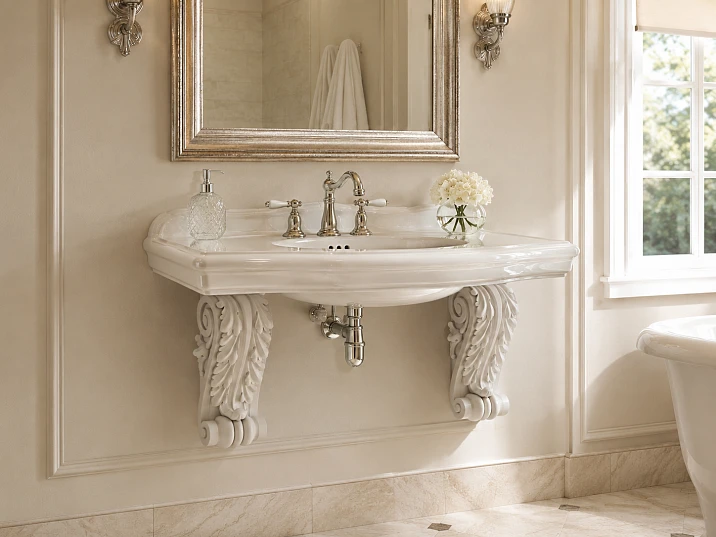
The wall-mounted sink is already installed, held by standard fasteners, plumbing is connected and working properly. But the interior seems too utilitarian: under the bowl, the free wall, siphon, and communications are visible, and we would like to achieve the look of a classic console sink — with two symmetrical carved brackets on the sides. In this situation, the idea of placing two polyurethane KRPU-003 under the bowl seems logical, but only under one fundamental condition: these elements are considered exclusively as decor, not as supports for the plumbing.
For this article, we fix one specific product variant — KRPU-003 measuring 139 × 70 × 48 × 32 × 66 mm. It is made of polyurethane and costs 3,240 ₽ per piece, so a symmetrical pair costs 6,480 ₽ excluding glue, surface preparation, and possible painting. If after a trial fit it becomes clear that the chosen size is not suitable, it is more logical to choose other polyurethane brackets, rather than trying to force KRPU-003 into a conflicting plumbing unit at any cost.
The short answer to the main question is this: yes, two KRPU-003 can be considered under an already installed wall-mounted sink as decorative pseudo-supports, if the sink itself is fully held by the mounting system provided by the manufacturer, and the brackets do not interfere with the siphon, supply lines, shut-off valves, cleaning, and future maintenance. But you cannot buy a pair based only on a product photo. Under the sink bowl, many more variables are at play than it seems: the shape of the plumbing, bowl depth, drain position, siphon type, faucet height, flexible supply routing, wall cladding, hand access to connections, and even how convenient it is to wipe the area between the decorative bracket and the ceramic.
It is precisely these checks that should determine whether it is worth spending 6,480 ₽ on a pair. If the task is simply to add classic character without interfering with the sink's construction, the solution can be very expressive. If, however, the KRPU-003 covers plumbing fixtures, creates hard-to-reach pockets for cleaning, or visually looks like elements that "should hold something" while actually holding nothing, the composition is better changed.
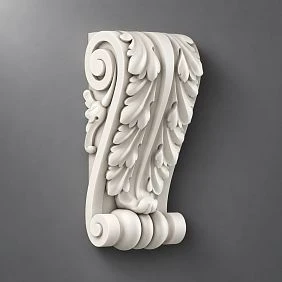
KRPU-003 is a decorative bracket, not a plumbing support
The most important boundary runs not by style or size, but by purpose. KRPU-003 belongs to polyurethane molded decor. The card confirms the material and geometry of the selected option, but does not provide a calculated load by which the product could be considered a load-bearing support for a wall-mounted sink. Therefore, this article cannot recommend transferring the weight of the bowl onto it, weakening the standard mounting, or using the pair as a safety structure.
The wall-mounted sink must remain installed exactly as intended by its manufacturer: on standard studs, brackets, frame, mounting system, or other structural support. The polyurethane KRPU-003 appears after this—as a visual element that creates the impression of a traditional console.
This separation is also useful compositionally. If the decorative bracket does not have to actually bear weight, it can be placed where it looks best, rather than where a real metal support would have to be installed. This provides freedom in symmetry, offsets from the center, and relationships with the shape of the bowl.
But freedom does not mean arbitrariness. The viewer still reads the bracket as an element that visually supports the sink. Therefore, it cannot be placed too low, detached from the lower plane of the bowl, or positioned so far toward the edges that it ceases to be perceived as part of a unified composition. The decor does not bear physical load, but it must convincingly bear it visually.
If, after all checks, this scenario fits, buying the carved bracket KRPU-003 made of polyurethane is reasonable precisely as a pair, because a single piece under a centrally located wall-mounted sink will almost always ruin the symmetry and look like a random fragment.




Why two brackets under a sink work differently than on furniture or a shelf
In a furniture composition, a decorative bracket usually interacts with the rigid geometry of the cabinet, countertop, or shelf. There, it is easy to build a clear vertical: the top surface, side edges, and bottom decorative element. With a wall-mounted sink, everything is more complicated.
The bowl has its own curvature. The bottom surface can be flat, oval, deep, asymmetrical, or almost completely hidden. The siphon occupies the center, flexible supply lines may run along the sides, and shut-off valves are often located exactly where you would visually want to place a second bracket. Therefore, two identical parts under the sink cannot be placed using the principle of "stepped back 100 mm from the edges and glued them on."
The task is to align four coordinate systems at once:
-
the geometry of the sink itself;
-
the central axis of the drain and siphon;
-
the position of the utilities;
-
the symmetry of the two KRPU-003 units.
If at least one of these systems conflicts with the others, a beautiful render will not save the real result.
For example, with a sink 750 mm wide, the siphon may be strictly centered, while the shut-off valves are located 130–160 mm to the right and left. These zones often coincide with potential mounting spots for decorative brackets. If you glue KRPU-003 over them or right next to them, you will end up with either difficult access or a visually cramped assembly.
Therefore, unlike decor under a shelf, here you first study the plumbing, and only then the decorative symmetry.
Our factory also produces:
How to do a proper fitting: not a rectangle, but a full-size contour
For KRPU-003, the card lists five dimensions: 139 × 70 × 48 × 32 × 66 mm. These numbers cannot be mechanically interpreted as ordinary "height × width × depth" without reference to the factory drawing. For a real fitting, it is safer to rely not on an imaginary rectangle of 139 × 70 mm, but on a full-size contour of the product according to the drawing or a printed image at 1:1 scale.
This is especially important under the sink, where a few millimeters can determine whether there will be room for a hand and a tool.
A practical method is as follows:
-
Open the KRPU-003 drawing or prepare a scaled contour of the selected size.
-
Make two identical templates.
-
Mark the central axis of the sink on the wall.
-
Separately mark the siphon, shut-off valves, flexible hoses, and points that need to be touched during maintenance.
-
Place the two templates symmetrically relative to the axis.
-
Without gluing them, check by hand the access to all connections.
-
Look at the composition from the bathroom entrance level, not just from a distance of 30 cm.
This fitting solves two tasks at once. The first is technical: whether the pair physically fits. The second is visual: whether the brackets really make the sink look like a classic console, rather than a modern bowl with two randomly added ornaments.
If after the template the chosen size seems excessive or conflicts with the pipes, it is better to choose decorative polyurethane brackets of a different scale. The KRPU-003 has other options, but the task of this article is not to compare all sizes, but to test a specific pair of 139 mm.
Get Consultation
Plumbing compatibility of the KRPU-003 pair
Where to place the pair relative to the edges of the sink
For decorative pseudo-supports, there is no universal offset that can be called correct for all sinks. The reason is simple: plumbing varies in shape more than it seems from a frontal photograph.
If you place the brackets too close to the side edges, they may look like random end decorations. If you move them too close to the center, a tight pocket will remain around the siphon, and the sink itself will visually become "heavy on top." In a good option, the pair should simultaneously support the width of the bowl and leave the central plumbing unit readable and serviceable.
It is useful to evaluate not one size, but three zones:
Central zone
Here is usually where the drain outlet and siphon are located. It is better to consider it a technological core that should not be constrained by decorative elements. If the siphon is decorative and remains exposed, it becomes part of the composition itself. If the siphon is technical and you would like to visually "calm" it, the brackets can partially draw attention to themselves, but they should not block access.
Side service zones
Here, supply lines may run and valves may be located. Any threaded connection that might theoretically need to be tightened, replaced, or shut off must remain accessible without dismantling KRPU-003.
External compositional zones
This is where you most often want to see brackets. They should be perceived as a continuation of the bowl downward, while not extending too close to the outer edges.
The correct position is determined not by a formula, but by fitting. However, once two templates are on the wall, the solution usually becomes obvious within a few minutes.
What to check with the siphon before ordering a pair
The siphon is the main central conflict of this idea. It can be a compact bottle trap, a pipe trap, a designer model, hidden, or partially recessed into the wall. For each scenario, the role of the brackets differs.
Compact siphon in the center
This is the most convenient case. Two KRPU-003 units are placed on the sides, without blocking the central node. Visually, this creates a classic three-part composition: bracket — siphon — bracket.
Large bottle siphon
Here it's important whether the center starts to dominate over the decor. If the siphon is large, chrome-plated, and positioned low, small decorative brackets may appear too weak visually. Then the issue is no longer physical compatibility, but scale.
Siphon with offset outlet
Some sinks have an offset outlet. Then a symmetrical pair of KRPU-003 and an asymmetrical plumbing center can conflict. The decor emphasizes symmetry, while the siphon simultaneously disrupts it. Here you need to look at the composition as a whole.
Hidden siphon
This is one of the best scenarios for decorative brackets. The technical center almost disappears, and the KRPU-003 pair can form a clean classic look. But even with a hidden siphon, you must not forget about access to inspection or service elements of the system, if they are provided.
The practical test is simple: photograph the sink strictly from the front, overlay two KRPU-003 outlines, and see what attracts the eye most. If the decorative pair holds the composition together and the siphon remains neutral, the idea works. If it turns into a competition of three large elements, you should change the scale or abandon the brackets.
Supply lines and shut-off valves: why they often break a beautiful scheme
In interior photos, flexible supply lines are almost always hidden, aligned, or retouched. In a real bathroom, they can run at an angle, have extra length, cross each other, and approach the mixer from different sides. Valves also rarely stand perfectly symmetrically.
If KRPU-003 are installed after a completed renovation, the decorative composition must conform to the actual engineering, not the other way around.
Before purchasing, it is useful to do a simple service experiment. Turn each faucet off and on as you would in real life. Look at where your hand is. Then imagine a bracket nearby. If the decorative element blocks the hand's path, the installation is unsuccessful, even if it looks beautiful externally.
The same applies to flexible hose connections. You must not create a situation where, to replace a hose normally, you first have to tear the polyurethane part off the wall.
In a good option, the brackets form a visual frame around the plumbing but do not become part of its maintenance.
Cleaning: the most underestimated criterion
In the bathroom, a decorative bracket is evaluated not only on installation day. After a few months, what matters more is how easy it is to wipe the space around it.
Under the sink, drops, soap residue, dust, towel lint, and small dirt regularly appear. The carved relief itself requires more careful cleaning than a smooth wall. If a narrow gap remains between the top of KRPU-003 and the bottom plane of the bowl, where a hand or cloth cannot reach, this area will quickly become problematic.
Three places need to be checked:
-
the space between the bracket and the bowl;
-
the inner side between the bracket and the siphon;
-
the lower part of the relief near the wall.
If access is only possible with a thin brush, and the bathroom is used daily, it is worth considering whether such decorativeness is justified. In a guest bathroom, where the load is lower, the same unit may be quite acceptable.
This is a good example of why you cannot choose KRPU-003 based only on its frontal view. The frontal view answers the question "is it beautiful," while the operational fitting answers "can you live with this decor every day."
Composition, scale, and visual persuasiveness
How much the KRPU-003 pair changes the look of an ordinary wall-mounted sink
Two symmetrical brackets can noticeably change the perception of plumbing. An ordinary wall-hung sink reads as a modern functional object: the bowl seems to emerge from the wall. Decorative pseudo-supports add vertical elements and visually shift it into a classical or neoclassical coordinate system.
The effect is especially noticeable if the room already has:
-
a framed mirror;
-
brass or bronze hardware;
-
moldings;
-
carved decor;
-
a traditional faucet;
-
stone or marble finish;
-
classic lamps.
In such an environment, KRPU-003 does not look like a single stylistic quote. They support the existing language of the interior.
If the bathroom is completely minimalist — large-format porcelain stoneware, concealed mixer, frameless mirror, linear lighting — carved brackets may look alien. Then the question of compatibility with the siphon becomes secondary: the composition does not work at the style level.
A useful principle: a decorative bracket should continue the existing decorativeness, not create it from scratch in one random place.
If you want to develop a classic bathroom system, it is useful to look at the material "Stucco decor for bathroom and toilet" and understand how a pair of brackets can be supported on the walls without turning the room into a set of unrelated ornaments.
Example: sink width 700–800 mm
Let's take a typical range that is often found in wall-mounted models. There is no need to build an artificial formula here, because the selected KRPU-003 has complex geometry, and the actual position is determined not only by the width of the bowl.
For a sink of 700–800 mm, a pair of selected brackets is usually already perceived as a noticeable decorative gesture. These are not miniature details that can be hidden under the edges. Therefore, it is useful to evaluate the entire frontal scene at once.
If the sink has a clean, relatively flat bottom surface and a central compact siphon, two KRPU-003 can visually divide the lower space into three calm sectors. This scenario looks the most convincing.
If the bowl is deep and rounded, and the supply lines diverge to the sides, the geometry becomes more complex. The brackets may partially overlap with the silhouette of the sink or seem too short relative to its depth. In such a case, there is no need to increase their importance in the composition just because a pair has already been selected. Sometimes the absence of brackets looks cleaner.
A commercial decision for such a sink should be made after two templates, not after a single width figure.
What symmetry provides and when it cannot be broken
The main strength of a pair of decorative brackets is symmetry. Even if the plumbing communications are not hidden perfectly, two identical vertical accents create order.
Therefore, deliberately shifting one KRPU-003 for the sake of a pipe while leaving the second in its original place is almost always a bad idea. You technically save access, but visually you lose the main meaning of the pair.
If symmetrical installation is impossible due to engineering, it is better to consider three alternatives:
-
choose a different size or a different bracket model;
-
change the method of visually masking the communications;
-
abandon a pair in favor of another decorative system.
Trying to "slightly break the symmetry" is dangerous precisely because under the sink the eye easily compares two elements relative to the center of the bowl and the faucet. The mistake is more visible than on a large wall.
How to account for the depth of the sink and the line of sight
A frontal photo is not enough. A person rarely looks at the sink strictly perpendicular to the wall. Usually they enter the bathroom at an angle, approach from the side, and lean toward the bowl. Therefore, decorative brackets must be convincing in perspective as well.
If the sink protrudes significantly from the wall, and the KRPU-003 visually remain small and flat, a sense of depth mismatch may arise. Conversely, too active relief under a shallow bowl can look heavy.
To check, take photos of the templates from at least three points:
-
directly from the entrance;
-
at an angle of 30–45 degrees;
-
from a close working distance in front of the sink.
If from a side point the bracket seems to "not reach" the visual mass of the bowl, this is more important than perfect symmetry in a frontal shot.
Finishing and daily use
Painting the pair: in the color of the wall, sink, or as a separate accent
Once technical compatibility is confirmed, the question of finishing arises. Polyurethane decor can be incorporated into the interior in various ways.
Matching the wall color
The calmest option. The brackets are perceived through relief and shadow, but do not turn into separate bright objects. This works well for a small bathroom where decorativeness is needed but should not overload the space.
In a color close to the ceramics
If the sink is white and the wall is also light, you can create an almost monolithic classic look. But the shade of white needs to be checked: cold white ceramics and warm white paint nearby can differ more than it seems from a sample.
Contrast finish
Bronze, gold, dark color, or patina can make KRPU-003 a strong accent. This option requires support in the faucet, mirror frame, lighting, or other hardware. Otherwise, two contrasting brackets will look like a separate theatrical decoration.
For an already finished bathroom, it is usually safer to paint the pair in the color of the wall or in a close palette. In this case, the relief itself creates a classic character without extra visual weight.
Humidity and use: what matters specifically for the sink area
The KRPU-003 card confirms the polyurethane material. For a bathroom, this is fundamentally better than using unsuitable decor sensitive to periodic humidity. But this does not mean that the installation location does not matter.
Under the sink, splashes, condensation, leaks during maintenance, and regular wet cleaning are possible. Therefore, the quality of the result depends not only on the polyurethane itself, but also on:
-
surface preparation;
-
adhesive composition;
-
primer and paint;
-
tightness of adjacent plumbing connections;
-
operating mode.
If the area is constantly wet due to a malfunction of the siphon or supply lines, no decorative element should be used as a way to "cover up the problem." First, the cause of the water is eliminated, then the decor is installed.
In a broader sense, KRPU-003 is just one of the options for molded decor for the bathroom and toilet, so it should be evaluated together with the overall finishing system, not separately from the room's conditions.
Installation on an already finished wall
What to check before applying adhesive
When the sink is already hanging, you don't want to redo the wall. This is what makes the decorative scenario attractive: the pair can be added after the renovation is complete. But a finished surface requires care.
First, determine the type of substrate. Painted plaster, porcelain stoneware, ceramic tile, decorative plaster, and moisture-resistant panels require different approaches to preparation and adhesive compatibility. Recommendations for painted walls cannot be automatically transferred to glazed tile.
Second, check the flatness. If the tile has a relief, bevel, or protruding joint, the rear mounting area of the bracket may not sit evenly. This affects both the appearance and the quality of fixation.
Third, do not use the decorative element to mask an active plumbing connection. If there is a thread, faucet, or joint behind the bracket, this is almost always a bad idea.
Fourth, decide on painting in advance. Painting a complex relief under an already installed sink is much less convenient than preparing the product before installation and only doing a final touch-up on site.
Why service access matters more than a perfect picture
Plumbing requires maintenance. The trap can clog, the gasket may need replacement, the supply line may need updating, and the faucet may need to be shut off. A good decorative project does not make these operations more difficult.
Before fixing the pair, it is useful to do a "service rehearsal":
-
place the KRPU-003 templates on the intended locations;
-
try to reach the siphon nut;
-
try to shut off both valves;
-
assess whether the tool fits through;
-
imagine removing the siphon downward;
-
check whether the bracket will need to be dismantled.
If at least one routine operation becomes impossible, the position needs to be changed.
This is more important than a perfect visual offset. The decor must yield to operation, because dismantling a glued polyurethane element to replace a flexible supply line is a bad scenario for both the owner and the technician.
When buying a pair is justified, and when it is better to decline
When a pair of KRPU-003 truly enhances the interior
The solution is especially successful if several conditions coincide.
First, the sink itself has a fairly calm shape. Then the carved decor becomes the main stylistic layer, rather than competing with complex ceramics.
Second, the utilities are either compact or neatly organized. The pair emphasizes order, rather than trying to hide engineering chaos.
Third, the mirror, faucet, and lighting already have a classic or neoclassical character. Then KRPU-003 continue the language of the interior.
Fourth, there is sufficient height under the bowl. If the sink is installed low and the brackets visually press the space to the floor, the composition loses lightness.
Fifth, cleaning remains normal. Beautiful decor in the bathroom should withstand daily use, not just a photo shoot after renovation.
When it is better to refuse KRPU-003 under the sink
There are situations where refusing to buy is a more professional decision.
Utilities pass directly through the intended installation locations
If one bracket overlaps the faucet and another overlaps the supply line, decorative symmetry is not worth future problems.
There is too little space under the bowl
A carved element needs air around it. In a tight cluster, the relief turns into visual noise.
The sink has a distinctly modern design
An ultra-thin rectangular bowl, a concealed drain, and a minimalist faucet may clash with a classic carved bracket.
The trap and pipes themselves are decorative
If a designer brass trap with attractive pipes is used, additional brackets can overload the lower part of the composition.
Normal cleaning cannot be maintained
If after a trial fit there remain narrow pockets that cannot be wiped, it is better not to create a future household problem for the sake of a decorative effect.
There is doubt that the bracket is perceived as a true load-bearing element
If visually it is positioned as if the sink rests on it, but in reality there is a strange gap between them, the viewer may find the composition unconvincing. Sometimes a clean wall under the bowl looks more professional.
What to choose instead of KRPU-003 if the pair idea is right, but the size doesn't fit
Rejecting a specific article doesn't mean rejecting the idea itself. If two decorative pseudo-supports really improve the look of the sink, but the chosen KRPU-003 conflicts with the plumbing, it's worth moving to the section polyurethane brackets and looking for a different ratio of size and relief.
When choosing an alternative, not only the external dimensions matter. Look at:
-
the shape of the rear mounting part;
-
depth of the relief;
-
the width of the most protruding area;
-
the nature of the ornament;
-
the possibility of symmetrical installation;
-
compatibility with the bottom line of the bowl.
If the problem is not the size, but the very style of the brackets, you can move to a calmer wall decor or leave the lower part of the sink without molding altogether.
Budget for the pair: 6,480 ₽ — what exactly you get for this money
For the selected size, the arithmetic is simple:
2 × 3 240 ₽ = 6 480 ₽.
But it is useful to understand that what is bought for this money is not a structural system or a ready-made plumbing console. The buyer acquires two decorative items whose task is to change the visual perception of an already installed sink.
The final budget may also include:
-
adhesive compatible with polyurethane and the specific substrate;
-
primer and paint;
-
consumables for preparation;
-
master's work;
-
local touch-up of the wall;
-
template or printed outline for fitting.
Therefore, the commercial question is better formulated as: does the pair provide an effect worth 6,480 ₽ plus installation, rather than "is it cheaper than real supports." Comparison with real supports is incorrect because the tasks are different.
After a successful fitting, you can order KRPU-003 139 × 70 × 48 × 32 × 66 mm specifically as a decorative pair.
Practical algorithm before ordering
To make a decision without guesswork, it is useful to go through a sequence from technique to aesthetics.
-
Check the sink mounting. Make sure it is fully supported by its standard system and KRPU-003 should not bear any load.
-
Fix the selected size. For this article — 139 × 70 × 48 × 32 × 66 mm.
-
Obtain or make two full-size outlines. Do not limit yourself to a conventional rectangle.
-
Mark the sink axis. The symmetry of the pair should be built from it.
-
Mark the plumbing fixtures. Siphon, faucets, supply lines, connections.
-
Place two templates. First without glue.
-
Check the maintenance. Access by hand and tool must be preserved.
-
Check the cleaning. No inconvenient pockets should appear between the bowl, wall, and decor.
-
Look from different points. Especially from the entrance and from the side.
-
Resolve the color issue. In most ready-made bathrooms, the wall color or a close palette is safer.
-
Compare with the option without decor. If the difference does not improve the interior, the purchase is not necessary.
-
Only after this, arrange the pair.
This order protects against the main mistake: first buying a beautiful item, and then looking for where to place it among the existing plumbing.
Decision table: buy the pair, change the size, or decline
| What the fitting showed | Solution |
|---|---|
| Two KRPU-003 stand symmetrically, plumbing is accessible, cleaning is convenient | You can buy the pair |
| The pair is beautiful, but one element overlaps the faucet or the supply line. | Change the position or size, do not fix it this way. |
| The central drain visually conflicts with both brackets. | Check a different scale or a different type of decor. |
| There are inconvenient gaps for cleaning left under the sink. | Abandon it or choose a more compact element. |
| The interior is minimalist, the decor looks out of place. | Better to leave the wall clean. |
| The pair looks convincing only in a frontal photo, but poorly from the side. | Reassemble the composition. |
| The brackets are perceived as real supports, although there is a strange gap between them and the bowl | Adjust the position or give up |
| Everything fits, but the 139 mm size seems too active | View other brackets in the category |
Common Mistakes
Buy a pair before checking the plumbing
The reason is clear: the product is liked, and the space under the sink seems free. In reality, after ordering, a faucet, supply lines, or an inconvenient service area are discovered. The solution is two templates before purchase.
Use KRPU-003 as a real support
This is no longer a decorative mistake, but a misunderstanding of the purpose. The card has no confirmed calculated load for holding the sink. The standard plumbing mounting should remain the only structural basis.
Install the brackets asymmetrically for the pipes
Such a compromise usually destroys the main value of the pair. If the engineering does not allow symmetry, it is better to change the size or model.
Making the gap too small for cleaning
On the day of installation, the gap is almost invisible; a month later, it becomes a constant source of dirt. Checking with a cloth and hand before installation solves the problem.
Ignore the side view
Under the sink, the decor often looks good only from the front. From the actual entry point, it may turn out that the depth of the bowl and the relief of the bracket do not match in scale.
Trying to "make the bathroom classic" with just one decor piece
If everything else is minimalist, a pair of carved brackets is rarely enough to convincingly change the style on its own. It's better to either support it with other details or not introduce such an accent.
How different shapes of wall-mounted sinks change the solution
The same pair of KRPU-003 can look convincing under one sink and completely out of place under another. The reason is not the size per se, but the geometry that the plumbing itself defines.
Rectangular sink with a flat bottom line
This is the most straightforward scenario for decorative pseudo-supports. The horizontal line of the bowl gives the brackets a clear "top support" in the composition. Even if the parts physically do not bear load, the viewer easily reads them as classic console elements.
Here, it is especially important not to press the brackets too close to the center. If the space between them remains too narrow, the siphon looks squeezed. If you spread them too wide, they turn into decorative endings at the edges and lose connection with the center of the sink.
Oval or round bowl
Under a round sink, decorative brackets appear softer, but another problem arises: the lower line of the bowl does not provide a strict horizontal. Therefore, the flat upper part of the template can visually "argue" with the curvature of the plumbing.
Here, it is better not to try to imitate a real structural junction. A small visually justified gap sometimes looks more natural than an attempt to forcibly bring polyurethane decor to a complex ceramic shape.
Bowl sink on a wall console
If the wall structure actually has a small shelf or countertop, the brackets can be subordinated not to the bowl, but to the lower line of the console. This is often the most convincing classic scenario: the decorative pair visually supports the horizontal plane, while the plumbing itself remains a separate object on top.
Asymmetric designer sink
With an asymmetric sink, the paired scheme becomes more complex. Two identical KRPU-003 emphasize the symmetry that is absent in the bowl itself. Sometimes this contrast is interesting, but more often it looks like a conflict of two design ideas.
If the shape of the sink is intentionally asymmetric, first you need to ask not "where to place two brackets," but "whether a symmetric pair should be introduced at all." In some interiors, it is better to use other wall decor than to try to correct modern geometry with classic elements.
How tile joints and wall patterns can ruin perfect symmetry
On a clean painted wall, placing a pair relative to the sink axis is relatively simple. On tiles, a second module appears — the joints. If ignored, two brackets can be geometrically correct relative to the bowl, but visually seem shifted relative to the cladding.
Let's imagine a wall with large-format tiles and a central vertical seam. If the sink axis coincides with the seam, the composition is simplified: two KRPU-003 can be placed mirror-symmetrically on both sides. If the seam is shifted by 20–30 mm, the eye begins to compare three lines at once — the sink, the siphon, and the tile grid.
It's not always necessary to submit to the tile. The main axis is still set by the plumbing. But before installation, it's useful to assess whether the edge of the bracket runs directly along a convex seam, chamfer, or height difference. Such contact can worsen the fit of the rear surface and make the element look visually skewed.
For a marble pattern or tile with active veining, a different rule applies. There, the seam may be almost invisible, but the pattern itself can visually "cut" the ornament. If one KRPU-003 falls on a calm area, and the second on a bright contrasting vein, the symmetrical details will look different in mass. This is not a technical error, but it's worth seeing before the adhesive.
Light and shadow: why the relief under the sink may look heavier than in the product card
A carved bracket is perceived not only by its outline. Its volume is shaped by shadows. Under the sink, the light is more complex than on an open wall: the bowl itself creates an upper shadow, the mirror and lights provide reflected light, and side sources can strongly emphasize the relief.
With soft overhead lighting, KRPU-003 will look calmer. The deep areas of the ornament will darken slightly, but the overall shape will remain cohesive.
If wall sconces are placed nearby at mirror level, light can fall from the side and create contrasting shadows. Then the brackets will visually become larger and more embossed. For a small bathroom, this is sometimes too active.
It's especially useful to check the evening scenario. During the day, through a window or under general light, the decorative pair may look neat, but in the evening under directional sconces, it can suddenly become the main object of the entire wall. If you don't want this effect, painting it the color of the wall and softer lighting
Connection of the brackets with the mirror and the faucet
A wall-mounted sink almost never exists on its own. Above it, there is a mirror, a faucet, sometimes sconces. If a pair of KRPU-003 appears below, it creates a vertical rhythm that the eye tries to continue upward.
A good option is when the distance between the brackets roughly supports the compositional width of the mirror or its frame. This is not about an exact millimeter match, but about visual balance.
If the mirror is very narrow and the brackets are widely spaced, the lower part of the wall becomes wider than the upper part. If the mirror is massive and wide, and the pair of KRPU-003 is pressed toward the center, the bottom may look too weak.
The faucet also affects the center. A tall classic faucet strengthens the vertical axis and helps the brackets. A hidden wall-mounted faucet, on the contrary, makes the space around the bowl more minimalist. In that case, the carved decor below should be especially well justified by the rest of the interior.
This is another reason to look at the entire wall as a whole. The solution of "two brackets under the sink" actually affects the vertical composition from the floor to the top edge of the mirror.
What to do with exposed pipes: hide them or incorporate them into the composition
If pipes are visible under the sink, the first desire is to hide them between decorative elements. But KRPU-003 are not a box and should not be used as masking covers for engineering connections.
There are two more honest approaches.
The first is to make the plumbing neutral. Neatly laid white or chrome supply lines, a compact siphon, symmetrical decorative cups on the wall. Then the brackets become a separate decor, and the engineering does not compete with them.
The second is to make the plumbing part of the style. Brass pipes, a decorative siphon, taps matching the faucet color. Then there is already a full composition under the sink, and KRPU-003 need to be introduced more carefully. Sometimes they perfectly complement classic plumbing, and sometimes they create an excess of details.
The bad way is to try to position the brackets so that they partially block the hoses from one viewpoint. A person will take a step to the side and see both the hoses and the strangely shifted decor. It is better to solve the engineering appearance separately.
How to check a pair for "fake constructiveness"
Decorative pseudo-supports have an interesting visual risk. If they look too realistic as load-bearing elements, the viewer begins to unconsciously assess their constructiveness. And if there is a large gap between the top of the bracket and the bowl, the question arises: why do these "supports" not touch anything?
To avoid this effect, the composition must be either convincingly classical or clearly decorative.
The convincingly classical option is when the brackets visually align with the bottom line of the sink or console, and their position seems natural for support.
The clearly decorative option is when the details are slightly offset, painted in the wall color, and read more as a wall relief than as an actual structure.
The worst is the intermediate scenario: the brackets are placed as if for support, but by scale and position they clearly support nothing. This is exactly what needs to be cut off on the template.
The same KRPU-003 in a small and spacious bathroom
The size of the product does not change, but the visual weight depends on the room.
In a small bathroom, a person is close to the sink. The relief is visible in detail, shadows are stronger, and there is less free wall. Here, the pair can become very active. If there is already ornamental tile or a decorative mirror frame around, KRPU-003 can overload the wall.
In a spacious bathroom, the viewing distance is greater. The same two elements become calmer and can get lost if the sink itself is wide, the mirror is large, and the ceiling height is significant. In this case, it is worth evaluating not only the selected pair, but also the overall molding system.
Hence an important conclusion: 139 mm is not an "average size that fits everyone." It is a specific dimension that needs to be checked at the room scale. The article deliberately does not compare the four sizes of KRPU-003, but if the chosen version does not work, switching to another model or size is a normal outcome, not a purchase mistake.
How to organize installation so that the pair does not "drift apart" by a few millimeters
On paired elements, a small error is more noticeable than on a single decor piece. If one KRPU-003 is positioned a few millimeters higher than the other or rotated differently, the eye reads this relative to the horizontal line of the sink.
Therefore, it is better to build the layout not independently for each element, but from a common system of axes:
-
draw the central axis of the sink;
-
mark a single horizontal control line;
-
determine equal distances to the right and left;
-
apply two templates simultaneously;
-
check their position with a spirit level;
-
only after this, transfer the mounting contours.
If the wall is tiled, the joint should not be used as the only reference line unless it is perfectly horizontal itself. The main guide is the geometry of the sink and tool-based marking.
After fixing the first piece, it is better to check the second one again against the overall template. In a paired composition, there is no "almost symmetrical": if the difference is noticeable, the entire classical effect weakens.
Usage after a year: which solutions will remain convenient
A good interior technique should be sensible not only on the day of purchase. It is useful to mentally project yourself a year ahead.
Will you be able to replace the siphon without dismantling the decor? Will a wrench fit to the nut? Will you be able to wipe the wall behind the bracket? Won't dust constantly settle on the top of the relief? Won't the paint start to wear off from regular hand contact during cleaning?
If the answers are positive, the pair has a chance to become a normal part of the interior rather than a decorative obstacle.
If you already understand at the template stage that the plumber will curse during the first maintenance, it is better to change the decision now. The cost of the pair is 6,480 ₽ — a sufficient amount to approach the purchase as a permanent interior element rather than an experiment.
When it is better to develop the composition further, and when to stop at two brackets
After a successful fitting, there may be a desire to add more molding around the mirror, an overlay above it, a cornice, or other carved decor. Here it is important not to lose the original task.
If the KRPU-003 pair already makes the sink visually complete, it is not necessary to continue the ornament in all directions. In a small bathroom, two brackets can be the only classical accent.
If the rest of the wall looks empty and the interior style requires a system, a wider option can be considered. polyurethane molding. But new elements should be added according to your own compositional logic, not because "the brackets need something to support them."
A good stopping criterion: if the composition already reads as complete without the next element, the next element is not necessary.
Adjacent furniture and towels: check not only the plumbing scheme
Even if the siphon and supply lines don't interfere, a pair of KRPU-003 can conflict with items near the sink. This is especially typical in a compact bathroom: a narrow cabinet, laundry basket, towel holder, or radiator stands to the side, and the door opens almost flush against the bowl.
The brackets protrude from the wall plane and create additional volume in an area that was previously almost free. Therefore, after installation, it may unexpectedly turn out that the towel catches on the relief, the basket no longer fits against the wall, and the adjacent cabinet door opens at a smaller angle.
Before ordering, it's useful to do not only a frontal fitting but also a "household route." Place the templates, then perform usual actions: take a towel, open the adjacent door, move the basket, stand in front of the sink the way you do every morning. If the decor constantly gets in the way of movement, the beautiful view will quickly stop pleasing.
Particular attention should be paid to narrow passages. KRPU-003 is wall decor, not an element designed for constant hits from a hip, basket, or mop handle. The calmer the area around the pair, the longer it will be perceived as part of the architecture, rather than a protruding object that has to be walked around.
What if there is already a semi-pedestal or decorative cover under the sink
Sometimes a wall-mounted sink is formally suspended, but the siphon is covered by a semi-pedestal, ceramic cover, or compact panel. In such a case, the idea with two KRPU-003 changes fundamentally.
A semi-pedestal already creates a central vertical mass. If you add two carved brackets on the sides, you get three distinct elements. For a wide classic sink, this may be acceptable, but for a compact bowl, the composition often becomes heavy.
If the shroud is very minimalist and almost blends with the wall, a pair can still work. If the semi-pedestal has its own voluminous profile, it is better to consider it the main lower element and not try to additionally imitate console supports.
The practical criterion is simple: in a frontal photo, the lower part of the sink should have one clear principle. Either a central pedestal/shroud, or a pair of side brackets, or exposed plumbing. Mixing all three schemes requires a very strong stylistic justification.
Do not rely on KRPU-003 as protection against accidental impact on the sink
There is another psychological trap. After two elements appear under the bowl, it seems that the sink has become "propped up" and therefore safer if someone accidentally leans on it. For a decorative pair, you cannot think this way.
KRPU-003 in this article are not part of the load-bearing scheme. This means the rules for handling a wall-mounted sink do not change. You cannot allow additional load on the bowl just because supports visually appeared below. If there are children in the family or someone is used to leaning heavily on the edge of the sink, the issue of strength is resolved by standard plumbing mounting, not by stucco decor.
This is especially important to explain to everyone who uses the bathroom. A decorative illusion can be convincing, but it should not create a false sense of structural function.
How to make a final decision in one evening
If all the reasoning seems too complicated, you can reduce the check to one practical test. Prepare two full-size outlines, attach them temporarily, and leave them until evening.
During the day, see how the pair combines with natural light and tile. In the evening, turn on the usual lights. Use the sink several times, turn on the taps, wipe the wall, take a towel. Do not try to specially "admire" the decor — just live with its mockup for a few hours.
After that, answer four questions:
-
has the space become visually more cohesive;
-
is the plumbing still accessible;
-
do protruding elements not irritate in everyday use;
-
do you want to keep the pair in place after the novelty effect has worn off.
If the answers are positive, the purchase is justified. If you have to convince yourself that "it will look better after painting," "we'll get to the pipes somehow," or "we'll get used to the gap for cleaning," that's a good signal not to order KRPU-003 in the current scenario.
How the finish affects daily cleaning of the relief
The KRPU-003 finish should be chosen not only by color, but also by how the surface will behave during regular wiping. Under the sink, the decorative element is below eye level, so dust and small drops become noticeable on the relief protrusions faster than on the upper cornice.
Too textured decorative painting, active patina, or complex multi-layer finishing may look beautiful right after installation, but require more careful cleaning. For a daily-use bathroom, a smoothly painted surface that can be wiped with a soft cloth without the risk of constantly catching on a complex decorative layer is more practical.
Before choosing a finish, it's also useful to consider household chemicals. The bracket should not become a surface that has to be treated with aggressive agents just because it is installed too close to the splash zone. If strong chemicals are regularly used around the sink, it's better to first determine the compatibility of the specific primer–paint–finish system with such a cleaning regimen.
This is not a reason to give up on a decorative pair. On the contrary, well-chosen trim makes the KRPU-003 part of the everyday interior, not an object people are afraid to touch. For a finished bathroom, it is wiser to choose a finish that supports the style while not complicating normal maintenance.
Bottom line: when two KRPU-003 under a wall-mounted sink make sense
Two carved decorative brackets KRPU-003 can successfully transform an already installed wall-mounted sink into a visually more classic console composition. For the selected option of 139 × 70 × 48 × 32 × 66 mm, the pair costs 6,480 ₽. But this purchase only makes sense when the decorative aspect does not interfere with the plumbing.
The correct logic is this: the sink is fully supported by the standard mounting; the two KRPU-003 do not participate in load calculations; the pair is symmetrical; the siphon, faucets, and supply lines remain accessible; cleaning is not complicated; the shape of the brackets supports the room's style.
If at least one of these conditions is not met, it is better to change the size, look at other Polyurethane brackets or abandon this approach. If the technical and visual fitting has been successful, purchasing the pair becomes meaningful: you are not trying to reinforce the plumbing with molding, but adding a strictly decorative classical layer to an already finished assembly.
For broader work with walls and other bathroom areas, you can You can buy ready-made stucco matching the Baroque style. Calculate the quantity: linear meters of cornices and moldings, number of rosettes, pilasters, consoles, corner elements. Add a ten to fifteen percent allowance for trimming. as part of a larger interior system, but under the sink it is better to start with a practical check of two full-size KRPU-003.
FAQ
Can KRPU-003 be installed under a sink if the walls are tiled?
Yes, the scenario is possible, but the fixing technology must match the specific tile and mounting compound. A smooth glazed surface and painted plaster require different preparation. Before installation, adhesion must be checked, and you need to ensure there is no assembly behind the mounting point that will require maintenance.
Do I need to press the decorative bracket flush against the bottom of the sink?
Not necessarily. Since KRPU-003 is not a load-bearing support, its position is determined by the visual composition and access for cleaning. However, a too noticeable gap can ruin the illusion of "supporting" the bowl, so the distance is better assessed on a full-size template.
Can I use only one KRPU-003 on the side of the siphon?
Technically, the decorative element can be placed alone, but under a central wall-mounted sink it rarely looks convincing. The main point of this technique is paired symmetry. One bracket is more likely to be perceived as a random ornament unless the interior is specifically designed asymmetrically.
Will KRPU-003 work if a decorative brass siphon is installed under the sink?
Both options are possible. If the siphon is already a strong decorative object, two carved brackets may overload the composition. It is better to do a photomontage or try out two templates and assess whether the three accents compete with each other.
Do I need to remove the sink to install the decorative brackets?
Not always. If the wall is accessible, the base can be prepared without dismantling, and the work does not affect the standard plumbing mounting, installation is possible on a finished object. But the specific procedure depends on the shape of the bowl and the accessibility of the work area.
What to do if one of the two brackets interferes with the shut-off valve?
Do not move only one element arbitrarily. It is better to reassemble both positions symmetrically or choose a different model/size. Otherwise, the technical problem will be solved at the cost of a visual mistake.
Can KRPU-003 be painted before installation?
This is often more convenient, especially under an already installed sink where there is little space for a brush. The final preparation and painting method should match the finishing system, but the main work on the relief is practical to do before fixing, and then perform local touch-up painting.
What is more important when choosing — the size of the bracket or the distance between them?
Both parameters are related, but first you need to ensure plumbing compatibility. Even an ideal external size is not suitable if the pair overlaps faucets or the siphon. After that, adjust the distance and visual scale.
Can this technique be used in a small guest bathroom?
Yes, and sometimes it works especially well in a guest bathroom because the room is used less often and the decorative accent is more noticeable. But a small space is more sensitive to overload, so a full-size fitting is mandatory.
If the sink already looks classic, are brackets needed?
Not necessarily. If the shape of the bowl, the faucet, and the mirror already create a complete look, a pair of KRPU-003 may be redundant. The absence of additional decor can sometimes look more expensive and calmer than another ornamental layer.