Article Contents:
- One lost letter changes not the name, but the pattern
- Verified characteristics of R-063L that need to be transferred to the request
- Why you can't determine L and R only with the words "left" and "right"
- Four different concepts that are often mixed up
- R-063L — 2 pcs.
- R-063L — 1 pcs.; R-063R — 1 pcs.
- R-063R — 2 pcs.
- Why you cannot write "small" or "large"
- Checking the mirror pair
- Checking the repetition of two identical L's
- Portal with one pair on top
- Portal with top and bottom pair
- Portal with repetition of one direction
- One common mirror composition
- Two independent leaves
- Dynamic repetition
- Door with four accents
- One door
- Two adjacent doors
- Four fronts in a row
- Tall cabinet
- Dresser with multiple drawers
- Sideboard with central display case
- Width coordination
- Depth coordination
- Finishing coordination
- Beech for enamel
- Oak for tinting
- Two clear schemes, not a strict prohibition
- Why the material must be repeated in both lines of the pair
- For enamel
- For tinting
- What cannot be implied automatically
- Example with six doors
- Example with ten identical facades
- How to plan an order for the installation date
- Check before paying the invoice
- Painted MDF
- Solid wood
- Veneer
- "R-063 — 2 pcs."
- "Left socket — 1 pcs."
- "Pair R-063"
- "R-063L/R — 2 pcs."
- "R-063L, large"
- "R-063L 80 mm"
- "Wood"
- "For painting"
- Sanding is specified only for L
- Two Ls are automatically replaced with L + R
- L is determined by the observer's side
- The part is turned and considered mirrored
- L and R dimensions differ randomly
- In one pair, beech and oak are mixed
- The "On order" status is mistaken for availability
- Production time is mistaken for delivery time
- Only R-063L in quantity 2 was added to the cart
- Only the front image is approved
- Molding is cut before L/R check
- Parts are not labeled after receipt
- One part is finished separately from the batch
- Baseboard and moldings are selected after painting the rosettes
- A carved rosette is called an electric 'wood-look' one
- Four items are ordered without a diagram
- Only the photo is transferred to the production order
- One accent on a furniture door
- Mirror pair on two cabinet doors
- Two identical left sockets on one pilaster
- Two pairs on the portal
- Three double doors with one mirror pair on each
- Four identical facades with one L on each
- Open card R-063L
- Select the size
- Specify material
- Select sanding
- Determine preparation
- Calculate L and R separately
- For mirror pair, open card R-063R
- Check status and deadline
- Add related materials
- Save confirmation
- What does the letter L mean in the article number R-063L?
- What does R mean in R-063R?
- Can I simply write R-063 in the application?
- If I need two parts, will I automatically get a pair of L and R?
- How to correctly order a mirror pair?
- Can I rotate R-063L to get R-063R?
- Is R-063L always installed to the left of the viewer?
- What sizes are available for R-063L?
- How does the large size differ from the small one?
- Which size should I choose for the trim?
- Which size to choose for a furniture facade?
- What materials are R-063L made from?
- What to choose for enamel?
- What to choose for tinting?
- Can I order oak for enamel?
- What do 'Standard' and 'Prestige' mean?
- Is R-063L sold pre-painted?
- Is the product in stock?
- How long does it take to manufacture R-063L?
- Is delivery included in those 5–10 days?
- Can I buy R-063L with one click?
- Is R-063R included with R-063L?
- How do I order two identical left sockets?
- How do I order two mirror pairs?
- Do I need to specify the direction additionally if there is an L letter?
- What to do if the image in the project is mirrored?
- Can R-063 be combined with wooden moldings?
- Is glue included in the kit?
- What Adhesive to Use?
- Do I need to buy a spare?
- How to check the order upon receipt?
- What to choose if the R-063 direction is not suitable?
- Can I first order one R-063L as a sample?
- What is more important when ordering: the article number or the image?
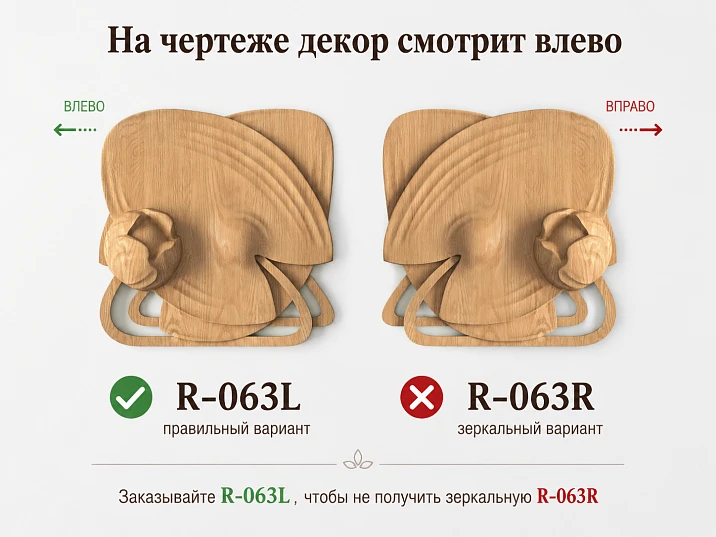
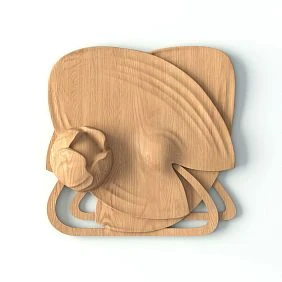
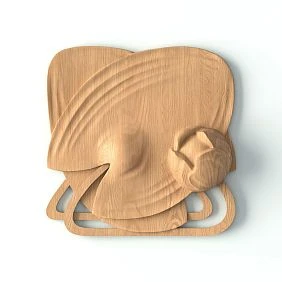
The designer approved a door portal, furniture facade, or decorative pilaster. In the drawing, the ornament clearly unfolds to the left, but in the request, the abbreviated designation remains: "R-063 — 2 pcs." At first glance, everything is clear. The size is known, the material is selected, the finish is agreed upon. However, for an asymmetric wooden rosette, such a line is not enough: R-063L and R-063R are two separate article numbers with a mirrored pattern.
The letter L or R next to the number is not a comment to the manager or an optional note. It is part of the product article number. If the left version is needed according to the manufacturer's drawing, the specification must include R-063L. If a mirrored right part is required, R-063R is written. If the project is based on a facing pair, both positions are indicated separately: R-063L — 1 pc. and R-063R — 1 pc.
It is here that the most expensive of small mistakes occurs. Wooden decor may be correctly chosen in size, species, and preparation, but after delivery it may turn out to be oriented in the wrong direction. Rotating the piece like a regular square is not enough: the entire pattern rotates along with the outer contour. A mirrored composition is not restored by simply turning the part.
The short practical answer is this: do not send the abbreviated "R-063" in your order. Verify the direction against the image or drawing of the specific card, write down the full article number, then add the size, material, sanding quality, preparation for finishing, and quantity. After such a check, you can buy the wooden rosette R-063L for the left direction, or separately order the mirrored right position.
One lost letter changes not the name, but the pattern
With a symmetrical round or square rosette, the abbreviated designation sometimes still allows you to identify the product by number. With R-063, this approach is dangerous. The ornament is asymmetrical: it has directional movement that is read relative to the adjacent molding, the door axis, the edge of the facade, and the second mirrored piece.
Imagine two pilasters on either side of a doorway. The left part of the composition should lead the pattern toward the center, and the right should mirror it. If you place R-063L in both positions, instead of a converging movement you get a repetition of one direction. If you order two R-063R, the mistake is the same, just turned the other way. If you write "R-063 — 2 pcs.", the supplier does not receive unambiguous information about which of the three options is needed:
-
two left pieces;
-
two right pieces;
-
one left and one right.
The quantity "2" does not reveal the direction. The word "pair" is also insufficient if it is not clarified whether it is a mirror pair or a repetition of two identically directed elements. In a professional specification, direction and quantity exist as two independent parameters.
The correct principle is simple:
the article determines the direction, and a separate column determines the quantity.
Therefore, the line "R-063L — 2 pcs." means two identical left sockets. It should not automatically turn into an L + R set. The line "R-063L — 1 pc.; R-063R — 1 pc." means a mirror pair. And the entry "R-063 — 2 pcs." should be sent back for clarification before calculation and order launch.




Verified characteristics of R-063L that need to be transferred to the request
R-063L is available in two confirmed sizes. You can choose beech or oak, sanding quality "Standard" or "Prestige", as well as a preparation option for enamel or for tinting. The product has the status "Made to order"; the average production time is stated as 5–10 days. The card includes add to cart and one-click purchase.
| Parameter | Confirmed options | What to write in the specification |
|---|---|---|
| Full article number | R-063L | Do not shorten to R-063 |
| Mirror version | R-063R | Specify on a separate line |
| First size | 80 × 80 × 20 mm | Record all three values |
| Second size | 110 × 110 × 27 mm | Do not replace with the wording "large" |
| Material | Beech or oak | Specify the breed |
| Sanding | "Standard" or "Prestige" | Choose one option for the batch |
| Preparation | For enamel or tinting | Do not write only "for painting" |
| Status | Custom Order | Consider production before delivery |
| Average production time | 5–10 days | Not to be confused with delivery time |
| Ordering method | Cart or one-click purchase | Check the final configuration before payment |
| Quantity | As per project | Describe separately for L and R |
| Direction | L according to the manufacturer's drawing | Do not explain only with the words "to the left of the viewer" |
The table seems detailed for one small part. But it is precisely this detail that eliminates sorting errors. The order line should allow a person who has not seen the original interior to unambiguously understand what to manufacture, calculate, pack, and hand over.
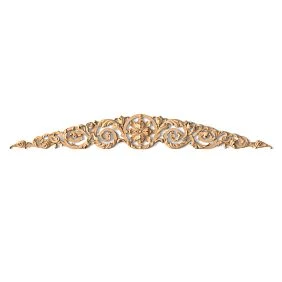
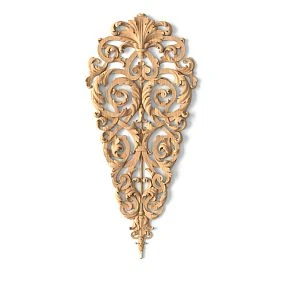
Our factory also produces:
Why L and R cannot be determined only with the words "left" and "right"
At the everyday level, the direction can be explained as follows: L is placed on the left, R on the right. In a real project, this rule quickly breaks down.
One person looks at a door portal from the front. Another looks from inside the room. A third examines a part on a table, and a fourth examines its reverse side before installation. When a socket is rotated by 90 or 180 degrees, the words "left" and "right" start referring either to the installation location or to the direction of the pattern. A new ambiguity arises.
Therefore, the letter in the article number should be checked not by the position of the part "to the left of the viewer," but against a specific drawing or image from the manufacturer's card. First, open R-063L, compare the orientation of the ornament with the project, then record the article number. For the mirrored position, perform the same check on the R-063R card.
The phrase "left version according to the manufacturer's drawing" is more accurate than "socket for the left side of the door." R-063L may indeed end up on the right part of the composition if the designer rotated it and created a dynamic pattern. The installation location and the letter designation do not have to literally match.
Get Consultation
Four different concepts that are often mixed up
In requests, four similar but not identical definitions are encountered:
-
Left side of the product. The geometric side of the part itself.
-
Left direction of the pattern. What is fixed by the letter L in the article number.
-
Left side of the composition. The location on the facade, door, or portal.
-
Left side for the observer. Depends on the point from which they look.
In a correct specification, the second concept is used — the direction of the article according to the manufacturer's card. The installation location is better specified separately: "upper left position of the portal," "lower right corner of the facade," "left pilaster from the corridor side." Then the article and the coordinate do not replace each other.
Three records that look similar but mean different orders
R-063L — 2 pcs.
These are two parts of the same direction. This scheme is suitable if the designer intentionally repeats the movement of the ornament. For example, two identical rosettes can go in a vertical rhythm on one pilaster or repeat on two furniture facades oriented the same way.
The manager should not replace the second R-063L with R-063R just because the quantity is two. Mirroring is not implied automatically.
R-063L — 1 pc.; R-063R — 1 pc.
This is a full mirror pair. It is used for counter-facing two sides of a portal, paired architraves, a double door, a symmetrical cabinet, or a central furniture composition.
Each article must remain a separate line in the invoice, production order, and packing list. Combining them into a faceless "R-063 — 2 pcs." is not allowed even after approval: upon reordering or packaging inspection, the direction will become unclear again.
R-063R — 2 pcs.
These are two right-side parts. They may be needed for a repeating rhythm, two identical facades, or a composition with direction to one side.
Quantity does not indicate symmetry. The article number does not indicate location. Only the combination of the full article number, position on the drawing, and quantity creates a clear task.
Full order line: what should follow the article number
For the left socket with a size of 80 mm, the line can be formatted as follows:
R-063L; size A × B × C — 80 × 80 × 20 mm; material — beech; sanding quality — "Prestige"; preparation — for enamel; quantity — 2 pcs.; direction — L per manufacturer's drawing.
For the large oak version:
R-063L; size A × B × C — 110 × 110 × 27 mm; material — oak; sanding quality — "Prestige"; preparation — for tinting; quantity — 1 pc.; direction — L per manufacturer's drawing.
For the mirror pair:
R-063L — 1 pc.; R-063R — 1 pc.; size of each part — 110 × 110 × 27 mm; material — oak; sanding quality — "Prestige"; preparation — for tinting; direction of each position verified against the approved layout.
In these examples, there are no extra words. Each characteristic answers a separate production question. Removing any of the key lines creates a risk:
-
without L/R, the direction is unclear;
-
without size, the modification is unclear;
-
without material, the type is unclear;
-
without polishing, the surface preparation is unclear;
-
without a finish option, the further scenario is unclear;
-
without quantity, it is impossible to calculate the order;
-
without a reference to the drawing, it is easy to mix up the position.
After approving the line, you can reopen the card and order the R-063L of the required size, having verified the selected parameters before adding to the cart.
R-063L 80 × 80 × 20 mm or 110 × 110 × 27 mm: the size does not change the letter, but changes the scale
The main topic of the article is the direction, but the size must also be present in the request. The R-063L has two options, and the entry "left socket R-063L" without dimensions remains incomplete.
The 80 × 80 × 20 mm model is more compact in both plane and depth. The 110 × 110 × 27 mm version is 30 mm wider and taller, and also 7 mm thicker. In numbers, the difference seems moderate, but the face area increases almost twofold:
-
80 × 80 mm = 6400 mm²;
-
110 × 110 mm = 12,100 mm².
The larger version takes up approximately 1.89 times more area. It stands out more on a wide architrave, tall pilaster, or large furniture facade. At the same time, the protrusion above the base increases, so you need to check adjacent moldings, door edges, handles, sash opening, and the depth of the entire composition.
| Criterion | R-063L 80 × 80 × 20 mm | R-063L 110 × 110 × 27 mm |
|---|---|---|
| Visual scale | Compact directional accent | More noticeable standalone ornament |
| Overall area | 6400 mm² | 12,100 mm² |
| Protrusion above the base | 20 мм | 27 мм |
| Difference on the side | Basic option | 30 mm more |
| Task for fitting | Narrow casing, small facade, rhythm of several details | Wide pilaster, large portal, central furniture zone |
| Risk | May get lost on a large surface | May overload a narrow field |
| Mandatory check | Visibility of the drawing from a normal distance | Free field and side offset |
| Number of L/R | Determined by the project | Determined by the project |
The table does not establish a universal size assignment. It sets the fitting logic. On a miniature door, 110 mm may be excessive. On a tall portal, 80 mm may look too subtle. The decision is confirmed with a full-scale template.
Why you cannot write "small" or "large"
Words do not convey the third dimension. The client may consider a 110 × 110 mm option "large," while the craftsman may consider any detail larger than the adjacent molding as large. Additionally, the invoice and production order must contain verifiable parameters.
The full notation 80 × 80 × 20 mm or 110 × 110 × 27 mm leaves no room for interpretation. The size should be specified in the same order in all documents.
Paper layout for L and R: more than one outline needs to be printed
A regular square template helps understand the scale but does not show the direction of the pattern. For R-063L and R-063R, separate full-size images or at least conditional arrows indicating the orientation of the ornament are needed.
Prepare a set of mockups:
-
R-063L 80 × 80 mm;
-
R-063R 80 × 80 mm;
-
R-063L 110 × 110 mm;
-
R-063R 110 × 110 mm.
On each template, write the article number in large letters. Do not place the designation on a separate piece of paper nearby: after rearranging sheets, the labels may get mixed up. It is better to apply L or R directly to the front of the layout and duplicate it on the back.
Checking the mirror pair
Place the templates in their design positions, step back to a normal viewing distance, and compare the direction of the inner ornament lines. Make sure the patterns actually meet or diverge as the designer intended. Then photograph the layout strictly from the front and label each position in the photo.
A photo does not replace a drawing, but it helps quickly detect an accidental swap. The photo is especially useful for a double door: the seam line of the panels creates a strong axis, relative to which an incorrect direction is immediately noticeable.
Checking the repetition of two identical L
Place two copies of R-063L in the intended positions. If the composition should move in one direction, make sure the repetition does not look like a mistaken attempt at symmetry. The designer's decision may be asymmetric, but it must read as intentional.
Mirror pair for a door portal: count not as "two sockets", but as two positions
A door portal is often built from several groups of elements: platbands, moldings, pilasters, capitals, bases, and local carved decor. In this system, R-063L and R-063R act as directional accents. They do not just fill empty space, but set the movement of the entire composition.
For a symmetrical portal, a safe entry looks like this:
| Position | Article | Size | Material | Preparation | Quantity |
|---|---|---|---|---|---|
| First side according to the approved drawing | R-063L or R-063R after checking the pattern | 80 × 80 × 20 or 110 × 110 × 27 mm | Beech/oak | For enamel/tinting | 1 |
| Second mirror side | Opposite article number | Same size | Same species | Same preparation | 1 |
It is intentionally not stated here that L is always on the physical left side. The article is selected based on the card image. After each position is approved, the table becomes unambiguous.
For the portal, it is especially important to maintain the same size, material, polishing quality, and preparation. Mixing R-063L 80 mm with R-063R 110 mm is only acceptable as a deliberate design choice. In a regular mirror pair, this would look like a scale error.
If a right-hand position is needed, it is processed separately through a card where you can order the right-hand rosette R-063R. Adding a left-hand part to the cart does not mean that the mirror version will be included automatically.
Portal with one pair at the top
The calmest layout is one R-063L and one R-063R at the top of the two side elements. The ornaments can be directed toward or away from the opening, but this decision must be fixed on the facade drawing.
For a narrow casing, first try the size 80 × 80 × 20 mm. The 110 × 110 × 27 mm version requires a wider field and protrudes more from the plane. Even if the larger part physically fits, it may visually shift attention from the door to the decor.
Portal with top and bottom pair
If directional rosettes are repeated at two levels, the order contains two L and two R. However, stating "two of each" is not sufficient for installation. You need to specify the top and bottom positions, because the bottom pair may be rotated relative to the top pair.
Correct statement:
-
position 1 — upper left zone, R-063L;
-
position 2 — upper right zone, R-063R;
-
position 3 — lower left zone, R-063R after confirmation of rotation;
-
position 4 — lower right zone, R-063L after confirmation of rotation.
This is only an example of recording logic, not a universal scheme. Actual article numbers for lower positions are determined by the specific layout.
Portal with repetition of one direction
In modern interiors, symmetry is not always the goal. Two or four R-063L can create movement along one arc, support the staircase diagonal, or guide the eye from the entrance to the main room. In such a case, the mirrored R-063R is not needed.
The main thing is to show the repetition on the drawing and not allow a manager or picker to turn intentional asymmetry into a familiar pair.
Two door leaves: first determine whether it is one composition or two
For a double door, different schemes are possible. Externally they may look similar, but the order composition differs.
One common mirror composition
Ornaments are placed on the sides of the central joint and directed towards each other. Then usually one L and one R are required for the corresponding pair of positions. If the decor repeats at the top and bottom, the quantity doubles:
-
R-063L — 2 pcs.;
-
R-063R — 2 pcs.
Two independent leaves
Each leaf receives its own composition. One door may need a pair of L + R, and the second door — the same pair. The total order will again be 2L + 2R, but the layout will be different.
The numbers match, but the installation scheme does not. Therefore, the quantity without a positional drawing does not reveal the project.
Dynamic repetition
Both leaves use the same direction R-063L. Then the order contains:
-
R-063L — 2 pcs.;
-
R-063R — 0 pcs.
The manager should not "fix" such a line to symmetry without approval. The repetition may be intentionally designed by the designer.
Door with four accents
If each leaf has two directional outlets, first approve one leaf as a module. Then the module is either mirrored or fully duplicated on the second door. In the first case, the L/R composition may be equal; in the second, it depends on the original direction.
It is convenient to use a table:
| Leaf | Top position | Bottom position | Note |
|---|---|---|---|
| Left | R-063L | R-063R | After rotation check |
| Right | R-063R | R-063L | Mirror repetition |
This table is also an example of formatting, not a ready-made universal rule.
Furniture facade: L and R need to be tied to handles, frames, and adjacent doors
On a wardrobe, dresser, or sideboard, the directional pattern is read not only relative to the center of the facade. It is influenced by handles, panels, molding frames, and the rhythm of adjacent doors.
One door
If R-063L is used as a single accent, clarify the orientation relative to the handle. The ornament can direct the eye toward the hardware or away to the edge. Both options are acceptable but give a different impression.
Size 80 mm is easier to fit into a compact panel. Size 110 mm requires more free surface and competes more strongly with the handle. Depth 27 mm is also more noticeable in side view.
Two adjacent doors
For a mirrored composition, L and R are needed. For a repeating one, two identical versions. The set cannot be determined only by the number of doors.
On a wardrobe with two handles, the central line is especially strong. If the rosettes should support symmetry, their direction is better checked against a photo of the closed wardrobe rather than individual doors in production.
Four facades in a row
Possible schemes:
-
L + R + L + R;
-
L + L + R + R;
-
L + L + L + L;
-
two mirror pairs around a common central axis.
Each layout must be recorded by positions. The wording "R-063 — 4 pcs." does not allow reconstructing any of them.
Tall cabinet
The size 110 × 110 × 27 mm is more noticeable on a large surface, but it needs to be compared with the width of moldings and the handle. The 80 mm version is suitable for a more delicate rhythm or several repeating points.
Chest of drawers with multiple drawers
On a chest of drawers, R-063 can work not as a mirror pair, but as a rhythm. For example, one R-063L repeats on every second drawer. Then the quantity is determined by the number of fronts, and R-063R is not added.
If two versions alternate, make a numbered layout. A simple sequence "L/R/L/R" must match the order of drawers from top to bottom or from left to right.
Sideboard with a central display case
On the side doors, you can use opposing L and R, directing the pattern toward the center. Here it is important not to confuse the outer left and inner left edge. Labels on the drawing must be tied to the door number.
Pilasters and casings: the direction is checked before cutting the molding
When R-063 is combined with linear elements, an L/R error affects not only two rosettes. The molding may be cut for a specific joint, and the part's position is already fixed on the panel. If the direction is discovered after cutting, rearranging the elements will require new fitting.
First, lay out the entire composition without final fixation:
-
left-oriented rosette;
-
right mirror rosette;
-
vertical and horizontal moldings;
-
trim;
-
central axis;
-
pilaster boundaries;
-
distances to the door and wall.
After the scheme is approved, you can buy wooden moldings in the agreed wood species and for the selected finish. The mere presence of a suitable molding does not guarantee automatic connection with R-063: the profile, width, and junction point must be checked on a mockup or drawing.
Width coordination
An 80 mm rosette on a very wide molding field may get lost. A 110 mm rosette on a narrow casing may overlap its boundaries or leave too little breathing room. It is important to assess not only the possibility of physical placement but also the proportion.
Depth coordination
A depth of 20 or 27 mm affects the side profile. If the molding is significantly thinner, the rosette will become a pronounced volumetric accent. This may be intentional, but it should not be discovered after installation.
Finishing coordination
When R-063 and the molding are painted with the same enamel, the wood species may be visually hidden, but surface preparation must be coordinated. With tinting, the texture of different parts remains visible, so a single test sample is required.
Beech or oak: direction is equally important for both species
Choosing a wood species does not eliminate L/R control. R-063L in beech and R-063L in oak remain left-hand versions by article number, and R-063R are right-hand. The material is responsible for the visual character and subsequent finishing, but it does not change the geometry of the pattern.
Beech for enamel
Beech is often chosen for compositions intended to be painted opaquely. When the rosette, molding, casing, and pilaster receive one color, attention shifts from differences in wood grain to form and chiaroscuro.
In the request, you still need to write "beech" and "under enamel." The phrase "white R-063L" does not confirm the wood species, delivery condition, or specific shade. Preparation for enamel does not mean that the selected paint is already included and applied.
Oak for tinting
Oak has a more pronounced grain, so it is considered for finishes that preserve texture. In a mirrored pair, the fibers will not become absolutely identical: natural wood varies. However, a single wood species, consistent sanding quality, and one tinting system allow for a coordinated composition.
The entry "oak, for tinting" must accompany each article. You cannot specify the material only in the general header of the document if different decorative groups follow below: when copying rows, part of the information may be lost.
Two clear schemes, not a strict prohibition
The combinations "beech under enamel" and "oak for tinting" are convenient as typical selection routes. They do not mean that beech is prohibited from tinting or oak from opaque painting. The final finish depends on the card, project, and finishing technology.
Why the material needs to be repeated in both lines of the pair
Imagine a specification that says:
-
R-063L — oak;
-
R-063R — 1 pc.
Formally, the material of the second item is not specified. A person might assume it matches the first, but a production document should not rely on assumptions. A safe entry repeats all key parameters.
"Standard" or "Prestige": an identical pair must have identical preparation
The matching pair L/R is considered simultaneously. If one part is ordered in the "Standard" option and the other in "Prestige", a different amount of preparation may be required after finishing. For a symmetrical composition, this is an unnecessary risk.
The list must contain identical parameters:
-
R-063L — oak, "Prestige", for tinting;
-
R-063R — oak, "Prestige", for tinting.
Or:
-
R-063L — beech, "Standard", under enamel;
-
R-063R — beech, "Standard", under enamel.
Which option to choose depends on the surface requirements and the finisher's work. Before ordering, it is useful to check the sanding quality of the wooden decor to agree with the craftsman on what volume of preparation will be done after receipt.
The quality of sanding does not replace inspection. A specific configuration is made to order, and before painting, the parts are still laid out, checked, and cleaned of dust.
Under enamel or under tinting: preparation is part of the order
The phrase "we'll paint later" is too vague. For the request, you need to choose a confirmed scenario: under enamel or under tinting.
Under Enamel
This option is chosen when the wood grain should not be the main feature. R-063L and R-063R can be painted in the color of moldings, pilasters, facades, or doors. As a result, the mirror pair is read through the relief and the direction of the ornament.
Under Tinting
This option is needed when the wood texture is preserved and the shade is changed with a transparent or semi-transparent finish. Particular attention is paid to controlling the sample and the consistency of the finishing system for L and R.
What cannot be implied automatically
Preparation for finishing does not mean:
-
a ready-selected color;
-
included paint;
-
included oil or stain;
-
an absolute match of shade between two parts;
-
completed installation;
-
universal compatibility with any base.
The composition of the finishing system is calculated separately. In the section, you can buy materials for installing wooden decor, but specific compositions are chosen based on wood species, base, and technology.
One R-063L or a mirror pair: choice based on the task, not on habit
Buyers often assume that an asymmetrical item must be sold as a pair. This is incorrect. The separate card R-063L allows you to order one, two, or more parts of the same direction.
| Task | Correct composition | What not to write |
|---|---|---|
| One left accent | R-063L — 1 pc. | R-063 — 1 pc. |
| Two identical left accents | R-063L — 2 pcs. | R-063 — 2 pcs. |
| One right accent | R-063R — 1 pc. | Right R-063 without article number |
| Mirror pair | R-063L — 1 pc.; R-063R — 1 pc. | R-063 — set |
| Two mirror pairs | R-063L — 2 pcs.; R-063R — 2 pcs. | R-063 — 4 pcs. |
| Three identical left parts | R-063L — 3 pcs. | Three R-063 |
| Four facades L/R/L/R | R-063L — 2 pcs.; R-063R — 2 pcs. + position diagram | R-063 — 4 pcs. |
Even when the final quantities of L and R are equal, the position diagram remains useful. It shows exactly where each part goes and prevents the installer from accidentally swapping them.
Quantity formula for repeating compositions
If one portal requires one R-063L and one R-063R, the calculation for K identical portals is simple:
Quantity of R-063L = K.
Quantity of R-063R = K.
For two pairs on each portal:
Quantity of R-063L = 2 × K.
Quantity R-063R = 2 × K.
If two identical left parts are used on each facade:
Quantity of R-063L = 2 × K.
Quantity R-063R = 0.
Formulas do not replace the layout. They are applied after the composition of one repeatable module is approved. First, a 'reference module' is created, then it is multiplied by the number of identical doors, facades, or portals.
Example with six doors
Let each door receive a mirrored pair on top:
-
per door: 1L + 1R;
-
for six doors: 6L + 6R;
-
total: 12 rosettes.
If the doors are paired and one L/R pair is placed on two leaves, the calculation will be different:
-
three door blocks;
-
per block: 1L + 1R;
-
total: 3L + 3R.
The same number of leaves does not determine the quantity without a diagram.
Example on ten identical facades
If each has one R-063L, the order contains 10 left parts. If the facades form five mirror pairs, the order contains 5L + 5R. The number of facades is the same, but the specification differs.
Status "Made to Order": production time and delivery time are not the same
R-063L has the status "Made to Order". The average production time is listed as 5–10 days. This is the manufacturing period, not a promise to receive the item in any city within 5–10 days.
The full calendar route includes:
-
confirmation of the article and direction;
-
size selection;
-
material selection;
-
grinding selection;
-
preparation selection;
-
quantity confirmation;
-
order placement;
-
manufacturing;
-
preparation for transfer;
-
delivery or pickup by the chosen method.
If the project is tied to an installation date, do not rely only on average production time. Payment and shipping terms need to be checked separately. For this, you can look in advance at how to order carved rosettes with delivery and allow time after manufacturing.
The deadline is especially critical for a mirror pair. If you first order R-063L and then discover after receiving it that R-063R is needed, the second part will also be made to order. Proper verification before payment reduces the risk of a repeated production cycle.
How to plan an order for an installation date
Create a reverse calendar. From the installation date, subtract delivery time, then the average 5–10 days of manufacturing, then add a buffer for approval and verification. Do not schedule a finisher for the day after the estimated production end: the actual schedule needs to be confirmed when placing the order.
If the project includes moldings, baseboards, and other parts, order them considering the overall cycle. Receiving one rosette earlier than the entire composition is not enough if dry layout cannot be done without the linear elements.
Cart and one-click purchase: a convenient method does not cancel the specification
The card allows you to add a product to the cart or make a one-click purchase. These mechanisms speed up order submission but should not shorten the check.
Before pressing the button, make sure the following are selected:
-
card R-063L, not R-063R;
-
size 80 × 80 × 20 mm or 110 × 110 × 27 mm;
-
beech or oak;
-
"Standard" or "Prestige";
-
preparation for enamel or for tinting;
-
exact quantity.
If a mirror pair is being ordered, open both cards and add both items separately. The final cart should show two full article numbers. One line R-063L with quantity 2 does not replace L + R.
When purchasing with one click, provide the configuration in full. The message "need two as in the picture" is not a specification: different images may show different directions or compositions.
Check before paying the invoice
Even if the cart is correctly composed, check the invoice. Sometimes long names are shortened during line wrapping. The document must retain L and R, sizes, and quantities. If both items are combined, ask to separate them before payment.
What to buy together with R-063L so the order does not remain a single part
A wooden rosette rarely exists in a vacuum. On the portal, it is linked to architraves and moldings, on furniture—to a frame and handles, on a pilaster—to vertical trim. Related items are best consolidated into one list, but do not mix their article numbers.
| What to add | What for | When required | What to Check |
|---|---|---|---|
| R-063R | Mirror right part | For a matching pair | Direction per card |
| Wooden moldings | Lines of the frame, architrave, or pilaster | If the rosette is included in a trim composition | Profile, width, wood species, finish |
| Installation materials | Preparation and fixation | after choosing the base | Material compatibility |
| Enamel materials | Opaque finish | For enamel option | Unified system and sample |
| Materials for tinting | Preservation of texture | For oak or beech under tinting | Test shade |
| Wooden skirting board | Lower completion of the overall carpentry composition | For room with coordinated trim | Wood species and finish |
| Design project | Positional layout L/R | For a complex portal or a series of facades | All dimensions and quantities |
| Delivery | Receiving a batch | After manufacturing | Order timeline and composition |
If sockets, moldings, casings, and bottom framing are part of one joinery composition, it is better to consolidate them into a single list. In it, R-063L and R-063R are indicated separately, and you can also buy wooden skirting board from the same wood species or under an agreed finish.
The purpose of a consolidated list is not to make all parts identical. It is needed to control material, finish, and quantity. Each item remains an independent line.
Comprehensive design: where to look for R-063 alternatives
R-063L is needed when its specific directional pattern, size, and depth are suitable. If the task has changed, do not force this model into the project.
In the catalog
Base and mounting materials: there is no universal glue for any surface
The socket can be installed on a furniture facade, panel, wooden portal, or other prepared base, if the technology allows such fixation. However, one mounting compound cannot be declared suitable for solid wood, veneer, painted MDF, lacquer, and old finish at the same time.
Before installation, check:
- base material;
- strength of the top layer;
- presence of dust, wax, oil, or polish;
- contact area;
- size of the selected version;
- compatibility of the glue with wood and coating;
- fixation time;
- ability to remove excess;
- connection of the mounting composition with the future finish.
The 110 × 110 × 27 mm version has a larger area and depth than the 80 × 80 × 20 mm one. This does not automatically allow concluding the mounting method, but requires a separate assessment of the node.
Do not glue the first part until the entire pair is laid out. Even a slight shift of R-063L relative to R-063R will disrupt the mirror balance.
Painted MDF
The adhesive actually bonds to the coating, not to the slab underneath. If the enamel peels off, the decorative element will come off with it. The strength of the top layer and compatibility of the composition are checked.
Solid wood
Oil, wax, or varnish can affect adhesion. Untreated wood and finished coating require different approaches. The technology is chosen after inspection.
Veneer
A thin layer cannot be sanded thoughtlessly. For an expensive facade, it is reasonable to conduct a test on a sample with the same coating.
Preparation for enamel: first dry pair, then the overall cycle
If L and R are to be painted opaquely, they still need to be distinguished before finishing. Enamel can hide color and some textural differences, but does not change the directionality of the ornament.
First:
- distribute the parts by positions;
- label the article numbers;
- check the size and joints;
- do a test assembly with the moldings;
- approve the color and gloss level;
- only then start the finishing.
Painting the entire pair in one cycle helps maintain the overall shade. But absolute matching cannot be guaranteed without controlling the technology, base, and number of coats.
Preparation for staining: mirror symmetry of the pattern does not mean mirror symmetry of the wood
With a transparent finish, the natural texture remains visible. R-063L and R-063R will be mirror images in the carved pattern, but the wood fibers do not have to mirror each other.
This is normal for solid wood. The buyer needs to decide in advance what is more important:
- exact mirror symmetry of the shape;
- the closest possible color;
- expressive natural texture;
- uniform tone with moldings and trims.
For a pair, use the same wood species and the same finishing system. Before the main finishing, do a test on the appropriate material. The words "oak for tinting" are not enough to determine the final shade.
Mistakes in the application that need to be stopped before payment
"R-063 — 2 pcs."
Direction not specified. List L and R on separate lines.
"Left socket — 1 pc."
Full article number missing. Specify R-063L and confirmation per drawing.
"Pair R-063"
It is unclear whether this is a mirrored pair or two identical parts. Write down the composition of the pair.
"R-063L/R — 2 pcs."
The slash again makes the direction undefined. Create a separate line for each item number.
"R-063L, large"
The size is not specified numerically. Write 110 × 110 × 27 mm.
"R-063L 80 mm"
Only the side is recorded, but not the depth. A full line 80 × 80 × 20 mm is needed.
"Wood"
The species is not defined. Specify beech or oak.
"For painting"
The confirmed preparation scenario is unclear. Choose for enamel or for tinting.
Polishing is specified only for L
Mirror R remains without a characteristic. Repeat "Standard" or "Prestige" in both lines.
Two Ls were automatically replaced with L + R
This changes the designer's intent. Do not adjust the direction without approval.
L is determined by the observer's side
When changing the viewpoint, the direction gets confused. Cross-check with the manufacturer's card.
The part is rotated and considered mirrored
Rotation does not create a reflection. For the mirrored version, R-063R is needed.
L and R dimensions differ randomly
The pair loses balance. For symmetry, choose the same size.
In one pair, beech and oak are mixed
After a clear finish, the difference becomes noticeable. Use a single wood species if the project does not require contrast.
The status "On order" is mistaken for availability
Production is not included in the schedule. Allow an average of 5–10 days for manufacturing.
The production time is counted as the delivery time
Installation is scheduled too early. Add time for receiving.
Only R-063L in quantity 2 has been added to the cart
The customer expected a mirrored pair. Open both product cards.
Only the front image is approved
The depth of 20 or 27 mm has not been checked. Create a side view diagram.
Molding is cut before checking L/R
After an error is detected, the joint does not match. First, do a dry layout.
Parts are not labeled after receipt
L and R are mixed up in the finish. Mark each position.
One part is finished separately from the batch
A difference in color and preparation appears. Run paired elements together.
Baseboard and moldings are selected after painting rosettes
The overall finish is not coordinated. Compile a single list before the final stage.
A carved rosette is called an electrical "wood-look" one
The search query leads to the wrong product group. Specify "decorative wooden rosette".
Four items are ordered without a scheme
The quantity is known, the distribution is not. Add a coordinate table.
Only the photo is transferred to the production task
The image may be mirrored when inserted. Duplicate the picture with a text article number.
The image in the messenger may be mirrored: the article number is more important than the forwarded picture
When approving decor, screenshots are often used. The image is downloaded, cropped, mirrored for presentation, and inserted into a collage. As a result, the designer sees a beautiful left composition, but the original card could have been right and mirrored in the layout.
To avoid errors, put a caption on each visualization:
- R-063L;
- R-063R;
- size;
- position.
If the image has been mirrored, this must be indicated separately. You cannot assign an article number based only on the appearance of a file that has been edited.
The most reliable source of direction is the current card of a specific article number and the approved project drawing, where L/R are labeled with text.
The invoice, production order, and packing list must say the same thing.
The error often appears not in the original request, but when transferring data between documents.
The customer writes:
- R-063L — 1;
- R-063R — 1.
In the commercial proposal, items are combined as "R-063 — 2". In the production order, the contractor sees a shortened line and chooses one direction. To prevent this, the full article number must be preserved at all stages.
Check:
- request;
- invoice;
- order confirmation;
- production specification;
- packing list;
- packaging labeling;
- acceptance certificate.
It is not necessary to require access to all internal documents. It is enough to verify that in the confirmation available to the buyer, both items are recorded separately.
When two identical R-063L look better than a mirror pair
Mirror symmetry is common for classic portals, but asymmetric modern allows for directional rhythm. Two identical L can guide the eye along the wall, repeat the movement of the staircase, support the diagonal of a furniture composition, or create a sequence across multiple facades.
Such an order is correct if it is consciously approved. It does not need to be "corrected" to L + R.
Signs of intentional repetition:
- on the drawing, both parts are labeled R-063L;
- the direction is connected to the overall composition line;
- there is no expectation of mirror symmetry;
- the items are numbered;
- the client understands the difference between rotation and reflection;
- The L/R quantity is recorded separately.
If these signs are absent, it is better to clarify the request for "two lefts" before payment.
When R-063L is especially well suited
R-063L should be considered when:
- a directional asymmetric wooden ornament is needed;
- the project requires the left version according to the manufacturer's drawing;
- the size 80 × 80 × 20 or 110 × 110 × 27 mm fits;
- beech or oak is required;
- preparation for enamel or tinting is selected;
- the composition is built on one L, a repetition of several Ls, or a pair of L/R;
- the customer is ready to write down the specification in detail;
- the decor is made to order and the 5–10 day lead time is included in the schedule;
- moldings and other details are agreed upon before installation.
When it's better to choose another product
R-063L should not be ordered out of habit if:
- a symmetrical ornament without direction is needed;
- there is no space in the project for a depth of 20 or 27 mm;
- both sizes do not fit the scale;
- a different shape of the rosette is required;
- the direction of the pattern does not match the drawing;
- the customer cannot determine L/R;
- the base does not allow reliable installation of the decor;
- the finish is not coordinated;
- a ready painted element is needed, but the selected configuration implies further preparation;
- the lead time for custom order does not fit into the installation schedule.
In such a situation, it is more reasonable to return to the socket catalog rather than try to change the meaning of the article number.
Practical ordering scenarios: five requests where you cannot lose direction
One accent on a furniture door
Need: R-063L — 1 pc.
Additionally, specify the size, material, sanding, and preparation. On the facade, check the direction relative to the handle and the molding frame. If the pattern should guide the eye to the center of the door, this is recorded on the sketch. If it is directed to the outer edge, the note is also preserved.
For a small door, first try 80 × 80 × 20 mm. On a large facade, compare both versions. The choice cannot be made only by the name "socket 80" or "socket 110": the depth is part of the dimension and affects the side view.
Mirror pair on two cabinet doors
You need to:
- R-063L — 1 pc.;
- R-063R — 1 pc.
Both parts are taken in the same size and material, unless the project provides for differences. In the photo of the closed cabinet, label which card corresponds to each door. Before installation, check that the doors have not swapped places after installing the hinges.
Two identical left sockets on one pilaster
You need to:
- R-063L — 2 pcs.
On the diagram, mark the top and bottom positions so that the installer maintains the same direction. When placed vertically, one part cannot be accidentally rotated 180 degrees if the project requires repetition without changing the pattern.
Two pairs on the portal
You need to:
- R-063L — 2 pcs.;
- R-063R — 2 pcs.
Positions are marked as top L/R and bottom L/R. If the bottom pair is rotated relative to the top, this is shown with separate images. A single common label "mirrored" is not enough.
Three double doors with one mirror pair for each
You need to:
- R-063L — 3 pcs.;
- R-063R — 3 pcs.
Six parts in total. The size and finish are repeated in each line. It is convenient to assign numbers to door blocks and specify positions for each block in the installation sheet.
Four identical facades with one L on each
You need to:
- R-063L — 4 pcs.
Do not add R-063R automatically. If all four facades repeat the same composition, the same direction is the correct specification.
How to place an order with STAVROS without ambiguity
Open the R-063L card
Compare the drawing with the approved blueprint. Do not rely only on the literal position of "left".
Select size
Write 80 × 80 × 20 or 110 × 110 × 27 mm. If in doubt, print both options at 1:1 scale.
Specify the material
Choose beech or oak. For a mirror pair, repeat the wood type in both lines.
Select sanding
Specify "Standard" or "Prestige". Do not leave the parameter implied.
Determine preparation
Write "under enamel" or "under tinting". The word "painting" is too broad and does not replace the exact configuration.
Count L and R separately
Even if they are equal in number. The quantity of each item must be visible in the cart and invoice.
For a mirror pair, open the card R-063R
Add it as a separate line item. Do not increase the quantity of R-063L to two expecting that one piece will be the right one.
Check the status and deadline
Item is made to order, average production time is 5–10 days. Delivery time is calculated separately.
Add related materials
Only after agreeing on the base and finish. Do not buy mounting compound based on the single general word "wood."
Save the confirmation
Record the selected parameters, quantity, and positional layout. For a complex system, you can order a layout design for wooden decor, providing the dimensions of the portal or facades, L/R designations, and desired finish.
Checklist before payment
-
The application states R-063L, not R-063.
-
The direction has been verified against the manufacturer's card.
-
For the right-hand version, R-063R is specified separately.
-
Understood, one part is needed, two identical or a mirror pair.
-
Selected size 80 × 80 × 20 or 110 × 110 × 27 mm.
-
Beech or oak specified.
-
Selected sanding "Standard" or "Prestige".
-
Preparation for enamel or tinting determined.
-
Quantity of L and R counted separately.
-
There is a positional diagram for multiple parts.
-
Average 5–10 days of production taken into account.
-
Delivery calculated separately from production.
-
Moldings and baseboard agreed on material and finish.
-
Mounting compounds are selected based on the base.
-
The final cart did not merge L and R into one line.
-
Order confirmation saved.
Frequently asked questions about R-063L and R-063R
What does the letter L mean in the article number R-063L?
L denotes the left direction of the ornament according to the card and the manufacturer's drawing. This is part of the article number, not an optional note.
What does R mean in R-063R?
R denotes the mirrored right version. R-063R is listed as a separate product.
Can I simply write R-063 in the request?
No. Such a record does not specify the direction and requires clarification before calculating the order.
If two parts are needed, will a pair of L and R be created automatically?
No. Two parts can be two Ls, two Rs, or a pair of L + R. The composition must be specified explicitly.
How to correctly order a mirror pair?
Specify two lines: R-063L — 1 pc. and R-063R — 1 pc. Then repeat for both items the size, material, sanding, and preparation.
Can R-063L be rotated to get R-063R?
No. Rotation changes the position of the part but does not create a mirror image of the pattern.
Is R-063L always installed to the left of the viewer?
No. The location depends on the project. The letter refers to the direction of the article according to the manufacturer's drawing, not to a mandatory installation side.
What sizes are available for R-063L?
80 × 80 × 20 mm and 110 × 110 × 27 mm.
How does the large size differ from the small one?
It is 30 mm wider and taller, 7 mm deeper, and takes up almost 1.89 times more area by dimension.
Which size should you choose for the trim?
Make templates of both options and compare them with the trim width, moldings, and free space. There is no universal size for all portals.
What size should I choose for a furniture facade?
This depends on the width and height of the facade, the handle, and the frame. Check 80 and 110 mm at full scale and evaluate the depth from the side.
What wood species is R-063L made from?
in beech or oak.
What to choose for enamel?
Beech can be considered a clear scenario for opaque painting, but the final choice depends on the project and the available configuration.
What to choose for tinting?
Oak is often chosen when you want to preserve an expressive texture. The final shade is confirmed with a test coat.
Can I order oak under enamel?
Yes, if such preparation is selected in the product card and matches the project. The combinations "beech — enamel" and "oak — tinting" are clear scenarios, not a prohibition on other combinations.
What do "Standard" and "Prestige" mean?
These are confirmed sanding quality options. For a mirrored pair, it is better to choose the same option.
Is R-063L sold ready-painted?
Preparation options for enamel and tinting are confirmed. A specific ready color cannot be considered included without separate confirmation.
Is the item in stock?
The product card has the status "To order".
How long does it take to produce R-063L?
The average production time is stated as 5–10 days.
Is delivery included in these 5–10 days?
No. This is the average production time; pickup and delivery are calculated separately.
Can I buy R-063L in one click?
Yes, the product page supports one-click purchase. The configuration still needs to be provided in full.
Is R-063R included with R-063L?
No. It is a separate mirrored product and an independent order item.
How do I order two identical left sockets?
Write R-063L — 2 pcs and do not add R-063R.
How do I order two mirrored pairs?
R-063L — 2 pcs.; R-063R — 2 pcs. Additionally, attach a diagram of four positions.
Do I need to specify the direction additionally if there is the letter L?
For a complex project, it is useful to write "L per manufacturer's drawing" and add a positional diagram. This eliminates disputes about the point of view.
What to do if the image in the project is mirrored?
Do not determine the article number from an edited picture. Check the original card and label L/R in text.
Can R-063 be combined with wooden moldings?
Yes, if the profile, size, wood species, finish, and junction point are agreed upon before ordering.
Is adhesive included in the kit?
Mounting materials should not be considered automatically included. They are selected separately.
Which glue should I use?
The specific composition depends on the base, coating, and installation technology. There is no universal answer without checking the surface.
Is it necessary to buy a spare?
For a single pair, the exact quantity is usually calculated. For a series, the reserve is determined deliberately and recorded as a separate line.
How to check an order upon receipt?
Count R-063L and R-063R separately, verify dimensions, material, sanding, preparation, and sort parts by position before finishing.
What to choose if the R-063 direction is not suitable?
Look at other shapes and sizes in the wooden rosette catalog. Do not try to replace a mirrored piece with a simple rotation.
Can I first order one R-063L as a sample?
You can place an order for one piece if this approach fits the project timeline. However, for a mirrored pair, a separate sample order does not confirm the visual match of the entire composition, so the R-063R direction still needs to be checked in advance.
What is more important when ordering: the article number or the image?
The full article number and the drawing must work together. The image may be cropped or mirrored, while the text entry R-063L or R-063R preserves identification.
The full designation is more important than the familiar word "pair"
R-063L and R-063R are similar in size, material, and purpose, but are not interchangeable in direction. The letter next to the number defines the specific geometry of the pattern. Therefore, the line "R-063 — 2 pcs." is not a space-saving measure in the document. It removes a critically important characteristic.
Before ordering, you need to confirm seven parameters: full article number, direction according to the drawing, size, wood species, sanding quality, preparation for finishing, and quantity. For a mirror pair, create two lines. For a repeating motion, you can order two identical L or two identical R, but this decision must be shown on the diagram.
Size 80 × 80 × 20 mm is suitable for a more compact composition, while 110 × 110 × 27 mm requires more free space and protrudes more above the base. Beech and oak are chosen together with the future finish. "Standard" and "Prestige" are agreed upon identically for the entire pair. The status "Made to order" means that the average 5–10 days of production time must be added to the project calendar before calculating delivery.
When the specification is ready, you can open the card again and buy the wooden rosette R-063L in the confirmed configuration. STAVROS allows you to assemble an accurate order from individual left and right positions, moldings, and finishing materials. The buyer just needs to remember the main thing: do not shorten the article number where a single letter determines the entire pattern of the composition.