Article Contents:
- One request to "make it larger" changes not just one part, but the entire frame
- Five parameters need to be read from the DWG, not deciphered out of habit
- The front view is responsible for the scale
- The side view is responsible for the depth
- The section is responsible for the joint
- The end may no longer match the mounting zone
- The profile may cover part of the thread
- A gap may appear between the parts
- The profile depth may become visually weak
- Old molding lengths no longer work
- Strategy 1. The outer frame contour remains the same
- Strategy 2. Straight section lengths are preserved
- Strategy 3. Both the frame and the profile change
- Step 1. Bring the drawings to the same scale
- Step 2. Determine the actual end face of the profile
- Step 3. Find the pad mating area
- Step 4. Apply the cross-section
- Step 5. Build the frontal development
- Step 6. Do a dry fit
- What to prepare
- What to look at from the front
- What to look at from the side
- What to check at the end
- What to record
- Small furniture door
- Narrow door panel
- Small molding frame on the wall
- Chest of drawers or sideboard
- Composition with several carved details
- Repair of a finished frame
- Large wall panel
- Tall interior door
- Wide wardrobe or built-in library
- Single frame on an accent wall
- Portal
- When large size doesn't work
- Compact version mockup
- Large version mockup
- Place both in one frame
- View from a real distance
- Add a shadow
- Compact overlay in the frame series
- Large overlay in the main section
- The same large detail in each section
- High and low panels require different solutions
- Frame above furniture
- Compact N-257-1 on the door
- Large N-257-1 on the door
- Double door
- Door opening towards the wall
- Overlay on the top panel
- One overlay on the common central panel
- One overlay per door
- Built-in library
- Floor-to-ceiling wardrobe
- Paired fronts
- Horizontal composition on a wide drawer
- Central door of the cabinet
- Handle in the center
- Beech for opaque enamel
- Oak for tinting
- Mixing breeds
- The material of the entire composition is recorded line by line
- Beech and oak participate differently in scale
- For compact overlay
- For large overlay
- "Standard"
- "Prestige"
- The visible group must be coordinated
- Opaque enamel
- Toning
- One color does not fix an incompatible profile
- Sample before batch
- Light and dark finish
- Side lighting
- Already painted surface
- Installation before finishing
- Installation after finishing
- Do not confuse two sizes of oneWhat to check in the invoice before payment
- Cost of reworking a finished frame
- Price of a sample and a test unit
- One furniture facade
- A pair of doors
- Series of wall frames
- Object configuration
- Multiple rooms
- Standard furniture series
- Unfold and section solve different tasks
- 3D model does not cancel dimensions
- Marking by frames
- Packaging of deep relief
- Documents
- Five dimensions
- Carving
- Molding
- Dry joint
- Pair comparison
- Error 1. Compared only A
- Error 2. Assignments of E and F were made up based on numbers
- Error 3. Matching 22 × 11 was taken as compatibility with MLD-002
- Error 4. The outer contour was left unchanged
- Error 5. Straight sections were left unchanged
- Error 6. The 39 mm depth was not seen on the frontal sketch
- Error 7. The molding covered the leaves of the ornament
- Error 8. A gap appeared between the profile and the overlay
- Error 9. Side N-258-1L/R left in old places
- Error 10. Large version placed on a small box
- Error 11. Handle not checked
- Error 12. Beech and oak mixed
- Error 13. "Prestige" mistaken for finished coating
- Error 14. Moldings trimmed before fitting
- Error 15. Ordered both versions under one line
- Error 16. Used duplicate URL as another modification
- Error 17. Same color considered sufficient
- Error 18. Glue bought before the project
- Error 19. The depth on the door was not taken into account
- Error 20. The center price became the only criterion
- Error 21. The size was changed after painting the sample
- Error 22. The overlay axis was shifted to preserve the old molding
- Error 23. Only one frame in the series was checked
- Error 24. The molding was chosen by the collection name
- Error 25. The large overlay was called "scale 1.6"
- What dimensions does N-257-1 have?
- Can they be called small and large?
- Will the large N-257-1 fit the molding from the compact version?
- Why is it not enough to compare 155 and 247 mm?
- What do A, B, C, E, and F mean?
- Is it true that E and F are molding dimensions?
- Is the compact N-257-1 compatible with MLD-002 22 × 11 mm?
- Which molding should I choose for a large N-257-1?
- Where can I see the moldings?
- What will change in the frame when switching to 247 mm?
- Can I keep the outer size of the frame?
- Can I keep the lengths of the straight moldings?
- How do I check the depth?
- Do I need a full-size template?
- What is a dry fit?
- Can I fix the gap with putty?
- Can I trim the overlay itself?
- Can I trim the molding in place?
- Is N-257-1 suitable for a wall?
- Is it suitable for a door?
- Is it suitable for a furniture facade?
- What size should I choose for a dresser?
- What size should I choose for boiserie?
- Can I use both sizes in the same room?
- What materials is N-257-1 made from?
- What to choose for enamel?
- What to choose for tinting?
- Can I mix an oak overlay and a beech molding?
- What does "Standard" mean?
- What does 'Prestige' mean?
- Is preparation for enamel and tinting included in the card?
- Do I need to order a sample?
- Where can I see the 'Grape' collection?
- Is N-257-1 compatible with N-258-1L/R?
- How to calculate the lengths of molding?
- Can the amount of molding be calculated by perimeter?
- How to write compact N-257-1 in the invoice?
- How to write the large one?
- Where to find the price?
- Are there multiple cards for N-257-1?
- Can I order a kit check?
- What data does the designer need?
- What Adhesive to Use?
- Can it be mounted on an already painted wall?
- When to paint — before or after installation?
- How to accept an order?
- How to arrange delivery?
- Where to buy wall molding for decoration?
- What to do if no profile fits?
- How to understand that the large N-257-1 is really better?
- Do I need to change corner trims when switching to 247 mm?
- Can I use the compact N-257-1 with a wide molding?
- Can I use the large N-257-1 with a thin molding?
- How to check the axis position?
- What to do if the handle interferes with the large trim?
- Can I order just one N-257-1 for fitting?
- Why does the large overlay look darker under the same tint?
- Do I need to check the back surface?
- Can I install N-257-1 without the molding frame?
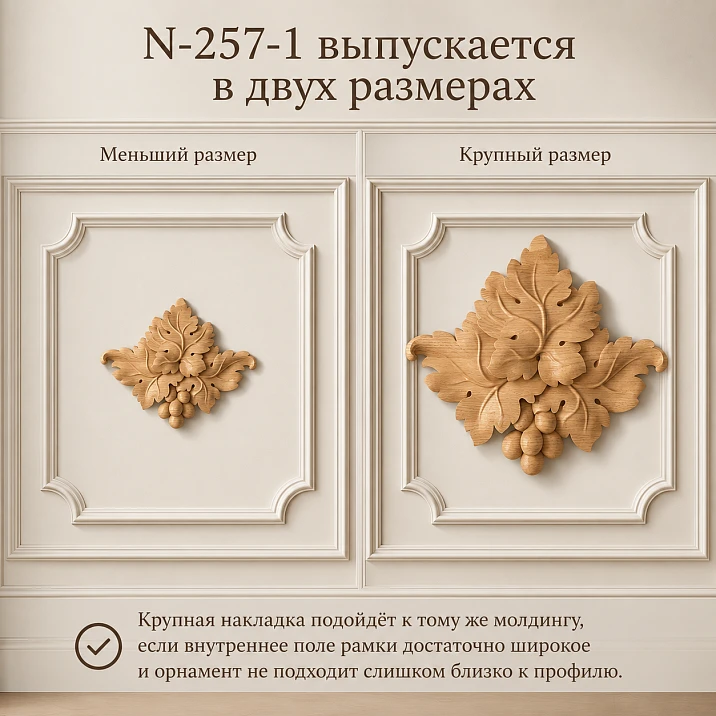
The molding frame is already approved. The compact N-257-1 is centered, straight sections are calculated, the inner field looks proportional, the profile is selected, and the color is agreed upon. Then a short request appears: "Let's install the same overlay, only larger." It seems like only one detail changes. In reality, the entire composition needs to be rechecked — from the length of the moldings to the depth of the relief and the position of the side elements.
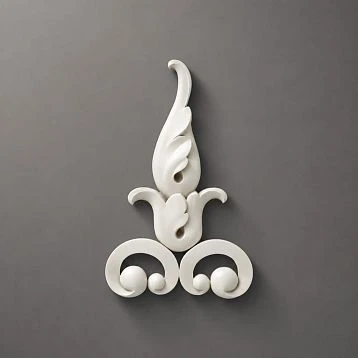
N-257-1 has two versions. The compact decorative element measures 155 × 120 × 24 × 22 × 11 mm. The large one is 247 × 190 × 39 × 35 × 12 mm. The difference is not limited to the first digit. A, B, C, E, and F all increase. Therefore, the question "will the large overlay fit the same molding" cannot be resolved by a photo or by the similarity of the ornament. You need the N-257-1 drawing, the drawing of the selected profile, a scale overlay, and a dry fit.
A buyer who wants buy decorative element N-257-1, chooses not just a small or large carved overlay. He determines the scale of the entire molding frame. The large version takes up more wall or facade space, protrudes further forward, requires a different inner field, and may connect differently to the profile end. If you leave the old straight sections without recalculation, the frame will become cramped, elongated, or lose symmetry.
There is no universal answer here like "yes, it will fit" or "no, you need a different molding." Compatibility is confirmed only after checking the geometry. But there is a clear procedure: compare the five dimensions, determine the profile entry point, check that the molding does not cover the carving, build the frame at full scale, choose beech or oak, agree on sanding and finishing, and then compile the set into one specification.
One request to "make it bigger" changes not one detail, but the entire frame
The compact and large N-257-1 retain the general character of the grape ornament, but work at different scales. The buyer often looks only at size A: 155 or 247 mm. This is a convenient designation of the variant, but it is insufficient for joining with the molding. The dimension line contains five parameters.
| Parameter | Compact N-257-1 | Large N-257-1 | Change |
|---|---|---|---|
| A | 155 мм | 247 мм | +92 mm |
| B | 120 мм | 190 мм | +70 mm |
| C | 24 мм | 39 мм | +15 mm |
| E | 22 мм | 35 мм | +13 mm |
| F | 11 мм | 12 мм | +1 mm |
| Material | Beech or oak | Beech or oak | Selected for the entire visible group |
| Sanding | "Standard" or "Prestige" | "Standard" or "Prestige" | Matches the molding and preparation |
| Preparation | For enamel or tinting | For enamel or tinting | Determines further finishing |
| Application | Walls, doors, furniture | Walls, doors, furniture | The scale of the composition changes |
In percentage terms, the large version is noticeably bigger: length increases by about 59%, width by about 58%, depth by 62.5%, parameter E by about 59%. Only F changes slightly — by 1 mm. This picture immediately shows why the large N-257-1 cannot be treated as the same part with a slightly more expressive face pattern.
The increase in depth from 24 to 39 mm is especially important. It is almost imperceptible in frontal visualization, but in a side view it changes the shadow, the offset from the wall or facade, and the connection with the profile. If the molding remains relatively flat, the large overlay may look attached on top of the frame rather than built into it.




Five parameters need to be read from the DWG, not deciphered by habit
The letters A, B, C, E, and F only make sense on the official drawing. You cannot automatically decide that A is length, B is width, C is depth, and E and F are mounting dimensions if the graphic scheme does not directly show this. For ordering, what matters is not our guesses, but the specific dimension lines.
Before choosing, you need to download drawing N-257-1 and find on it:
-
overall frontal dimension;
-
overall height or width;
-
maximum overhang;
-
molding interface area;
-
end zone size;
-
carved ornament boundary;
-
part axis;
-
rear plane;
-
possible seating selection;
-
the direction from which the profile approaches.
If the purpose of E and F is not obvious, they cannot be called the width or depth of the molding. The correct wording is different: "Parameters E and F are checked against DWG N-257-1 and compared with the actual profile." This is not caution for the sake of formality. An error in a single letter can cause the profile to fit into the wrong part of the overlay or cover the ornament.
Our factory also produces:
The frontal view is responsible for scale
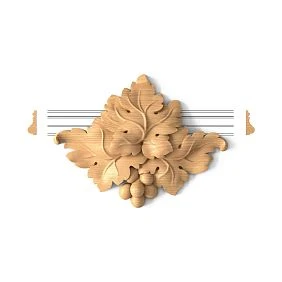
On the facade, you can see how much space N-257-1 takes up inside the frame, how it relates to the axis, and how close it comes to the corners. Here, 155 and 247 mm are compared, but no conclusion is made about the fit.
Get Consultation
The side view is responsible for depth
The difference of 24 and 39 mm affects the shadow and overhang. A large overlay can protrude 15 mm further. For a wall, this changes the light and shadow; for a door leaf, the overall relief; for a furniture facade, the distance to the handle, adjacent door, or passage.
The section is responsible for the joint
Only the section shows how the end of the molding meets the carved element. The profile may approach a flat area, enter a groove, adjoin a relief, or end nearby. Until this geometry is confirmed, it is too early to use the expression "compatible molding."
Why the previous molding cannot be automatically retained
The designer chose a profile for the compact overlay. He checked one width, one depth, one end line. After switching to a larger size, four significant dimensions and one small parameter change. Even if the molding visually belongs to the same collection or has a similar size, the joint needs to be recalculated.
The end may no longer align with the seating area
The compact N-257-1 could accept molding in area E = 22 mm with specific geometry. For the large one, parameter E is 35 mm. But without DWG, it cannot be asserted that this exact number describes the fit. What is clear is that the corresponding dimension line changed by 13 mm, so the old joint cannot be blindly copied.
The profile may cover part of the thread
If the molding goes deeper or comes closer to the center, it can overlap the sheet, cluster, or ornament transition. On a small part, such a conflict might be absent; on a large one, it may appear due to different geometry.
A gap may appear between parts
The end of the profile and the overlay must meet without an accidental gap. A gap cannot be considered acceptable just because it is planned to be filled with finishing material later. First, the cause is determined: incorrect angle, unsuitable depth, different seating area, or scale error.
The depth of the profile may become visually weak
Even with physical coincidence, the large N-257-1 with a depth of 39 mm may look too massive next to a thin molding. The frame ceases to be perceived as a single relief: straight sections "sink," and the center protrudes as a separate sculpture.
The old molding lengths no longer work
A large overlay takes 92 mm more along parameter A and 70 mm more along B. If the outer dimensions of the frame remain the same, the straight sections are shortened. If the straight sections are preserved, the frame increases. There is no third option: extra space must appear somewhere.
Two overlays — two frame geometries
| What is checked | Compact N-257-1 | Large N-257-1 | Why you cannot copy the old scheme |
| Central field | Requires less space | Requires more space | The inner frame may become cramped |
| Length of straight moldings | Calculated for 155 mm | Recalculated for 247 mm | Difference in A is 92 mm |
| Height or width of composition | Linked to B = 120 mm | Linked to B = 190 mm | Change of 70 mm affects proportions |
| Offset from surface | C = 24 mm | C = 39 mm | Chiaroscuro and adjacency change |
| Size E | 22 мм | 35 мм | Purpose is clarified per DWG |
| Size F | 11 мм | 12 мм | Even a close value does not prove compatibility |
| Side elements | Placed in a single layout | Checked anew | The center becomes larger |
| Indent to corners | Smaller | Larger | Possible conflict with the facade boundary |
| Distance to the handle | Usually larger | May be reduced | Especially important for doors and furniture |
After switching to 247 mm, you cannot simply replace the central piece in the visualization and leave all other dimensions unchanged. You need to decide what is preserved: the outer frame contour, the inner field, the length of straight moldings, or the distance to adjacent elements. It will not be possible to preserve everything at once.
Three strategies for switching from 155 to 247 mm
Strategy 1. The outer frame contour remains the same
The large overlay takes up more space inside. Straight molding sections shorten, the inner free field decreases, and the distance to corners changes. This approach is possible if the frame is initially spacious.
Need to check:
-
whether the composition has become cramped;
-
whether the carving has come closer to the molding;
-
whether symmetry is preserved;
-
whether there is enough straight section for a calm rhythm;
-
Does the overlay intersect with the adjacent decor?
Strategy 2. Lengths of straight sections are preserved
Then the external size of the frame increases. More space is required on the wall. On a door or furniture front, there may not be enough margin to the edge.
Check:
-
surface dimensions;
-
distance to hinges and handles;
-
offset to the adjacent frame;
-
position relative to the panel;
-
center of the entire composition.
Strategy 3. Both the frame and the profile change
Sometimes a large N-257-1 requires not only new lengths, but also a more expressive molding. Then the project is essentially recreated: a different profile is chosen, the perimeter is recalculated, the depth is checked, and the specification is updated.
This path requires more work, but it allows you to align the scale rather than adapting a large center to a too-light frame.
How to check the selected molding against two drawings
For the check, you need the DWG of N-257-1 and the DWG of the profile. The category allows Buy wooden molding after comparing options, but choosing by photo does not confirm the joint.
Step 1. Bring the drawings to the same scale
If one file is printed at 1:1 and the other is reduced, visual overlay is meaningless. All dimensions must be read in one system.
Step 2. Determine the actual end of the profile
The molding has width, height, relief, and installation direction. The drawing indicates which edge fits N-257-1.
Step 3. Find the junction area of the overlay
They do not assume it by symmetry. They look at a specific line on the DWG.
Step 4. Overlay the section
Check:
-
height coincidence;
-
depth;
-
absence of intersection;
-
absence of gap;
-
position of front planes;
-
preservation of the carved motif;
-
possibility of processing the end face.
Step 5. Construct the frontal development
Even a perfect cut does not guarantee a beautiful frame. You need to see the length of straight sections and the location of the central piece.
Step 6. Do a dry fit
A drawing reduces risk, and a real fit confirms it. For a batch, first assemble one unit without final finishing.
MLD-001, MLD-002, and MLD-003: cards for comparison, not a ready compatibility list
The SEO scheme confirms real pages of several wooden moldings. They can be used as starting points for comparing drawings:
These links do not mean that each profile is compatible with both sizes of N-257-1. Even the match of MLD-002 in numbers 22 × 11 mm with the parameters of the compact overlay E = 22 and F = 11 mm is not yet proof. You need to ensure that the dimensions refer to the same directions and areas. For the large version, E = 35 mm, F = 12 mm, so you certainly cannot transfer the conclusion without a new overlay.
Matching numbers are a reason to open two DWG files, not a reason to place an order.
Dry fit: the moment when a beautiful scheme becomes a real node
A dry fit is an assembly without final fixation and finish coating. For N-257-1 it is especially useful because it simultaneously checks the front, depth, and ends.
What to prepare
-
one overlay of the selected size;
-
molding fragments;
-
a base or surface mockup;
-
a drawing;
-
a square;
-
a ruler;
-
temporary fixation that does not damage parts;
-
a sample of side elements, if they are part of the composition.
What to look at from the front
The overlay must be on the axis. Straight sections must have equal length if the project is symmetrical. The molding must not overlap the carved pattern.
What to look at from the side
Compare the overhang of 24 or 39 mm with the profile. The larger version creates a deeper shadow. Make sure the transition looks intentional.
What to check at the end
There should be no random angle, gap, or step. If the profile is cut along a complex line, a template is made before processing the entire batch.
What to record
After a successful fitting, write down:
-
position of the molding;
-
length of each straight section;
-
cutting angle;
-
overlay orientation;
-
distance to edges;
-
drawing number;
-
selected finish option.
Compact N-257-1: when 155 mm gives the right scale
The size 155 × 120 × 24 × 22 × 11 mm is suitable not because a small overlay is “simpler.” It is appropriate where the center of the frame needs to remain expressive but not take up most of the surface.
Small furniture door
On the facade, the width, height, distance to the handle, and hinge zone are limited. The compact N-257-1 leaves more straight molding and free background.
Narrow door panel
A tall door may have a relatively narrow inner field. The central overlay of 155 mm fits more easily without approaching the edges.
A small molding frame on the wall
In a composition of several identical frames, a large center could create too dense a repetition. The compact size supports the rhythm without turning each section into a separate panel.
A dresser or cabinet
On drawer fronts, height is especially important. N-257-1 with a width of 155 mm needs to be checked across the full line, but it usually leaves more space to the handle and edges than the 247 mm version.
A composition with several carved details
If side elements, corners, or rosettes are used in addition to the center, a compact overlay helps distribute accents. A large one may draw attention to the middle.
Repairing a finished frame
When the outer contour cannot be changed, the 155 mm version has a better chance of preserving the molding lengths. But even here, a DWG check is required.
To design a compact version, you can order N-257-1 size 155 mm after confirming all five parameters.
Large N-257-1: when 247 mm becomes an architectural center
Size 247 × 190 × 39 × 35 × 12 mm takes up almost 60% more space in two main directions and protrudes noticeably more. Such a part requires a surface that can withstand the scale.
Large wall panel
In a spacious boiserie, a large grape motif can become the center of a section. It is important to leave enough flat areas around it so that the carving does not look cramped.
Tall interior door
Large N-257-1 can support the scale of the panel, but you need to check the panel, handle, edges, decor thickness, and opening.
Wide cabinet or built-in library
On large facades, a small overlay can get lost. The 247 mm version forms a noticeable axis, especially if the center is located on a blank panel or above a pair of doors.
Single frame on an accent wall
When there is one frame and a lot of free wall around it, a large element reads more confidently. But increasing the center must be accompanied by recalculating the outer contour.
Portal
In a wide architectural framing, a large overlay can tie together moldings and side decor. Here, the 39 mm depth and side view are especially important.
When a large size doesn't work
If the frame is narrow, the straight sections are short, and there are rosettes, handles, or corners nearby, the 247 mm version becomes heavy. Physical placement does not equal a successful composition.
For a large project, you can buy large N-257-1 size 247 mm after building a full-size layout.
Full-size mockup: two contours instead of an argument about scale
The numbers 155 and 247 mm are hard to assess on a wall or door. Make two paper templates at full dimensions.
Mockup of the compact version
Build a rectangle according to A and B, mark the maximum depth on the side, draw the axis and the intended entry points of the molding.
Layout of the large variant
Repeat the operation for 247 × 190 mm. Show 39 mm with a separate side template.
Place both in one frame
First, do not change the outer contour. Compare how much straight molding remains. Then enlarge the frame for the large overlay and assess whether it fits on the surface.
Look from a real distance
A furniture facade is evaluated up close, a wall panel from several meters, the top of a door from below. The same size is perceived differently.
Add a shadow
A cardboard strip with a depth of 24 and 39 mm will show the overhang. The large overlay may appear visually more massive than expected from the front.
Inner field of the frame: free space also needs to be designed
The carved overlay should not fill the entire area between the moldings. Empty field helps read the ornament and separates it from the profile.
When switching to the large N-257-1, the internal field decreases if the frame remains the same. Need to check:
-
the distance from the extreme points of the thread to the molding;
-
symmetry at the top and bottom;
-
space for side parts;
-
position relative to the panel;
-
color and texture of the background;
-
shadow from the relief;
-
visual center.
There is no universal margin. It depends on the scale of the surface and the pattern. But the principle is unchanged: the free field should look intentional, not left over after the parts barely fit.
Side N-258-1L and N-258-1R: the central size changes the entire trio
The SEO scheme indicates that N-257-1 can be used together with the side N-258-1L and N-258-1R. This does not confirm automatic compatibility of each size. When switching from 155 to 247 mm, you need to re-check:
-
distance between the central and side parts;
-
axes;
-
direction of the grape ornament;
-
overall dimensions;
-
length of the connecting moldings;
-
depth of the relief;
-
symmetry of the left and right sides;
-
margins to the corners of the frame.
If the side elements are already ordered for a compact center, replacing only N-257-1 may ruin the proportions. The large overlay will approach them, shorten the straight sections, or change the rhythm.
Without a confirmed URL of the article about N-258-1L/R in the current scheme, a link cannot be invented. To select elements of the same style, it is better to open the page where you can buy wooden decor from the "Grape" collection, and then compare the drawings of specific cards.
"Grape" collection: a unified ornament does not cancel dimensional verification
Belonging to the same collection helps align the motif. Grape leaves, clusters, and smooth lines create a common decorative language. However, the collection is not a constructor with automatic fitting.
Two parts can be stylistically related and still have different:
-
dimensions;
-
depth;
-
direction;
-
mounting zones;
-
connection points;
-
scale;
-
requirements for molding.
Therefore, the request to order carved elements with a grape ornament should lead to a comparison of the entire composition, not to purchasing elements solely by the collection name.
Wall panel and boiserie: a large center changes the architecture of the section
In boiserie N-257-1, it can be placed in the center of the upper, lower, or a separate decorative frame. The wall surface offers more freedom than a furniture facade, but scale errors become more noticeable.
You can view wall panels with moldings and overlays and assess how carved centers work with straight profiles. For your own project, you need to check:
-
panel height;
-
section width;
-
rhythm of adjacent frames;
-
position of sockets and switches;
-
furniture in front of the wall;
-
eye level;
-
lighting;
-
joint with baseboard and cornice.
Compact overlay in the frame series
If there are many identical sections on the wall, 155 mm creates a calmer repetition. The centers do not merge into a continuous carved strip.
Large overlay in the main section
247 mm can highlight the central panel behind a sofa, console, or fireplace. Then it is better to make adjacent frames calmer so that the hierarchy is readable.
Same large detail in each section
This approach requires a wide wall and precise rhythm. If the gaps between frames are small, the grape ornament will become too dense.
High and low panels require different solutions
In the high section, the large N-257-1 receives enough air from above and below. In the low panel, the same 190 mm for parameter B may take up an excessive share of the internal field. Therefore, the same wall width does not mean the size fits in height.
Frame above furniture
If the boiserie is placed above a sofa, console, or dresser, the center of N-257-1 must be aligned with the furniture's axis. Switching to a large overlay may require shifting the entire frame, not just replacing the central piece.
Interior door: depth of 39 mm is checked together with opening
The door leaf moves. Therefore, a frontal layout is not enough.
You can order decor for an interior door after checking:
-
thickness of the leaf;
-
position of the panel;
-
handles;
-
lock;
-
hinges;
-
edge of the trim;
-
opening trajectory;
-
distance to the wall;
-
relief depth;
-
weight and mounting method according to the project.
Compact N-257-1 on the door
The 155 mm size is easier to fit into a narrow panel. It leaves more space to the handle and edges.
Large N-257-1 on the door
Version 247 mm is suitable for a tall wide panel if the frame and panel are designed for it. The depth of 39 mm is especially important: the overlay must not hit the wall, furniture, or the adjacent leaf.
Double-leaf door
The center of the composition can be on each leaf or on the common axis. A large overlay on two panels creates a very strong repetition. A mockup is mandatory.
Door opening toward the wall
Measure not only the distance from the panel to the wall, but also the actual point where the relief approaches the surface. The handle, limiter, and casing can change the trajectory. You cannot assume that an additional 15 mm of depth will go unnoticed.
Overlay in the upper panel
A high-mounted N-257-1 is viewed from below. The large size may look more proportional, but the straight sections of the molding must remain readable. A too-tight frame creates the impression that the ornament is squeezed into the opening.
Cabinet and built-in library: check the doors, handles, and adjacent fronts
On a wide cabinet, a large N-257-1 seems logical, but furniture has its own limitations. Before you buy wooden decor for the wardrobe, need to check:
-
the width of each door;
-
the overall axis of the wardrobe;
-
the position of the handles;
-
hinge gaps;
-
the protrusion of the adjacent facade;
-
opening;
-
distance to the ceiling cornice;
-
depth of the carving;
-
Repeat on paired doors.
One overlay on the common central panel
A large size can become the main accent and not be repeated on each door. This reduces visual density.
One overlay per door
The compact option usually leaves more space. The large one needs to be checked on two adjacent facades simultaneously.
Built-in library
The grape ornament supports the classic composition. But shelves, glass doors, and lighting create additional lines. N-257-1 should not overlap the usable area or interfere with hardware.
Cabinet up to the ceiling
The upper zone is often already occupied by a cornice, frieze, or mezzanine frame. Increasing N-257-1 may require reducing other details. You cannot simply move the molding to the edge if there is a structural gap there.
Paired facades
If two doors are identical, the overlays should be at the same height and have the same indents. With a large size, any difference is more noticeable because the center occupies a larger share of the facade.
Dresser and nightstand: the height of the drawer limits the choice more than the width
On the dresser, the buyer looks at the overall width of the facade and decides that 247 mm will fit. But the overlay also has parameter B = 190 mm. The height of the drawer or door may be insufficient.
To select, you can choose a carved overlay for the dresser and check:
-
facade height;
-
handle;
-
frame binding;
-
edges;
-
adjacent drawer;
-
depth of 24 or 39 mm;
-
access to opening;
-
repeat throughout the furniture.
Compact N-257-1 is often more convenient on individual drawers. A large one can be used on a central door or a wide blank facade, but this is decided by the layout.
Horizontal composition on a wide drawer
Even if A = 247 mm fits easily in width, B = 190 mm can almost fill the height. The molding at the top and bottom will lose straight sections, and the handle will have to be moved. Therefore, the frame is checked as a whole.
Central cabinet door
A large overlay can work on one blank door if the adjacent drawers remain calm. This gives the furniture hierarchy, not equally heavy decor on every surface.
Handle in the center
If the handle is already on the axis, N-257-1 cannot be placed in the same spot without changing the hardware. The decision to move the handle affects the holes and the facade construction, so it is made before ordering the decor.
Beech or oak: the material of the overlay and molding must speak the same language
N-257-1 is available in beech and oak. The material is chosen not separately from the profile, but for the entire visible group.
Beech for opaque enamel
Beech is often considered for painting when the color should unify the molding and carving. The relief is read through light and shadow, and the wood texture takes a back seat.
You can find out the price of N-257-1 in beech in the selected size and sanding quality. But the cost of the set also includes moldings, side elements, finishing, and delivery.
Oak for tinting
Oak is chosen when the texture should remain visible. On the large N-257-1, the wood grain and deep relief interact especially actively. Tinting must be checked on a sample.
The customer can order an oak N-257-1 for tinting after agreeing on an oak or visually compatible molding.
Mixing wood species
If the overlay is oak and the profile is beech, a clear finish will highlight the difference. Under enamel, the materials may also require different preparation. Such a combination is possible only as a deliberate technological solution.
The material of the entire composition is recorded line by line
The specification specifies the wood species for:
-
N-257-1;
-
moldings;
-
N-258-1L/R;
-
corner elements;
-
additional overlays;
-
frames and bases, if they are included in the set.
Beech and oak participate differently in the scale
On a compact overlay under enamel, the silhouette becomes the main focus. On a large oak part under tinting, the texture adds another visual layer. Therefore, the 247 mm version may seem more massive not only due to its dimensions, but also due to the expressive wood grain pattern.
"Standard" or "Prestige": sanding is chosen together with size and finish
Both versions of N-257-1 are available with "Standard" or "Prestige" sanding quality. These options are not a ready-made color.
For compact overlay
Small transitions are located closer to each other. When installed on furniture or a door, the part is viewed closely, so thread preparation is noticeable.
For large overlay
The area and depth are larger. Side light emphasizes recesses more strongly. Uneven preparation will be visible on a large surface.
"Standard"
Suitable for a project where the workshop performs further preparation according to its own technology. The exact scope of work is clarified before finishing.
"Prestige"
Involves more detailed manual sanding. But even this option does not cancel inspection, test coating, and preparation of new molding ends.
The visible group must be agreed upon
If the overlay is in "Prestige" and the molding is prepared differently, after tinting or enamel there may be a difference in texture. Surface requirements should be fixed for the entire set.
Enamel or tinting: size affects color perception
The card provides for preparation for enamel or tinting.
Opaque enamel
Color unites parts of different shapes. The compact N-257-1 can become a subtle relief center, while the large one can be an architectural accent. Contrasting enamel visually enlarges the overlay, while a color close to the background softens it.
Staining
The texture remains visible. On oak, a large ornament is perceived as deeper. But the recesses may look darker, so a test on a flat board is insufficient.
One color does not fix an incompatible profile
Even a fully painted composition will reveal a gap, a step, or an incorrect end grain. First geometry, then finishing.
Sample before batch
Beneficial order a molding sample and check it next to the overlay. The sample helps to coordinate the profile, wood species, and color, but does not replace a full-size assembly.
Light and dark finishes
Light color softens the boundaries of the relief and helps the large N-257-1 blend into the panel. Dark tinting enhances depth and makes the 39 mm more noticeable. This is not a compatibility criterion, but an important part of the visual mockup.
Side light
Wall sconces, cabinet lighting, or natural light can highlight the step between the molding and the overlay. The test assembly is evaluated under the lighting that will be present in the interior.
Mounting adhesive and fastening: first the base and structure
The diagram includes a materials page where you can Buy mounting adhesive for wooden decor. However, the availability of the product in the category does not mean that one adhesive is sufficient for any N-257-1.
The installation method depends on:
-
walls, doors, or furniture facades;
-
base material;
-
overlay size;
-
weight, which needs to be specified;
-
depth of 24 or 39 mm;
-
surface conditions;
-
future finishing;
-
part position;
-
manufacturer's requirements;
-
design unit.
The article does not specify fasteners, adhesive consumption, or fixing scheme. These data are determined after selecting a specific base.
Already painted surface
If a wall or facade has a finish coating, check adhesion, material compatibility, and the possibility of marking without damage. Not every paint can be considered a suitable base for installation.
Installation before finishing
This order facilitates joining seams but complicates painting of deep areas. The decision is made together with the finisher.
Installation after finish
Allows separate processing of thread and profile, but requires careful fixation without damaging the coating. Corners and joints must be confirmed in advance.
What to buy with N-257-1
| Position | Why it's needed | What to check |
| N-257-1 155 mm | Compact central element | All A, B, C, E and F |
| N-257-1 247 mm | Large frame center | New dimensions, depth, and margins |
| Wooden molding | Forms straight sections | Section, end face, material, and DWG |
| N-258-1L/R | Side elements of the composition | Orientation and distance to the center |
| Corner overlays | Complete the frame | Scale and joint with the profile |
| Profile sample | Check the junction | Real geometry and finish |
| Finishing materials | Enamel or tinting | Beech or oak, test stain |
| Installation materials | Fixation by project | Basis and technology |
| Drawing | Coordinates the set | One version for all participants |
| Delivery | Receiving a batch | Marking of dimensions and packaging |
In the general category, you can Buy Decor for Moldings and assemble the central, corner, and side elements. Each bundle is still checked against the drawings.
How not to confuse N-257-1 with similar products
Do not confuse two sizes of oneWhat to check in the invoice before payment
Match the commercial proposal with the drawing:
-
recommended product URL and article number;
-
full size line;
-
155 or 247 mm;
-
beech or oak;
-
"Standard" or "Prestige";
-
enamel or tinting;
-
quantity;
-
molding;
-
dimensions and number of straight sections;
-
side elements;
-
sample;
-
finishing materials;
-
delivery;
-
absence of accidental profile replacement.
The query "N-257-1 price" refers to the card of a specific modification. The cost of one overlay is not equal to the budget of the frame.
Price of the large version: you need to calculate the set, not just the center
When switching from 155 to 247 mm, the following may change:
-
the price of the N-257-1 itself;
-
the length of the molding;
-
the profile model;
-
the number of side elements;
-
frame size;
-
finishing consumption;
-
number of samples;
-
packaging;
-
design cost;
-
Delivery.
Therefore, two complete options are compared:
-
compact overlay plus proven profile and straight sections;
-
large overlay plus recalculated frame and confirmed profile.
Otherwise, the buyer sees the difference only in the central part's card, and discovers additional costs after approval.
Cost of reworking a finished frame
If the molding has already been purchased and cut, switching to a larger version may require new straight sections. Old fragments cannot always be reused in another section. Therefore, changing the size after cutting is more expensive than checking at the layout stage.
Price of a sample and test unit
An additional sample may seem like an expense, but it helps verify the profile and finish before the batch. In a series wall panel, the cost of an error is multiplied by the number of frames.
Order for one facade and for a series: different levels of control
One furniture facade
You can make a full-size mockup and a dry fit on a specific door. The error is local, but reworking a painted part is still undesirable.
Pair of doors
Need to check mirror symmetry, equal gaps, and one height. Two large N-257-1 may visually converge.
Series of wall frames
Check the typical module and repetition. One erroneous joint will multiply across the entire room.
Object configuration
Useful for designers to get configuration conditions and provide a list of dimensions, materials, and finishing options.
Multiple rooms
The same N-257-1 can be used in the living room, study, and hallway, but frame sizes differ. Do not transfer a node from one room without checking the surface and viewing distance.
Standard furniture series
Before production starts, a control facade is assembled. After approval, its dimensions become the reference. Any replacement of 155 with 247 mm requires a new version of the reference.
Design: when comparing two DWGs is not enough
A complex frame includes a center, side elements, corners, multiple profiles, and surface constraints. Then it is useful to order a check of the overlay and molding on the section.
You will need:
-
surface dimensions;
-
photographs;
-
frame drawing;
-
selected size N-257-1;
-
molding card;
-
beech or oak;
-
finish;
-
adjacent elements;
-
distances to edges;
-
handles and hardware;
-
installation conditions.
Design does not replace a structural check of the base, but links decorative parts into a single geometry.
A flat pattern and a section solve different tasks
A flat pattern shows scale and margins, a section shows profile and depth. Ordering a large overlay based only on a pretty front view is not allowed.
A three-dimensional model does not eliminate dimensions
Even an accurate visualization may use a conditional profile. The specification requires real part numbers and DWG.
Delivery: two sizes need to be marked separately
If both versions are present in one order, the packaging must be clear to the installer. Before payment, clarify:
-
number of packages;
-
marking of 155 and 247 mm;
-
thread protection;
-
separate packaging for moldings;
-
samples;
-
finishing materials;
-
acceptance procedure;
-
actions in case of damage.
After approval of the specification, you can order N-257-1 with Contact us to confirm shipping to your destination..
Marking by frames
For a large batch, it is useful to label not only the size but also the section number: Р-01, Р-02, Д-01. This way, overlays and cut profiles do not get mixed up on site.
Packaging of deep relief
The large version protrudes more strongly, so the thread requires careful protection. The specific packaging method is specified in the order.
Acceptance before painting and trimming of the molding
Inspection is carried out before irreversible work.
Documents
They check the article number, size, material, sanding, and preparation.
Five dimensions
Measure A, B, C, E, and F according to the drawing. You cannot check only 155 or 247 mm.
Carving
Inspect the grape ornament under side light.
Molding
Check the profile, lengths, and direction.
Dry joint
They assemble one frame. Only after that do they cut the remaining profiles and start finishing the batch.
Comparison of a pair
If there are two overlays, they are placed side by side and checked for identical orientation, size, and preparation. Natural wood has peculiarities, so the final selection for transparent finishing is evaluated before installation.
Errors due to which the large N-257-1 does not fit the previous molding
Error 1. Compared only A
247 mm physically fit, but the depth and seating did not match.
Fix: check A, B, C, E, and F.
Error 2. The purpose of E and F was invented based on the numbers
The parameters were mistakenly taken as the molding cross-section.
Fix: read the DWG.
Error 3. The match 22 × 11 was taken as compatibility with MLD-002
Did not check the direction of dimension lines and the profile.
Fix: overlay two drawings.
Error 4. The outer contour was left unchanged
The large overlay squeezed the inner field.
Fix: recalculate the frame.
Error 5. Straight sections were left unchanged
The frame went beyond the boundaries of the door or facade.
Fix: check the surface.
Error 6. The depth of 39 mm was not seen on the front sketch
The center turned out to be too protruding.
Fix: build the side view.
Error 7. The molding overlapped the ornament leaves
The end face came too close to the center.
Fix: check the junction line.
Error 8. A gap appeared between the profile and the overlay
The cross-section did not match.
Fix: dry fit before finishing.
Error 9. Side N-258-1L/R left in old positions
The composition became cramped.
Fix: recalculate the entire triple.
Error 10. Large version placed on a small box
B = 190 mm did not leave margin to the edges.
Fix: full facade layout.
Error 11. Did not check the handle
The relief ended up too close to the grip.
Fix: apply hardware to the flat pattern.
Error 12. Mixed beech and oak
The tint highlighted the difference.
Fix: coordinate the material of the group.
Error 13. "Prestige" was mistaken for a finished coating
The finish was not included in the order.
Fix: record the finish separately.
Error 14. Trimmed moldings before fitting
The angle and length did not fit.
Fix: first one test joint.
Error 15. Ordered both versions under one line
The sizes were mixed up on site.
Fix: separate items and labeling.
Error 16. Used a duplicate URL as another modification
Extra cards appeared in the estimate.
Fix: one recommended address.
Error 17. Same color was considered sufficient
Geometric step remained noticeable.
Fix: first profile, then enamel.
Error 18. Glue was bought before the project
It was not confirmed for the base.
Fix: choose installation technology.
Error 19. Depth on the door was not taken into account
The overlay approached the wall when opening.
Fix: check movement.
Error 20. Center price became the only criterion
Did not account for the new molding and frame rework.
Fix: compare sets.
Error 21. Size changed after sample painting
Color was approved on a compact relief, but the large part gave deeper shadows.
Fix: repeat painting on the selected size.
Error 22. Overlay axis shifted to preserve the old molding
The frame became asymmetric.
Fix: recalculate both sides from the center.
Error 23. Only one frame in the series was checked.
On the adjacent surface, there was not enough space to the switch or edge.
Fix: measure each section.
Error 24. The molding was chosen by the collection name.
Stylistic similarity was mistaken for geometric compatibility.
Fix: compare cross-sections.
Error 25. A large overlay was called "scale 1.6".
We tried to proportionally increase all distances, although F changed by only 1 mm.
Fix: use the real five parameters.
Who will suit the compact N-257-1
The size 155 × 120 × 24 × 22 × 11 mm is worth considering if:
-
the frame is small;
-
the surface is limited;
-
more straight molding is required;
-
there are other carved elements nearby;
-
the part is placed on a furniture door;
-
moderate projection is important;
-
the outer contour is already defined;
-
the composition is repeated many times;
-
the distance to the handle is small;
-
The large version overloads the layout.
Compact size does not mean less significant decor. In a small frame, it can look more convincing because it maintains proper margins and does not overwhelm the profile.
Who the large N-257-1 suits
The size 247 × 190 × 39 × 35 × 12 mm is worth checking when:
-
the wall panel is wide;
-
the door is tall and spacious;
-
the cabinet has a large central section;
-
the frame is single;
-
there is enough free space around;
-
a strong central motif is needed;
-
The profile can support depth;
-
The side elements are placed far apart;
-
The outer contour can be enlarged;
-
The composition is visible from several meters away.
A larger version is justified only when the entire frame becomes stronger, not tighter.
When no size fits
Different decor is needed if:
-
The compact overlay gets lost;
-
The large one does not fit;
-
The profile cannot be matched;
-
depth hinders operation;
-
grape ornament does not match the project;
-
molding frame is too narrow;
-
cannot change the lengths of straight sections;
-
no possibility to do a dry fitting;
-
a different material is required;
-
a ready-made unit is needed without design work.
In the category you can wooden decor for moldings — catalog and prices use for comparison of other models and dimensions.
Compatibility control card N-257-1 and molding
Before payment, it is convenient to fill in one table. It turns the general phrase "molding fits" into a verifiable result.
| Check | Compact version | Large version | Project status |
| Full line A, B, C, E, F | 155 × 120 × 24 × 22 × 11 | 247 × 190 × 39 × 35 × 12 | Confirmed / no |
| DWG overlay | Received | Received | Yes / no |
| DWG molding | Received | Received | Yes / no |
| Profile end | Checked | Rechecked | Yes / no |
| Thread overlap | Absent | Absent | Yes / no |
| Gap | Absent | Absent | Yes / no |
| Frame outer contour | Fixed | Recalculated | Yes / no |
| Straight sections | Calculated | Recalculated | Yes / no |
| Side elements | Arranged | Rearranged | Yes / no |
| Depth | 24 мм | 39 мм | Checked / not |
| Material | Beech / Oak | Beech / Oak | Approved |
| Finishing | Enamel / tinting | Enamel / tinting | Sample approved |
| Dry fitting | Completed | Completed | Yes / no |
An empty line means the solution is not yet ready for ordering. It is especially dangerous to mark "compatible" without two drawings and a physical node.
Ready action plan before ordering
-
Determine the surface: wall, door, or furniture.
-
Fix the outer contour of the frame.
-
Download DWG N-257-1.
-
Compare two full dimension lines.
-
Select preliminary option 155 or 247 mm.
-
Get the molding DWG.
-
Overlay the cross-sections.
-
Check the end and relief.
-
Recalculate straight sections.
-
Apply side elements.
-
Check the depth.
-
Create a full-size layout.
-
Assemble a dry joint.
-
choose beech or oak
-
Choose "Standard" or "Prestige".
-
Coordinate the enamel or tinting.
-
Compile a complete specification.
-
Verify the invoice.
-
Order the set as a single batch.
-
Conduct acceptance before finishing.
This route is especially important when the size is changed after the project is approved. It prevents old moldings, lengths, and offsets from silently carrying over into the new version.
Frequently asked questions about N-257-1 and choosing a molding.
What are the dimensions of N-257-1?
There are two versions: 155 × 120 × 24 × 22 × 11 mm and 247 × 190 × 39 × 35 × 12 mm. The entire string must be specified in the request.
Can they be called small and large?
In conversation, yes, but not in the specification. Words do not eliminate confusion. Numbers are needed.
Will the large N-257-1 fit the molding from the compact version?
Possibly, but there is no automatic compatibility. The DWG of the overlay and profile must be compared again, and then a dry fit must be performed.
Why is comparing 155 and 247 mm not enough?
B, C, E, and F change. The depth is especially noticeable: 24 and 39 mm.
What do A, B, C, E, and F mean?
The purpose of each letter is determined by the official drawing. They cannot be interpreted by habit.
Is it true that E and F are molding dimensions?
Without DWG, this cannot be stated. They may refer to specific sections of the part, but the exact meaning is shown in the diagram.
Is the compact N-257-1 compatible with MLD-002 22 × 11 mm?
The coincidence of numbers E = 22 and F = 11 with the profile size 22 × 11 mm looks promising, but does not prove compatibility. You need to check the direction of dimensions, shape, and end face.
Which molding should be chosen for the large N-257-1?
The one whose cross-section and end face are confirmed by overlaying drawings and fitting. A universal model cannot be named based on a single dimension line.
Where can I view moldings?
The category presents moldings made of oak, beech, and MDF — catalog. Material and profile are checked in the product card.
What will change in the frame when switching to 247 mm?
The central dimension and depth will increase. Straight sections will shorten, or the outer contour will grow. Side elements will need to be moved.
Can the outer frame size be kept?
Yes, if the large overlay fits and the inner field remains proportional. This is checked with a mockup.
Can the lengths of straight moldings be preserved?
Then the overall frame size will increase. You need to check the wall, door, or furniture facade.
How to check the depth?
Build a side cross-section or a mockup of 24 and 39 mm. On the frontal image, the difference is barely visible.
Is a full-size template needed?
Yes, especially for the large version. It shows the field, distances to corners, handles, and adjacent parts.
What is a dry fit?
Assembly of the overlay and molding fragments without final fastening and finishing. It shows gaps, steps, and overlap of the ornament.
Can the gap be fixed with putty?
First, you need to understand the cause. If the profile does not match geometrically, filling does not turn an incorrect joint into a correct one.
Can the overlay itself be trimmed?
The possibility of modifying the carved part must be coordinated with the manufacturer. Self-trimming may damage the ornament.
Can the molding be trimmed on site?
The end of the profile is fitted according to an approved template. Mass cutting is performed after a trial joint.
Is N-257-1 suitable for a wall?
Yes, the card provides for use on walls. The size selection depends on the frame and the free field.
Is it suitable for a door?
Yes, after checking the panel, handle, opening, and depth.
Is it suitable for a furniture facade?
Yes, but you need to consider the door dimensions, hardware, adjacent panels, and protrusion.
What size should I choose for a dresser?
The compact one is usually easier to place, but the final decision is made based on the height and width of the facade. The large version may suit a central door.
What size should I choose for paneling?
For repeating small sections, 155 mm is often considered, for the main large panel — 247 mm. This is not a universal rule, but a scenario for a mockup.
Can both sizes be used in the same room?
Yes, if they create a clear hierarchy. For example, a large center in the main panel and compact ones on the sides. Random mixing looks like a mistake.
What materials are N-257-1 made of?
in beech or oak.
What to choose for enamel?
Beech is often used for opaque painting, but the technology must be coordinated for the entire composition.
What to choose for tinting?
Oak is suitable for preserving texture. The color is checked on a real sample.
Can oak veneer and beech molding be mixed?
Only as a deliberate decision. Under tinting, the difference will be noticeable; under enamel, materials may require different preparation.
What does "Standard" mean?
This is a sanding quality option, not a finished finish.
What does "Prestige" mean?
More detailed manual sanding. The final coating is still chosen separately.
Is preparation for enamel and tinting included in the card?
Yes, these options are confirmed. The specific final composition is chosen separately.
Is it necessary to order a sample?
For a large batch, transparent finish, or doubts about the profile, a sample is useful. It does not replace DWG, but shows the real surface.
Where can I view the "Grape" collection?
You can select overlays, balusters, and frames from one collection, then check each item by size.
Is N-257-1 compatible with N-258-1L/R?
It can be part of the overall composition, but dimensions and distances need to be checked separately. Automatic compatibility of two variants is not confirmed by a single collection name.
How to calculate molding lengths?
After selecting the size of N-257-1, the outer and inner contours of the frame are constructed. From them, the lengths of each straight section are obtained, taking into account approved joints.
Can the amount of molding be calculated by perimeter?
The total perimeter does not show individual lengths and cutting. A list of sides is needed.
How to write a compact N-257-1 in an invoice?
Full size, material, sanding, preparation, quantity, and link to the mating drawing.
How to write a large one?
For example: N-257-1, 247 × 190 × 39 × 35 × 12 mm, oak, «Prestige», for tinting, 2 pcs., assembly with molding per approved DWG.
Where to find the price?
On the recommended product card. Do not compare only the cost of the central part — calculate the entire frame.
Are there multiple cards for N-257-1?
The diagram marks duplicate URLs. The article uses one recommended address in the «Grape» collection. Before publishing the site, check canonical or redirect, but one link is enough for the buyer.
Can I order a kit check?
Yes, you can send drawings and to order a check of the overlay and molding on the section.
What data does the designer need?
Surface size, selected N-257-1, molding card, material, finish, side elements, handles, edges, and photos.
Which glue should I use?
The composition is selected based on the substrate, wood, finish, and project. The article does not prescribe a universal adhesive.
Can it be installed on an already painted wall?
The possibility depends on the coating, substrate condition, and chosen technology. This needs to be checked before ordering materials.
When to paint — before or after installation?
The order is determined by the finishing system. Geometry and dry fitting are confirmed before the final finish.
How to accept the order?
Verify five dimensions, material, sanding, preparation, quantity, and thread integrity. Then assemble a test joint.
How to arrange delivery?
After the set is approved, you can buy N-257-1 with delivery and agree on the terms of the general supply.
Where to buy moldings for wall decor?
First determine the required cross-section according to N-257-1, then open the category of wooden profiles. The search query "where to buy wall decoration moldings" should lead not to a random profile, but to a comparison of DWG.
What to do if no profile fits?
Consider another molding, another overlay, or rework the joint. There is no need to force incompatible parts to connect through a large gap or random trimming.
How to understand that the large N-257-1 is really better?
It should not only fit, but also improve the scale: leave margin, support the profile, not interfere with operation, and maintain the integrity of the frame.
Is it necessary to change the corner overlays when switching to 247 mm?
Not necessarily, but their scale and distances need to be checked. A large center can make the previous corners too small or bring them too close.
Can a compact N-257-1 be used with a wide molding?
Such a joint can be considered if the profile does not overwhelm the center and the geometry matches. The solution is confirmed with a development and a section.
Can a large N-257-1 be used with a thin molding?
Physical joining is possible only after checking, but visually the profile may appear weak. The mockup should show a solid relief.
How to check the position of the axis?
Mark the center of the surface and the center of N-257-1, then lay out straight sections in both directions. Do not start marking from a random edge.
What to do if the handle interferes with the large overlay?
Change the size of the decor, the position of the frame, or the facade construction. Moving the handle is agreed upon before manufacturing, especially if holes are already made.
Can I order only one N-257-1 for a trial fit?
Order terms are specified in the product card or with the manager. For a series, it is useful to check one real unit before the entire batch.
Why does the large overlay look darker under the same tint?
A deeper relief creates more shadows. The color composition may be the same, but the visual perception is richer.
Do I need to check the back surface?
Yes. It determines the fit to the base and is part of the mounting assembly. The frontal photo does not show this.
Can N-257-1 be installed without a molding frame?
The card allows use on walls, doors, and furniture, but a standalone composition still requires checking scale, base, and finish. The article is dedicated to the molding assembly.
Five dimensions matter more than one word "large"
N-257-1 is available in two variants, but the choice cannot be reduced to comparing 155 and 247 mm. The compact model has a full line of 155 × 120 × 24 × 22 × 11 mm, the large one — 247 × 190 × 39 × 35 × 12 mm. The frontal dimensions, depth, and mating parameters increase. Therefore, the previous molding remains only a candidate, not a confirmed solution.
Before ordering, open two DWGs, overlay the profile on the overlay, recalculate straight sections, check the inner field, and do a dry fit. Then choose beech or oak, "Standard" or "Prestige", enamel or tinting. In the specification, record all five dimensions and one recommended product URL.
STAVROS company allows assembling the kit sequentially: choose N-257-1, compare decor for moldings, open the "Grape" collection, select a wooden profile, view solutions for boiserie, doors, and furniture, get drawings, order a sample, agree on finish, and arrange delivery. This order protects against the most common mistake: a large overlay does not simply replace a small one — it redefines the geometry of the entire frame.