Article Contents:
- Short answer: NPU-383 can be installed on a sliding door only after checking the full travel with a volumetric mock-up of 298 × 642 × 20 mm
- What is NPU-383 and why all three dimensions are important for a sliding-door wardrobe
- NPU-383 298 × 642 × 20 mm: what exactly is confirmed
- Why the new task does not reduce to a general article about molding for furniture
- Where exactly the mechanical risk arises: a map of moving planes of a sliding-door wardrobe
- What is the dynamic overlap zone
- How to make a simple map without disassembling the wardrobe
- 20 mm at NPU-383: where exactly to measure the free passage
- Why the rear flap usually requires stricter checking
- Useful selection sequence
- Large face size 298 × 642 mm is no less important than the 20 mm depth
- How to determine if NPU-383 fits on the door itself by width
- Height 642 mm requires separate checking of position on the door
- Step 2. Add the 20 mm depth
- Fixed side panel
- Why a large pattern on one door changes the appearance of the entire wardrobe
- How much a decorative scheme can cost
- When the combination works
- When the combination becomes too busy
- How to check the composition with a slatted wall before purchasing
- NPU-383 can work beautifully in a closed wardrobe and poorly in an open one
- Color of NPU-383: why monochrome is often safer next to slats
- If the door is mirrored, NPU-383 changes not only the facade but also the reflection
- Glass, acrylic, and laminated facades require the same base inspection
- The profile handle can be more important than the slat wall itself
- Why NPU-383 should not be placed over a material joint
- If the door mechanism does not allow 20 mm, NPU-383 does not have to disappear from the project
- When it is better to choose a less protruding decor instead of NPU-383
- When it is better to abandon the molding on a moving leaf altogether
- Next to a slat wall, it is important to check not only the style but also the door's extreme position
- Light and shadow can make 20 mm visually significantly deeper
- Daily operation: what happens after a beautiful fitting
- Cleaning and dust: large relief requires access
- What to measure before ordering NPU-383
- Practical algorithm: from liking NPU-383 to purchase decision
- Decision tree
- When it makes sense to buy a pair of NPU-383
- Installing NPU-383 on a sliding door: what to check besides the gap
- Why you should first check the mechanism, and only then choose glue and paint
- How to choose a flatter element without repeating the whole mistake again
- If the slatted wall is still being designed
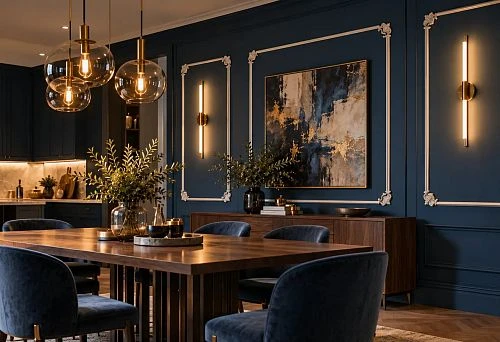
- NPU-383 and general molding in the room: one large ornament should have context
- When NPU-383 on a fixed wall next to a cabinet is stronger than on the door
- A three-door sliding wardrobe cannot be checked as two identical pairs
- Soft closer, brushes, and door adjustment can change the actual passage
- If the cabinet is slightly skewed, the problem will not appear uniformly along the entire height
- Why you cannot rely only on the passport clearance of the system
- When it is better to include NPU-383 in the cabinet project before manufacturing
- How to find a candidate safe zone on the door leaf itself if the door overlaps with the adjacent one not across its full width
- Why shifting NPU-383 from the center is acceptable only with a clear compositional reason
- Why checking a large NPU-383 should not copy the check of a small NPU-505 one-to-one
- If the cabinet has two rails, but the doors never fully pass one behind the other
- When one large ornament is safer than several small ones
- Can NPU-383 be installed on a regular two-door sliding wardrobe?
- What is more important for a sliding wardrobe: 298 mm, 642 mm, or 20 mm?
- Can you simply measure the distance between the doors with a ruler?
- If the gap between the doors is visually more than 20 mm, does that mean NPU-383 will definitely fit?
- Can NPU-383 be installed only on the front door?
- Why is the rear door considered more risky?
- Can two NPU-383 be glued symmetrically on both doors?
- What to do if the 20 mm template slightly touches the adjacent door?
- Can the thickness of NPU-383 be reduced from the back side?
- Is NPU-383 suitable for a mirrored sliding wardrobe door?
- Can NPU-383 be installed on a fixed side panel of the wardrobe?
- How to visually check NPU-383 next to a rack wall?
- If NPU-383 matches the facade color, is a test with racks still needed?
- Can NPU-383 be installed on a door leaf with a long profile handle?
- If the wardrobe has three doors, do three NPU-383 units need to be installed?
- What to do if one NPU-383 seems too large next to the racks?
- Can I buy NPU-383 first and then check it?
- What to check right before payment?
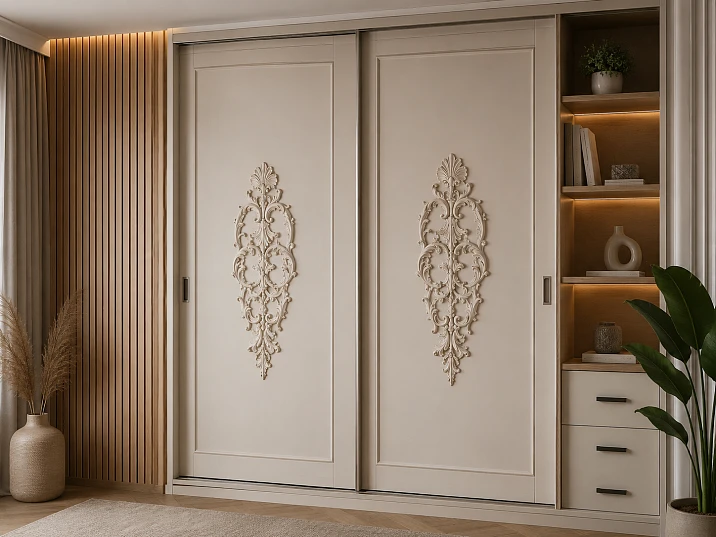
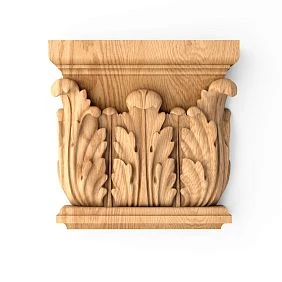
Short answer: NPU-383 can be installed on a sliding door only after checking the full travel with a volumetric mock-up of 298 × 642 × 20 mm
For a sliding wardrobe, NPU-383 has a parameter more important than the beautiful pattern, color, or even centering on the door: 20 mm in depth of the selected option. On regular hinged furniture, this dimension primarily affects the relief volume. On a sliding door, it becomes an additional dimension that must pass next to another door leaf, profile, side panel, and any system elements throughout the entire range of motion.
According to the current STAVROS product card, the NPU-383 variant discussed in this article measures 298 × 642 × 20 mm, is made of polyurethane, and costs 14,050 ₽ per piece. The product has a second size of 347 × 650 × 22 mm, but it is not compared here: the buyer's task is already fixed on the specific variant of 298 × 642 × 20 mm.
The main question before payment is not phrased as:
Is a polyurethane furniture pad suitable at all?
But like this:
Is there a safe zone on the selected sliding wardrobe door where a volume of 298 × 642 × 20 mm will pass the full door travel without entering the trajectory of the adjacent door?
There is no universal answer like "20 mm is definitely enough" or "20 mm is too much for a sliding door." Sliding systems differ. In one wardrobe, the doors are on two tracks with a noticeable gap between planes; in another, the panels pass almost flush. The front door and the back door are also in different conditions: what is safe on the outer door may immediately conflict on the inner one.
Therefore, before purchasing for 14,050 ₽, you need to do two test fits:
-
a flat template of 298 × 642 mm — for the composition on the facade;
-
a volumetric safe mock-up with a maximum protrusion of 20 mm — to check the mechanics.
After that, slowly move the door from one extreme position to the other. If the mock-up does not touch the adjacent door, profile, side panel of the wardrobe, handle, stopper, or slatted wall at the edge of the opening anywhere, the position can be considered further. If contact occurs at least in one section, then ordering NPU-383 for this moving door is not advisable without changing the position or design.
In that case, there are three normal alternatives:
-
move NPU-383 to another, mechanically safe door;
-
place it on a stationary furniture panel or side panel;
-
choose a less protruding decorative element.
After checking a specific position, you can buy the carved decorative overlay NPU-383 made of polyurethane, already understanding what it is for and where it will work.




What is NPU-383 and why all three dimensions are important for a sliding wardrobe
Our factory also produces:
NPU-383 298 × 642 × 20 mm: what exactly is confirmed
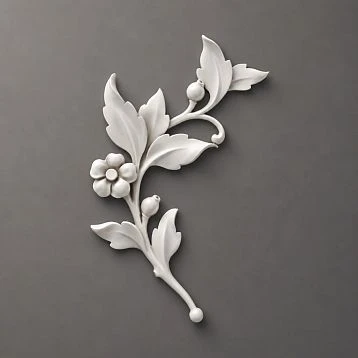
The STAVROS card classifies NPU-383 as polyurethane stucco decor and places the product in the category "Decor for moldings." The description directly calls the item a carved overlay and offers it for decorative compositions on walls, ceilings, and furniture.
For the selected option, the following parameters are confirmed:
| Parameter | Value |
|---|---|
| Article number | NPU-383 |
| Product type | carved decorative overlay / stucco decor |
| Material | Polyurethane |
| Size A × B × C | 298 × 642 × 20 mm |
| Confirmed interpretation for the selected orientation | width 298 mm, height 642 mm, relief/depth 20 mm |
| Price | 14,050 RUB per 1 pc. |
| Second option in the card | 347 × 650 × 22 mm, 15,670 RUB |
| Drawing and 3D model | available on the product card |
The orientation needs to be fixed separately. The card itself displays A × B × C, but the official STAVROS material on choosing NPU-383 for a tall wall already decodes the smaller variant as 298 mm in width, 642 mm in height, and 20 mm in relief. Therefore, in this article, frontal calculations can be correctly made for a vertically oriented overlay.
The second size here is only needed as a fact of the assortment variant's existence. It does not become a second selection branch, because otherwise the new article would repeat the already published material "298 × 642 or 347 × 650 mm".
Get Consultation
Why the new task does not boil down to a general article about molding for furniture
STAVROS already explains in detail that polyurethane overlays can be used on cabinets, dressers, doors, and other furniture facades. These pages answer the general question of decor application.
But a sliding wardrobe differs from a regular hinged wardrobe in its very mechanics.
With a hinged door, the decorative element moves outward together with the panel. Usually, the handle, adjacent wall, opening angle, and possible contacts are checked.
For sliding wardrobes, the door panels:
-
move in parallel planes;
-
pass one in front of the other;
-
have overlapping sections;
-
can extend beyond the side post or adjacent facade;
-
use profile handles, brushes, limiters, and guides.
Therefore, the large relief on the front side cannot be assessed only as furniture decoration.
For NPU-383, three dimensions are especially important:
-
width 298 mm determines how much of the panel the ornament occupies and whether it falls into the side dynamic zone;
-
height 642 mm determines the large vertical section that moves together with the door;
-
depth 20 mm determines the additional volume that must physically pass by adjacent parts.
It is precisely the combination of a large face area and a 20-millimeter protrusion that makes this task separate.
Sliding wardrobe mechanics: where a 20-millimeter relief can enter the trajectory of an adjacent door
Where exactly the mechanical risk arises: a map of moving planes of a sliding wardrobe
To understand whether the NPU-383 is suitable, you need to stop looking at the wardrobe as one flat furniture wall. It has several different planes of movement.
For a two-door system, one can usually distinguish:
-
the front door;
-
the rear door;
-
the area where the doors pass one in front of the other;
-
extreme positions;
-
side posts or walls;
-
handles and profiles;
-
the upper and lower guides.
For a three-door system, there are more options: one panel can move along the middle or a separate plane, and different sections of the track give different actual clearance.
The main mistake is measuring the distance between doors only in the closed position.
A closed wardrobe shows only one configuration. After movement starts, one panel enters the zone of another, and that is where the risk of contact appears.
What is the dynamic overlap zone
This is the part of the path where the decorative element on one panel passes opposite the surface of another panel or its profile.
For NPU-383, you need to know not only whether such a section exists, but also whether the exact place chosen for the overlay passes through it.
If the ornament is located closer to the center of the door, and the doors overlap only at the edges, it may turn out that NPU-383 does not enter the danger zone at all.
If the overlay is shifted toward the side edge, it may pass near the adjacent panel over a significant part of the travel.
Therefore, it is impossible to answer the question by only measuring "the distance between the doors is currently 25 mm."
A movement map is needed.
How to make a simple map without disassembling the cabinet
-
Close the cabinet completely.
-
Use painter's tape to mark the edge of the selected door on the floor or bottom profile.
-
Slide it smoothly.
-
Mark the positions where the selected zone of the facade begins to pass opposite the adjacent door.
-
Separately mark the extreme open position.
-
Repeat for the second door.
After this, it becomes clear where the 298-mm-wide NPU-383 will be during movement.
Such a test is more useful than the abstract question "what is the gap of the cabinet."
20 mm on the NPU-383: where exactly to measure the free passage
The 20 mm parameter cannot be compared with the distance between any two convenient points.
It needs to be compared with the actual free space in front of the mounting surface of the NPU-383 in the zone through which it moves.
It is easier to imagine it this way.
If the NPU-383 is installed on the rear door, its front point shifts forward from the surface of that door. During movement, the rear or profile part of the front door may pass nearby.
It is precisely the distance between:
the front mounting plane of the rear door
и
the nearest part of the front door in the overlap zone
determines whether there is any room for the 20-millimeter volume at all.
But even here, one number is not enough. The free distance can vary:
-
at the handle;
-
at the side profile;
-
in the brush area;
-
due to a slight misalignment of the door;
-
in the extreme position;
-
near the limiter.
Therefore, the article does not set a universal rule of "need 21, 22, or 25 mm." Such a gap should be determined by the design of the specific cabinet and real testing.
A reliable practical criterion is different:
a volumetric mock-up 20 mm high should pass the entire trajectory freely, without touching and without needing to apply force.
If on some section the mockup only "barely passes," the purchase cannot be considered confirmed just because there is nominally no contact. In a real cabinet, there are mounting tolerances, play, guide rail contamination, and operational deviations, so the decision should be made based on actual free movement, not mathematical equality.
Why the rear door usually requires stricter checking
In a two-plane cabinet, the outer and inner doors are in different conditions.
The rear door goes deeper into the body. If NPU-383 is added to its front side, the 20 mm volume may approach the back side of the front door.
Therefore, for the rear door, passage becomes the first question.
The front door often has more free space in front of it, but it is not automatically safe either. In the extreme position, the overlay may approach:
-
the wall;
-
the slat panel;
-
the side post;
-
the body;
-
protruding handle of the other door.
That is, the rule is not like this:
front door — allowed, rear door — not allowed.
The rule is like this:
each leaf is checked as a separate mechanical trajectory.
Useful selection sequence
If you want to install one large NPU-383, it is rational to check surfaces in this order:
-
front leaf in the assumed position;
-
rear leaf;
-
fixed central or side panel, if present;
-
adjacent stationary surface.
So first, the simplest decorative solution is considered, and if the mechanics do not allow it, the decor is moved to where the relief does not participate in movement.
Size 298 × 642 mm on the facade: free field, leaf width, and vertical position
The large face size of 298 × 642 mm is no less important than the depth of 20 mm
For a small overlay, it is relatively easy to find a zone that does not fall into the overlap.
With NPU-383, it is more complicated.
A width of 298 mm means the ornament occupies a noticeable part of the leaf. A height of 642 mm means this zone extends more than half a meter vertically.
Therefore, it is necessary to check not just one conditional point, but the entire overall rectangle.
For example, the central part of NPU-383 may pass freely, but the edge of the ornament will hit:
-
the handle profile;
-
at the joint;
-
on the decorative insert;
-
into the area where the adjacent door passes closer;
-
on the section with a mirror or other material.
That is why the full-size template should be 298 × 642 mm, not a small piece of 20-millimeter thickness.
How to determine if the NPU-383 fits on the door leaf itself by width
After the mechanical check, the composition needs to be evaluated.
If the leaf has a width W, when centering the overlay, the free space on the sides is calculated as follows:
E = (W − 298) / 2.
This is not a standard or a "correct offset." The formula shows the scale.
| Leaf width | Total free field | Field on sides when centering |
| 600 мм | 302 мм | 151 мм |
| 700 мм | 402 мм | 201 мм |
| 800 мм | 502 мм | 251 мм |
| 900 мм | 602 мм | 301 мм |
| 1000 мм | 702 мм | 351 мм |
On a 600 mm leaf, NPU-383 takes up almost half the width of the door's overall field and looks large.
On 800–900 mm, it gets more air.
On a very wide leaf, a single element can already be perceived as a local central ornament.
This table does not answer the question of mechanics. It solves a different task — scale on the facade.
Height of 642 mm requires a separate check of position on the door
On a door 2200–2500 mm high, NPU-383 remains noticeable but takes up only part of the vertical.
If placed strictly in the geometric center, the composition may conflict with:
-
the handle;
-
mirror insert;
-
by horizontal division;
-
by the level of adjacent furniture;
-
by lighting;
-
by a slatted wall nearby.
Therefore, the installation height is chosen after the mockup.
For a sliding wardrobe, it is especially useful not to stick the test outline immediately, but first move it along the door:
-
above the center;
-
exactly in the center;
-
below center.
After that, each position is run through the entire door trajectory, because changing the height can also change the conflict with profiles or adjacent elements.
Full-size check before purchase: flat template and 20 mm volumetric mockup
To buy NPU-383 or not: checking a sliding wardrobe in 10 minutes before ordering.
For a preliminary decision, a complex cabinet drawing is not needed. It is enough to carefully check the actual trajectory.
Step 1. Make a flat template 298 × 642 mm.
Use paper, cardboard, or thin foam board.
On the template, mark:
-
central axis;
-
external dimensions;
-
assumed position relative to the handle;
-
top and bottom.
The flat mock-up is needed only for a visual fitting.
Step 2. Add 20 mm of depth
For a mechanical check, a second mock-up is needed.
Its task is to simulate the maximum dimension in depth.
Important: the mock-up does not have to repeat the shape of the ornament. For checking the passage, it is safer to use a simple rectangular volume that occupies the entire calculated dimension.
This test turns out to be even stricter than a real decorative relief, because the real NPU-383 is not a solid bar of uniform thickness across the entire area.
Step 3. Temporarily secure the mockup in a safe manner.
The fixation must:
-
hold the mockup;
-
not damage the varnish, enamel, mirror, or film;
-
not leave marks;
-
allow quick removal of the structure.
If the surface is sensitive, first test the tape on an inconspicuous area.
Step 4. Move the sash along the entire travel path.
Not just 20–30 cm.
Need to pass:
-
closed position;
-
start of overlap;
-
middle;
-
almost open position;
-
extreme position.
Move the door slowly.
If resistance occurs, stop.
Do not "test the strength" by pushing the model through a narrow spot.
Step 5. Repeat the test with the adjacent leaf.
Sometimes NPU-383 moves freely on its own, but the adjacent door approaches it differently in another movement scenario.
Check both sequences:
-
first the decorated door moves;
-
first the adjacent one moves.
Step 6. Check the edge of the cabinet next to the slat wall.
If the cabinet is built flush against the slat field, the outermost door may come into contact with that surface when fully opened.
Make sure the 20-millimeter volume does not meet:
-
the end of the slat;
-
the decorative profile;
-
the protruding baseboard;
-
with the side panel;
-
other finishes.
Step 7. Only then evaluate the appearance.
If the mechanics didn't pass the test, there's no point in spending a long time choosing the color and position.
If it passed, compare the composition with the slat wall.
This exact order reduces the risk of buying an expensive product that physically cannot be used in the chosen location.
Choosing the surface and quantity: front door, back door, or fixed panel
Front, back, or fixed panel: where NPU-383 is safer.
For the same cabinet NPU-383, it may be safe on one surface and unsuitable on another.
Front sliding door.
Advantages:
-
usually better visible;
-
usually has more free space in front of the facade;
-
large ornament is easier to read.
Risks:
-
extreme position near the wall or slat panel;
-
conflict with the handle of the adjacent door;
-
visual asymmetry if the ornament is only on one leaf.
Rear sliding leaf.
Advantages:
-
can give a calmer composition;
-
sometimes allows placing the ornament in the central zone.
Risks:
-
it is 20 mm that often turn out to be critical between the leaf planes;
-
the front door may pass too close;
-
The profile and brush can reduce the actual space.
Fixed side panel
This is often an underestimated alternative.
If the NPU-383 is liked for its style, but the sliding mechanism does not allow using a 20-millimeter relief on the doors, the decorative element can be considered on the stationary panel of the cabinet.
Advantages:
-
The relief does not participate in the movement;
-
There is no need to check the passage between the leaves;
-
The large size of 298 × 642 mm can work as a separate furniture accent.
But other checks remain:
-
is there enough space;
-
Whether the base is suitable;
-
Whether the decor interferes with the passage;
-
does it not conflict with the slat wall.
Fixed wall insert next to the cabinet.
If there is a smooth field between the cabinet and the slats nearby, NPU-383 can be moved there.
Thus, the product remains part of the 'cabinet + slat wall' composition but ceases to be an element of the sliding door.
This is especially reasonable if the cabinet is expensive, the mechanics are already perfectly tuned, and there is no desire to risk their operation.
Why a large ornament on one door changes the appearance of the entire cabinet
NPU-383 is not a small marker.
With a height of 642 mm and a width of 298 mm, it becomes an independent decorative center.
If the cabinet has two wide doors, one overlay on only one door creates asymmetry.
This can be intentional if:
-
the adjacent slat wall is on the same side;
-
the room composition is asymmetrical;
-
the ornament supports a lamp or console;
-
the second door is mirrored.
But on a symmetrical two-door wardrobe, one NPU-383 often raises the question: why is the decor only here?
Then there are three solutions:
-
one overlay as a deliberate asymmetrical accent;
-
a pair of overlays — one on each suitable door;
-
one NPU-383 on a fixed central or side panel.
The quantity is determined not only by price, but also by the mechanics of each position.
If one door leaf passes the 20 mm test and the other does not, you cannot buy a symmetrical pair just for the sake of appearance.
How much can a decorative layout cost
At the current price of 14,050 ₽:
| Quantity | Cost |
| 1 × NPU-383 | 14 050 ₽ |
| 2 × NPU-383 | 28 100 ₽ |
| 3 × NPU-383 | 42 150 ₽ |
For a standard two-door wardrobe, one or two overlays are usually considered.
But if the wardrobe has three doors, you cannot automatically multiply the product by the number of door leaves. Each door must undergo a separate trajectory check.
On one front door leaf, NPU-383 may pass freely, but on the rear one, it may not.
Therefore, the correct order formula is:
the number of mechanically safe and compositionally necessary positions = the number of NPU-383.
NPU-383 next to a slatted wall: dynamic composition, color, and light
A slatted wall next to a wardrobe: when NPU-383 ties the interior together, and when it adds unnecessary noise.
Mechanical compatibility is only half the solution. The other half is visual.
The slat wall already creates:
-
a pronounced vertical line;
-
a repeating rhythm;
-
contrast of light and shadow;
-
the texture of wood, MDF, or a painted surface.
NPU-383 works differently. It is a large carved ornament with its own pattern. It does not literally continue the rhythm of the slats but introduces a second decorative language.
When the combination works
NPU-383 usually looks more convincing if:
-
the cabinet has a smooth, calm door;
-
the rails are nearby, not on the facade itself;
-
the ornament is painted in the color of the door or a close tone;
-
the interior has other classical or floral elements;
-
a visual pause remains between the door and the rails;
-
the overlay does not compete with the long handle.
Then the composition is built on contrast:
strict vertical rails → smooth furniture facade → one large carved center.
When the combination becomes too active
The risk of overload is higher if:
-
the doors themselves are slatted;
-
nearby dark contrasting slats;
-
the doors already have long vertical handles;
-
NPU-383 is highlighted in gold, bronze, or dark color;
-
the cabinet is narrow;
-
the slat wall starts right from the edge of the facade.
In this case, large floral decor adds another strong rhythm.
You need to be especially careful in minimalist interiors. The mere presence of an expensive carved overlay does not automatically make the cabinet more expressive. Sometimes a smooth door next to slats looks stronger precisely because of its calmness.
How to check the composition with a slat wall before purchasing
You need the same full-size template 298 × 642 mm that is used for the mechanics.
But now we look not at the passage, but at the interior.
Take at least four frames:
-
cabinet closed, NPU-383 on the selected door;
-
cabinet closed without overlay;
-
door with mockup shifted halfway;
-
door in extreme position next to slatted wall.
Why are the third and fourth frames important?
Because the decorative overlay on the sliding wardrobe constantly changes position relative to the slats.
When the cabinet is closed, the pattern may be exactly centered.
After opening, it moves:
-
closer to the slatted wall;
-
further from it;
-
behind the adjacent door;
-
to the side panel.
That is, the composition of the sliding wardrobe is dynamic, not static.
This is another significant difference from a decorative overlay on a regular wall.
NPU-383 can look beautiful in a closed wardrobe and poorly in an open one.
For example, with the doors closed, one overlay is perfectly centered relative to the slatted wall.
After opening this door, NPU-383 ends up almost flush against the slats. The large ornament 298 × 642 mm begins to compete with the frequent vertical pattern.
The reverse scenario is also possible: with the wardrobe closed, the decor seems a bit lonely, but in the half-open position it beautifully connects with the slatted area.
Therefore, you need to choose which view is more important:
-
the cabinet is closed most of the time;
-
doors often remain open;
-
the interior is photographed in the closed position;
-
the cabinet is used constantly.
For a bedroom, the closed view may be the main one.
For a hallway, where the cabinet is constantly opened and closed, the entire cycle needs to be evaluated.
Color NPU-383: why monochrome is often safer next to slats
Due to its large size, the overlay is noticeable enough even without contrast.
If you paint it the color of the door:
-
the relief is read through the shadow;
-
The ornament does not conflict with the slats;
-
The cabinet maintains its integrity;
-
Different door positions are easier to accommodate.
This is especially useful if there is dark wood nearby.
The contrasting NPU-383 becomes an independent graphic element. Then, when the door moves, this element literally travels across the wall.
For some interiors, this is an interesting effect.
But if you want a calm built-in wardrobe, monochrome is usually safer.
Facade material, handle, and joints: limitations not visible in a pretty render
If the door is mirrored, NPU-383 changes not only the facade but also the reflection
A mirrored door is a separate scenario.
Big overlay:
-
covers part of the reflective surface;
-
creates a strong contrast;
-
may visually double in adjacent mirrors;
-
changes the perception of the slat wall through reflection.
Besides aesthetics, a technical issue arises: the NPU-383 card does not provide universal confirmation for adhesion to any mirror.
Therefore, it is necessary to check separately:
-
mirror assembly material;
-
protective coating;
-
acceptable adhesive;
-
the possibility of dismantling;
-
Mounting stability during movement.
Without confirmed technology, it is better not to automatically transfer the pattern from painted MDF to a mirror.
Glass, acrylic, and laminated facades require the same base inspection.
A "smooth door" does not mean the same base.
On sliding wardrobes, you may encounter:
-
glass;
-
mirror;
-
MDF in enamel;
-
LDSP (laminated chipboard);
-
veneer;
-
decorative plastic;
-
acrylic.
NPU-383 may be compositionally suitable for all these surfaces, but the mounting method must be compatible with the specific coating.
You cannot confidently write:
"glue it onto any facade."
More correctly:
first, confirm the bonding technology for the specific door material and the chosen mounting compound.
The profile handle can be more important than the slat wall itself.
In a sliding wardrobe, the handle is often built into the vertical profile.
This is already a strong line on the facade.
NPU-383, 298 mm wide, can compositionally intersect with it even without physical contact.
Before ordering, you need to check:
-
distance from the ornament to the profile;
-
the grip working area;
-
hand position;
-
position of the overlay when fully open.
If fingers or the palm pass near the relief, the decorative element will get dirty more often and receive accidental touches.
Why NPU-383 cannot be placed over a material joint
A sliding door can consist of several inserts:
-
mirror + MDF;
-
glass + panel;
-
horizontal sections;
-
different decorative materials.
A large overlay 298 × 642 mm can cross such a joint.
This is bad for two reasons.
First, the bases may behave differently under load and temperature.
Second, during future repairs or replacement of the insert, the decor will interfere with disassembly.
Therefore, it is safer when the entire NPU-383 is on one stable panel.
If 20 mm does not fit: a fixed panel, flatter decor, or omitting the molding
If the door mechanism does not allow 20 mm, NPU-383 does not have to disappear from the project
The most useful alternative is to move the decor from the moving leaf to a fixed surface.
This could be:
-
side of the cabinet;
-
fixed panel above the track;
-
smooth insert between the cabinet and the slatted wall;
-
stationary panel in the center of the furniture composition;
-
adjacent wall area.
Such a transfer changes the task.
On a fixed surface, there is no longer a need to check the passage between the leaves. But there are still:
-
free size;
-
stability of the base;
-
distance to the passage;
-
visual connection with the rails;
-
light;
-
Installation.
When a fixed side panel is better than a sliding door.
This option is especially reasonable if:
-
the wardrobe works flawlessly and you don't want to interfere with the mechanics;
-
the gap between the doors is small;
-
NPU-383 is liked precisely as an ornament;
-
the side panel is clearly visible from the room;
-
The rack wall is located next to it.
Then NPU-383 can become a connecting element between the furniture and the wall without risk to the guides.
When the side panel is worse.
If it is barely visible, is in a narrow passage, or is constantly blocked by an open door, an expensive product loses its decorative purpose.
Therefore, the relocation should solve not only a technical but also a visual task.
When it is better to choose a less protruding decor instead of NPU-383
If 20 mm does not fit, there is no need to look for a way to "slightly squeeze" the door or make the mechanism work tighter.
The correct alternative is to choose a product with a smaller depth.
In the STAVROS category, there are other polyurethane decorative elements of different scales. After checking, you can buying polyurethane molding decor and select a flatter model that fits the actual passage.
At the same time, a new product cannot be evaluated only by the third digit.
Need to check again:
-
width;
-
height;
-
depth;
-
ornament;
-
position on the door;
-
base;
-
handle.
Less depth solves one risk but may create another — for example, a different size does not fit into the free field.
When it is generally better to refuse molding on a moving leaf
There are sliding wardrobes where the strongest option is a smooth door.
Refusing NPU-383 is rational if:
-
the gap is minimal;
-
doors are often moved;
-
facades are mirrored;
-
handles are integrated into the profile;
-
the slat wall is already the main accent;
-
the interior is minimalist;
-
the large floral pattern looks out of place;
-
all the mechanics are designed for flat panels.
In that case, you can keep NPU-383 for another surface, and use a calmer decor on the wardrobe or skip it altogether.
Commercially, this is a reasonable conclusion. A product for 14,050 ₽ should not be purchased just because it looks good in the listing.
Next to the slat wall, it's important to check not only the style but also the extreme door position
If the wardrobe is installed flush against the slat area, the outermost door may swing closer to that wall when opened than it appears when closed.
The 20 mm relief is added to the front plane of the door.
If in the extreme position there is nearby:
-
end of the batten;
-
protruding wooden profile;
-
decorative molding;
-
socket;
-
switch;
-
wall sconce;
-
Baseboard,
local contact may occur.
Therefore, a separate test is performed specifically in the extreme position.
It is not enough to check the middle of the stroke.
Light and shadow can make 20 mm visually significantly deeper
The slat wall already has its own shadow.
If NPU-383 is located nearby and lighting comes from the side, the 20 mm relief gives a pronounced pattern.
This can be a plus if a decorative accent is needed.
But if the slats also have deep shading, the two reliefs begin to compete.
Check:
-
daylight;
-
evening;
-
backlighting of the slats;
-
light from the corridor;
-
spotlight from above.
It is especially important to evaluate NPU-383 in the position of the leaf where it is closest to the slatted wall.
The color of the door and trim can reduce or intensify the conflict with the slats.
NPU-383 in the color of the facade.
The calmest scenario.
Advantages:
-
the ornament is read through the relief;
-
the slatted wall remains the main accent;
-
the large size of 298 × 642 mm does not turn into a bright spot.
NPU-383 in the color of the slats.
The connection becomes literal.
If the slats are dark and the cabinet is light, a large dark ornament appears on the door. This can beautifully unify the surfaces, but increases visual density.
Contrasting patina or metallic finish.
The most active option.
On a large relief, such a color is clearly visible even from a distance. For a cabinet next to the slats, this requires a particularly strict composition.
If the mechanics are already complex, it is visually better to start with a monochrome mockup rather than compensate for questionable scale with expensive finishing.
Operation of a large overlay on a sliding door
Daily use: what happens after a beautiful fitting
A sliding wardrobe is used by hands every day.
Therefore, it is necessary to check not only the movement of the doors, but also ordinary actions:
-
grab the handle;
-
open halfway;
-
open fully;
-
close;
-
run your hand along the facade;
-
wipe off dust;
-
take items out of the end section.
A large relief 642 mm high creates a noticeable area that is easier to accidentally touch.
If your hand constantly passes over the ornament, the location is unfortunate.
Cleaning and dust: the large relief requires access
The carved NPU-383 has a complex shape.
On the smooth two
Mistakes that turn a decorative upgrade into a problem with doors
Nine mistakes before buying NPU-383 for a sliding wardrobe.
Mistake 1. Measure the gap only with the doors closed.
Why it happens: in the closed position everything is accessible and clear.
Consequence: a dangerous area is discovered only after installation, when the panel starts to overlap the adjacent one.
How to check: run a volumetric mock-up along the entire path.
How to avoid: measure the dynamic zone, not a single static point.
Mistake 2. Use only a paper template.
Why it occurs: it shows a beautiful position and is easy to attach.
Consequence: paper has almost no thickness and says nothing about the 20-millimeter protrusion.
How to check: make a second volumetric mock-up.
How to avoid: separate visual and mechanical fitting.
Mistake 3. Decide that the front flap is automatically safe.
Why it occurs: there is more air in front of it.
Consequence: in the extreme position, NPU-383 may approach the slat wall, side panel, or another part.
How to check: full travel in both directions.
Mistake 4. Check only the center of the overlay.
Why it occurs: it seems that if the central point passes, the whole part will pass too.
Consequence: the edge of the dimension 298 × 642 mm falls on a profile, handle, or narrowing.
How to check: use a full-size rectangular volume.
Error 5. Place NPU-383 at the junction of two materials.
Why it occurs: the ornament beautifully overlaps the boundary.
Consequence: the installation ends up on two different bases, and future repair or replacement of the insert becomes more complicated.
How to check: apply the boundaries of all panels to the template.
How to avoid: one overlay — one stable base.
Error 6. Ignore the handle.
Why it occurs: attention is focused on the door opening.
Consequence: the hand constantly touches the relief, or the profile ends up too close.
How to check: open the cabinet ten times with the mockup.
Mistake 7. Choosing NPU-383 only by a photo next to the rails.
Why it happens: on the render, the scale looks impressive.
Consequence: in a real room, a large pattern competes with the vertical wall.
How to check: a template of 298 × 642 mm at full scale.
Mistake 8. Buying two for symmetry before checking the second door.
Why it happens: a two-door cabinet seems obligated to be symmetrical.
Consequence: one door mechanically accepts 20 mm, while the other does not.
How to check: each door separately.
How to avoid: the quantity is determined by safe positions, not by the number of doors.
Error 9. Pushing the layout against resistance.
Why it happens: you want to make sure it will still fit.
Consequence: you can damage the door, the guide, or the temporary fixation.
How to check: resistance itself is a negative result.
How to avoid: stop at the first contact and change the decision.
From measurements to decision: algorithm and choice tree
What to measure before ordering NPU-383
Before purchasing, it is convenient to fill in one table.
| Parameter | What to record | Why |
| Width of the selected leaf | … mm | check the scale of 298 mm |
| Sash height | … mm | select position 642 mm |
| Sash type | front / rear | understand overlap mechanics |
| Maximum NPU-383 depth dimension | 20 мм | volumetric test |
| Free passage in danger zone | Actual value | assess movement capability |
| Handle/profile | Diagram | exclude conflict with the hand |
| overlap zone | mark on the facade | check if NPU-383 fits there |
| extreme position at the rack wall | photo/measurement | exclude contact |
| facade material | actual | select installation technology |
| main viewpoint | Photo | evaluate the composition |
| Color of slats and cabinet | Sample | Select finish |
| Lighting scenario | day/evening | See relief and shadow |
Important point: the measured clear passage does not automatically turn into permission to purchase. The final confirmation is provided by the volumetric test with the door fully open.
Practical algorithm: from the liked NPU-383 to the purchase decision
-
Record the specific option 298 × 642 × 20 mm.
-
Do not substitute it with the second size 347 × 650 × 22 mm.
-
Determine which door you want to install the decor on.
-
Find out whether it is the front or rear door.
-
Mark the overlap zone with the adjacent panel.
-
Check the handles, profiles, inserts, and seams.
-
Cut out a flat template 298 × 642 mm.
-
Select the position on the facade.
-
Make a 20 mm three-dimensional mock-up.
-
Temporarily secure it safely.
-
Slowly move the door along its entire travel.
-
Repeat the movement of the adjacent panel.
-
Check the extreme position near the slat wall.
-
Open the cabinet with a normal grip several times.
-
Photograph the closed, half-open, and open cabinet.
-
Remove the mockup and compare the view without decor.
-
If the mechanism is free and the composition is better, order it.
-
If there is contact, change the surface or model.
-
If a smooth cabinet next to slats looks stronger, drop NPU-383 for this position.
Decision tree
Do you like NPU-383 298 × 642 × 20 mm specifically?
No → choose a different decor.
Yes → continue.
Is there a solid field of 298 × 642 mm on the door without a handle or seams?
No → change the position or surface.
Yes → continue.
Does the 20 mm depth clear the full door travel?
No → do not order NPU-383 for this leaf.
Yes → continue.
Does the adjacent door also move freely in all scenarios?
No → change the position.
Yes → continue.
Is there no contact with the slat wall or side panel in the extreme position?
No → move the decor.
Yes → continue.
Does the large pattern visually fit next to the slats?
No → monochrome, calmer decor, or 0.
Yes → NPU-383 is compatible with this specific position.
What to do if NPU-383 only fits on one door.
Do not automatically reject the product.
There are several options.
One overlay as an asymmetric accent.
Suitable if the interior is already asymmetric and one door is logically connected to the slatted wall.
One overlay on the fixed panel.
Preserves the pattern but removes the symmetry issue of the two doors.
Another, flatter model on both doors.
If symmetry is more important than the specific NPU-383 pattern, it's better to change the product.
A bad option is to put NPU-383 on the second door despite the contact, just for the sake of a uniform appearance.
When it makes sense to buy a pair of NPU-383
Two overlays cost 28,100 ₽, so a pair should have a clear purpose.
It is justified if:
-
two identical doors;
-
both pass the volumetric test;
-
handles are positioned symmetrically;
-
large decor does not overload the slatted wall;
-
the cabinet should have a classic or neoclassical character.
If at least one door does not fit mechanically, the pair ceases to be a correct set.
Installation and maintenance: what to check after mechanical fitting
Installing NPU-383 on a sliding door: what to check besides the gap
Even if the 20-millimeter mock-up fits perfectly, the installation task remains.
NPU-383 must be fixed on a surface that:
-
quite stable;
-
does not peel off;
-
does not deform when the door moves;
-
compatible with the selected mounting material.
The product card confirms polyurethane and decorative use, but cannot know in advance the coating of your cabinet.
Therefore, the technology for enamel, mirror, laminated chipboard, and acrylic should not be prescribed in one phrase.
Check the finishing layer.
If the facade is painted, make sure the paint adheres well to the base.
Otherwise, the overlay may hold better than the top layer itself.
Exclude adjustment areas.
The decor should not cover:
-
service screws;
-
removable profile;
-
handle attachment points;
-
areas that the furniture maker must disassemble.
Do not use the overlay as a structural limiter.
NPU-383 is a decorative element.
It must not:
-
stop the door;
-
serve as a handle;
-
replace the stop;
-
fix the panel.
If the user starts grabbing the relief instead of the standard handle, the position is poorly chosen.
Why you should first check the mechanism, and only then choose glue and paint
The order of work matters.
Weak sequence:
-
buy NPU-383;
-
paint;
-
choose glue;
-
glue;
-
check if the cabinet opens.
Correct:
-
check the dimension;
-
check movement;
-
select position;
-
confirm base;
-
define finish;
-
only then buy and install.
Thus, mechanical risk is removed before irreversible operations.
If the gap does not pass, do not trim the NPU-383 relief at random.
Sometimes an idea arises:
"A couple of millimeters short — we'll remove the rear part."
This is a bad path without confirmed technology.
Trimming can:
-
change the geometry;
-
weaken individual sections;
-
damage the mounting surface;
-
change the pattern design;
-
not resolve the conflict across the entire height.
If the 20-millimeter dimension does not fit, it is safer to choose a different surface or a different model.
How to choose a flatter element without repeating the entire mistake
After rejecting the NPU-383, measure the actual allowable space and then look for a product with a smaller depth dimension.
But first, determine again:
-
whether a large carved composition is needed;
-
Is a vertical form needed?
-
How many doors are being decorated?
-
What is the door size?
-
What handles?
-
What style next to the slats?
It is useful to go to the category of decor for polyurethane moldings and compare models already along three axes, not just by picture.
If you need a general principle for choosing polyurethane overlays for furniture, STAVROS has a separate material about stucco for cabinets, dressers, and doors.
For the mechanics of a small relief on a sliding door, a separate analysis is also useful NPU-505 on a wardrobe sliding door: it shows the same basic principle of full travel, but for a compact overlay 50 × 228 × 10 mm. NPU-383 requires a new full-size test precisely because its dimensions and protrusion are different.
New and already finished slat wall: when to coordinate the wardrobe decor
If the slat wall is still being designed
In that case, the two systems can be routed in advance.
For example:
-
leave a smooth end section between the wardrobe and the slats;
-
provide a safe extreme door position;
-
do not extend a protruding slat into the NPU-383 trajectory;
-
select the wardrobe and decor colors together;
-
Coordinate the light.
If the slat panels have not been purchased yet, after checking the node you can buy slat panels for walls for interior finishing already taking into account the sliding wardrobe.
If the slat wall is already ready.
Then the user even has more real data.
No need to guess:
-
finish thickness;
-
color;
-
position of the outermost slat;
-
light;
-
distance to the wardrobe.
Simply make a full-size mockup of NPU-383 and check it in the existing room.
This scenario is better than catalog visualization because the decision is made on the actual object.
NPU-383 and the overall stucco in the room: one large ornament should have context
A large carved overlay fits in more easily if the interior already has:
-
moldings;
-
carved decor;
-
classic doors;
-
a decorative cornice;
-
furniture with ornament;
-
a botanical motif.
If NPU-383 is the only classical detail next to minimalist slats and the aluminum profile of the cabinet, it may look random.
This is not a ban on mixing styles. It's just that such a contrast should be deliberate.
If necessary, the overall system can be assembled through polyurethane molding, but the number of elements does not need to be increased just to justify one NPU-383.
When NPU-383 on a fixed wall next to the cabinet is stronger than on the door
This is a particularly good option if:
-
sliding mirror panels;
-
the gap is small;
-
the rails are located close together;
-
there is a smooth insert;
-
you want to preserve a large ornament.
Then the overlay becomes part of the wall architecture, and the cabinet remains mechanically simple.
Plus — the ornament does not move when opening.
Minus — the effect of decorated furniture disappears.
Which option is stronger is tested on the same template:
-
on the door;
-
on the fixed insert.
Sometimes the second option looks more expensive precisely because it does not try to combine rich stucco with a moving system.
Complex compartment systems: three doors, door closers, misalignments, and factory gaps
A three-door sliding wardrobe cannot be checked as two identical pairs
A three-door wardrobe has more movement combinations.
One door can:
-
pass in front of two adjacent ones;
-
move only in one direction;
-
move on a separate track;
-
have another handle;
-
stop at another extreme position.
Therefore, you cannot do one 20 mm test on the central door and extend the result to all three.
For each position, make a simple checklist:
| Leaf | Plane | Where it moves | Passes 20 mm? | Is NPU-383 needed visually? |
| Left | … | … | Yes/No | Yes/No |
| Central | … | … | Yes/No | Yes/No |
| Right | … | … | Yes/No | Yes/No |
Only the intersection of two "yes" answers gives the real position for ordering.
If two doors fit mechanically, but only one is needed visually — one is purchased.
If visually you want three, but mechanically only the front one passes — you cannot turn the desire for symmetry into a load on the mechanism.
The door closer, brushes, and door adjustment can change the actual passage.
A sliding wardrobe is not just two panels on rails.
The system may include:
-
door closers;
-
bottom rollers;
-
brush seals;
-
limiters;
-
stops;
-
frame profiles;
-
adjustment screws.
Some parts are not where the user expects to see them based on the frontal photo.
Therefore, before a volumetric test, it is useful to:
-
open the cabinet;
-
inspect the top and bottom;
-
determine what passes near the selected zone;
-
do not cover service access with decor.
If the door was recently adjusted and it passes very close to the adjacent one, do not consider the current ideal gap as a permanent constant. For the solution, the actual free movement of the volumetric mockup without contact is more important.
If the cabinet is slightly skewed, the problem will not manifest equally along the entire height
A sliding door may not be perfectly parallel to the adjacent one.
Even a small difference means that the free space at the top and bottom differs.
The NPU-383 has a height of 642 mm, so checking only the midpoint is risky.
A full-size mockup is useful precisely because it simultaneously occupies a large vertical zone.
If the top passes and the bottom touches, the position is not confirmed.
Why you cannot rely only on the system's nominal clearance
Even if the cabinet manufacturer specifies the nominal distance between door planes, the finished object may differ due to:
-
insert thickness;
-
profiles;
-
handles;
-
adjustment;
-
actual assembly.
Therefore, specification data is useful for preliminary assessment, but the final decision is still confirmed on the assembled cabinet.
If the cabinet is still being designed, on the contrary, it makes sense to provide the furniture maker with the dimensions of NPU-383 298 × 642 × 20 mm in advance and ask them to take it into account in the construction.
When is it better to include the NPU-383 in the cabinet project before manufacturing
If the cabinet is new and the order has not been placed yet, the situation is simpler.
The furniture maker can in advance:
-
determine which door will be the front one;
-
choose the distance between the planes;
-
position the handle;
-
leave a solid panel;
-
avoid conflict with the profile;
-
provide for a decorative center.
This is better than trying to fit 20 mm into an already existing minimum gap.
But even the design calculation does not cancel the final check after assembly.
If the cabinet is already installed, there is no need to start by dismantling the doors.
For the first check, disassembling the system is not required.
Most key issues can be resolved on site:
-
with a flat template;
-
with a volumetric mock-up;
-
with full travel;
-
by inspecting profiles;
-
with photos of extreme positions.
Disassembly is justified already at the stage of professional installation, if the chosen technology requires it.
The purchase of NPU-383 should end with a specific answer, not a general impression.
After all checks, one of three outcomes should result.
Solution 1. Order for the selected sliding panel.
Terms:
-
field 298 × 642 mm is free;
-
volume 20 mm passes the entire stroke;
-
the adjacent door also moves without contact;
-
the extreme position near the rack wall is safe;
-
the handle does not conflict;
-
the composition looks better.
Solution 2. Do not install on the door, but keep NPU-383 in the project.
Terms:
-
the ornament suits the interior;
-
the door mechanism does not accept 20 mm;
-
there is a good fixed panel or wall insert.
Solution 3. Refuse NPU-383 for this zone.
Terms:
-
there is no safe surface;
-
there are too active slats nearby;
-
the ornament overloads the cabinet;
-
a flatter or more modern decor is needed.
This is the useful commercial result of the article.
How to use partial door overlap and not place NPU-383 in a dangerous zone
How to find a candidate safe zone on the door leaf itself if the door overlaps with the adjacent one not across its full width
For some cabinets, it's not the entire facade that is dangerous, but only part of it. This is an important nuance specifically for the large NPU-383.
Let's imagine a door leaf 900 mm wide that, when opened, only overlaps the adjacent door by a certain width. If the NPU-383 is placed far from the overlap zone, its 20-millimeter relief may not fit between the two doors at all—it will remain on the open part of the facade.
But such a conclusion cannot be made from memory or from a photograph.
You need to build a candidate map.
Step 1. Mark the left and right boundaries of the future NPU-383 on the door.
For vertical orientation, a frontal dimension of 298 mm is required.
Do not draw only the central axis. Mark both outer edges.
Step 2. Slide the door to the position of maximum overlap.
Look at which sections of the door actually go behind the adjacent leaf.
If the entire NPU-383 rectangle remains outside this area, the risk of inter-door contact may be significantly lower.
But the cabinet edge, handle, and other parts still remain.
Step 3. Check not just one boundary, but the full dimension of 298 × 642 mm.
For a large overlay, the top and bottom parts may pass near different profiles.
This is especially important if the door is divided by horizontal frames.
Step 4. Confirm the conclusion with a 20 mm volumetric mock-up.
The map shows a promising location.
The mock-up confirms or refutes it.
This way, a safe position can be found without attempting to increase the inter-door gap or change the mechanism.
Why shifting NPU-383 from the center is acceptable only with a clear compositional reason
After searching for a safe zone, it may turn out that mechanically it is better to shift the overlay left or right.
This does not yet mean that it should be done.
Too much offset creates a feeling of a markup error.
It is justified if:
-
the handle occupies the opposite side;
-
the slat wall forms an asymmetric accent;
-
the door itself has an asymmetric division;
-
two leaves create a common composition;
-
there is another object on the adjacent panel with which NPU-383 is aligned.
If the only reason for the offset is "otherwise it won't fit," you need to compare it with the option of a fixed panel. Mechanically possible installation does not have to be the best interior solution.
If the safe zone is too narrow for 298 mm.
This is a direct negative result.
Do not:
-
enter part of NPU-383 into the dynamic area;
-
trim the ornament;
-
rotate the product randomly;
-
glue it flush against the profile.
It is better to choose a more compact element.
This is exactly where the large size of NPU-383 becomes an independent limitation, which small decorative overlays almost do not have.
Why checking the large NPU-383 should not copy the check of the small NPU-505 one-to-one
For NPU-505, the main mechanical question is whether the compact volume of 50 × 228 × 10 mm can pass between the sashes.
For NPU-383, a different variable is added: a large front rectangle 298 × 642 mm.
It:
-
more often falls into several functional zones of the door;
-
more strongly limits the choice of position;
-
more noticeably interacts with the handle;
-
may cross frames and inserts;
-
changes the composition near the slat wall;
-
requires more space for safe installation.
Therefore, the general principle of full travel is the same, but the solution for NPU-383 cannot be obtained by simply replacing the number 10 with 20.
The entire area and position of the product need to be re-checked.
If the cabinet has two rails, but the doors never fully pass one behind the other
Such structures are found in niches or furniture systems with limited travel.
In this case, it is useful to determine the actual maximum overlap.
There is no need to assume that every point of one door will ever be opposite the second.
It is the actual travel that sometimes allows finding a safe central or side zone.
But if the owner later removes the limiter, changes the adjustment, or rebuilds the system, conditions may change. Therefore, installation must comply with the standard operating mode of the cabinet.
When one large ornament is safer than several small ones
At first glance, it seems that small overlays are simpler.
Mechanically, often yes.
But several elements create several separate zones that need to be checked.
One NPU-383 can be stronger if:
-
found one guaranteed safe field;
-
don't want to decorate every panel;
-
one center is needed;
-
the slat wall already creates enough repetitive rhythm.
This is not a universal advantage of NPU-383, but another scenario where a large single accent may be more logical than many small details.
Final recommendation: NPU-383 is suitable for a sliding wardrobe not by product name, but by the specific trajectory of a specific door
For the selected NPU-383 option, the dimensions 298 × 642 × 20 mm, polyurethane, and price 14,050 ₽ are confirmed. But this data is not enough to say: "install it on a sliding wardrobe."
For sliding furniture, you need to pass four independent checks.
The first is the front size.
The panel must have a solid field of 298 × 642 mm without a handle, seam, mirror border, or other unsuitable area.
The second is depth.
The 20 mm volume must travel the entire door stroke without contact.
Third — extreme positions.
Need to check not only the adjacent panel, but also the side, profile, and slatted wall nearby.
Fourth — composition.
A large carved ornament should enhance the cabinet next to active vertical slats, not turn the wall into a set of competing details.
If all four points are confirmed, you can order NPU-383 298 × 642 × 20 mm for the selected position.
If the mechanics don't work, don't trim the product, push the panel, or order a pair for symmetry. Better to move the decor to a fixed panel or choose a flatter element.
For this topic, the main principle can be stated in one line:
The flat template is responsible for the appearance, the three-dimensional 20-millimeter mockup — for the right to buy NPU-383 for a sliding door at all.
FAQ
Can NPU-383 be installed on a regular two-door sliding wardrobe?
Yes, if the specific door has a free field of 298 × 642 mm and the three-dimensional mockup of 20 mm passes the entire travel without contact with the adjacent door, profile, side panel, and wall. The very fact that the wardrobe is two-door guarantees nothing: systems differ in the distance between planes and in the design of profiles.
What is more important for a sliding wardrobe: 298 mm, 642 mm, or 20 mm?
For mechanical compatibility, the 20 mm in depth is the most critical. But 298 × 642 mm determine where exactly on the facade this volume passes. Therefore, you cannot check only a small piece of 20 mm thickness: you need a full-size mockup.
Can I simply measure the distance between the doors with a ruler?
This is a useful preliminary check, but it is not enough. The free distance can vary along the door travel and by height. The final answer is given by a three-dimensional mockup of 298 × 642 × 20 mm, run through the full cycle of movement.
If visually there is more than 20 mm between the doors, does that mean NPU-383 will definitely fit?
No. You need to measure not an arbitrary visible gap, but the distance from the mounting surface of the selected door to the nearest part in the actual overlap zone. A handle, profile, or limiter can locally reduce the passage.
Can NPU-383 be installed only on the front door?
Yes, if that specific position passes mechanical inspection and the asymmetric composition looks intentional. The front door is not automatically safe: in its extreme position, it may come close to the rack wall or side panel.
Why is the rear leaf considered more risky?
On the rear door, the 20-millimeter relief protrudes toward the plane near which the front leaf often passes. But this is not a universal prohibition. Some designs provide sufficient clearance. The specific cabinet needs to be checked.
Can two NPU-383 overlays be glued symmetrically on both doors?
Only after independent inspection of both leaves. If one passes and the other does not, symmetry is not a basis to ignore the mechanical conflict. Two overlays at the current price cost 28,100 ₽, so both positions must be justified both technically and visually.
What to do if the 20 mm mock-up slightly touches the adjacent door?
Consider the position unsuitable. Do not force the mock-up, rely on settling, or reduce resistance by adjustment without a furniture specialist. Better to change the location, surface, or choose a less protruding decor.
Can the thickness of NPU-383 be reduced from the back side?
The article does not recommend such modification without confirmed manufacturer technology or a specialist. Trimming may alter the mounting surface, rigidity, and geometry of the product. If 20 mm does not fit, it is safer to choose a different model.
Is NPU-383 suitable for a mirrored sliding wardrobe door?
Compositionally it may fit, but the technology of attaching to a specific mirror must be confirmed separately. The coating, adhesive, removal, and the large size of the overlay must be taken into account. The mounting method cannot be universally transferred from MDF to a mirror.
Can NPU-383 be installed on a fixed side panel of a wardrobe?
Yes, and this is one of the main alternatives if the sliding mechanism does not accept 20 mm. On the side panel, the risk of passage between the doors disappears, but checks for size, base, passage of people, light, and proximity to the slatted wall remain.
How to visually check NPU-383 next to a slatted wall?
Attach a flat template 298 × 642 mm and photograph the wardrobe in closed, half-open, and fully open positions. With a sliding door, the decor changes position relative to the slats, so a single closed frame is not enough.
If NPU-383 is in the color of the facade, is a test with slats still needed?
Yes. Monochrome reduces contrast, but does not change the large size of 298 × 642 mm and the shadow from the 20 mm relief. With side lighting, the ornament may be more noticeable than it seems on a flat template.
Can NPU-383 be installed on a door with a long profile handle?
Only if the overlay does not interfere with the grip and does not enter the working area of the hand. First, apply the actual position of the profile to the template, then open the wardrobe several times with a volumetric mock-up.
If the wardrobe has three doors, is it necessary to install three NPU-383?
No. Each door is checked separately by plane, trajectory, and compositional role. The number of panels does not equal the number of overlays.
What to do if one NPU-383 seems too large next to the slats?
Compare the option without it and a flatter or smaller decor. Don't try to "calm down" the wrong scale with color alone. You can switch to the category of decor for moldings and choose another element.
Can I buy NPU-383 first and then check?
Physically, yes, but the point of the article is the opposite order. The item costs 14,050 ₽, so it's better to make a full-size mockup in advance, check the trajectory, and only then place the order.
What should you check right before payment?
Article NPU-383, selected size 298 × 642 × 20 mm, current price, quantity, specific door or fixed panel, full travel of the 3D mockup, handle, extreme position near the slatted wall, and mounting base.