Article Contents:
- Short answer: what to check before ordering KZ-005
- Confirmed dimensions of KZ-005
- Why a high cornice is more complex than a small strip
- Height 110 mm
- Length 2400–2600 mm
- Pronounced front side
- Mirror joints
- Maximum height is not equal to maximum width
- Straight cut is not equal to angled cut
- New passport is not equal to the state of the tool at the site
- Vertically at the rear stop
- Horizontally on the table
- Backing plate or special cradle
- What the template checks
- What the template does not check
- MDF is tested on MDF
- Beech is tested on beech
- Oak is tested on oak
- A similar profile only confirms the geometry
- Checking a 90-degree cut
- Why make a second straight cut
- When to move to the corner
- It is impossible to repeat one plane
- Marking has thickness
- The profile is asymmetrical
- Play multiplies
- The step appears in the corner
- Re-trimming steals length
- Why short samples specifically
- What is evaluated
- The wall angle is not always 90 degrees
- Do not automatically apply the setting to the entire room
- Table rotation
- Blade tilt
- Compound cut
- Why one assistant doesn't replace a support
- Why the packaging frame isn't used as a bed
- What to check
- Why pre-painted MDF is stricter with tools
- Why one test cut saves the finish
- Risks
- Control sample
- Reserve
- Cornice selection answers questions
- Tool verification answers other questions
- Look only at the disc diameter
- Compare 110 mm with one passport number
- Do not account for width 40 or 41 mm
- Do not check 45 degrees
- Start with the main oak plank
- Cut towards from the other side
- Change orientation of adjacent parts
- Cut the whole room without fitting
- Consider walls ideal
- Paint before testing
- Do not support length
- Hold by hand instead of using a clamp
- Do not assign reserve
- Order array later
- Do not fix responsibility
- Step in the middle of the end face
- End face is even on top and opens at the bottom
- Small chips on the front edge
- Burn and dark stripe
- Wavy line
- The angle matches on the table but diverges on the wall
- Which section to choose
- What is fixed before cutting
- What is checked after cutting
- Why the first piece should not be a spare
- Rectangular bedroom without external corners
- Living room with a column and short returns
- Hall with oak KZ-005 for tinting
- Kitchen with cornice above cabinets
- What dimensions does KZ-005 have?
- Is the size the same for MDF, beech, and oak?
- Will a regular miter saw work?
- How to find out the maximum cutting height?
- Is it enough to know the blade diameter?
- Do you need a saw with a sliding mechanism?
- Can you finish cutting the cornice from the other side?
- Why does a step appear after a double cut?
- Which blade should be used for MDF?
- How to check the oak KZ-005?
- Do you need to order one strip for a test?
- When should painting be done?
- How many planks should be kept in reserve?
- Who is responsible for the cutting error?
- Can professional trimming be ordered from STAVROS?
- Where can I buy KZ-005?
- Can the saw be checked with a cardboard template?
- Is one straight cut enough?
- How can I tell if the end is skewed?
- Is it necessary to measure every angle?
- Can KZ-005 be cut with a hand saw?
- Can a miter box be used?
- What matters more: the saw model or a test cut?
- Do you need to support the molding from both sides?
- What to do if KZ-005 has already been delivered, but the saw doesn't fit?
- Can I choose a smaller cornice instead of KZ-005?
- Why is an external corner harder than an internal one?
- Is a dry fit necessary?
- Where can I see other profiles?
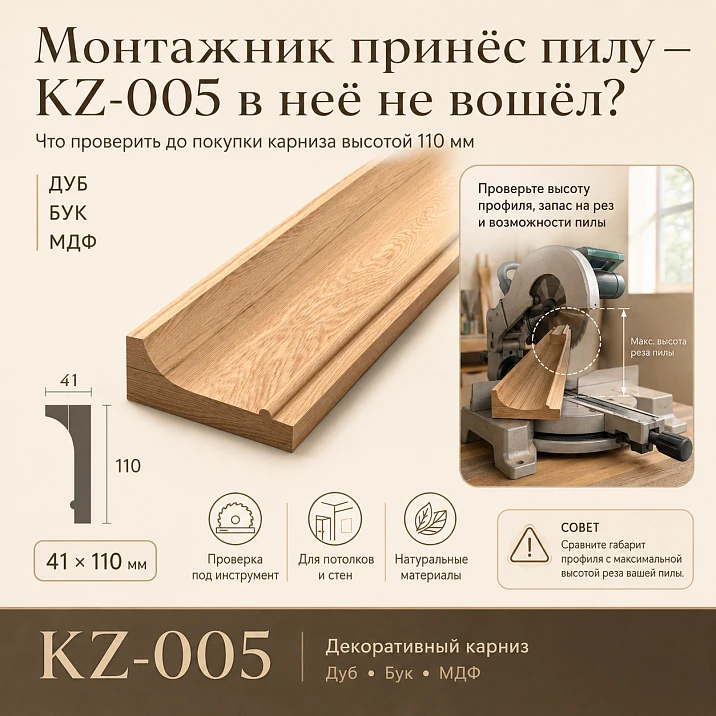
The cornice has already been chosen based on the pattern, material, and room scale. The 110 mm height supports the high ceiling, the top line of door portals, and the large baseboard well. The moldings have been delivered, the packaging is opened, the installer places the first piece against the stop of the miter saw—and work stops before even the first corner. The blade doesn't cover the profile in one pass. The standing position doesn't fit by height, the lying position is limited by the cut width, the guard hits the workpiece, and when the table is turned 45 degrees, the work area becomes even smaller.
Then often the most expensive action happens: the craftsman tries to finish cutting KZ-005 from the reverse side. The first cut line ends inside the cross-section, the molding is flipped, the marks are realigned, and the blade is run toward the first cut. A barely noticeable step appears on the end. On a straight section, it could be sanded down, but in a corner, two complex surfaces must meet mirror-perfectly. The step turns into a gap, the profile doesn't match in relief, and the outer edge gets a chip. To fix the corner, the molding has to be shortened. After the second attempt, the cutting plan for the entire room is disrupted.
By this point, the buyer has already spent not only on the cornice. The estimate included long-length delivery, packaging, finishing, the master's work, and room preparation. However, the most important check — whether a specific saw can properly process a 110 mm high profile — remained outside the order.
KZ-005 cannot be chosen by eye alone. Before you buy the KZ-005 ceiling cornice with a height of 110 mm, you need to check not the abstract "tool power," but the actual position of the profile on the bed, the height at the rear stop, the width of the workpiece in a horizontal position, the working stroke of the blade at 90 and 45 degrees, the height of the guard, the possibility of reliable fixation, and the quality of a test cut on the same material.
This article is not about buying a miter saw or rating tools. Its task is to preserve KZ-005, the budget, and installation deadlines. We will analyze the confirmed dimensions of the cornice, create a passport for the control cut, show what questions to ask the installer, why one blade diameter is not enough, when a professional workshop is needed, and how to include the risk of cutting in the calculation of the number of planks.
Short answer: what to check before ordering KZ-005
Before paying for the entire batch, you need to pass seven checks.
-
Choose the exact version of KZ-005: MDF 110 × 40 × 2600 mm or beech or oak 110 × 41 × 2400 mm.
-
Get the model and technical parameters of the installer's miter saw.
-
Check the working size not only for a straight cut, but also when rotating the table at 45 degrees.
-
Determine the position of the cornice on the bed: vertically against the stop or horizontally.
-
Make a cross-section template of 110 × 40 or 110 × 41 mm and apply it to the work area.
-
Perform a test cut on actual material or a technological offcut.
-
Only after a successful dry assembly of the corner, order and finish the entire batch.
If the saw does not cover the profile in one continuous pass, a counter cut after flipping the plank cannot be considered standard technology. Without special tooling, it is difficult to align two lines in the same plane. For an expensive painted cornice, oak for tinting, or a room with several external corners, it is wiser to find a workshop with suitable equipment in advance rather than turning the first plank into test material.




Confirmed dimensions KZ-005
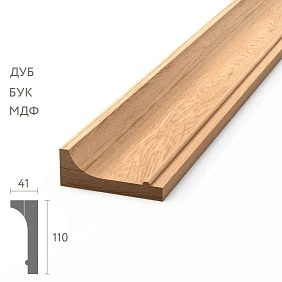
In the tool calculation, different versions must not be mixed. The height is the same for all variants — 110 mm, but the width and length depend on the material.
| Version KZ-005 | Cross-section, mm | Length, mm | Confirmed preparation | What to check before cutting |
|---|---|---|---|---|
| MDF | 110 × 40 | 2600 | For enamel | Edge cleanliness, support for long planks, cutting width in the lying position |
| Beech | 110 × 41 | 2400 | The preparation option is checked in the card | Fiber direction, chips, disc sharpness |
| Oak | 110 × 41 | 2400 | For tinting according to the card | Cleanliness of the visible end, repeatability of mirror cuts |
| All options | Height 110 | Depends on material | Prestige sanding | Possibility of one continuous cut |
At the time of checking, the card shows MDF, beech, and oak, with 'Prestige' sanding quality, as well as packaging conditions for long-length products. Price, availability, lead times, and stock levels change, so they are verified immediately before ordering.
The size of 110 mm is not the only figure compared with the tool. The profile is not a flat board. With an angled cut, its position, table rotation, and blade tilt change the geometry of the working area. A saw that cuts a workpiece 110 mm high at 90 degrees may not handle the same cross-section at 45 degrees.
Our factory also produces:
Why a tall cornice is harder than a small strip
KZ-005 combines four properties at once that raise the requirements for the equipment.
Get Consultation
Height 110 mm
The profile falls into a range that not every miter saw covers in the vertical position.
Length 2400–2600 mm
A long strip creates leverage. Without side supports, it pulls the workpiece down, lifts it off the table, and changes its position during the cut.
Pronounced front side
The cornice must continue around the corner without a step. Any chip or dip on the end is visible in the top line of the room.
Mirror joints
For an internal or external corner, two parts are needed, machined in opposite directions but with the same geometry. An orientation error destroys the useful length.
A small smooth batten can be corrected by sanding. On KZ-005 this approach is dangerous: manual finishing of one part of the relief disrupts the match with the mating part.
Why the question "Does the saw cut 110 mm?" is posed incorrectly
The tool's data sheet usually contains several maximum dimensions. A person sees a number greater than 110 mm and considers the check complete. But the maximum value refers to a specific configuration.
Need to clarify:
-
cut size at a turntable angle of 0 degrees;
-
size at 45 degrees;
-
size with the disc tilted;
-
presence of a pull function;
-
actual carriage travel;
-
position of the protective guard;
-
height of the rear stop;
-
allowable workpiece width;
-
restrictions when installing the clamp;
-
actual diameter of the installed blade;
-
degree of tooling wear.
Maximum height is not equal to maximum width
If KZ-005 is positioned vertically, the key dimension is the height of 110 mm. If the profile is laid horizontally, the blade must pass through a width of 40 or 41 mm, but the complex shape must lie stably and not be damaged on the face side.
Straight cut is not equal to angled cut
When the table is rotated, the blade passes through the workpiece diagonally. The working width increases, and the available height may decrease due to the saw design.
A new data sheet is not equal to the condition of the tool on site
Play in the rotary assembly, a dull blade, a deformed stop, or incorrect adjustment make the rated maximum meaningless for a clean angle.
The working position of KZ-005 determines the result.
Before a test cut, you need to understand how the profile will sit on the bed.
Vertically against the rear stop.
This position simulates the installation of a cornice and may be convenient for some angle schemes. But the 110 mm height imposes requirements on the blade and the guard.
Check:
-
whether the rear part rests against the stop;
-
whether the profile rocks;
-
whether the stop height is sufficient;
-
whether the guard clears;
-
whether a clamp can be installed;
-
does the relief not fall onto a narrow support point;
-
does the lower edge not shift.
Horizontally on the table
The cornice is laid with the wide side. For a straight cut, this option can simplify passing the height, but an angled cut requires sufficient cut width and stable support.
Check:
-
what surface lies on the table;
-
is the face edge not damaged;
-
is there a flat support area;
-
does the blade pass through the entire width;
-
can the position be repeated on the second part;
-
does the relief not interfere with the clamp.
Backing or special cradle
For complex profiles, a supporting bed is sometimes made that replicates the safe support geometry. It must not change the angle, spring, or get under the blade. The fixture is first tested on a scrap piece.
Template 110 × 40 or 110 × 41 mm before delivery
Before receiving the actual cornice, a rectangular template of full dimensions can be made.
For MDF:
110 × 40 mm.
For beech and oak:
110 × 41 mm.
The template is made from rigid cardboard, thin plywood, or another stable material. It does not replicate the relief or confirm cut quality, but shows physical compatibility with the work area.
What the template checks
-
whether the cross-section fits at the back stop;
-
whether the guard clears;
-
whether the height is sufficient;
-
whether the width is accessible;
-
whether a clamp can be installed;
-
does the guide rail interfere;
-
how does the position change at 45 degrees;
-
is there a safe zone for hands;
-
can a long plank be supported.
What the template does not check
-
MDF chipping;
-
oak fiber behavior;
-
enamel cleanliness;
-
match of the relief;
-
tool play;
-
disc quality;
-
the actual level of the end face.
Template — a preliminary filter. After it, a real sample is still needed.
A photo of the saw with a ruler is more useful than the model name
The same tool can be used with different blades, stops, and additional accessories. Therefore, before ordering, ask the installer to send photos.
Need shots:
-
General view of the machine.
-
Rear stop.
-
Table and swivel mechanism.
-
Blade in the lower position.
-
Work area with a vertical ruler.
-
Work area with horizontal ruler.
-
Position at 45 degrees.
-
Clamp and side supports.
-
Model nameplate.
-
Example of a clean cut of a similar high profile.
A photo does not replace a test cut, but quickly shows that the craftsman understands the task. An answer like "I have a professional miter saw, it will handle everything" without a working size is insufficient.
Test cut certificate
To ensure the agreement is not left in correspondence, create a short document.
| Field | Value |
| Product | KZ-005 |
| Material | MDF / beech / oak |
| Cross-section | 110 × 40 / 110 × 41 mm |
| Plank length | 2600 / 2400 mm |
| Saw model | ___ |
| Installed disk | ___ |
| Cut at 90° | confirmed / not |
| Cut at 45° | confirmed / not |
| Profile position | vertical / horizontal / in the bed |
| Has pull-through | Yes / no |
| Has clamp | Yes / no |
| Side supports | Yes / no |
| Reference sample | article / material / length |
| Straight cut made | date, result |
| Inner corner assembled | date, result |
| Outer corner assembled | date, result |
| Responsible for defects | ___ |
| Decision on batch | order / change technology |
Such a passport seems redundant only until the first spoiled oak plank. On a site with many corners, it saves money and time.
Control sample must match the material
A dimensional template can be made from cardboard, but the cleanliness of the end is checked on the material that will be used in the project.
MDF is tested on MDF
A homogeneous structure helps achieve a clean cut, but a coarse or dull blade can tear the edge. After enameling, the gray end and white chip are especially noticeable.
Beech is tested on beech
Dense wood requires steady feed.
Oak is tested on oak
Pronounced grain can chip at the blade exit. Under a clear finish, the defect cannot simply be covered with opaque putty.
A similar profile only confirms the geometry
A skirting offcut 110 mm high will show whether the blade passes through. But it does not confirm the match of the KZ-005 relief and the behavior of the chosen wood species.
The possibility of obtaining a short technical sample or ordering one control strip should be clarified with the manager. The card does not promise the sale of an arbitrary offcut or individual cutting to size.
First a straight cut, then an angle
Starting the check at 45 degrees is irrational. A straight end allows separating the quality of the disc from the adjustment of the rotary mechanism.
Checking the 90-degree cut
After the pass, inspect:
-
the entire plane of the end;
-
the disc exit;
-
the front edge;
-
the rear edge;
-
the presence of a step;
-
perpendicularity;
-
traces of vibration;
-
burn mark;
-
fiber tear-out;
-
line deviation.
Apply a square to several zones of the end face. Complex relief can hide a collapse that will only show up when joining.
Why make a second straight cut
Repeatability matters more than one lucky result. Two cuts in the same position show whether the saw is holding steady.
When to move on to the corner
Only if straight end faces come out clean and perpendicular without flipping the workpiece.
Why a tall profile cannot be cut from both sides
A separate STAVROS article on cutting tall MDF profile directly warns: when the tool does not cover the height in one pass, a counter double cut gives an uneven end face. Before working with KZ-005, it is useful to understand, Why a high profile cannot be finished from both sides.
The problem has several causes.
It is impossible to replicate a single plane
After flipping the bar, the new support surface changes position relative to the disc. Even a slight difference creates a step.
Marking has thickness
A pencil line or laser beam does not define an infinitely precise plane. The second cut may pass nearby.
The profile is asymmetric
Flipping KZ-005 changes the support. The front and back sides do not have to lie identically.
Play multiplies
The deviation of the turntable and disc occurs twice, but in different directions.
The step appears in the corner
Two parts form four potentially mismatched halves. Even if one end seems acceptable, the mirror pair reveals the defect.
Re-trimming steals length
To remove the step, you have to cut off a few more millimeters. The last plank may not have such a reserve.
Do not confuse flipping for another position with a double opposing cut
Sometimes a tall profile is indeed laid differently to make one full pass through a smaller width. This is not the same as cutting from both sides.
Acceptable logic:
-
choose a stable position;
-
fix it;
-
make one continuous pass;
-
repeat the position on the mirrored part.
Risky logic:
-
make an incomplete cut;
-
turn the workpiece over;
-
try to align the line;
-
join the two halves of the end face.
In the first case, the plane is created by a single pass of the disc. In the second, by two independent operations.
Internal corner as the main control point
After a straight cut, one internal corner is assembled from two short samples.
Why short samples specifically
They are easier to fix, do not create a long lever, and allow focusing on the accuracy of the machine. However, their cross-section and material must match the main batch.
What is assessed
-
correctness of left and right orientation;
-
coincidence of the top line;
-
coincidence of the bottom relief;
-
gap at the apex;
-
gap at the edges;
-
step on the front surface;
-
chips;
-
actual angle of the room;
-
need for adjustment of settings;
-
quality of dry fitting.
The corner of the wall is not always 90 degrees
Even a perfectly tuned saw will not assemble a tight joint if the building angle differs. The actual value is measured, divided between two pieces, and confirmed with a test cut.
Do not automatically transfer the setting to the entire room
Different corners of the same room may vary. The first test joint confirms the equipment but does not replace a map of the actual geometry.
Check the external corner separately
The external corner remains visible and reacts more strongly to chipping. The vertex should be sharp but not damaged.
The check includes:
-
two mirror cuts;
-
identical positioning of the strips;
-
full pass of the blade;
-
support for the exit edge;
-
sufficient useful length;
-
dry assembly;
-
inspection under side light;
-
solution for protection and finishing of the end face.
If the project contains at least one external corner, the statement "the internal one is assembled — so everything is ready" is incorrect.
Rotating the table by 45 degrees changes the working capability of the saw
Suppose the saw confidently makes a straight cut KZ-005 in a horizontal position. When the table is rotated, the trajectory through the rectangular dimensions becomes longer.
For a conditional rectangle with a width of 40 mm, the diagonal path is greater than the width itself. The real profile is more complex, and the position of the disc is limited by the design. Therefore, the rated maximum width at 0 degrees cannot be transferred to an angled cut.
Ask the installer to show:
-
cornice or template at 0 degrees;
-
the same template at 45 degrees to the left;
-
at 45 degrees to the right;
-
lower position of the disc;
-
clearance to the guard;
-
ability to press the part;
-
disc exit beyond the entire profile.
Disc tilt and table rotation are different movements
In conversation, both modes are called "cut at 45." But the mechanics differ.
Table rotation
The cut line changes in the horizontal plane. This forms the left or right end of the corner.
Disc tilt
The disc deviates from vertical. This results in a bevel across the thickness.
Combined cut
The table is turned, the disc is tilted. The tool's working capability decreases, and fixation becomes more difficult.
For the standard KZ-005 joint, it is necessary to accurately describe which mode is used. The word "forty-five" without specifying the plane is not a technology.
The disc diameter does not answer the main question
A large disc potentially increases the depth of cut, but the working capability is determined by the entire saw construction.
Limitations may include:
-
motor shaft;
-
guard;
-
table height;
-
stop form;
-
joint travel;
-
broaching;
-
depth stop;
-
clamp;
-
installed tooling.
Therefore, one cannot say: "for KZ-005 a disc of a specific diameter is mandatory." An overly precise universal recommendation of a model or diameter should be confirmed by a technological chart. It is much more reliable to check the actual full cut.
Disc for a clean cut: what to discuss with the installer
There is no need to turn an article about KZ-005 into a tooling catalog. It is enough to ask the right questions.
-
Is the disc intended for wood, MDF, or a clean crosscut?
-
How many teeth and what geometry?
-
How worn is it?
-
Is there any runout?
-
Does the installation direction match?
-
Does it cut cleanly on the exit edge?
-
Is there a test on the same material?
-
Does it overheat the wood?
-
Does it leave burn marks?
-
When was the blade last serviced?
The number of teeth is evaluated together with the diameter and purpose. An isolated number does not guarantee the result.
The pull-through helps with width, but does not solve everything
A saw with a carriage can guide the blade through a wider workpiece. For KZ-005, this is useful in the horizontal position and during angled cuts.
But the pull adds its own risks:
-
play in the guides;
-
line drift;
-
incorrect feed direction;
-
vibration;
-
pressure changes;
-
the need for a long, stable movement.
The check remains the same: one full cut on a real profile and a dry assembly.
Rear stop height and cornice fixation
If the profile is vertical, it needs sufficient support. A low stop supports only the lower part of KZ-005, and the upper part may deviate.
Possible solutions are designed by the master:
-
additional high stop;
-
rigid temporary panel;
-
special cradle;
-
clamp;
-
side supports.
The fixture must be secured and not interfere with the blade path. Do not hold a tall long profile by hand near the cutting zone.
Side supports for a plank 2400–2600 mm
Even an ideal saw will give an inaccurate cut if the long end sags.
The supports are set:
-
at table level;
-
on both sides;
-
without difference in height;
-
without wobbling;
-
so that the bar moves freely;
-
outside the disc path;
-
with protection of the front surface.
Why one assistant does not replace a support
A person changes the height of hands and pressure. During cutting, the bar can turn. A roller or stationary support provides repeatability.
Why the packaging frame is not used as a bed
Packaging protects transport but does not guarantee a flat working surface.
MDF 110 × 40 × 2600 mm: separate control
MDF profile is 200 mm longer than the solid wood. This affects support and cutting.
What to check
-
cleanliness of the front edge;
-
no tear-out at the exit;
-
condition of primer or enamel;
-
support along the length;
-
repeatability of the cut;
-
possibility to seal the end grain;
-
protection from moisture before installation.
Why pre-painted MDF is more demanding on tools
A chip reveals a contrasting core. Touching up the edge does not always hide the damaged relief line.
Why one test cut saves the finish
The test is done before painting the entire batch. If the blade or position is not suitable, the technology is changed without repairing the finished coating.
Beech 110 × 41 × 2400 mm: dense wood and clean geometry
Beech is often chosen for opaque finishes. The density of the material requires stable feed.
During the test, evaluate:
-
small chips;
-
tear-out at the exit;
-
perpendicularity;
-
heating;
-
clamping marks;
-
surface change after grinding;
-
the ability to process the left and right ends equally.
Enamel can unify color, but does not fix a step.
Oak 110 × 41 × 2400 mm: the most expensive training material
Oak is valued for its texture. Therefore, experimenting on the main plank is especially unwise.
Risks
-
chip along the grain;
-
difference between the end grain and the face surface;
-
noticeable repair insert;
-
loss of a plank from one batch;
-
impossibility to repeat the tinting;
-
need for a late reorder;
-
difference of the new batch.
Control sample
For oak, it is desirable to have a technological offcut of full cross-section. A test on beech does not confirm the behavior of oak fibers.
Reserve
If the project has several external corners and the tool is only partially confirmed, the reserve plank gets an economic justification.
Do not paint the entire batch before the control cut
Finishing seems like a logical stage before installation: long planks are convenient to paint in the workshop. But irreversible treatment before checking the equipment increases the cost of a mistake.
Reasonable sequence:
-
Obtain or fabricate a sample.
-
Check the straight cut.
-
Check the internal corner.
-
Check the external corner.
-
Secure the profile position.
-
Align the blade and tooling.
-
Resolve the end cutting technique.
-
Only then start the batch for finishing.
The final order depends on the coating. Sometimes primer is applied in advance, and the finish is done after installation. The key is not to turn a finished expensive surface into the first test for the saw.
The corner map matters more than the overall perimeter.
The number of KZ-005 slats depends not only on the length of the walls. Each corner carries a risk of trimming.
Create a report:
| № | Section | Length | Left end | Right end | Inner/outer corner | Risk |
| 1 | Wall A | ___ | Internal | Internal | 2 inner | Medium |
| 2 | Wall B | ___ | Internal | External | mixed | High |
| 3 | Return | ___ | External | Straight | 1 outer | High |
| 4 | Niche | ___ | Internal | Internal | several | High |
| 5 | Wall above the cabinet | ___ | Joint | Straight | No | Low |
After the table, slats are assigned to specific sections. A long leftover from a straight wall can become a control reserve, but short trims from a niche cannot.
How many slats to keep in reserve
A universal percentage does not work. KZ-005 is sold in whole slats, and the risk is related to corners and tools.
The reserve is assessed by matrix.
| Factor | Low risk | Medium risk | High risk |
| Tool | Verified on KZ-005 | Verified on similar profile | Not verified |
| Installer | Worked with article | Worked with high linear footage | No confirmed experience |
| Angles | Internal only | One external | Multiple external, bay window |
| Material | MDF without finish | Beech under enamel | Oak for tinting |
| Geometry | Rectangular room | Niche | Columns, returns, bevels |
| Logistics | Local warehouse | Repeat self-pickup | Far region |
| Remains | Has long reserve | Reserve is limited | No useful remainder |
An additional strip is rational when several factors are in the right column. In a simple room with a confirmed machine, it may be unnecessary.
Cost of the first corner error
The full cost of defects includes not only the price of the strip.
Cost of error = ruined KZ-005 + repacking + delivery + new finishing + master visit + delay of subsequent work.
Universal amounts cannot be assigned. Fill the table with your own data.
| Consumption | Value |
| Strip KZ-005 | ___ RUB |
| Packaging | ___ RUB |
| Delivery | ___ RUB |
| Re-finishing | ___ RUB |
| Additional visit | ___ RUB |
| Simple | ___ RUB |
| TOTAL | ___ RUB |
Now compare the result with the price of a control sample, rental of suitable equipment, or outsourcing cutting to a professional workshop.
When it is better to entrust trimming to specialists
A professional workshop is rational if:
-
the installer's saw is not certified;
-
KZ-005 is already painted;
-
oak is used;
-
there are several external corners;
-
there is a bay window or non-standard angles;
-
repeatability of a large batch is required;
-
the site is far from the warehouse;
-
reserve is limited;
-
the installer is not ready to take responsibility;
-
there is no safe place for the machine on the site;
-
dust and noise are unacceptable;
-
preliminary marking of all parts is needed.
STAVROS in the FAQ card does not promise individual cutting to size. Therefore, professional trimming and its conditions are agreed separately with the chosen contractor, not automatically included in the cornice order.
When KZ-005 is not suitable for self-installation
Refusal of self-installation is reasonable when there is no:
-
a miter saw with a confirmed working size;
-
stable supports;
-
clamp;
-
protractor;
-
control material;
-
experience with mirror cuts;
-
safe working area;
-
ability to fix the finish;
-
reserve;
-
assistant for long planks.
Buying an expensive profile should not become a training project for mastering the tool.
Comparison of KZ-005 and a smaller profile in terms of cutting
The website has a separate article that helps first choose the height of KZ-005 or KZ-007. After choosing the scale, another check begins — instrumental.
KZ-005 has a height of 110 mm. A more compact cornice is potentially easier to place in the work area, but you cannot replace the article just for the sake of the saw if the architectural proportion changes. Three solutions are possible:
-
Keep KZ-005 and find suitable equipment.
-
Change the technology using professional tooling.
-
Choose a different profile after a repeated visual inspection of the interior.
The right choice connects design and installation, rather than making one randomly subordinate to the other.
How not to confuse the instrumental check with the choice of cornice
The choice of cornice answers the questions
-
does the profile suit the interior;
-
does the height match the ceiling;
-
is MDF, beech, or oak needed;
-
how does KZ-005 combine with doors and baseboards;
-
how many slats are needed.
Tool check answers other questions
-
can the saw make one full cut;
-
in what position;
-
at what angle;
-
with what tooling;
-
how clean the end face will be;
-
who is responsible for defects.
Both checks are mandatory, but they cannot be substituted for each other.
What to buy together with KZ-005
| Position | Commercial task | What to check |
| View KZ-005 dimensions | Choose material and length | Cross-section, price, availability |
| view all ceiling cornices | Compare profile | Height, overhang, material |
| Control strip or sample | Check the saw | Order availability is being clarified |
| Spare plank | Close the risk of defects | Is it needed according to the matrix |
| Suitable blade | Make a clean cut | Compatibility with the saw and material |
| Side supports | Hold a long workpiece | Table level |
| Clamp | Exclude offset | Safety for relief |
| Protractor | Measure actual angle | Accuracy and calibration |
| Materials for installing wooden cornice | Prepare glue and finish | Compatibility with the base |
| Protection of ends | Close the cut | Coating system |
The table does not mean that all positions are sold in the KZ-005 card or included in the kit. It shows what resources the buyer should prepare.
Materials for installation are selected after the corners
First, you need to prove that the profile can be cut accurately. Then choose the adhesive, primer, and finish. In the catalog, you can select adhesive for KZ-005, but compatibility is checked against the wall and cornice material.
Why is this order important? If the corners do not fit, the installation compound will not fix the geometry. The adhesive will hold the gap in the form left by the saw.
Dry fitting before adhesive
The cut pieces are first assembled without final fixation.
Check:
-
position on the wall;
-
internal corners;
-
external corners;
-
joints;
-
line along the ceiling;
-
match of the relief;
-
length;
-
adjacent to doors;
-
useful leftovers;
-
numbering order.
If an error is detected, the part can still be adjusted without destroying the adhesive joint and wall finish.
Numbering of slats and mirror parts
After the control angle, a map is compiled.
Example labeling:
-
A-L — left part of wall A;
-
A-R — right;
-
B-L;
-
B-R;
-
VN-1 — internal angle;
-
VSh-1 — external;
-
R-1 — reserve;
-
O-1 — useful remainder.
Marking protects against the most annoying mistake: a correctly cut left part st
Mistakes that cause the first plank to go to waste
Looking only at the disc diameter
The machine's design may limit the travel.
Comparing 110 mm with a single specification number
The angled mode differs from the straight one.
Not accounting for the width of 40 or 41 mm
In the lying position, it becomes part of the trajectory.
Not checking 45 degrees
A straight cut does not yet confirm the angle.
Start with the main oak plank
Oak should not be used as test material.
Cut towards from the other side
A step appears.
Change the orientation of adjacent pieces
The grain and mirrored cuts no longer match.
Cut the entire room without a dry fit
One systematic error repeats at all corners.
Assume walls are perfectly straight
Actual degrees differ.
Paint before testing
Finish repair increases labor costs.
Do not support length
The strip shifts and tilts the end.
Hold by hand instead of using a clamp
Position is non-repeatable and unsafe.
Do not assign reserve
Complex object stops after one defect.
Order array later
The party may differ.
Do not fix responsibility
The dispute begins after damage.
Who KZ-005 suits
The cornice is rational if:
-
height 110 mm matches the interior;
-
there is suitable equipment;
-
the installer confirmed the angle cut;
-
a test sample can be made;
-
long slats are safely supported;
-
actual angles are measured;
-
material selected for finishing;
-
reserve calculated;
-
logistics prepared;
-
installation is not done "by eye".
When it's better to choose a different profile
Another cornice may be more practical if:
-
110 mm is too much for the room;
-
available tool cannot handle it;
-
professional trimming cannot be found;
-
the site does not allow machinery and dust;
-
external corner cannot be processed properly;
-
the budget does not include a reserve;
-
the stop height does not ensure fixation;
-
the skid path is not suitable;
-
the selected finish does not allow repairs;
-
the buyer plans self-installation without experience.
The decision to replace the profile is made after checking the design. You cannot choose a smaller cornice just because it fits into a random saw.
How to order KZ-005 on STAVROS
The commercial route is built as follows:
-
Open the product card and check the price of KZ-005.
-
Choose MDF, beech, or oak.
-
Fix the cross-section.
-
Calculate the planks along the walls and corners.
-
Select an installer.
-
Check the saw with a template.
-
Perform a test cut.
-
Assemble the inner corner.
-
Assemble the outer corner, if present.
-
Determine the reserve.
-
Agree on the finishing.
-
Prepare installation materials.
-
Check packaging and delivery.
-
Process the entire batch.
Purchase after a control cut appears slower than immediate add to cart. In practice, it reduces the likelihood of a second delivery.
Checklist before payment
-
SKU KZ-005 confirmed;
-
Material selected;
-
Cross-section 110 × 40 or 110 × 41 mm recorded;
-
Length 2600 or 2400 mm accounted for;
-
Number of planks calculated;
-
Angles applied to the plan;
-
Actual degrees measured;
-
Installer selected;
-
Saw model known;
-
Straight cut confirmed;
-
45-degree cut confirmed;
-
photo of work area received;
-
template attached;
-
control sample prepared;
-
disc checked;
-
clamp present;
-
side supports present;
-
profile position fixed;
-
inner corner assembled;
-
outer corner assembled;
-
double counter cut excluded;
-
Finishing agreed upon;
-
reserve calculated;
-
responsibility for defects is fixed;
-
delivery and storage are prepared.
End face diagnostics: what defect indicates what
A test cut is not for the sake of a photo. Its task is to show the cause of future defects before the main strips are marked. The inspection is carried out in good side light, on a clean surface, without trying to immediately mask flaws with sanding or primer.
Step in the middle of the end face
The main sign of a counter cut from two sides is that the two planes do not match. Sometimes the step is barely felt with a fingernail, but on a corner pair it becomes a visible line. Correction requires a new full pass with a suitable tool or a change of technology. Sanding down one half by eye is not allowed: the angle and geometry of the relief will change.
End face is even on top and opens up at the bottom
The cause may be a disc tilt, a non-perpendicular support, or movement of a tall strip during the pass. Check with a square not just one point, but the entire available plane. If the deviation repeats on two samples, the problem is systemic.
Small chips on the front edge
Chips indicate an unsuitable or dull blade, incorrect tooth exit direction, vibration, or too fast a feed rate. For MDF under enamel, they create a contrasting edge; for oak, they destroy the natural fiber. Not only the speed needs to be changed, but also the tooling, fixation, and position of the face side.
Burn mark and dark stripe
A burn mark appears with a dull blade, slow movement combined with strong friction, misalignment, or dirty tooling. On oak, the mark may go deeper than the surface. It cannot be considered a normal part of cross-cutting.
Wavy line
The wave is related to play, vibration, shifting of a long plank, or uneven pull motion. When joining two parts, such an end creates alternating gaps.
Angle matches on the table but diverges on the wall
If the test pair is tight on a flat surface but opens up on the site, check the actual wall angle, flatness of the base, and the position of KZ-005 in space. Not every gap is caused by the saw.
| Defect | Likely cause | Next action |
| Step in the middle | Double counter cut | Exclude flipping, make one full pass |
| End face collapse | Incorrect support or adjustment | Check with square, stop and fixation |
| Chips | Disc, vibration, feed | Change tooling or mode, repeat test |
| Burn mark | Friction, dulling, misalignment | Check the disc and trajectory |
| Wave | Play or movement of the workpiece | Check the broach, clamp, supports |
| Gap only on the wall | Room geometry | Measure the actual angle and planes |
After diagnostics, a new sample is made. The technology cannot be accepted on the principle of 'no one will notice on the ceiling.' Side light at the top line, especially near windows and lighting, emphasizes steps more than inspection on the workbench.
Check the first production plank
Control trims confirm the technology, but a long plank of 2400 or 2600 mm behaves differently. Before cutting the entire room, one piece with a clear purpose is selected and the first production cycle is completed fully.
Which section to choose
Don't start with the longest wall and don't take a single piece for an external corner. Better to choose a medium-length section with an internal corner, where there will be a useful reserve for re-fitting.
What is fixed before cutting
-
plank number;
-
original length;
-
material;
-
front side;
-
top and bottom;
-
left and right ends;
-
actual angle;
-
position on the bed;
-
saw setting;
-
allowance for fitting.
What is checked after cutting
First, measure the remaining length. Then, fit the piece to the area without adhesive, checking profile alignment, level, and contact with the base. If the first production unit required unexpectedly large adjustments, revise the cutting plan before working with the remaining strips.
Why the first piece should not be a spare
The spare must remain untouched until the primary technique is confirmed. If used for the first trial, the object will again be left without a safety net.
Four scenarios where risk varies
The same height of KZ-005 does not mean the same installation complexity. The angle map and site conditions change decisions about the contractor, sample, and spare.
Rectangular bedroom without external corners
Four internal corners, flat walls, MDF under enamel, installation before final painting. Risk is relatively moderate. Confirmed corner cuts, precise measurements, and a useful remainder are needed. A whole extra strip is not automatically assigned if the cutting leaves a full spare.
Living room with a column and short returns
The column creates four external corners and short pieces. Each directional error quickly destroys the workpiece. Here, a control external corner is mandatory, part numbering becomes critical, and the spare strip gets a real purpose.
Hall with oak KZ-005 under tinting
The material is expensive, the texture is open, and light passes along the cornice. A late additional order may differ in pattern. For such a project, the cut is first approved on an oak sample, then the batch and reserve are ordered simultaneously, and trimming is handed over to a specialist at the slightest doubt in the installer's saw.
Kitchen with a cornice above the cabinets
Corners can be simpler, but joints appear above furniture sections, access is limited, and the planks need to be tied to the cabinets. The long profile must be laid out so that connections fall into the design locations. Checking the saw remains mandatory, but the cutting map is built together with the furniture drawing.
Decision on the reserve in specific numbers
Suppose the room requires six planks according to the cutting map. There are two external corners, three short returns, and one niche. The installer showed a similar profile, but has not cut KZ-005 yet. The site is in another city.
In such a situation, a percentage margin explains little. Three practical questions need to be asked.
What error will the seventh plank cover? It should allow replacing a long piece with an external corner, not just provide a set of short offcuts.
Does the additional plank create a new packaging unit? Packaging conditions are confirmed when ordering. Sometimes the reserve fits into the existing standard, sometimes it changes logistics.
How much does a repeat delivery cost? They compare not only the product price, but also packaging, delivery, finishing, and the master's visit.
For a simple room with four internal corners, a checked saw, and a long useful remainder, the decision may be the opposite: an additional full plank is not needed. The article does not sell a reserve at any cost; it helps assign it meaningfully.
Object readiness matrix for purchase
Before clicking the order button, evaluate four directions. Green status means the data is confirmed. Yellow means additional control is needed. Red means it's too early to buy the entire batch.
| Direction | Green | Yellow | Red |
| Profile | Material and size selected | Choice between MDF and solid wood | Size not confirmed |
| Tool | Full cut KZ-005 completed | Template or similar profile checked | There is only the master's promise |
| Angles | Measured, samples collected | One control angle measured | Angles are considered equal to 90° without checking |
| Finishing | Technology agreed upon | There is a general idea | Batch already painted before test |
| Reserve | Has a specific purpose | Decision not made | Order without cutting map |
| Responsibility | Recorded | Discussed verbally | No one is responsible for defects |
| Logistics | Delivery and storage are prepared | There are unconfirmed areas | The bar may not pass to the site |
One red indicator does not always force a rejection of KZ-005, but requires closing the issue before purchasing the entire batch.
What to check in the product card on the day of order
Even a ready-made installation diagram does not cancel the final verification of the card.
Check:
-
main URL KZ-005;
-
available materials;
-
exact cross-section;
-
length;
-
sanding quality;
-
preparation for finishing;
-
price;
-
availability;
-
production time;
-
packaging conditions;
-
possibility to order the required quantity;
-
delivery information.
Do not transfer the saved price or stock balance from the old screenshot. These data change. For a general understanding of profiles and purposes, it is useful to read, how to choose a wooden curtain rod by size and purpose, but the article number, material, and current conditions are confirmed in the KZ-005 card.
Control before launching the entire batch
The batch is allowed for cutting when all conditions are met:
-
A clean straight end face was obtained on the actual material.
-
One continuous cut covers the full cross-section.
-
The left and right parts of the inner corner matched.
-
The outer corner is checked if it is present in the project.
-
The position of KZ-005 on the bed is fixed by a photo or diagram.
-
The long strip is supported at the table level.
-
The actual angles are recorded in the list.
-
The strips are numbered.
-
The reserve is not spent on random short parts.
-
The finishing cycle accounts for end cuts and possible correction.
-
Responsibility for defects has been agreed upon.
-
The cutting plan has been updated based on the results of the first serial unit.
Only now does work speed become an advantage. Before this, fast cutting only multiplies a single error faster.
Acceptance of corners after installation
Even an approved reference sample does not cancel final acceptance. After installation, inspect KZ-005 not only from the ladder up close, but also from the usual entry point into the room. The top line is perceived as a whole, so a locally neat end may become noticeable due to a step relative to the adjacent plank.
The inspection is carried out under daylight and artificial lighting. Side light reveals plane differences, frontal light reveals gaps and shade differences at the ends. At external corners, the sharpness of the vertex and the absence of chips are assessed. At internal corners, the tightness of the joint along the entire height of 110 mm is checked. At length joints, it is checked whether a shadow from the collapse of one end has appeared.
Before signing off on the work, record:
-
profile match;
-
an even top line;
-
absence of a counter step;
-
same installation depth;
-
quality of end touch-up;
-
integrity of enamel or tinting;
-
absence of pressure marks;
-
preservation of reserve remnants;
-
marking of the remaining plank;
-
location of its horizontal storage.
The useful remnant is not thrown away immediately. A piece of the same article and batch will be useful for local repairs, testing future paint, or making a small replacement. On it, the material, article KZ-005, order date, and applied coating are labeled. Such a simple note in a few years will be more useful than a photo without dimensions and batch number.
FAQ: KZ-005, miter saw, and control cut
What dimensions does KZ-005 have?
MDF — 110 × 40 × 2600 mm. Beech and oak — 110 × 41 × 2400 mm.
Is the size the same for MDF, beech, and oak?
The height is the same — 110 mm. The width of MDF is 40 mm, of solid wood — 41 mm. The length also differs.
Will a regular miter saw work?
It cannot be answered based on the word "regular." You need to check the working size of the specific machine at 90 and 45 degrees.
How to find out the maximum cutting height?
From the tool's manual and a real test with a template or sample. The rated figure is checked in the required configuration.
Is it enough to know the blade diameter?
No. The travel is limited by the guard, hinge, stop, slide, and workpiece position.
Is a sliding saw needed?
It can help in a horizontal position and on a wide cut, but by itself it does not guarantee accuracy.
Can the cornice be cut from the other side?
A counter double cut creates a risk of a step and misalignment of planes. For KZ-005 corners, this method cannot be considered reliable.
Why does a step appear after a double cut?
After flipping, the support, position, and blade line change. The two halves of the cut do not match.
Which blade should be used for MDF?
The blade must be designed for a clean crosscut of MDF or wood materials and fit the specific saw. The result is confirmed by a test cut.
How to test an oak KZ-005?
Perform a cut on a full-section oak sample, inspect the fibers, and assemble the corner before finishing the batch.
Is it necessary to order one strip for a test?
Not always. You can specify a short sample or a technological offcut. If they are not available, a control strip may be reasonable for a complex object.
When to perform painting?
After confirming the cutting technology and control angles. The specific cycle depends on the coating.
How many strips to keep in reserve?
The quantity is determined by angles, installer experience, tools, material, logistics, and useful leftovers.
Who is responsible for a cutting error?
Responsibility is fixed before work begins in the estimate, contract, or correspondence.
Can professional trimming be ordered from STAVROS?
The site's card and FAQ do not promise individual cutting to size. The service and contractor must be agreed upon separately.
Where to buy KZ-005?
In the confirmed STAVROS card, after selecting the material and checking the installation technology.
Can you check the saw with a cardboard template?
Yes, for the overall size. It does not show the edge quality.
Is one straight cut enough?
No. You need to check repeatability and the angular pair.
How to understand that the end is collapsed?
Apply a precise square and connect two control samples. A gap or step will show the deviation.
Is it necessary to measure every angle?
For a quality result — yes, especially in old or complex rooms.
Can the KZ-005 be cut with a hand saw?
Theoretically, individual operations are possible with guidance and experience, but achieving repeatable high-profile mirror angles is difficult. The technology is confirmed with a sample.
Can a miter box be used?
Most standard miter boxes are not designed for a profile height of 110 mm. You need a fixture that accommodates the full cross-section without distortion.
What matters more: the saw model or a test cut?
A test cut. The model name does not show the blade condition, play, or actual adjustment.
Is it necessary to support the plank on both sides?
Yes, a long piece must rest on supports at the level of the bed, otherwise its weight changes the position.
What to do if KZ-005 has already been delivered, but the saw is not suitable?
Do not cut the main batch. Find suitable equipment, prepare a sample, and re-approve the control angle.
Can a smaller cornice be chosen instead of KZ-005?
It can be done after checking the interior and proportions. Replacing it just for the sake of the available saw may worsen the design.
Why is an external corner more difficult than an internal one?
Its apex is exposed to view, and a chip or mismatch is immediately noticeable.
Is a dry fit necessary?
Yes. It reveals errors before glue and final finishing.
Where can I see other profiles?
In the category you can compare KZ cornice sizes and then check the tool for the selected cross-section.
Final conclusion: the cornice must fit not only into the interior but also into the work area.
KZ-005 is chosen for its scale. The 110 mm height provides a strong top line, linking the ceiling, doors, and large architectural details. But this expressiveness comes at a cost to preparation. The profile must not just fit between the wall and ceiling—it must sit stably on the bed, pass under the blade in one continuous cut, and mirror the geometry on the second piece.
Before ordering, don't ask the installer: "Do you have a good saw?" Ask differently: "What full size does it cut at 45 degrees, in what position will KZ-005 be, and where is the control sample?" Make a template 110 × 40 or 110 × 41 mm, check the square end, assemble the internal and external corner, fix responsibility, and only then send the batch to finishing.
STAVROS company offers KZ-005 from MDF, beech, and oak, a category of ceiling cornices, installation materials, and expert articles about moldings. Use these pages as a single route: choose a profile, confirm dimensions, check equipment, calculate the reserve, and place an order without the risk of losing the first plank on the first corner.