Article Contents:
- How KZ-005 differs from KZ-007
- What a ceiling cornice does in an interior
- When to buy a high cornice KZ-005
- For high ceilings
- For a formal living room
- For a hall and stair space
- For an interior with a high baseboard
- For oak trim
- When KZ-005 may be excessive
- For a medium-sized living room
- For Office
- for the bedroom
- For modern classic
- For a room with a medium-height ceiling
- When KZ-007 may get lost
- MDF under enamel
- Beech for enamel
- Oak for tinting
- Why the plank length shouldn't be the only deciding factor
- Cornice and ceiling plinth
- Ceiling cornice and curtain rod
- Profiled and carved cornice
- Furniture and ceiling cornice
- Molding and cornice
- Formal living room with high doors
- Ordinary living room in an apartment
- Bedroom with a high headboard
- Study with a library
- Dining Room
- Hallway
- Staircase hall
- Commercial interior
- Classic Interior
- English study
- Minimalist interior with a classic detail
- Interior with natural wood
- Choosing Only by Photo
- Consider a difference of 10–15 mm insignificant
- Buying KZ-005 for a small room without checking
- Choosing KZ-007 for a grand hall just because it is more versatile
- Confusing a profiled cornice with separate carved decor
- Not considering the different lengths of slats
- Dividing the perimeter by the length without layout
- Starting installation from a crooked corner
- Gluing onto weak paint
- Relying only on adhesive for any substrate
- Not making a test cut
- Painting oak without a test coat
- Placing a joint directly on an external corner
- Not accounting for cabinets up to the ceiling
- Ordering the exact perimeter without allowance
- Which cornice is higher — KZ-005 or KZ-007?
- How noticeable is the difference of 10–15 mm?
- Which cornice is suitable for a high ceiling?
- Which profile to choose for a bedroom?
- What is the size of KZ-005 made of MDF?
- What is the size of KZ-005 made of beech or oak?
- What is the size of KZ-007 made of MDF?
- What is the size of KZ-007 made of beech or oak?
- What to choose for white enamel?
- What should I choose for natural staining?
- Can KZ-005 be called a carved cornice?
- Does KZ-007 match the request for a 100 mm ceiling cornice?
- What is the length of the planks?
- How to calculate the quantity?
- Can the leftovers be used on the adjacent wall?
- Do I need to order samples?
- What Adhesive to Use?
- Is one glue enough?
- Can I glue it on a painted wall?
- How to design a corner if it is not 90 degrees?
- Where is the best place to position the joint?
- Can I install the cornice after the furniture?
- Which cornice visually lowers the ceiling the least?
- Where can I see other wooden cornices?
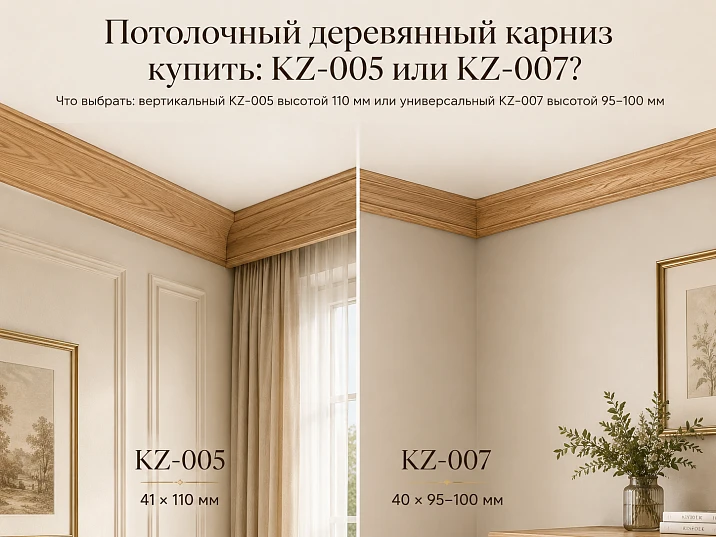
You can buy a ceiling wooden cornice in a few minutes, but correcting a scale error after installation will take much longer. The profile runs along the entire perimeter of the room, so even a difference of 10–15 mm has a greater impact than it seems from a small photo. The tall KZ-005 forms a strong top line, emphasizes the verticals of doors and pilasters, and noticeably participates in the room's architecture. KZ-007 retains a large classical character but looks lighter and calmer: it is easier to combine with a medium-sized room, standard doors, and a moderate floor plinth.
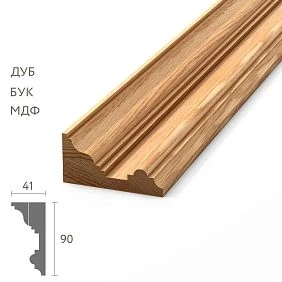
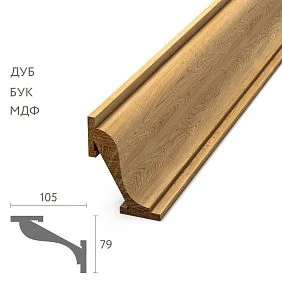
Both models are produced from MDF, beech, and oak. For KZ-005, the dimensions are confirmed as 110 × 40 × 2600 mm in MDF and 110 × 41 × 2400 mm in beech or oak. For KZ-007, the size depends more on the material: MDF has a cross-section of 100 × 40 mm and a length of 2600 mm, while solid beech or oak has 95 × 40 mm and a length of 2400 mm. Therefore, the buyer chooses not only between two profile designs. They simultaneously determine the height of the top line, the number of joints, the material, the finish, and how noticeable the transition from wall to ceiling will be.
KZ-005 is suitable for formal interiors, spacious living rooms, halls, dining rooms with high doors, and spaces where the cornice should be perceived as an independent architectural detail. KZ-007 is appropriate for living rooms, studies, bedrooms, or dining rooms of medium to large scale when a large cornice is needed without excessive heaviness. The difference between profiles does not mean one is better than the other. A mistake occurs only when the dominant KZ-005 is installed in a cramped room without support from other elements, or conversely, when KZ-007 is chosen for a large formal space where it gets lost next to high portals and massive baseboards.
Below is a breakdown of which specific cornice to order, how heights of 110 and 95–100 mm change the perception of the ceiling, how MDF differs from beech and oak, how to calculate the number of planks 2400 or 2600 mm long, where to place joints, how to design internal and external corners, and why you should view the OMLD-005 sample set before placing a large order. The practical part does not replace the installation project: the fastening method depends on the weight of the selected material, the base of the wall and ceiling, the geometry of the room, and the permissibility of additional mechanical fixation.
Short answer.
KZ-005 and KZ-007 are large ceiling cornices made of MDF, beech, or oak. KZ-005 has a height of 110 mm and creates a stronger architectural dominant. KZ-007 has a height of 100 mm in MDF and 95 mm in solid wood, making it look slightly lighter and more versatile. For spacious formal rooms, high ceilings, and large door portals, choose KZ-005. For living rooms, studies, bedrooms, or dining rooms of moderate scale, KZ-007 is often more suitable. Before ordering, be sure to compare actual samples near the ceiling and calculate the length considering corners, joints, and trimming.
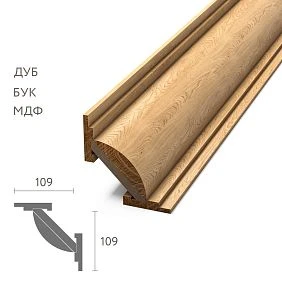
How KZ-005 differs from KZ-007
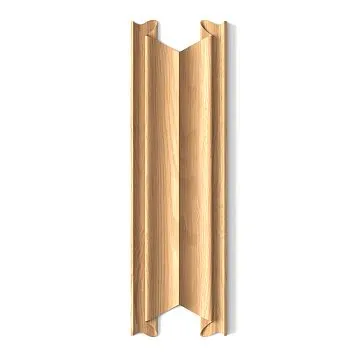
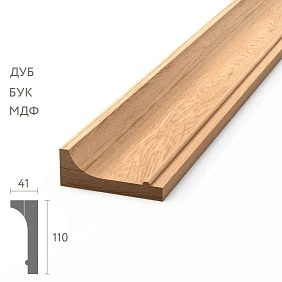
The main difference between the models is the height of the visible vertical. KZ-005 maintains a height of 110 mm in all materials. MDF has a width of 40 mm and a length of 2600 mm, beech and oak have a width of 41 mm and a length of 2400 mm. The cornice is elongated upward and is clearly visible on the wall. It forms an expressive strip under the ceiling and can support high doors, massive architraves, pilasters, wall panels, and wide floor baseboards.
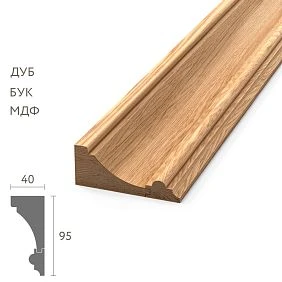
KZ-007 is slightly more compact. In MDF, its height is 100 mm, in beech and oak — 95 mm. The profile width is 40 mm, the plank length is 2600 mm for MDF and 2400 mm for solid wood. On a sample, the difference of 10 or 15 mm seems small. Around the perimeter of the room, it turns into a calmer upper frame: more of the visible wall plane remains, the cornice presses less on the ceiling, and it combines more easily with medium-scale furniture.
Both models belong to large profiles. KZ-007 cannot be considered a small fillet, and KZ-005 is not exclusively a palace decor. The choice depends on the context. In a room with a high ceiling and two-meter doors, KZ-005 may look natural. In a room with a low ceiling and small windows, the same profile can visually take up too much wall space. KZ-007 offers more freedom, but in a spacious hall, it may require support from other elements so that the top line does not appear insufficiently expressive.
The calculation of the number of planks also differs. The material determines the length: MDF — 2600 mm, beech and oak — 2400 mm. On the same perimeter, the MDF option may result in fewer joints. However, length should not be the sole reason for choosing. Oak for tinting creates a natural texture, beech and MDF for enamel create a smooth painted surface. First, choose the visual result and material, then optimize the cutting.
| Criterion | KZ-005 | KZ-007 |
|---|---|---|
| MDF | 110 × 40 × 2600 mm | 100 × 40 × 2600 mm |
| Beech and oak | 110 × 41 × 2400 mm | 95 × 40 × 2400 mm |
| Military symbolism, ancient motifs | MDF, beech, oak | MDF, beech, oak |
| Sanding | «Prestige» | «Prestige» |
| MDF and beech | Primarily for enamel | Primarily for enamel |
| Oak | For tinting while preserving texture | For tinting while preserving texture |
| Character | Tall, vertically elongated, dominant | Large, but more balanced |
| Best scenario | Formal living room, hall, high ceiling | Living room, study, bedroom, dining room |
| Samples | Set OMLD-005 | Set OMLD-005 |
| Installation | Glue and additional fixing per project | Glue and additional fixing per project |




What a ceiling cornice does in an interior
A ceiling cornice covers the transition between wall and ceiling, but its role goes beyond simply masking the joint. The profile creates a continuous horizontal line, unites walls into one architectural system, and sets the upper boundary of the finish. If a floor baseboard gathers the interior from below, the cornice completes it from above. The higher the profile, the stronger this frame influences the perception of the room.
The cornice helps hide minor visual irregularities at the junction but is not intended to compensate for serious curvature. A wavy wall or uneven ceiling will cause the rigid strip to pull away from the base, and attempting to force it into place will create tension. Before purchasing, it is necessary to check the geometry of the perimeter, especially in an old house and after rough renovation.
In a classic interior, the cornice connects doors, baseboards, molding frames, and the ceiling rosette. In modern classic style, it can be the only profiled element and work against a backdrop of smooth walls. In a study, a wooden cornice supports the library and panels. In a dining room, it completes the vertical line above the sideboard. In a bedroom, it softens the transition to the ceiling but should not visually lower it above a large headboard.
The height of KZ-005 or KZ-007 is perceived not in isolation but next to the door. If the casing is tall and wide, a thin profile gets lost. If the door is compact, a too-large cornice begins to be perceived as a separate heavy belt. The same applies to the floor baseboard: the upper and lower lines do not have to be identical but should belong to the same scale.
The cornice also affects light and shadow. The profile has a projection of about 40–41 mm, so side light creates shadows on the curves. In daylight, the pattern may be soft; in the evening under ceiling lights, it may be more contrasting. The sample should be viewed in the conditions in which the room is most often used.
Our factory also produces:
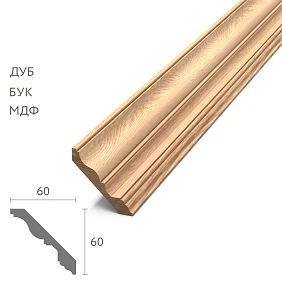
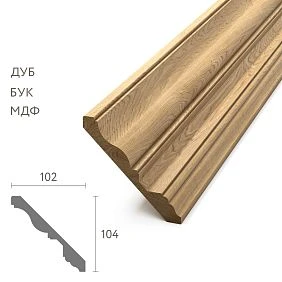
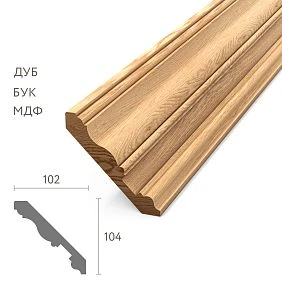
When to buy a tall cornice KZ-005
Get Consultation
For a high ceiling
KZ-005, 110 mm high, works well in a room where the top line should be readable from a distance. A high ceiling creates a lot of free wall space, and a small profile can get lost. KZ-005 occupies enough height to connect the ceiling with door portals and large furniture.
The very concept of a "high ceiling" depends on the area and proportions of the room. A narrow corridor with increased height is perceived differently than a spacious living room. Therefore, KZ-005 cannot be assigned based on a single number. You need to look at the entire volume and the distance to the opposite wall.
For a formal living room
In a formal living room, the cornice can become part of a system with pilasters, moldings, tall doors, and a wide baseboard. Here buy wooden cornice KZ-005 is worth it when the upper border should not get lost next to other large details.
If the walls remain completely smooth, KZ-005 can still work, but its height needs to be supported by the scale of the furniture. A low sofa, small paintings, and a thin baseboard will create a disconnect. The solution is not fixed by adding random decor, but by aligning all the main lines at the design stage.
For the hall and stair space
Halls and staircases often have increased height and long perspectives. The cornice is viewed from below and at an angle, so a large profile looks more convincing. KZ-005 maintains readability at a distance and can unify several walls around the stair opening.
In complex geometry, the number of internal and external corners increases. The 110 mm profile requires precise cutting and pre-layout. An error on an external corner is more noticeable than on a small cornice.
For an interior with a high baseboard
If the floor baseboard is large and noticeable, the top line should have sufficient weight. KZ-005 creates balance, especially with high door casings. This does not mean the sizes must match. The overall persuasiveness of the architectural frame is important.
Before ordering, it is useful to temporarily mark the height of 110 mm with painter's tape along the top of the wall. Such a mockup does not convey the depth of the profile, but shows how much area the cornice will occupy.
For oak finish
Profiled oak cornice suits an interior where the natural grain should remain visible. Tinting can tie the cornice to doors, panels, furniture, and the floor baseboard. At a height of 110 mm, the oak texture reads well enough.
It is not necessary to paint all wooden elements in exactly the same color. Natural wood has variability. It is important to coordinate the overall temperature of the shade and the degree of gloss, and before ordering a large footage, look at a sample.
When KZ-005 can be excessive
In a small bedroom, narrow room, or room with low doors, KZ-005 can take up too much wall space. This is especially noticeable with contrasting paint. If the cornice is white and the wall is dark, the 110 mm height reads as a wide light stripe and can visually reduce the vertical.
In such a situation, KZ-007 more often gives a calmer result. The buyer does not lose the classic profile but reduces the pressure of the top line.
When to choose the universal KZ-007
For a medium-sized living room
KZ-007 with a height of 95–100 mm remains large but does not require a grand space. It pairs well with an ordinary living room that has a sofa, cabinets, standard-sized doors, and a moderate floor plinth. The profile is noticeable but does not become the main object.
The MDF version with a height of 100 mm is especially convenient for enamel. It creates a smooth top line and can be painted in the color of the ceiling or walls. The solid version at 95 mm looks slightly lighter and suits tinted oak or beech for painting.
For a study
In a study, the cornice should support the library, desk, and doors without distracting from the work area. KZ-007 forms an architectural finish and pairs well with wooden furniture. The oak version can be tied to shelves and countertops, the painted one to panels or the wall.
In a small study, KZ-005 can be too active, especially if the ceiling is not high. KZ-007 leaves more air between the furniture and the ceiling.
For the bedroom
The bedroom requires a calm upper contour. Buy wooden cornice KZ-007 can be used for a room where a classic line should support the headboard, textiles, and doors, but not create formal heaviness.
It is especially important to check the height above the cabinet. If built-in furniture almost reaches the ceiling, the cornice may conflict with the top panel. The junction of furniture and profile is designed in advance.
For modern classic
KZ-007 fits more easily into interiors with smooth facades, simple molding frames, and modern furniture. It retains a profiled pattern but does not require a lot of additional decor. White or light enamel makes the transition soft.
The oak version adds natural texture and can be used in a more restrained modern interior. The main thing is not to overload the wall with several competing wood shades.
For a room with a medium-height ceiling
A difference of 10–15 mm helps preserve more visible wall. KZ-007 does not physically make the ceiling higher, but creates a less heavy top frame. In a room with active wallpaper, a tall cabinet, and large curtains, this advantage is especially noticeable.
When KZ-007 may get lost
In a large hall, double-height living room, or room with very high portals, KZ-007 may look insufficiently expressive. Then KZ-005 better supports the scale. The decision should be made based on a sample, not a description of "universal."
How the height of 110 and 95–100 mm affects the interior
In MDF, the difference between models is 10 mm: 110 vs 100. In solid wood, it's 15 mm: 110 vs 95. On a ruler, this is a small segment, but around the perimeter of a room, it becomes a constant width. The eye reads the cornice as a frame, so the difference repeats on each wall.
KZ-005 leaves less open wall plane. If the ceiling and cornice are the same color, the profile can be perceived as part of the ceiling and visually lower its boundary. If the cornice is painted the color of the wall, the top horizontal becomes softer, but the profile height is still noticeable through light and shadow.
KZ-007 preserves more wall and creates a smaller shadow. It pairs more easily with small paintings, thin casings, and medium-height furniture. However, the profile cannot be called unnoticeable: 95–100 mm is still a substantial size.
The vertical orientation of KZ-005 is especially important next to tall doors. It continues their scale and helps the upper part of the room not look empty. KZ-007 acts more calmly and does not compete with the door portal.
On a dark wall, a white cornice looks wider due to contrast. On a light wall and ceiling, the difference between models is more pronounced in shadows. Therefore, the color scheme can enhance or reduce the perception of height.
Which cornice to choose based on ceiling height
It is impossible to create a universal table like "up to this height — KZ-007, above — KZ-005" without considering the area and architecture. The same ceiling is perceived differently in a room three meters wide versus a spacious living room. However, a practical evaluation sequence can be used.
First, look at the distance from floor to ceiling. Then, at the height of doors and cabinets. After that, at the width of the room and the length of the perspective. The larger the space and the larger the vertical elements, the easier KZ-005 is perceived as natural.
In a low room, KZ-007 is often safer. But if the walls are high and the room is very narrow, a large profile can still feel oppressive. In a spacious room of medium height, KZ-005 sometimes works well due to the large viewing distance.
The sample is applied under the ceiling, not examined in hand. You need to look from the opposite side of the room, from the doorway and at normal eye height. For stairs — also from below.
How to coordinate the cornice with doors and baseboard
Doors set the main vertical line of the interior. If the trim is wide and the portal is high, KZ-005 supports the scale. If the door is compact, KZ-007 looks more balanced. The gap between the top of the trim and the cornice is also important: too small a strip of wall creates a feeling of tightness.
The floor baseboard forms the bottom frame. A high baseboard and KZ-005 create a solemn architecture. A moderate baseboard and KZ-007 give a calmer system. A random combination of a very thin baseboard with a dominant cornice can make the room visually unstable.
Material and color also connect the elements. An oak cornice is logically supported by an oak or similar tone baseboard, doors, furniture. Painted MDF can be combined with white trims and ceiling. But literal matching of all details is not necessary: sometimes the cornice works in the color of the wall, while the doors remain contrasting.
Before ordering, draw a wall elevation with the door, baseboard, and cornice to scale. This simple action shows proportions better than a catalog photo.
MDF, beech, or oak
MDF under enamel
MDF allows for a smooth painted surface without the need to preserve wood texture. The plank has a length of 2600 mm, so on many walls there will be fewer joints than when using solid wood of 2400 mm. For KZ-005, the size is 110 × 40 mm, for KZ-007 — 100 × 40 mm.
MDF is chosen for white, colored, or complex enamel. The cornice can be painted in the color of the ceiling, wall, doors, or highlighted contrastingly. Before a large order, you need to determine the gloss level because a glossy surface shows the profile and joints more strongly.
Beech for enamel
Beech belongs to solid wood and has a plank length of 2400 mm. For KZ-005, the cross-section is 110 × 41 mm, for KZ-007 — 95 × 40 mm. Beech is primarily chosen for opaque enamel when a wooden base and even color are needed.
Compared to MDF, beech has a natural material structure, but under enamel the pattern does not become the main feature. The decision depends on the project, processing features, and the desired system of wooden moldings.
Oak for tinting
Oak is chosen when the cornice must retain its natural pattern. Tinting emphasizes the profile and connects the top line with doors, panels, or furniture. The planks are 2400 mm long. For KZ-005, the size is 110 × 41 mm, for KZ-007 — 95 × 40 mm.
An oak cornice requires careful shade selection. Under the ceiling, the wood receives different lighting than the floor plinth. One sample should be viewed vertically and horizontally, in daylight and evening light.
Why the length of the plank should not decide everything
MDF is 200 mm longer, which reduces the number of joints. But choosing solely for length can lead to the wrong material. If the interior is based on natural oak, it is better to carefully execute an additional joint than to replace solid wood with painted MDF.
On the other hand, if a perfectly smooth enamel and a large number of meters are required, MDF can be rational. The total cost is calculated considering finishing, cutting, joints, and installation, not just the price of one plank.
| Material | KZ-005 | KZ-007 | When to choose |
|---|---|---|---|
| MDF | 110 × 40 × 2600 mm | 100 × 40 × 2600 mm | A smooth opaque enamel and a longer plank are needed. |
| Beech | 110 × 41 × 2400 mm | 95 × 40 × 2400 mm | A solid wooden base is needed, primarily for enamel. |
| Oak | 110 × 41 × 2400 mm | 95 × 40 × 2400 mm | The natural texture needs to be preserved under tinting. |
| Finishing in the color of the ceiling | Reduces contrast, but the profile remains dominant. | Creates a calm classic frame. | Suitable for light interiors and a unified enamel system. |
| Contrast trim | Strongly emphasizes the 110 mm height. | Provides a noticeable but more moderate line. | Requires verification on a sample in a real room. |
How to calculate the number of planks
The calculation starts with the perimeter of all walls where the cornice will be installed. Each wall is measured separately because the actual length may differ from the design. Openings are usually not subtracted if the cornice runs continuously above them. If the profile is interrupted by a cabinet, niche, or architectural element, the section is calculated separately.
For MDF, the length of one plank is 2600 mm. For beech and oak, it is 2400 mm. Simply dividing the total perimeter by the length is not enough. It is necessary to consider where the joints will be, which remnants can be used on short walls, and how much material will be needed for corners and test cuts.
Each long wall is laid out with planks. The joint should not fall near a corner if a too short piece remains. It is better to use one full plank and a continuation of sufficient length than to assemble a wall from several small remnants.
Internal and external corners require cutting. An error of a few millimeters can ruin the end of a plank. Therefore, a reasonable margin is needed, but naming a universal percentage without a room layout is incorrect. The more corners, niches, and complex transitions, the higher the need for additional material.
For oak, it is important to consider the pattern. Two adjacent segments may differ in tone. The layout is done before installation, selecting planks based on visual compatibility. For painted MDF, the tone is evened out with enamel, but the joints must still be neat.
Example calculation without fictitious waste
Suppose a room has four walls of different lengths. First, record each length in millimeters. Then, separately lay out planks of 2600 mm for MDF or 2400 mm for solid wood on a sheet. The remainder from one wall can be used on the next only if it is sufficient and the joint falls in a suitable place.
If a wall is longer than a plank, choose the joint position in advance. On a well-lit wall, the joint is more noticeable, so it can be shifted to a less active area. But you cannot make a short insert of a few centimeters near a corner — it is more difficult to install and looks random.
After layout, add material for test cuts and possible replacement of an element. The exact quantity depends on the craftsman's experience and the room's geometry. For expensive tinted finishes, it is especially important to have the ability to replace a plank with an unsuitable pattern.
How to position joints
It is better to place the joint on a straight section of the wall, where both planks can be securely fixed. Do not combine a longitudinal joint with an internal or external corner. The corner itself requires precision, and an additional joint complicates profile alignment.
On a long wall, it is advisable to shift the joint away from the center if the center contains a main object: a fireplace, mirror, TV, or painting. At the same time, the joint should not end up directly above a door casing if the lines are not coordinated.
For tinted oak, the direction and shade of the grain are selected. A sharp transition between a light and dark plank is more noticeable than the seam itself. Before cutting, the elements are laid out on the floor in the order of installation.
For enamel, the joint can be prepared and painted according to the chosen technology. However, it cannot be guaranteed that it will become completely invisible: wood and MDF can react to changes in temperature and humidity. Proper preparation reduces visibility but does not eliminate the properties of the materials.
How to finish internal corners
The internal corner rarely makes an ideal 90 degrees. It is measured before cutting. If you cut both planks at 45 degrees without checking, a gap will appear or the profile will not match the pattern.
Large KZ-005 is particularly demanding: a height of 110 mm makes the mismatch noticeable. KZ-007 is a bit more forgiving in scale, but the pattern must still continue. A test template helps adjust the tool before cutting an expensive plank.
On a curved wall, you cannot forcibly pull the cornice into the corner, creating tension. The base is leveled or a local solution is developed. Glue should not replace precise fitting.
How to design external corners
The external corner is open to view and easily damaged. Two planks must meet exactly along the profile. Even a small chip on the protruding part is noticeable under side lighting.
Cutting is done with a sharp tool while supporting the profile. The material cannot be held only by the edge: a long plank can shift. After fitting, the angle is checked from a distance, not just up close.
If the external corner is in a passageway, the risk of impacts must be assessed. Large KZ-005 protrudes more and is visually more noticeable. The corner can only be protected by constructive and careful installation; accidental thick putty will ruin the profile pattern.
How to attach heavy wooden profile
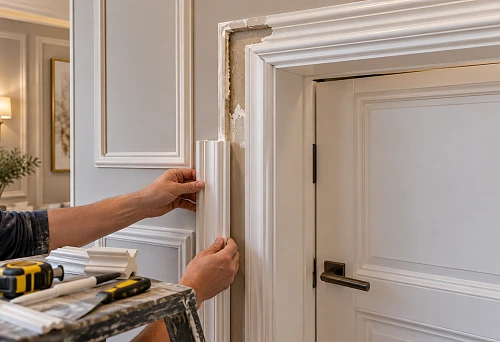
The cornice is mounted to a strong, level, and clean base. The glue bonds not to 'concrete in general' but to the top layer of paint, putty, or plaster. If this layer is weak, the profile will come off with it. Therefore, before installation, the entire line under the ceiling is checked.
In the STAVROS section you can buy glue for wooden cornice and other finishing materials. One of the available options is to buy TYTAN mounting adhesive. But specific suitability depends on the material of the cornice, the base, and the product instructions.
A large profile may require additional mechanical fastening. The method is determined by the weight of the plank, the wall, the ceiling, and the project. It cannot be stated that one adhesive is sufficient for any KZ-005 or KZ-007. Particular care is taken with solid wood, long sections, external corners, and ceilings with unstable finishes.
The marking must be continuous. If the ceiling is uneven, the craftsman decides whether to run the cornice level or follow the existing line. Both options have consequences: a level profile may reveal a variable gap, following the ceiling may show a wave. The decision is made before applying the adhesive.
The plank is pressed evenly, without damaging the protrusions. Temporary fixation remains until the adhesive gains strength according to the instructions. Excess adhesive is removed immediately using an acceptable method, without smearing it on oak, beech, or prepared MDF surfaces.
Why installation cannot begin before the finishing decision
The cornice can be finished before installation, after installation, or in a combined manner. The choice depends on the material, wall color, and method of joint treatment. Oak tinting is convenient to control on individual planks, but after cutting angles, local work may be required. MDF and beech for enamel are often painted as part of a system with doors or the ceiling. If the cornice is installed before final painting, the walls and ceiling need protection. If after, damage to finished surfaces must be avoided.
Glue zones cannot be covered with material that impairs adhesion if prohibited by the instructions. Oil, wax, or glossy enamel on the back side may alter the bond. Technological areas are determined in advance. Special attention is paid to the ends: after cutting, the material is exposed and must be protected and visually coordinated with the front surface.
For a painted cornice, the sequence of work with joints is important. If the planks are fully painted before installation, the craftsman will get neat surfaces, but the joints will require local touch-ups. If painting after installation, it is easier to even out the color, but the risk of staining walls and ceiling is higher. There is no universal order—it is chosen for the specific finishing system.
Why order OMLD-005 samples
The OMLD-005 set contains over 60 samples of wooden decorative profiles and allows you to compare shape, dimensions, and materials before a large order. This is especially useful for KZ-005 and KZ-007, because the 10–15 mm difference is hard to read on screen and almost imperceptible when the profile is lying on a table.
Better purchase the OMLD-005 sample set before calculating the entire perimeter. Samples are placed against the wall near the ceiling, viewed from the opposite side of the room, and compared in daylight and evening lighting. It is useful to evaluate the profile from the doorway, from the center of the room, and next to the main piece of furniture.
Evaluating a profile on a table is incorrect. The horizontal position and close distance make KZ-005 and KZ-007 look similar. Under the ceiling, shadows, scale, and viewing angle change. KZ-005 begins to stretch the top of the wall more, KZ-007 leaves more air.
It is useful to compare the sample with the door casing and baseboard. You can temporarily secure it in a safe way and leave it for a few days. The first impression often differs from the perception after habitual use of the room. For oak, the sample shows the texture and possible toning character, but natural planks may vary. For MDF and beech, the sample helps choose the shape, while the final color is checked on a separate swatch.
How not to confuse a ceiling cornice with similar profiles
Cornice and ceiling molding
In everyday speech, the words are often used as synonyms. However, for the buyer, it is not the names that matter, but the actual dimensions and profile. KZ-005 and KZ-007 are large architectural cornices, not thin neutral fillets. If the project requires a nearly invisible transition, both models may be too large.
Ceiling cornice and curtain rod
KZ-005 and KZ-007 are used to transition the wall to the ceiling. They are not a curtain guide and do not replace a functional suspension system. The search query "wooden cornice" may refer to different products, so you always need to open the specific product card and check its purpose.
Profiled and carved cornice
KZ-005 is sometimes found under the query "carved cornice," but it is more accurately called profiled. The pattern is formed by the geometry of the profile itself, not by a separate applied carved ornament. In the product card, you need to look at the cross-section and dimensions, not just rely on the search term.
Furniture and ceiling cornice
Furniture profile is designed for the scale of a cabinet or kitchen. Ceiling profiles KZ-005 and KZ-007 are significantly larger and intended for room interiors. Installing such an element on furniture can disrupt proportions and structure. The reverse replacement is also not always successful: a small furniture cornice will be lost under the ceiling.
Molding and cornice
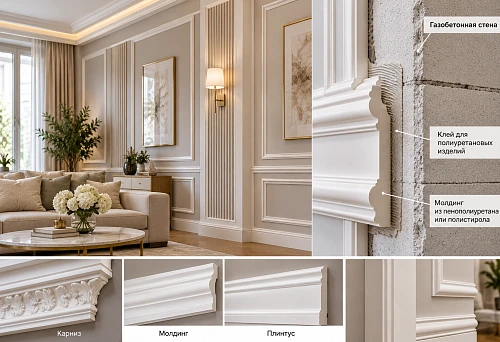
Molding is more often used on the wall surface for frames, panel divisions, and decorative lines. A cornice covers the top junction and has a profile designed for viewing from below. Similar width does not make the elements interchangeable.
Practical selection for specific rooms
Formal living room with high doors
KZ-005 is more often suitable for the scale. The height of 110 mm supports portals and wide baseboards. If the walls are rich in decor, the profile can be painted in the ceiling color to preserve the architecture without unnecessary contrast. The oak version is suitable when doors and panels also have a noticeable wood texture.
Standard living room in an apartment
KZ-007 looks calmer. It remains noticeable and classic, but doesn't take up too much wall space. MDF under enamel is convenient for a unified white line, oak is for interiors with natural wood. Before ordering, check the distance from the cornice to the top of the cabinet and the curtain niche.
Bedroom with a high headboard
KZ-007 usually doesn't compete with the headboard and curtains. KZ-005 is possible in a spacious bedroom with high ceilings. Check the distance from the top of the cabinet and the cornice, as well as whether a too narrow strip of wall above the furniture is formed.
Study with a library
Oak KZ-007 can connect shelves, a desk, and doors. KZ-005 suits a tall study with large panels. The joint above the library is best positioned so that it does not coincide with the main vertical division and does not fall directly above the center of the built-in section.
Dining room
In a separate formal dining room, KZ-005 supports a sideboard, tall doors, and a large table. In a medium-scale kitchen-dining room, KZ-007 is easier to combine with modern furniture and appliances. If kitchen cabinets reach the ceiling, the cornice and top row are designed together.
Corridor
A narrow corridor enhances the perception of the profile's height. KZ-007 is often safer. KZ-005 suits a wide hallway where there is viewing distance. On a long wall, you need to decide in advance where the joints will be and how the profile will pass above the doors.
Staircase hall
KZ-005 is well readable from below and along the perspective. But complex geometry increases the number of corners. It is necessary to calculate cutting and installation in advance. KZ-007 may be appropriate if the staircase space is not very wide and the top line should remain calm.
Commercial interior
In a restaurant, salon, or showroom, the cornice is viewed from a distance. KZ-005 creates a ceremonial look, KZ-007 — a more universal frame. Before a large order, a trial section is made to evaluate light and shadow, finish durability, and seam visibility.
Selection for different interior styles
Classic Interior
KZ-005 naturally supports large architraves, wall panels, pilasters, and decorative ceilings. KZ-007 suits calmer classic styles where profiled elements are present but should not dominate all attention. In both cases, it is important to coordinate the
English study
Oak KZ-005 supports high panels and a library. KZ-007 suits a smaller study and preserves more visible wall. The cornice tint is compared with furniture under real lighting, because the upper zone often appears darker.
Minimalist interior with a classic detail
KZ-007 can be the only profiled element against smooth walls. It adds completeness without requiring additional frames. KZ-005 in such an interior requires a large room and very precise proportions.
Interior with natural wood
Oak cornice connects doors, furniture, and floor plinth. KZ-005 makes the wood line more prominent, KZ-007 — calmer. Do not mix several mismatched oak shades: samples are checked side by side.
What to buy together with the cornice
The cornice requires not only slats. Samples, mounting materials, finishing system, and tools for precise cutting are needed. The list depends on the material and base. Do not buy random glue or oil without compatibility testing.
In the category you can buy a wooden cornice and compare KZ-005, KZ-007, and other profiles. For installation and finish, it is useful to open the section where presented materials for installing ceiling profile.
| What to add to the purchase | Why this is needed | For which scenario | What to Check |
|---|---|---|---|
| Select profile KZ-005 or KZ-007 according to samples | Compare actual height, depth, and light-shadow of the ceiling. | Any project before ordering large footage. | Perception from different points and under different lighting. |
| Glue for wooden cornice TYTAN | Consider transparent mounting compound for compatible materials. | KZ-005 or KZ-007 on a solid prepared base. | Instructions, base, material, and need for mechanical fixation. |
| materials for painting MDF | Prepare and paint the profile in the selected color. | MDF and beech under enamel. | Compatibility of primer, enamel, and adhesive area. |
| Select oil for oak cornice. | Preserve the wood grain and achieve the desired shade. | KZ-005 or KZ-007 made of oak. | Test swatch, color of doors and baseboard. |
| Material for test cuts. | Adjust the angle and tool before working with the main planks. | Rooms with internal and external corners. | Actual wall angle and profile pattern match. |
Errors in Selection and Installation
Choosing only by photo
The photo does not convey the height of 110 or 95–100 mm in the room's scale. The sample should be held against the ceiling and viewed from the opposite wall.
Consider the difference of 10–15 mm insignificant
Along the entire perimeter, it changes the width of the top frame, shadows, and the amount of visible wall. The difference is especially noticeable on a contrasting color.
Buying KZ-005 for a small room without checking
A high profile can visually lower the ceiling and compete with furniture. A mockup and sample help avoid mistakes.
Choosing KZ-007 for a grand hall just because it is more versatile
In a large space, the profile can get lost. Versatility does not replace scale and architectural support.
Confusing a profiled cornice with separate carved decor
KZ-005 has a developed cross-section, but you should not promise the buyer an applied ornament that does not exist.
Not taking into account the different lengths of the planks
MDF is 2600 mm, solid wood is 2400 mm. The number of joints and cutting patterns will differ.
Divide the perimeter by the length without layout
This calculation does not account for corners, trimming, and awkward short inserts. Each wall is laid out separately.
Start installation from a crooked corner
The error carries over to the entire perimeter. Marking and a level-based solution are needed.
Glue onto weak paint
The cornice will come off along with the coating. The strength of the entire finishing system must be checked.
Rely only on glue for any base
Large profiles may require mechanical fastening as per the project. This is especially important for solid wood and complex areas.
Do not make a test cut
The first corner can ruin the entire plank. It's better to set up the tool on a sample.
Staining oak without a test piece
The shade near the ceiling may differ from expectations and other wooden elements.
Placing the joint directly on an external corner
A complex joint becomes unstable and noticeable. The connection is shifted to a straight section.
Not accounting for cabinets up to the ceiling
The cornice may conflict with the top panel of furniture. The junction is designed in advance.
Ordering the exact perimeter without allowance
Corners, test cuts, and pattern selection require additional material calculated according to the layout.
Who KZ-005 suits and who KZ-007 suits
| Situation | What to choose | Why |
|---|---|---|
| High ceiling and large doors | KZ-005 | Height of 110 mm supports a grand scale. |
| Medium-sized living room or study | KZ-007 | Profile 95–100 mm looks large but calmer. |
| Need a strong upper dominant | KZ-005 | Vertically elongated profile is more noticeable on the wall. |
| Modern classic without overload | KZ-007 | Preserves the classic shape and more visible wall. |
| Natural oak interior | Both models are made of oak | The choice depends on scale, both are suitable for tinting. |
| Need a profile about 100 mm | KZ-007 made of MDF | The confirmed height is 100 mm. |
KZ-005 will not suit an interior where a large top line is not supported by doors, baseboard, and room area. KZ-007 may not be expressive enough for a very high grand hall. Both profiles require precise calculation and a prepared base.
How to buy KZ-005 and KZ-007 on STAVROS
The first step is to open both cards. For the dominant profile, you can buy a high ceiling cornice 110 mm KZ-005. For a more moderate solution — buy a ceiling cornice 100 mm KZ-007 in MDF or choose solid wood with a height of 95 mm.
The second step is to determine the material. MDF and beech are suitable for enamel, oak for tinting. At the same time, consider the length of the slats: 2600 mm for MDF and 2400 mm for solid wood.
The third step is to order samples and hold them under the ceiling. You cannot make a decision by looking at the profile only on the screen. Compare the sample with the door, baseboard, and furniture.
The fourth step is to lay out the layout for each wall. Calculate the number of joints, corners, and the necessary margin. After that, choose the glue and additional fixation according to the base.
If KZ-005 and KZ-007 are not suitable, open the catalog of ceiling cornices and compare other sizes. Before final ordering, check the current parameters in the product cards and, for complex geometry, consult with a STAVROS manager and a craftsman.
How the color of the cornice changes the perception of KZ-005 and KZ-007
The size of the profile cannot be evaluated separately from the color. The same KZ-005 can look almost like part of the ceiling or, conversely, turn into a contrasting architectural strip. A white cornice on a white ceiling is usually perceived as lighter because the boundary dissolves. On a dark or saturated wall, the height of 110 mm becomes more noticeable: the light strip separates the ceiling more strongly and visually reduces the open wall area.
KZ-007, thanks to its height of 95–100 mm, is easier to use in a contrasting scheme. It remains noticeable but does not take up as much space. This is useful in a bedroom, study, and medium-sized living room where the walls are painted in a deep color. However, even KZ-007 cannot be chosen only by color visualization: the profile has a depth of 40 mm and creates a real shadow.
A cornice in the color of the wall works differently. The top line becomes a continuation of the vertical plane, and the ceiling looks like a separate surface. This technique can visually increase the wall but requires careful joining to the ceiling. KZ-005 in the color of the wall retains its architectural height but resembles a wide white frame less. KZ-007 becomes even calmer.
Oak tinting is always more noticeable than solid enamel because the texture creates an additional pattern. If the room already has wooden panels, doors, and furniture, KZ-005 in oak can unify them into a single system. If there is a lot of wood and it varies in shade, the more moderate KZ-007 reduces the risk of overload. Before ordering, it is useful to place a sample next to the door and baseboard, rather than comparing shades from photos.
How to prepare the room before curtain rod delivery
Long planks require free space for storage, inspection, and layout. MDF 2600 mm long and solid wood 2400 mm long cannot be left in the passage, placed vertically on a narrow end, or pressed with heavy materials. Before delivery, a flat, dry area must be designated where the molding will not bend or be subjected to impacts.
Storage conditions are especially important for beech and oak. Natural wood reacts to humidity and temperature. Exact adaptation requirements should be clarified in the product card or with a STAVROS manager, but the general principle is simple: planks should not be moved from a cold or damp room directly to final installation without checking their condition. The material is inspected, allowed to acclimate to the room conditions, and only then is the precise layout performed.
Walls and ceiling must have completed the main wet processes. If plaster, putty, or paint has not yet dried, the cornice may have an unstable base. Moisture can also affect solid wood. Therefore, cornice installation should not precede the room's readiness.
Before delivery, also clear access around the entire perimeter. Tall cabinets, curtain rods, light fixtures, and temporary structures may prevent a long plank from turning and taking its position under the ceiling. Sometimes the profile cannot be brought into the room after large furniture has been installed. The sequence of work should be planned in advance.
How to check the quality of the layout before the first cut
Planks are laid out along the walls or marked on a plan. For oak, the order is immediately chosen based on grain and shade. For MDF and beech intended for enamel, the length of the segments and the position of joints are more important. Each plank receives clear markings that will not damage the surface and will not remain visible after finishing.
Special attention is paid to short walls between a door and a corner, niches, bay windows, and protrusions. In these areas, remnants can often be used, but only if their length is sufficient for reliable installation. Economy should not lead to many small inserts.
Before cutting, check the direction of the profile. A ceiling cornice has an upper and lower part. An orientation error may be unnoticeable on a single segment but will become apparent at the joint. All elements are laid out identically and the pattern is compared at the connections.
Visible walls are planned separately. If the room has a main perspective from the entrance, the longest solid sections are used there. Joints can be moved to a wall with a wardrobe, curtains, or less direct light, but without compromising fastening reliability.
When it's better to choose a different cornice instead of KZ-005 or KZ-007
Both models are large profiles. If the room is very small, the ceiling is low, the doors are compact, and the interior should remain almost without decorative lines, even KZ-007 may look excessive. In such a case, it's more reasonable to open the catalog of ceiling cornices and compare more compact profiles.
Another cornice is also needed when the project requires a completely different design. KZ-005 and KZ-007 are similar in scale and classic character, but differ in height. If the buyer needs a minimalist straight profile, a deep niche for hidden lighting, or a special connection to a stretch ceiling, the choice should not be limited to these two items without checking the construction.
You should not choose both models for a wall with significant curvature, expecting the wide profile to cover everything. A large rigid cornice, on the contrary, emphasizes waves and gaps. First, fix the base or develop a different connection system.
If cabinets up to the ceiling, curtain boxes, and ventilation grilles are already installed in the room, the profile may not fit in height or depth. Then you either need to redo the connections or choose a cornice of a different size. Purchasing before measuring creates unnecessary cuts and line breaks.
How to care for the cornice after installation
The ceiling cornice is located high and does not experience constant touch, but dust accumulates on its protrusions. The more developed the profile, the more horizontal and inclined sections there are. Care is performed with a soft dry cloth or a method acceptable for the coating, without using random aggressive agents.
Enamel, oil, and tinting require different care. Specific recommendations depend on the finishing material, not just the cornice base. Before using a cleaner, test it on an inconspicuous area. An oak surface cannot be automatically treated with the same product as painted MDF.
After the first heating season, it is useful to inspect joints and corners. Minor changes in the room and material can reveal the connection line. Any correction is performed within the used finishing system, without covering the profile with a random thick layer of putty.
If the cornice is damaged during furniture rearrangement or renovation, the local area is assessed before painting. Sometimes it is easier to replace a section than to try to restore a complex profile manually. Having an exact article number and a saved sample makes selection easier.
Additional check before placing an order
Before payment, it is useful to go through a short but meaningful check. Verify the article number: KZ-005 or KZ-007. Then select the material and ensure the size matches it. For KZ-007, it is especially important not to confuse MDF with a height of 100 mm with solid wood with a height of 95 mm. For KZ-005, the MDF width is 40 mm, and the solid wood width is 41 mm.
Check the length of each plank and the layout along the walls. Ensure all niches, columns, openings, and external corners are accounted for. Separately mark walls where a single plank is especially desirable. Calculate the reserve based on actual cuts, not an arbitrary number.
Coordinate the finish. For MDF and beech, determine the enamel system; for oak, determine the tint or other confirmed coating. Order a color sample and view it under the ceiling. If the finish is done by different contractors, establish uniform requirements for shade and gloss level.
The last point is installation. The base must be ready, the adhesive chosen according to the instructions, and additional fixation agreed upon. If at least one node remains unclear, it is better to clarify it before delivery of the linear elements. This way, purchasing KZ-005 or KZ-007 turns into a manageable project, not a set of long planks without a ready installation method.
FAQ: questions about KZ-005 and KZ-007
Which cornice is higher — KZ-005 or KZ-007?
KZ-005 has a height of 110 mm in all materials. KZ-007 is 100 mm in MDF and 95 mm in beech or oak.
How noticeable is the difference of 10–15 mm?
On the sample it seems small, but around the entire perimeter it affects the width of the top frame, shadows, and the amount of visible wall.
Which cornice is suitable for a high ceiling?
Usually KZ-005. But you need to consider the room area, doors, baseboard, and viewing distance.
Which profile to choose for a bedroom?
KZ-007 usually looks calmer. KZ-005 is suitable for a spacious bedroom with a high ceiling and large doors.
What is the size of KZ-005 made of MDF?
110 × 40 × 2600 mm.
What is the size of KZ-005 made of beech or oak?
110 × 41 × 2400 mm.
What is the size of KZ-007 made of MDF?
100 × 40 × 2600 mm.
What is the size of KZ-007 made of beech or oak?
95 × 40 × 2400 mm.
What to choose for white enamel?
MDF or beech. The choice between KZ-005 and KZ-007 depends on the desired height and room scale.
What should I choose for natural tinting?
Oak KZ-005 or KZ-007. A shade sample needs to be made before ordering.
Can KZ-005 be called a carved cornice?
This phrasing is encountered in searches, but it is more accurate to call the model a profiled wooden cornice with a developed cross-section.
Is KZ-007 suitable for the query "ceiling cornice 100 mm"?
Yes, the MDF version has a confirmed height of 100 mm. The solid wood version has a height of 95 mm.
What is the length of the planks?
MDF — 2600 mm, beech and oak — 2400 mm for both models.
How to calculate the quantity?
Measure each wall, lay out the planks by length, account for corners, joints, test cuts, and spare.
Can leftovers be used on an adjacent wall?
Yes, if the piece is long enough, the joint is well-placed, and the profile matches in material and finish.
Is it necessary to order samples?
It is advisable. OMLD-005 helps to see the real scale and compare profiles under the ceiling.
Which glue should I use?
Only one compatible with the cornice material and base. TYTAN can be considered as one option after checking the instructions.
Is one adhesive enough?
Not always. A large profile may require additional mechanical fastening as per the project.
Can it be glued to a painted wall?
Only if the paint is firmly adhered and compatible with the adhesive. Weak coating is removed.
How to finish a corner if it is not 90 degrees?
Measure the actual angle and adjust the cut on a test piece. Standard 45 degrees may not work.
Where is the best place to position the joint?
On a straight section of the wall, away from corners and main architectural focal points, where both planks can be securely fastened.
Can the cornice be installed after furniture?
Yes, if there is access and the junctions are coordinated. Built-in cabinets up to the ceiling are better accounted for in advance.
Which cornice visually lowers the ceiling less?
KZ-007 usually creates a lighter top line. Color and contrast also greatly affect perception.
Where can I see other wooden cornices?
In the STAVROS cornice category, you can compare other profiles, materials, and sizes.
Result: KZ-005 or KZ-007
KZ-005 and KZ-007 are made from the same material groups, have similar depth, and belong to large ceiling profiles. However, the difference in height changes the character of the interior. KZ-005, with a height of 110 mm, creates a strong architectural dominant and suits spacious formal rooms, tall doors, and large baseboards. KZ-007, with a height of 100 mm in MDF or 95 mm in solid wood, looks lighter and fits more easily into a medium-sized living room, study, bedroom, or dining room.
MDF and beech are primarily chosen for enamel, while oak is chosen for tinting. MDF has a length of 2600 mm, solid wood 2400 mm, so the number of joints differs. However, the material should not be chosen solely for a longer plank: first determine the visual result, then the cutting layout.
Before ordering, hold samples against the wall under the ceiling, compare them with doors and baseboards, calculate each wall, and determine joint locations. Mounting adhesive and additional fastening are selected based on the base and profile weight.
On the STAVROS website, you can open the product pages for KZ-005 and KZ-007, order OMLD-005, and select materials for installation and finishing. This approach helps you buy not just a wooden cornice, but a profile that matches the ceiling height, room area, doors, baseboards, and chosen finish.