Article Contents:
- Why one furniture frame cannot simply be multiplied by 60
- What exactly is being purchased: MLD-026 16×16×2000 mm
- Why the 2000 mm length matters more here than the total linear metres
- First, create a bill of finished parts for one frame
- Turn one frame into a combined bill for 60 fronts
- Why the rule “one frame — two strips” can be wrong
- What a carry-over offcut is
- When an offcut is actually considered useful
- Creating a master list of parts from longest to shortest
- Why "frame by frame" cutting differs from "whole batch" cutting
- How to build a cutting map for the MLD-026 2000 mm strip
- Accounting for the saw kerf before approving the quantity
- Why the last 20 frames sometimes yield a different cutting layout than the first 40
- Should leftover pieces be physically stored between production shifts
- Labeling system for carryover leftovers
- Beech and oak are considered two separate batches
- Why a beech leftover cannot be used to complete an oak part
- How to split 60 fronts into production batches
- When it is more cost-effective to order the entire MLD-026 batch at once
- When it is more rational to split the order into stages
- How to build a production reserve
- Why several short offcuts do not replace one 2000 mm reserve strip
- When leftover stock ceases to be a production asset
- How to verify the quantity before placing a wholesale order
- How to receive a large MLD-026 batch
- Packaging backing and why it should not be mixed with the cutting reserve
- How to submit a request for MLD-026
- Common mistakes in wholesale calculation of MLD-026
- Central summary table for 60 frames
- Practical conditional calculation: why a series can save whole planks
- How to choose a cutting scheme among several acceptable options
- Why the order of cuts also affects the use of the remainder
- When overall cutting does not yield noticeable savings
- When MLD-026 does not need to be purchased as a whole series in advance
- How to control actual consumption during production
- How to calculate work in progress after the first batch
- How to handle a reorder if there were not enough planks
- How to value the remainder in money without distorting the production picture
- What to communicate to the manager before placing a wholesale order
- Checklist before launching MLD-026 into production
- How to verify that the costing item hasn't substituted the actual technology
- Buy MLD-026 moulding wholesale after the final cutting plan verification

For serial production of furniture frames, MLD-026 moulding cannot be calculated using the formula "consumption per frame × 60". This arithmetic shows the net length but does not answer the key production question: how many whole two-metre strips are actually needed after the parts of all 60 frames are combined into a single cutting plan. The offcut that appears useless when calculating a single frame can become a horizontal or another short part of the next facade in a series. Therefore, the unit of optimisation becomes the entire batch, not an individual frame.
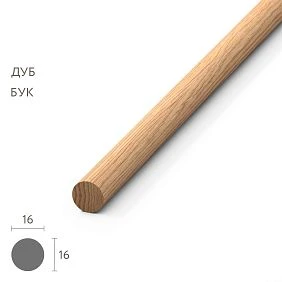
For MLD-026 this is especially convenient to calculate in advance: the profile has a cross-section of 16×16 mm and a commercial length of 2000 mm, and the product page offers beech and oak versions with "Prestige" sanding quality. If production makes repeating facades, the fixed length of the source strip allows building a clear cutting list: first write out all finished parts, then arrange them from the most length-critical to the shortest, account for the saw kerf width, preserve usable carry-over offcuts, and only then determine the number of whole strips and the reserve.
This is exactly the sequence to follow if you need to buy MLD-026 moulding wholesale for furniture production. The total linear metreage is needed for control, but by itself it is not a sufficient basis for an order. Two orders with the same number of linear metres may require a different number of 2000 mm strips if the part dimensions and their combination pattern differ.
Why a single furniture frame cannot simply be multiplied by 60
Let's imagine a serial order: 60 identical facades, each with a frame made of MLD-026. Each frame has two vertical and two horizontal parts. The fastest calculation method is to take one facade, determine the consumption for it, find out how many two-metre strips are required, and then multiply the result by 60. For a preliminary labour estimate this approach is acceptable. For purchasing it can produce an inflated quantity.
The reason is that an individual frame exists as a finished product, while the source moulding exists as a shared material flow. The offcut remaining after the parts of facade No. 1 does not have to remain the "property" of facade No. 1. If its length is sufficient for one of the parts of facade No. 2, No. 17 or No. 53, it is more profitable for production to use the offcut further. When each frame is calculated in isolation, this possibility is lost.
There is also the opposite mistake. Sometimes the buyer adds up the finished lengths of all parts, divides the total by 2000 mm, and rounds up. The resulting figure looks very economical, but it may be unattainable on a real machine. The metric balance does not know which specific parts need to be produced. If the required combination of lengths cannot be placed from a single strip taking into account cuts, the mathematically sufficient meterage will be insufficient.
Therefore, for a series, two control values are needed at once. The first is the net meterage of all frames, which shows the lower theoretical limit of material. The second is the number of whole strips according to the actual cutting map. Ordering should be based on the second value, while the first should be used as a check: if the cutting requires noticeably more material, it is necessary to understand due to which remnants and constraints the difference arises.
Series production provides an advantage precisely through scale. In one frame, the combinations of parts are limited to four elements. In sixty frames, production already works with 240 parts. The larger the pool of identical blanks, the more options there are to use the remainder of one strip in another set without changing the design of the facade itself.




What exactly is being purchased: MLD-026 16×16×2000 mm
Before calculation, the source product must be fixed without substituting parameters. For this article, molding MLD-026 with a cross-section of 16×16 mm and a length of 2000 mm is considered. Material — beech or oak. Sanding quality — “Prestige”. These are the initial characteristics around which the cutting map is built.
It makes sense to link the product card to the working specification once: MLD-026 16×16×2000 mm. When ordering a large batch, it is important not to reduce the item to the faceless line “molding 16×16”. The cross-section alone does not replace the article number, and the article number does not replace the material. If part of the furniture is made of beech and part of oak, these are two separate purchasing and production batches.
The fixed length of 2000 mm is not a secondary characteristic. It is precisely this that defines the container into which the technologist must “fit” the set of finished parts. A strip may contain one long part and several short ones, two medium parts, a series of short horizontals, or another combination, if it physically fits within 2000 mm taking into account technological losses.
There is no need to turn this task into a story about moldings in general. For furniture production, specific parameters are essential: 16×16 mm, 2000 mm, the selected wood species, the approved lengths of frame elements, and the cutting rules on the specific equipment. Everything else matters only to the extent that it affects the quantity and quality of the resulting parts.
Our factory also produces:





Why 2000 mm length matters more here than the total linear meters
A linear meter answers well the question "how much clean length is required." It answers poorly the question "how many source items to buy." Suppose two furniture series each require 150 linear meters of MLD-026. In the first, all parts are short and combine well within a two-meter strip. In the second, a significant portion of the elements is close to the length of the source blank. The clean meterage is the same, but the cutting yield will differ.
This is a typical cutting task: the source length is discrete. You cannot purchase 0.37 of a strip where the calculation shows a shortage of 740 mm. You need to open another whole 2000 mm strip, and the resulting remainder can either be used further, allocated to reserve, or written off as unsuitable for the current series.
Therefore, the formula "total meterage ÷ 2" gives only a theoretical minimum. If all parts of a series have a total length of 148,000 mm, dividing by 2000 gives 74 strips. But this does not mean that 74 strips are sufficient. To get 74 as a real result, each of them must be filled almost without waste with a suitable combination of parts. In practice, lengths may conflict with each other, and each cut further reduces the available material.
The opposite extreme is to set aside a large percentage on top in advance without cutting. If the parts map allows the use of carryover remnants, 10–15% "just in case" may simply turn into unnecessary warehouse stock. For wholesale purchases of building materials and furniture trim, it is more advantageous to first build an actual cutting model, and only after that form a justified reserve.
Get Consultation
First, we create a bill of finished parts for one frame
The first working table should describe not the frame in linear meters, but the parts of which it consists. Even if the product is visually simple, the entry "frame — 2.8 m" is too coarse. For cutting, you need to know which specific lengths make up these 2.8 m.
| Part code | Purpose | Finished length | Quantity per one frame | Quantity for 60 frames |
|---|---|---|---|---|
| В | Vertical | According to the approved drawing | 2 | 120 |
| Г | Horizontal | According to the approved drawing | 2 | 120 |
In real production, orientation, allowance for the finish cut, facade number, grain direction, permissible blank class, and other attributes can be added to this list if they actually affect the cutting plan. But the basic idea remains the same: first the set of parts is fixed, then the material is calculated.
The finish length cannot be replaced with an approximate frame size. If the joint involves a cut, a butt joint, or other processing, the technologist must use exactly the blank size required before final assembly. The article does not provide a universal allowance because it depends on the adopted technology. It must be obtained from the working drawing and the process sheet of the specific production facility.
Such a table solves another problem as well: it protects purchasing from facade changes. If the designer or engineer changes the frame height, it is clear which specific part has changed. There is no need to "guess" the total linear meters again. The 120 verticals are recalculated, after which the cutting map is rebuilt.
Turning one frame into a general list for 60 facades
For 60 identical facades, the batch contains 120 verticals and 120 horizontals. After this transformation, the frame temporarily ceases to be the cutting unit. Production sees 240 finished parts of two types.
This does not mean that the parts can be mixed without control. Each of them must return to the correct set after cutting, especially if subsequent processing is performed in batches. But at the stage of distributing the initial two-meter stock, the common pool of parts provides much more freedom.
An illustrative conditional example. Suppose, solely to illustrate the method, that the approved vertical has a length of 920 mm and the horizontal has a length of 310 mm. These figures are not characteristics of MLD-026 and do not define the size of a real facade; they are needed to show the mechanics of serial cutting.
One frame requires 2 × 920 + 2 × 310 = 2460 mm of clean profile. If the frame is calculated in isolation and the remnants are not carried over to the next set, it is easy to arrive at the "two strips per frame" scheme: one strip is allocated for the long elements, the second for the short ones. For 60 frames, this approach would yield 120 initial strips.
If the series is combined, the situation changes. All 120 verticals can be distributed across 60 strips, placing two 920 mm parts each. All 120 horizontals can be assembled in separate series; a two-meter strip accommodates several identical short parts, taking into account the actual kerf width. In the conditional model, before adding reserve, about 80 strips might be required instead of 120. The exact figure depends on the actual kerf width and the adopted cutting map, but the principle is obvious: calculating each product in isolation can greatly overstate the requirement.
That is why purchasing furniture moulding in bulk for a series should be based on a consolidated parts list, not on the number of finished frames.
Why the rule "one frame — two strips" can be wrong
The error arises from an artificial boundary between kits. Imagine that after making a frame, a 420 mm section remains. Within that specific frame, it is no longer needed. If production closes the order piece by piece, the remainder goes into the offcut box, and a new strip is opened for the next front.
In a series model, the 420 mm section is first checked against the list of future parts. If the horizontal of the next frame is shorter and the technological allowance permits the required cut, the remainder becomes a full-fledged blank. It ceases to be waste.
This is an important distinction: waste is not determined by the mere fact that a piece remained after cutting. It becomes waste when it cannot be used for any approved future part while complying with technology and quality requirements.
With 60 identical fronts, the likelihood of finding a use for a short suitable blank is higher than with a single item. Therefore, a series usually allows creating a "bank" of standard remainders. Production knows that a segment of a certain range can go to a horizontal, an insert, or another repeating position if it is present in the project.
However, one should not turn this into the opposite dogma and keep absolutely everything. If a section is too short, damaged, has lost identification, or belongs to a different wood species, it cannot be considered a production asset just for the sake of a nice yield percentage.
What is a carryover remainder
A carryover remainder is a suitable segment of MLD-026 that, after cutting one source strip, is not written off but carried over to the next operation and used for parts of the same production series or another known compatible position in advance.
The term is convenient because it separates a useful blank from an ordinary offcut. If after cutting 610 mm remains and there are horizontals in the queue requiring a shorter length with a technological allowance, this section has a purpose. If 140 mm remains and no future part fits, production is already facing a different type of remainder.
The carry-over remnant must exist not only physically but also in the records. If it is placed on a rack without a length and code, after a few shifts it turns into an unidentified piece of wood. To use it again, an employee will have to re-measure it, determine the species, and check the quality. The savings are quickly eaten up by additional sorting.
Therefore, in serial cutting, the remnant is obtained, measured, labeled, and assigned. The more typical the frame parts are, the simpler this system is. For two types of elements, ranges can be set in advance: which remnants are still suitable for a vertical, which are only for a horizontal, and which no longer participate in the map.
A carry-over remnant is especially useful when dividing output into shifts or queues. It links production batches together. But this works only when the next shift knows that a specific cut-off piece is reserved and cannot be accidentally used for an unrelated task.
When a remnant is truly considered useful
Physical length is the first, but not the only, condition. For remnant MLD-026 to be included in the calculation of a future part, it must meet several requirements at the same time.
- After all necessary finish cuts, sufficient working length must remain.
- The material must match the required batch: beech must not be counted in an oak series, and vice versa.
- There must be no defect on the workpiece that falls within the working part of the future component.
- The end and the direction of the subsequent cut must allow the required geometry to be obtained.
- The remnant must be identified, measured, and available by the time of the next operation.
This leads to an important rule: you cannot enter the entire physical remainder into the table as 100% usable. For example, a cut piece is 335 mm, while the finished part is 330 mm. Formally, the lengths are almost the same. But if the process plan requires an additional allowance and one or more cuts, using these 335 mm may be impossible.
For calculation, it is better to work with the actual length of the workpiece and the requirements of the specific equipment. The kerf width is also taken from the process chart, not from an abstract "average figure." That is why the final number of strips must be confirmed by the production cutting plan, not just by the estimate table.
If batch MLD-026 is going into quality furniture, the usability of the remainder is also determined by the visible part of the component. You cannot include a cut piece in the calculation just because it fits by length if the actual quality of the section does not meet the product requirements.
Create a general list of parts from long to short
After forming the list, it is useful to sort the parts by length. First, place those elements for which there are fewer cutting options. In a furniture frame, these are usually the long sides. Short parts are more flexible: they can be obtained from the remainder after a long one or several pieces can be combined in one strip.
If you do the opposite and first actively cut short elements from whole two-meter strips, a paradox may arise. The warehouse will have a lot of total meterage in the form of pieces, but not a single section sufficient for the long side of the frame. Then you will have to open a new whole strip, even though arithmetically "there are plenty of remainders."
Sorting from long to short is not a mechanical law for every cutting plan, but it is a reliable starting point. Then the process engineer checks combinations. Sometimes a long part combines well with one short one, sometimes two medium ones give a better yield, sometimes short ones are advantageously grouped separately.
The working algorithm can be formulated as follows: first, provide for all parts that require almost a whole strip or a limited number of combinations; then fill the free sections with short positions; after that, assemble the remaining short elements from carryover remainders and new strips.
This approach helps not only to reduce the amount of source linear stock but also to make the result predictable. Production knows in advance how many whole strips remain untouched in reserve and how many will be opened for the current queue.
Why cutting "frame by frame" differs from cutting "the whole batch"
| Calculation method | What happens to the remainder | Advantage | Risk |
|---|---|---|---|
| Each frame separately | Tied to a single set or written off | Simple configuration | Excessive consumption of whole planks |
| The entire series together | Carries over between sets | The 2000 mm length is used better | Strict tracking of parts and remainders is required |
Piece-by-piece cutting is convenient when the item is a one-off, the parameters are constantly changing, or production deliberately assembles each front from separate blanks. For 60 identical frames, this approach usually forgoes the main advantage of repeatability.
Cutting a whole batch, on the other hand, requires more preparation before starting. You need to know exactly the dimensions, quantity, material, and status of all parts. But once the cutting map is approved, the process becomes serial: identical cuts can be grouped, remnants can be assigned, and the number of whole strips can be controlled in advance.
It is important not to confuse material optimization with mixing up kits. Parts can be cut in a common flow and then assembled by fronts. The serial map answers the question of which source strip each part came from; the picking list answers where that part will go.
If the company already uses barcoding, QR marking, or route sheets, it makes sense to integrate MLD-026 into the existing system. There is no need to create a separate parallel tracking system for a single item. You only need to maintain the link between the source strip, the wood species, the resulting parts, and the carry-over remnants.
How to build a cutting map for the MLD-026 2000 mm strip
The cutting map should show not only the remnant but also the purpose of each part of the source strip. A convenient record looks like this:
Strip No. 001 → B-01 → G-01 → cuts → remnant 415 mm → G of the next frame.
| MLD-026 strip | Part 1 | Part 2 | Part 3 | Cuts | Usable remainder | Where to use |
|---|---|---|---|---|---|---|
| №001 | V-01 | G-01 | — | per process chart | As per actual | next frame |
| №002 | B-02 | G-02 | — | per process chart | As per actual | next frame |
| №003 | G-03 | G-04 | G-05 | per process chart | As per actual | reserve or next operation |
You shouldn't limit yourself to the formula "2000 minus the sum of parts." It doesn't show what exactly was obtained or whether the remaining piece can be used further. The map should be a production document, not abstract mathematics.
In a serial batch, it's convenient to group identical patterns. If 40 source strips are cut using a single template, there's no need to describe each one individually, provided the tracking system allows specifying a range of numbers and the repeat count. Detailed records are needed for non-standard remnants and deviations.
Account for the saw kerf before approving the quantity
The finished dimensions of the parts don't add up to the source strip without losses. Each cut removes a small strip of material. On a single frame, this amount may seem insignificant. Across hundreds of repeating operations, it turns into a noticeable total length.
In this article, you can't plug in a universal kerf width: it depends on the specific equipment, tooling, and adopted process scheme. Therefore, in the formulas it's convenient to denote it as p and substitute the actual production value.
If two parts are obtained from a single two-meter strip, the following condition must be checked:
L1 + L2 + process losses ≤ 2000 mm.
If six short parts are obtained, the number of cuts and the blank separation scheme will be different. Therefore, you can't first build a map "tight" to the finished lengths and then simply hope that the kerf will "fit in somewhere."
The serial effect here is twofold. On one hand, the accumulated kerf increases overall consumption. On the other, the repeatability of parts allows for better distribution of remnants. Therefore, the result is determined not by a single percentage markup, but by the entire map.
Before building materials wholesale Moscow or a specific furniture profile is being launched into a large purchase, the process value of the kerf must be included in the calculation, rather than left to the operator's discretion after the raw material arrives.
Why do the last 20 frames sometimes yield a different cutting plan than the first 40
If production is divided into batches of 20 fronts, the output of the third run may differ from the first, even when the frames are identical. The reason is the accumulated bank of carryover remnants.
At the start of the first run, the warehouse contains only full 2000 mm strips. As cutting progresses, usable short blanks appear. If they are accounted for and preserved, the second or third run can use some of the horizontals from this bank, opening fewer new full strips.
This leads to a useful rule: production efficiency must be calculated cumulatively. You cannot compare each shift only by the metric of "how many full strips were opened today" without accounting for the remnants it received from the previous shift and passed on to the next.
For example, the first queue may have deliberately created more usable offcuts because long parts were cut with priority. The second queue uses these offcuts and appears more economical. This does not mean the first one performed worse. Both queues are parts of a single cutting model.
For the purchaser, this leads to another conclusion: an entire series order can be calculated using the overall map, even if production is physically split into stages. But if the geometry of subsequent fronts has not yet been approved, carryover remnants cannot be counted as guaranteed material for them.
Should remnants be physically stored between production shifts?
Yes, if these remnants are included in the approved map and have a specific purpose. Otherwise, the calculation exists only on paper. If the evening shift plans to hand over 36 usable offcuts to the morning shift, they must be physically separated from waste and labeled.
Minimum data set: SKU, material, actual length, status, and permitted purpose. For a complex series, a batch number and date can be added.
Do not use a shared box labeled "MLD-026 offcuts." Within a few days, it will mix beech, oak, different lengths, defective parts, and usable blanks. To find the needed section, an employee will have to sort through the entire contents. Such a system formally preserves wood, but in practice makes it expensive to use.
Storage should match the value of the remnant. Long sections capable of replacing a significant portion of a new plank should be tracked strictly. Very short pieces that do not fit any future part should not be turned into inventory debt.
If production space is limited, this can also affect the cutting map itself. Sometimes a slightly higher consumption of whole planks turns out to be economically more reasonable than accumulating hundreds of differently sized offcuts that require separate sorting, shelving, and tracking. The goal of optimization is to reduce total production losses, not to achieve the minimum theoretical waste at any cost.
Carryover remnant labeling system
The simplest code might look like this:
MLD026 / BEECH / 415 / H
It means: item code MLD-026, material — beech, actual length — 415 mm, permitted use — horizontal. For the oak batch, a separate designation is used instead of BEECH. The specific code format is chosen by the company itself; what matters is that the system is uniform across all shifts.
Do not encrypt too much information into an incomprehensible string of letters. The code should speed up work, not require a separate reference guide at every machine. If a company uses a digital system, a short physical tag may contain only an identifier, while the full data is stored in the program.
Particular attention should be paid to the actual length. A nominal note such as “remainder about 400” is unsuitable for precise cutting. Before including an offcut in a future part, the real available length after the previous operation must be known.
Marking is also useful for analyzing yield. At the end of a batch, you can see which remainder ranges were actually used and which systematically carried over from shift to shift and were ultimately written off. This helps improve the next cutting map.
Beech and oak are considered two separate batches
The same cross-section of 16×16 mm and the same length of 2000 mm do not make beech and oak MLD-026 interchangeable in accounting. If the furniture program contains both species, the purchasing specification must have at least two lines.
Incorrect:
MLD-026 — 150 pcs.
Correct:
MLD-026 / beech / 16×16×2000 mm / “Prestige” / ___ pcs.
MLD-026 / oak / 16×16×2000 mm / “Prestige” / ___ pcs.
Separate accounting is needed from the very beginning, because carryover remnants also belong to a specific species. If the general table shows 20 usable offcuts of MLD-026, but 18 of them are beech, the oak batch effectively has only two.
The same principle applies to production reserve. "Ten spare strips of MLD-026" is an insufficient record if the project uses two materials. You need to know how many whole spare strips belong to beech and how many to oak.
For a wholesale order through a large building materials supplier or directly by product line, precise material separation reduces the risk of mix-ups even before shipment.
Why a beech remnant cannot be closed with an oak part
At the finished product level this is obvious, but at the warehouse level the error arises precisely because of identical geometry. Two offcuts of 16×16 mm and 430 mm long can lie next to each other and seem equivalent to an operator who sees only the size.
Therefore the remnant bank is divided not only by length, but also by material. Sorting "short/long" without species is insufficient.
If after a beech batch many usable offcuts remain, they can be transferred only to future beech items where the profile and quality requirements match. The oak series must have its own balance of whole strips and its own bank.
Any material substitution is no longer cutting optimization, but a change to the product specification. It requires a separate decision and must not happen unnoticed just to use up remnants.
How to split 60 fronts into production batches
Sixty frames do not have to be produced in one continuous operation. Production can split them, for example, into three queues of 20 fronts each. At the same time, the purchasing requirement for the entire series and the cutting map can remain shared.
This is an important distinction. A production queue answers the question of when and in what quantity products pass through the area. The purchasing requirement answers the question of how many source strips are needed to fulfill the entire confirmed program.
If the geometry of all 60 fronts is approved, a combined calculation is usually more advantageous. The remnants of the first twenty are included in the bank of the second, and the remnants of the second are included in the third. But the actual issuance of material to the machine can be done in stages so as not to mix too large a volume.
If the third queue is still being designed, using its future parts for today's optimization is risky. A remnant may be reserved for a horizontal piece whose length will change later. Then the purchasing calculation will turn out to be based on a nonexistent part.
A practical rule: only confirmed products are included in the shared map. Everything that may change significantly is counted as a separate future requirement.
When it is more advantageous to order the entire MLD-026 batch at once
Purchasing the entire series in full is rational when the front dimensions are approved, the material is selected, the finish is fixed, the volume will actually go into production, and the warehouse has the conditions to store two-meter linear stock.
In such a situation, one shared cutting map allows repeatability to be used to the maximum. The purchaser sees the full pool of parts and can determine the real number of whole strips rather than summing up separate small orders.
A single purchase also simplifies the formation of production reserve. Instead of adding stock to each small batch, one can assess the risks of the entire program and keep part of the material as whole strips.
But "in bulk" does not mean "necessarily everything at once." If half of the fronts have not yet been approved, early purchasing turns logistics savings into the risk of excess material. An expert calculation must take into account the degree of project readiness, not just the unit price.
When it is more rational to split an order into phases
A phased order is better if the dimensions of the second part of the furniture are still changing, some fronts may switch to a different species, there are no conditions for long-term storage, or the production team wants to verify the actual output of the first series before scaling up.
In this case, the first batch serves as a test of the technological model. After it is produced, you can see the actual consumption, the structure of leftovers, the defect rate, and the convenience of the chosen schemes. This data allows the second purchase to be adjusted without changing already finished items.
However, the result cannot be transferred automatically. If the front dimensions have changed, the old map is no longer proof of need. The parts list must be generated anew.
Splitting an order must be a conscious decision. If the only reason is the absence of a ready calculation, it is better to finish the cutting model first rather than turn uncertainty into a series of urgent reorders.
How to form a production reserve
The reserve for MLD-026 is best divided by purpose. The simple formula of "plus 10%" hides the reasons why additional material is needed in the first place.
The cutting reserve arises from real combinations of parts and should not be confused with safety stock. If, to obtain 240 finished elements, the map requires 82 whole planks instead of the theoretical 76, those six planks are already part of the working requirement.
A damage reserve is needed in case part of the source profile or a finished part becomes unusable before assembly.
A production setup reserve may be required if the technological process involves trial operations or control parts. Its size is determined by production, not by the article.
A repair reserve is whole products or material that the customer deliberately keeps after a production run for possible subsequent repairs.
Separation allows you to see what exactly can be reduced. You cannot remove the "excess" strips from the cutting requirement and expect the run to still add up. However, the volume of the operational reserve can be the subject of a separate decision.
For beech and oak, the reserve is also calculated independently. A total stock of MLD-026 without specifying the species is not informative enough.
Why several short offcuts do not replace one 2000 mm reserve strip
Total length can be misleading. Five pieces of 400 mm each give the same 2000 mm of material as one whole strip, but the production value of these two sets is different.
If a 900 mm part is damaged, none of the five short offcuts will help. A new sufficiently long section will be needed.
Therefore, it is reasonable to keep part of the reserve in whole strips, especially if the frame contains long elements. Short carryover remnants work as an additional resource for short parts, but they do not replace the versatility of the original 2000 mm length.
This is another reason why the warehouse report should show the structure of the remainder: whole strips separately, usable offcuts by ranges separately. The entry "remainder 18.4 linear m" by itself does not say whether this material is capable of covering a future risk.
When the remainder ceases to be a production asset
It is useful for the enterprise to establish a write-off rule in advance. A remnant ceases to participate in the calculated bank if it is too short for any future part, damaged, lacks reliable identification, belongs to a different species, or is not included in any confirmed map.
Such a rule protects against false economy. If the accounting program shows hundreds of meters of "remnant," but those meters are represented by pieces that cannot be used, the purchaser gets a distorted picture of inventory.
There is no need to store material just because it is a pity to throw it away. A production asset must have a probable use and a cost of use lower than the cost of new material, taking into account the labor of searching, checking, and moving.
For a repeating frame, the criteria are simpler: the list of acceptable parts is known. A minimum useful length can be set based on the shortest item plus the technological requirement. Anything below this threshold and not used in other approved products should not artificially increase the calculated remnant.
How to verify the quantity before placing a wholesale order
The final sequence must be reproducible:
- Record the number of fronts.
- Record the finished dimensions of the verticals and horizontals.
- Multiply the quantity of each part type by 60.
- Separate the calculation by beech and oak if both species are used.
- Enter the actual kerf width and technological allowances.
- Build a cutting map for 2000 mm strips.
- Determine carry-over remnants and their purpose.
- Exclude unusable pieces from the usable bank.
- Add a justified production reserve.
- Obtain the final number of whole MLD-026 strips to order.
The short formula looks like this:
facades → finished parts → quantity of each type → 2000 mm cutting → carry-over remnants → reserve → whole MLD-026 strips.
If any step is skipped, the quantity becomes an assumption. For example, a clean linear meterage without a map does not account for the discreteness of the two-meter length. A map without kerf may be physically impossible. Cutting without a remnant bank may overstate the order. A bank without labeling will not work in production.
Before placing the order, it is useful to perform one more check: compare the result with the theoretical minimum based on clean linear meterage. Too large a difference requires explanation. Sometimes it is objective due to the geometry of the parts. Sometimes it reveals an inefficient combination of cuts.
How to receive a large batch of MLD-026
Acceptance must confirm exactly the item that was calculated. The article MLD-026, cross-section 16×16 mm, length 2000 mm, species, quantity, condition, straightness, marking and packaging are checked.
If the order is split into beech and oak, the quantity is verified separately for each species. The total figure must not hide a mix-up. For example, if 80 beech and 40 oak planks were ordered
Packaging backing and why it should not be mixed with the cutting reserve
For MLD-026, packaging matters and additional elements of a small order belong to a different task. For a serial article, it is enough to establish the principle: the packaging component is not a production reserve and must not be added to the number of planks as if it were a material stock.
The cutting calculation answers the question of how much MLD-026 is needed to produce the parts. Packaging answers the question of how the finished batch will be prepared for handover and transport. Mixing these two blocks makes the calculation opaque.
Therefore, in the request it is useful to separate the quantity of commercial planks from the packaging conditions. Then a change in the packaging scheme does not force the frame map to be recalculated, and a change in cutting does not distort logistics costs.
How to submit a request for MLD-026
A working line for a beech batch may look like this:
MLD-026 / beech / 16×16×2000 mm / “Prestige” / ___ pcs. / project ___ / batch ___ / reserve ___ pcs.
A separate line is created for oak:
MLD-026 / oak / 16×16×2000 mm / "Prestige" / ___ pcs. / project ___ / batch ___ / reserve ___ pcs.
If production purchases building materials wholesale from the manufacturer and several types of wooden moulding at the same time, this format helps prevent MLD-026 from dissolving into the general nomenclature. The item code, species, and length remain visible at every stage.
It is reasonable to attach a summary cutting table or at least a final parts list to the request. The supplier does not necessarily need to see the internal technology of all cuts, but the buyer must have a document that makes clear why exactly this quantity was ordered.
Common mistakes in wholesale calculation of MLD-026
Mistake 1. Dividing the total linear meters by 2 and counting the result as the number of strips. This formula gives a theoretical minimum, but does not prove that the cutting plan is feasible. Prevention — a parts map for each two-meter blank.
Mistake 2. Calculating each frame independently. In serial production, this blocks the use of leftovers between sets. Prevention — combine 120 verticals and 120 horizontals into a single list.
Mistake 3. Writing off the remainder immediately after manufacturing one frame. The piece may be a fully usable blank for the next facade. Prevention — a bank of carryover remnants.
Mistake 4. Cutting short parts first without analyzing the long ones. You can end up with many short leftovers and lose material for critical elements. Prevention — first provide for the parts with the fewest cutting options.
Error 5. Forgetting the saw kerf. A layout filled exactly to 2000 mm by finished dimensions may not be physically executable. Prevention — use the technological kerf width value before approving the quantity.
Error 6. Mixing beech and oak. Identical geometry does not make materials interchangeable. Prevention — two purchasing positions and two remnant banks.
Error 7. Storing offcuts without size and code. An unidentified piece quickly ceases to be a useful asset. Prevention — a unified labeling system.
Error 8. Considering every physical remnant useful. The length may be insufficient after the finish cut, the section may have a defect or may not fit any future part. Prevention — criteria for inclusion in the bank.
Error 9. Replacing a solid reserve with a pile of short offcuts. The total linear meters do not guarantee the ability to make a long part. Prevention — account for whole strips separately.
Error 10. Ordering before approving finished dimensions. Any change in vertical or horizontal changes the cutting combinations. Prevention — start the final calculation only from confirmed drawings.
Error 11. Confusing packaging and reserve. The packaging component does not increase the available volume of MLD-026 for frames. Prevention — separate production and logistics calculations.
Error 12. Transferring an old map to a modified facade. Even a small change in length can ruin a successful combination of parts within 2000 mm. Prevention — recalculate the map after changing the geometry.
Central summary table for 60 frames
| Parameter | Value | What it checks |
|---|---|---|
| Number of frames | 60 | Production series volume |
| Verticals | 120 | Number of long parts |
| Horizontals | 120 | Number of short or secondary parts |
| Net length | according to approved dimensions | Theoretical material volume |
| Whole 2000 mm strips according to the map | By cutting | Actual working requirement |
| Useful carryover remnants | according to actual lengths | Resource for the next operation |
| Production reserve | separately by reason | Protection against damage and process risks |
| Total for the order | working requirement + reserve | Number of whole MLD-026 |
This table is more useful than the entry “60 frames × N meters.” It shows the entire logic from product to purchase. If the final order figure changes, the cause can be identified: the size of the parts changed, the cutting map worsened, a reserve was added, or part of the carryover remnants became unusable.
For serial production, it is useful to keep the second level nearby as well — the detailed cutting plan for the slats. The summary table answers for the manager and the purchaser how much material is required. The detailed map answers for the technologist and the operator exactly how that result is achieved.
Practical conditional calculation: why a series can save whole slats
Let us return to the conditional model with a vertical of 920 mm and a horizontal of 310 mm. It is needed only to demonstrate the method and does not define the dimensions of a real furniture facade.
For 60 frames, the following is required:
- 120 verticals × 920 mm = 110,400 mm;
- 120 horizontals × 310 mm = 37,200 mm;
- net total = 147,600 mm, or 147.6 m.
Theoretical minimum without kerf:
147 600 ÷ 2000 = 73,8, that is, at least 74 whole strips.
But 74 is the mathematical lower bound, not a finished order. The actual placement of parts needs to be checked. If each frame is counted separately and two strips are opened for it, the result is 120 strips. This is obviously a rough scheme: the second strip of each frame is used only partially.
With overall cutting, 120 verticals can be distributed across 60 source strips as two verticals each, if the actual process losses fit within the available length. For horizontals, group cutting of several identical parts from one strip can be used. In a conditional model, this sharply reduces the number of new strips compared with the “two per frame” scheme.
After adding the real kerf width, the process engineer may obtain, for example, a working map of about eighty strips, and then add a separate reserve. What matters here is not the specific number, but the range between three levels: 74 as an unattainable theoretical minimum without verification, 120 as an inflated isolated calculation, and the actual value from the optimized map in between.
This example shows why buying molding wholesale for furniture is more advantageous after the process calculation, not before it. Linear meters are needed, but only in combination with the discrete length of 2000 mm and real parts.
How to choose a cutting scheme among several acceptable options
The same batch can have several technically feasible cutting plans. For example, a long part can be combined with one short part, or the remainder can be reserved for two future short positions. Both schemes fit within 2000 mm, but their production outcomes differ.
You should not choose based on a single criterion of "minimum waste." At least four factors need to be considered: the number of full planks opened, the number of operations, the convenience of assembling parts, and the volume of remnants that will have to be stored and labeled.
A scheme with minimal waste can turn out to be inconvenient if it creates dozens of unique short remnants. A scheme with slightly more waste but repeating standard cuts is sometimes faster and more reliable in production. Therefore, optimal cutting is a compromise between material yield and process manageability.
For 60 identical frames, repeating patterns are especially valuable. If most of the planks are cut according to two or three standard schemes, it is easier for the operator to control output, and the probability of error is lower than with dozens of unique combinations.
Why the order of cuts also affects remnant usage
Even with the same set of parts, the sequence of operations can affect which remnants are produced. If a short part is separated first and then a long one, the free section may end up a different size than with the reverse sequence. The process chart must account not only for the sum of lengths but also for the actual logic of the machine.
This is especially important when a clean end or additional edge processing is required. Not every millimeter of the plank can be considered available if part of the length is used to prepare the initial end.
Therefore, the purchaser should not independently optimize cutting in Excel while ignoring production. Their task is to collect the correct source data and obtain a confirmed quantity from the process scheme. The purchasing table and the machine chart must be linked, but not substitute for each other.
When overall cutting does not provide noticeable savings
The serial principle is not always equally useful. If one frame already fits almost perfectly into one or several two-meter planks with almost no remnant, combining 60 items will not produce a dramatic reduction in quantity.
The same is possible if all parts are long and each requires almost a separate source strip. In such geometry, the leftover offcuts are physically unable to cover the next part.
This is a normal result. The goal of the overall calculation is not necessarily to "save 20%", but to prove the real requirement. Sometimes the best outcome is confirmation that the piece-by-piece scheme is nearly optimal and the order cannot be reduced further.
That is exactly why you should not promise savings in advance just because production is serial. Serial production creates an opportunity for optimization, but the result is determined by the geometry of the parts.
When MLD-026 does not need to be purchased as a full series in advance
A large wholesale order is not universally the best solution. If the geometry of some facade parts has not been approved, production is still choosing between beech and oak, or it is unknown whether the series will be produced in full, buying the entire calculated volume in advance is risky.
You should also not purchase the full batch just for a formal reduction in the number of deliveries if the site does not have suitable storage conditions for long-length profile. Damage or mixing of material can outweigh the benefit of a single purchase.
If the first series is to be used as a pilot, it is more rational to first confirm the actual yield, the quality of the parts, and the convenience of the cutting map. After that, scale the calculation to the remaining facades.
The economics of serial cutting work best when the series is truly stable. Repeatability is a source of optimization only with repeatable dimensions and materials.
How to control actual consumption during production
After production begins, the theoretical map should be compared with actual results. For each queue, it is useful to record the number of whole strips opened, the number of finished parts, the volume of leftover offcuts, and the reasons for write-offs.
If the plan assumed a certain number of usable horizontal pieces from offcuts, but in reality fewer are produced, it is necessary to find out why. The cause may be a wood defect, a different cutting sequence, an incorrect allowance estimate, or lost marking.
Such control is needed not to punish the operator, but to adjust the next purchase. The first batch of 20 fronts provides actual data that can be used to plan the remaining 40 more accurately.
It is especially useful to separate technological waste from organizational waste. Technological waste arises inevitably due to geometry and saw kerf. Organizational waste appears when a usable offcut is lost, mixed up, or used for the wrong purpose. These causes require different solutions.
How to calculate work in progress after the first batch
After part of the fronts are produced, the warehouse may simultaneously contain whole strips, carry-over offcuts, and already cut parts for the next batch. If all of this is shown as a single figure, the “MLD-026 balance,” planning will become inaccurate.
It is better to separate at least three groups. The first is whole 2000 mm strips, which can be used for almost any part made of this species. The second is carry-over offcuts with limited use. The third is finished parts already assigned to specific frames.
Such a balance is especially useful before reordering. The purchaser sees not only the physical meterage in the warehouse, but also what portion of that meterage is actually free.
How to handle a reorder if there were not enough strips
A reorder of MLD-026 should not be placed as “ten more moldings.” The full product specification must be indicated: item code, species, 16×16×2000 mm, quantity, and link to the original batch.
Before reordering, it is useful to recalculate the unfinished parts rather than repeat the original reserve percentage. If six long verticals remain to be made, a bank of short offcuts will not reduce the requirement. If only horizontals remain, usable offcuts can significantly reduce the number of new strips.
That is why a reorder is a small new cutting plan based on the remainder of the production program. It begins not with the question "how much was ordered before," but with the question "which parts have not yet been manufactured and which suitable blanks are already available."
How to value the remainder in monetary terms without distorting the production picture
For financial accounting, there is a temptation to value all pieces in proportion to their length. From a production standpoint, this is not always correct. A 900 mm offcut and nine 100 mm offcuts have the same total linear meterage, but a different ability to cover future parts.
Therefore, a management report is better not used as the sole source for purchasing. Finance may calculate the value of the material remainder in one way, while the technological warehouse calculates usefulness in another.
For the next series, what matters is precisely technological suitability: whether a specific section can replace part of a new strip. If not, the presence of its value in accounting does not reduce the purchasing requirement.
What to pass to the manager before a wholesale order
To calculate and process a batch, it is enough to prepare a structured data set: MLD-026, material — beech or oak, size 16×16×2000 mm, sanding quality "Prestige," the number of whole strips according to the plan, a separate number of reserve strips, and, if necessary, a breakdown by production queues.
If the final quantity has not yet been calculated, it is better to pass a parts list than an approximate "about 150 meters are needed." In serial production, it is precisely the lengths of the elements that determine the real requirement.
For a comprehensive purchase through construction material suppliers Moscow the SKU line MLD-026 should remain separate and not merge with the general wooden decor group.
If both species are used, their quantities are specified separately. If delivery is made in batches, the volume of each shipment is recorded alongside. This makes it possible to verify not only the contract total but also the readiness of a specific production series.
Checklist before launching MLD-026 into production
Before opening the first plank, it is useful to run a short check. Have all 60 fronts been confirmed? Do the finished dimensions in the drawing and the cutting list match? Are beech and oak separated? Has the actual saw kerf been entered? Have you determined which offcuts count as usable? Is there a place and a system for marking them? Is the full-length reserve separated from short offcuts?
If at least one answer is negative, the problem does not necessarily require stopping the project yet, but it must be consciously resolved. For example, if the last 20 fronts are not approved, they can be excluded from the first map, and future horizontals should not be treated as a basis for using today's offcuts.
The checklist is useful because it links purchasing and production before any physical material appears. Most costly mistakes are easier to prevent in a spreadsheet than to correct after hundreds of parts have already been cut.
How to check that a calculation article has not substituted for the real technology
Any written methodology has a limitation: it does not know the specific machine, saw, allowance, frame joining technology, or the requirements of a particular production facility. Therefore, an article can provide a calculation structure, but it should not present a universal cutting map as a ready-made production specification.
The correct way to use the material is to take the sequence of actions from the article, while substituting the specific dimensions, saw kerfs, and allowances from your own drawing and process sheet. This is precisely why the conditional dimensions of 920 and 310 mm in the example are explicitly marked as demonstrative.
This maintains the balance between practical usefulness and factual accuracy: the method is clear, but the production parameters are not invented.
Buy MLD-026 moulding wholesale after the final cutting check
A wholesale order of MLD-026 for 60 identical furniture frames only makes sense once the finished dimensions have become a consolidated parts list, and that list has become a cutting plan for two-meter strips. It is this transition that separates a real production calculation from simple linear-meter arithmetic.
First, 120 verticals and 120 horizontals are counted. Then the parts are sorted by length and combined into compatible cutting layouts. After each cut, what is evaluated is not a "leftover in general" but a specific carry-over remnant: its species, actual length, quality, and purpose. The real saw kerf width is added to the calculation. Only after that does it become clear how many whole 2000 mm MLD-026 strips actually need to be opened.
Calculations for beech and oak are kept separate. Usable remnants are not mixed between species. The whole-strip reserve is stored separately from short blanks, because several offcuts with a combined length of two meters cannot replace a single two-meter strip when a long part is needed.
If the series is stable, a consolidated cutting plan can significantly reduce the amount of source linear stock compared with the "each frame for itself" approach. If the dimensions are still changing, it is better to split the order into confirmed batches and not treat future remnants as a guaranteed resource.
The final purchasing logic for MLD-026 is simple:
not "one frame × 60," but "all parts of 60 frames → consolidated cutting plan → carry-over remnants → saw kerf → reserve → number of whole strips."
This calculation makes it possible to order wooden moulding wholesale without two typical pitfalls: buying dozens of extra strips because each facade was calculated in isolation, or ending up short because the total meterage was divided by 2000 mm too optimistically. After the final check, you can place an order for MLD-026 in beech or oak in the quantity confirmed by the production plan, not by a rough estimate.