Article Contents:
- MLD-009: what exactly is purchased from the supplier
- What must be known before requesting a price for the entire series
- Load-bearing base
- Soft insert
- Decorative framing MLD-009
- Why the size of the rigid base cannot be automatically passed to the carpentry shop as the insert size
- Fabric allowance for cutting is not equal to the finished insert size
- Why the corners of a soft component must be checked separately
- Why "it fits in" does not yet mean "it fits"
- The depth of the joint must be coordinated separately from the frontal dimension
- The side view often reveals an error earlier than the frontal view
- The result of the sample must be a document, not a verbal statement
- Why the fabric color should not change the joinery dimension by itself
- If one fabric requires a separate frame version, all participants must be able to see this
- The MLD-009 supplier does not need to receive the entire furniture list
- How to divide responsibilities among project participants
- Designer or engineer
- Upholstery shop
- Carpentry shop
- Purchaser
- Assembly
- What must happen before moving from sample to series
- Why the external headboard dimension cannot be used as the molding length
- For an angled cut, you must specify between which points the part is measured
- Practical example of a first-size frame
- How to calculate MDF 2600 for conditional parts 1560 and 760 mm
- One long + one short
- How to calculate solid wood 2400 for the same parts
- Why you cannot automatically promise the same number of slats for 2400 and 2600 mm
- Two headboard sizes must be calculated as separate pools
- The remainder of one size can be useful for another
- Why you cannot purchase the entire volume before approving the first real upholstery
- Three parts of purchasing: samples, production, repair
- Sample material
- Production volume
- Repair reserve
- Why the reserve should be tied to critical parts
- How to store the MLD-009 repair reserve
- What to do if the fabric changes after purchasing the molding
- Step 1
- Step 2
- Step 3
- Step 4
- Step 5
- What to do if the new fabric increased the insert by only a few millimeters
- How to maintain drawing revisions
- Who has the right to change the approved size
- Why frame unification is useful but should not be an end in itself
- Master working list for the entire series
- How to build a separate parts list
- Why the cutting map should be built after the final frame composition
- But materials and finishes cannot be mixed in one pool
- How to account for material with two identical geometries
- Why a cheap slat may not yield a cheap headboard
- How to compare supplier offers
- It is useful to tie the production sequence to checkpoints
- Stage 1
- Stage 2
- Stage 3
- Stage 4
- Stage 5
- Stage 6
- Stage 7
- The first small series should test more than just the appearance
- When MLD-009 is better not to buy for this task
- How to check the scale of the 32×23 profile on a full headboard
- What is handed over to the carpentry shop
- What is handed over to the upholstery shop
- What is handed over to assembly
- When a separate revision is needed for the second production batch
- How to maintain a model passport for a headboard
- How to create a repair order several years later
- Why a new material may look different from the old one
- How to store leftovers after a batch
- Why the total remaining length in meters is misleading
- How to compare MDF, beech, and oak for the same frame
- MDF
- Beech and oak
- How to avoid turning the article into a choice of “which material is better”
- Why you should not re-cut already finished frames from the first batch
- A responsibility matrix helps stop changes “by phone”
- How to compare two versions of the frame before mass recalculation
- Why every size change must be checked not only on the product but also in the cutting layout
- How to account for test parts that can be used in the series after approval
- How to proceed if the reference sample had to be redone several times
- Customer questions that need to be resolved before ordering
- Can the entire MLD-009 be ordered before the fabric is approved?
- Is it enough to give the carpentry shop the dimensions of the rigid base?
- Should a separate frame be made for each fabric color?
- Who calculates the cutting layout for MLD-009?
- Can the quantity be calculated using the total perimeter?
- Do I need to order additional profile processing?
- What should I do if the fabric was replaced after the batch was ordered?
- What should I do if, after upholstery, the insert differs from the approved size?
- What the final wholesale batch request should look like
- Final Procurement Readiness Matrix
- When the system is truly ready to scale
- How to check that the purchasing batch does not get ahead of the project's readiness
- Why the first small purchase does not count as a loss of wholesale efficiency
- What should be considered a fully approved set
- 1. Measure the frame according to the bed size
- 2. Passing the hard base size as the finished insert size
- 3. Confusing fabric allowance with the finished size
- 4. Buying the entire batch before the control upholstery
- 5. Checking only the front view
- 6. Not checking the corner of the soft insert
- 7. Making the opening too large “just to be safe”
- 8. Calculating the cutting layout based only on the net footage
- 9. Using an MDF map for solid wood
- 10. Not allocating material for samples
- 11. Using one overall reserve percentage
- 12. Change the fabric without re-checking
- 13. Change the frame size in only one document
- 14. Ask the supplier to restore the quantity according to furniture dimensions
- 15. Place a reorder using only the SKU
Wholesale purchasing of MLD-009 for upholstered headboards does not begin with calculating linear meters. First, you need to make sure that the carpentry and upholstery shops are talking about the same finished assembly. If one project participant is measuring the size of the rigid base, another the size of the foam, a third the size of the already upholstered insert, and the buyer translates all of this directly into the frame size, the error appears before the first cut.
For a single bed, the problem can be fixed on site. For a series of 20, 50, or 100 identical headboards, such uncertainty turns into reworking frames, additional cutting, reordering profile, and delaying the entire furniture batch.
Therefore, MLD-009 molding should be bought wholesale for serial upholstered headboards only after four different things have been agreed upon:
-
size of the load-bearing base;
-
actual overall dimension of the finished upholstered insert;
-
decorative surround opening;
-
finished lengths of MLD-009 parts.
Only after that is the cutting plan built and the number of commercial strips determined.
The main principle of the article:
bed size, hard base size, upholstered insert overall dimension, and decorative frame size are not the same thing.
Work sequence:
headboard construction → control upholstery → actual insert size → decorative opening → corner sample → frame schedule → cutting plan → MLD-009 quantity → reserve → wholesale order.
MLD-009: what exactly is purchased from the supplier
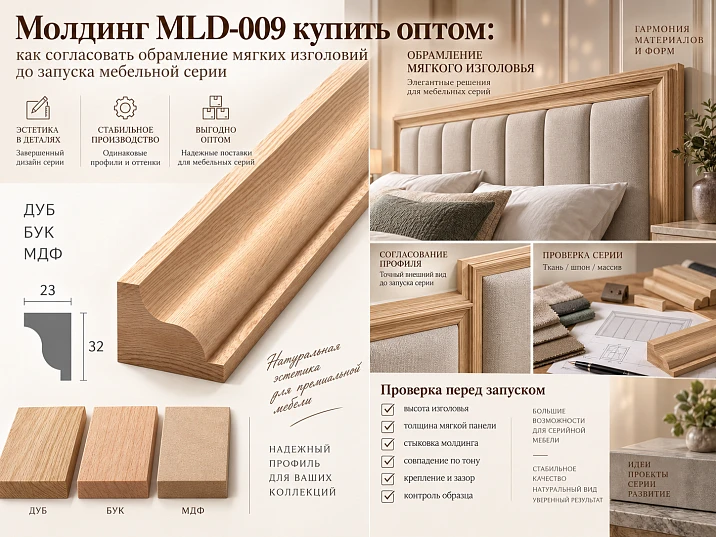
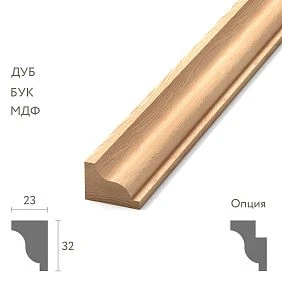
According to the current product page, STAVROS MLD-009 is available in three main versions.
| Material | Section | Product length |
|---|---|---|
| MDF | 32×23 mm | 2600 мм |
| Beech | 32×23 mm | 2400 мм |
| Oak | 32×23 mm | 2400 мм |
Sanding quality — "Prestige".
Product card: buy MLD-009 moulding.
Two things from this table are important for furniture production.
First — the same profile has different commercial lengths in MDF and solid wood.
Second — the supplier sells the profile as a commercial blank. The finished soft headboard frame appears only after the furniture production has determined:
-
lengths of parts;
-
corner joints;
-
base;
-
the mounting system;
-
finishing;
-
assembly order.
MLD-009 does not replace the load-bearing headboard frame and is not a finished upholstery mounting system.




What should be known before requesting a price for the entire series
Minimum:
-
MDF, beech, or oak;
-
2600 or 2400 mm;
-
number of headboard models;
-
dimensions of finished frames;
-
number of sets;
-
finish condition;
-
amount of material for samples;
-
reserve;
-
production sequence.
If only the following is known:
headboard 1800 mm,
this is not enough to purchase a batch.
Our factory also produces:



One finished assembly needs to be divided into three separate elements
For the article, let's adopt a clear design scheme.
Get Consultation
Load-bearing base
It is responsible for the rigidity and securing of the entire structure.
This can be a furniture panel, a frame, or another base provided for by the design.
The article does not specify a particular material or fastener.
Soft insert
This is the rigid upholstery base plus:
-
filling;
-
fabric;
-
fold-overs;
-
technological layers.
After upholstery, its actual dimensions may differ from the original size of the base.
Decorative trim MLD-009
It forms the visible contour and must be coordinated with the actual, not theoretical, size of the finished soft part.
These three elements are related, but should not be measured with a single number.
Why the size of the rigid base cannot be automatically passed to the carpentry shop as the insert size
Let's imagine the base:
1500×700 mm.
After adding the filling and fabric, the finished soft component may become larger in outer dimensions.
How much depends on the specific upholstery.
The article does not introduce a universal allowance.
That is exactly why the upholstery shop must provide not:
base 1500×700,
But:
the actual dimensions of the finished control sample after upholstery.
If this is not done, the frame may be calculated for the inner base rather than the actual soft insert.
The fabric allowance for cutting is not equal to the size of the finished insert
This is one of the most common terminology traps.
The upholsterer might say:
we add 50 mm each.
But this may refer to the fabric allowance for the fold.
The buyer hears:
the soft insert will become 100 mm larger.
These are not the same thing.
Therefore, in the general list, the designations must be separated.
For example:
O-Zh — rigid base.
O-G — finished upholstered insert.
R-P — decorative opening.
Then the line:
O–F = 1500 mm
cannot accidentally end up in the joinery drawing as:
R–P = 1500 mm.
What dimensions should the upholstery shop pass to the joinery shop
For each reference headboard, it is useful to provide:
-
the actual width of the finished insert;
-
actual height;
-
the thickness at a characteristic point;
-
the shape of the corners;
-
the presence of a local thickening;
-
the position of seams or piping, if they affect the fit;
-
the allowable deformation during installation, if provided for by the design.
There is no need to turn a procurement article into an upholstery textbook.
For MLD-009, it is enough to know which actual dimensions must go into the joinery documentation.
Why the corners of a soft part need to be checked separately
Two inserts can have the same width and height but different corners.
For example:
-
on one, the filling rounds the edge more;
-
on the other, the fabric creates a denser fold;
-
on one, the piping creates additional thickening.
If the decorative opening is very close to the finished insert, this difference will show up at the corners earlier than on the straight sides.
Therefore, the control sample must verify:
-
straight section;
-
angle;
-
Side view.
The opening of the decorative frame is a separate dimension
After receiving the finished insert, the carpentry shop sets the decorative opening.
It does not have to exactly equal the overall dimension of the insert.
Various design solutions are possible:
-
visible uniform gap;
-
almost tight fit;
-
overlap of the base;
-
another design.
The article does not set a universal value.
But the calculation method is the same:
opening size − actual dimensions of the finished insert = remaining space.
Practical example: two control inserts
Let's assume the width of the decorative opening is approved:
1520 mm.
After upholstery, two control inserts were obtained.
| Option | Actual width | Remaining space | With symmetrical placement |
|---|---|---|---|
| А | 1510 мм | 10 мм | 5 mm on each side |
| Б | 1518 мм | 2 мм | 1 mm on each side |
Calculation:
1520 − 1510 = 10 mm.
10 / 2 = 5 mm per side.
For option B:
1520 − 1518 = 2 mm.
2 / 2 = 1 mm per side.
But these figures are not a standard.
They only show the geometry.
Whether 5 mm or 1 mm is acceptable is determined by:
-
in design;
-
fabric;
-
the installation method;
-
the real control point.
Why "fits" doesn't mean "suits"
Option B mathematically fits into the opening.
But 1 mm per side can be too sensitive to:
-
soft deformation;
-
uneven angle;
-
actual assembly;
-
local thickening.
Option A provides more free space.
But it may visually appear too large.
Therefore, the right question is:
is it not just that the insert fits, but does the approved assembly look the way it was intended?
The depth of the assembly must be coordinated separately from the frontal dimension
MLD-009 has a cross-section of 32×23 mm.
But the 23 mm dimension alone does not tell you:
-
how far the soft insert should protrude;
-
where its base is located;
-
how deeply it is seated;
-
which part of the profile covers the base.
The product cross-section and the depth of the entire furniture assembly are different initial data.
That is why a section view is needed.
It shows:
-
load-bearing base;
-
soft insert;
-
MLD-009;
-
gap or overlap;
-
visible front line.
The side view often reveals a mistake earlier than the front view
From the front, the frame may look nice.
From the side, it turns out:
-
the soft part protrudes too much;
-
the base is visible;
-
the fabric presses against the profile;
-
the molding gets lost relative to the volume of the insert.
That is why the reference sample needs to be examined not only frontally.
Especially if the headboard has a pronounced thickness and stands in an interior where it is visible at an angle.
A corner sample before mass production is a mandatory checkpoint
A full bed is not needed for the first test.
A real corner fragment is enough:
-
MLD-009;
-
base;
-
filling;
-
fabric;
-
the designed fastening;
-
two sides of the frame.
It is used to check:
-
appearance of the corner;
-
fabric finishing;
-
position of the soft component;
-
access to the mounting;
-
possibility of assembly without force;
-
absence of an exposed base.
Only after this does the series receive an approved assembly.
The result of the sample must be a document, not a verbal statement
Bad result:
we made a sample, everything is fine.
Stronger:
IG-01 / assembly U-01 / fabric A / MLD-009 / revision 1 — approved.
The following are attached to it:
-
photo;
-
a drawing;
-
sizes;
-
material;
-
finishing.
If the fabric is changed later, it is clear which assembly needs to be rechecked.
One headboard model with two fabrics should not automatically turn into two different frames
Let's imagine a series:
-
HB-01-A — headboard of the first size, fabric A;
-
HB-01-B — the same headboard, fabric B.
Intuitively, one wants to immediately create two joinery specifications.
This is not always necessary.
If the control samples after upholstery give the same working dimensions and fit equally well into the approved opening, the frame can remain shared.
Then:
HB-01-A and HB-01-B use one version of F-01.
If fabric B creates a different thickness, a bulkier piping, or noticeably changes the actual dimensions, a separate version appears.
For example:
HB-01-B / F-01B.
The basis is a proven finished assembly, not the color or name of the fabric.
Why fabric color should not change the joinery dimension by itself
Red and beige fabric can have the same structure and behave the same way after upholstery.
Then changing the decorative opening just because of color makes no sense.
And conversely, two fabrics of the same color can have different thickness, stretch, and texture.
Therefore, in the joinery shop specification, what matters is not the marketing fabric collection, but the result of the control upholstery.
Rule:
geometry changes according to the actual assembly, not according to the name of the finishing material.
If one fabric requires a separate frame version, this should be visible to all participants
For example:
IG-01-A / R-01 / fabric A.
IG-01-B / R-01B / fabric B.
Next, the modified version should go to:
-
to the finished inserts list;
-
to the carpentry drawing;
-
to the cutting map;
-
to the purchasing table;
-
to the bill of materials.
You cannot correct a single number only in the carpentry file.
Otherwise, the purchaser will continue to count the old quantity of MLD-009.
The master list must link the upholstery and carpentry shops
The worksheet might look like this:
| Set | Headboard type | Upholstery | Frame drawing | Reference sample | Quantity | Status |
|---|---|---|---|---|---|---|
| IG-01-A | Size 1 | Fabric A | P-01 | OA-01 | 30 | Approved |
| IG-01-B | Size 1 | Fabric B | R-01B | OB-01 | 20 | Approved |
| IG-02-A | Size 2 | Fabric A | P-02 | OA-02 | 10 | Approved |
This table does not replace the drawing.
It links the documents.
If IG-01-B changes, you can immediately see which frame is affected.
The supplier of MLD-009 does not need to be given the entire furniture schedule
The supplier needs the product specification.
For example:
MLD-009 / MDF / 32×23×2600 / quantity ___.
And separately:
MLD-009 / oak / 32×23×2400 / quantity ___.
They do not need to reconstruct the number of slats from phrases:
30 headboards with velvet, 20 with bouclé.
This information is needed by the furniture production department.
The supplier receives the final quantity of product blanks.
How to divide responsibility among project participants
One of the working options:
Designer or engineer
Approves:
-
appearance;
-
opening size;
-
provision MLD-009;
-
general section.
Upholstery shop
Confirms:
-
actual size of the finished insert;
-
thickness;
-
the shape of the corners;
-
characteristics of the selected fabric.
Carpentry shop
Prepares:
-
a frame;
-
angles;
-
base;
-
parts list;
-
cutting map.
Purchaser
Purchases:
-
correct execution of MLD-009;
-
in the required quantity;
-
with separate material for samples and reserve.
Assembly
Works only with the approved revision.
This scheme eliminates the situation:
each person considered their part correct, but the overall assembly does not come together.
What must happen before moving from sample to series
Checkpoint:
sample approved.
The following changes are allowed:
-
fabrics;
-
insert size;
-
the opening;
-
profile position.
After that, changing one parameter triggers a check of related documents.
For example, the fabric was replaced.
The frame does not necessarily need to be changed.
But you need to check whether the actual dimensions have been preserved.
If so, the purchasing card can remain unchanged.
How to convert an approved frame into finished parts MLD-009
First, it's not the meters that are recorded, but the details.
For example, frame R-01 consists of:
-
top detail;
-
the lower part;
-
two side details.
For each row, specify:
-
finish length;
-
measurement system;
-
miter angle;
-
quantity;
-
Material.
If the construction uses a different composition, the list is adapted.
The article should not impose four details on every frame.
The main point:
the composition of details is determined by the drawing, not by a general perimeter formula.
Why the outer size of the headboard cannot be used as the length of the molding
Let's imagine the outer width of the headboard:
1800 mm.
This does not mean:
top part MLD-009 = 1800 mm.
Possible options:
-
side parts that add width;
-
measurement at the outer corner;
-
measurement at the inner corner;
-
the protrusion of the frame;
-
a different cutting system.
Therefore, the length of the finished part must come from the joinery drawing.
The bed size is used for the architecture.
The molding length — for production.
For an angled cut, you need to specify between which points the part is measured
Line:
top 1520 mm
may be insufficient.
It is necessary to understand:
-
along the outer edge;
-
along the inner;
-
along the axis;
-
between the saw cut vertices.
There is no need to introduce a universal system.
But the entire project must use one clear system.
Otherwise, two cutters will produce different parts from the same cutting list.
Practical example of a frame of the first size
Suppose that after approval, the finished parts are obtained:
-
top — 1560 mm;
-
bottom — 1560 mm;
-
side — 760 mm;
-
side — 760 mm.
Per one set:
1560×2 + 760×2 = 3120 + 1520 = 4640 mm.
For 30 headboards:
4640 × 30 = 139,200 mm = 139.2 m of net parts.
This figure is needed as a check.
But the purchase quantity is determined by the commercial length.
How to calculate MDF 2600 for conditional parts 1560 and 760 mm
Let's check the combinations.
One long + one short
1560 + 760 = 2320 mm.
Nominal remainder:
280 mm.
Before accounting for cutting and processing.
So one strip potentially yields:
-
one top/bottom;
-
one side.
Two such strips are needed for the frame.
For 30 frames:
60 MDF strips 2600 mm to a separate reserve.
Net length:
60 × 2600 = 156 m of source material.
Difference from the net 139.2 m:
16.8 m of nominal unused material before accounting for technological losses and possible use of remnants.
How to calculate solid wood 2400 for the same parts
The same combination:
1560 + 760 = 2320 mm.
Nominal remainder:
80 mm.
That is, geometrically the combination also fits.
But much less free length remains.
The actual cutting plan must be checked for:
-
saw kerf;
-
end trimming;
-
edge quality;
-
cuts.
If 80 mm is not enough for the technological process, the solid wood layout must change.
This is a good example:
the math says “it fits,”
but production may say:
the layout is too tight.
Why you cannot automatically promise the same number of slats for 2400 and 2600 mm
In our conditional example, both lengths nominally accept 1560+760.
For a different frame size, the situation may change.
For example:
1600 + 780 = 2380 mm.
For the 2400 array, nominally 20 mm remains.
For MDF 2600 — 220 mm.
The first scheme may be production-unacceptable.
Therefore, changing the material MLD-009 always requires its own cutting map.
The two headboard sizes must be counted as separate pools
Let's imagine:
HB-01 — 30 sets.
HB-02 — 20 sets.
You cannot first add up the total linear meters and then divide it by 2600 or 2400.
First:
-
HB-01 map;
-
IG-02 map.
After that, you can see whether leftovers of one size help cover parts of another.
This way the series is optimized as a whole, but does not lose its structure.
A leftover of one size may be useful for another
For example, after IG-01, a 820 mm piece remains.
If IG-02 has a side part of 780 mm and the following match:
-
material;
-
finish;
-
profile orientation;
-
surface quality,
the leftover may be useful.
Then the total consumption decreases.
But this decision is made after both lists are built.
Why you shouldn't purchase the entire volume before approving the first real upholstery
Even if the design drawing looks complete, the soft insert can still change the actual dimensions.
If you buy all of MLD-009 and cut the frames before the control upholstery, the project loses the opportunity for low-cost correction.
A phased approach is stronger:
-
material for the sample;
-
control upholstery;
-
approval of the opening;
-
final bill of materials;
-
main batch.
This is especially useful with a new fabric or a new upholstery technique.
Sample material cannot be quietly deducted from the main series
If the purchaser ordered exactly as many planks as needed for the finished products, and made several test corners from the first two planks, the series is already short.
Therefore, the specification must have separate lines.
For example:
samples — 3 planks;
series — 60 planks;
reserve — 2 planks.
The exact numbers depend on the project.
Main principle:
material for testing is a separate part of the order.
It must not "accidentally" disappear from the production volume.
Three parts of the purchase: samples, production, repair
Sample material
Used until final launch.
It is used to make:
-
corner fragment;
-
control frame;
-
possible repeat version.
Production volume
Calculated according to the approved list of finished parts.
Repair reserve
Stored for:
-
damage;
-
part replacement;
-
service repair after handover.
These three groups solve different tasks.
Therefore, one general reserve percentage is worse than a deliberate split.
Why the reserve should be tied to critical parts
Let's imagine the long top part R-02 is 2250 mm.
From a 2400 board, it requires almost a whole plank.
If the short side piece of 600 mm is damaged, it can be obtained from the usable offcut.
This means a reserve consisting of many short offcuts does not protect the critical top part.
It is more useful to keep:
-
one or several whole planks;
-
or a ready-made long spare part.
The quantity is determined by the actual map.
How to store the MLD-009 repair reserve
Marking:
MLD-009 / oak / T-01 / project reserve.
If the reserve is assigned to a specific model:
MLD-009 / oak / T-01 / IG-02 / reserve.
For MDF:
MLD-009 / MDF / E-01 / reserve.
This way, a year later you don't have to guess which profile and material were used in the series.
What to do if the fabric changes after purchasing the molding
This is a real B2B scenario.
Batch MLD-009 has already been ordered.
The designer is changing the fabric.
Frames cannot be reworked immediately.
A short check is required.
Step 1
Make a control insert from the new fabric.
Step 2
Measure the actual overall dimensions.
Step 3
Check the existing decorative opening.
Step 4
Check the depth and angle.
Step 5
Only if the assembly does not pass, release a new revision of the frame.
If the new fabric is geometrically equivalent to the old one, the procurement card may remain unchanged.
What to do if the new fabric increased the insert by only a few millimeters
There is no need to automatically change all parts.
First check the actual working clearance.
For example:
old opening — 1520 mm.
Old insert — 1510 mm.
New — 1514 mm.
Remaining space:
1520 − 1514 = 6 mm.
With symmetrical placement:
3 mm per side.
Whether this result is acceptable is determined by the test assembly.
If yes, frame R-01 remains.
If no, R-01B appears.
How to manage drawing revisions
For example:
R-01 / revision 1 — fabric A.
After checking fabric B:
R-01 / revision 2 — if the geometry has changed.
Or:
R-01 / revision 1 applies to A and B.
This must be stated explicitly.
You cannot keep two different files with the name:
final.
Who has the right to change the approved size
In serial production, it is useful to assign responsibility.
For example:
-
the upholstery shop reports the actual size;
-
the designer changes the assembly;
-
the process engineer updates the bill of materials;
-
the purchaser recalculates the slats;
-
production receives the new revision.
The upholsterer must not reduce the frame on their own.
The carpenter must not "add another 5 mm" on their own.
Otherwise, the changes will not be included in the general specification.
How to work with two headboard sizes and two fabrics
We get four combinations:
-
HB-01-A;
-
HB-01-B;
-
HB-02-A;
-
HB-02-B.
It is not necessary to have four different frames.
After the control samples, you may get:
-
HB-01-A → F-01;
-
HB-01-B → F-01;
-
IG-02-A → R-02;
-
IG-02-B → R-02B.
That is, the real complexity is determined not by the number of fabrics, but by the number of confirmed geometric variants.
This helps avoid bloating the nomenclature.
Why frame unification is useful but should not be an end in itself
One frame for two fabrics:
-
simplifies cutting;
-
reduces the number of SKUs within the workshop;
-
reduces the risk of mis-sorting.
But if one fabric physically requires a different geometry, unification cannot be forcibly maintained.
Rule:
First a working assembly, then unification.
Not the other way around.
Working master list for the entire series
Example:
| Set | Frame | Fabric | Quantity | Status |
|---|---|---|---|---|
| IG-01-A | P-01 | А | 30 | Approved |
| IG-01-B | P-01 | Б | 20 | Approved |
| IG-02-A | P-02 | А | 10 | Approved |
| IG-02-B | R-02B | Б | 10 | Approved |
Now the technician can sum not the external bed dimensions, but the finished frame versions.
How to build a separate parts list
For example:
| Frame | Detail | Length | Quantity per frame | Material |
|---|---|---|---|---|
| P-01 | Top | 1560 | 1 | MDF |
| P-01 | Bottom | 1560 | 1 | MDF |
| P-01 | Side | 760 | 2 | MDF |
| P-02 | Top | ... | 1 | MDF |
| P-02 | Bottom | ... | 1 | MDF |
After that:
number of frames × parts = production requirement.
And only then:
parts → source slats.
Why the cutting map should be built after the final frame composition
If P-01 is optimized first, and it later turns out that P-02 has short parts that perfectly use P-01 leftovers, the earlier calculation will prove to be overestimated.
Therefore, it's better to:
-
approve all frame versions;
-
collect all lengths;
-
protect critical long parts;
-
optimize the short ones.
This way the series works as a single production pool.
But materials and finishes cannot be mixed in one pool
Separately:
-
MDF 2600;
-
beech 2400;
-
oak 2400.
If there are different solid wood finishes, they are separated as well.
The oak leftover does not cover the beech requirement.
If the visible finish differs, the remainder of T-01 should not automatically be transferred to T-02.
How to account for material with two identical geometries
R-01 can exist:
-
in MDF;
-
in oak.
The frame dimensions are the same.
The cutting map is different due to 2600/2400.
Therefore, it is better to designate it as:
R-01-MDF.
R-01-O.
If a material only affects the purchasing map and not the external dimensions, it is still useful for production.
How to compare the full cost of a batch
The price of a plank is only one part.
Need to consider:
-
commodity blanks;
-
finishing;
-
material for samples;
-
reserve;
-
cutting;
-
corner joints;
-
packaging;
-
delivery.
A useful indicator:
full cost of batch preparation / number of approved sets.
For the request building materials at wholesale prices this is stronger than simply comparing the price of one plank.
Why a cheap plank may not result in a cheap headboard
If the material is cheaper, but:
-
produces more waste;
-
requires a separate frame version;
-
more rework;
-
more complex finishing,
the final set may be more expensive.
And conversely, a more expensive plank may cut more efficiently.
Therefore, the commercial choice is made after the parts map.
How to compare supplier offers
for Wholesale building material suppliers the technical basis must be the same.
You need to compare:
-
the same MLD-009;
-
one material;
-
one commercial length;
-
the same quantity;
-
the same surface requirements;
-
the same packaging and delivery.
If one supplier quotes MDF and another oak, the total price is not directly comparable.
It is useful to tie the production sequence to milestones
For example:
Stage 1
Material for samples.
Stage 2
Approval of IG-01-A and IG-01-B.
Stage 3
Final schedule.
Stage 4
Order of the main batch MLD-009.
Stage 5
First 5–10 sets.
Stage 6
Monitoring actual consumption and assembly.
Stage 7
Remaining series.
So wholesale supplies of building materials are synchronized with the actual readiness of the furniture project.
The first small series should test not only the appearance
After the first sets, check:
-
the insert fits without forced deformation;
-
the frame does not require trimming;
-
the corners align;
-
the fabric is not damaged;
-
the actual dimensions match the specification;
-
the actual consumption of MLD-009 is close to the estimate;
-
the marking is clear.
If the problem recurs, the system is adjusted for the remaining batch.
When it is better not to buy MLD-009 for this task
A specific profile should not be used at any cost.
It is better to consider another solution if:
-
the 32×23 cross-section is too bulky for the selected headboard;
-
the profile visually conflicts with the upholstered part;
-
the depth of the assembly does not allow the insert to be positioned properly;
-
the project requires a thinner outline;
-
a different furniture style has been selected;
-
MLD-009 interferes with servicing or removing the upholstered insert.
The expert article should allow the conclusion:
this profile is not suitable for the specific assembly.
How to check the scale of the 32×23 profile on a full headboard
The corner sample tests the construction.
But for scale, it is useful to attach a real MLD-009 to a full-size headboard outline.
Then you can see:
-
how wide the visual edge is;
-
whether the frame "eats into" the soft field;
-
whether the depth of the relief is suitable;
-
whether the profile matches the bed and nightstands.
This is already an aesthetic check before a wholesale order.
How to prepare a request to the supplier after approving all frames
The supplier does not need to be sent photos of fabrics or an explanation of how the headboard is constructed.
They need an exact product specification.
For example:
MLD-009 / MDF / 32×23×2600 / "Prestige" quality / quantity ___ pcs.
And separately:
MLD-009 / oak / 32×23×2400 / quantity ___ pcs.
If the series is divided by materials, each line is counted separately.
The purchaser must attach:
-
quantity;
-
material;
-
the required commercial length;
-
surface requirements;
-
delivery sequence;
-
packaging;
-
delivery.
SKU anchor order molding MLD-009 it makes sense to use it at this stage, when the furniture project has already been converted into a commercial request.
What is handed over to the joinery shop
The joinery production, on the contrary, needs:
-
frame version;
-
lengths of parts;
-
corner cuts;
-
measurement system;
-
material;
-
quantity;
-
cutting map;
-
kit codes.
For example:
R-01-MDF / top / 1560 / 30 pcs.
R-01-MDF / bottom / 1560 / 30 pcs.
R-01-MDF / side / 760 / 60 pcs.
So the workshop does not restore dimensions from the general headboard card.
What is passed to the upholstery workshop
The upholstery workshop must receive:
-
dimensions of the rigid base;
-
allowable geometry of the finished insert;
-
corner drawing;
-
fabric code;
-
kit designation;
-
project version.
They do not need to know the number of MLD-009 slats.
But they must understand which actual overall dimension needs to be confirmed after upholstery.
What is handed over to assembly
The assembler receives:
-
kit IG-01-A;
-
insert;
-
a frame;
-
base;
-
current revision;
-
assembly order.
If the assembler finds that the soft insert does not fit, they must not file down MLD-009 on their own without
When a separate revision is needed for the second production run
For example, the first run:
IG-01 / R1.
After it, the upholstery shop changes the filling.
The finished overall dimensions have changed consistently.
Then the following appears:
IG-01 / R2.
There is no need to rewrite the old documentation as if R1 never existed.
It has already been used in finished products.
The revision history is needed for repairs and reordering.
How to keep a passport for a headboard model
Useful passport:
-
model HB-01;
-
frame version F-01;
-
MLD-009;
-
material;
-
finish;
-
opening size;
-
reference fabric;
-
actual size of the reference insert;
-
photo of the assembly;
-
parts map;
-
revision.
A year later, this is far more useful than the phrase:
the frame around the headboard was approximately like this.
How to create a repair order after several years
If the upper section of the frame is damaged, the reorder must start with the passport.
For example:
IG-01 / R-01 / top 1560 / MLD-009 / oak / T-01.
If a whole strip is being purchased:
MLD-009 / oak / 32×23×2400 / T-01 / 2 pcs. for repairing IG-01.
This way the new part reproduces the correct geometry.
Why the new material may look different from the old one
For oak and beech, the natural wood grain may differ between batches.
If the profile is under a covering finish, this is less significant.
If the wood is visible, the repair reserve from the original batch becomes especially useful.
The article does not promise an exact match with new wood after a few years.
How to store leftovers after a series
After cutting, the following remain:
-
full planks;
-
long offcuts;
-
short pieces.
Not everything should be counted as a repair reserve.
For example, if the upper repair part is 1560 mm, a 600 mm piece will not replace it.
Therefore, leftovers are classified:
whole;
long useful ones;
short ones for specific parts;
not used in the current series.
Why the total remaining length in meters is misleading
In stock:
MLD-009 — remaining 18 m.
Actual:
-
20 pieces of 300 mm;
-
8 at 800 mm;
-
one plank 2600 mm.
For the top part 1560 mm, the real reserve is one whole plank.
Therefore, after the series, it is important to keep the length structure.
How to compare MDF, beech, and oak for the same frame
If the design allows for different materials, each option must be calculated separately.
MDF (740–760 kg/m³, emission class E1/E0) provides ideal geometry, uniformity, and better base for enamel: high adhesion, smooth surface, absence of knots and cracks.
-
32×23×2600;
-
a covering finish can simplify external inspection;
-
the cutting map is built for 2600.
Beech and oak
-
32×23×2400;
-
with visible wood, a natural texture appears;
-
cutting map for 2400.
You cannot transfer the number of slats from MDF to oak without a new calculation.
How not to turn the article into a choice of "which material is better"
There is no universally best material.
The choice depends on:
-
design;
-
finishing;
-
budget;
-
adjacent parts;
-
furniture series logic.
The central objective of the article remains the same:
first approve the finished upholstered unit, then purchase the profile.
How to proceed if the first and second production batches yielded different actual dimensions
Let's imagine the first ten IG-01 inserts consistently came out at roughly the same overall size after upholstery. Frame R-01 is approved, MLD-009 is purchased and cut.
In the second batch, the upholstery shop changes the production operation, the filling batch, or the fabric tensioning method. The model looks the same, but the finished inserts begin to differ systematically.
Bad scenario:
the carpentry shop continues with the old frame, while assembly "presses" the upholstered part into place.
It is better to stop at the level of a control sample and determine whether this is:
-
random one-off variation;
-
a sustained change in technology;
-
a measurement error;
-
new actual version of the insert.
If the change is permanent, a new revision must be issued.
For example:
IG-01 / R-01 / revision 1 — first batch.
IG-01 / R-01B / revision 2 — second.
This way, the finished furniture remains traceable.
Why there is no need to re-cut the already finished frames of the first batch
If the first batch:
-
is assembled;
-
matches the sample;
-
has passed acceptance,
a change to the second batch does not automatically make the first one incorrect.
The new revision applies only where the design has actually changed.
This prevents unnecessary rework of already quality products.
A responsibility matrix helps stop changes “by phone”
In serial production, it is useful to have a short rule for who changes which parameter.
| Parameter | Who provides | Who approves | Who is notified |
|---|---|---|---|
| Finished upholstery dimensions | upholstery shop | Construction set | carpentry workshop, purchaser |
| Decorative opening size | Construction set | project/designer | carpentry, assembly |
| MLD-009 details | Technologist | Construction set | purchaser, production |
| Number of planks | technologist/purchaser | Production | Supplier |
| Material and finish | Project | customer/designer | all related workshops |
The reader does not need such a table as bureaucracy.
It solves a specific problem:
no one changes the frame size verbally without updating the related documents.
How to compare two versions of a frame before mass recalculation
If Р-01 and Р-01Б differ by a small dimension, it is useful to first compare:
-
which parts actually changed;
-
whether the number of slats changes;
-
whether the cutting map changes;
-
whether already cut elements can be used;
-
whether new waste appears.
For example, the top part has increased:
1560 → 1570 mm.
The side ones remained 760 mm.
For MDF 2600, the combination:
1560 + 760 = 2320 mm.
After the change:
1570 + 760 = 2330 mm.
Both schemes nominally fit.
This means the number of planks may not change.
Then the purchasing adjustment is minimal.
But if the parts were:
1800 + 780 = 2580 mm,
and after the change the long one became 1820:
1820 + 780 = 2600 mm.
The net total already equals the full product length of the MDF, and the real technological allowance disappears.
So a change of just 20 mm can completely break the cutting map.
Why every size change must be checked not only on the product but also in the cutting layout
The designer might say:
the opening was increased by only 10 mm.
For a single frame, that is negligible.
For the purchasing map, this can change:
-
the combination of two parts in one strip;
-
the number of whole blanks;
-
reserve;
-
batch cost.
Therefore, after changing the frame, the cutting layout must be recalculated.
It is not necessary to rewrite the entire article or the entire project.
It is enough to recalculate the affected groups.
How to account for test parts that can be used in the series after approval
Sometimes the control frame remains suitable for the finished product.
Then the question arises:
should the sample material be counted as a separate expense?
It can be used in the series if:
-
it fully matches the final version;
-
the finish is the same;
-
no signs of testing;
-
quality confirmed;
-
the set can be traced.
But until verification, the sample should be treated as a separate line item.
Only after approval does its status change:
sample → production part.
This way, the buyer does not assume in advance that the test material will necessarily "come back."
How to proceed if the reference sample had to be redone several times
For example:
-
U-01 — opening too tight;
-
U-02 — gap too large;
-
U-03 — approved.
Material U-01 and U-02 has already been used up.
This is a normal development cost.
Only one thing is bad:
not accounting for it in the total requirement and then suddenly discovering a shortage.
Therefore, before a new headboard design, the material for samples must have a realistic reserve.
Not a universal percentage, but a separate line item.
Buyer questions that need to be resolved before ordering
Can the entire MLD-009 be ordered before fabric approval?
Technically, the profile can be purchased in advance.
But for a new series, this increases the risk if the size of the finished insert has not yet been verified.
It is wiser to first confirm the control assembly, especially if the fabric, filling, or construction are new.
Is it sufficient to give the carpentry shop the size of the rigid base?
No.
The actual dimensions of the finished upholstered insert are needed, or a confirmed technological model that has already proven repeatability.
Is it necessary to make a separate frame for each fabric color?
No.
A different color by itself does not change the geometry.
A separate version is needed only when a change to the finished assembly is confirmed.
Who calculates the cutting for MLD-009?
The furniture production team or a designated technologist who knows the finished part lengths, the selected commercial length, and the technological allowance.
The supplier is given the number of product strips.
Can the quantity be calculated using the total perimeter?
The perimeter is useful as a verification value.
But it does not show which parts actually fit into a 2400 or 2600 mm strip.
A cutting map is needed for purchasing.
Do I need to order additional profile processing?
Only if it is specified by a particular drawing and a confirmed assembly.
This article does not use additional rebate sampling as the basis for the decision.
What should I do if the fabric was replaced after ordering the batch?
First make a test insert of the new version and check the existing frame.
MLD-009 should only be recalculated if the geometry has actually changed.
What should be done if, after upholstery, the insert differs from the approved size?
Do not adjust frames en masse on site.
First determine the cause and decide whether the upholstery technology is being adjusted or a new version of the frame is being released.
What the final request for a wholesale batch should look like
After all checks, the letter or request becomes short and unambiguous.
For example:
We ask you to calculate a batch of MLD-009 molding in the finish specified in the specification. The profile is intended for the production of decorative framing for a series of upholstered headboards. The frame dimensions have been agreed upon using control upholstered inserts. The number of commercial strips has been calculated according to the approved cutting map; material for samples and the reserve have been allocated separately. Please confirm the finish, batch cost, preparation time, packaging, and delivery.
This is sufficient because all the complex furniture logic is already handled within the project.
Final procurement readiness matrix
| Check | Status |
|---|---|
| MLD-009 and material selected | Yes/No |
| Control soft insert manufactured | Yes/No |
| Actual dimensions measured | Yes/No |
| Decorative opening approved | Yes/No |
| Corner sample assembled | Yes/No |
| Side section approved | Yes/No |
| Fabric versions checked | Yes/No |
| Frame list final | Yes/No |
| Cutting plan approved | Yes/No |
| Number of product strips known | Yes/No |
| Material for samples accounted for | Yes/No |
| Reserve determined | Yes/No |
| All workshops work from a single revision | Yes/No |
If at least the key geometric lines remain "no", a large wholesale order is still premature.
When the system is truly ready for scaling
Not when a single beautiful sample has pleased the designer.
But when:
-
several ready-made inserts repeat the approved geometry;
-
the frame is assembled without individual fitting;
-
the corners look identical;
-
the first small batch confirms consumption;
-
drawings Р-01, Р-02 and their versions are unambiguous;
-
the carpentry and upholstery shops use the same designation system;
-
the purchaser knows the exact number of slats.
Then the wholesale purchase of MLD-009 becomes the final step in preparing the series, rather than an attempt to buy material before the furniture structure itself is defined.
How to verify that the purchasing batch does not get ahead of the project's readiness
Before payment, it is useful to compare two lists.
The first — what has already been approved:
-
material MLD-009;
-
control insert;
-
actual dimensions after upholstery;
-
decorative opening;
-
frame version;
-
cutting map.
The second — what is still changing:
-
fabric;
-
filling;
-
base size;
-
angle;
-
assembly method.
If a parameter that can change the geometry remains in the second list, it is better not to convert the entire preliminary footage into a final order.
This is especially important for a large series: an error in one control unit is multiplied not by one bed, but by dozens of identical sets.
Why the first small purchase is not considered a loss of wholesale efficiency
Sometimes you want to order the entire volume at once for the sake of one delivery and one price.
But for a new design, a small first batch can be economically more reasonable because it tests:
-
actual cutting;
-
consumption for samples;
-
actual repeatability of upholstery;
-
suitability of packaging;
-
clarity of documentation.
If the series does not require rework after it, the remaining volume is purchased according to the already verified specification.
The savings here come not from fewer meters, but from preventing a mass error.
What counts as a finally approved set
A set can be considered ready for mass purchasing when four documents refer to the same item:
-
the upholstery drawing shows the actual insert;
-
the joinery drawing — the confirmed opening and MLD-009 parts;
-
the cutting map — the actual number of commercial strips;
-
the purchasing specification — the same material and the same revision.
If at least one document contains an old size, the series is still vulnerable to mis-sorting and rework.
Before paying for the main batch, it is useful to put the same revision number and approval date on all four documents. Then any subsequent adjustment immediately becomes visible to the purchaser, the process engineer, and both production groups.
Such a check takes less time than correcting frames that have already been manufactured. For a wholesale order, it is especially valuable: a single unnoticed millimeter conflict is repeated across dozens of items, while a single agreed-upon revision, conversely, allows a series to be produced without constant on-the-spot decisions.
Fifteen mistakes when purchasing MLD-009 for soft headboards
1. Calculating the frame based on the bed size
Why it happens: this is the most obvious dimension.
Consequence: the molding lengths do not match the actual assembly.
How to prevent it: work from the carpentry drawing of the frame.
2. Passing off the size of the rigid base as the size of the finished insert
Why it happens: the base is known earlier.
Consequence: the upholstery increases the overall dimensions, and the insert does not fit.
How to prevent it: measure a reference finished upholstery piece.
3. Confusing fabric allowance with the finished size
Why it happens: both are expressed in millimeters.
Consequence: the buyer incorrectly increases the opening.
How to prevent: different designations for O-Zh, O-G, and R-P.
4. Buy the entire batch before the control upholstery
Why it happens: they want to save time.
Consequence: changing the fabric requires redoing the entire series of frames.
How to prevent: sample first.
5. Check only the front view
Why it happens: that is exactly what the designer sees.
Consequence: the base is exposed from the side or the thickness conflicts.
How to prevent: cut and side sample.
6. Not checking the angle of the soft insert
Why it happens: width and height match.
Consequence: local thickening hits the molding.
How to prevent: real corner fragment.
7. Making the opening too large "just in case"
Why it happens: they want to avoid a tight fit.
Consequence: the visible gap becomes part of the design without approval.
How to prevent: approve the opening on the sample.
8. Calculating the cutting layout only by net footage
Why it occurs: it is convenient to divide by 2400/2600.
Consequence: the number of product planks is underestimated.
How to prevent: a map of real part combinations.
9. Use an MDF map for solid wood
Why it happens: the cross-section is the same.
Consequence: 2600 and 2400 give different cutting stock allowances.
How to prevent: a separate map for each material.
10. Do not allocate material for samples
Why it occurs: tests are counted as part of the total consumption.
Consequence: there is not enough production material.
How to prevent: a separate “samples” line.
11. Use a single overall reserve percentage
Why it happens: standard practice.
Consequence: short remnants do not cover a critical long part.
How to prevent: reserve based on real risks.
12. Change the fabric without re-checking
Why it happens: the headboard model does not change.
Consequence: the new upholstery changes the actual dimensions.
How to prevent: test-fit the new fabric.
13. Change the frame size in only one document
Why it happens: the edit is made urgently.
Consequence: the purchaser and the workshop are working from different revisions.
How to prevent: a linked master ledger.
14. Ask the supplier to restore the quantity by furniture dimensions
Why it occurs: the cutting map is not ready.
Consequence: the product request is ambiguous.
How to prevent: pass the number of standard strips.
15. Place a reorder only by SKU
Why it occurs: MLD-009 is already known.
Consequence: the material, length, finish, and frame version are lost.
How to prevent: the full repair code.
Pre-wholesale order checklist MLD-009
Before paying for the main batch, the following must be determined:
-
SKU MLD-009;
-
material;
-
32×23×2600 or 32×23×2400;
-
surface quality;
-
headboard model;
-
dimensions of the rigid base;
-
actual finished upholstery size;
-
corner shape;
-
insert thickness;
-
decorative opening;
-
side section;
-
control angle;
-
control frame;
-
fabric versions;
-
which fabrics share a common frame;
-
frame codes;
-
finished parts list;
-
cut measurement system;
-
cutting map;
-
number of whole slats;
-
material for samples;
-
production reserve;
-
repair reserve;
-
production sequence;
-
documentation revision;
-
reorder format.
If only the external bed size and the number of headboards are known, the procurement task is not yet closed.
Final logic of the MLD-009 wholesale order
For serial upholstered headboards, the order should be as follows:
MLD-009 32×23
→ material
→ HEADBOARD CONSTRUCTION
→ RIGID BASE
→ CONTROL UPHOLSTERY
→ ACTUAL INSERT DIMENSIONS
→ CORNER SHAPE
→ DECORATIVE OPENING
→ SIDE SECTION
→ CORNER SAMPLE
→ APPROVED FRAME VERSION
→ FINISHED PARTS LIST
→ CUTTING MAP
→ NUMBER OF COMMERCIAL STRIPS
→ SAMPLE MATERIAL
→ RESERVE
→ FIRST SMALL BATCH
→ ACTUAL CONSUMPTION CONTROL
→ MAIN BATCH
→ REPAIR PASSPORT AND REORDER
After such preparation, you can order molding MLD-009 as an exact product batch, rather than as a preliminary linear footage around a theoretical headboard.
The main question in wholesale purchasing is not:
how many meters of moulding are needed for 50 beds?
But:
what actual size does the finished upholstered insert have, which decorative opening is confirmed by the control assembly, which parts form the frame, and how many standard MLD-009 strips are obtained after the actual cutting map?
If these parameters are agreed upon before payment, the carpentry and upholstery shops work with a single geometry, and a change of fabric or filling does not turn into mass rework of the decorative frames.