Article Contents:
- MLD-002: which stock lengths are used in the calculation
- Why total linear meters don't answer the question of which lengths to buy
- The first fork is material, the second is length
- First, a bill of finished parts is compiled
- We divide parts by required length, not by furniture name
- Group A — long critical parts
- Group B — parts up to 1000 mm
- Group C — very short parts
- Why you shouldn't start cutting with drawers
- When buying 1000 mm is not worthwhile
- Conditional example: an 820 mm part
- Conditional example: three 700 mm parts
- Conditional example: a long vertical and a short horizontal
- The number of 1000 mm strips is determined last
- A 2600 mm MLD-002 made of MDF is calculated using a different scheme
- Why you shouldn't choose beech just for the convenient 1000 mm length
- Beech 1000 and 2400 mm — two separate items of the same material
- Oak 1000 and 2400 mm: the same logic plus finish control
- Why calculating each facade separately is not always profitable
- But assembly after cutting is still done by facades
- How to label the source strips 1000 and 2400 mm
- Why the reserve is also divided by lengths
- How to determine the minimum useful remnant
- Remaining stock report
- Scheme A — 2400 mm only
- Scheme B — 2400 + 1000 mm
- Tall doors
- Horizontals of tall doors
- Drawers
- Checking drawer 420 + 420
- Checking drawer horizontals 760 mm
- What to do with parts 950–990 mm
- What to do with parts slightly longer than 1000 mm
- How to account for technical allowance in part classification
- Why MDF 2600 can more efficiently cover short and long parts simultaneously
- How to distribute long parts between 2400 and 2600
- How to work with parts of the same length in different materials
- How to use 1000 mm for the repair stock
- How not to cut into the long repair reserve for the current series
- How to combine short parts within 1000 mm
- 420 + 420
- 420 + 500
- 300 + 300 + 300
- When 1000 mm is especially convenient for serial drawers
- When short planks can reduce warehouse risk
- How to compare a scheme by cost without made-up prices
- How to account for the packaging frame in a mixed batch
- Why a mixed batch of 1000/2400 requires a separate packaging list
- How to receive MLD-002 in production
- What to do if fewer one-meter strips arrived
- What to do if too many 1000 mm were ordered
- How to transfer surplus one-meter strips to the repair reserve
- How to work with multiple furniture models
- But furniture sets must be preserved after cutting
- How to work with the first production batch
- Phase 1
- Queue 2
- How to verify that one-meter strips actually delivered an economic benefit
- How to calculate the actual usable remainder
- Why short strips should not be purchased "just in case"
- How to process changes if the facade has become longer
- Third phase
- Why the remnants of the previous batch need to be inventoried before the next order
- How to recalculate the scheme after changing the number of drawers
- How to recalculate the scheme after reducing the number of tall doors
- How to determine whether part of the 1000 mm should be converted back to 2400
- How to assess the warehouse complexity of a mixed scheme
- How to calculate the cost of an error in incorrect length distribution
- Why the length function is more important than the total remainder
- How to use a short bar for control samples
- What to do if a sample can be used in a series after approval
- How to create a repair passport
- When MLD-002 1000 mm is especially useful for repairs
- When MLD-002 should not be purchased at all for specific furniture
- Quick length selection matrix before the final order
- How to tell that the 1000/2400 scheme has become too complex
- How to lock in the final balance before payment
- How to verify actual savings after the first production week
- Why the final order must retain its structure even after optimization
- 1. Ordering everything only in 2400 mm
- 2. Ordering too much 1000 mm
- 3. Starting cutting with drawers
- 4. Considering any leftover useful
- 5. Buying 1000 mm for a 760 mm part automatically
- 6. Considering 995 mm guaranteed to fit under 1000
- 7. Transferring the 1000/2400 scheme to MDF
- 8. Choosing beech only for its short length
- 9. Mixing beech and oak
- 10. Not separating 1000 and 2400 upon receipt
- 11. Storing reserve only in meters
- 12. Cut a long reserve into short parts
- 13. Do not take into account the remains of the first batch
- 14. Count each furniture facade separately
- 15. Make a reorder only by SKU
- What size is MLD-002?
- Is there an MLD-002 with a length of 1000 mm?
- Is there MDF MLD-002 1000 mm?
- When is it profitable to buy 1000 mm?
- When is it more profitable to use 2400 mm?
- Can I order only 1000 mm for small facades?
- Why can't I calculate using only linear meters?
- Which parts should be cut first?
- Should I keep a full-length piece in reserve?
- Can I mix 1000 and 2400 mm from the same batch?
- How do I receive a wholesale delivery?
- How should I label short and long strips?
- What should I do if the facade dimensions changed after ordering?
- Where can I buy MLD-002?
- What should I provide to the manager for a batch calculation?
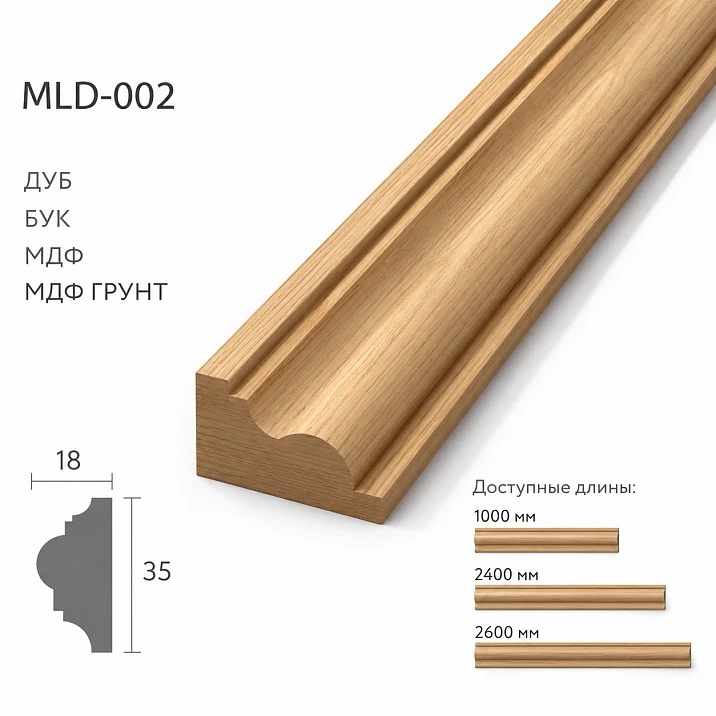
MLD-002 is interesting for wholesale purchasing not only because of the 22×11 mm profile itself, but also because of the range of available commercial lengths. For solid beech and oak, you can work with both 1000 mm strips and 2400 mm long lengths. For MDF, a 2600 mm strip is used. On a large furniture series, this gives the buyer an additional tool: short parts can be allocated to a separate one-meter pool, while long blanks are kept for verticals and other critical elements.
But the very ability to buy MLD-002 in 1000 mm length does not yet mean that all parts shorter than a meter should automatically be made from one-meter strips. Sometimes three short elements are much more economical to obtain from a single 2400 mm strip. Sometimes, after a long vertical, a usable piece remains that covers a drawer without an additional purchase. And conversely, if a long length is cut into short fronts too early, there may not be enough solid blanks later for tall doors.
Therefore, MLD-002 should be bought wholesale after dividing all finished parts by actual length and purpose.
Main sequence:
facade schedule → finished parts schedule → long critical parts → long strips 2400/2600 → actual remnants → short parts → shortage of short parts → MLD-002 1000 mm → final quantity of commercial strips → marking → reserve → wholesale batch.
The main rule of this article:
the quantity of MLD-002 in 1000 mm length is determined last, after the real residual stock of long strips is clear.
MLD-002: which commercial lengths are included in the calculation
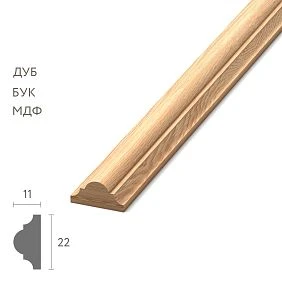
The current MLD-002 range is built around the 22×11 mm profile.
| Material | Section | Product length |
|---|---|---|
| Beech | 22×11 mm | 1000 мм |
| Oak | 22×11 mm | 1000 мм |
| Beech | 22×11 mm | 2400 мм |
| Oak | 22×11 mm | 2400 мм |
| MDF | 22×11 mm | 2600 мм |
Product card: MLD-002 in STAVROS.
For current versions, the "Prestige" grinding quality is used. MDF is considered a separate product line at 2600 mm. The short length of 1000 mm applies to solid beech and oak.
The following cannot be written in the purchasing table:
MLD-002 — 120 pcs.
At minimum, the following must be separated:
MLD-002 / beech / 22×11×2400 — ___ pcs.
MLD-002 / beech / 22×11×1000 — ___ pcs.
MLD-002 / oak / 22×11×2400 — ___ pcs.
MLD-002 / oak / 22×11×1000 — ___ pcs.
MLD-002 / MDF / 22×11×2600 — ___ pcs.
These are five different product lines, even if the profile visually belongs to one model.




Why total linear meters don't answer the question of which lengths to buy
Let's imagine a furniture series:
-
18 tall doors;
-
24 standard fronts;
-
36 drawers;
-
one MLD-002;
-
some parts are longer than a meter;
-
some are shorter.
The buyer receives:
MLD-002 — 186 linear meters.
This figure is useful for a rough budget. But it does not show:
-
how many parts require a length over 1000 mm;
-
how many 2400 strips need to be kept whole;
-
which short parts can be covered by leftovers;
-
how many one-meter strips will be needed in total;
-
which material corresponds to which length.
If you buy everything only in long lengths, some of the 2400 mm strips may go toward parts of 400–800 mm.
If you buy too many 1000 mm pieces, the opposite problem arises: the short pool will be overflowing, while long whole parts will be left without material.
Therefore, linear meters are only a checksum. A production order is calculated in whole strips of a specific length.
Our factory also produces:
The first fork is the material, the second is the length
You cannot start with the words:
we have many short parts, so we take MLD-002 1000 mm.
First, the project determines the material.
If MDF is required, the current product logic is 2600 mm. The economics of one-meter beech and oak planks do not apply to it.
If beech is selected:
-
2400 mm;
-
1000 mm.
If oak is selected:
-
2400 mm;
-
1000 mm.
That is, the short length is a tool for optimization within the selected solid wood, not a reason to change the material.
Get Consultation
First, a list of finished parts is compiled
Not:
cabinet Ш-01 — 7.8 m MLD-002.
But:
| Code | Detail | Finished length | Quantity |
|---|---|---|---|
| D-01 | long vertical | According to the drawing | ... |
| D-02 | short vertical | According to the drawing | ... |
| G-01 | Top horizontal | According to the drawing | ... |
| G-02 | drawer horizontal | According to the drawing | ... |
| Ya-01 | short side | According to the drawing | ... |
Each length is taken from the approved facade.
Only such a table allows determining:
-
what necessarily requires 2400 or 2600;
-
what potentially fits into 1000;
-
what can be manufactured from the remainder.
We divide parts by required length, not by furniture name
This is the central method.
Group A — long critical parts
Do not fit within 1000 mm.
For example:
-
tall verticals;
-
long horizontals;
-
large frame sides.
They are first provided with long strips.
Group B — parts up to 1000 mm
Potential candidates for the short MLD-002.
But the word "potential" is key here.
Group C — very short parts
They are primarily attempted to be covered by useful remnants after long cutting.
For example:
-
drawer horizontals;
-
short upper elements;
-
small side sections.
Main conclusion:
a part shorter than 1000 mm does not yet mean a separate purchase of a 1000 mm strip.
Why short parts are checked against leftovers first
Suppose a long vertical of 1750 mm is made from a 2400 mm strip.
Nominal remainder:
2400 − 1750 = 650 mm.
If the project has a short horizontal of 600 mm, a separate one-meter strip may not be needed for it.
If the horizontal is 720 mm, the 650 mm leftover is already insufficient.
Then a short 1000 mm strip becomes a real candidate.
The one-meter MLD-002 is needed not because the part is short, but because it cannot be covered by rational leftovers from the long stock.
Why you should not start cutting with drawers
Drawers are often most convenient to start with first:
-
the parts are short;
-
there are many repeats;
-
cutting seems simple.
But this is exactly what can ruin long-length stock.
Let's imagine there is a beech board MLD-002 2400 mm in the warehouse.
The craftsman starts cutting drawer frames at 700–800 mm.
After a few hours, several whole strips turn into a set of short pieces.
When it's time for tall fronts, it turns out that few long solid blanks remain.
By meters, there is still material.
In terms of length structure — no longer.
Therefore, a strict production order is introduced:
first the long critical parts, then the short ones.
When MLD-002 with a length of 1000 mm is truly useful
The one-meter strip is especially rational if several conditions are met simultaneously:
-
beech or oak is selected;
-
the part is definitely shorter than 1000 mm;
-
there are many such parts;
-
there are not enough suitable 2400 mm remnants;
-
the parts are repeated in series;
-
purchasing 1000 mm reduces long-length material consumption or warehouse chaos.
Typical scenario:
-
dozens of boxes;
-
small doors;
-
narrow upper facades;
-
identical horizontals.
But the exact effect is determined by the map.
When buying 1000 mm is unprofitable
If all short parts are well covered by 2400 mm leftovers, a separate short pool will only complicate purchasing.
Additional consequences:
-
more product units;
-
more stock items;
-
more packaging groups;
-
new leftovers from 1000 mm;
-
additional labeling.
Therefore, you cannot use the formula:
short part = buy 1000 mm.
More correctly:
short part → check remaining stock → output only the shortage as 1000 mm.
Conditional example: part 820 mm
An 820 mm part fits into MLD-002 with a length of 1000 mm.
Nominal remainder:
1000 − 820 = 180 mm.
Before accounting for the actual cut and processing.
At first glance, a short strip looks like the ideal solution.
But if, after a long part of 1500 mm, what remains of the 2400 is:
900 mm,
then the 820 mm part can be made from this leftover.
In that case, a separate one-meter strip is not needed.
That is why 1000 mm is counted after the long cutting.
A conditional example: three parts of 700 mm each
Three parts:
700 + 700 + 700 = 2100 mm.
They nominally fit into one 2400 mm strip.
If you buy three one-meter ones:
1000×3 = 3000 mm of source material.
It turns out that the short product here increases the purchased length.
The difference:
3000 − 2400 = 600 mm.
This does not automatically mean that 2400 is always more advantageous: price, packaging, leftovers, and production logic can have an influence.
But the example shows the main thing:
A one-meter profile does not equal automatic savings.
A conditional example: a long vertical and a short horizontal
Let the vertical be:
1750 mm.
Horizontal:
720 mm.
Sum:
2470 mm.
A 2400 mm piece does not fit in one plank.
After the vertical, 650 mm remains, and the horizontal does not fit there.
This is where a 1000 mm one-meter plank looks logical.
If the horizontal were 600 mm:
1750 + 600 = 2350 mm.
Both parts could be obtained from a single long stock length.
Therefore, changing the short part by just 120 mm completely changes the purchasing scheme.
The number of 1000 mm strips is determined by the last one
Work sequence:
-
assemble all finished parts;
-
identify the long ones;
-
build a 2400 mm cutting plan for the solid wood;
-
generate actual remnants;
-
allocate remnants to the short parts;
-
see the uncovered shortage of short elements;
-
only now calculate MLD-002 with a length of 1000 mm.
This is how meter-long strips become an optimization tool rather than a separate dogma.
MLD-002 made of 2600 mm MDF is calculated according to a different scheme
In the current product table, MDF uses 2600 mm.
Therefore, the logic is:
parts → layout at 2600 mm → remnants → next short element.
You cannot transfer to MDF the rule:
we'll move the short parts to 1000.
There is no such version in this product branch.
Therefore, the same furniture specification can produce different purchasing results depending on the material.
Why you cannot choose beech just for the convenient length of 1000 mm
The workpiece length must not replace the design decision regarding the material.
Bad logic:
1000 mm is convenient for drawers, so we'll use beech instead of MDF.
Material is selected based on:
-
a project;
-
finishing;
-
visual result;
-
adjacent parts;
-
requirements of the specific furniture.
Only after that is the length optimized within the selected product line.
Otherwise, the buyer starts changing the material for the sake of production arithmetic.
Beech 1000 and 2400 mm — two separate items of the same material
The working specification must not contain the line:
MLD-002 beech — 85 pcs.
It needs to be divided into:
MLD-002 / beech / 22×11×2400 — ___ pcs.
MLD-002 / beech / 22×11×1000 — ___ pcs.
This is important not only for ordering, but also for receiving.
If the invoice specifies 40 short and 45 long, getting just "85 beech MLD-002" is not enough. The length distribution must match.
Oak 1000 and 2400 mm: the same logic plus finish control
If the oak remains visible, short and long planks must be part of the same finishing program.
It is useful to record:
-
one tinting code;
-
one finishing system;
-
belonging to the same project batch;
-
visual matching if necessary.
There is no need to promise an identical wood grain pattern.
The task is simpler:
short parts must not accidentally look like material from a completely different finishing group.
If the oak is coated with opaque enamel, visual grouping by grain pattern may not be needed.
How to build a cut list for one standard facade
Let's say F-01 is a tall door.
It requires:
-
two verticals;
-
two horizontal lines.
Working table:
| Code | Detail | Length | Quantity per facade |
|---|---|---|---|
| F-01-V | Vertical | According to the drawing | 2 |
| F-01-G | Horizontal | According to the drawing | 2 |
For F-02:
| Code | Detail | Length | Quantity per facade |
|---|---|---|---|
| F-02-V | Vertical | According to the drawing | 2 |
| F-02-G | Horizontal | According to the drawing | 2 |
For drawer D-01:
| Code | Detail | Length | Quantity |
|---|---|---|---|
| D-01-B | Side | According to the drawing | 2 |
| D-01-D | Horizontal | According to the drawing | 2 |
After that, you can already see which parts actually belong to the up to 1000 mm group.
Why it is not always beneficial to calculate each facade separately
If each frame is closed within its own strips, there will be a lot of leftover material.
For example, one F-01 leaves a piece of 620 mm.
The next F-01 — another 620 mm.
And the project has drawers with parts of 600 mm.
If the fronts are calculated in isolation, these remnants may be lost.
If the series is calculated as a common pool, they immediately get an assignment:
O-001 → Ya-01-G.
Therefore, wholesale optimization is built across the entire batch of one material and one finish.
But after cutting, assembly still proceeds by fronts
The material can be optimized as a common pool.
Finished parts must not be left unnamed.
After cutting:
F-01 / B1.
F-01 / B2.
F-01 / G1.
F-01 / G2.
If the fronts are identical and the parts are interchangeable, the code can be simplified.
But production attribution must be preserved.
Otherwise, savings on cutting turn into mixed sorting at assembly.
How to label the source strips 1000 and 2400 mm
In stock:
MLD-002 / beech / 1000 / main batch.
Separately:
MLD-002 / beech / 2400 / main batch.
And separately:
MLD-002 / beech / 2400 / reserve.
So a worker won't take a long repair piece for three short boxes.
For oak — likewise.
For MDF:
MLD-002 / MDF / 2600 / main batch.
Why the reserve is also divided by lengths
Bad entry:
reserve MLD-002 — 5 meters.
Five meters could be:
-
five pieces of 1000;
-
two pieces of 2400 plus remainder;
-
ten short offcuts.
For a long vertical, these options are not equivalent.
Stronger:
long reserve — 3 strips × 2400.
short reserve — 5 strips × 1000.
usable remnants — per the schedule.
This way the reserve can be checked physically.
How to determine the minimum useful offcut
No universal rule needs to be introduced:
everything longer than 300 mm is kept.
The minimum useful length depends on the project.
If the shortest serial part:
420 mm,
a 400 mm remnant does not participate in the main map.
If there is a 280 mm part, the same piece is already usable.
Therefore, the project first determines:
the shortest repeating part.
And only after that is the stock storage logic introduced.
Stock list
Example:
| Remainder code | Length | Material | Finish | Possible purpose |
|---|---|---|---|---|
| O-001 | 860 мм | Beech | B-01 | Ya-01 |
| O-002 | 640 мм | Beech | B-01 | G-02 |
| O-003 | 1180 мм | Oak | T-01 | Reserve |
| О-004 | 520 мм | Oak | T-01 | short horizontal |
This way the warehouse knows what is actually available.
Entry:
stock — 11 m
almost useless for production.
How to compare two purchasing schemes
For solid wood, it is useful to compare two scenarios.
Scheme A — 2400 mm only
Advantages:
-
fewer product items;
-
greater flexibility;
-
long stock can be used for almost any part.
Disadvantages:
-
risk of cutting expensive long boards into short parts;
-
possibly more short offcuts.
Scheme B — 2400 + 1000 mm
Advantages:
-
long stock is protected;
-
short flow is separated;
-
easier serial drawers and small fronts.
Disadvantages:
-
more stock items;
-
more units of the product;
-
1000 mm may be excessive if short parts are covered by offcuts.
You need to compare:
-
number of planks;
-
total purchased length;
-
remnants;
-
price;
-
packaging;
-
warehouse complexity;
-
reserve.
A mixed scheme cannot be declared best in advance.
Practical example: 18 tall doors and 36 drawers
Let's take a conventional beech series.
Tall door F-01:
-
verticals 1800 mm;
-
horizontals 700 mm.
Drawer Ya-01:
-
verticals 420 mm;
-
horizontals 760 mm.
Quantity:
-
18 tall doors;
-
36 drawers.
Tall doors
For 18 doors:
36 verticals of 1800 mm.
36 horizontals of 700 mm.
From 2400 after a 1800 vertical, the remainder is:
600 mm.
A 700 horizontal does not fit there.
Therefore, the long verticals require a minimum of:
36 strips of 2400 mm.
Horizontals of tall doors
700+700+700:
2100 mm.
One 2400 strip potentially yields three parts.
For 36 horizontals:
12 strips of 2400 mm, if using only long stock.
Drawers
For 36 drawers:
-
72 verticals of 420;
-
72 horizontals of 760.
Now the question arises:
is it beneficial to move part of this batch to 1000 mm?
Checking drawer 420 + 420
From 1000 mm:
420 + 420 = 840 mm.
160 mm remains before accounting for the actual cut.
For 72 verticals:
36 strips of 1000 mm.
If using 2400:
420×5 = 2100 mm.
One long strip potentially yields five verticals.
For 72 parts:
14 strips yield 70 parts, and one more — the remaining two.
Total:
15 strips of 2400 mm.
Purchased length:
1000-mm scheme:
36,000 mm.
2400 mm layout:
36,000 mm.
By net length, they are the same.
But in product units:
-
36 short;
-
15 long.
So length alone cannot determine the winner.
You need to look at the price, packaging, and whether the long offcuts are needed for other parts.
Checking the 760 mm drawer horizontals
Out of 1000:
one part:
1000 − 760 = 240 mm.
Two no longer fit.
For 72 pieces:
72 strips of 1000 mm.
From 2400:
760×3 = 2280 mm.
120 mm remains.
For 72 pieces:
24 strips of 2400 mm.
Purchased length:
1000-mm scheme:
72,000 mm.
2400-mm:
57,600 mm.
Here, the long-length item by net length looks much more efficient.
This is a strong example:
a short part of 760 mm does not mean a profitable purchase of 1000 mm.
What to do with parts 950–990 mm
At first glance, the one-meter strip fits perfectly.
But the technological allowance becomes small.
For example:
part 980 mm.
Remainder:
20 mm.
Need to check:
-
end trimming;
-
saw cut;
-
quality of the edge;
-
angle;
-
processing technology.
Therefore, all parts that are almost equal to 1000 mm must have the status:
check the possibility of obtaining from a commercial strip of 1000 mm.
They cannot be considered automatic.
What to do with parts slightly longer than 1000 mm
For example:
1050 mm.
A one-meter strip is not suitable at all.
Even if a series has hundreds of short fronts, this part must be included:
-
at 2400 mm;
-
or at 2600 mm for MDF.
This is obvious, but important for automatic classification.
The 1000 mm boundary must be real, not rounded.
How to account for technical allowance in part classification
If the part has a finished length of:
995 mm,
mathematically it fits within 1000.
In practice, the technologist may say:
No.
Therefore, parts should be classified not only by finished length, but also by whether they can be obtained from the selected workpiece.
That is:
finished length + technological allowance ≤ commercial length.
The article does not invent a specific allowance.
It is set by production.
Why MDF 2600 can more efficiently cover short and long parts at the same time
For example:
vertical 1800 mm.
After it:
800 mm.
If the short part is 760 mm, it potentially fits in the remainder.
Combination:
1800 + 760 = 2560 mm.
40 mm remains.
This is already a dense layout and requires a technological check, but the very possibility shows that the economics of 2600 MDF differs from 2400 solid wood.
Therefore, the conclusions of the article about 1000 mm cannot be transferred to MDF.
How to distribute long parts between 2400 and 2600
The material has already been chosen.
If the furniture series is mixed:
-
some facades are MDF;
-
some are oak;
each branch is calculated separately.
For MDF:
long parts → 2600.
For oak:
long parts → 2400.
You cannot optimize a single shared pool "MLD-002".
How to work with parts of the same length in different materials
For example:
a 760 mm horizontal exists in both MDF and oak.
It looks the same in the length table.
But these are two different requirements.
The bill of materials must include the material.
For example:
G-02 / 760 / MDF.
G-02 / 760 / oak.
Otherwise, the remaining 800 mm of MDF will accidentally cover the oak item only on paper.
How to use 1000 mm for the repair stock
A short strip can be convenient as a repair reserve if the project's standard parts are indeed short.
For example, most drawers require elements of 700–800 mm.
Then several 1000 mm strips provide a compact repair stock.
But for tall fronts, a separate long reserve is still needed.
Therefore, the reserve is mixed:
-
2400 mm;
-
1000 mm;
-
or 2600 mm for MDF.
How not to cut the long repair reserve for the current series
This is a typical mistake.
Two 2400 mm strips remain in stock "just in case."
Production is short of three short parts of 600 mm each.
Workers are opening the reserve.
After a month, the 1900 mm vertical is damaged.
There is stock in meters, but no longer in length.
Therefore, the reserve must have a separate status and a person responsible for issuing it.
How to count meter-long strips after distributing leftovers
After the long cutting, you need to get a real table of uncovered short parts.
For example:
| Detail | Length | Total needed | Closed with leftovers | Remaining |
|---|---|---|---|---|
| D-01-B | 420 | 72 | 20 | 52 |
| D-01-D | 760 | 72 | 12 | 60 |
| F-03-G | 820 | 24 | 6 | 18 |
Now we can already ask:
which of these 130 remaining short parts should rationally be closed with MLD-002, 1000 mm long?
Not before.
If the buyer first purchased a conditional 100 meters of short profile, and then started building this table, the order is reversed.
How to combine short parts within 1000 mm
A one-meter bar does not necessarily yield only one part.
For example:
420 + 420
840 mm.
160 mm remains.
420 + 500
920 mm.
80 mm remains.
300 + 300 + 300
900 mm.
100 mm remains.
Therefore, the short MLD-002 also requires a cutting map.
You cannot consider:
one short part = one 1000 bar.
The point of the one-meter position is not only the length, but also the ability to rationally group short elements.
When 1000 mm is especially convenient for serial drawers
Let's imagine 40 boxes.
Each needs two verticals of 430 mm.
Total:
80 pieces of 430 mm.
From one one-meter strip:
430 + 430 = 860 mm.
140 mm remains.
You need to:
40 strips of 1000 mm.
If using 2400:
430×5 = 2150 mm.
250 mm remains.
For 80 pieces:
16 strips yield exactly 80 pieces.
Purchased length:
1000-mm option:
40,000 mm.
2400-mm option:
38,400 mm.
In terms of material, the long-length option is slightly more efficient.
But the one-meter option may be more convenient:
-
does not consume the 2400 stock;
-
it is physically easier to allocate a flow of boxes;
-
reduces the risk of accidentally taking a long plank from the reserve.
That is, the economic assessment should take into account more than just millimeters.
When short planks can reduce warehouse risk
At the production facility, the following run simultaneously:
-
tall fronts;
-
drawers;
-
small doors.
If everyone works from a shared 2400 mm pool, a short section can accidentally destroy a long blank intended for a critical vertical.
A separate 1000 mm pool creates a physical barrier:
drawers are cut from here.
This does not always minimize linear meters, but it can reduce production risk.
In a serial B2B order, this effect also has a cost.
How to compare a layout by cost without made-up prices
There is no need to invent a price for 1000 and 2400 mm.
It is enough to count the structure.
For example, scheme A:
-
40 planks 2400;
-
0 planks 1000.
Scheme B:
-
28 planks 2400;
-
35 planks 1000.
Then the buyer enters the current prices from the commercial proposal.
Compared:
cost of long + cost of short + packaging + delivery + warehouse complexity.
This way the article remains accurate even when the price list changes.
How to account for the packaging frame in a mixed batch
For MLD-002, the product page separately indicates a rigid packaging frame.
The current product information provides the following norms:
-
up to 20 solid wood items;
-
up to 35 MDF items.
These values are useful for logistics planning, but they do not mean:
the supplier will necessarily pack each group at exactly 20 or 35.
The actual scheme is confirmed during order processing.
For the article, the principle is more important:
1000, 2400, and 2600 mm must remain distinguishable product groups upon receipt.
Why a mixed batch of 1000/2400 requires a separate packing list
Let's imagine an order:
MLD-002 / beech / 2400 — 38 pcs.
MLD-002 / beech / 1000 — 46 pcs.
Even if it's one SKU and one material, these are different sizes.
The invoice and the receiving report must match:
-
38 long;
-
46 short.
Not:
84 moldings in total.
Because 84 items with the correct article number may have an incorrect length balance.
How to receive MLD-002 in production
Work sequence:
SKU → material → 22×11 → length → quantity → packaging group → purpose.
For example:
MLD-002 / oak / 1000 / Ya-01 / main batch.
and:
MLD-002 / oak / 2400 / F-01 / long reserve.
Already at receiving, it is clear if meter-long and long items are mixed up.
What to do if fewer meter-long strips arrived
Long-length stock must not be opened automatically.
First, the picture needs to be updated.
Check:
-
which short parts are actually still not closed;
-
which 2400 remnants are already available;
-
how many long critical parts have not yet been manufactured;
-
is the reserve affected;
-
redistribution or reordering is more advantageous.
Only after that can part 2400 be moved to the short flow.
What to do if too much 1000 mm was ordered
An excess is not necessarily a loss.
It can be kept:
-
for repairing short fronts;
-
for the next furniture series;
-
for another project with the same material and finish.
But value is determined by a real future part.
If all the following furniture requires a vertical height of 1500 mm, a one-meter leftover won't help it.
Therefore, a short stock cannot be considered universal.
How to convert an excess of one-meter strips into a repair reserve
For example, after a series, the following remained:
beech / B-01 / 1000 — 8 pcs.
If standard drawers require parts of 760 mm, this is a good repair reserve.
If all short parts of the series are 1050 mm, these eight strips do not cover them at all.
The repair reserve must be linked to the parts list, not just to the SKU.
How to maintain a master specification for the entire furniture series
It is useful to have a table:
| Material | Length of the product strip | Purpose | Quantity | Status |
|---|---|---|---|---|
| Beech | 2400 | long parts F-01 | ... | Primary |
| Beech | 1000 | short pool Ya-01 | ... | Primary |
| Beech | 2400 | long reserve | ... | Reserve |
| Beech | 1000 | short reserve | ... | Reserve |
| MDF | 2600 | series F-02 | ... | Primary |
This table answers the question:
what exactly we are buying and why.
It is much more useful than the line:
MLD-002 — 186 m.
How to work with multiple furniture models
One MLD-002 can be used:
-
in bedroom wardrobes;
-
in the hallway;
-
in a chest of drawers;
-
in a bookcase;
-
in cabinets.
There is no need to order each model separately if:
-
the material is the same;
-
the finish is the same;
-
the batch is shared.
First:
model → front → part → length.
Then the parts are combined into a common production pool.
Thus, the remainder of a long cabinet door can cover a short dresser part.
But furniture sets must be preserved after cutting
The material is optimized across the entire batch.
The finished parts are returned to their products.
For example:
ShS-01 / F-01 / V-L.
KM-02 / Ya-03 / G-V.
If parts are not labeled after the general cutting, the advantages of wholesale optimization turn into mixed-up sorting.
How to work with the first production batch
It is not necessary to cut the entire wholesale batch at once.
For example:
Phase 1
-
4 tall doors;
-
8 standard;
-
10 boxes.
Goal:
-
check consumption;
-
check leftovers;
-
understand whether 1000 mm is really needed in the calculated volume.
Phase 2
The remaining series after adjustment.
This is especially useful if the mixed 1000/2400 scheme is being used for the first time.
How to verify that the one-meter planks actually produced an economic effect
After the first phase, compare plan and actual.
For example:
Plan:
-
12 planks 1000;
-
10 planks 2400.
Actual:
-
8 planks 1000;
-
12 planks 2400.
Why?
Possibly:
-
short parts were well covered by the leftovers;
-
one long piece had to be used additionally;
-
the map was inaccurate.
Then the next purchase is adjusted.
There is no need to repeat the original calculation just because it was approved first.
How to calculate the actual usable remainder
After the first phase:
-
remainder 850 mm — 6 pcs.;
-
620 mm — 4;
-
300 mm — 15.
If the short parts of the next queue:
-
760;
-
600;
-
420 mm,
that:
-
850 covers 760;
-
620 covers 600;
-
300 does not cover 420.
Therefore, the useful remainder is calculated based on the specific next requirement.
Why short planks should not be bought "just in case"
In purchasing, it is easy to say:
let's take 20 more one-meter pieces, they will come in handy.
But 20 one-meter pieces are 20 additional stock units and 20 meters of material.
If they are not tied to parts or repairs, this is not a reserve but an undefined surplus.
The reserve is formed according to the risk scenario.
For example:
-
3 strips 2400 for long emergency parts;
-
5 strips 1000 for standard drawers.
So the purpose is clear.
How to process changes if the facade has become longer
For example, vertical F-02 was:
980 mm.
Initially it could come from 1000 mm.
After the change:
1020 mm.
Now the short strip physically does not fit.
All F-02 parts must be transferred to the long pool.
Consequences:
-
the requirement decreases by 1000; <
Third phase
Remaining furniture and operational reserve.
All batches reduce a single master specification.
You cannot add the full reserve anew each time.
Why the leftovers from the previous batch must be inventoried before the next order
Let's imagine that after the first batch, the following remained:
-
4 pieces of 850 mm;
-
6 of 620;
-
3 strips of 1000;
-
2 whole 2400.
If the next purchase is formed without this balance, you may buy an extra short profile.
First, the remaining stock is compared with the new list.
Only the shortage becomes an order.
How to recalculate the layout after changing the number of drawers
Initially:
-
36 drawers.
After adjusting the project:
Only the short parts increased.
There is no need to automatically increase the entire MLD-002 order proportionally.
Recalculated:
-
Ya-01;
-
remaining pool;
-
shortage of short parts;
-
1000 mm;
-
possibly, part 2400.
The long frame of tall facades remains the same if the facades themselves have not changed.
How to recalculate the layout after reducing the number of tall doors
Was:
-
18 tall doors.
Now:
A portion of the 2400 mm strips is freed up.
Now these long blanks can:
-
go into reserve;
-
cover standard facades;
-
replace part of the 1000-mm procurement through a new cutting plan.
That is, a change in the long group also affects the short one.
Therefore, the final map is always built after the current bill of materials.
How to determine whether part of the 1000 mm should be converted back to 2400
Let's imagine the initial order:
-
50 planks of 1000;
-
30 planks of 2400.
After optimizing the remnants, it turned out:
-
the shortfall for short planks remained only for 22 planks of 1000;
-
the long stock is short by 4 planks.
New scheme:
-
22×1000;
-
34×2400.
It can be better.
The initial 50/30 ratio should not be considered fixed.
How to assess the warehouse complexity of a mixed scheme
Mixed purchasing can save on long-length items, but adds:
-
individual cells;
-
marking;
-
more SKUs;
-
more control during receiving.
If the batch is small and there are few short parts, this complexity may not pay off.
If the batch is large and there are dozens of drawers, a separate short flow becomes more useful.
This means the "1000 + 2400" solution has a threshold of practical feasibility, not just a mathematical calculation.
How to calculate the cost of an error in incorrect length distribution
Suppose 10 long strips of 2400 were cut into short parts.
Then 10 long verticals are needed.
Result:
-
short parts are already available;
-
long ones need to be reordered;
-
extra stock of short leftovers appears;
-
the lead time increases.
The error is not in losing all 24 meters of material, but in losing the length function of these strips.
For serial production, this is fundamental.
Why length function matters more than total remainder
Remaining:
24 m MLD-002.
At first glance, the stock seems large.
But if these are:
-
40 pieces of 600 mm,
they do not replace the 1800 mm verticals.
Therefore, the report should separate:
-
total footage;
-
number of whole 2400;
-
number of whole 1000;
-
usable offcuts by length.
How to use a short plank for control samples
MLD-002 1000 mm can be convenient for:
-
test finishing;
-
corner sample;
-
checking the frame of the small facade.
But the material for samples must not imperceptibly reduce the serial requirement.
If purchased:
40×1000,
and two strips went to tests, 38 remained in the production balance.
This is recorded.
What to do if the sample can be used in the series after approval
If the strip:
-
is not damaged;
-
matches the final finish;
-
has the required length;
-
is traceable by batch,
it can be returned to the production stock.
The status changes:
sample → base material.
Until that point, its return cannot be counted on in advance.
How to create a repair passport
After the project is completed, the following are saved:
-
MLD-002;
-
material;
-
lengths available in the project;
-
finish;
-
facade codes;
-
lengths of critical parts;
-
remnants;
-
reserve.
Two years later, during renovation, you can quickly tell:
do you need a 1000 or 2400 strip?
Without a passport, the request turns back into:
I need the same molding.
When MLD-002 1000 mm is especially useful for renovation
If a standard repair part:
-
700;
-
800;
-
900 mm,
the one-meter reserve is compact and clear.
If critical parts:
-
1500;
-
1800;
-
2200 mm,
the repair stock should include a long-length piece.
Therefore, the reserve mirrors the risk structure.
When MLD-002 should not be purchased at all for a specific piece of furniture
Even a convenient range of lengths does not make the profile universal.
You should choose a different SKU if:
-
22×11 mm does not match the scale of the facade;
-
the profile conflicts with the handle;
-
the frame becomes too tight;
-
the project requires a different geometry;
-
the chosen finish works better with a different profile.
Purchasing optimization begins only after MLD-002 itself has been approved by the designer and the engineer.
Quick length selection matrix before final order
After building the map, it is convenient to check each repeating part using a simple matrix.
Situation First action Possible source Part longer than 1000 mm straight to the long pool 2400 or 2600 Part up to 1000 mm, suitable offcut available use offcut offcut 2400/2600 Part up to 1000 mm, no offcuts compare 1000 and long-length 1000 or 2400 Part is almost equal to 1000 mm check technological allowance after technologist approval Long critical vertical reserve first whole 2400/2600 Repair short part check short reserve 1000 or usable remainder This table does not replace the cutting plan. It helps you quickly determine which issue needs to be resolved for each group.
How to tell when the 1000/2400 scheme has become too complex
Optimization stops being useful when a small batch requires dozens of short subgroups, and the savings are limited to a few meters.
It is useful to compare:
-
how many long planks were actually saved;
-
how many short planks were added;
-
how many new packaging and warehouse lines appeared;
-
how much time sorting takes;
-
whether the number of waste items and reorders decreases.
If the mixed scheme barely changes the quantity of long stock while the warehouse becomes noticeably more complex, you can keep only 2400 mm.
If, however, a separate 1000-millimeter pool protects dozens of long planks and simplifies serial boxes, the additional SKU range is justified.
How to lock in the final balance before payment
Before sending the order, it helps to have one short table:
Position Main batch Reserve Total Beech 2400 ... ... ... Beech 1000 ... ... ... Oak 2400 ... ... ... Oak 1000 ... ... ... MDF 2600 ... ... ... It must match the master parts list and the cutting map.
If the number of strips in the commercial request cannot be explained by these documents, the calculation needs to be checked again before payment.
How to verify the actual benefit after the first production week
The planned map shows what should happen. The first run shows what happens on the actual shop floor.
It is useful to compare:
-
how many 2400 mm strips were planned to be opened;
-
how many were actually opened;
-
how many meter-long strips went into work;
-
how many short parts were closed out with remnants;
-
how much long-length material was lost due to defects or incorrect cutting;
-
how many meter-long planks remained unused.
For example, the calculation assumed 20 planks of 1000 mm. In fact, 12 were used, because more short elements were covered by the remaining 2400 mm pieces. Then the next queue should not mechanically repeat the original proportion.
And conversely, if meter-long planks had to be constantly reordered, it means that in the first map the short-length deficit was underestimated.
This is how mixed purchasing turns into a managed model that is refined based on actual results, rather than a one-time theoretical calculation.
Why the final order should preserve its structure even after optimization
After all the redistributions, the purchaser may want to reduce everything again to a single figure:
a total of 142 MLD-002 items.
This should not be done.
The final order should preserve the structure by materials and lengths. It is precisely this that makes it possible, upon acceptance, to verify that production received not just the required quantity of SKUs, but the correct set of functions: long blanks for critical parts, short ones for the confirmed short-length deficit, and a separate reserve for repairs.
Fifteen mistakes when purchasing MLD-002 wholesale
1. Ordering everything only in 2400 mm
Why it happens: long stock seems universal.
Consequence: good long planks get used for short parts.
How to prevent it: after the stock map, count 1000 mm separately.
2. Ordering too much 1000 mm
Why it happens: many drawers and short fronts.
Consequence: the short stock is overflowing, while long parts are in short supply.
How to prevent it: count 1000 mm last.
3. Starting cutting with drawers
Why it happens: short parts are simpler.
Consequence: whole 2400 pieces disappear.
How to prevent: long critical parts first.
4. Treat any leftover as useful
Why it happens: the warehouse sees meters.
Consequence: offcuts don't cover real parts.
How to prevent: minimum useful length per project.
5. Automatically buying 1000 mm for a 760 mm part
Why it happens: it seems logical.
Consequence: three parts could be placed more efficiently in 2400.
How to prevent: compare combinations.
6. Treating 995 mm as guaranteed to fit under 1000
Why it happens: pure arithmetic.
Consequence: no technological buffer remains.
How to prevent: technologist approval.
7. Transferring the 1000/2400 scheme to MDF
Why it happens: a single SKU.
Consequence: MDF uses a different length of 2600.
How to prevent: a separate MDF map.
8. Choosing beech only for its short length
Why it happens: cutting convenience.
Consequence: the material changes without a design rationale.
How to prevent: material first, optimization second.
9. Mixing beech and oak
Why it happens: the size is the same.
Consequence: leftovers and reserve become fictitious.
How to prevent: separate pools.
10. Do not separate 1000 and 2400 during receiving
Why it happens: the total quantity matched.
Consequence: the length balance is incorrect.
How to prevent: check each item line.
11. Store reserve only in meters
Why it happens: it is easier to manage the warehouse this way.
Consequence: no replacement for a long part.
How to prevent: reserve by lengths.
12. Cut a long reserve into short parts
Why it happens: there is an urgent shortage of boxes.
Consequence: the emergency long workpiece is lost.
How to prevent: a separate status and responsible cutting.
13. Not taking into account the remnants of the first batch
Why it happens: it is easier to repeat the old order.
Consequence: an extra 1000 mm is purchased.
How to prevent: inventory before each delivery.
14. Count each furniture facade separately
Why it happens: the set seems self-contained.
Consequence: leftover stock from one frame does not help another.
How to prevent: a shared pool of one material and finish.
15. Place reorders by SKU only
Why it happens: the SKU is known.
Consequence: the correct profile arrives in the wrong length.
How to prevent: material + 1000/2400/2600 + quantity + purpose.
Buyer questions before payment
What size is MLD-002?
Cross-section — 22×11 mm. In the current product range, 1000 and 2400 mm are used for solid wood, and 2600 mm for MDF.
Is MLD-002 available in 1000 mm?
Yes, in the article's plan, the short length applies to beech and oak.
Is MDF MLD-002 1000 mm available?
In the current product table on which the calculation is based, MDF is listed with a length of 2600 mm. Therefore, we do not transfer the short solid scheme to MDF.
When is it advantageous to buy 1000 mm?
When, after distributing usable remnants, a significant serial shortage of parts up to 1000 mm remains and the short flow improves economics or protects the long-length material.
When is it more advantageous to use 2400 mm?
When several short parts combine well into one long strip or the remnants after long elements cover the short pool.
Can I order only 1000 mm for small fronts?
Only if all their parts and the technological allowance really fit within 1000 mm and such a cutting map is more advantageous. The repair reserve must also be taken into account.
Why can't we count only linear meters?
Because 5 meters in short pieces and two whole 2400 mm strips have different production value.
Which parts should be cut first?
The longest and most critical ones. They have fewer alternatives.
Should a whole long-length item be kept in reserve?
If the project contains long parts — yes, the reserve must retain the ability to reproduce them.
Can 1000 and 2400 mm from the same batch be mixed?
Yes, that is exactly the point of the mixed purchasing scheme, but the items are accounted for separately in the order, receiving, and warehouse.
How should a wholesale delivery be received?
By SKU, material, cross-section, length, and quantity of each group. The total number of items is not enough.
How should short and long strips be labeled?
Minimum: MLD-002 / material / length / main or reserve group.
What should I do if the facade dimensions changed after placing the order?
Update the parts list, redistribute the remaining stock, and only then recalculate 1000/2400/2600.
Where can I buy MLD-002?
Once the map is ready, you can order MLD-002 in the required configurations and lengths.
What should I provide to the manager for a batch calculation?
Material, 22×11 mm, the number of strips of each length, reserve, packaging, and delivery. There is no need to restore the supplier's internal furniture parts map.
Checklist before placing a wholesale order for MLD-002
Before paying for the main batch, the following must be determined:
-
exact SKU MLD-002;
-
material;
-
22×11 mm;
-
1000/2400 for solid wood;
-
2600 for MDF;
-
list of furniture models;
-
facade types;
-
finished lengths of parts;
-
long critical parts;
-
map 2400 mm;
-
map 2600 mm;
-
actual remnants;
-
short parts covered by remnants;
-
shortage of short parts;
-
map 1000 mm;
-
quantity of each commercial length;
-
finish;
-
marking;
-
production reserve;
-
repair reserve;
-
packaging units;
-
first production queue;
-
inventory of remnants;
-
reorder format.
If only the following is known:
MLD-002 — 186 meters,
the wholesale task is not yet closed.
Final logic of the MLD-002 wholesale order
For a large furniture series, the order should be as follows:
MLD-002 22×11
→ material
→ FACADE LIST
→ FINISHED PARTS LIST
→ LONG CRITICAL PARTS
→ STRIPS 2400 OR 2600
→ LONG CUTTING MAP
→ ACTUAL REMAINDERS
→ SHORT PARTS THAT ARE COVERED BY REMAINDERS
→ UNCLOSED SHORT DEFICIT
→ MLD-002 1000 MM FOR BEECH/OAK
→ SHORT CUTTING MAP
→ TOTAL NUMBER OF STRIPS
→ MARKING
→ SEPARATE RESERVE BY LENGTHS
→ acceptance
→ FIRST STAGE
→ ACTUAL BALANCE OF REMAINING STOCK
→ ADJUSTMENT OF THE NEXT DELIVERY
→ REORDER IN FULL CONFIGURATION
The main question here is not:
how many total meters of MLD-002 are needed?
But:
how many long parts require whole 2400/2600 mm strips, how many short elements can actually be covered by offcuts, and how many 1000 mm meter-long strips remain to be purchased after this optimization?
Once this question is settled, the short MLD-002 becomes not a random extra length from the catalog, but a precise tool for wholesale assembly: the long-length material is preserved for those parts that truly need it, and the short serial elements do not force whole 2400-millimeter strips to be cut down without a production necessity.
-