Article Contents:
- Square, tetrahedral, and conical — these are not three different legs
- What does "tetrahedral" mean
- What does "conical" mean
- What shape will actually be delivered
- A is the height, but not the final height of the furniture
- B = 60 mm cannot be turned into a straight block
- The drawing is more important than the colloquial name
- What to check when choosing 80 mm
- Example of calculating a TV cabinet
- Example of a bedside table
- Why 180 mm change the look of the body
- Bench with legs 250 mm
- Cabinet furniture for 250 mm
- Table with legs 350 mm
- Table with legs 430 mm
- Bench for 430 mm
- Why you cannot automatically order 740 mm
- Example of a table with legs 740 mm
- Where a 740 mm size may be appropriate
- Example of a dresser
- Example of a wardrobe
- Which parts can increase the height
- What to check on the tabletop
- What to check on the cabinet body
- Four legs are not always suitable
- Close to the outer corners
- With an inward offset
- In line with the facade
- At an angle
- For a long cabinet
- 80 мм
- 120 мм
- 180 мм
- What else to check
- What dimensions to consider
- What to measure
- Example
- Short legs
- Medium legs
- High supports
- Additional support
- Swing doors
- Sliding systems
- Open bottom clearance
- What to check besides height
- Tabletop thickness
- Tabletop weight
- Distance Between Legs
- Lateral forces
- Face orientation
- Beech for enamel
- Oak for tinting
- One item — one wood species
- What to check for FUR-012
- Why glides must be identical
- The glide is included in the height calculation
- When four legs may not be enough
- Straight block
- Four-sided tapered leg
- Round tapered leg
- Turned leg
- Carved leg
- Leg with metal tip
- Ready-made MN-146M
- Scenario 1. Low TV stand should allow cleaning device to pass through
- Scenario 2. Nightstand turned out to be too low
- Scenario 3. Dresser needs to be visually lightened
- Scenario 4. Tall cabinet almost touches the ceiling
- Scenario 5. Square legs for a table are required
- Scenario 6. Tabletop is already manufactured
- Scenario 7. All items in the room should have the same legs
- Scenario 8. Need an oak base for transparent finish
- Scenario 9. The body will be painted with enamel
- Scenario 10. The cabinet is long, but only four legs are desired
- Scenario 11. Legs should be easily removable for transport
- Scenario 12. The floor has a sensitive coating
- Mistake 1. Ordering only the article number
- Mistake 2. Expecting a straight bar
- Mistake 3. Assuming 60 mm is the same width along the entire length
- Mistake 4. Choosing 740 mm legs for a table height of 740 mm
- Error 5. Choose 650 mm without accounting for the thin tabletop
- Error 6. Not adding the support foot
- Error 7. Not checking the ceiling above the cabinet
- Error 8. Raising the TV stand without checking the screen
- Error 9. Not inspecting the bottom of the cabinet
- Error 10. Installing four legs on a long dresser without calculation
- Error 11. Choosing the mounting based on a photo
- Error 12. Attaching the plate with screws that are too long
- Error 13. Screwing the insert into a weak base
- Error 14. Turning the legs differently
- Error 15. Ordering different wood species in one set
- Error 16. Painting without a test swatch
- Error 17. Covering threaded areas with finish
- Error 18. Not ordering floor protectors
- Error 19. Using floor protectors of different thicknesses
- Error 20. Assuming a frame-less structure is automatically stable
- Error 21. Assigning MN-146 for radius furniture only because of the word "conical"
- Error 22. Considering MN-146M coated as fully equivalent to uncoated MN-146 in configuration
- Error 23. Buying legs one at a time at different times for a visible oak set
- Error 24. Not accounting for the baseboard and wall
- Error 25. Not making a mounting template
- By shape
- By size
- By design
- Regarding fastening
- By material
- Regarding the lower part
- Regarding logistics
- MN-146 square or conical?
- Will I receive a straight block 60 × 60 mm?
- Why is it called square?
- Is the cone leg necessarily round?
- How many sizes does MN-146 have?
- Which parameter indicates the height?
- What does B = 60 mm mean?
- What height should I choose for a TV stand?
- Will 120 mm legs fit a bedside table?
- Can I put MN-146 with a height of 180 mm on a bedside table?
- What size should I choose for a dresser?
- Is a central leg needed for a long dresser?
- Will MN-146 fit a wardrobe?
- What size should I choose for a coffee table?
- Can I buy table legs 740 mm?
- Why is 650 mm sometimes better for a table?
- Will MN-146 fit a table without an apron?
- Which material to choose for enamel?
- When is the best time to order oak?
- Can I mix beech and oak in one set?
- What does the "Prestige" sanding finish mean?
- Can I order MN-146 already painted?
- Is mounting hardware included with the leg?
- What is the difference between FUR-001 and FUR-012?
- How to choose between FUR-001 and FUR-012?
- Can MN-146 be attached with regular screws?
- Do I need a mounting plate for each leg?
- What is FUR-023 for?
- How many glides should I order?
- Will the furniture leg pad increase the height of the furniture?
- Can MN-146 be installed on an already finished cabinet?
- How do I know if the base will support the mounting?
- Do I need to make a template for four legs?
- How should MN-146 be turned correctly?
- Can MN-146 be used for a sofa?
- Will MN-146 fit a bench?
- Can one height be used for all furniture in the room?
- How do I order four identical oak legs?
- Is a spare leg needed?
- What to check upon receipt?
- Can unpainted legs be installed immediately?
- Where can I see other square and cone-shaped legs?
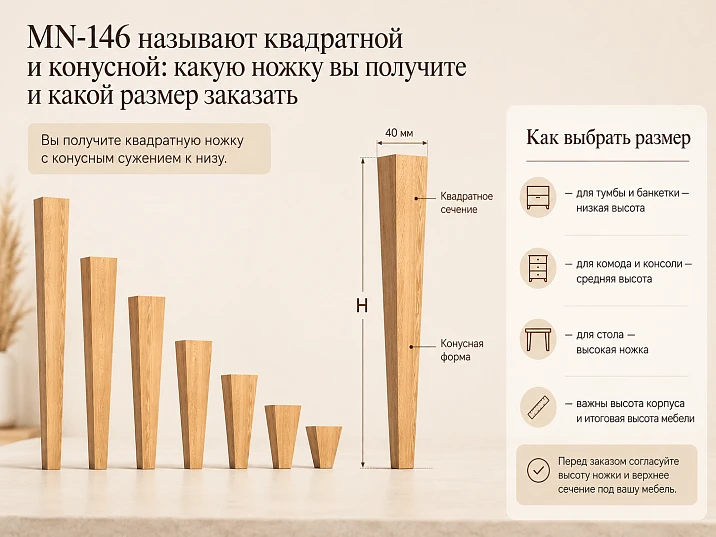
Square legs for furniture are searched for by a clear external feature: the buyer needs a support with straight edges, without a round turned shape, spirals, or carved ornament. Then he opens the MN-146 card and sees a different definition — "four-sided cone-shaped furniture leg." A natural question arises: is this really the square leg shown in the photos, or will a completely different, cone-shaped part arrive in the order?
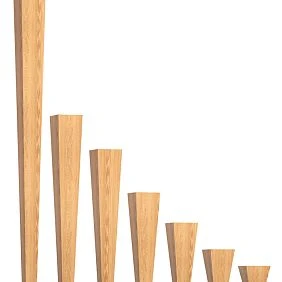
There is no contradiction here. The words describe different properties of the same model. The four-sided shape means the leg has four flat sides and pronounced edges. In everyday search, such geometry is called square. The support is called cone-shaped because its body gradually tapers downward. The buyer receives not a straight block with the same square cross-section along the entire height, but a geometric four-sided leg with a directed cone-shaped taper.
But figuring out the name is only half the task. Under the article MN-146, not one size is sold, but eight height options: from 80 to 740 mm. An order for "four MN-146 needed" remains incomplete. For a cabinet, chest of drawers, bench, and table, different modifications will be required, although their shape will be common.
Before purchasing, you need to determine the final height of the furniture, match it with the body or tabletop, choose beech or oak, check the frame-less construction, and decide in advance how the legs will be attached. The card offers compatible options FUR-001 and FUR-012, and for the lower part, a square foot pad FUR-023 is recommended.
If the shape already suits the project, you can buy a four-sided cone-shaped leg MN-146 of the required height. But first, it is worth understanding what the dimensions mean, how the furniture will change after installation, and what set should be in the order along with the supports.
Square, four-sided, and cone-shaped are not three different legs
The name of the shape is often taken too literally. Hearing "square leg," the buyer imagines a wooden block with identical top and bottom platforms. The word "tapered," on the contrary, evokes the image of a round support resembling an elongated truncated cone. MN-146 does not fully correspond to either of these simplified images.
Its geometry combines two features:
-
four pronounced faces;
-
a gradual reduction in cross-sectional size toward the floor.
Therefore, the definition "four-sided tapered" is more accurate than the usual search name. It conveys not only the number of sides but also the character of the silhouette.




What does "four-sided" mean
If you look at the leg from above or examine its cross-section, the shape is built around four sides. Edges run between the planes. Thanks to this, the support is perceived as geometric, strict, and modern.
Buyers use different expressions for this shape:
-
square leg;
-
square wooden support;
-
leg with four facets;
-
geometric leg;
-
faceted furniture support;
-
square table leg;
-
square cabinet leg.
All these formulations can lead to MN-146 if a downward taper is required at the same time.
Our factory also produces:
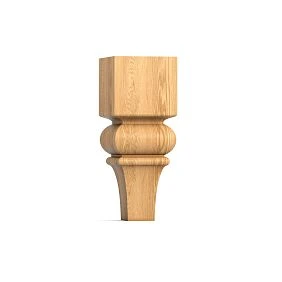
What does "tapered" mean
Tapering describes a change in shape along the height. The upper part is visually more massive, the lower part is lighter. The facets do not disappear but gradually converge.
Tapering solves several aesthetic tasks at once:
-
lightens the lower part of the furniture;
-
makes the support look slimmer;
-
creates a directed vertical silhouette;
-
distinguishes the product from a regular square block;
-
helps combine a stable upper part with a lighter finish at the floor.
Therefore, conical furniture legs do not necessarily have to be round. Square, rectangular, and polygonal profiles can also taper.
Get Consultation
What shape will actually be delivered
The order will include a four-sided wooden leg that tapers from the top to the bottom. It is not:
-
a cylinder;
-
a round turned support;
-
a straight block 60 × 60 mm along the entire height;
-
pyramid with a sharp tip;
-
carved leg;
-
support with shaped rings and transitions;
-
metal furniture leg;
-
two different models to choose from — "square" or "conical".
No need to choose between square and conical MN-146. Both definitions refer to the same article.
MN-146 specifications to verify before ordering
The card shows eight sizes of one geometric model. In all variants, parameter B is specified as 60 mm, and parameter A varies from 80 to 740 mm.
| Parameter | Confirmed data | Practical Meaning |
|---|---|---|
| Article number | MN-146 | Must match in the card, invoice, and installation list |
| Form type | Four-sided conical | Four edges are preserved, and the body tapers downward |
| Dimensions A × B | 80 × 60, 120 × 60, 180 × 60, 250 × 60, 350 × 60, 430 × 60, 650 × 60, 740 × 60 mm | A is chosen according to the required height, B is checked against the drawing |
| Number of height options | 8 | It is not enough to specify only the article number MN-146 |
| Materials | Beech and oak | The wood species is chosen based on the finish and combination with furniture |
| Sanding quality | «Prestige» | The surface is prepared for further finishing according to the quality category |
| Purpose | Benches, tables, sofas, chests of drawers, cabinets, and other suitable structures | The specific application is determined by the size and the project |
| Type of structure | Frameless furniture | The top mounting unit must work without a traditional frame |
| Mounting options | Stud M8 × 60, FUR-001 or FUR-012 | The choice depends on the base and furniture construction |
| Recommended foot pad | Square FUR-023 | Protects the bottom end and floor covering |
| Finish | In the basic card, the leg is offered without a ready decorative coating | Finishing should be planned before installation |
| Number of legs | Determined by the furniture construction | It is not possible to assign four supports universally for any object. |
The table helps to quickly see the composition of the selection, but it does not replace the drawing. The main mistake occurs when B = 60 mm is taken as a constant cross-section of 60 × 60 mm over the entire height. For a conical leg, the geometry changes toward the bottom, so for design purposes, the full profile is important, not just two numbers from the dimension row.
What do A and B mean in the size MN-146
The dimensions in the card are written as A × B. For example, 120 × 60 mm or 740 × 60 mm.
Parameter A is the selected leg height.
Parameter B is the cross-sectional dimension specified for this model in the card and on the drawing.
This is enough to distinguish eight variants, but not enough to manufacture the mounting assembly without additional verification.
A is the height, but not the final height of the furniture
If MN-146 with a height of 180 mm is selected, this does not mean that the cabinet will have a height of 180 mm. The body is added to the leg. In some projects, a foot pad, mounting plate, or another element is taken into account, which may change the final size.
For a table, the thickness of the tabletop or the entire upper structure is added to the leg height. If there is an under-table, an insert part, or an additional plate between the leg and the tabletop, its geometry is also included in the calculation.
B = 60 mm cannot be turned into a straight bar
The notation 740 × 60 mm does not mean that the buyer will receive a 60 × 60 mm post from top to floor. The model is tapered, therefore, the lower part is visually and geometrically narrower than the upper part.
Why is this important?
If a designer has drawn a straight square post of uniform thickness, MN-146 will change the silhouette of the project. The furniture will become lighter toward the bottom. On a long leg, the taper is more noticeable than on a low modification.
If a craftsman calculates the bottom foot or decorative junction, one cannot rely only on the B value. You need to look at the drawing and the actual bottom platform.
The drawing is more important than the colloquial name
For a preliminary search, the phrase "square furniture legs" is sufficient. For furniture production, other data are needed:
-
total height;
-
dimensions of the top platform;
-
taper geometry;
-
lower platform;
-
mounting axis;
-
threaded assembly location;
-
distance from housing edges;
-
base thickness;
-
installation direction.
The name helps find the product. The drawing helps not ruin the furniture.
Eight heights MN-146: one silhouette, different furniture items
The size range allows using one geometric shape in several items. However, the table below shows only preliminary selection logic, not a strict manufacturer assignment.
| Size MN-146 | Preliminary scenario | What to check |
|---|---|---|
| 80 × 60 mm | Low cabinet, wardrobe, chest of drawers with a small gap | Will the gap be too small for cleaning and the foot |
| 120 × 60 mm | TV cabinet, bedside table, compact wardrobe | The final height of the body and ease of use |
| 180 × 60 mm | Chest of drawers, cabinet, wardrobe with a noticeable gap | Will the furniture rise above neighboring items |
| 250 × 60 mm | Bench, cabinet furniture on high supports | Stability, mounting base, and seat height |
| 350 × 60 mm | Low coffee table, special bench, or designer construction | Total height with body or tabletop |
| 430 × 60 mm | Coffee table, bench, or ottoman | Purpose, lateral loads, and distance between supports |
| 650 × 60 mm | Table or tall cabinet structure | The thickness of the tabletop, underframe, and the required final height |
| 740 × 60 mm | Dining, writing, or drafting design | Will the finished table not end up higher than the calculated mark |
After an initial comparison, you can choose and buy wooden furniture legs in the general category. This is useful if MN-146 fits the shape, but the required height or taper character for the project is insufficient.
Height 80 mm: when furniture only needs to be lifted off the floor
MN-146 measuring 80 × 60 mm creates a small gap. This leg does not turn a cabinet into furniture on high supports, but visually separates the body from the floor.
This size is worth considering for:
-
low TV stand;
-
chest of drawers with a heavy body;
-
compact wardrobe;
-
hallway cabinets;
-
sofa base;
-
furniture that does not need to be noticeably lifted.
For a low leg, the four-sided geometry is perceived as denser. There is a taper, but due to the small height, it does not create such an elongated silhouette as in the 430–740 mm options.
What to check when choosing 80 mm
The first question is cleaning. Less than 80 mm will remain between the floor and the body, because part of the space is visually occupied by the lower plane of the furniture, and actual accessibility depends on the depth of the body and the position of the legs.
The second question is visibility of the bottom. If the body previously stood on a plinth, the bottom panel may not have been intended for open viewing. After installing the legs, it will become visible.
The third question is placement of supports. Too much inward offset will create a noticeable overhanging edge of the body. Too close to the corner will require a strong mounting area.
Height 120 mm: a popular scale for a TV stand, but not universal
Legs for TV stands and bedside furniture are often sought specifically in the range of a small lift. The size 120 × 60 mm creates a more noticeable gap than 80 mm, but the cabinet still doesn't look raised on long supports.
This option may be suitable for:
-
a TV stand;
-
a bedside table;
-
a small dresser;
-
a cabinet unit;
-
to the sofa;
-
hallway furniture.
But the purpose cannot be chosen only by the item's name. Two TV stands can have cabinet heights of 250 and 500 mm. With the same legs, they will result in completely different final levels.
Example calculation for a TV stand
Suppose the cabinet body height is 360 mm. MN-146 legs with a height of 120 mm are selected.
Basic calculation:
360 + 120 = 480 mm.
If a foot pad or mounting assembly adds height, it must be added separately:
360 + 120 + actual additional height of the mounting kit and foot pad.
Therefore, the final result will be slightly higher than 480 mm if additional elements protrude beyond the calculated planes.
Before purchasing legs for a TV cabinet, you need to compare the resulting height with the TV, sofa, neighboring cabinets, and the outlet line. A cabinet that is too tall can disrupt the composition of the TV area, even if the supports themselves look good.
Height 180 mm: the furniture becomes lighter and noticeably taller
The size 180 × 60 mm creates a pronounced gap. The cabinet is no longer just separated from the floor — it begins to be perceived as an independent volume on slender supports.
MN-146 with a height of 180 mm can be considered for:
-
bedside table;
-
dresser;
-
wardrobe;
-
console cabinet;
-
small bench;
-
sofa if the design allows.
Example of a bedside table
Let the body have a height of 420 mm.
420 + 180 = 600 mm.
After accounting for the foot and mounting assembly, the final height may become slightly larger.
This size already needs to be matched with the height of the bed. The bedside table should not accidentally end up significantly higher or lower than the mark that is comfortable for the user. There is no universal value: mattresses, bed bases, and owner habits all differ.
If you are looking for legs for a bedside table, you need to measure not only the table itself, but also the finished bed from the floor to the top working area of the mattress.
Why 180 mm changes the look of the cabinet
A high gap reveals the bottom panel. The following become noticeable:
-
fasteners;
-
technological holes;
-
material joints;
-
direction of fibers;
-
bottom edge of the front panel;
-
wires behind the table.
Before ordering, it is worth deciding whether the bottom of the furniture is ready for open viewing.
Height 250 mm: the boundary between a support and an independent silhouette element
MN-146 measuring 250 × 60 mm is already actively involved in the design. The four-sided taper is clearly visible, and the furniture body is significantly raised.
This height can be considered for:
-
benches;
-
a special cabinet;
-
a tall chest of drawers;
-
custom case furniture;
-
upholstered furniture;
-
a low bench.
But here it is especially dangerous to assign legs based on a single attractive image. The final height of the seat, cabinet, or body may exceed the project's limits.
Bench with 250 mm legs
For the banquette, you need to add up:
-
the height of the leg;
-
the thickness of the bottom frame;
-
the thickness of the soft padding;
-
the thickness of the seat;
-
any possible addition of a footrest.
If the soft part has a height of 220 mm and the support is 250 mm, the finished seat already approaches 470 mm without considering other structural layers. Whether this suits a specific project is determined by ergonomics and purpose.
Case furniture at 250 mm
A cabinet on such legs looks almost suspended. This can be a strong design technique, but requires carefully styled lower space.
The importance of lateral loads also increases. The higher the support, the more noticeable the force from a push, movement, or uneven load on the body.
Heights 350 and 430 mm: do not choose based on the word "coffee"
Dimensions 350 × 60 and 430 × 60 mm fall into a zone where the same leg can be used in very different items:
-
coffee table;
-
bench;
-
stool;
-
special cabinet;
-
stand;
-
custom furniture.
The name of the item does not provide a ready answer. A coffee table may have a tabletop 20 mm thick or a massive underframe 150 mm high. In the first case, a 430 mm leg will give one result, in the second — a completely different one.
Table with 350 mm legs
If the countertop has a thickness of 30 mm, the base height is:
350 + 30 = 380 mm.
If an additional structure with a height of 50 mm is provided under the countertop:
350 + 30 + 50 = 430 mm.
Externally, both models use the same leg, but the work surface differs by 50 mm.
Table with 430 mm legs
With a 25 mm countertop:
430 + 25 = 455 mm.
If the mounting plate does not change the height, this will be the approximate calculated mark. If a pad or under-table appears between the leg and the countertop, the size will increase.
Banquette at 430 mm
A 430 mm leg by itself is already close to the height of some ready-made seats. Adding the frame and the soft part will make the banquette noticeably higher. Therefore, this option cannot be assigned by a single product category — a full breakdown is required.
Height 650 mm: the table starts with a formula, not with an article number
Square table legs are searched by external shape, but the working height is determined not by shape. MN-146, sized 650 × 60 mm, is only suitable for those structures where the remaining elements bring the table to the design mark.
Formula:
Leg height + tabletop thickness + height of the underframe or intermediate assembly = final table height.
For example:
-
leg — 650 mm;
-
tabletop — 40 mm;
-
underframe or intermediate structure — 50 mm.
Summary:
650 + 40 + 50 = 740 mm.
In such a project, a 650 mm leg can lead to the desired result. If there is no underframe and the tabletop is thin, the finished surface will be lower.
Why you cannot automatically order 740 mm
A customer sometimes reasons like this: "I need a table about 740 mm high, so I order 740 mm legs." After installing the tabletop, the height increases. If the tabletop is 40 mm thick, the work surface ends up at about 780 mm without accounting for additional parts.
Therefore, the 650 mm size is often closer to the task than 740 mm if the upper structure is thick enough.
Height 740 mm: the leg is tall, but the finished table will be even higher
MN-146 measuring 740 × 60 mm is the tallest modification in the line. It is not suitable "for any dining table," but for projects where the support itself needs to be exactly that length.
Example of a table with 740 mm legs
Terms:
-
leg height — 740 mm;
-
tabletop thickness — 30 mm;
-
no additional under-table frame;
-
the fasteners do not add noticeable height vertically.
Calculation:
740 + 30 = 770 mm.
If a lower mounting part is added or the tabletop is thicker, the final height increases.
Therefore, the query "buy table legs 740 mm" should be accompanied by a second question: what height should the top surface be after assembly?
Where the 740 mm size may be appropriate
-
in a tall design structure;
-
with a very thin tabletop and corresponding target height;
-
in a special table;
-
in a console;
-
in furniture where the support partially enters the mounting assembly;
-
in a designer piece with non-standard ergonomics.
It cannot be promised that a 740 mm leg will automatically create a comfortable writing or dining table. This is determined by the entire structure.
Formula for a nightstand, dresser, and wardrobe
For cabinet furniture, the basic calculation looks like this:
Body height + leg height + actual allowance for the support pad and mounting assembly = final furniture height.
If the mounting does not change the vertical dimension, its contribution may be zero. If the support pad protrudes beyond the bottom edge, its thickness is added.
Example of a dresser
Let the dresser body have a height of 720 mm.
With 120 mm legs:
720 + 120 = 840 mm without additional allowance.
With 180 mm legs:
720 + 180 = 900 mm.
The difference between the two options is 60 mm. It changes:
-
the position of the dresser top;
-
the proportions of the facades;
-
the accessibility of the top surface;
-
the visibility of the wall behind the furniture;
-
the gap at the bottom;
-
the impression of the overall silhouette.
Example of a wardrobe
The body has a height of 1900 mm.
With 80 mm legs:
1900 + 80 = 1980 mm.
With 180 mm legs:
1900 + 180 = 2080 mm.
If there is limited space above the cabinet, the second option may not fit. The article number and leg shape remain the same — only A changes.
Before choosing, it is useful look at wardrobe design ideas and to assess how supports of different heights change the relationship of the body to the floor, plinth, and facades.
Formula for a table
For a table, a different scheme is used:
Leg height + tabletop thickness + height of elements between the leg and the top surface = final height.
You cannot count only the leg.
Which parts can increase the height
-
countertop;
-
mounting plate;
-
underframe;
-
mortise panel;
-
decorative frame;
-
intermediate beam;
-
mounting base;
-
adjusting element.
If part of the leg is integrated into the structure and does not add full length to the height, the calculation is adjusted downward instead. Therefore, a section of the mounting assembly is needed.
MN-146 for frameless construction: what it changes
The card indicates the use of MN-146 in frameless constructions. A stretcher is a connecting element under the tabletop or body that links the legs and helps the structure resist wobbling.
If there is no stretcher, the load and stability are provided by:
-
furniture base;
-
mounting platforms;
-
fastening units;
-
distance between legs;
-
rigidity of the body or tabletop;
-
quality of material at fastening points;
-
correct placement of supports.
This does not mean that it is enough to screw four legs into any board and get a stable table.
What to check on the tabletop
-
thickness;
-
material;
-
presence of embedded inserts;
-
ability to hold threaded fasteners;
-
distance from the hole to the edge;
-
risk of delamination;
-
flatness;
-
mass;
-
length and width;
-
expected lateral loads.
What to check on the cabinet body
-
thickness of the bottom panel;
-
presence of reinforcement;
-
position of internal partitions;
-
absence of voids in the mounting area;
-
access for installation;
-
distance from the facade;
-
opening of doors and drawers;
-
mass distribution.
Four legs are not always suitable
For a compact cabinet, four supports may be logical. A long TV stand or a wide dresser may require central or additional support. The solution depends on the span, bottom rigidity, and load.
The number cannot be determined only by the usual formula of "one leg in each corner."
Where to place square legs under the body
The position of MN-146 affects not only stability but also the appearance of the furniture.
Close to the outer corners
The body looks stable, and the supports are well visible. But the fasteners end up near the edges of the material. You need to check sufficient base area and the absence of risk of panel damage.
Recessed inward
The furniture appears lighter, with legs partially receding into shadow. However, too large an indent increases the overhang of the body and the load on the bottom panel.
Flush with the front
This option emphasizes the geometry. The front edge of the leg can continue the vertical line of the side panel or the frame of the front.
At an angle
MN-146 has pronounced edges, so its orientation is noticeable. If one leg is turned relative to the others, the edges will reflect light differently. The set should be installed uniformly.
For a long cabinet
The front legs must account for the placement of drawers and doors. An additional central support should not interfere with the plinth, wires, or access to the outlet.
MN-146 for a TV cabinet: not raising the screen too high
Queries like "legs for a TV cabinet" and "TV cabinet legs" reflect a specific task: to separate the body from the floor, make it visually lighter, and open up space for cleaning.
MN-146 fits the geometry of modern cabinets, but the height should be chosen carefully.
80 мм
Provides a small gap. The cabinet retains a low profile. Suitable if the TV is already positioned high enough or the cabinet has a large body.
120 мм
Creates clearly visible legs. The cabinet becomes lighter, but the screen rises along with the top surface if the TV is placed on it.
180 мм
Changes the item more significantly. A low cabinet can turn into medium-height furniture. Before ordering, check the TV position relative to the viewing area.
What else to check
-
whether the cleaning device will fit;
-
whether the wires will become visible;
-
where the outlets will be;
-
whether the bottom surface of the cabinet is ready for open view;
-
whether a central support is needed;
-
will the leg cover the ventilation opening;
-
will the bottom withstand the fasteners;
-
will the stability of a tall cabinet change.
In this section you can look at the legs on dressers and cabinets and compare different proportions of the body and the gap. The image should be used as a composition guide, not as a substitute for calculation.
MN-146 for a bedside table: height is related to the bed
Legs for a bedside table cannot be chosen separately from the bed. Even a beautiful table becomes inconvenient if the top surface is too low or too high relative to the sleeping area.
What dimensions to consider
-
80 mm — for a tall body;
-
120 mm — for a moderate lift;
-
180 mm — for a low cabinet that needs to be noticeably raised;
-
250 mm — only after a full calculation, if the structure really must stand high.
What to measure
-
The height of the cabinet body.
-
The height of the bed when assembled.
-
The position of the top surface of the mattress.
-
The thickness of the cabinet's top panel.
-
The actual addition of the foot pad.
-
Free space under the cabinet.
-
Location of outlets and switches.
-
Height of handles and drawers.
Example
Cabinet body — 390 mm.
MN-146 120 mm:
390 + 120 = 510 mm plus possible addition of a support foot.
MN-146 180 mm:
390 + 180 = 570 mm plus possible addition.
The 60 mm difference can determine whether it will be convenient to put a phone or reach a switch.
MN-146 for a dresser: the clearance should match the weight of the body
A dresser is usually heavier than a small cabinet. It contains drawers, items, hardware, and a top panel. When choosing high supports, you need to consider not only the appearance.
Short legs
Sizes 80 and 120 mm maintain a sense of a stable body. They open up space underneath but do not make the furniture visually fragile.
Medium legs
180 and 250 mm create a more pronounced silhouette. The dresser looks lighter, but the bottom panel and fasteners work under different conditions.
High supports
350 mm and above for a regular dresser require a special project. The body rises significantly, and lateral forces increase. Such a solution cannot be assembled from a photo.
Additional support
For a long dresser, the middle of the bottom panel may need support. The central leg must be the same height, have a compatible foot, and not interfere with drawer operation.
MN-146 for a wardrobe: consider the ceiling, doors, and stability
A wardrobe on legs looks lighter but at the same time becomes taller. This is especially important for built-in and tall models.
Before purchasing, measure:
-
body height;
-
distance to ceiling;
-
cornice height;
-
swing door travel;
-
hinge position;
-
floor unevenness;
-
cabinet depth;
-
filling mass;
-
access to the mounting;
-
possibility of additional support.
If the cabinet almost reaches the ceiling, even 80 mm legs can make installation impossible. You need to consider not only the finished height, but also the method of lifting the body into a vertical position.
Swing doors
After lifting the cabinet, the distance from the doors to the floor changes. This can solve the problem with the carpet or, conversely, reveal an unsightly gap.
Sliding systems
The legs must not compromise the rigidity of the base on which the guide operates. Installation requires calculating the cabinet body.
Open bottom clearance
High legs open up the bottom of the cabinet. Its surface, edge, and fasteners become part of the visible interior.
MN-146 for a bench and ottoman: seat height consists of multiple layers
An ottoman consists not only of legs. The calculation includes:
-
bottom frame;
-
base;
-
decking;
-
filling;
-
upholstery;
-
decorative piping;
-
foot cap.
If you choose MN-146 with a height of 430 mm, and the soft part adds another 150 mm, the finished bench will be significantly higher than what a single image of the leg suggests.
For such projects, 250, 350, or 430 mm are more often considered, but the final decision is made based on the cross-section.
What to check besides height
-
distance between supports;
-
frame rigidity;
-
side loads when sitting;
-
fabric attachment;
-
possibility to remove legs;
-
stability on soft flooring;
-
maintaining the same orientation of faces.
MN-146 for table: shape fits, but stability is calculated separately
Square table legs are valued for their clear geometry. MN-146 adds a taper to it, making the table look lighter than a straight construction on blocks.
Dimensions of 650 and 740 mm are obvious candidates for high tables, but sometimes 350 or 430 mm are suitable for coffee furniture.
Tabletop thickness
The thicker the top, the lower the leg should be at the same final height.
Tabletop weight
Wood, MDF, stone, glass, and multi-layer constructions create different loads. Fasteners cannot be assigned without considering the material.
Distance between legs
Too close placement hinders seating. Too large increases the tabletop span and can lead to deflection.
Lateral forces
The table is moved, leaned on, and pushed. In a system without aprons, the top attachment takes on a significant portion of these impacts.
Face orientation
On a rectangular table, legs are usually oriented the same way relative to the long and short sides. A different orientation must be built into the design.
Beech or oak: the shape remains the same, the character changes
MN-146 is made of beech and oak. The geometry is the same, but the surface is perceived differently.
| Criterion | Beech | Oak |
|---|---|---|
| Texture | Calmer and more uniform | Pronounced, with noticeable pores and grain |
| Opaque painting | A practical option after proper preparation | Possible, but hides the natural texture |
| Toning | Allows changing the shade | Emphasizes the wood grain |
| Transparent coating | Gives a restrained, natural look | Makes the texture an important part of the design |
| Combination | With painted furniture, beech, and calm wood surfaces | With oak veneer, solid wood, and expressive texture |
| What to check | Test stain and color matching | Selection by pattern and grain direction |
| For a set | All legs from the same wood species and same preparation | All legs from the same wood species and same preparation |
Beech for enamel
If the legs need to be painted with an opaque finish along with the body, beech often becomes an obvious choice. Its natural pattern is not the main part of the composition, and the MN-146 form is read through facets, edges, and light and shadow.
It cannot be assumed that any paint is applied directly to sanded wood. A compatible preparation system is needed.
Oak for tinting
Oak is chosen when the texture is to be preserved. On the edges of MN-146, the pattern will reflect light differently, and the taper will emphasize the direction of the grain.
For four or more legs, the parts should be laid out nearby in advance. Supports that differ too much in tone and pattern may look like a randomly assembled set.
One item — one wood species
Do not order two legs of beech and two of oak to save money or replace a missing item. After finishing, the difference may remain noticeable.
Before choosing, you can choose beech, oak, and sanding quality and understand which surface preparation corresponds to the subsequent finishing.
"Prestige" does not mean the coating is already applied
Sanding quality and decorative coating are different characteristics.
"Prestige" describes surface preparation. But unpainted MN-146 still requires a chosen finishing system if the furniture is to be used with a coating.
The buyer will need to determine:
-
whether enamel is needed;
-
whether tinting is needed;
-
whether a clear coat is required;
-
whether the color should match the body;
-
whether the texture needs to be preserved;
-
when to paint — before or after installation;
-
how to protect the seating area.
To select the accompanying system, you can order materials for painting and finishing woodafter checking them against the selected breed and project.
Unpainted MN-146 or readyFUR-012: mounting via mounting plate
Order FUR-012 kit for furniture legs possible for a project where mounting via a round plate and stud is suitable.
The plate distributes fasteners across multiple points of the base, but requires free space.
What to check for FUR-012
- whether the plate fits under the body;
- whether it intersects with the side panel;
- whether there is material under the fastener holes;
- does the screw not protrude to the front side;
- is it possible to install the plate evenly;
- does the central axis align;
- does the plate not interfere with the drawer or internal hardware;
- will the base withstand the load;
- does the joint not create extra height.
If the bottom panel of the cabinet is thin or has a void in the required area, the presence of a mounting plate alone does not solve the problem. The base must be prepared.
FUR-001 and FUR-012: which to choose
| Criterion | FUR-001 | FUR-012 |
| Basic principle | Stud and threaded insert | Stud and mounting plate |
| Visible area under the housing | No separate round plate | Plate is present |
| Requirement for the base | Must securely hold the insert | Must hold the plate fastener |
| Dismountability | Threaded connection | Threaded connection through the plate |
| Main risk | Loose fit of the insert | Lack of area or thickness for the plate |
| What to check first | Material and depth of the mounting hole | Size of the free mounting zone |
| For MN-146 | After checking the specific design | After checking the specific design |
You cannot designate one set as the best for all items. The right choice depends on the bottom panel, countertop, insert, and access for installation.
If the project includes additional elements, it is useful to buy hardware for attaching furniture legs in the relevant category and assemble a single mounting kit.
The M8 × 60 stud does not cancel the base calculation
The presence of the specified pin does not mean that it can be screwed into any slab without preparation.
Check:
- which part goes into the leg;
- which part works at the base;
- is a bushing needed;
- is the depth sufficient;
- does the fastener intersect with other hardware;
- will the hole split the material;
- can the vertical axis be maintained;
- how the face will be oriented after tightening.
Do not transfer hole dimensions from another project without verifying the specific set.
FUR-023: a small detail noticed after assembly
Recommended for MN-146 buy a square glide FUR-023.
The foot pad is installed on the bottom platform and performs several practical functions:
- separates the wood from the floor;
- protects the bottom end;
- reduces direct contact of the coating with the surface;
- helps preserve the floor covering;
- creates an identical point of support;
- finishes the lower part of the leg.
Why foot pads should be identical
If three legs have identical glides and the fourth has a different thickness, the furniture may wobble.
The entire set must match in:
- model;
- size;
- thickness;
- installation method;
- position relative to the center;
- degree of protrusion.
The glide is included in the height calculation
If FUR-023 protrudes below the wooden leg, this value is added to the furniture height. The exact addition should be checked against the actual part and the installation diagram.
For a low cabinet, even a few millimeters can matter if the furniture must fit under a windowsill, stand next to another cabinet, or maintain a specified line of fronts.
What to buy together with MN-146
One leg does not form a finished structure. The customer needs a set of supports, fastening, foot pads, and a finishing system.
| What to add | Why | For which project | What to check |
| Complete set MN-146 of one height | Create all support points | Any furniture | Quantity, wood species, sanding, and one batch |
| FUR-001 | Threaded connection via a bushing | Prepared solid or reinforced base | Thickness and density of the attachment zone |
| FUR-012 | Mounting via a plate | Body or tabletop with a free area | Plate size and fastener length |
| FUR-023 | Protect the leg and floor | Cabinet, dresser, wardrobe, table, bench | Centering and equal height |
| Finishing materials | Create enamel, tint, or protective layer | MN-146 without coating | Compatibility of the entire system |
| Test swatch | Check color | Beech and oak | Matching with the body |
| Additional central leg | Support a long body | TV cabinet or dresser after calculation | Installation location and same height |
| Spare leg | Save series for a large project | Commercial or serial furniture | Same material and finish |
| Mounting template | Repeat holes and orientation | Several identical items | Axis accuracy |
| Packaging and delivery | Preserve geometry and surface | Remote order | Number of seats and shipment contents |
Set of four legs: consistency matters more than quantity
A customer often orders four supports because furniture has four corners. But even for a simple item, the set must be consistent.
All legs must have:
- one SKU;
- one height;
- one wood species;
- identical sanding;
- one finish;
- one mounting type;
- identical glides;
- single orientation of faces.
When four legs may not be enough
- long TV stand;
- wide dresser;
- heavy tabletop;
- body with a weak bottom;
- structure with a large span;
- furniture with concentrated load in the center;
- composite item;
- long bench.
The quantity is determined by the designer after evaluating dimensions, material, and load.
How not to confuse MN-146 with a straight square bar
In the catalog and search, parts that look similar only in the first photo may appear next to each other.
Straight bar
Has a constant cross-section along its length. The MN-146 body tapers.
Four-sided tapered leg
Retains four faces but becomes narrower toward the bottom. This is MN-146.
Round tapered leg
Has a smooth round cross-section without four flat planes. This is a different geometry.
Turned leg
May include rings, rollers, transitions, and rounded elements. MN-146 is built on clean edges.
Carved leg
Has an ornamental relief. For MN-146, decorativeness is created through proportions and tapering.
Leg with metal tip
Combines wood with a separate metal part. The base MN-146 does not have this feature in its name.
Finished MN-146M
Retains the shape of MN-146 but differs by having a selected finish. This is not a new geometric model, but a variant of execution.
Practical Selection Scenarios
Scenario 1. A low TV cabinet should allow a cleaning device to pass through
First, measure the required clearance. Then compare 80, 120, and 180 mm.
It cannot be assumed that the leg height fully equals the available space: the position of the body, the footrest, and the depth of the cabinet affect passability.
Scenario 2. The bedside table turned out to be too low
Measure the current height of the body and the desired mark of the top surface. The difference gives a reference for the leg, but the influence of the foot and mounting assembly must be subtracted or added to it.
Scenario 3. The dresser needs to be visually lightened
Dimensions of 120 or 180 mm create a gap. 250 mm changes the silhouette more strongly. The choice is checked on a visualization of the entire item.
Scenario 4. A tall cabinet almost touches the ceiling
First, the full dimension is calculated. Even a 80 mm option can make installation impossible. The method of lifting the cabinet must be considered.
Scenario 5. Square legs for a table are required
MN-146 is suitable in shape if the conical taper is acceptable. The height is chosen after adding the tabletop, underframe, and leg.
Scenario 6. The tabletop is already manufactured
Check the material, thickness, and mounting points. Only then choose FUR-001 or FUR-012.
Scenario 7. All items in the room must have identical legs
Different heights of MN-146 can be used for the nightstand, dresser, and table, maintaining the overall style. But each item is calculated separately.
Scenario 8. Oak is needed under a transparent finish
The entire set is ordered in oak, and parts are pre-sorted by grain pattern. A test finish is done before installation.
Scenario 9. The cabinet will be painted with enamel
Beech without coating or ready-made MN-146M can be considered. The decision depends on whether an exact match with the designer's color is required.
Scenario 10. The nightstand is long, but only four legs are desired
First, check the deflection and rigidity of the bottom panel. Aesthetic preference does not eliminate the need for central support.
Scenario 11. Legs must be easily removable for transport
Threaded mounting is convenient for knockdown furniture, but the joint must withstand repeated assembly and maintain the orientation of the faces.
Scenario 12. The floor has a sensitive coating
Identical FUR-023 items are added to the order at once, and the absence of contamination under the glides is checked.
Errors due to which MN-146 is not suitable after delivery
Error 1. Order only the article number
Eight heights share one name. Without the size, the order is incomplete.
Error 2. Expect a straight bar
MN-146 tapers downward. If the project is drawn with a constant cross-section, the silhouette will change.
Error 3. Consider 60 mm as the same width along the entire length
Parameter B should be read together with the drawing and the conical geometry.
Error 4. Choose 740 mm legs for a table with a height of 740 mm
The countertop will increase the finished size.
Error 5. Choose 650 mm without accounting for the thin countertop
The finished surface may end up lower than the design mark.
Error 6. Not adding the support leg
If it adds height, the furniture won't align with adjacent items.
Error 7. Not checking the ceiling above the cabinet
The cabinet body with legs may not fit.
Error 8. Raising the TV stand without checking the screen
The TV will end up higher than the comfortable viewing zone.
Error 9. Not inspecting the bottom of the cabinet body
After lifting, the mounting holes and unfinished edges become visible.
Error 10. Installing four legs on a long dresser without calculation
The middle of the body may need support.
Error 11. Choosing a fastener based on a photo
FUR-001 and FUR-012 require different mounting conditions.
Error 12. Screwing the plate with screws that are too long
The fastener may protrude inside the body or damage the front surface. The length is chosen based on the actual thickness.
Error 13. Screwing a threaded insert into a weak base
The threaded joint will not be reliable.
Error 14. Turning the legs differently
Faces and edges will begin to reflect light in different directions.
Error 15. Ordering different wood species in one set
Beech and oak differ in texture and behavior during finishing.
Error 16. Painting without a test sample
The color on wood may differ from the sample on another base.
Error 17. Covering threaded areas with finish
Fastening will become more difficult, and the connection less precise.
Error 18. Not ordering base plates
The bottom end will remain in direct contact with the floor.
Error 19. Using base plates of different thicknesses
The furniture will start to wobble.
Error 20. Considering a structure without tsargi as automatically stable
Stiffness depends on the base, fastening, and placement of supports.
Error 21. Assigning MN-146 for radius furniture only because of the word "conical"
Conicity refers to the tapering of the leg, not the ability to follow a curved surface.
Error 22. Considering MN-146M coated as completely equal to uncoated MN-146 in configuration
Before ordering, you need to check the card of the specific version.
Error 23. Buying legs one at a time at different times for a visible oak set
The pattern and shade can differ.
Error 24. Not accounting for the baseboard and wall
The rear legs may interfere with placing the body at the required distance.
Error 25. Not making a mounting template
On several legs, the mounting axes will diverge, and the body will become skewed.
When MN-146 is truly appropriate
The model is worth considering if:
- square legs are needed for furniture with a slight taper;
- you like a geometric shape without threading;
- height selection from 80 to 740 mm is required;
- the furniture is designed without an apron;
- the base can be prepared for FUR-001 or FUR-012;
- need beech for painting;
- need oak with visible texture;
- a single silhouette is required for several items;
- a cabinet, dresser, wardrobe, bench, sofa, or table is planned;
- the buyer is ready to calculate the final height;
- glides will be added to the set;
- all supports can be installed in the same orientation.
When it's better to choose a different model
MN-146 may not fit if:
- need a straight square block without tapering;
- a round leg is required;
- need a carved ornament;
- want a complex turned shape;
- need a metal tip;
- the base does not allow installing compatible fasteners;
- the furniture must have a frame construction with a different type of seating;
- none of the eight heights gives the required final size;
- requires an adjustable height support;
- the lower platform is not compatible with the selected foot;
- the load and span require a different structural solution;
- the project includes angled legs;
- A ready-made finish is required that is not available in the selected execution card.
What to check before placing an order
Before adding the quantity to the cart, prepare a short specification.
By shape
- Is a four-sided taper suitable?
- Is a straight block not required?
- Will all legs be oriented the same way?
By size
- What is the required final height of the furniture?
- What is the height of the body?
- What is the thickness of the tabletop?
- Is there an under-table?
- Does the foot cap add height?
- Does part of the leg fit into the mounting assembly?
By construction
- Is there a crossbar?
- What is the base made of?
- Is its thickness sufficient?
- Are embedded inserts needed?
- How many supports are required?
- Is a center leg needed?
- Where will the internal partitions go?
Regarding mounting
- FUR-001 or FUR-012?
- Does the mounting plate fit?
- Will the material hold the bushing?
- Will the fastener protrude outward?
- How to ensure the orientation of the edges?
By material
- Beech or oak?
- Enamel or clear finish?
- Should the texture be preserved?
- Is a test paintout needed?
- Are all legs ordered in the same wood species?
By the lower part
- Has FUR-023 been added?
- Are the thrust pads identical?
- Are they compatible with the floor?
- Is their height taken into account?
Regarding logistics
- How many legs are in the order?
- Is a spare one needed?
- How will the set be packaged?
- To which city is the shipment being made?
- Have the deadlines and availability been checked in the card?
Example of a request to a manager
Need furniture legs MN-146 for ____________________.
Quantity: ______ pcs.
Dimension A × B: ______ × 60 mm.
Material: beech / oak.
Finish: without coating / ready-made MN-146M required.
Future finish: ____________________.
Body height or tabletop thickness: ______ mm.
Required final furniture height: ______ mm.
Construction: without tsarga / needs clarification.
Base material: ____________________.
Mounting zone thickness: ______ mm.
Expected fasteners: FUR-001 / FUR-012 / selection required.
Support foot: FUR-023, quantity ______ pcs.
Please confirm:
- compliance with selected height;
- completeness;
- mounting compatibility;
- need for embedded part;
- current availability;
- finishing conditions;
- package contents;
- Delivery terms.
Such a request is more useful than the phrase "send four square legs". The manager immediately sees the size, material, mounting, and purpose.
How to place order MN-146 at STAVROS
First, open the card of the unpainted model and choose one of eight heights. Then check the material and quantity.
After selecting the legs:
- Calculate the final height of the furniture.
- Check the drawing.
- Determine the number of supports.
- Choose FUR-001 or FUR-012.
- Add FUR-023 according to the number of legs.
- Decide whether self-finishing is needed.
- Compare the option with the ready-made coating MN-146M.
- Check availability and delivery times.
- Record all items in the specification.
- Review the conditions under which you can order delivery of furniture legs across Russia.
FAQ: common questions about the furniture leg MN-146
Is MN-146 square or conical?
It is both four-sided and conical. The four faces create a square geometric base, while the taper towards the bottom forms a conical silhouette.
Will I receive a straight block 60 × 60 mm?
No. MN-146 is not a straight block of uniform cross-section along its entire height. The value B = 60 mm should be read together with the drawing of the conical model.
Why is it called square?
This is how buyers describe a shape with four flat sides. A more accurate product name is a four-sided conical leg.
Is a conical leg necessarily round?
No. Conicity means a reduction in cross-sectional size toward the bottom. The shape that tapers can be round, square, or polygonal.
How many sizes does MN-146 have?
The product card shows eight heights: 80, 120, 180, 250, 350, 430, 650, and 740 mm. In all rows, B is specified as 60 mm.
Which parameter indicates height?
Height is indicated by A. For example, in the size 180 × 60 mm, the leg height is 180 mm.
What does B = 60 mm mean?
This is the cross-sectional dimension specified in the product card and drawing. It cannot automatically be considered a constant square cross-section along the entire length, since the leg tapers.
What height should I choose for a TV stand?
80, 120, or 180 mm are more commonly considered, but the choice depends on the cabinet height, TV position, required clearance, and bottom construction.
Will 120 mm legs fit a bedside table?
They may fit if the cabinet with legs ends up at a convenient height relative to the bed. First, add up the cabinet height, legs, and the actual added height of the foot cap.
Can MN-146 legs with a height of 180 mm be installed on a bedside table?
Yes, after calculation. This height noticeably raises the cabinet and exposes the bottom surface of the furniture.
What size should I choose for a dresser?
For regular cabinet furniture, you can preliminarily compare 80, 120, 180, and 250 mm. The final choice depends on the cabinet height, dresser length, and rigidity of the bottom panel.
Is a central leg needed for a long dresser?
It is possible. The number of supports is determined by the length, bottom material, and load. Four legs cannot be considered a universal scheme.
Will MN-146 legs fit a wardrobe?
Yes, the model is specified for suitable wardrobes and other cabinet furniture. You need to check the height to the ceiling, stability, weight, and bottom panel construction.
What size should I choose for a coffee table?
You can consider 350 or 430 mm, but the final height depends on the tabletop and underframe. Sometimes a different size works.
Can I buy table legs 740 mm?
Yes, such a modification exists. But the finished table will be higher than 740 mm after adding the tabletop and other elements.
Why is 650 mm sometimes better for a table?
Because the tabletop and underframe add height. For example, a 650 mm leg, a 40 mm tabletop, and a 50 mm structure give a total of about 740 mm.
Will MN-146 fit a trestle table?
The product card provides for use in trestle constructions. But stability depends on the tabletop, fastening, distance between legs, and load calculations.
What material to choose for enamel?
For opaque painting, beech is often chosen. The primer and enamel system should be tested in advance.
When is it better to order oak?
Oak is suitable if visible wood texture is required after staining or transparent finishing.
Can beech and oak be mixed in one set?
Not recommended. Differences in texture and reaction to finish may remain noticeable.
What does "Prestige" sanding mean?
This is a surface preparation category. It does not mean that a decorative coating has already been applied to the leg.
Can MN-146 be ordered already painted?
For a finished coating, the MN-146M card is provided. Available sizes, materials, and colors should be checked before ordering.
Is fastening hardware included with the leg?
The completeness must be verified in the card and invoice. FUR-001 and FUR-012 are considered as separate items for mounting.
How does FUR-001 differ from FUR-012?
FUR-001 creates a threaded assembly with a stud and insert. FUR-012 uses a mounting plate and stud. The base is prepared differently.
How to choose between FUR-001 and FUR-012?
Check the material, thickness, and free area of the base. For the insert, a reliable seating zone is needed; for the plate, space for its attachment.
Can MN-146 be mounted with regular self-tapping screws?
Random fasteners must not be assigned without verification. The card specifies a M8 × 60 stud and FUR-001 or FUR-012 kits.
Is a mounting plate needed for each leg?
Only if FUR-012 is selected and this method suits the construction. FUR-001 uses a different scheme.
What is FUR-023 used for?
The square foot pad is installed underneath, protects the end of the leg and the floor covering, and also forms an identical point of support.
How many foot pads should be ordered?
One for each leg, if the project uses FUR-023. For an additional central or spare support, a corresponding foot pad is needed.
Will the foot pad increase the height of the furniture?
It may increase it if it protrudes below the wooden end. The actual addition must be included in the calculation.
Can MN-146 be installed on an already finished cabinet?
It is possible after checking the bottom panel, mounting points, height, and the possibility of reinforcement. Not every existing bottom is designed for legs.
How can I tell if the base will withstand the mounting?
You need to know the material, thickness, location of partitions and embedded parts. If in doubt, the mounting unit is calculated by the furniture maker.
Do you need to make a template for four legs?
Yes. The template helps to repeat the position of holes, offsets, and orientation of edges.
How to correctly rotate MN-146?
All legs should be oriented identically relative to the front and side panels, unless the project specifies a different arrangement.
Can MN-146 be used for a sofa?
The card allows use in suitable sofa constructions. You need to calculate the frame, seat height, and lateral loads.
Will MN-146 fit a bench?
Yes, with a properly selected height. The calculation adds the frame, decking, padding, and upholstery.
Can one height be used for all furniture in a room?
Not always. One silhouette can be preserved by choosing different heights of MN-146 for the cabinet, dresser, and table.
How to order four identical oak legs?
In the request, specify the article number, height, oak, sanding quality, quantity, finish, mounting, and floor glides. It is advisable to order the set at the same time.
Is a spare leg needed?
Not necessary for single pieces of furniture. For serial, commercial, or complex projects, a spare part from the same batch may be useful.
What to check upon receipt?
Article number, quantity, height, material, geometry, edge condition, surface quality, fasteners, and floor glides.
Can unpainted legs be installed immediately?
If the project involves a coating, the finish and protection of mounting areas must be agreed upon first. Operation without the necessary finishing system may not match the design intent.
Where can I see other square and tapered legs?
In the general category of furniture legs, you can compare geometric models by height, shape, material, and purpose.
MN-146 should be ordered not by a single word, but by the entire design.
Square and conical are not mutually exclusive definitions. MN-146 has four faces, which is why it is called square in search results. At the same time, the body tapers downward, so the manufacturer uses the precise definition "four-sided conical furniture leg."
The buyer will receive not a straight wooden block, but a geometric support with a more massive upper part and a lighter lower end.
The main difficulty of ordering is not even the name, but the size range. One article combines eight heights: 80, 120, 180, 250, 350, 430, 650, and 740 mm. You need to choose not "a leg for a cabinet" or "a leg for a table" in general, but a size that, together with the body, tabletop, underframe, mounting, and floor cap, will give the desired final height.
For a cabinet, add the body and the support. For a table, add the leg and the entire top structure. For a bench, also consider the frame and the upholstered part. For a wardrobe, check the ceiling and the installation method. For a long dresser, calculate the need for central support.
After choosing the size, complete the mounting. FUR-001 is suitable for a threaded joint with a threaded insert, FUR-012 for mounting through a plate. FUR-023 protects the lower end and the floor. The material should also be consistent: beech is convenient to prepare for opaque finishing, oak is chosen for its expressive texture.
When all parameters are consolidated into one specification, you can order MN-146 legs of the required height along with suitable mounting and square floor caps.
STAVROS allows you to assemble not a random set of parts, but a coordinated furniture unit: choose one of eight heights, beech or oak, unfinished or finished version, fasteners, and floor protection. This approach eliminates the main mistake — buying a beautiful leg without calculating the furniture it is meant to support.