Article Contents:
- What exactly is CPU.VRS-059
- Why a 900 mm pier is a real design challenge
- What happens in width if you place CPU.VRS-059 in the center
- Why arithmetic alone is not enough
- Three real scenarios for a wall between doors
- Option 1. One CPU.VRS-059 in the center
- Option 2. Two separate frames from moldings
- Option 3. One large simple frame from moldings
- 1. The wall section is on the axis and calls for a center
- 2. The doors are calm, and the interior allows for decor
- 3. A single vertical accent is needed, not fragmentation
- 4. There's no desire to compose the arrangement yourself
- 5. A more decorative, less dry result is needed
- 1. The doors are already very active
- 2. The room is small and saturated
- 3. Strictness is needed, not ornament
- 4. It is important to finely adjust the proportions
- 5. The buyer is not ready for installation of the set as a separate assembly task
- CPU.VRS-059
- Two frames from moldings
- One large frame
- Check 1. Width proportion
- Check 2. Environment saturation
- Check 3. Perception from a distance
- 1. Gap from the baseboard
- 2. Gap from the top
- 3. Connection with doors
- 4. Obstacles on the wall
- Mistake 1. Looking only at the 441 mm width
- Error 2. Treating CPU.VRS-059 as a ready-made solid panel
- Error 3. Choosing two frames just because they are safer
- Error 4. Forgetting about the 2040 mm height
- Error 5. Not considering the nature of the doors
- Error 6. Not comparing with one large frame
- Will CPU.VRS-059 fit the width of a 900 mm wall?
- CPU.VRS-059 — is it a ready-made panel?
- What is visually calmer: CPU.VRS-059 or two molding frames?
- What is better for a small hallway?
- Are two molding frames necessarily better for a narrow wall section?
- What to choose if the doors are already beautiful and decorative?
- Can CPU.VRS-059 be compared only with two frames?
- What to do if you want one accent, but CPU.VRS-059 seems too saturated?
- Do I need to check the height of 2040 mm?
- Is CPU.VRS-059 better than moldings?
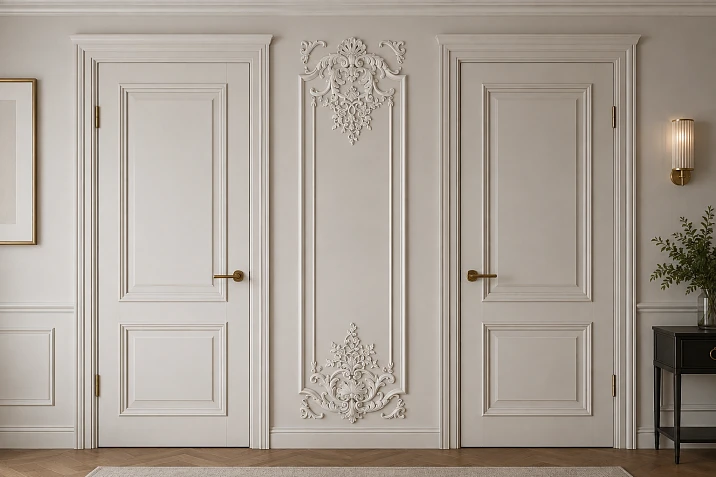
If you want to get one noticeable vertical composition between two doors, and the door portals themselves are quite calm and not overloaded with decor, the decorative stucco set CPU.VRS-059 can indeed be a good solution. Its ready-made width is 441 mm, so on a 900 mm wall after centering, approximately 229.5 mm of free space remains on the left and right. This means the set does not fill the entire wall section but works as an independent central accent.
If the doors are already active in design, with pronounced trims, the space does not like extra ornamentation, or you want a calmer architectural rhythm, two separate frames made of polyurethane moldings often work better. This solution does not create one large ornamental center, but looks stricter, lighter, and adapts more easily to a specific interior.
Another important point: CPU.VRS-059 is not a ready-made solid panel that you simply take out of the box and glue on. The kit is supplied uncut and unglued, and the elements are fitted during installation. Therefore, the choice between a ready-made kit and molding frames is not only a choice of appearance, but also a choice of how you work with the product.
To put it very briefly, the logic is as follows:
- if you need one expressive vertical accent — first try CPU.VRS-059;
- if you need a calm, more architectural, and less ornamental option — moldings usually win;
- if the doubt is not about style but about saturation — compare three scenarios at once: one CPU.VRS-059, two separate frames, and one large simple frame without complex ornament.
Buy the CPU.VRS-059 polyurethane stucco decor kit
What exactly is CPU.VRS-059
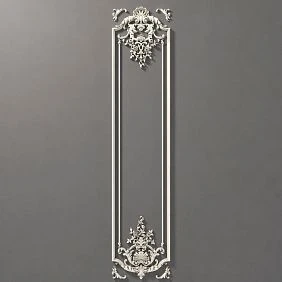
CPU.VRS-059 should correctly be called a polyurethane stucco decor kit. This is important not for formality, but because the type of product immediately sets the right expectation.
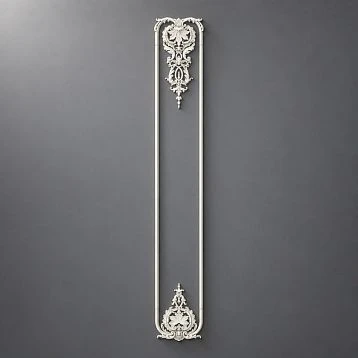
It is not a single overlay, not a baguette, not a rosette, and not a separate molding. What the buyer faces is precisely a compositional kit designed to assemble an expressive vertical scheme. It is already conceived as a cohesive decorative motif, but structurally it is supplied not as a monolith, but as a set of elements that need to be fitted and assembled on the wall.
Current parameters for this topic:
| Parameter | CPU.VRS-059 |
|---|---|
| Product type | set of stucco decor |
| Material | Polyurethane |
| Dimensions of the finished composition | 441 × 2040 × 22 mm |
| Price | 46 170 ₽ |
| Delivery format | elements separately, uncut and unglued |
| Feature | elements with moldings come with allowance for trimming and assembly |
Even from this table alone, it's clear why the topic is truly commercial and useful. The buyer chooses not between "beautiful / not beautiful," but between two fundamentally different approaches:
- buy one large ready-made composition in concept, which still needs to be assembled;
- do not take a ready-made set, but build your own scheme from moldings.
Both solutions relate to polyurethane decor, but their logic is different. In the first case, the main pattern is already designed for you. In the second, you control proportions, saturation level, and the character of the wall almost from scratch.




Why a 900 mm pier is a real design challenge
When a narrow section of wall remains between two doors, it's easy to underestimate it. On the plan, it seems secondary. In a real interior, such places often end up on a very visible axis: in a hallway, in a foyer, in a passage area, between two symmetrical openings. A person may not linger on the pier with their gaze, but it is precisely such gaps that shape the feeling of tidiness or chaos in an interior.
A width of 900 mm makes the task especially interesting. It's not quite a narrow strip where only one long vertical will fit. But it's also not a wide wall where you can easily unfold a large multi-component system. A pier of this size requires careful balance.
If you leave it completely empty, it may look like a random gap between two doors. If you place decor that's too heavy, it will start to compete with the openings and visually "squeeze" the wall. If you make elements too small, they will get lost and fail to connect the space.
Therefore, a width of 900 mm is a case where the decision "one set or moldings" truly affects the purchase, rather than being a minor taste nuance.
Our factory also produces:

What happens in terms of width if you place CPU.VRS-059 in the center
The main number here is very simple, but it's from it that the right conversation begins.
The width of the finished CPU.VRS-059 composition is 441 mm.
The wall width is 900 mm.
Therefore:
900 − 441 = 459 mm
If you place the composition in the center, what remains:
459 / 2 = 229.5 mm
That is, approximately 229.5 mm on the left and right.
This is a good sign. It shows that the set does not behave as something excessively wide for such a wall segment. It has its own readable width, but there is air around it. This is what makes the CPU.VRS-059 option viable.
It is important to understand that these 229.5 mm are not just a mathematical remainder. These are future resting margins. They separate the composition from the door trims and prevent the decor from merging with adjacent openings. If the remainder were 50–70 mm, the set would almost press against the doors and look cramped. But a margin of about 230 mm on each side is already quite noticeable.
Hence the key conclusion: on a 900 mm wall, CPU.VRS-059 fits not tightly, but as an independent central accent.
Get Consultation
Why arithmetic alone is not enough
Despite the usefulness of the calculation 900 − 441, this figure is not enough to make a purchase decision. The article is precisely needed to avoid reducing everything to the formula "it fits — so it suits."
In a real interior, at least five more factors influence perception:
- how active the doors themselves are;
- what trims or portals surround them;
- what is the height of the pier itself and what happens above and below;
- is an ornamental center needed in this place or is a geometric rhythm better;
- how important it is that the decor looks assembled at once, rather than requiring independent construction.
CPU.VRS-059 can fit perfectly in width and at the same time turn out to be too saturated in pattern for a specific wall. Or vice versa: someone might decide that two molding frames are safer, but in reality they will fragment the pier more than one central set.
Therefore, it is important next to compare not only sizes, but also the behavior of three possible solutions.
Three real scenarios for the wall between doors
In this topic, it is useful not to fixate only on comparing "set or moldings". In essence, the buyer has three working directions.
Option 1. One CPU.VRS-059 in the center
The pier receives one vertical ornamental composition. It immediately sets the center, unifies the wall, and makes it noticeable. Calm fields remain around it.
Option 2. Two separate molding frames
The wall is divided into two independent vertical sections. This gives a stricter, more architectural, fractional rhythm. Often the solution looks calmer and softer, especially if the molding profile is thin.
Option 3. One large simple frame made of moldings
Here the pier remains one solid plane, but without complex ornament. The frame emphasizes the boundaries of the wall without creating a saturated center, like CPU.VRS-059.
It is from these three scenarios that one usually should choose. Sometimes a person is sure that the debate is only between a ready-made set and two frames, but in the end it turns out that the best compromise is one large simple frame.
The visual character of CPU.VRS-059: it is not just decor, but a ready-made composition
The main advantage of CPU.VRS-059 in such a task is that it gives a ready-made character to the wall. The set does not look like a collection of random details. It is perceived as one developed vertical composition.
This is especially useful on piers between doors, because such zones often require exactly one clear center. Two doors already create side boundaries by themselves. Between them, one wants to see not another fragmentation, but a cohesive answer. The set does exactly that.
This approach is especially good:
- in classical and neoclassical interiors;
- on a prominent frontal wall;
- if the two doors are symmetrical;
- if you need to emphasize the axis of the room;
- if you don't want to leave the pier empty, but want to give it a full-fledged role.
CPU.VRS-059 works as a ready-made vertical accent. That's its strength. The buyer doesn't need to figure out on their own where the top will be, where the bottom will be, what pattern is needed inside, and how to distribute the ornament. All of this is already built into the set itself.
But this is also the limitation: you're getting not just a material, but a fairly strong compositional solution. It's not suitable everywhere.
What two frames made of moldings provide
When two frames made of moldings are chosen instead of a ready-made set, the meaning of the wall changes.
The pier no longer receives one large ornamental center. It is divided into two sections, each of which can be empty inside or supplemented with calm decor. This scheme almost always looks stricter, lighter, and more architectural.
Two frames have several advantages.
First, they allow for stronger control over the degree of saturation. You can take a thin profile and get a very light pattern. You can choose a more massive one — and get closer in effect to a more pronounced decorative solution, but without a complex ornament.
Secondly, frames are easier to align with doors. If trims or portals are already active, repeating geometric lines looks more natural than another central molding set.
Thirdly, frames are simpler to adapt to wall features. You choose their height, width, spacing, offsets from doors, and their relationship with the baseboard and cornice.
But two frames also have a downside: on a 900 mm wall, they inevitably create fragmentation. The pier is already between two doors, meaning it is already bounded on the edges. If a division into two sections appears inside it, the result may become slightly more restless than desired.
Therefore, two frames are not automatically a safer option. They are simply of a different character.
What one large simple frame provides
This option is often underestimated, although it often turns out to be the most delicate.
One large frame made of molding preserves the pier as a single vertical plane but does not saturate it with complex ornament. Essentially, you emphasize that there is a separate wall section between the doors deserving decoration, but you do it calmly.
This approach is especially good if:
- the doors already have their own decor;
- the interior leans toward laconic classicism;
- what is needed is not so much ornament as structuring of the wall;
- the room is small and we don't want extra relief;
- there is a desire to later add a painting, mirror, different color, or finer decor inside the frame.
One large frame is not a replacement for CPU.VRS-059 in effect. It is a completely different answer to the same task. If CPU.VRS-059 says: "let's make a vertical decorative accent out of the wall section," then one large frame says: "let's neatly highlight the wall section as an architectural element and stop there."
When CPU.VRS-059 is better than two frames
There are several situations where a ready-made set truly wins over a frame scheme.
1. The wall section is on the axis and asks for a center
If there is a noticeable, almost ceremonial gap between two doors, you want not just to outline the empty wall with molding, but to give it its own center of gravity. CPU.VRS-059 solves this immediately.
2. The doors are calm, and the interior allows for decor
If the trims are laconic, the door panels themselves are not overloaded with carving, and the interior allows for expressive stucco, one set works convincingly and does not create a sense of conflict.
3. Need one vertical accent, not fragmentation
For a 900 mm wall, this is an important point. Two frames fragment the space. One set, on the contrary, gathers it into a single axis. If the wall is already narrow, this may be aesthetically more correct.
4. Don't want to compose the arrangement myself
Some buyers find moldings safer, but in practice they lack clarity: which profile to choose, what width to make the frames, what height to select, how to divide the wall. CPU.VRS-059 removes this uncertainty.
5. Need a more decorative, less dry result
Frames are architecture. The set is architecture plus ornament. If the wall is expected to provide not only structure but also decorative expressiveness, the set delivers this directly.
When it's better to refuse CPU.VRS-059 in favor of moldings
Not every wall between doors benefits from a complex ready-made set. There are cases where moldings are objectively more reasonable.
1. The doors are already very active
If the trims are wide, there are cornices above the doors, capitals, sandriks, a pronounced portal, or the doors themselves have complex paneling, another noticeable composition between them may start to compete with the entire surroundings.
2. The room is small and saturated
In a narrow corridor, where a person looks at a wall section from a short distance, an overly active set can sometimes feel heavier than on a large living room wall. There, a framed option often wins.
3. Strictness is needed, not ornament
There are interiors where you want the wall to be decorated, but without additional narrative. Then moldings give a sense of completeness without drawing attention away.
4. It's important to finely adjust proportions
The set has a fixed width of 441 mm and a fixed compositional character. Moldings allow you to vary almost everything: frame width, height, offsets, rhythm. If the wall section is complex in height or limited by switches, sconces, outlets, or furniture, the flexibility of moldings can be decisive.
5. The buyer is not ready to treat the installation of the set as a separate assembly task
CPU.VRS-059 is not supplied as a ready-made monolith. It needs to be cut, adjusted, and assembled. For some, this is normal. For others, it's easier to immediately assemble a clear framed scheme from moldings.
Buy polyurethane wall moldings
Why it's important that CPU.VRS-059 is supplied uncut and unglued
This is one of the most important practical points on the topic. It cannot be skipped.
When a buyer sees the size 441 × 2040 mm, they can easily imagine a finished solid panel or an already assembled block. But in fact, the product card directly states that the set is supplied uncut and unglued, and the elements with moldings come with extended shoulders and allowance for trimming.
What does this mean in practice?
Firstly, the size 441 × 2040 mm is the size of the final composition, not the size of a single monolithic product that is simply glued to the wall in one action.
Secondly, the buyer needs to understand in advance that there will be a fitting stage. Even if the composition is designed by the manufacturer, it still has to be assembled on a specific wall.
Thirdly, the comparison with moldings becomes fairer. Otherwise, one might think that the set is "simple and quick," while moldings are "complex and time-consuming." In reality, the ready-made set also requires careful assembly.
Fourthly, this point affects expectations regarding installation. If a person is not ready for cutting, precise marking, checking the vertical, and joining elements, they should understand this before purchasing, not after unpacking.
That is, the question in the article is not only: "what is more beautiful?" It is also: "what is more reasonable to buy in my specific conditions — a ready-made compositional set for assembly or an independent molding scheme?"
The wall between two doors and the axis of symmetry
Walls between doors are almost always sensitive to symmetry. Even if the doors themselves are different, the viewer still perceives them as two side boundaries. Therefore, any decorative solution in the center will be evaluated primarily by how well it maintains or breaks the axis.
CPU.VRS-059 by its nature works very well with the axis. It is placed in the center and immediately fixes the vertical.
Two frames behave differently. They create a double rhythm within one zone. This can also be beautiful, but the effect is different. The wall ceases to be a place of one center and turns into a place of two secondary verticals.
One large frame is a compromise option: it preserves a single axis but does not create a dense ornament in the center.
Therefore, when choosing, it is very useful to ask yourself one direct question:
Do I want one main center between the doors, or do I need a calmer and more delicate treatment of the plane?
The answer to this question often immediately leads either to CPU.VRS-059 or to moldings.
How the 229.5 mm margins behave next to the architraves
The remaining 229.5 mm on the sides seem sufficient, but it is important to understand how they work next to real door architraves.
If the architraves are narrow and calm, these margins will be perceived as a good air gap. The set will not seem pressed against the doors.
If the architraves are wide, expressive, with a profile or additional decor, the visual gap will become smaller not mathematically, but precisely in perception. Part of the attention will be taken by the portals themselves. And then CPU.VRS-059 will seem closer to the doors than the ruler shows.
This does not mean that the set is not suitable. It means that on such a wall it is especially important to try it on visually, not relying only on numbers.
For two frames, the situation is the opposite: the indents can be adapted. If the architraves are massive, the frames can be made narrower, higher, thinner, giving them more air from the edges. The flexibility of moldings here is higher.
This is why an identical wall width of 900 mm can lead to different solutions depending on the nature of the door surroundings.
Composition height 2040 mm: why you shouldn't forget about it
Many, upon seeing the figure 900 mm, focus only on the wall width and forget about the height. This is a mistake.
The finished composition CPU.VRS-059 has a height of 2040 mm. This is a significant vertical. This means you need to check not only the width of the wall segment, but also how the set will relate to:
- the baseboard;
- the ceiling cornice or ceiling;
- the height of the doors;
- handles and trim;
- possible wall sconces, switches, or outlets on that wall.
For most standard room heights, 2040 mm can be a workable size, but it does not exist in isolation. For example, if the room has a height of about 2700 mm, it's worth checking how much will remain at the top and bottom after accounting for the baseboard, gaps, and overall compositional logic. The set should not accidentally bump into the lines of adjacent doors or look like a "foreign column," too tall or too short relative to the openings.
In this sense, two frames made of moldings have more freedom. Their height can be tied to specific doors, the level of the upper lintel, the height of the casings, the baseboard, and the cornice.
Therefore, the vertical dimension is another argument in favor of evaluating CPU.VRS-059 not by the catalog picture, but by the actual wall.
When the set between doors looks especially convincing
CPU.VRS-059 reveals itself best in situations where the partition wall truly needs to play the role of a small central wall, rather than just a gap.
Such a situation often arises:
- in hallways between symmetrical rooms;
- in long corridors where door openings form a rhythm, and an empty partition wall requires completion;
- in living rooms or bedrooms where two doors stand side by side and a noticeable vertical zone forms between them;
- in interiors where classical logic of wall accents already exists.
If two doors stand as an almost mirror pair, then one set between them can work as an axis that unites both openings into a complete ensemble. In this case, it not only decorates the wall but ties the entire composition together.
If the doors are placed randomly, one is already occupied by furniture, a wardrobe, sconce, or mirror stands nearby, and the wall section itself reads as secondary, a complex set may be excessive. Then moldings or even a single calm frame often look more appropriate.
Two frames made of moldings: who they suit best
The solution with two frames works especially well for buyers who prefer architectural order over pronounced ornament.
This is a good path if you want:
- to decorate the wall, but without a large decorative center;
- to support the rhythm of door trims;
- to leave the possibility of adding other elements inside the frames later;
- to get a classic of a calmer, modern-strict type;
- to avoid the feeling that too strong an accent has appeared between the doors.
Two frames are especially good if there will be nothing inside them at all except a calm wall color. Then they work as subtle graphics. If overlays, sconces, small panels, or a contrasting color are planned inside, the result becomes richer, but still not equal in character to CPU.VRS-059.
Here, one thing is important: two frames should not be chosen just because they seem simpler. They should be chosen if you really want a more fractional, calmer, and more geometric wall.
One large frame: an underestimated compromise
Very often, the debate between a ready-made set and two frames makes one forget about the third solution — one large frame.
And yet, it is often this that answers the buyer's internal question: "I want to decorate the wall between openings, but I don't want to overload it."
One large frame:
- preserves a single center;
- does not fragment the wall;
- does not create a dense ornamental pattern;
- is easier to align with door lines;
- is suitable if the interior is built on a restrained classical rhythm.
Sometimes this very solution turns out to be the most mature and calm. It is not as striking as a kit, but it is also not as neutral as a completely empty wall.
Installation logic: kit versus moldings
If you look not only at the appearance but also at the process, each option has its own logic.
CPU.VRS-059
The plus is that the composition is already designed. There is no need to design the wall pattern from scratch. The minus is that the kit needs to be assembled, cut, marked out, and fitted. A good result requires precision and an understanding of how all the elements will come together into a finished composition on a specific wall.
Two frames made of moldings
Here there is no ready-made pattern, but there is flexibility. You need to determine the frame sizes, the distance between them, the height, and the offsets yourself. Installation also requires cuts and precision, but the scheme itself is clearer and simpler in terms of pattern.
One large frame
The calmest in a visual sense, but it also requires careful marking and quality corner cuts.
That is, technically it cannot be said that moldings are necessarily simpler and a kit is necessarily more complex. It is more correct to say this:
- the kit is more complex in terms of compositional richness;
- moldings are more flexible in terms of design;
- the kit offers more predictability in terms of the finished look;
- with moldings, there is more freedom, but also more responsibility for proportions.
Budget: what the buyer is really comparing
The price of CPU.VRS-059 is known: 46,170 ₽.
The situation with moldings is different. The final budget depends on the chosen profile, total length, number of cuts, possible additional corner or center elements, glue, and the complexity of the layout.
Therefore, it would be unfair to give an arbitrary cost for two frames if you haven't yet chosen a specific molding and specific frame sizes. But one useful thing can be said for sure:
CPU.VRS-059 is a fixed compositional solution with a clear starting price, while moldings are a more open system where the budget is formed after choosing the profile and size.
For some, this is a plus of the kit: the price is known immediately. For others, it's a plus of moldings: you can choose a solution for a wider range of budgets and complexity levels.
If you want to solve the wall section as calmly as possible and without complex ornamentation, it often turns out that a molding scheme is not only stylistically but also economically more rational. If you need a full-fledged accent, you should compare the kit not with the price of "sticks," but with the price of the entire actually conceived composition.
How to understand whether CPU.VRS-059 will be too massive
This is the buyer's main fear in this topic, and it is absolutely logical.
The answer to it is built not on a single feeling, but on three checks.
Check 1. Width proportion
In terms of width, the set looks workable: 441 mm on a 900 mm wall leaves 229.5 mm of margins on each side. So the problem is not that it is too wide.
Check 2. Surrounding saturation
If there are active doors, complex trims, and generally a lot of decor around, CPU.VRS-059 may indeed seem heavy not by itself, but together with the entire surroundings.
Check 3. Perception from a distance
You need to understand from what point a person sees the wall section. In a long corridor or hall, the set may look appropriate and cohesive. In a small passage where it is viewed almost up close, the same relief seems more active.
If after these three checks there remains a feeling that the set is still too saturated, this does not mean that you should abandon wall decoration altogether. It just means the best answer shifts toward one large frame or two calmer frames.
How to do a simple try-on before purchasing
The most sensible practical step before ordering is to make a paper or painter's tape template according to the dimensions.
For CPU.VRS-059, it is useful to mark a rectangle of 441 × 2040 mm on the wall. This won't convey the relief, but it will immediately show:
- how the set fits between the doors;
- how much space remains on the sides;
- how it looks relative to handles, trim, baseboard, and the top line of the doors;
- whether it seems too tall;
- whether one large vertical center is needed in this place.
For two frames made of moldings, the template is even more useful. You can quickly sketch different options:
- two narrow frames;
- two slightly wider ones;
- one large frame.
Such a test often resolves the issue better than any verbal argument. Especially on walls between doors, where millimeters and offsets greatly affect perception.
What is important to check by height before ordering
Vertically, several things should be checked at once.
1. Offset from the baseboard
The set should not start accidentally too low or too close to the bottom line of the wall. The composition needs to have a confident base and not conflict with the baseboard.
2. Top offset
It is necessary to understand how the top of CPU.VRS-059 will relate to the overall height of door trims, ceiling cornice, or the upper zone of the wall.
3. Connection with doors
Sometimes a decorative vertical between doors looks especially good when its compositional levels roughly correspond to the height of the openings themselves. Sometimes, on the contrary, it is better for it to live a bit more independently. This needs to be assessed on site.
4. Obstacles on the wall
Switches, sconces, intercoms, thermostats, outlets — all of this can interfere with the layout. For frames made of moldings, they can still be worked around by adapting the sizes. For a ready-made set, flexibility is lower.
If the doors are already decorative
This is a very important scenario.
If both doors already have pronounced paneling, carved trim, an extended portal, or a complex profile, then the wall between them is in an area of high visual load. Adding another dense decorative set there is possible, but only if it is truly needed as a unifying center.
In many such situations, moldings win because:
- they support the architectural language;
- they do not compete with the doors for first place;
- they allow for dosing the saturation;
- they leave the wall between doors a neat but not aggressive role.
That is why CPU.VRS-059 cannot be recommended to everyone just because it looks beautiful on its own. Between doors, context is always important.
If the doors are simple and minimalist
But here the situation changes in favor of the set.
If the doors are smooth, the trim is calm, and the wall between them is empty, then CPU.VRS-059 can give the interior what it lacks: a cohesive decorative center.
On such walls, one large composition often looks more convincing than two frames, because:
- creates a full-fledged accent;
- brings a smooth surface to life;
- does not require additional decorative elements around it;
- helps turn the gap between doors from a random spot into a meaningful part of the interior.
In other words, the simpler the doors, the higher the chance that CPU.VRS-059 will look logical and beautiful.
How to decide whether you need one center or two secondary fields
This is one of the most useful questions on the topic. It can be asked directly.
If you want a single separate compositional vertical between two doors, choose between CPU.VRS-059 and one large frame.
If you want the wall between doors to become more structural and slightly fragmented, choose two frames.
Essentially, the ready-made set answers the idea of a center, while two frames answer the idea of separation.
And often the decision is determined by this. People sometimes discuss style, sizes, and price for a long time, although the real choice happens at a simpler level: does the wall need one voice or two quieter voices.
Practical selection algorithm
To avoid making a decision on emotion, it is convenient to go step by step.
- Measure the actual width of the wall between the trims, not just from memory.
- Check the height of the free wall from the baseboard to the upper zone.
- Assess how active the doors and trims themselves are.
- Determine whether one central accent or a calmer geometry is needed.
- Mark a rectangle 441 × 2040 mm on the wall.
- Mark the second option — two frames.
- Mark the third option — one large frame.
- Compare these three schemes from a normal viewing point.
- Consider not only pretty/ugly, but also saturation, connection with doors, and installation logic.
- If the best one looks like CPU.VRS-059 — buy the kit.
- If the best one looks like a strict frame scheme — proceed to selecting the molding.
This is a simple way that helps avoid disappointment after purchase.
Mistakes before ordering
Mistake 1. Looking only at the 441 mm width
Yes, the kit fits in width. But the main question is whether it fits in character and saturation.
Error 2. Treating CPU.VRS-059 as a ready-made solid panel
No. This is a kit for assembly, filing, and fitting. This approach needs to be understood in advance.
Error 3. Choosing two frames just because they are safer
Sometimes two frames break up the wall more than one kit. Without a trial fit, such a decision can be wrong.
Error 4. Forgetting about the 2040 mm height
Even if the width is perfect, the vertical may require a separate check relative to doors, baseboards, and cornices.
Error 5. Not considering the character of the doors
On calm doors, CPU.VRS-059 reveals itself better. On active portals, moldings are often more appropriate.
Error 6. Not comparing with one large frame
Sometimes the best answer lies between the two extremes.
When CPU.VRS-059 is definitely worth trying on first
There are situations where you need to start with a ready-made set.
- the wall section is on the visible axis;
- the doors are roughly symmetrical;
- the interior allows for classic decor;
- you want not just to decorate the wall, but to make it a vertical accent;
- the doors and trims themselves are quite restrained;
- you don't want to split the wall section into two parts.
If most of these points match, CPU.VRS-059 is a strong candidate. Then it's worth comparing not a set or nothing, but a set or a calmer design.
Order CPU.VRS-059 441 × 2040 mm
When is it better to start with moldings
But moldings should be considered first if:
- the doors are already decorated;
- the interior is closer to strict neoclassicism than to rich decorativeness;
- the wall space should be styled but not become a separate picture;
- there are switches, sconces, or other constraints on the wall;
- a more flexible option in terms of size and pattern is needed;
- there is a desire to later add other elements to the wall.
In such a situation, moldings are not a simplification but a more precise tool.
Choose polyurethane wall decor
What to do if CPU.VRS-059 is appealing but seems a bit too active
This is a very common situation. The buyer likes the idea of one vertical accent, but there is a concern that the finished set is too saturated.
Then there are three possible paths:
- replace it with one large simple frame;
- keep the idea of a center, but consider a more compact or less complex decorative element;
- look at polyurethane decorative overlays if you want one accent, but without the scale and richness of a full set.
That is, if the main question is not about the idea of the center itself, but about the intensity of the ornament, you don't necessarily have to immediately move to two frames. Sometimes the best answer is one, but a calmer vertical element.
Buy decorative polyurethane overlays
Final selection logic
This topic is good because it has no mechanical answer. You can't say: "900 mm means only a set" or "between doors means only moldings." Everything depends on what role the wall segment should play.
If you need one expressive vertical center that will bring the wall between the doors together and give it character, CPU.VRS-059 indeed looks very convincing. In width, it fits well: 229.5 mm margins on each side give the air enough space.
If you need a calm architectural rhythm, especially against the background of already decorative doors, moldings usually win — either two frames or one large one.
The key benefit of the article is not to name the right option for everyone, but to help you choose your own wall type:
- accent wall;
- architectural frame wall;
- calm gap wall.
CPU.VRS-059 is good precisely when the pier should become an accent, not just a filled space.
Final recommendation
For a 900 mm pier between two doors, CPU.VRS-059 does not look excessively wide: its composition, 441 mm wide, leaves 229.5 mm of calm wall on the left and right. So the question here is not whether the set will fit, but whether you need exactly one pronounced ornamental center on this wall.
If the two doors are calm, the wall is on a prominent axis of the room, and the interior allows for a classic decorative accent, the ready-made CPU.VRS-059 set should be considered first. But when purchasing, you need to understand that this is an assembled set, not a solid panel: the product is supplied uncut and unglued, for fitting and installation.
If the doors themselves are already active, the space is small, or you want a more delicate solution, it is better to compare CPU.VRS-059 not only with two frames, but also with one large molding frame. In many cases, it is this that will give the calmest and most architecturally precise result.
The easiest way to make a decision is this:
- mark the dimension 441 × 2040 mm on the wall;
- mark two frames;
- mark one large frame;
- see which of the three options works best with your doors.
If the best of them is a central accent, then it is worth Buy the CPU.VRS-059 polyurethane stucco decor kit. If the wall asks for calm rather than a rich ornament, it is more reasonable Buy polyurethane wall moldings and assemble a softer composition.
FAQ
Will CPU.VRS-059 fit the width for a 900 mm wall?
Yes. The width of the finished composition is 441 mm. After centering on a 900 mm wall, 459 mm remains, that is, about 229.5 mm of free space on each side.
Is CPU.VRS-059 a ready-made panel?
No. For this topic, it's important to understand that the kit is supplied unfiled and unglued. That is, it's a set of elements for trimming, assembly, and installation.
Which looks visually calmer: CPU.VRS-059 or two frames made of moldings?
As a rule, frames made of moldings look calmer. CPU.VRS-059 provides a more pronounced ornamental accent.
What is better for a small hallway?
Often in a small hallway, moldings or one large simple frame work better, especially if the doors are already active. But if the doors are minimalist and a central accent is needed, CPU.VRS-059 can also be appropriate.
Are two frames made of moldings necessarily better for a narrow wall section?
No. On the contrary, two frames can fragment the wall more than one central kit. Therefore, they cannot be considered a universally safer solution.
What to choose if the doors are already beautiful and decorative?
In such a situation, moldings usually win because they don't compete with the doors for attention. But if a pronounced central accent is needed, CPU.VRS-059 is also possible—only after a trial fitting on site.
Can CPU.VRS-059 be compared only with two frames?
Not worth it. It is very useful to also compare the option of one large frame. Sometimes it is exactly the one that turns out to be the most appropriate.
What to do if you want one accent, but CPU.VRS-059 seems too saturated?
Then you can consider one large frame made of molding or more compact decorative polyurethane overlays.
Do I need to check the height of 2040 mm?
Definitely. You need to understand how the composition will relate to the baseboard, doors, the upper zone of the wall, and possible constraints on the wall section.
Is CPU.VRS-059 better than moldings?
Not in general. It is better in cases where one noticeable decorative center is needed. Moldings are better where calmness, flexibility, and architectural restraint are needed.