Article Contents:
- What it means to buy furniture parts with no minimum order
- Start with a drawing of a single piece of furniture
- Make a bill of materials
- How to determine the number of furniture legs
- What to check on a single sample leg
- When a single wooden rosette is enough
- Example of two frames on doors
- Why total footage is sometimes only enough on paper
- When reserve is justified
- When an extra part is not needed
- Can I buy a single new leg to replace a broken one on old furniture
- How to order furniture parts with no minimum order when the client is still choosing the design
- What to do if the customer added a second identical item
- Can different projects be combined into one purchase
- What to do with molding left over after cutting
- Can I skip a trial order when buying remotely
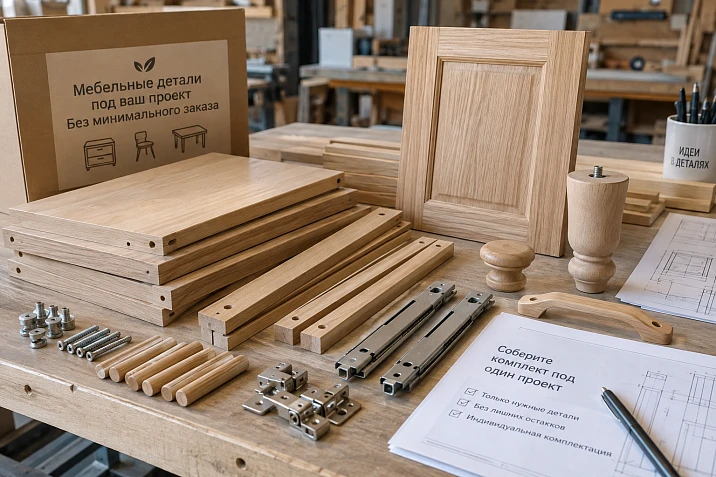
One chest of drawers needs four legs, six handles and two overlays. But somehow the cart ends up with eight supports, ten handles and a few more carved elements "for the next order". The furniture is not assembled yet, but the money has already turned into stock for which there is neither a drawing nor a buyer.
Furniture parts without a minimum order allow an item to be assembled according to actual need. Each item is bought in the quantity specified by the design and finish of the particular piece. To take advantage of this, first draw up a parts list, check dimensions and fastenings, and calculate the cutting of the linear stock. Then separately decide whether a trial element or a reserve is needed.
Different components have their own counting logic. Legs are counted by support points, handles by the facade map, overlays with the pattern direction in mind. For moulding, you have to check how the pieces will fit on the retail strips. If everything is reduced to a single rule of "I'll take a little extra", some parts will remain unused, and the long piece you need may still be in short supply.
What it means to buy furniture parts without a minimum order
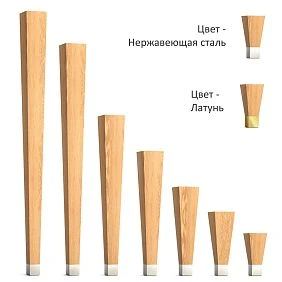
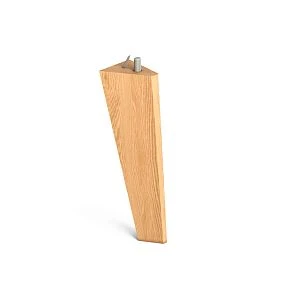
For a private furniture maker or a small workshop, this is an opportunity to buy components for a single item: for example, four wooden supports, two handles and one decorative rosette. The number of different items in the order may vary. Buying four legs does not create a need to order four elements from the other product groups.
On the page conditions for manufacturers STAVROS offers shipping from one piece. This is useful when making custom furniture, repairing a single item and testing a new solution before putting it into production. You can select ready-made furniture parts for an approved project without increasing the purchase for the sake of a nominal batch.
However, selling a catalogue item by the piece and making a new model to your own drawing are different conditions. STAVROS considers non-standard items and size changes for batch orders. Therefore, for a single cabinet it makes sense to first find a suitable ready-made model and check its compatibility with the carcass. The ability to buy one leg does not in itself mean the ability to order a single copy of any shape you invent.
The unit of sale is clarified separately. For a handle it may be one ready-made part, for mounting hardware a set, for linear stock a strip of a certain length. The wording "from one piece" does not turn a long profile into a set of short pieces cut to the buyer's dimensions. To calculate the order, you need to know what exactly is added to the cart and how many such units will be required.




Start with a drawing of one piece of furniture
Until the facades, supports and decorative fields are defined on the sketch, the final quantity of components remains an assumption. Changing one drawer to two doors may keep the number of handles the same but change their position. The appearance of a central partition sometimes changes the support scheme of the carcass. Moving an overlay requires revising the moulding frame.
For procurement, you need at least a simple working drawing with overall dimensions and labels for all parts. It should show the front view, the side view, and the placement of fasteners where they affect the choice. No elaborate formatting is required: it is enough for the person assembling the furniture to clearly understand the purpose of each item.
It is convenient to assign internal designations to parts: H-01 for legs, P-01 for handles, D-01 for overlays. These are project designations, not product SKUs. If a suitable model has not yet been selected, the internal code already links the position on the drawing to the row in the bill of materials. After the product is selected, the manufacturer's SKU is added to that row.
At this stage, unnecessary purchases are also identified. If the top drawer opens by its lower edge, it may not need a decorative handle. If the side panel will be completely hidden by an adjacent cabinet, an overlay placed there will not serve any visible purpose. These decisions are made before ordering, when omitting a part costs nothing.
To check the selected shapes, use drawings and product models. The image helps evaluate the pattern, while the drawing shows the actual width, thickness, and location of mounting areas. Placing the part into the project at the correct scale is more useful than comparing two photographs taken from different distances.
Our factory also produces:
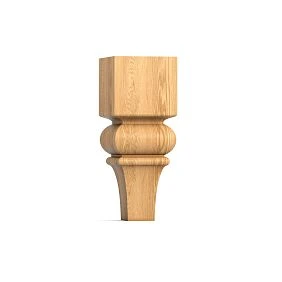
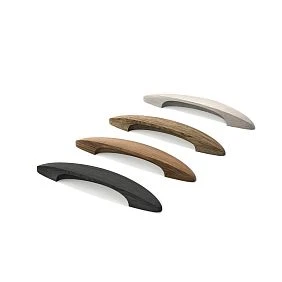
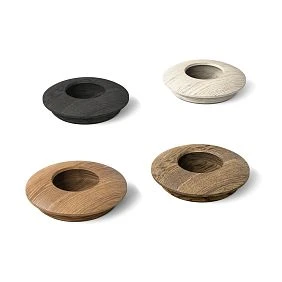
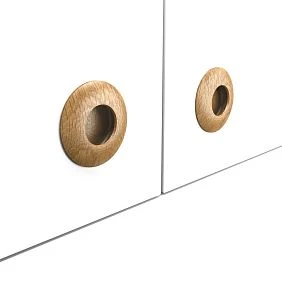
Create a bill of components
The bill of materials links the furniture construction to the purchase. It records which part is needed, in which finish, where it is installed, and how many units are used. For a one-off project, an ordinary table that can be checked next to the drawing is sufficient.
Below is a conditional example of a chest of drawers with four drawers, two doors, and a decorative top strip. The number of supports in the example is set by an already developed construction; it cannot be transferred to any cabinet body of the same width.
| Designation in the project | Element | Installation location | Quantity per item |
|---|---|---|---|
| H-01 | Wooden leg | Four specified support points | 4 pcs. |
| P-01 | Furniture handle | Four drawers and two doors | 6 pcs. |
| D-01 | Overlay | One on each door | 2 pcs. |
| RZ-01 | Wooden rosette | Center of the upper decorative strip | 1 pc. |
| M-01 | Molding | Two frames on the doors | According to the cutting map |
| K-01 | Fasteners for supports | Connecting legs to the body | According to the selected fastening diagram |
| K-02 | Fasteners for handles | Connecting handles to fronts | According to the handle design |
In the worksheet, add the full SKU, dimensions, material, surface preparation option, product link, and unit of sale. The line “oak leg, four pieces” is insufficient: it does not distinguish the tall model from the short one and does not describe the mounting plate.
It is useful to have separate columns for “already have” and “to order.” If one sample has passed inspection and is suitable for installation, it reduces the next purchase. For four supports, if one suitable leg is available, three remain to be purchased. When a sample has been used for destructive testing or an unsuitable color sample, the suitable remainder column is set to zero.
The calculation for individual items looks like this:
To order = quantity per product + agreed reserve + separate test parts − usable remainder.
The result cannot be negative. If you have more of your own parts than the project needs, the purchase for this line is zero. The remainder is considered usable only after checking its execution and condition: a similar handle of a different height does not cover the need for the selected model.
Get Consultation
How to determine the number of furniture legs
Individual furniture legs are convenient because they allow you to assemble the support system envisaged by the project. For a small cabinet, these could be four identical parts. A long sideboard may have additional supports under loaded areas. A console can rest on legs together with wall mounting. The quantity is determined by the design, not by the habit of ordering a set of four.
Before buying Wooden furniture legs, mark all load transfer points on the bottom view. Check what each support is attached to: a reinforced bottom, a rail, a mounting plate, or another designated assembly. A beautiful part will not fix a weak connection to the cabinet.
Do not calculate the permissible furniture weight by simply multiplying the stated load of one leg by the number of supports. The performance of the structure is affected by the rigidity of the cabinet, the placement of contents, the fastenings, and contact with the floor. A tall support also changes the working conditions of the joint under lateral force. For a heavy or unusual product, the scheme is checked by a design engineer.
Four installation points do not always mean four identical SKUs. On a model with pronounced threading, the front side must face the required direction. Front legs may differ from rear legs in design, and corner variants may differ in orientation. In this case, separate lines appear in the bill of materials, for example, two front and two rear supports.
What to check on a single trial leg
A trial purchase is justified when a new assembly raises a specific question: whether the top section fits, whether there is enough space for mounting, whether the support looks too bulky. Before ordering a sample, determine what uncertainty it should resolve. Sometimes a full-size paper template is enough to assess the silhouette; checking the joint already requires a real part.
Try the leg against the section of the cabinet where it will be installed. Check tool access, the position of the fasteners relative to the edge, and that there is no conflict with adjacent elements. The dimensions on the diagram must match the actual orientation of the part. Letter designations for dimensions on different models cannot automatically be read as the same height, width, and depth.
If the project involves custom painting, choose from STAVROS open boundless possibilities for designers, furniture makers, and anyone striving to create unique high-quality furniture. with the appropriate preparation option. It is best to check the fit before finishing. Then a suitable sample can be included in the set, and the coating can be applied at the same time as the other supports.
Count handles using the facade map
For handles, the source document is the drawer and door diagram. Mark every grip point and the selected opening type on it. A single facade may have one handle, two handles, or none — for example, if the design provides another way of opening.
In the example dresser, there are four drawers and two doors. If each facade is assigned one handle, six will be needed. If two separate handles are provided on each of the two wide drawers, the quantity will increase to eight. The number of facades will remain the same.
| Section | Number of facades | Handles per facade | Total |
|---|---|---|---|
| Two upper drawers | 2 | 1 | 2 |
| Two wide lower drawers | 2 | 2 | 4 |
| Side doors | 2 | 1 | 2 |
| Total for this option | 6 | — | 8 |
The final layout is agreed upon based on ease of use, drawer construction and the chosen model. The number of handles is not determined by the width of the front alone: a single suitable pull can serve a purpose for which another design uses two knob handles.
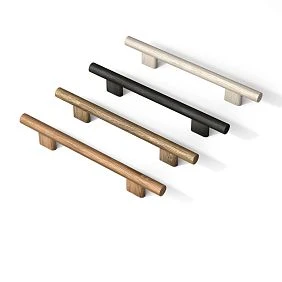
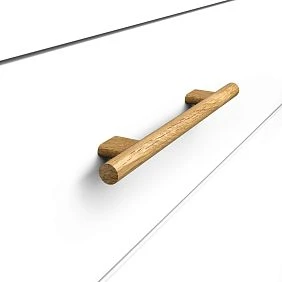
When choosing wooden furniture handles separately check the overall length and the distance between the mounting holes. These dimensions are not interchangeable. A handle with a single mounting point requires a different drilling pattern than a pull with two fastening points.
When replacing handles on existing furniture, first measure the existing holes. Ordering six equally attractive handles does not solve the problem if none of them matches the previous drilling pattern. For a new piece, it is useful to test a sample on an offcut of material of the same thickness as the front: the grip, finger access, screw length and the position of its head on the reverse side.
Fasteners are counted separately. Six handles do not necessarily require six screws: the chosen model may have two mounting points. Also check whether the fasteners are included in the delivery and whether they suit the thickness of the front. Buying extra handles does not make up for missing screws on assembly day.
Count overlays and rosettes together with the direction of the pattern
Carved decor is especially easy to miscount from a general photograph. Two similar overlays may form a mirrored pair, and four corner elements may have different orientations. The number of pieces matches, but the set turns out different.
On the front layout, mark each installation position and the direction in which the pattern should face. A central symmetrical overlay usually occupies one position. For two mirrored compositions, you may need two left-hand and two right-hand pieces. If such variants have separate item codes, record them as separate lines.
Do not assume that a left-hand overlay can always be turned around to make a right-hand one. Rotating it changes the position of the leaves, scrolls and base of the composition. Check the frontal view in the orientation in which the piece will be installed. Match the side designations on the website with the manufacturer's drawing, not with the direction of the hand of the person standing at the workbench.
For selection decorative overlays for furniture a full-size paper template is useful. Place it on the front together with the handle and the moulding frame. This reveals a conflict that is invisible when viewing products separately: the handle lacks free space, the pattern falls on a joint, or the edge of the overlay comes too close to the neighbouring door.
However, paper shows only the outline. The thickness of the relief and the clearance when opening are checked with a three-dimensional sample or an accurate model. This applies especially to doors near a wall and fronts that pass close to each other. If the decor obstructs movement, reducing the number of pieces will not solve the problem — a different shape or position will be needed.
When a single wooden rosette is enough
A single rosette can complete the central composition on the top rail of a chest of drawers or occupy a separate panel on a door. There is no need to buy four identical pieces just because the item has four corners. The quantity is determined by the drawn decorative nodes.
Choosing Wooden sockets, check the size of the free field, the depth of the relief and the neighboring elements. If a round piece with a diameter of 80 mm is placed in the middle of a 120 mm wide field, 20 mm remains on each side. This is the arithmetic of a specific example, not a universal recommendation for margins: the result is evaluated visually and structurally on your own facade.
You should not add a rosette to an order in advance just for the sake of a complete list. On a small facade, the handle, the overlay and the frame may already occupy all the available field. Refusing one more accent in such a case reduces both costs and the risk of a cramped composition.
Order brackets for a specific node
A bracket can be part of the decorative finish or help support a shelf. External similarity does not confirm the same load-bearing capacity. Before calculating, determine the function of the chosen model and the permitted installation method.
If the developed node for one shelf provides for two identical brackets, two such shelves will require four. But the scheme with two points is not a ready-made calculation: the length of the shelf, its material, the load and the fastening to the base may require a different solution.
When ordering wooden brackets match the projection of the piece with the depth of the supported element and check the fastening point. For a portal or a console, the orientation of the pattern is added. The pair of pieces must work in the composition shown on the product facade.
You should not buy another bracket "for reinforcement" without changing the scheme. An additional support is useful only where it actually bears the load and has a suitable fastening. If the bracket serves purely as decoration, the load-bearing part of the structure is resolved separately.
Calculate the linear trim according to the cutting map
For a single piece trim, the quantity is usually visible on the front. With moulding it is more complicated: first the finished segments are counted, then it is checked how many stock strips will be needed to make them. Dividing the total linear meters by the strip length gives only a preliminary estimate.
In the cutting list, enter the length of each element, the number of identical segments, the end-trimming angle and the measurement basis. For a frame with an angled joint, it must be clearly stated whether the length is measured along the outer long points or along another line. Mixing these methods can ruin all the blanks even if the numbers add up correctly.
Example of two frames on doors
Suppose the project requires two identical frames with external dimensions of 600 × 300 mm. Each needs two long and two short elements. Across the whole set, that gives four segments of 600 mm and four of 300 mm. Their total finished length is:
4 × 600 + 4 × 300 = 3,600 mm.
For the training calculation, let us take the stock strip length as 2,400 mm. It is chosen as a condition of the example and must be replaced with the actual length of the required product. We will also conditionally allow 10 mm per segment for the chosen end-trimming sequence and 20 mm for preparing the ends of each strip. Actual losses are determined by the tool, cutting angles and condition of the material.
One possible option is to distribute the blanks evenly:
| Plank | Blanks with conditional allowance | End preparation | Used | Remainder |
|---|---|---|---|---|
| First, 2,400 mm | 610 + 610 + 310 + 310 mm | 20 мм | 1,860 mm | 540 мм |
| Second, 2,400 mm | 610 + 610 + 310 + 310 mm | 20 мм | 1,860 mm | 540 мм |
For the given conditions, two strips are enough. The total purchased length is 4,800 mm, of which 3,600 mm will go into finished elements, 120 mm will be the anticipated process waste, and another 1,080 mm will remain as two offcuts of 540 mm each. This is already a clear result: not only the number of strips is known, but also the shape of the remainder.
These two offcuts cannot be mentally combined into one long piece. Each can still yield a short frame part if the allowance is sufficient, but they cannot replace a damaged 600 mm element. The decision about an additional strip therefore depends on which specific risk needs to be covered.
Why total footage is sometimes only enough on paper
Another hypothetical project requires three continuous segments of 1,300 mm each. The finished requirement equals 3,900 mm. By total length, two strips of 2,400 mm give 4,800 mm and appear sufficient.
However, one strip cannot yield two segments of 1,300 mm: they require 2,600 mm even before accounting for saw cuts. This means three continuous elements will require three strips. The remainders from the first two will not replace the third element if the project does not allow a joint.
Before ordering Wooden trim, check specifically the placement of the segments. For a textured profile, pattern matching may additionally be required, and for a transparent finish, adjacent elements may need to be matched by appearance. Then a geometrically acceptable cutting plan still has to be evaluated taking the finish into account.
You cannot shorten a long element on your own to save on the strip: that is a change to the project. If a joint is acceptable, its position is first agreed upon and shown on the drawing. If continuity of the line is essential, the required amount of material is included from the start.
How not to confuse similar versions
Externally identical wooden furniture elements may differ in size, wood species, preparation for finishing, or the design of the mounting part. All these parameters matter for an order. A photo saved on your phone does not replace a complete product record.
Start with the item code and the selected size variant. Then specify the material, blank quality, presence of a coating, and other available options. Next to it, save the exact link to the product page. If variants switch within a single page, the link may lead to the original version; therefore, duplicate the selected characteristics in text.
With a clear or semi-transparent finish, the wood grain remains visible. Parts of the same species do not become identical in color just because of the shared material name. For opaque enamel, the requirements for visual matching of blanks are different, but surface condition and geometry still matter.
Before choosing an option, read the description materials and product quality. The designations for preparation for enamel and for tinting must be matched with the future coating. A mistake here is especially unpleasant with a small order: replacing one noticeably different part can be harder than selecting a coordinated version of the entire set in advance.
Useful for your own color samples Product samples, if they include a suitable material and processing option. A wood sample helps verify color but does not confirm handle comfort or the compatibility of the leg with the mounting. These tasks require the appropriate parts.
Do not change the wood species in one order line just because another option is available faster. First assess whether the project allows the substitution. Under a clear finish, it will affect the appearance, and during modification it may change the usual processing regime. The decision must be reflected in the specification; otherwise, parts from different project versions will meet during assembly.
Trial purchase and reserve serve different purposes
A trial part is purchased to make a decision. A reserve part is purchased to carry out an already-made decision in case the main element is damaged or lost. If these purposes are not separated, it is easy to end up with two identical "spares" in an order, although only one is needed.
For a new project, a sample can confirm fastener fit, grip comfort, pattern scale, or the finish result. After testing, it must have a clear further purpose: installation in the product, storage as a reference sample, or use for subsequent process trials.
Suppose a craftsman first purchased one handle, tested it on a facade sample, and kept it undamaged. For a dresser with six such handles, five remain to be ordered. If the sample was painted with a different composition and returning it to the required finish is impractical, six new ones will be needed. The quantity is determined by the suitability of the part, not by the fact of a previous purchase.
When reserve is justified
An additional element makes sense if its purpose can be formulated in advance. For example, a complex rework of a fragile area is ahead, delivery is only possible after a wait, and a halt in assembly will significantly delay the product's readiness. Another case is an agreed service stock for furniture that will be repeated many times.
A universal ten percent surcharge is inconvenient here. For four legs, that is 0.4 of a part, which after rounding becomes one more leg, i.e., already a quarter of the main quantity. For a single expensive overlay, one spare doubles the cost for the item. Such a decision requires justification, not an automatic percentage.
| Situation | Possible solution | What to check before purchase |
|---|---|---|
| New handle with unknown grip | One trial unit | Can it be included in the final set |
| Complex processing of the selected part | Separate blank for operation testing | Which area will be used in the sample |
| Single offcut without rework | Purchase by project | Reorder availability and lead time |
| Molding with long continuous segments | Reservation for a specific cutting plan | Which part the remainder can replace |
| Repeatable furniture model | Small agreed reserve | Probability of reusing the same finish |
When an extra part is not needed
You can skip the reserve if the project is a one-off, the part is not subject to risky modification, a repeat delivery fits within the acceptable timeframe, and the remainder is unlikely to be used in another item. An expensive central decoration for a custom cabinet rarely becomes a universal consumable in the workshop.
Be especially careful when buying "for the next client." The next order may require a different leg height, a different pattern, and a different wood species. The per-unit format lets you wait for a specific project. For working stock, it is better to choose items whose repeatability has already been confirmed by workshop orders.
How to assemble an accurate order for a single dresser
Let's return to the original example: four drawers, two doors, one handle on each front, and four legs provided by the design. The doors carry two identical overlays and two molding frames. One socket is located on the fixed top rail, where a separate field is allocated for it.
This is a calculation example, not a ready-to-build project. The load-bearing joints, cabinet dimensions, and relative placement of the decor must be developed separately. To calculate the linear footage, we use two 600 × 300 mm frames and the conventional 2,400 mm strips from the previous section.
Suppose a suitable test leg is already available, as is one handle of the chosen model. The paint test was performed on a separate sample. No additional reserve of piece parts has been approved for this project.
| Position | Needed for the dresser | Usable from what has already been purchased | Add to order |
|---|---|---|---|
| Legs of the same finish | 4 pcs. | 1 pc. | 3 pcs. |
| Handles of the same finish | 6 pcs. | 1 pc. | 5 pcs. |
| Overlays | 2 pcs. | 0 | 2 pcs. |
| Rosette | 1 pc. | 0 | 1 pc. |
| Molding according to the approved cutting plan | 2 planks | 0 | 2 planks |
First check the quantity on the drawing, then subtract the usable parts, and only then transfer the result to the cart. In the example, the craftsman purchases three legs, although the dresser will stand on four. This is a normal result of accurate accounting.
Fasteners are added to the table. If the selected system provides for a separate mounting part for each leg, four are required regardless of the fact that three new legs are being purchased. The already purchased sample may have been supplied without a fastener. Similarly, screws are counted for all handles being installed, not only for the five new ones.
Section furniture hardware are checked against the requirements of the selected connections. The name "for legs" is not sufficient confirmation of compatibility: the thread, length, mounting dimensions, and method of attachment to the cabinet body matter.
After kitting, compare the order with the manufacturing sequence. If the holes in the cabinet body depend on the actual mounting point of the leg, this check must be completed before final drilling. If the handle affects the position of the overlay, both parts are test-fitted before drilling the front. An accurate quantity does not protect against an error made at the previous technological stage.
How to transfer the calculation to a nightstand or a small cabinet
For a nightstand with two drawers and one handle on each, the initial requirement is two handles. If the design provides for four supports, four legs are recorded. Overlays and molding are added only if the corresponding trim is present on the drawing. A simple nightstand may not have these lines at all.
A narrow front is especially sensitive to the combined size of the handle and the decor. Check the distance between them and the space for fingers. In a separate photo, an overlay may look small, but once placed on a drawer it can take up almost its entire height. A full-size template lets you avoid an unsuitable purchase before you even pay.
A small cabinet has another peculiarity: identical doors are often designed as mirror images. If each door needs its own directional overlay, the order consists of one left and one right piece. Two identical items do not form the required composition, even if the quantity in the table adds up.
For a cabinet, also check the principle of support. If the carcass is installed on a solid base or a plinth provided for by the design, decorative legs may not be needed. A visible support should not be added just because it was present in the calculation for a chest of drawers: another item has its own construction.
It is also useful to count two identical cabinets in a single bill of materials. Piece parts with an unchanged construction are usually multiplied by two. Linear lengths are laid out again on the strips for both items at once: short elements of one set sometimes fit into the leftovers of the other. Simply doubling the number of strips may produce excess material, or it may turn out to be correct — the cutting plan shows which.
At the same time, do not mix parts of different materials and finishes in one waste calculation. A leftover oak profile does not cover the need for a beech one just because its length fits. Reuse is possible for a specific compatible version.
Compare the cost of a complete set
For a single piece of furniture, it is useful to calculate the total cost of getting the parts ready for installation. It includes the items themselves, the required hardware, delivery, any required samples, and processing. A low unit price does not guarantee lower expenses if it forces you to buy an unnecessary quantity.
A conditional example not tied to STAVROS prices: six handles are required. Individually, one costs 350 rubles, while a pack of ten is offered at 300 rubles per handle. In the first case, the purchase costs 2,100 rubles; in the second, 3,000 rubles. The unit price in the pack is lower, but for the current project you will have to pay 900 rubles more and store four extra parts.
If all ten handles will indeed be used in already agreed projects, the calculation changes: the pack costs 3,000 rubles versus 3,500 rubles for ten individual purchases. The saving arises from a confirmed need. A promise to use the remainder someday is not such a need yet.
Delivery is also noticeable for a small order. Sometimes it is reasonable to combine legs, handles, decor, and fasteners into one shipment after checking the entire bill of materials. In another situation, it is worth getting a sample part earlier: the cost of a separate delivery may be less than the expense of correcting an incompatible set.
The decision is made based on a specific uncertainty. If the dimensions are known, the fastening has been verified, and the material has already been used, a trial order may not provide new information. If a new tall leg is being connected to a thin cabinet base for the first time, the joint itself must be checked first. Purchasing the full set before such a check transfers the risk to the entire order.
Check the order before payment and upon receipt
Before paying, verify not only the total amount but also each line of the confirmation. Check the item code, selected dimensions, material, surface preparation, grain direction, quantity, and unit of sale. If the parameters were communicated in correspondence, they must unambiguously match the agreed order.
To place an order, STAVROS suggests specifying the item code, material, size, quality, and quantity. The ordering procedure and available delivery methods are described in the section payment and delivery. It makes sense to confirm the readiness date of the entire set based on the latest item: having five handles in stock does not complete the project if the sixth will be manufactured later.
Do not include an unconfirmed service in the assembly plan. For example, a self-made cutting plan does not mean that the supplier will cut the strips according to that list. STAVROS states in its FAQ that it does not perform cutting to the customer's size. Arranging cutting and suitable tools must be planned separately.
After receipt, lay out the parts according to the packing list before starting painting and drilling. Compare the quantity and finishes, inspect the surface, check the pairing of the decor and the main dimensions. If a discrepancy arises, record it and discuss it with the seller before modifying the product: traces of processing will make it harder to establish the original condition.
For several identical parts, a preliminary layout on the furniture is useful. This makes it easier to select the mutual arrangement by wood grain and to notice differences that are not obvious when viewed individually. After the layout, mark the hidden areas in a way that is safe for the future finish and keep track of the installation location.
Do not send the entire set for irreversible processing at once if the first assembly joint has not yet been checked. First confirm the marking and settings on a suitable test material. Then check one working part, and only after that repeat the operation on the rest.
Prepare the information for a reorder
Six months later, a photo of the finished dresser will help you recall its appearance, but it will not always let you identify the handle model. Similar SKUs may differ in size, and the finish can conceal the characteristics of the original material. For a repeat purchase, keep the full set of documents together with the project.
A fairly short record is enough: the full SKU, the selected finish, dimensions, material, preparation, a link to the product, the date and the order number. Separately save a photo of the part before finishing and of the finished item. If the finish was applied by a workshop, note the compositions and the sequence of operations: the store will not be able to reproduce the customer's own custom color from the model name alone.
For molding, also save the cross-section profile and the cutting map. When replacing a short damaged element, a leftover piece from assembly may come in handy. It should clearly show the SKU, material and usable length. Without labeling, similar profiles quickly get mixed up.
Availability in the catalog today does not guarantee indefinite availability. Before reordering, check the model and its finish again. If the required option has changed, first determine whether a single part can be replaced without a visible difference. Sometimes a more consistent result comes from replacing a pair of handles at the same level or both overlays of a mirrored composition.
A saved reference sample is especially useful for repeatable furniture. But its purpose must be marked: such a sample should not be quietly used up on the current assembly. Otherwise it is listed as a reference in the inventory, while in fact it has already been installed at the customer's.
Where to buy furniture parts for a one-off project
Start your selection with the elements that define the construction and the dimensions of the assemblies. In the catalog ready-made wooden elements for furniture you can choose product groups to complete the project. Once the supports and handles are agreed, move on to the facade finishing: this way the decorative elements will be selected to match the already defined fields and grip points.
If you need to buy wooden decor for furniture, compare the models from the section wooden carved decoration with a facade drawing. Evaluate each selected item together with its neighboring elements. Two successful details individually may not match in scale within one small field.
It is convenient to order furniture components at retail after the entire list has been filled in. It should show how many parts are required, which samples are already suitable for assembly, and which items are still awaiting verification. An unverified option is better to be clearly marked than accidentally paid for together with the approved set.
Furniture parts without a minimum order are especially useful when working on a single item: the quantity can be subordinated to the project. For a chest of drawers, this would be four legs and six handles; for a nightstand, a different set; for restoration, one missing part. Before placing the order, all that remains is to verify the specific versions, availability, and lead times, then transfer to the order only the calculated requirement and a justified reserve.
Additional questions about a small order
Can I buy one new leg to replace a broken one on old furniture?
Yes, if a compatible model can be found. Compare the height, top cross-section, mounting, orientation, and appearance. Even a close pattern does not compensate for a difference in height. If there is no exact match, you need to evaluate replacing the agreed set of legs and check the structure after the change. You should not cut down a load-bearing part or rework the mounting without assessing the assembly.
How to order furniture parts without a minimum order if the client is still choosing the design
Divide the list into approved and under-discussion items. Postpone the purchase of interdependent parts until the choice is made: a different handle may require shifting the plate or changing the frame. If a sample is needed for a decision, order exactly that with a clear verification task. Bulk purchasing of several alternatives turns the client's choice into the workshop's stock.
What to do if the customer added a second identical item
First, confirm that the dimensions and design have indeed not changed. Then increase the quantity of piece items, take into account usable leftovers, and recalculate the linear footage for both products together. Check the need for fasteners and finishing materials. The previous purchase is not always doubled in full: a trial sample already exists, and some short elements may come from leftovers.
Can different projects be combined into a single purchase?
Yes, if the separate requirement for each item is preserved. For identical items, the quantity for the order is summed, but after receipt the parts are distributed back to the projects. A matching item code is verified together with size, material and finish. Delivery can be shared, but consumption tracking must make it possible to tell which item each part belongs to.
What to do with moulding left over after cutting
Measure the usable length, inspect the ends and label the finish. A suitable offcut can be used for a coating test, tool setup or a future short element. Store a long intact remainder so that the profile is not damaged. If there is no use for it, do not count it in calculations as a full future saving: stock is only useful when it is compatible with a specific task.
Can a trial order be avoided when buying remotely?
Yes, when the model has already been used or its parameters are sufficiently confirmed for your assembly. A template based on the drawing helps to assess the contour, while exact dimensions and fastening information help with verification. But a photo and description do not replace checking the grip of a new handle or testing your own coating. Choose the verification method based on the question that still remains open.