Article Contents:
- Why it is not enough for a mascaron to simply fit on the surface
- What has been confirmed for M-011
- Five sizes of M-011 — five different scales
- Why the depth of the relief is as important as height and width
- How to determine the clean decorative field
- Why one universal indentation cannot be assigned
- Full-size fitting: the most reliable way to choose M-011
- How to prepare templates
- Why it's useful to photograph every option
- Close distance
- Medium distance
- Long distance
- Oak
- Oak
- Material Comparison
- Standard
- Prestige
- Small chest of drawers
- Sideboard with a medium central door
- Tall cabinet
- Door portal
- Wall panel above the console
- Fireplace portal
- How many sizes does M-011 have?
- Which size of M-011 should I choose for a furniture facade?
- Can I choose M-011 only by the width of the facade?
- What does the third size in the line mean?
- How much space should be left around the mascaron?
- Can M-011 be placed next to a furniture handle?
- Will M-011 be suitable for a door portal?
- Which M-011 should I choose for a large wall panel?
- How is M-011 different from a regular overlay?
- What wood is M-011 made from?
- What is better to choose for enamel?
- What should I choose for clear tinting?
- How does Standard differ from Prestige?
- Do I need to make a 1:1 template?
- Can M-011 be trimmed if it doesn't fit slightly?
- Do I need to repeat the mascaron on all cabinet fronts?
- What can be matched from the "Grape" collection?
- How to install M-011?
- Can the mascaron be attached to a painted surface?
- How to check that a large M-011 won't obstruct the passage?
- Do I need to order all the decor at once?
- Where can I see all variants of M-011?
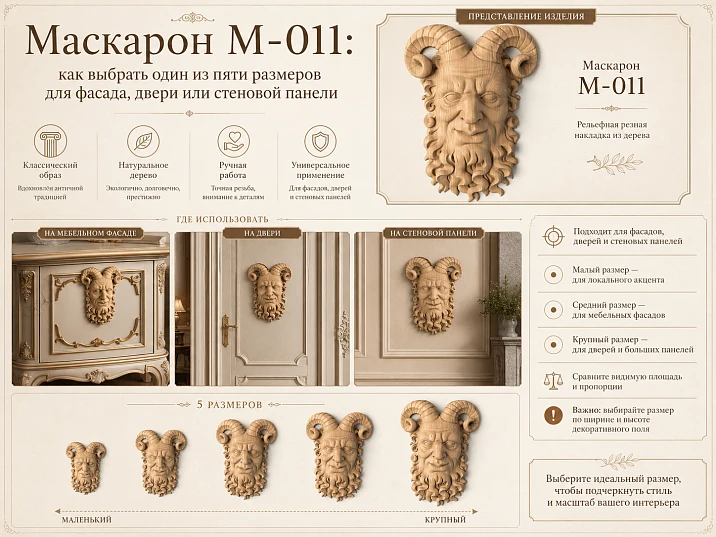
The M-011 mascaron is chosen not only for the beauty of its carving. The same design is produced in five sizes, and each variant works differently on a furniture facade, door, wall panel, or portal. A too-small element gets lost, a too-large one starts to overwhelm the composition, and a mascaron that formally fits in width may end up squeezed between a molding, handle, and panel. Therefore, before ordering, you need to evaluate not just one number, but the entire decorative unit: the clear field, relief depth, viewing distance, surrounding details, and future finish.
The product card presents a carved mascaron M-011 in five sizes. The minimum version has dimensions of 131 × 100 × 34 mm, the maximum — 328 × 250 × 84 mm. Between them are three more variants: 171 × 130 × 44 mm, 210 × 160 × 54 mm, and 269 × 205 × 69 mm. For each size, beech and oak are available, with Standard or Prestige preparation, as well as options for further finishing.
The buyer's practical task sounds simpler than the designer's technical specification: which M-011 to choose so that it truly decorates the facade, rather than just fitting on it? The answer starts with a full-size template. You need to see the mascaron at real scale, check the free space around the contour, assess the relief protrusion, and only then confirm the material, preparation quality, and the set of adjacent decor.
Why it's not enough for a mascaron to simply fit on the surface
A decorative element has two different states. In the first, it technically fits within the rectangle: the edges do not extend beyond the facade, the door closes, and the molding is not overlapped. In the second, the mascaron is perceived as the main image of the composition: a calm background remains around it, the face reads well, shadows emphasize the relief, and handles and frames do not compete with the central accent.
It is the second state that needs to be designed. If you only rely on the rule "it fits — so it's suitable," the result often looks random. The mascaron may almost touch the inner edge of the molding frame, the lower part may press against the panel, and the furniture handle may be so close to the face that the two details form an awkward and visually heavy group. On a portal, the problem manifests differently: a large relief conflicts with the cornice or capital, while a small variant gets lost on a tall plane.
The clear field is not emptiness that must necessarily be filled. It works as a background. The more complex and deeper the carving, the more important it is to give it space. A calm surface around M-011 helps to see the overall silhouette, the grape motif, and the volume, rather than a set of individual protrusions and shadows.




What is confirmed for M-011
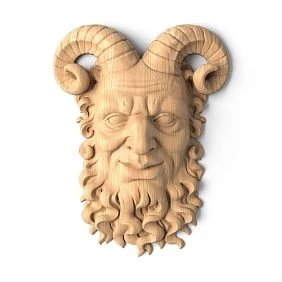
M-011 is a carved wooden mascaron, available in five size variations. It belongs to the decorative collection "Grape" and can be used as a central accent in furniture and interior compositions. The exact purpose of a specific size is determined by the project, not just by the product name.
| Parameter | Confirmed data |
|---|---|
| Article number | M-011 |
| Product type | Carved wooden mascaron |
| Number of sizes | Five |
| Dimensions | 131 × 100 × 34 mm; 171 × 130 × 44 mm; 210 × 160 × 54 mm; 269 × 205 × 69 mm; 328 × 250 × 84 mm |
| Material | Beech or oak |
| Surface preparation | Standard or Prestige |
| Preparation for finishing | For enamel or for tinting |
| Production | Custom Order |
| Drawings | Provided for size verification |
| Collection | "Grape" |
| Main card | Buy mascaron M-011 from beech or oak |
The three values in each size line should be read according to the current drawing. In the article, they are used as a confirmed overall dimension A × B × C, but assigning the functions "width", "height", or "depth" to the letters without checking against the dimension arrows is not recommended. For design purposes, it is important to open the drawing and check the orientation of the part, the outer contour, and the maximum protrusion.
Our factory also produces:
Five sizes of M-011 — five different scales
The five versions should not be perceived as the same decor that was simply enlarged or reduced. As the size grows, not only the area occupied on the base changes, but also the depth of the relief: from 34 to 84 mm. Consequently, the shadow, side view, installation requirements, and the distance from which the mascaron is perceived as a whole change.
| Size M-011 | Possible design role | What to check before ordering |
| 131 × 100 × 34 mm | Small facade, decorative insert, compact central zone | Will the pattern be lost from a normal viewing distance |
| 171 × 130 × 44 mm | Chest of drawers, bedside table, middle door of a sideboard or cabinet | Distance to the handle, panel, and frame |
| 210 × 160 × 54 mm | Large furniture facade, central door, wall section | Is there enough free background and does the protrusion interfere |
| 269 × 205 × 69 mm | Door, wall panel, portal, large furniture composition | Scale relative to the entire plane and adjacent decor |
| 328 × 250 × 84 mm | Large central field, tall panel, expressive portal | Base strength, maximum protrusion, and viewing distance |
These scenarios help start the selection but do not replace project verification. The same facade can be perceived differently depending on color, molding width, panel shape, and overall amount of decor. Therefore select size M-011 from 131 to 328 mm better after comparing full-size contours.
Get Consultation
Why relief depth is as important as height and width
The buyer often looks at the first two digits because they help understand whether the decor will fit into the frame. The third parameter is often perceived as secondary. For M-011, this is a dangerous simplification. Depth increases with size: the minimum variant has 34 mm, the maximum — 84 mm. The difference of 50 mm significantly changes the behavior of the part.
Deep relief is more visible from the side. It creates an expressive shadow and makes the mascaron look not like a flat overlay, but like an independent volume. At the same time, the risk of snagging increases: the handle of an adjacent door, a leaf, clothing in a narrow passage, or a protruding portal element may conflict with the mascaron.
On a furniture facade, you need to check whether the protrusion will be inconvenient when opening. On a wall panel — whether the mascaron will be in a constant walk-through zone. On a door portal — whether the relief will intersect with the trim, cornice, or the direction of the leaf movement. On a fireplace composition — whether the protrusion will visually compete with other volumetric details.
The maximum M-011 size of 328 × 250 × 84 mm cannot be considered just an enlarged decorative plate. It is a noticeable volumetric element that requires a reliable base, free side visibility, and sufficient viewing distance.
How to determine the clean decorative field
The total width of the facade or panel does not yet show how much space is actually available for the mascaron. First, you need to highlight the clean decorative field — the area within which M-011 can be located without intersecting with structural and decorative zones.
The following are excluded from the overall plane:
-
molding frames and their inner protrusions;
-
panels, chamfers, and profile transitions;
-
furniture handles, keyhole plates, and keyholes;
-
hinge zones and fastening elements;
-
adjacent carved overlays;
-
technological joints;
-
areas covered when the adjacent door is opened;
-
cornices, plinths, and protruding horizontal parts.
After this, a rectangle or complex field remains, inside which five M-011 variants are compared. It is important to measure not only the maximum width and height, but also to see where the mascaron contour comes closest to the frame. In a carved product, the edges do not form a simple geometric rectangle, so it is useful to work with the actual silhouette.
For example, the facade may have enough space in the center, but the upper part of the mascaron may be too close to the inner profile. Or the lower grape element may fall onto the panel transition. Formally, the dimensions fit, but the composition looks cramped. A full-size contour reveals such problems earlier than the ordered decor.
Why you can't assign one universal indent
A rule like "leave 50 mm on all sides" seems convenient, but it doesn't work for M-011. The five sizes differ in scale and depth, and the surrounding surfaces can have completely different geometry. The same 50 mm next to a small mascaron will look spacious, but next to a large one it will feel cramped.
The required background depends on several factors:
-
Size of M-011. A larger version usually requires a wider field so that the volume is perceived calmly.
-
Relief depth. The stronger the protrusion, the more noticeable the shadow, and the more important it is to separate it from neighboring profiles.
-
Frame shape. A narrow molding, a wide baguette, and a complex panel create different visual boundaries.
-
Color. A contrasting mascaron reads more actively than one painted in the facade color.
-
Viewing distance. On furniture, the decor is seen up close; on a portal, from several meters away.
-
Amount of neighboring carving. The more ornaments around, the wider the calm background should be.
-
Lighting. Side light intensifies the shadow, frontal light makes the relief softer.
-
Handle position. Hardware can visually reduce the free field even without physical overlap.
Therefore, the task is not to find a single number, but to compare several options on the actual plane. Often the correct size becomes obvious only after molding, handle, and panel borders appear next to it on the mockup.
Full-size fitting: the most reliable way to choose M-011
The photo in the product card helps evaluate the pattern but does not convey the real scale. On screen, options may look almost identical because images are automatically adjusted to one size. Full-size fitting restores real proportions.
How to prepare templates
First, you need to look at the M-011 drawings and get the outlines of the sizes of interest. It is advisable to print not only the outer rectangle but also the overall silhouette of the product. If the exact outline is not available for printing, you can make a check rectangle by overall dimensions, but the final decision should still be made based on the drawing.
On each template, it is useful to indicate:
-
article M-011;
-
exact size;
-
top direction;
-
central vertical axis;
-
maximum protrusion;
-
expected finish;
-
facade or panel number.
The template is secured with painter's tape that does not damage the surface. Nearby, the contours of moldings, handles, locks, and adjacent carvings are marked. Then the facade is examined from three distances: close up, from the usual usage distance, and from the main entry point of the room.
Why it's useful to photograph each option
The eye quickly gets used to the new scale. After several rearrangements, it's hard to remember which size looked better. Photos from the same point allow comparing options without the influence of the current impression. In the photo, it's especially clear when the mascaron:
-
got lost on a large surface;
-
ended up too close to the frame;
-
conflicts with the handle;
-
is visually shifted;
-
became too heavy for the furniture;
-
does not match the scale of adjacent parts.
For a large portal, it is useful to take a photo from the far end of the room. For a chest of drawers, take it from the eye level of a standing person and from the usual place where the furniture is most often seen.
Geometric and visual center are not always the same thing
On a symmetrical empty facade, the geometric center is usually suitable for M-011. But real furniture rarely consists of a single clean plane. A handle, a keyhole plate, an asymmetrical panel, a side pilaster, or an overhanging cornice change the perception of the center.
The geometric center is obtained by measurement. The visual center is determined by the entire composition. For example, a heavy handle in the lower part of the facade may require a slight upward shift of the mascaron so that the parts do not form a dense group. A side pilaster with active carving can visually "pull" the composition to the side. A protruding cornice can make the top of the facade heavier, and then a mascaron placed strictly in the middle will seem too low.
You also cannot shift a part by eye without marking. First, mark the geometric axes, then check possible adjustment on a template. The change must be deliberate and repeatable, especially if several facades are decorated identically.
How to choose M-011 for a furniture facade
A furniture facade is viewed from a close distance, so the quality of carving, precision of finishing, and position relative to the handle are especially noticeable here. For a chest of drawers, sideboard, or cabinet, M-011 can become the main central accent, but only if its scale is coordinated with the clean field.
Before ordering, check:
-
width and height of the available field;
-
facade thickness;
-
the shape and depth of the panel;
-
the position of the furniture handle;
-
the opening of adjacent doors;
-
possible contact with the relief;
-
the direction of the solid wood or veneer texture;
-
the presence of other overlays;
-
the future finishing system.
On a small facade, the 131 × 100 × 34 mm option may look appropriate if the pattern remains legible. On a medium door, 171 × 130 × 44 mm or 210 × 160 × 54 mm is often considered. But you cannot choose based only on the word "medium": two facades of the same width may have different panels and different free space.
For a chest of drawers or a sideboard, one M-011 on the central door is usually more convincing than repeating it on each drawer. A mascaron is a strong figurative element. Repeated multiple times, it turns an expressive accent into ornamental noise and complicates the selection of handles.
Mascaron and furniture handle on the same facade
The handle performs a practical function, while the mascaron serves a decorative one. When both parts are on the same plane, they must be separated both physically and visually.
The handle must not cross the relief, interfere with the perception of the face, or create the impression of a random detail directly near the chin, cheek, or grape motif. It is necessary to check the grip comfort: fingers should not touch the carving. When opening the adjacent door, its handle must not hit the mascaron.
Several solutions are possible:
-
move the handle below the decorative center;
-
choose a compact button handle;
-
place M-011 above the geometric middle;
-
use a mascaron on a blind central panel;
-
choose a smaller size of M-011;
-
change the molding frame so that the hardware and carving are in different zones.
The solution is tested on a mockup. A separately drawn handle and a separately selected mascaron may look good, but after combining they can become competing accents. They need to be designed simultaneously.
M-011 inside a molding frame
A common mistake is to first assemble a small frame and then look for a mascaron that will "roughly fit." The correct order is the reverse: determine the clear field, choose the size of the central decor, then select the width and profile of the molding.
Work sequence:
-
Measure the available surface.
-
Note the technical constraints.
-
Compare several sizes of M-011.
-
Approve the clear space around the silhouette.
-
Select the molding.
-
Check the corner elements.
-
Make a general template of the frame and mascaron.
-
Make sure the relief does not touch the inner edge.
-
Check the finish and color.
-
Only after this order the entire set.
The molding should not look like a tight box. A visible area of the background is needed between it and the carving. With deep M-011, it is important to consider the shadow: even if the physical distance is sufficient, the shadow from the relief can visually connect with the frame profile.
How to use M-011 on a door or door portal
On a door and portal, the surface scale is larger than on a furniture facade, and the viewing distance increases. Therefore, a small M-011 can get lost. At the same time, a large version with a depth of 84 mm requires careful checking of the protrusion and direction of movement.
For a door, check:
-
position relative to the axis of the panel;
-
perception height;
-
distance to the casing;
-
position of the handle and lock;
-
opening direction;
-
possibility of touching the wall or furniture;
-
distance to the cornice and capitals;
-
view from both sides if the decor is visible at an angle.
For a portal, the connection with the entire architectural composition is important. The mascaron can be a central detail above the opening, part of the frieze, or an accent between pilasters. In any case, it should be evaluated not separately, but together with the height of the opening, the width of the architraves, the cornice, and neighboring carved elements.
The large version 269 × 205 × 69 mm or 328 × 250 × 84 mm can be well readable on the portal, but this is not a universal recommendation. First, you need to make a full-size mockup and check the base. For a narrow portal, a smaller size sometimes looks more convincing because it preserves the background and does not conflict with the capitals.
M-011 on a wall panel and boiserie
On a wall panel, the mascaron can become the center of one section, part of a vertical composition, or an accent above a console. It can also be located between pilasters or be part of a decorative panel.
The main condition is a calm background. If the entire panel is filled with small overlays, rosettes, gilded profiles, and complex texture, the face of M-011 ceases to be the main image. In such a situation, it is better to reduce the amount of neighboring decor rather than try to enhance the mascaron with even more contrasting finishing.
The boiserie section should be designed as a single field. First, its width and height are determined, then the position of the mascaron, after that — the moldings and side elements. If the panel already exists, the template helps to understand whether the inner frame is too narrow.
Side lighting is especially noticeable on the wall. It emphasizes the relief, but can create a heavy shadow. Before installation, it is worth viewing the mockup in the morning, evening, and under artificial lighting. This helps to choose not only the size, but also the color of the finish.
Viewing distance and scale selection
M-011 should be readable from the distance at which a person usually sees the decorated surface. For furniture, this is a close and medium distance. For a wall, door, or portal, it is a medium and far distance.
Close distance
For close viewing, the following are important:
-
carving detail;
-
edge cleanliness;
-
preparation of recesses;
-
quality of the final finish;
-
neatness of the junction with the base;
-
absence of rough glue traces.
Here, a larger size is not always better. If a person is almost right up against the facade, a deep relief can be perceived as too heavy.
Medium distance
At medium distance, the overall silhouette, central axis, contrast with the background, and free space become the main factors. This is where a wardrobe, sideboard, door, or panel is most often evaluated.
Far distance
For a tall portal or a large wall, a small variant may disappear. The details of the grape ornament stop being readable, leaving only a small dark outline. In such a situation, the larger M-011 is considered, but at the same time, it is checked whether it overloads the close-up view.
One mascaron or several repeats
M-011 creates a strong focal point. It should not be automatically repeated on every cabinet door, every drawer, or around the entire perimeter of a wall panel. Repeated faces especially quickly overload the interior.
A calmer scheme is built as follows:
-
one main M-011;
-
repetition of the grape motif through side overlays;
-
molding frame;
-
one pair of matching brackets or capitals;
-
unified finish.
This way the composition remains cohesive, but the central element does not lose its significance. An exception is possible for strictly symmetrical paired surfaces, for example two identical doors. Even then, it is necessary to check whether two mascaroons become too active in one field of view.
The "Grape" collection: how to assemble a coordinated set
M-011 is presented in the "Grape" collection together with overlays, capitals, brackets, baguette, and frame. This helps to create a composition with a repeating motif without accidentally mixing ornaments.
To select, you can open decor of the "Grape" collection for M-011. The collection includes, in particular, overlays N-252L and N-252R, N-253L and N-253R, N-254L and N-254R, central overlays N-259, N-260 and N-261, capital KL-035, brackets KR-035 and KR-052, baguette K-063 and frame RM-013.
It is not necessary to use all elements at once. Usually two or three coordinated types are enough. For example:
-
M-011 as the center;
-
paired side overlays;
-
simple baguette or molding;
-
uniform tinting.
Or:
-
M-011 above the doorway;
-
capitals on pilasters;
-
calm cornice;
-
finish in one shade.
For a furniture facade, you can choose M-011 and one pair of overlays with a grape ornamentwithout adding the rest of the collection elements. This approach preserves the recognizable motif and does not overload the surface.
What to buy together with M-011
Purchasing the central mascaron is often part of a larger task. Before ordering, it is useful to determine the entire set so that the material, preparation quality, and finish do not differ between batches.
| What to add | What it is for | When appropriate | What to check |
| Side overlays of the "Grape" collection | Support the motif without repeating the second mascaron | Cabinet, sideboard, panel, portal | Dimensions, orientation of the left and right parts |
| Molding or cornice | Form a frame and a clean decorative field | Furniture facade, door, boiserie | Profile width and distance to relief |
| Capitals or brackets | Connect central decor with vertical composition | Portal, fireplace, tall panel | Scale relative to M-011 |
| Mounting materials | Secure the product to a specific base | Any scenario | Compatibility with wood, wall, or facade |
| Control sample of finish | Check color and relief behavior | Enamel, tinting, patina, transparent finish | Match of material and preparation |
| Reserve coordinated decor | Save a unified set for a complex project | Large furniture or interior composition | SKUs, wood species, quality, and batch |
If instead of a mascaron a calmer central element is needed, it is worth opening the catalog of wooden decorative overlays. For a complex project, useful carved wood decor for a complex project, where you can connect the design of furniture, walls, openings, and portals.
How not to confuse a mascaron with a regular overlay or rosette
The mascaron is built around the image of a face or head and is perceived as the narrative center. A regular overlay more often works as an ornament filling part of the facade or supporting a frame. A rosette forms a central geometric or floral motif without an expressed face.
The difference matters not only in the name. A mascaron requires more visual attention and free background. It is harder to repeat multiple times. A handle next to a mascaron causes a more noticeable conflict than next to a neutral overlay. On a minimalist facade, a mascaron may be too figurative, while a calm overlay or rosette would be more appropriate.
Before choosing, it is useful to study how a mascaron differs from a regular carved overlay. If the type of central decor is not yet determined, material on what to place in the center of the facade: a mascaron, rosette, or overlay.
Beech or oak for M-011
Both wood species are available for the five sizes of M-011. The choice is related not only to price or the master's habit, but also to the future finish, surrounding furniture, and how noticeable the texture should be.
Beech
Beech is logical for projects with white or colored enamel, opaque patina, and painting the decor to match the facade color. With opaque finishes, the relief becomes the main focus, not the wood grain. This is convenient when M-011 should look like part of the furniture or wall architecture.
Beech is also suitable when the entire set—moldings, overlays, and the mascaron—is painted with one system. But the final result depends on surface preparation and finishing technology, so a test sample is needed before the entire batch.
Oak
Oak is chosen when the texture should participate in the composition. It suits stain, clear varnish, oil, or translucent tinting. On the large M-011, the wood grain is more noticeable, so the direction and shade should be evaluated together with adjacent parts.
For transparent finishing, it is especially important to order the mascaron and supporting decor consistently. Different batches may differ in natural grain and shade. This is a normal property of solid wood, but in one composition, differences need to be controlled.
Comparison of materials
| Criterion | Beech | Oak |
| Main visual effect | Smooth base for opaque finishing | Pronounced wood texture |
| Common scenarios | Enamel, furniture color, opaque patina | Stain, oil, varnish, translucent tinting |
| What becomes the main thing | Silhouette and relief | Relief and wood grain |
| What to check | Uniformity of preparation for painting | Selection of texture and shade of adjacent parts |
| For which project | Architecturally painted facade or panel | Interior with visible wood grain |
This is not a division into "better" and "worse". The species is chosen for a specific finishing task.
Standard or Prestige
Standard and Prestige preparation allows you to choose the amount of independent finishing and surface requirements.
Standard
Standard involves machine preparation. This option may be convenient for a workshop that independently finishes the entire set before finishing. With a complex transparent system or close viewing distance, additional work with recesses and small details may be required.
Prestige
Prestige provides more detailed manual sanding. It is especially useful for M-011, which is viewed up close, as well as for transparent or semi-transparent finishes. On the large version, the area and depth of the relief are greater, so the quality of preparation becomes more noticeable.
The choice depends on the project technology. You cannot automatically assume that one preparation suits everyone. If the workshop has its own finishing cycle, Standard can be part of the workflow. If you need to reduce the amount of manual preparation of complex relief, Prestige is considered.
For enamel or for tinting
The wording "for finishing" must correspond to the actual finish. A blank for enamel and a version for tinting solve different tasks.
For enamel, it is chosen when the surface will be completely covered with color. Here, evenness, cleanliness of the relief, and absence of defects that will appear after the covering coating are important. The mascaron can be painted in the color of the facade or a contrasting shade.
Tinting is chosen when the visibility of the wood is preserved. Then the grain pattern of the solid wood, shade transitions, and preparation of recesses are especially noticeable. On oak M-011, tinting can emphasize the texture, while deep areas of the relief may become darker.
Transparent finish cannot be used on a workpiece selected without considering such a finish. Before ordering, you need to specify the planned system and make a control sample on the agreed material.
How to check the color before finishing the entire composition
The color on the screen does not show how M-011 will look in a real room. Perception is influenced by the wood species, primer, number of coats, lighting, and relief depth. In recesses, the coating often looks darker, on protrusions — lighter.
The control sample must reproduce not only the color but also the technology:
-
the same material;
-
the same preparation;
-
the same primer;
-
the same tinting or enamel;
-
the same finish;
-
intended application method.
The sample is examined next to the facade, molding, and handle. For a mascaron, it is especially important to see the shadows. Too dark a patina can hide facial features, while excessively contrasting gilding can turn one accent into a visually heavy detail.
Installation M-011: why there is no single universal method
M-011 can be installed on a furniture facade, wall panel, door, or portal. The bases differ in material, thickness, strength, and operating conditions. Therefore, a universal mounting scheme without project data would be unreliable.
Before installation, check:
-
base strength;
-
surface evenness;
-
weight of the selected version;
-
condition of the old coating;
-
compatibility of the adhesive with materials;
-
need for mechanical fixation;
-
direction of load;
-
ability to hold the part until it sets;
-
access from the reverse side;
-
influence of the mounting on the front surface.
On a furniture facade, it is important not to damage the thin panel and not to interfere with opening. On a wall, the base material must be considered. On a door, vibration and regular movement must be taken into account. On a portal, the size and depth of a large-scale execution must be considered.
Before fixing, a dry fit is performed. The marking should include the central axes and the outer contour. If M-011 is part of the set, first check the mutual position of all parts, rather than gluing the central element separately.
Foundation Preparation
Even a well-prepared mascaron will not correct a weak or uneven base. The surface must ensure full and stable contact.
The old coating is checked for peeling. The decorative part cannot be attached only to a weak layer of paint or plaster. On a furniture facade, the thickness and construction of the panel are assessed. On a wall panel, check for voids and deformations.
If the base has a pronounced relief, the mascaron may only contact at individual points. In such a case, the mounting assembly requires a separate solution. A significant difference cannot be compensated by randomly increasing the adhesive layer without checking compatibility.
Practical scenarios for choosing the size
Small chest of drawers
On a compact central door, first check 131 × 100 × 34 mm and 171 × 130 × 44 mm. The main question is whether the minimal option will be lost and whether the medium one will be too close to the handle. If the dresser is viewed up close, the quality of preparation and finishing is more important than the maximum scale.
Sideboard with a central door
Here, sizes of 171 × 130 × 44 mm or 210 × 160 × 54 mm may be considered. The panel, frame, and hardware placement need to be evaluated. One mascaron on the central door often looks more convincing than repeating it on the side fronts.
Tall cabinet
On a large door, a small M-011 may get lost. Compare 210 × 160 × 54 mm and 269 × 205 × 69 mm, and sometimes the maximum size. But the height of the cabinet does not mean you should choose the largest option: the width of the clear field and the distance to the cornice remain decisive.
Door portal
For a portal, the overall scale, the view from a distance, and the connection with capitals are important. Options of 269 × 205 × 69 mm and 328 × 250 × 84 mm are checked at full size. The maximum protrusion requires evaluating the side passage and the base.
Wall panel above the console
M-011 can become the center of the section. The size is chosen together with the panel width and console height. If a mirror or painting is nearby, you need to decide which element is the main one. The mascaron should not end up as a random detail between two larger objects.
Fireplace portal
Here, it is especially important not to mix several strong themes. M-011 can be the central accent, while the rest of the decor supports the grape motif. The size depends on the frieze width, portal depth, and viewing distance.
When M-011 is truly suitable
M-011 should be considered when:
-
a central narrative accent is needed;
-
the facade or panel has a sufficient clear field;
-
the grape motif matches the design;
-
a calm background can be left around;
-
the size is selected according to the template;
-
the base allows for reliable installation;
-
the finish is coordinated with the material;
-
the adjacent decor is subordinated to the overall composition.
The mascaron is especially appropriate in classical and historically oriented interiors, as well as in designer furniture, where the carved central element is part of the concept. At the same time, the style cannot be defined in one word: the connection with the form of the facade, moldings, cornices, and finish is important.
When it's better to choose a different decor
M-011 is not suitable if the surface is too narrow, the handle crosses the decorative center, the deep relief interferes with opening, or there is no calm field left around. Another option is also needed when the interior requires a neutral geometric accent without a face.
Reasons to choose another product:
-
the size has to be reduced by trimming;
-
the grape motif is not connected to the rest of the composition;
-
there is already another mascaron on the surface;
-
a repeating ornament is needed on many facades;
-
the base is weak;
-
the large protrusion creates a risk of snagging;
-
minimalist furniture does not support
What to specify in the request for M-011
The request should contain more information than “we need a medium-sized mascaron.” The more precise the specification, the easier it is to verify the chosen execution and link it to the rest of the decor.
Recommended composition:
-
article M-011;
-
exact size A × B × C;
-
material — beech or oak;
-
preparation — Standard or Prestige;
-
option for enamel or tinting;
-
quantity;
-
installation location;
-
dimensions of the clean decorative field;
-
Base type;
-
future finishing;
-
list of adjacent decor;
-
need to select the «Vinograd» collection;
-
delivery method.
Example:
M-011, 210 × 160 × 54 mm, beech, Prestige, preparation for enamel, 1 pc. Installation on the central door of the sideboard. The clean field and handle location are indicated on the attached diagram. Please check the selected size and the possibility of assembling a set with the side overlays of the «Vinograd» collection.
Such a record does not replace a drawing, but reduces the risk that a different size or unsuitable preparation will be included in the order. If the mascaron is used on a door, panel, or portal, it is useful to attach a frontal view of the entire composition to the request and mark the distances to moldings, handles, trims, and cornices.
How to accept M-011 after manufacturing
Acceptance begins with checking the marking and specification. You need to make sure that the received item is exactly M-011, the selected size, wood species, and preparation quality. If the order includes several elements of the «Vinograd» collection, all positions are checked against the article numbers before finishing begins.
Next, check the overall dimensions against the drawing, the integrity of the relief, the absence of transport damage, and the condition of the mounting side. The natural grain of the wood may vary, especially for oak, but for a transparent finish it is important to lay out the parts in advance and assess how they will look in a single composition.
Before painting or tinting, M-011 is applied to the installation site. A dry fit confirms that the selected size matches the actual field, the handle does not interfere, adjacent doors open, and the mascaron does not extend beyond the agreed boundaries. If a problem is discovered after the finish coat has been applied, correction becomes more difficult.
Storage before installation and finishing
The carved element should not be left in a random place in the workshop where it could be struck on protruding parts. M-011 is stored so that the relief does not bear point loads and the edges do not come into contact with tools or heavy workpieces.
If a set is ordered, each part is marked according to its installation location. For a transparent finish, this helps preserve the approved layout according to the wood grain. For a painted set, marking is needed to avoid mixing up sizes, sides, and preparation quality.
Storage conditions must comply with the requirements for wooden products and the future finishing technology. Before starting work, the part is inspected again and cleaned using a method compatible with the chosen coating system.
How to buy M-011 at STAVROS
First open the card and check the price of the M-011 mascaron for the selected size and version. Then download or request the drawing, make a full-size template, and compare it with the actual decorative field.
Before placing an order, you need to confirm:
-
exact size;
-
beech or oak;
-
Standard or Prestige;
-
preparation for future finishing;
-
quantity;
-
the adjacent decor;
-
Base type;
-
installation diagram;
-
the terms of production and delivery.
If M-011 is part of a large furniture or interior project, it is useful to order an agreed set at the same time. This simplifies the selection of material, preparation, and finishing. Separately check whether a different proportion or a more neutral motif is needed instead of the mascaron: in the catalog of wooden mascarons you can compare M-011 with other models.
How to compare two adjacent sizes without subjective debate
Most often, doubt arises not between the minimum and maximum M-011, but between two adjacent options. For example, 171 × 130 × 44 mm seems neat, while 210 × 160 × 54 mm is more expressive. The argument "which is prettier" does not help, because each project participant looks at the element from a different distance and evaluates different features.
It is better to compare using a single map:
Criterion Smaller option Larger option Free field Usually more background remains Background shrinks, frame feels tighter Readability from a distance May get lost Silhouette is more noticeable Relief depth Less protrusion and shadow Protrusion and shadow are stronger Proximity to the handle Easier to separate details Requires more space Impact on the facade Works as a delicate accent Becomes mainly Requirements for the base Usually easier to agree on Need to check the installation more carefully Both templates are placed at the same point along the same axis and photographed from the same distance. You cannot compare a smaller version on an empty facade and a larger one already inside a frame: the conditions must match. The mockup must include the handle, molding, and panel borders.
After this, the decision is formulated concretely. For example: "The 171 × 130 × 44 mm option preserves the background but gets lost from three meters away" or "The 210 × 160 × 54 mm option reads well, but the distance to the handle is insufficient." Such a conclusion can be verified and passed on to the designer, client, and installer.
Light and shadow around M-011
The relief of the mascaron is revealed by light. The same size is perceived differently on a brightly lit facade and in a deep niche. A side light source emphasizes protrusions and creates deep shadows. Frontal light makes the surface calmer. Light from above intensifies the shadow under the chin and lower ornamental elements.
Before ordering, lighting sources are often not yet installed, but their positions can already be marked on the diagram. If M-011 is near a sconce, spotlight, or built-in lighting, the mockup is checked under similar light direction. It is not necessary to imitate exact brightness: the key is to see where the main shadow forms and whether it merges with the molding.
A too dense decorative field looks even tighter under side light. The shadow from a deep version can reach the inner profile of the frame and visually erase the free background. In this case, a smaller size, a wider frame, or a change in light direction helps.
Finishing also changes the relief. Dark tinting enhances the contrast of recesses, light enamel makes the shape more architectural, and patina highlights individual details. Therefore, size and color cannot be approved independently: a large dark mascaron is visually heavier than the same element in the color of the facade.
Placement map for a furniture maker or installer
After approving the size, it is useful to prepare a simple mounting map. It does not replace a professional fastening project, but it records the position of M-011 and prevents the solution from being lost when handing over the work to another contractor.
The map indicates:
-
article number and full size of M-011;
-
facade, door, or panel number;
-
geometric vertical and horizontal axes;
-
approved position of the mascaron;
-
distances to the boundaries of the clear field;
-
contours of moldings and handles;
-
top direction;
-
maximum protrusion according to the drawing;
-
base material;
-
selected finish;
-
method of temporary fixation during fitting;
-
note on checking the opening of adjacent elements.
If the facades are paired, a card is made for each. Simple mirror copying is not always sufficient: handles, hinges, and opening direction may differ. On the wall panel, the connection to the section axis, console, pilaster, or opening must be indicated.
The installer must receive not only dimensions but also a photo of the approved template. It shows what volume of the background the client and designer considered correct. Without such fixation, the executor may mechanically place the part in the geometric center and lose the visual adjustment.
Checking the entire set before applying the finish coating
Mascarons, overlays, moldings, and handles must be assembled into a trial composition before final finishing. This is especially important when elements have different depths. On the drawing, they may look coordinated, but in real volume, one part begins to dominate.
The check is carried out in the following logic:
-
Lay out all the decor according to the approved scheme.
-
Check the central axes.
-
Install or temporarily mark the handle.
-
Open adjacent doors.
-
View the composition from the side.
-
Check shadows under working lighting.
-
Photograph the overall view and major junctions.
-
Only after approval proceed to coating and permanent fixation.
Such control helps detect not only the M-011 size error, but also mismatched adjacent overlays, overly wide molding, or conflicting finishes. Correcting the layout before painting is much easier than after completing the facade.
How to preserve human scale in a complex classical interior
A classical interior does not require filling every free surface with carving. M-011 works better when a person understands where to look. One central image, supported by two or three calm elements, is perceived as richer than a large number of equal accents.
When designing, it is useful to define a hierarchy:
-
main element — M-011;
-
secondary elements — paired overlays or capitals;
-
frame — molding or baguette;
-
background — facade, door, or panel;
-
functional detail — handle.
If each position tries to become the main one, the composition loses clarity. The handle should remain comfortable, the frame should form the field, the side overlays should support the motif, and the mascaron should hold the center. This order makes complex decor understandable and does not turn furniture or a portal into a random set of carved details.
FAQ: questions about the M-011 mascaron
How many sizes does M-011 have?
M-011 is available in five size variants: 131 × 100 × 34 mm, 171 × 130 × 44 mm, 210 × 160 × 54 mm, 269 × 205 × 69 mm, and 328 × 250 × 84 mm. You should choose not by a single number, but by the overall dimensions and the actual contour.
Which M-011 size should I choose for a furniture facade?
First, measure the clean field without moldings, handles, and panels. Then compare two or three full-size templates. The choice depends not only on the facade, but also on the viewing distance, relief depth, and the amount of adjacent decor.
Can M-011 be selected only by the facade width?
No. All three parameters must be checked: the actual silhouette, the protrusion depth, and the free background. A mascaron that formally fits by width may turn out to be too tall, too deep, or too close to the frame.
What does the third dimension in the line mean?
The exact purpose of the parameter is checked against the drawing. In the project, it is related to the relief dimension in the corresponding direction and helps assess the protrusion. You cannot assign values to letters without cross-checking with the dimension arrows.
How much space should be left around the mascaron?
There is no universal number. The clearance depends on the size of M-011, depth, frame, color, lighting, and viewing distance. A reliable method is to compare full-size templates and evaluate the visible background from all sides.
Can M-011 be placed next to a furniture handle?
Yes, if the handle does not cross the relief, does not interfere with the grip, and does not create a competing focal point. The position of both parts is checked on a single mockup, as well as when opening adjacent doors.
Will M-011 be suitable for a door portal?
Yes, if the scale and project match. You need to check the axis of the opening, the distance to the trim, cornice, and capitals, the depth of the protrusion, the direction of opening, and the strength of the base.
Which M-011 should I choose for a large wall panel?
Large options are compared, but the maximum size is not automatically the choice. It is important that a calm background remains around it and the mascaron reads well from the actual distance. Sometimes the 269 × 205 × 69 mm option looks more proportional than the maximum one.
How is M-011 different from a regular overlay?
M-011 is a narrative mascaron with a face and a grape motif. It works as a strong central accent. A regular overlay more often supports the ornament and is easier to repeat in several areas.
What wood is M-011 made from?
Beech and oak are available for M-011. The species is chosen considering the future finish and the material of adjacent parts.
What is better to choose for enamel?
Beech is often considered for opaque enamel and painting to match the facade color. But the final choice depends on the entire finishing system, workshop requirements, and agreed surface preparation.
What to choose for transparent tinting?
Oak is logical when you need to preserve the pronounced wood texture. You should choose preparation for the appropriate finish and make a test sample on the same material.
How does Standard differ from Prestige?
Standard means machine preparation and may require self-finishing. Prestige involves more detailed manual sanding, which is useful for complex relief, close viewing, and transparent finishes.
Is it necessary to make a 1:1 template?
Yes. The template shows the real scale, position relative to the handle and molding, free field, and visual center. It is especially important when choosing between adjacent sizes.
Can M-011 be trimmed if it doesn't fit slightly?
Trimming will disrupt the carved pattern and proportions. Better to choose a smaller size, change the frame, or reconsider the decorative field.
Do I need to repeat the mascaron on all cabinet fronts?
Usually not. One central M-011 and supporting overlays create a calmer composition. Repetition is possible only after checking the entire system and the distance from which all fronts are visible simultaneously.
What can be selected from the "Grape" collection?
For M-011, you can consider paired and central overlays, a capital, brackets, a baguette, and a frame. Using the entire set at once is not necessary: a few coordinated types are enough.
How to mount M-011?
The method depends on the base: furniture front, wall, door, or portal. You need to check the surface strength, execution weight, adhesive compatibility, and the need for mechanical fixation. Universal installation without this base data cannot be assigned.
Can a mascaron be attached to a painted surface?
Only after checking the strength of the coating and material compatibility. A three-dimensional relief cannot be attached to a peeling decorative layer.
How can I check that a large M-011 won't obstruct the passage?
Make a side mock-up taking into account the maximum protrusion and place it on the actual surface. Then walk past it, open doors, and check possible contact zones.
Do I need to order all the decor at once?
For a coordinated project, this is preferable. It's easier to maintain the same wood species, surface preparation, ornamental system, and finishing technology.
Where can I see all M-011 options?
Five sizes, materials, and preparation options are collected in the M-011 product card on the STAVROS website. Before ordering, you need to check the current parameters of the selected version.
Conclusion
The human way to choose M-011 starts not with the question "which size is prettier," but with checking the actual surface. You need to allocate a clean decorative field, exclude moldings, handles, and opening zones, print several outlines, and look at them from a normal distance. Only after this does it become clear which of the five sizes maintains air around itself and truly works as a central accent.
A small M-011 should not get lost, a large one should not overwhelm the facade, and any option should not conflict with a handle or frame. The depth of the relief, material, Standard or Prestige preparation, and future finishing are also taken into account separately. If the project includes other elements, it's better to select them from the "Grape" collection and order them as a coordinated set.
STAVROS allows you to choose M-011 from beech or oak, compare five sizes, and prepare the part for future finishing. Before ordering, open the drawing, make a 1:1 template, and check not only whether the mascaron fits, but also whether enough calm space remains around it. This is what turns a separate carved piece into a cohesive furniture or interior composition.
-