Article Contents:
- What is a mascaron and why is it needed in furniture decor
- Mascaron as a central accent
- Where is a mascaron appropriate: facade, door, panel, portal
- When it's better to choose a lion mascaron
- By facade size
- By wood species: oak or beech
- By carving depth
- By furniture style: classic, Empire, Baroque, Eclectic
- Need to decorate the center of a chest of drawers
- Need to design hinged cabinet doors
- Need to update an old sideboard
- Need to decorate an interior door
- Need to make a decorative panel
- Need to select decor for a commercial interior
- What to buy for the center of a furniture facade: mascaron or rosette
- How is a mascaron different from a rosette
- Is a mascaron an overlay
- Can a mascaron be used on a door
- When is it better to choose a lion mascaron
- Which carved overlay to choose for the facade?
- Can you combine a mascaron and rosettes?
- What to choose for a small facade?
- What to choose for a wide decorative panel?
- Do I need to buy finishing materials together with the decor?
- Can a mascaron be used in a modern interior?
- What to check before buying a mascaron?
- How is a carved overlay better than a regular flat piece?
- Where to buy mascaron, rosettes, and carved overlays for furniture?
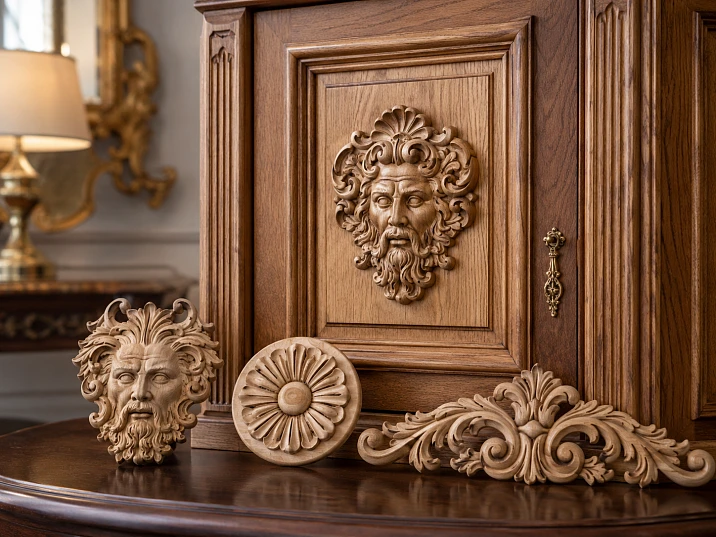
When a furniture facade looks too empty, flat, or unfinished, it doesn't always need a complete redo. Sometimes one precise carved element in the center is enough: a mascaron, rosette, or decorative overlay. But this is exactly where it's easy to make a mistake. The buyer wants to purchase mascarons or other wooden decor, sees beautiful carving, but doesn't always understand which element will truly suit the facade, door leaf, decorative panel, or interior composition.
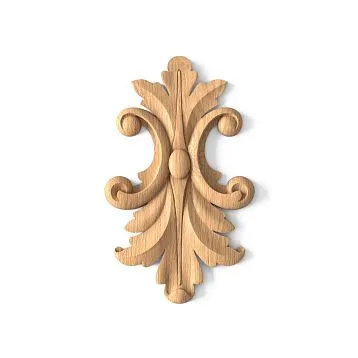
A mascaron, rosette, and carved overlay solve different tasks. A mascaron creates a strong figurative accent: a face, lion's head, expressive relief, almost an architectural center. A rosette works more calmly: it emphasizes the middle of the facade, adds symmetry, and does not overload the furniture. A carved overlay is more versatile: it can be placed in the center, used on the sides, top, bottom, in pairs, or as part of a complex decorative scheme.
Therefore, the question 'what to buy for the center of a furniture facade' is better decided not by the principle of 'what looks prettier in the photo,' but by the task. If you need an expressive center, it's worth looking at buy wooden mascarons. If you need a lion accent, you can consider lion mascaron for furniture facade. If you want a calmer center, wooden rosettes for central decor. And if you need to decorate not only the middle but the entire surface of the facade, it's better to choose Carved decorative inserts for furniture.
This approach is especially important for solid wood furniture, classic facades, door panels, decorative panels, sideboards, chests of drawers, portals, and interior compositions. The central decor should look not like a random detail, but part of the overall idea. It should match the scale of the facade, support the style, and combine with handles, moldings, rosettes, overlays, and future finishing.
What is a mascaron and why is it needed in furniture decor
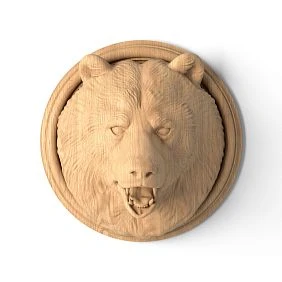
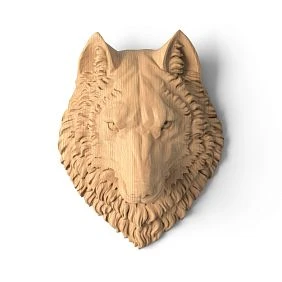
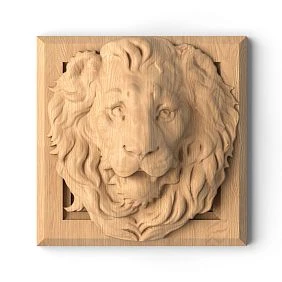
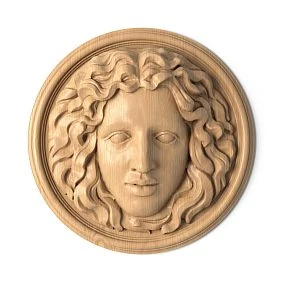
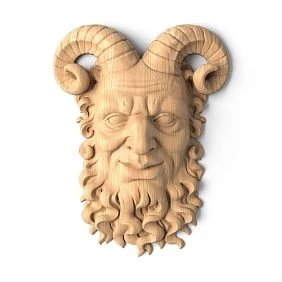
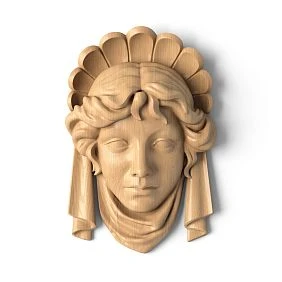
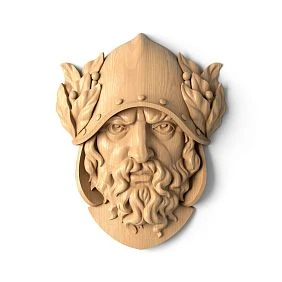
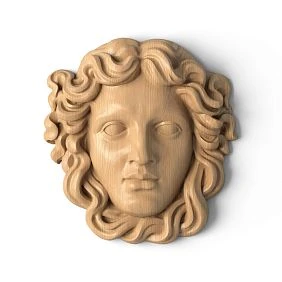
A mascaron is a relief decorative element featuring an image of a face, head of a person, animal, lion, mythological character, or stylized figure. In furniture decor, it acts as a strong visual center. It is not just an ornamental detail, but an accent that defines the character of the facade.
If a rosette calmly decorates a surface, and an overlay adds ornament, then a mascaron creates an image. It immediately draws the eye. Therefore, it is often used where furniture should look expressive: on the central part of the facade, on a door panel, on a decorative panel, on a portal, on the top of a sideboard, or in the center of a large furniture composition.
The mascaron works particularly well in classic interiors. It suits furniture with panels, frames, cornices, carved details, massive forms, and decorative symmetry. On such furniture, it looks natural. It does not conflict with the facade but enhances it.
But a mascaron cannot be chosen without considering scale. A too large element on a small door will look heavy. A too small mascaron on a wide facade will get lost. If the furniture is modern, smooth, and minimalist, a mascaron may look out of place if not supported by other details.




Mascaron as a central accent
The main task of a mascaron is to create a center. It is needed where the facade lacks an expressive middle. For example, a chest of drawers may have a beautiful shape but an empty central area. A wardrobe may have a large door without an accent. A decorative panel may have a frame but lack a main detail. In such cases, a mascaron helps to assemble the composition.
Central decor for a furniture facade should be visible but should not take over the entire surface. A good mascaron leaves space around it. Then the relief is readable, and the facade does not look overloaded. If the detail takes up too much space, the furniture becomes heavy.
A mascaron can be used alone if the facade is small and the composition is already clear. But on wide surfaces, it is often supplemented with overlays or rosettes. The mascaron becomes the main accent, and other elements support it on the sides or in adjacent areas.
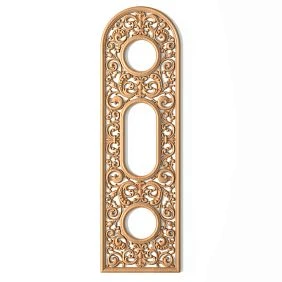
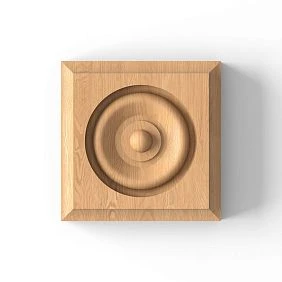
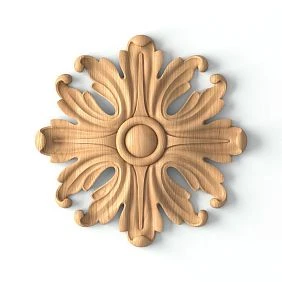
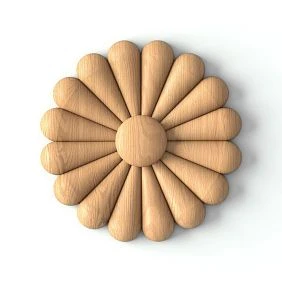
Our factory also produces:
Where a mascaron is appropriate: facade, door, panel, portal
A wooden mascaron for a furniture facade is appropriate where not just carving is needed, but an expressive central detail. This could be a chest of drawers facade, a wardrobe door, a sideboard, a console, a decorative panel, a portal, an interior door, or a furniture composition in a classic interior.
On a door, a mascaron works very noticeably. The door leaf is at eye level, so the relief immediately attracts attention. But here it is especially important not to make a mistake with the size. If the door is narrow, a too large mascaron will feel oppressive. If the leaf is wide and decorated with panels, the relief decor can look very organic.
On a decorative panel, a mascaron helps define the center. A panel without a central detail sometimes looks like a simply framed border. The mascaron makes it complete. It looks especially good in combination with rosettes, overlays, and wood finishing.
On a portal, a mascaron can become the top central accent. This technique works well in classic, Empire, Baroque, and eclectic interiors. The main thing is that the portal can support the strength of the element. If the structure itself is light, too active decor may look excessive.
Get Consultation
When it is better to choose a lion mascaron
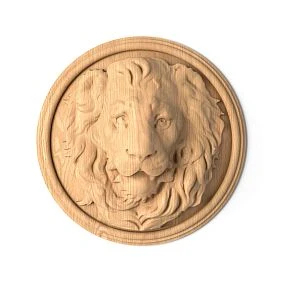
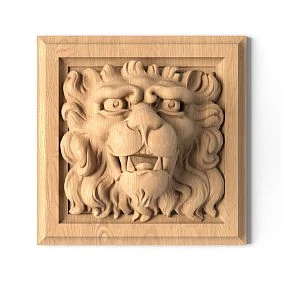
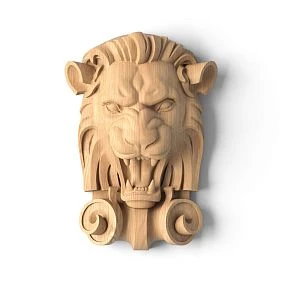
A lion mascaron is the most expressive option for cases when the facade needs a strong character. A lion's head in decor is associated with strength, protection, grandeur, status, and classical architecture. Such an element immediately changes the mood of the furniture.
If you need to buy a lion mascaron, it is better to determine the installation location in advance. lion mascaron for furniture facade it will suit a classic chest of drawers, sideboard, cabinet, decorative panel, portal, or door, if the entire composition can support such relief.
A lion mascaron should not be chosen just because it is striking. It is a strong detail. It should be the main one or one of the main ones. If too many large overlays, rosettes, and active handles are placed nearby, the facade will become overloaded.
If a calm center is needed, it's better to choose a rosette. If an elongated area of the facade needs to be covered, a carved overlay is more suitable. And if a symbolic, figurative, and expressive center is needed, a lion mascaron would be the right choice.
Mascaron, rosette, and overlay: what's the difference
Maskaron, rosette and overlay can refer to carved decor, but in a furniture composition they work differently. The mistake begins when a buyer chooses any element they like and places it in the center of the facade without understanding its role.
The mascaron is the most expressive. It is needed when the facade requires a face, a lion's head, an image, character, and a strong central point. The rosette is calmer. It provides symmetry, emphasizes the center, and does not conflict with other details. The overlay is the most versatile. It can be used as a center, an addition, a side element, a top ornament, or part of a pair.
| Type of decor | What it looks like | Where to use | What effect it gives | Link |
|---|---|---|---|---|
| Mascaron | Relief with a face, lion's head, or expressive image | Center of facade, door, panel, portal | Creates a strong central accent | buy wooden mascarons |
| Lion maskaron | Carved element with a lion's head | Classic facades, doors, portals, decorative panels | Adds status, strength, and architectural character | lion mascaron for furniture facade |
| Rosette | Symmetrical round, square, or ornamental center | Panel, facade, board, furniture composition | Emphasizes the center calmly and neatly | wooden rosettes for central decor |
| Carved overlay | Ornamental detail of various shapes | Facades, doors, side areas, top and bottom parts of furniture | Adds relief, covers empty areas, helps compose the arrangement | Carved decorative inserts for furniture |
| Finishing materials | Finishing products for wooden decor | After selecting decor and before final finishing | Help tie the decor to the facade in color and surface | Materials for finishing wooden decor |
This difference helps you quickly understand what to buy. If you need a main image — a mascaron. If you need a calm center — a rosette. If you need to decorate a wider facade, support the central element, or cover an elongated part — an overlay.
Mascaron — an expressive accent with a face or head
A mascaron always makes a stronger impression than a regular overlay. It can be strict, solemn, classic, leonine, mythological, or decorative. But in any case, it acts as the main character of the facade.
Such decor is good for furniture that should look not just neat, but expressive. For example, for a sideboard in a classic interior, a chest of drawers with massive shapes, a cabinet with wide doors, a paneled door, a decorative panel, or a portal.
A mascaron does not need to be placed many times. In most cases, one element in the right place gives more effect than several random details. It sets the center, and the other elements should support it, not overpower it.
If the facade is large, the mascaron can be complemented with carved overlays or rosettes. If the facade is small, it is better to leave enough free space around it. Otherwise, the relief will look too heavy.
A rosette is a symmetrical decorative center
A rosette is suitable for those who want to decorate the center of the facade but do not want too strong an image. It does not 'look' at the viewer like a mascaron. It simply gathers the composition, emphasizes the middle, and adds relief.
Rosettes work well on panels, doors, decorative panels, and the fronts of chests, cabinets, and sideboards. They can be used individually or in repetition. For example, on several identical doors, rosettes create order and symmetry.
If the facade is already rich in details, a rosette is often better than a mascaron. It doesn't compete with handles, moldings, and overlays. It adds completeness but doesn't overload the furniture.
When a buyer chooses between a mascaron and a rosette, you need to ask a simple question: do you need an image or a center? If you need an image — choose a mascaron. If you need a center without excessive drama — choose a rosette.
Overlay — a universal carved element for the facade
A carved overlay is the most flexible option. It can be central, side, top, bottom, horizontal, vertical, or paired. It can be used separately or together with a mascaron and rosettes.
An overlay helps solve several practical tasks. It covers an empty part of the facade, adds relief, supports handles, connects elements together, and makes furniture more decorative. If a mascaron is the main center, an overlay often works as compositional support.
For example, on a wide facade, one mascaron may look lonely. If you add ornamental overlays on the sides, the facade will become more cohesive. On a chest of drawers, overlays can support the central area. On a door, they can enhance the top or bottom part of the panel.
If you need a universal decor that can be used not only in the center, it's worth looking at Carved decorative inserts for furniture. They allow you to assemble a composition more flexibly than one large central element.
What to check before purchase
Before buying a mascaron, rosette, or carved overlay, you need to evaluate not only the appearance. It's important to check the size, material, relief depth, installation location, future finish, and neighboring elements. You need to be especially careful when choosing a mascaron, because it almost always becomes the main accent.
| Parameter | What to Check | Why this is important | Link |
|---|---|---|---|
| Type of decor | Maskaron, rosette or carved overlay | The strength of the accent and installation location depend on the type | buy wooden mascarons |
| Size | Element dimensions and facade area | Too large decor will overload the furniture, too small will get lost | — |
| Material | Current material in the product card | Material affects processing, finishing, and combination with furniture | — |
| Wood Species | Oak, beech, or another available option per the card | Wood species affects texture, density, and visual character of the decor | — |
| Thread depth | How much the relief protrudes above the facade plane | Deep relief is more noticeable but requires more space around | — |
| Installation location | Facade, door, panel, portal, central or upper zone | The same element looks different on a narrow door and a wide panel | — |
| Finish | Coating, oil, preparation for painting or another finishing option | Finishing helps connect wooden decor with the facade | Materials for finishing wooden decor |
If the exact dimensions, material, finish, configuration, or application method are not specified in advance, they need to be checked in the product card of the selected item. This is a normal part of purchasing carved decor: first, the type of element and decorative task are chosen, then the parameters of the specific model are verified.
How to choose a wooden mascaron
A wooden mascaron is chosen not only by its subject. A buyer may like a lion's face, expressive relief, or the overall character of the detail, but for a furniture facade, this is not enough. You need to understand whether the facade can handle such an accent, whether the element will be too large, whether the furniture style matches, and whether the mascaron can be tied to the rest of the decor.
By facade size
Size is the main filter. On a small door, a large mascaron will look heavy. It will visually 'eat up' the facade and make the furniture disproportionate. On a large cabinet or wide decorative panel, a too-small mascaron, on the contrary, will get lost. It will look like a random detail rather than a focal point.
There is a simple guideline: the mascaron should read as the main element, but there should be enough air around it. If it takes up almost the entire central zone, the facade becomes overloaded. If there is too much empty space around and the relief seems small, it's better to choose a larger element or complement the composition with rosettes and overlays.
For a tall facade, a mascaron is often placed above the geometric center, especially if there is a handle or panel below. For a chest of drawers, it may be closer to the top of the facade. For a decorative panel, it is strictly on axis. In each case, you need to look not only at the element itself but at the entire surface.
By wood species: oak or beech
If the buyer is choosing between oak, beech, or another available option, you need to consider not only strength but also the external character. Oak is usually perceived as more expressive and solid due to its texture. Beech may look calmer and smoother. But the current material options need to be checked in the product card of the specific item, because not every element is available in all finishes.
For a solid wood facade, it is better to select decor so that the material does not conflict with the base. If the furniture will be painted, the difference between wood species may be less noticeable visually, but it is still important for processing. If a transparent or semi-transparent finish is planned, the wood grain becomes part of the appearance.
When selecting a mascaron for existing furniture, it is better not to guess the material from a photo. You need to compare texture, color, density, future finish, and installation method. If in doubt, check compatibility with a STAVROS manager.
By carving depth
The depth of the relief determines how noticeable the element will be. A flat ornamental overlay can delicately decorate a facade. A mascaron with deep relief creates shadow, volume, and a strong visual center. This is beautiful but requires space.
Deep carving looks good on furniture where there are other volumetric elements: frames, cornices, carved legs, expressive handles, decorative overlays. On a completely flat modern facade, it can look too harsh. In such a case, it is better to either add a frame or choose a calmer decor.
The depth of the relief is also important to consider during use. If the element is located where it will be frequently touched by hands, bags, or clothing, it is better to think about placement in advance. The central decor should decorate the furniture, not hinder its use.
By furniture style: classic, Empire, Baroque, Eclectic
A mascaron looks organic in styles that have decorative expressiveness. Classic loves symmetry and central accents. Empire allows for solemn images and a strong axis. Baroque works with relief, movement, and rich plasticity. Eclectic allows combining old motifs with modern furniture but requires moderation.
If the facade is in strict minimalism, the mascaron should be used carefully. It can become an interesting contrast, but only if the entire composition is thought out. One carved element on a completely smooth surface sometimes looks not like an accent, but like a foreign insert.
For restoring classic furniture, a mascaron is often the perfect solution. An old facade may have lost its central decor, look empty, or show traces of previous styling. A carved element helps restore character to the furniture, but you need to check the size and style before purchasing.
What to buy for a specific task
A buyer rarely chooses decor in theory. Usually, they have a specific task: make the center of the facade expressive, pick a lion's head, decorate a door, create symmetry, fill an empty area, support a classic style, or prepare decor for finishing.
| Buyer's task | What to choose | Why this is suitable | Link |
|---|---|---|---|
| Need an expressive center for the facade | Wooden mascaron | It creates a strong relief accent and makes the facade more distinctive | buy wooden mascarons |
| Need a mascaron with a lion's head | Carved mascaron M-010 | The lion motif is suitable for formal, classic, and prestigious decor | lion mascaron for furniture facade |
| Need a calmer center | Carved rosette | It emphasizes the middle of the facade but does not make the look too active | wooden rosettes for central decor |
| A universal decor for the facade is needed | Carved overlay | It can be used in the center, along the edges, in pairs, or as part of a complex composition | Carved decorative inserts for furniture |
| Need to prepare the decor for finishing | Materials for treatment and finishing | They help match the wooden decor with the facade in color and surface | Materials for finishing wooden decor |
This choice is especially useful for those who do not want to buy decor blindly. First, the task is determined, then the type of element, then the specific product or category. This reduces the risk of error: a mascaron is not bought where a rosette is needed, and a rosette is not placed where a strong figurative center is required.
Mascaron M-010 as an example of accent decor
The carved mascaron M-010 can be considered as an example of an element that immediately sets the character of the facade. It is not a neutral detail or a background ornament. Such a mascaron is needed when the furniture should have a strong central image.
The lion's head works well in classic and expressive compositions. It can look appropriate on the central part of the facade, on a decorative panel, on a portal, or on a door, if the entire composition supports such a level of accent. Before purchasing, you need to carefully evaluate the size of the surface and neighboring elements.
If the facade already has active handles, carved overlays, moldings, and rosettes, the mascaron M-010 should become the main element, not one of many competing accents. It is better to support it with calmer details. For example, ornamental overlays can be used on the sides, and quieter rosettes in adjacent areas.
If the furniture is simple, but the buyer wants to make it more expressive, a lion mascaron can become the centerpiece of the update. However, in this case, you should consider the framing. On a completely empty surface, a strong relief can sometimes look isolated. It can be visually supported by a frame, symmetrical layout, repetition of material, or finish.
Before ordering a specific model, you need to check the parameters in the product card: dimensions, material, possible finish options, purpose, and current purchase conditions. This is especially important if the element is selected not for new furniture, but for an already finished facade.
What to choose for the center of a furniture facade
The central decor for a furniture facade should solve a clear task. It can make the furniture more formal, cover an empty surface, restore a classic character to the piece, connect several carved details, or simply create an expressive center. But each option has its own role.
A mascaron is suitable if the facade needs a main image. For example, a tall cabinet looks empty, a chest of drawers asks for a central detail, a portal requires a top accent, a door should look more ceremonial. A mascaron doesn't just decorate—it changes the mood of the piece.
A rosette is suitable if a center without too strong an image is needed. It works well on panels, doors, decorative panels, and facades where symmetry needs to be emphasized. A rosette can be independent or support a more complex composition.
A carved overlay is suitable if you need not only to mark the center but also to distribute decor across the facade. It can be used in pairs, at the top, bottom, sides, around a mascaron, or in combination with rosettes. An overlay helps avoid a situation where one element hangs alone on a large surface.
If the facade is narrow, it's better not to choose a too large mascaron. If the facade is wide, a single small element may get lost. If the facade is already rich in details, it's better to choose a rosette or a calm overlay. If the facade is empty and needs to become expressive, a mascaron will be stronger.
How to assemble a decorative composition, not just place a single detail
Good furniture decor is built not on the quantity of details, but on their connection. A mascaron, rosette, and overlay should work together with the facade's shape. If an element is placed without connection to the frame, handles, panel, or axis, it looks random. Even expensive carving won't save the composition if it's not in the right spot.
It's best to start with the central axis. A facade almost always has a vertical or horizontal center. A mascaron and rosette usually work there. Overlays can support this axis: be arranged symmetrically, cover side areas, highlight the top part, or create a transition to moldings.
Next, you need to assess empty areas. If there is too much empty space around the mascaron, you can add carved overlays. If there is already enough decor, it's better to leave the center freer. Not every centimeter of the facade needs to be filled. In classic furniture, empty space is as important as carving: it gives the eye a rest and helps the accent stand out.
Handles also participate in the composition. If the handle is large and decorative, the mascaron above it should be chosen carefully. Two strong centers nearby can compete. If the handle is calm, the mascaron can take the leading role. If rosettes, handles, and overlays are used, they need to be coordinated in scale.
Finishing completes the composition. Even perfectly chosen elements can look disjointed if they differ in color, gloss, or surface preparation. Therefore, after selecting the decor, you need to think about what Materials for finishing wooden decor will be needed for the desired result.
What to buy together with the mascaron
A mascaron rarely works completely alone. Sometimes one element is indeed strong enough, especially on a small facade. But for wide furniture, a decorative panel, door, or portal, a set is often needed: a central mascaron, side overlays, rosettes, finishing materials, and suitable hardware.
A mascaron plus carved overlays is a good option for symmetry. The mascaron becomes the center, and the overlays help distribute the ornament across the facade. This combination is especially useful for wide doors, chests of drawers, sideboards, and decorative panels.
Mascaron plus rosettes creates a more complex decorative rhythm. Rosettes can repeat the central motif, support corners, panel centers, or adjacent areas. If the mascaron is too strong, it's better to choose calmer rosettes so they don't compete with the main image.
A mascaron plus finishing materials is a practical combination. After purchasing wooden decor, you need to consider the finish: oil, coating, surface preparation, or another treatment option suitable for the specific product and facade. Current materials and application methods should be checked before ordering.
| What to add to the purchase | Why this is needed | Which scenario it suits | What to pay attention to | Link |
|---|---|---|---|---|
| Carved overlays | Help support the mascaron on the sides, top, or bottom of the facade | Wide facade, sideboard, chest of drawers, decorative panel | Size, carving style, symmetry, combination with the central element | Carved decorative inserts for furniture |
| Carved rosettes | Create calm additional centers and support the decorative rhythm | Panels, panel corners, adjacent doors, symmetrical composition | Shape, scale, repeatability, absence of conflict with the mascaron | wooden rosettes for central decor |
| Materials for finishing | Help prepare wooden decor for the desired appearance | Painting, oil, protective treatment, color matching with the facade | Compatibility with the decor material and furniture surface | Materials for finishing wooden decor |
| Mascaron M-010 | Suitable as a strong lion centerpiece for a formal composition | Classic facade, door, portal, decorative panel | Scale, installation location, adjacent details, future finishing | lion mascaron for furniture facade |
| Furniture handles in classic style | Help connect functional hardware with the decorative centerpiece | Chest of drawers, wardrobe, sideboard, swing facades | The shape of the handle should not conflict with the mascaron or rosette | — |
This comprehensive approach is especially important for furniture that is fully visible. If a customer is decorating only one door, you can limit yourself to a central element. If the entire facade is being decorated, it is better to think in advance which details will be the main ones and which will be supporting.
How not to confuse a mascaron with similar products
A mascaron can easily be confused with an overlay, because in terms of application it can also be an applied decorative element. But in terms of visual effect, it is not an ordinary overlay. A mascaron creates a figurative center: a face, a head, a symbolic relief. If a strong focal point is needed, a mascaron is chosen.
A rosette is distinguished by symmetry and calmness. It can be round, square, floral, ornamental, but usually does not have the figurative character of a mascaron. A rosette is suitable when you need to decorate the center, but not turn it into the main subject.
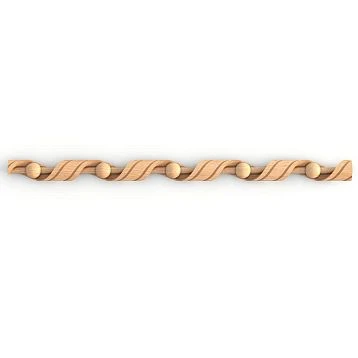
The carved overlay has a wider application. It can be placed in the center, but more often it works as part of an ornamental system. Overlays are convenient on elongated sections, in pairs, on the sides, above the handle, under the cornice, next to the rosette, or around the mascaron.
Molding is a different type of decor. It shapes the outline, frame, line, border, or transition. If you need to emphasize the perimeter of the facade, you need molding. If you need to place a main center, molding cannot replace a mascaron or rosette.
| Similar product | When you need exactly this | When to choose a mascaron | Link |
|---|---|---|---|
| Rosette | If you need a symmetrical round or square center without a strong image | If the facade needs character, a face, a lion's head, or an expressive relief | wooden rosettes for central decor |
| Carved overlay | If you need to cover an elongated part of the facade or add ornament | If the center should be the main focus and immediately read as an image | Carved decorative inserts for furniture |
| Molding | If you need to shape the outline, frame, or border of the facade | If you need not a contour, but a central decorative accent | — |
| Regular flat inlay | If you need an almost invisible detail without relief | If the facade needs volume, shadow, and an expressive center | — |
The main mistake is buying 'some carved thing' without understanding its role. For the center of the facade, you need a center. For a frame, you need a contour. For filling an elongated area, you need an overlay. For a strong image, you need a mascaron.
Practical selection for different situations
Need to decorate the center of the chest of drawers
A chest of drawers often has a wide horizontal shape. If you place one small element in the center, it may get lost. If you take a too large mascaron, the facade will become heavy. For a chest of drawers, it is important to connect the central decor with handles and drawer lines.
If the chest of drawers is classic, a mascaron can look good on the upper central part. If the drawer fronts are small, it is better to choose rosettes or calmer overlays. If you need to make one main accent, a lion mascaron is only suitable if there is enough space and support from other details.
Need to design the hinged doors of the cabinet
Hinged doors have a vertical axis. A mascaron can be used on the central area of each door or on a common axis if the composition is built as a single canvas. But two active lion heads next to each other can look too heavy. Sometimes it is better to place one main element or use rosettes.
Symmetry is especially important for a cabinet. If one door has a mascaron, the second must be designed logically. This could be a repeat, a paired overlay, a rosette, or a calm framing.
Need to update an old sideboard
An old sideboard often already has a classic shape but loses expressiveness due to lost details or outdated finishes. Here, carved decor works especially well. A mascaron can restore the central accent, rosettes can support the panels, and overlays can cover empty areas.
Before purchasing, you need to measure the facade, understand what details are already present, and decide what will be the main element. If the sideboard is tall and massive, a mascaron may be appropriate. If the facade is fragmented, it's better to use several calm elements.
Need to decorate an interior door
On a door, a mascaron looks noticeable because the panel is at eye level. Such decor is best used on doors with a classic character: with panels, frames, decorative fields. On a smooth modern door, a mascaron may look out of place.
If the door is narrow, it is better not to choose too active a detail. A rosette or carved overlay may be calmer. If the door is massive and should become part of a grand interior, a lion mascaron can be a strong solution.
Need to make a decorative panel
A decorative panel allows for more freedom in composition. Here, a mascaron can become the center, rosettes secondary accents, and overlays connecting elements. It is important to understand in advance where the top, center, side zones will be, and how the panel will look in the interior.
If the panel is large, one element may not be enough. If it is small, too many details will overload it. It is better to create a scheme: center, side elements, distances, height, future finish.
You need to select decor for a commercial interior
In a restaurant, salon, boutique, hotel, or showroom, carved decor must withstand the visitor's gaze. A mascaron can become a strong sign in the interior, but it cannot be used randomly. It must match the style of the place.
For commercial furniture, repeatability and neatness are especially important. If decor is used on several facades, you need to plan in advance whether it will be repeated, alternated with rosettes, or supported by overlays. This way, the interior will look cohesive.
Mistakes when choosing a mascaron, rosette, or overlay
| Mistake | What it leads to | How to choose correctly | Useful transition |
| Choosing only by a beautiful photo | The element may not fit in size, style, or installation location | First, measure the facade and determine the role of the decor | buy wooden mascarons |
| Too large a mascaron on a small facade | Furniture looks heavy and overloaded | Leave free space around the element | — |
| Too small a rosette on a wide panel | Center is unreadable, decor looks random | Match the rosette to the scale of the facade or complement the composition | wooden rosettes for central decor |
| Buying a single part instead of a set | The facade remains unfinished, empty areas appear around the center | Plan the mascaron, overlays, sockets, and finish together | Carved decorative inserts for furniture |
| Ignoring the finish | Parts may differ in color and look foreign on the facade | Choose the finish in advance and check material compatibility | Materials for finishing wooden decor |
| Confusion between mascaron and overlay | Instead of a strong center, the buyer gets a regular ornament or vice versa | Determine whether a figurative accent or a universal relief is needed | — |
Most mistakes are related not to the quality of the detail itself, but to its incorrect role in the composition. A mascaron is bought as a regular overlay, a rosette is tried to be used instead of a strong center, overlays are placed without symmetry, finishing is remembered at the very end. To avoid this, you need to choose decor not based on a single photo, but based on the entire facade task.
Who would benefit from a mascaron, rosette, or carved overlay
| Who or for what task | What is better to choose | Why | Link |
| For the manufacturer of classic furniture | Mascarons, rosettes, and overlays in a unified composition | You can assemble an expressive facade without random selection of details | buy wooden mascarons |
| For the restorer | Carved overlays and a central mascaron as needed | Decor helps restore lost relief and character to the facade | Carved decorative inserts for furniture |
| For the designer of classic interiors | A mascaron or rosette as the center of the composition | The element helps connect furniture with the architectural style of the room | wooden rosettes for central decor |
| For the buyer who wants an expressive facade | A mascaron or a lion's mascaron | Such decor immediately creates a strong central accent | lion mascaron for furniture facade |
| For those who want a calm center | Rosette | It adds symmetry and relief without too strong an image | wooden rosettes for central decor |
| For those who need a minimalist facade | It's better to choose a more restrained solution or avoid strong relief | A mascaron may look too active on a smooth modern surface | — |
| For those looking for a functional opening element | A handle or hardware is needed, not a decorative mascaron | The mascaron decorates the facade but does not replace functional hardware. | — |
An honest choice saves time. Not everyone needs a mascaron. But if the facade truly needs a strong center, a flat overlay won't achieve that effect. If calm symmetry is needed, a mascaron may be unnecessary. If you need to cover a large surface, a single central element is often not enough.
How to prepare the facade for installation and finishing
Before installing the decor, you need to prepare not only the element itself but also the installation site. The facade surface must be smooth, clean, and suitable for the chosen fastening method. If the furniture is old, assess the condition of the coating, the presence of cracks, old holes, traces of glue or varnish.
For a maskaron, precise marking is especially important. It immediately attracts attention, so even a shift of a few millimeters can be noticeable. It is better to mark the central axis in advance, check the installation height, and see how the element will combine with handles, frames, and adjacent overlays.
If decor is used on paired doors, check the symmetry. Two elements should be at the same height and the same distance from the edges. If a single central mascaron is used, determine whether it belongs to one door or the entire composition.
Finishing should be thought out before installation. Sometimes it's more convenient to process the element separately, sometimes after installation together with the facade. This depends on the material, coating, future color, and method of work. It's safer to select Materials for finishing wooden decor for a specific scenario and check compatibility.
If the facade is to be painted, achieve a uniform appearance for all parts. If the wood texture is to be preserved, coordinate the species, pattern, and shade. If the decor is placed on ready-made furniture, pay special attention to matching the color and depth of the relief.
How to buy on STAVROS and what to check before ordering
It's better to start shopping by choosing the element's role. Not with the question 'what is more beautiful,' but with the question 'what should the decor do.' If a striking central image is needed, look at mascaron. If a calm center is needed, look at rosettes. If you need to complement the facade or assemble an ornamental scheme, look at overlays.
Then you need to go to a specific category. For a strong central accent, you can open the section buy wooden mascarons. If you need a lion image, it is worth looking at lion mascaron for furniture facadeFor a more universal ornament, suitable Carved decorative inserts for furniture. For a calm center — wooden rosettes for central decor.
Before ordering, you need to check the dimensions, material, available options, application features, future finish, and compatibility with the facade. If the element is selected for already finished furniture, it is better to measure the surface in advance and understand how the part will look at real scale.
If not one element is purchased, but a set, it is important to check compatibility. Mascaron, rosettes, and overlays should be close in style, carving depth, and future finishing. Different parts can be beautiful individually but conflict with each other on the same facade.
If there are doubts about size, material, finish, or combination, it is better to clarify details with a STAVROS manager before ordering. Carved decor is especially sensitive to scale. Fixing a mistake after installation is more difficult than selecting the right element in advance.
FAQ: frequent questions about mascaron, rosettes, and carved overlays
What to buy for the center of a furniture facade: a mascaron or a rosette?
If you need an expressive accent with character, it is better to choose a mascaron. If you need a calm symmetrical center without a strong image, a rosette is more suitable. For a wide facade, both options are sometimes used: a mascaron as the main center, rosettes as additional elements.
How is a mascaron different from a rosette?
A mascaron usually has a face, lion's head, or other figurative relief. It looks stronger and immediately attracts attention. A rosette is more symmetrical and calm. It emphasizes the center but does not create such a vivid character.
Is a mascaron an overlay?
In terms of application, a mascaron can indeed be an overlay decorative element. But in terms of visual effect, it is stronger than a regular ornamental overlay. An overlay more often adds a pattern, while a mascaron creates the main figurative accent.
Can a mascaron be used on a door?
Yes, a mascaron can be used on a door if the panel matches in style, size, and composition. This decor looks best on classic, paneled, or decorative doors. On a smooth minimalist door, it may appear too active.
When is it better to choose a lion mascaron?
A lion mascaron is suitable when the facade needs a prestigious, expressive, and slightly ceremonial character. Such an element looks good on classic furniture, decorative panels, portals, and doors that can handle strong relief.
Which carved overlay to choose for a facade?
A carved overlay is chosen based on the size of the facade, the shape of the empty area, the furniture style, and adjacent details. If the overlay should support the mascaron, it should not conflict with it in relief and scale. For a pair or symmetry, it is better to plan the placement of two identical or similar elements in advance.
Can a mascaron and rosettes be combined?
Yes, such a combination is possible. The mascaron can be the main center, and the rosettes can be additional symmetrical accents. It's important not to overload the facade. If the mascaron is very expressive, it's better to choose calmer rosettes.
What to choose for a small facade?
For a small facade, a small rosette or a neat carved overlay is often suitable. A mascaron can be used only if it matches the scale of the surface. Too large a relief will make the facade heavy.
What to choose for a wide decorative panel?
For a wide panel, you can use a mascaron as a central element and complement it with carved overlays or rosettes. A single small decoration on a large surface often looks random, so it's better to assemble the composition as a set.
Do I need to buy finishing materials together with the decor?
It's better to plan the finishing in advance. Wooden decor should match the facade in color, texture, and surface. Before ordering, it's worth looking at finishing materials and clarifying which options are suitable for the chosen product.
Can a mascaron be used in a modern interior?
Yes, but carefully. In a modern interior, a mascaron should be a deliberate contrast, not a random classical detail. It is better to use it on furniture or panels where there is space, symmetry, and support from other elements.
What to check before buying a mascaron?
You need to check the size, material, relief depth, installation location, future finishing, and compatibility with the facade. If the element is being selected for ready-made furniture, be sure to measure the surface and assess whether the decor will be too large or too small.
How is a carved overlay better than a regular flat part?
A carved overlay provides relief, shadow, and decorative depth. It helps cover an empty area of the facade, support the furniture style, and connect several elements into one composition. A flat part works more calmly and does not provide such volume.
Where to buy mascaron, rosettes, and carved overlays for furniture?
For a central accent, you can check the section buy wooden mascarons. For a lion-like image, lion mascaron for furniture facade. For a calm center, you can choose wooden rosettes for central decor, and for a universal ornament — Carved decorative inserts for furniture.
Result: what to choose for a central accent
Mascaron, rosette, and carved overlay solve different tasks. Mascaron is needed when the facade requires a strong figurative center. Rosette is suitable if symmetry and a calm decorative accent are needed. Carved overlay helps to design the facade more broadly: cover empty areas, support the central element, pair elements, or add ornament.
If the furniture should look expressive, it is worth considering mascaron. If a particularly strong classical accent is needed, you can check lion mascaron for furniture facade. If the decor should be more restrained, wooden rosettes for central decorIf you need to assemble the entire facade composition, useful items include Carved decorative inserts for furniture.
The key is to choose not an individual beautiful detail, but a solution tailored to the specific furniture. You need to check the facade size, style, material, relief, future finish, and neighboring elements. Then the central decor will look like a part of a well-thought-out composition, not a random insert.
STAVROS helps to move from idea to purchase: choose the right type of carved decor, compare mascaron, rosette, and overlay, check the product card, and assemble a set for a facade, door, panel, or portal. This approach is especially important where furniture should look expressive, neat, and cohesive.