Article Contents:
- Slat panel PAN-003: what sizes and materials are confirmed by the manufacturer
- 2670 mm is the product size, not the confirmed transport dimension
- Why the cabin diagonal by itself guarantees nothing
- What parameters to request
- How to check the stairs as a backup route
- How to make a mock-up of the transport space before delivery
- How to coordinate lifting with the carrier or movers
- Why the word "compact roll" is not a size
- Receiving PAN-003 at the entrance: what to check before the roll goes into the elevator
- Ready-made request to the STAVROS manager before payment
- Why long PAN-003 logistics is part of a commercial choice, not a problem after purchase
- Final order specification
- Three practical elevator scenarios: why identical 2100 mm lead to different solutions
- How to check the entire delivery route with one checklist
- Edge case scenario: packaging only fits diagonally
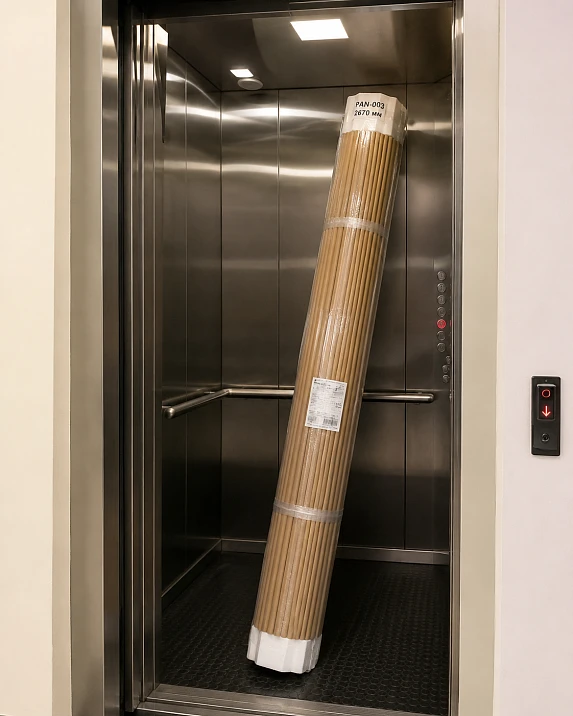
The PAN‑003 slat panel, 2670 mm long, has already been selected for wall finishing. Everything in the apartment fits the project, but before payment a practical question arises: the freight elevator has a depth of about 2100 mm. A simple comparison gives:
2670 > 2100 mm.
If PAN‑003 were transported fully unfolded in a rigid form, such a size would indeed be critical. But the specific PAN‑003 product card reports another important characteristic: the slats are attached to a flexible fabric base, and for transportation and storage, the panels are supplied rolled into compact rolls.
This leads to the main conclusion of the article: the nominal length of PAN‑003, 2670 mm, is not automatically the length of the shipping unit. Comparing 2670 mm directly with the elevator depth of 2100 mm is insufficient.
But the reverse conclusion — “since the panel is in a roll, it will definitely fit” — is also incorrect. The product card does not publish the actual shipping dimensions of the specific roll: diameter, length, packaging width, weight per unit, and the number of panels per shipping unit. Therefore, before payment, these parameters must be obtained from STAVROS or the carrier and then compared with the actual delivery route.
The correct order is as follows:
-
select a specific PAN‑003 modification;
-
determine the number of panels;
-
request the actual dimensions of the factory packaging for this specific order;
-
measure not only the cabin depth, but also the elevator opening, cabin width, diagonals, and the area in front of the door;
-
mentally trace the entire path from the car to the room;
-
check the front door, vestibule, stair landing, and turns;
-
agree in advance whether lifting is included in delivery and who is responsible for carrying it in;
-
only after logistics is confirmed, place the entire order.
If you are only comparing options and want Buy slatted panels for wall finishing, it is better to check logistics simultaneously with choosing the long modification. If the model is already approved, slat panel PAN-003 2670 mm should be considered as a specific cargo, not as an abstract “panel 2.67 m long.”
In this topic, it is fundamentally unnecessary to dive into a general overview of materials, calculating the quantity across the wall width, or installation around outlets. The buyer already wants PAN‑003. Their real task is not to receive a paid order at the entrance that cannot be safely carried into the apartment.
Slat panel PAN‑003: what dimensions and materials are confirmed by the manufacturer
For logistics calculations, not all product properties matter, but those that affect shape and transportation.
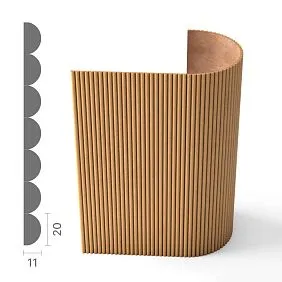
The current PAN‑003 card confirms a flexible fabric base and long versions:
| Material | A long modification used in the logistics scenario | Width A | Thickness C |
|---|---|---|---|
| MDF | 2670 мм | 1000 мм | 11 мм |
| Beech | 2400 мм | 1000 мм | 11 мм |
| Oak | 2400 мм | 1000 мм | 11 мм |
The card also includes shorter modifications. At the time of additional verification, the site showed, in particular, PAN‑003 1000 × 11 × 950 mm, and a fresh search snapshot showed another short MDF item 1000 × 8 × 740 mm. For this article, they are secondary: the buyer has already chosen the long MDF version of 2670 mm.




2670 mm is the product size, not a confirmed transport dimension
This is the main fact that must not be lost.
Size L = 2670 mm needed by the designer and installer: it shows the panel length in the unfolded working state.
For the elevator, a different set of dimensions is needed:
-
roll length;
-
outer diameter;
-
package width;
-
mass;
-
number of seats.
The card does not publish these transport parameters.
Therefore, the article should not turn the word "compact" into invented numbers.
What does a flexible fabric base mean
Structurally, the slats are attached to the fabric. Due to this, the panel is not a rigid board measuring 1000 × 2670 mm.
The manufacturer directly states that PAN‑003 rolls up for storage and transportation.
This explains why the long version can potentially fit into an elevator shorter than 2670 mm.
But the flexibility of the product does not mean that the buyer can:
-
roll it up tighter than the factory state;
-
fold it in half;
-
bend;
-
tighten with a strap to an arbitrary diameter.
The allowable transport folding radius is not specified in the card.
Why the package size depends on the specific order
Even if one panel forms a compact roll, several panels may be:
-
packed separately;
-
combined into one place;
-
additionally protected with cardboard;
-
secured on a rigid backing;
-
have different packaging by material and length.
Without a manufacturer's response, one cannot assume that an order of five PAN-003 units has the same dimensions as a single panel.
MDF 2670 and solid wood 2400 are different long modifications.
If the interior allows for material choice, logistics indeed differ:
-
MDF — 2670 mm when unfolded;
-
beech — 2400 mm;
-
oak — 2400 mm.
But this is not a reason to change material just for the elevator until transport dimensions are obtained.
The wooden panel of 2400 mm is also transported in a roll, and its actual packaging must also be confirmed.
Our factory also produces:






Why 2670 mm panels and a 2100 mm elevator cannot be compared directly
Comparison 2670 > 2100 looks convincing, but describes the wrong object.
2670 mm is the unfolded length of PAN-003.
2100 mm is one internal cabin dimension.
For logistics, you need to compare:
the dimensions of the shipping unit ↔ the geometry of the entry route.
Mistake #1: "2670 is greater than 2100 — it definitely won't fit"
This conclusion ignores the factory packaging in a roll.
The panel ceases to be a straight rigid element 2.67 m long.
Mistake #2: "it rolls up — so it will fit in any elevator"
This is the opposite, but equally dangerous extreme.
Without the actual diameter and length of the roll, it is unknown:
-
whether it will pass through the elevator door;
-
Can it be unfolded on the landing?
-
Will it fit diagonally?
-
Will the cabin width be enough?
-
Will the packaging not turn out to be too heavy for one person.
An elevator is not a rectangle on a floor plan
The cargo must not only be placed inside, but also brought through the doorway.
Even if there is enough diagonal space inside the cabin, a long or wide item may not turn through the door.
The path includes:
-
the landing in front of the elevator;
-
a doorway;
-
the turn inside;
-
position in the cabin;
-
reverse turn when exiting.
Get Consultation
Why the cabin diagonal by itself guarantees nothing
If depth D and width W are known, the floor diagonal can be calculated:
d = √(D² + W²).
For example, with a nominal depth of 2100 mm and width of 1200 mm:
d = √(2100² + 1200²) ≈ 2418 mm.
But even this figure does not answer the question about PAN‑003, because:
-
the roll can be much shorter than 2418 mm;
-
its diameter is also important;
-
the doorway may be narrower;
-
The packaging needs to be turned inward.
This calculation is only useful after obtaining the actual transport dimensions.
Vertical placement also requires checking.
Sometimes a long roll can be placed vertically.
Then the following matters:
-
doorway height;
-
cabin height;
-
the ability to lift the packaging vertically before the entrance.
You cannot simply see the cabin height of 2300 mm and decide that a roll 2200 mm long will fit: if the area in front of the elevator is low or narrow, it may be impossible to turn it.
Inclined transport
Theoretically, the cargo can be placed diagonally in the vertical plane.
But the solution depends on the three-dimensional geometry and on whether such a position is allowed for factory packaging.
Therefore, the article does not provide a "secret 45° angle." It teaches how to obtain real dimensions and check the route.
What to ask before buying a PAN‑003 slat panel
Before paying, it is useful to send one precise request to the manager.
Not:
"Will the 2670 panel fit into a 2100 elevator?"
But:
"We plan to order PAN‑003 made of MDF, length 2670 mm, quantity ___ pcs. Delivery to an apartment, floor ___. Please inform us of the actual dimensions of one shipping unit after factory packaging: length, maximum diameter/width, height or second cross-sectional dimension, weight, number of panels per unit, and the allowed position during carrying."
This shifts the conversation from assumptions to measurable data.
What information to provide to the seller
-
article number PAN‑003;
-
material;
-
length;
-
quality/finish;
-
quantity;
-
city;
-
floor;
-
availability of a freight elevator;
-
need to lift up to the apartment.
What parameters to request
Minimum:
| What to ask | Why this is needed |
| Length of the transport roll | compare with openings and turning capability |
| Maximum outer diameter | check door width and space in the cabin |
| Second packaging dimension | packaging may not be a perfect cylinder |
| Weight of one package | Understand how many movers are needed |
| Number of panels in one package | The entire order may have different packaging |
| Can it be carried vertically | Affects the way of entering the elevator |
| Can it be carried at an angle | Affects diagonal positioning |
| Can it be unpacked before reaching the apartment | Critical if factory packaging does not fit through |
| Can the order be split into packages? | sometimes reduces the weight and dimensions of one package |
Why it's better to get a written response
A logistics parameter is easy to lose in a phone conversation.
A letter or message can be:
-
passed to the transport company;
-
shown to the movers;
-
compared with elevator measurements;
-
saved along with the specification.
If the manager writes: "one package 1050 × 650 × 650 mm", this can already be checked on site.
If the answer is only "compact roll, it should fit," the data is still insufficient.
What not to ask "by eye"
Don't ask:
"Is it big?"
"Does it usually fit in the elevator?"
"Has it fit for other clients?"
Millimeters and kilograms are needed.
How to check the elevator before ordering slat wall panels
Cabin depth of 2100 mm is only one parameter.
The minimum elevator map should include:
-
the width of the doorway;
-
height of the opening;
-
cabin depth;
-
cabin width;
-
cabin height;
-
wall shape;
-
presence of handrails;
-
control panel protrusion;
-
free space in front of the door.
Doorway width
If the roll has a diameter of, for example, 700 mm, and the clear elevator door opens only 650 mm, the load will not fit frontally even with a huge cabin.
The numbers here illustrate the method, not the PAN‑003 parameters.
Opening height
Needed if the package is expected to be loaded vertically or at a steep angle.
Cabin depth
Your initial value is 2100 mm.
It matters if the roll is laid along the floor or at a slight angle.
Cabin width
Together with depth, it helps assess the diagonal and the possibility of turning.
Space in front of the elevator
This is often forgotten.
If there is a narrow corridor 1200 mm wide in front of the door and an opposite wall immediately, a long item may not achieve the required angle for entry.
Handrails and protrusions
The rated cabin width may be greater than the actual free space due to:
-
the handrail;
-
mirror frame;
-
protective panel;
-
folding seat;
-
inner box.
Measure the clean free dimension.
How to record data
It is convenient to create a table:
| Node | Size 1 | Size 2 | Comment |
| elevator door | ___ mm width | ___ mm height | Clear opening |
| Cabin | 2100 mm depth | ___ mm width | take into account handrails |
| Area in front of the elevator | ___ mm | ___ mm | is it possible to turn around |
| Floor corridor | ___ mm | ___ mm | narrowest section |
After obtaining the packaging dimensions, a real comparison task arises.
Slat panel PAN‑003 in a roll: what the flexible fabric base means
The flexible fabric base is the reason why PAN‑003 logistics cannot be considered as delivery of a rigid sheet of 1000 × 2670 mm.
But flexibility needs to be understood correctly.
The panel bends like a system of slats on fabric, not like a rubber sheet
Each slat remains a rigid element.
Flexibility occurs between the slats because they are attached to a fabric backing.
Therefore, the panel can be rolled into the transport state specified by the manufacturer, but not unconditionally:
-
fold it in half;
-
compressing the slats with straps;
-
reducing the roll to any diameter;
-
placing it on a sharp radius;
-
throwing it into a truck bed without factory protection.
Why you cannot "tighten" the roll on site
If the factory packaging does not fit in the elevator, the idea of "unpacking and rolling it tighter" seems simple.
But the card does not state:
-
minimum safe rolling radius;
-
allowable force;
-
can the product be re-rolled after packaging;
-
which sides should be inside/outside of the roll.
Unauthorized modification of packaging creates a risk:
-
creasing of the fabric base;
-
damage to the edges of the slats;
-
chips;
-
surface contamination;
-
geometry distortion.
Therefore, the safe logic is:
factory packaging does not pass → do not experiment → agree on an alternative method of bringing it in.
Why the factory roll should be inspected before lifting
Before handing the cargo to the movers, it is useful to check:
-
integrity of the outer packaging;
-
absence of strong impacts;
-
absence of wetting;
-
marking;
-
number of packages;
-
matching of the article number and material with the documents.
If the packaging is damaged already at the vehicle, this is recorded before bringing it in.
After lifting to the floor, it is harder to prove the moment of damage.
Can PAN-003 be stored in a roll after delivery?
The card states that panels are shipped rolled for transport and storage. But the article should not invent a maximum storage period for this.
Practically, after delivery you need to:
-
follow the manufacturer's storage conditions;
-
do not place the roll in a damp area;
-
do not press it down with heavy objects;
-
do not remove the factory protection earlier than required by the installer.
If the site is still damp after plastering, it is better to resolve the storage issue before delivery.
Unpacking in the apartment also requires space
Even if the roll successfully fits in the elevator, unrolling a panel 2670 mm long needs to be done indoors.
Check:
-
Is there a free room;
-
Can the panel be unfolded without bending;
-
Does the furniture get in the way;
-
Is the floor clean;
-
Can the panel be moved to the installation site after unpacking.
Sometimes the order goes through the entire staircase in a roll, but in a small hallway there is no safe place to unroll it.
MDF PAN‑003 2670 mm or wooden panel 2400 mm: how the material changes logistics
In this article, the material is compared only to the extent that it changes the transport scenario.
| Material | Long version | What to check |
| MDF | 2670 мм | transport roll of the specific 2670 version |
| Beech | 2400 мм | transport roll of the wooden version 2400 |
| Oak | 2400 мм | transport roll of the wooden version 2400 |
Why 2400 mm cannot automatically be considered a "simple" option
2400 mm is less than 2670 mm by:
2670 − 2400 = 270 mm.
But if both panels are rolled up, the length of the unfolded product itself ceases to be the main logistical parameter.
It is quite possible that:
-
the MDF roll 2670 has one transport size;
-
the oak roll 2400 — another;
-
packaging depends on the number of panels.
Until the manufacturer provides actual figures, it cannot be claimed that the wooden version is "definitely easier to bring in".
Why changing material just for the sake of lift is risky
If the project was originally built on painted MDF, switching to oak changes:
-
appearance;
-
finish;
-
texture;
-
budget;
-
the installation result.
Logistics should first be solved as logistics.
Only if delivery of the chosen option is truly impossible does it make sense to reconsider the specification.
When a length of 2400 mm can still help
If the manufacturer reports that the transport roll of the wooden modification is indeed smaller and fits the route, while MDF does not, then a rational comparison emerges.
But such a conclusion is based on actual packaging dimensions, not on the 2400/2670 figures in the product card.
If the short version of 950 mm passes without issues
This does not mean that the long 2670 should automatically be replaced with several short ones.
Short panels create a different installation scenario:
-
additional horizontal joints appear;
-
the layout changes;
-
the number of connections increases;
-
the visual rhythm may change.
If the project specifically chose 2670 for a seamless vertical, cutting the logistics problem into short modules can ruin the design.
The elevator fits, but the panel still may not get into the apartment
The delivery route does not end in the elevator cabin.
After exiting on the floor, there remain:
-
corridor;
-
turn;
-
fire door;
-
vestibule;
-
apartment entrance door;
-
hallway;
-
interior doorways;
-
turn to the room.
And each of these sections may be narrower than the elevator.
building entrance door
If the order is delivered to the entrance, the cargo must first pass through the outer door.
Check:
-
clear width;
-
door closer;
-
second leaf;
-
threshold;
-
space for turning.
Vestibule
Two doors in a row is a common problem.
The roll may pass through the first door, but between the first and second there won't be enough space to turn it.
Staircase landing
On the floor, you need to exit the elevator and turn toward the apartment.
If the apartment door is opposite the elevator — one scenario.
If it's to the side behind a narrow turn — another.
Apartment entrance door
The width of the frame in the door's passport is not equal to the clear passage.
You need to measure the actual opening with the door leaf fully open.
Consider:
-
handle;
-
limiter;
-
slope;
-
the casing;
-
the second leaf, if the door is double-leaf.
Narrow corridor inside the apartment
Sometimes the roll passes through the front door, but does not unfold in the hallway.
Especially if:
-
the cabinet is already installed;
-
low ceiling;
-
L-shaped corridor;
-
there is a partition immediately after the entrance.
Room door
If PAN-003 is installed in the bedroom, it must reach not only the apartment, but also the room itself.
After unpacking, the long 2670 panel becomes no longer a roll, but a long flexible sheet. This also requires space.
Why you need to walk the route in advance
Better to walk the path once with a tape measure and record the minimum openings than to discuss the problem with movers after delivery.
Useful diagram:
truck → entrance → vestibule → elevator → landing → front door → hallway → room → unpacking spot.
At each segment, record:
-
clear passage;
-
possibility of turning;
-
height;
-
presence of obstacles.
How to check the stairs as a backup route
If the elevator is not suitable, the first alternative option is usually the stairs.
But the phrase "we'll carry it up the stairs" also requires calculation.
Stair flight width
The roll must:
-
pass between the wall and the railing;
-
not get stuck in the turn;
-
not rest with its full weight on the edge of the slat.
Height between flights
On the landing, the load often has to be lifted vertically.
A low ceiling can be more critical than the width.
180-degree turn
In a typical entrance, flights turn around through a landing.
For a long transport location, the following are important:
-
platform depth;
-
width;
-
distance to the opposite wall;
-
handrails.
Number of floors
Physically carrying something to the second floor and to the twentieth floor are tasks with different labor costs.
Need to agree in advance:
-
number of movers;
-
cost of lifting;
-
whether manual lifting is allowed by the carrier;
-
Are there restrictions for the management company?
Why can't you unpack on the staircase without approval?
Factory packaging protects the panel.
After unpacking on the landing, the risk increases:
-
hitting the slats against the wall;
-
soiling the fabric;
-
breaking the edge;
-
losing packaging elements;
-
damaging neighboring property.
If unpacking is unavoidable, such a step must be approved as a separate decision.
What to do if the PAN‑003 roll still doesn't fit in the elevator
If measurements show incompatibility, the buyer has several options.
Option 1. Carrying up the stairs
Used only after checking the entire stair route.
Option 2. Another elevator
The building sometimes has:
-
passenger;
-
freight;
-
service.
They have different openings and cabins.
There is no need to automatically assume that "cargo" is always larger in every dimension.
Option 3. Splitting transport units
If the manufacturer can pack panels individually or in smaller groups, the weight/diameter of a single unit may decrease.
But this needs to be confirmed before payment.
Option 4. Delivery to the floor by third-party movers
Sometimes the transport company only delivers to the entrance, and the lifting is done by a separate crew.
In that case, the packaging dimensions need to be provided to that specific crew.
Option 5. Reconsidering the modification
If no route works, you can compare:
-
a different length;
-
different material;
-
another layout;
-
another article number.
But this is already a project change.
Option 6. Refusal to purchase before payment
This is a normal expert decision.
If delivery is not physically confirmed, it is better not to pay for a large order hoping "we'll somehow bring it in."
Why you shouldn't cut PAN-003 before delivery just for the elevator
The buyer chooses 2670 mm for a reason.
Often a long panel is needed to:
-
cover the height with a single panel;
-
reduce the number of horizontal joints;
-
maintain a continuous slat rhythm;
-
simplify the finish.
If you split the panel into two parts only for transportation, new challenges arise.
Horizontal seam
It interrupts the vertical slats.
Under side lighting, the line may be noticeable.
Pattern matching
The slats of the upper and lower parts must align.
Additional fixation
Each joint requires careful installation.
Cut finish
The transverse edge must be clean.
The manufacturer does not promise cutting to fit your elevator
Do not place an order with the assumption:
"STAVROS will cut 2670 into 1350 + 1320".
If such a service is not confirmed in writing, it cannot be considered part of the order.
When short modules are still rational
If the project allows a horizontal joint and logistics of the long version are objectively impossible, a short modification may be an alternative.
But the decision must be confirmed by a designer/installer.
How to calculate the quantity of PAN-003 after delivery check
For PAN-003, there is already a separate material on the actual width of 1000/1010 mm and quantity calculation. Therefore, the calculation is not duplicated here.
Correct sequence:
1. Confirm the logistics.
2. Record the actual modification of PAN-003.
3. Calculate the quantity based on the current card width.
4. Check the layout and margin.
5. Document the entire volume in a single specification.
For a separate calculation, use the material how to calculate the quantity of PAN-003.
Why should logistics come before quantity?
If you first purchased 8 long panels and then found out that the factory roll does not fit the route, the problem is already scaled to the entire order.
If logistics are verified in advance, the quantity becomes a routine purchasing task.
What to check in order PAN-003 before payment
When logistics are confirmed, the order needs to be consolidated into one technical line. For PAN-003, it is not enough to write:
"We need long slat panels for the apartment."
A useful specification looks like this:
PAN-003 / MDF / 1000 × 11 × 2670 mm / Prestige or primed finish per project / quantity ___ / delivery to address ___ / floor ___ / transport space ___ × ___ × ___ mm / weight ___ kg / lifting agreed yes/no.
Article number
Specifically PAN-003 is checked.
In the STAVROS line, there are several similar slat models. You cannot simply send "slat panel" to the carrier.
Material
It is specified:
-
MDF;
-
beech;
-
Oak.
The material is related to the available long modification.
Length
For the original topic:
2670 mm, MDF.
If after a logistics check the project changes to 2400 or a short version, this must be reflected in the specification before payment.
Quantity
The quantity affects not only the price but also the transport spaces.
One panel and ten panels may be packed differently.
Quality and preparation
MDF in the card has various preparation options available, including a primed version.
The logistics of the item do not require a detailed breakdown of painting, but the buyer must order exactly the configuration approved by the finisher.
Package size
This is a mandatory line specifically for this topic.
If the manager cannot provide the packaging dimensions immediately, it's better not to consider the order as logistically verified.
Number of packages
Need to know:
1 roll?
3 rolls?
1 combined package?
This affects the delivery to the door.
Package weight
The size may fit, but one person won't be able to safely lift the cargo.
Delivery conditions
It needs to be divided into:
-
delivery to the city;
-
delivery to the house;
-
unloading;
-
lifting to the floor;
-
carrying into the apartment;
-
carrying into the room.
These services are not the same thing.
Storage location
Before paying, ask yourself:
will installation start immediately?
If not, where will the rolls be stored?
They should not block the evacuation passage or be stored where they could get wet or hit.
Delivery route
It is useful to add to the specification:
elevator checked / stairs as backup / entrance door ___ mm / narrow turn ___ mm.
Then the information does not remain only in the apartment owner's head.
How to make a layout of the transport space before delivery
If the manager provides the actual roll size, it can be checked on site without the panel itself.
For example, conditional transport dimensions are received:
L = 1200 mm, D = 650 mm.
This is only an example, not the size of PAN-003.
You can assemble a mockup from:
-
a cardboard tube;
-
two circles with a diameter of 650 mm;
-
a lightweight frame;
-
a box of similar size.
Why a mockup is needed
It shows what a tape measure cannot:
-
whether it fits around a corner;
-
whether the load can be lifted with two hands;
-
whether it catches on the handrail;
-
is there enough space in front of the door;
-
where does the other end move when turning around.
Why is it better to draw the size rectangle with a margin
If the packaging is stated as 1200 × 650 × 650 mm, it is reasonable to make the layout no smaller than these dimensions.
There is no need to reduce it by 20–30 mm for the sake of a smooth pass.
What to do if the layout only fits tightly
This is a borderline scenario.
Need to consider:
-
hands of the movers;
-
soft protection;
-
unevenness of the walls;
-
door handles;
-
the impossibility of holding the load perfectly along the axis.
If a transport item only fits with millimeter precision, it's better to consider the route unconfirmed until a real carrier assessment.
Why a person also takes up space
When calculating the elevator, often only the roll is drawn.
But it is carried by at least one or two people.
If the cabin is completely filled with cargo, the movers may have nowhere to stand or hold it.
Therefore, you need to check the working scene, not just the geometric volume.
How to coordinate the lift with the carrier or movers
After receiving the packaging dimensions, they need to be passed to those who will actually lift the order.
Wording:
"Transport item PAN‑003: ___ × ___ × ___ mm, weight ___ kg, quantity ___ pcs. Freight elevator: door ___ × ___ mm, cabin 2100 × ___ × ___ mm. Confirm the possibility of lifting to the apartment and the cost."
Why the store manager and the loader answer different questions
STAVROS manager confirms:
-
the product;
-
packaging;
-
number of packages;
-
shipping method.
Loader confirms:
-
physical delivery to a specific building;
-
number of people;
-
use of elevator/stairs;
-
cost of lifting.
One specialist should not replace another.
If the transport company delivers only to the terminal
Then the buyer needs to organize the final stage themselves.
Check:
-
machine size;
-
loading;
-
securing the rolls;
-
unloading;
-
lifting.
If the courier arrives alone
You should not expect that he will necessarily help carry a large item to the apartment.
The conditions need to be agreed upon in advance.
If lifting up the stairs is needed
Report:
-
floor;
-
number of spans;
-
width of the flight;
-
turns;
-
absence of an elevator.
Price and number of movers may vary significantly.
Why the phrase "compact roll" is not a size
The marketing and everyday term "compact" conveys a relative thing: a panel in a roll is more convenient than a rigid sheet of 1000 × 2670 mm.
But for logistics, the word does not replace:
L × W × H / diameter / mass.
"Compact" relative to what
When unfolded, the panel occupies a long flat surface.
In a roll, the linear dimension along the length is smaller.
But how much smaller exactly, the card does not specify.
Why the roll diameter cannot be derived from the panel width
A panel width of 1000 mm does not mean:
-
a diameter of 1000 mm;
-
a roll length of 1000 mm;
-
a package height of 1000 mm.
It depends on the rolling direction and the design.
Why the roll cannot be calculated from the 11 mm thickness
The simple formula "2670 / circumference" doesn't work because the panel consists of slats and gaps, not a solid sheet 11 mm thick.
Additionally, the minimum radius is unknown.
Therefore, attempting to independently calculate the diameter of a factory roll without manufacturer data creates false precision.
Mistakes when ordering PAN‑003 with delivery to an apartment
Mistake 1. Comparing 2670 mm only with the elevator depth
Why it happens: the buyer sees two numbers.
Consequence: may prematurely reject a suitable product.
How to prevent: request the shipping roll.
Mistake 2. Assuming the roll will fit automatically
Why it happens: the word "compact".
Consequence: the order arrives but does not fit through the elevator door.
Prevention: actual package size.
Mistake 3. Measure only the cabin
Consequence: there is enough space inside, but the cargo cannot be turned through the opening.
Prevention: door + landing + cabin.
Error 4. Not checking the apartment's front door
The elevator fits perfectly, but the vestibule or entrance is already tight.
Error 5. Not accounting for the movers
The cargo mock-up fits, but there's no room for people to hold it in the cabin.
Error 6. Assuming the delivery price includes the lift
Delivery to the address and carrying in are different services.
Error 7. Folding the panel more tightly on your own
You can damage the product.
Error 8. Unpacking at the entrance without coordination
Protective packaging is removed before navigating a complex route, and the slats become vulnerable.
Error 9. Immediately replace 2670 with short panels.
Logistics is being resolved, but the wall design is changing.
Receiving PAN‑003 at the entrance: what to check before the roll goes into the elevator
Logistics does not end when the truck arrives. Before lifting, you need to make sure that the exact cargo for which you checked the route is actually in front of you.
Verify the number of transport units
If three rolls were expected per agreement, but one combined unit arrived, the previous elevator check may have lost its meaning.
Need to verify:
-
number of pieces;
-
marking;
-
sizes;
-
visual condition of the packaging.
If the packaging differs from the agreed one, the route is first re-evaluated.
Verify the actual dimensions
It is useful to have a tape measure.
If the manager reported a transport unit of 1200 × 650 × 650 mm, but the actual outer packaging is noticeably larger, there is no need to start bringing it in "while the movers are here."
First, measure.
This is especially important for soft protective packaging that may extend beyond the main roll.
Document damage before lifting
If there is:
-
dent;
-
film tear;
-
signs of moisture;
-
strong impact;
-
edge deformation,
take photos before moving.
After several turns in the entranceway, it will be harder to determine where the damage occurred.
Do not open the packaging just to reduce a few centimeters
If the space doesn't fit by 20–30 mm, there's a temptation to remove the cardboard and film.
But these centimeters may be part of the protection for the slats.
Unpacking should only occur after coordination and in a safe place.
Check the material marking and lengths
If MDF PAN‑003 2670 mm was ordered, but the documents show a different modification, the problem should be detected before lifting and especially before unpacking.
Where to place the roll after bringing it in
Clear the space in advance before delivery.
Do not leave it:
-
in the walkway;
-
near a radiator;
-
near wet plaster;
-
where boxes will be placed on the packaging;
-
near the entrance door if construction work will continue.
Ready-made request to STAVROS manager before payment
To avoid assembling logistics piece by piece, you can send one structured request.
Product: PAN‑003.
Execution: MDF, 1000 × 11 × 2670 mm.
Quantity: ___ pcs.
Address: ___ .
Floor: ___ .
Elevator: freight, cabin depth 2100 mm, width ___ mm, height ___ mm, door opening ___ × ___ mm.
Please confirm:
-
how many transport units will be in this order;
-
actual external dimensions of one unit in factory packaging;
-
weight of each unit;
-
how many PAN-003 are in one roll/unit;
-
is it permissible to carry the unit vertically;
-
is it permissible to tilt when bringing in;
-
is unpacking allowed before reaching the apartment;
-
are there special storage requirements before installation;
-
does the selected delivery option include lifting to the apartment;
-
if the lift is not included — where does the carrier's responsibility end.
Such a request does not require the manager to guess about your home. It asks for data that the seller knows, while the buyer checks the home's geometry.
What to do after receiving a response
If dimensions are received:
-
enter them into the route table;
-
re-measure the minimum opening;
-
make a cardboard mock-up for borderline geometry;
-
send the data to the movers;
-
get confirmation of the lift;
-
only then pay.
What to do if the exact shipping dimensions are only provided after packaging
That is also possible.
Then before payment, you need to clarify whether it is possible to:
-
get an estimated maximum dimension;
-
confirm packaging before shipment;
-
change delivery if the final size does not fit;
-
cancel or redirect the shipment before handing it over to the carrier.
The article cannot invent a store policy. It is important to ask the question in advance.
Why logistics of the long PAN-003 is part of a commercial choice, not a problem after purchase
The price of the product in the listing only answers the question of how much the panel itself costs.
For an apartment, the real cost of the solution may include:
-
delivery;
-
lifting;
-
additional movers;
-
staircase carry-in;
-
storage;
-
possible repeat delivery.
No need to invent amounts without an address and tariff. But the buyer should understand the cost structure itself.
Cheaper product — not always cheaper delivery
If one modification requires complex manual lifting, and another fits in the elevator, the final costs may change.
But the comparison is made only after real commercial proposals.
Why confirmation of lifting needs to be obtained before ordering the entire volume
One trial PAN‑003 and a full order for the wall create different logistical loads.
If the final project requires many panels, the number of places and weight increase.
Therefore, first:
chose the modification → got a transport format for the required quantity → checked the lift → ordered the entire volume.
Why the article should not promise "delivery to the door"
The STAVROS page confirms Contact us to confirm shipping to your destination. and options for transport companies/courier delivery. But the specific lifting service depends on the delivery method and address.
Therefore the phrase:
"PAN‑003 will be delivered directly to the apartment"
without confirmation would be unreliable.
Correctly:
"before payment, clarify where delivery ends and whether lifting/carrying is paid separately."
Where to buy PAN‑003 slat panels for interior finishing
If the model is still being compared with other profiles, it is convenient buy slat panels for interior wall finishing after checking dimensions and material.
If the choice has already been made, you can order slat panel PAN-003 only after the following are confirmed:
-
modification;
-
quantity;
-
packaging;
-
route;
-
lifting.
Before payment, separately check payment and delivery terms.
Final order specification
Example:
PAN-003 / MDF / 1000 × 11 × 2670 mm / Prestige / quantity 6 pcs. / transport spaces ___ / dimensions of one space ___ × ___ × ___ mm / weight ___ kg / elevator: door ___ × ___, cabin 2100 × ___ × ___ / lift to apartment confirmed / unpacking area prepared.
The figure "6 pcs." here is only an example of the specification structure. The actual quantity should be taken from a separate project calculation.
Why is such a specification better than the phrase "delivery to the apartment"
It divides responsibility into verifiable questions.
The buyer knows:
-
what is being delivered;
-
in what condition;
-
how many pieces;
-
who lifts;
-
where it is brought in.
This is a complete commercial scenario.
Three practical elevator scenarios: why identical 2100 mm lead to different solutions
A cabin depth of 2100 mm by itself says almost nothing without the other dimensions. Let's consider three conditional examples. They show a verification method, not the actual packaging dimensions of PAN‑003.
Scenario 1. The roll is short but wide
Suppose the manufacturer reported the shipping space:
1200 × 700 × 700 mm.
Elevator:
-
door — 800 × 2000 mm;
-
cabin — 2100 × 1200 mm.
By linear dimensions, the roll fits through the door: 700 mm is less than 800 mm.
Inside the cabin, a length of 1200 mm is also not a problem.
Here, a depth of 2100 mm turns out to be not a limiting parameter at all.
But still, you need to check the area in front of the elevator and the weight.
Scenario 2. The roll is longer than the door in height but fits horizontally.
Conditional packaging:
1900 × 600 × 600 mm.
Door:
900 × 1900 mm.
If carried horizontally, the 1900 mm length should not "fit through the 900 mm width" — the roll is inserted end-first and then turned.
The check depends on the landing and the depth of the elevator cabin.
Inside, a 2100 mm length fits a 1900 mm one.
But if the hallway in front of the door is only 1000 mm deep, the roll may not be able to achieve the required angle.
Scenario 3. The package fits into the elevator cabin but not into the apartment
Conditional roll:
1500 × 750 × 750 mm.
The elevator fits.
But the apartment's entrance door has a clear width of 720 mm.
If the package cannot be safely tilted or its maximum transverse dimension is 750 mm, the route ends at the apartment.
That is why the entire chain is checked.
What these examples prove
There is no formula:
panel length < elevator depth → can be delivered.
And there is no reverse one:
panel length > elevator depth → cannot be delivered.
For PAN-003 in a roll, they decide:
-
packaging dimension;
-
trajectory;
-
turns;
-
clear openings;
-
number of people.
How to check the entire delivery route with one checklist
Convenient to walk the path from the street to the wall without missing a single section.
1. Unloading near the house
Check:
-
can the car pull up;
-
is there a barrier;
-
where to unload;
-
is it far to carry to the entrance;
-
are there steps.
2. Entrance to the building
Measure:
-
width;
-
height;
-
the second door;
-
vestibule.
3. Path to the elevator
Check:
-
narrow corridors;
-
turns;
-
steps;
-
doors.
4. Elevator
Fix:
-
a doorway;
-
cabin;
-
height;
-
obstacles;
-
space in front of the door.
5. Floor
Check:
-
exit from the cabin;
-
turn;
-
fire door;
-
distance to the apartment.
6. Apartment entrance
Actual width when the door is fully open.
7. Hallway
Is there room to turn around.
8. Room
Can the roll be brought in.
9. Unpacking area
Can a long panel be safely unfolded.
10. Storage area
If installation is not today.
How to record the result
Use the table:
| Section | Minimum opening | Turning space | Verified |
| Entrance | ___ | Yes/No | □ |
| Vestibule | ___ | Yes/No | □ |
| Elevator | ___ | Yes/No | □ |
| Floor | ___ | Yes/No | □ |
| Apartment | ___ | Yes/No | □ |
| Room | ___ | Yes/No | □ |
After that, it is compared with the parking space.
Final decision tree before payment PAN‑003
Step 1. Is the long PAN‑003 2670 mm really needed for the project?
If not, consider a different format.
If yes — continue.
Step 2. Have the actual dimensions of the factory roll been obtained?
If not, do not consider the logistics confirmed.
If yes — continue.
Step 3. Does the roll fit through the entrance door?
If not, a different route is needed.
If yes — continue.
Step 4. Is there space to enter the elevator?
Not only the cabin is checked, but also the turn.
Step 5. Does the roll fit inside the elevator in the permitted position?
If yes — continue.
If not — the stairs are checked.
Step 6. Is there space on the floor for exiting and turning?
Step 7. Does it fit through the apartment entrance door?
Step 8. Is there space for unpacking?
Step 9. Are the lifting and carrying agreed upon in terms of service and price?
Only after the ninth step can logistics be considered closed.
What to do if one step fails
Do not try to 'compensate' for missing centimeters with hope.
Need to choose one of the solutions:
-
another route;
-
another way of lifting;
-
another transport location by agreement;
-
another modification;
-
another product.
Boundary scenario: packaging only fits diagonally
If the transport space after receiving manufacturer data turns out to be longer than the cabin depth, this is not an automatic rejection. You can check the diagonal position — but only as part of the real geometry.
For example, if a conditional roll has a length of 2200 mm, and the cabin is 2100 mm in depth, the difference is only 100 mm. Theoretically, the extra length could be provided by the diagonal across the floor or height. But before such a conclusion, you need to check:
-
cabin width;
-
a doorway;
-
the possibility of inserting the roll at the required angle;
-
space for movers' hands;
-
the permitted position of the packaging.
Therefore, the wording for the mover should not be 'it's only 10 cm longer there,' but:
"space 2200 × ___ × ___ mm; door ___ × ___; cabin 2100 × ___ × ___; confirm the actual insertion trajectory."
If the specialist does not confirm the route, the buyer should not turn the delivery into an experiment with expensive finishes.
If the transport roll is noticeably shorter than 2100 mm
Then the initial fear 'the 2670 panel won't fit' is indeed resolved by the elevator length, but the following remain:
-
diameter;
-
a doorway;
-
turn;
-
mass;
-
apartment.
That is, even a favorable transport size does not eliminate the need to check the entire route.
Frequently asked questions about PAN‑003 delivery
What is the length of the slat panel PAN-003?
In the long MDF version discussed here, the card confirms 2670 mm. Long variants in beech and oak are 2400 mm. There are also short modifications.
Is PAN-003, 2670 mm long, transported unfolded or rolled?
The card states that panels on a flexible fabric base are supplied rolled into compact rolls for convenient transportation and storage.
Does the length of 2670 mm mean that an elevator longer than 2670 mm is needed?
No. 2670 mm is the length of the product in the working unfolded state, but for the elevator you need the transport dimensions of the roll.
Does the roll mean that PAN-003 will definitely fit into an elevator with a depth of 2100 mm?
Also no. You need the actual dimensions of the packaging, the doorway, and the cabin.
How can I find out the roll size of PAN-003 before ordering?
Request from STAVROS the actual transport dimensions for the specific modification and quantity: length, maximum diameter/width, weight, and number of pieces.
Can the PAN-003 be rolled tighter if the factory roll doesn't fit?
Without confirmation from the manufacturer, this should not be done. The product card does not publish the minimum safe bending radius.
What is the long version of PAN-003 made of MDF?
For the article scenario — 2670 mm with a width of 1000 mm and a thickness of 11 mm.
What is the length of PAN-003 made of oak and beech?
Long variants from the array in the card — 2400 mm.
What should be measured in the elevator before delivery?
Door opening, depth, width, and height of the cabin, obstacles inside, as well as free space in front of the door.
Is it necessary to calculate the diagonal of the elevator?
It can be useful as an additional check, but by itself it does not guarantee clearance. The cargo still needs to be turned through the door.
What to check on the stair landing?
Width, depth of the turning platform, height, railings, doors, and the ability to turn the transport unit.
Can I order a single PAN-003?
The card shows the product as a single item, but the actual conditions of the specific modification and delivery are best checked before payment.
What to do if the panel does not fit in the elevator?
Check the stairwell lift, another elevator, a different division of transport spaces, or a revision of the modification. Do not arbitrarily break the factory packaging or bend the panel more strongly.
Can I unpack PAN-003 at the entrance?
Only if this method is agreed upon and there are safe conditions. The factory packaging protects the slats on a complex route.
Can I cut PAN-003 2670 mm in half for lifting purposes?
Technically, changing the layout must be coordinated with the project and the installer. The cut creates a horizontal joint and changes the original purpose of the long panel.
Do I need to check the apartment's entrance door if the freight elevator is large?
Yes. In practice, it is often the vestibule, turn, or entrance door that turns out to be the narrowest section.
Which is more important: the length of the roll or its diameter?
Both parameters. The length affects turns and position in the cabin, the diameter affects doorways and free space.
Can I find out the shipping dimensions from a product photo?
No. The photo does not provide an accurate scale of the packaging.
Where can I see other slat panels?
In the general STAVROS catalog, you can compare other slat panels after checking their actual formats.
What should I check at the last minute before payment?
Item number, material, length, quantity, current availability, shipping dimensions, number of pieces, delivery method, lifting, and route to the room.
Brief conclusion
An elevator with a depth of 2100 mm is not an automatic contraindication for PAN‑003 with a length of 2670 mm. The manufacturer's card confirms: the panel has a flexible fabric base and is transported in a compact rolled form. Therefore, comparing 2670 and 2100 directly is incorrect.
But delivery cannot be guaranteed based solely on the word "roll." The manufacturer does not publish the actual dimensions of the shipping unit on the card. These need to be requested for the specific modification and quantity.
After that, not just one elevator is checked, but the entire route:
entrance → vestibule → elevator/stairs → floor → front door → corridor → room → unpacking area.
If all openings and turns are confirmed, the lift is agreed upon, and the packaging fits in its factory state, the long PAN‑003 can be ordered without "hit-or-miss" logistics.
If at least one critical section is not confirmed, the correct action is to arrange delivery before payment, rather than altering or damaging the panel at the entrance.