










































































Article Contents:
- Why beautiful elements may not match each other
- What exactly causes the conflict
- How to avoid conflict
- Where to start: not with decor, but with the room's style
- Modern classicism
- Neoclassicism
- Formal classic
- Calm minimalism with moldings
- Natural decorative motif
- Commercial interior: status through decor
- Polyurethane moldings: the basic language of the entire composition
- What molding says about style
- Molding width and system scale
- Decor for moldings: corner elements in the same vocabulary
- Ceiling stucco: how not to knock the ceiling out of the overall style
- Rule of matching ceiling and walls
- Ceiling cornice: continuation of the molding system
- Ceiling rosette: the final chord of the system
- Decorative stucco: how to choose a motif that doesn't argue with moldings
- Strict geometric molding
- Classical molding with acanthus leaves
- Molding with a natural motif
- Level of detail: the "weight" of the relief should match
- Stucco decor: how to add individuality without chaos
- Rule of motif repetition
- The rule of one motif
- Paired stucco decor: symmetry as a sign of intention
- Where to place stucco decor within the system
- Decor for moldings: how to assemble a frame that doesn't fall apart
- How to choose corner blocks for molding
- Central decor inside the frame and corner blocks
- Color: the last but not least level of consistency
- White color: a universal solution
- Contrast color: a deliberate solution
- Nuanced tone: a complex solution for a complex interior
- Purchase formulas: how to assemble a set for a specific style
- Formula 1. "Calm modern classic"
- Formula 2. "Formal living room"
- Formula 3. "Natural decorative motif"
- Formula 4. "Commercial interior"
- Table: how stucco elements should match each other
- Practical algorithm: how to go from style to order
- About the company
- Frequently Asked Questions
Imagine an orchestra where every musician plays beautifully — but each plays their own piece. The violinist plays Mozart, the cellist plays jazz, the drummer plays rock. Each is good on their own. Together — chaos.
This is exactly what happens when molding you choose based on the principle 'this is beautiful, this is also beautiful, and I'll take this one too.' A beautiful thin molding in a strict style. A lush ceiling rosette with baroque swirls. A decorative overlay with birds in Japanese style. Corner elements with rough relief. And all of this — in one room, in one space, on the same walls.
Each element on its own may be good. Together they create what professionals call 'decorative noise' — a situation where the interior says a lot, but says nothing specific.
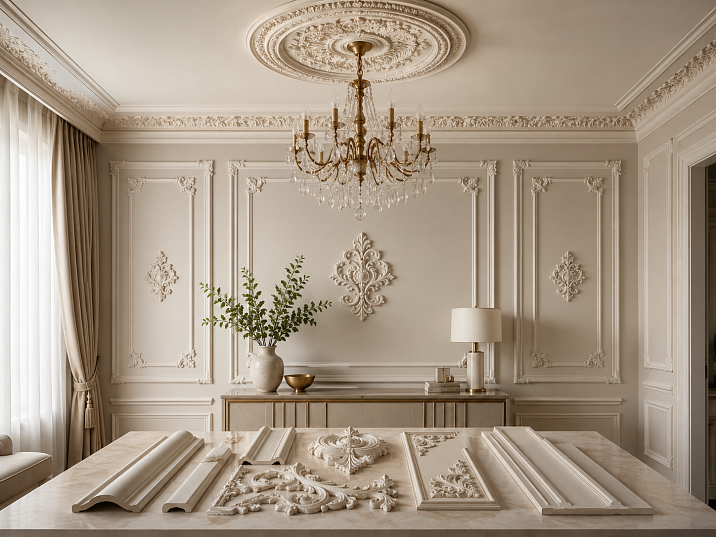
A cohesive interior is achieved not when you buy the most beautiful elements individually, but when Moldings made of polyurethane, Ceiling molding, Decorative stucco и Relief Decoration they speak the same language: matching in style, scale, relief, and color.
This article is about how to learn to read this language. And how Buy molding not as a set of random pretty things, but as a coordinated set that will make the interior cohesive.



Why beautiful elements may not go together
This is not an obvious problem. That's why it's so common. When a person chooses molding in an online catalog, they see each element separately — on a white background, without neighbors. The molding looks good. The rosette is beautiful. The decorative overlay is expressive.
But then they end up together — and a conflict begins.




What exactly is the conflict about
Style conflict. A classic molding with acanthus leaves is one visual vocabulary. A geometric neutral profile is a completely different one. If the rosette is in the first vocabulary and the molding is in the second, they will argue rather than support each other.
Scale conflict. A thin molding 20 mm wide and a large ceiling rosette 600 mm in diameter with a strong relief is a mismatch of scales. The small one will look insignificant next to the large one, and together they won't create a unified system.
Relief 'weight' conflict. Relief can be light (thin lines, shallow detailing) and heavy (deep volume, rich detail). If the molding is 'light' and Decorative stucco the rosette is 'heavy' — they will unbalance each other.
Motif conflict. A natural motif (leaves, flowers, birds) does not combine with a geometric one (meander, squares, straight lines). If one element says 'nature' and the other says 'architecture,' they live in parallel universes.
Era conflict. A Baroque curl, an Empire palmette, an Art Deco geometry — these are different historical styles, each with its own rules. Mixing them is possible, but it requires a conscious decision, not a random set.
Our factory also produces:


How to avoid conflict
The answer is simple in theory and requires discipline in practice: choose stucco in one style. First, define the style — then choose elements that match that style. Not the other way around.
Get Consultation
Where to start: not with decor, but with the room's style
The first question is not "which molding is prettier?" The first question is "what is my interior?" Or, if the interior is still being created, "what interior do I want to create?"
Style determines everything: the choice of moldings, the scale and character of the rosette, the type of decorative stucco, the level of detail of the stucco decor. Without a clear answer to this question selecting stucco into a unified system is impossible.
Let's break down the main stylistic directions and their characteristics in relation to stucco decor.
Modern classic
This is the most popular style in Russian interiors in recent years. Its distinctive features are calm elegance, clean lines, moderate decor. Not Baroque luxury, but not minimalist asceticism either.
Modern classics are characterized by:
-
medium-width moldings (30–55 mm) with a simple profile;
-
a rosette with calm proportions and no overloaded relief;
-
decorative stucco with a clean, uncluttered ornament;
-
a single white color or neutral tone.
Neoclassicism
A stricter and more geometric version of the classics. Decor is present, but it is precise, symmetrical, without excessive detailing. Fewer curls, more architectural lines.
-
Moldings with clear geometric profiles.
-
A ceiling rosette with proper symmetry, without Baroque opulence.
-
Decorative stucco with geometric or floral motifs of calm execution.
-
Strict corner elements within frames.
Formal classic
Rich interior with expressive decor. High ceilings (from 3 meters), wide moldings, rich stucco decor, large ceiling rosette with deep relief.
-
Moldings 60–100 mm and wider, with classic profile: acanthus, egg and dart, bead.
-
Large diameter rosette (from 400 mm) with rich ornament.
-
Buy Molded Decoration Need large, noticeable, with deep three-dimensional relief.
-
Formal cornice around the perimeter.
Calm minimalism with moldings
Moldings are used to structure the wall, but are decoratively neutral themselves. Emphasis is on geometry and proportions, not ornament.
-
Thin smooth moldings (15–30 mm) or profile with minimal relief.
-
Simple shaped rosette, small diameter.
-
Decorative stucco — one delicate accent, without unnecessary details.
-
No mixing of motifs.
Natural decorative motif
An interior where natural images — leaves, branches, flowers, birds — are a recurring theme.
-
Moldings can be neutral (they provide a container) or with a natural relief.
-
Relief Decoration — plant overlays, medallions with leaves, ornaments with flowers.
-
The natural motif is repeated in several spots in the room: above the mirror, by the sconce, in the center of the frame.
-
Rosette — with a leaf or floral ornament.
Commercial interior: status through decor
Restaurant, showroom, director's office, hotel lobby — here stucco works as a branding tool through space. The level of detail and scale is higher than in a residential interior.
-
Wide expressive moldings.
-
Decorative accents at focal points: above the entrance, in the reception area, around the perimeter of the main hall.
-
Ceiling rosette — large, expressive.
-
Set of stucco molding for interior is formed for a specific space.
Polyurethane moldings: the basic language of the entire composition
If you imagine the entire decorative system of a room as text, moldings are the font. They set the visual character of everything else. Everything that appears after them — the rosette, decorative stucco, stucco decor — must be written in the same font.
That's why the correct order is this: first choose Moldings made of polyurethane, then select everything else to match them. Not the other way around.
What the molding says about style
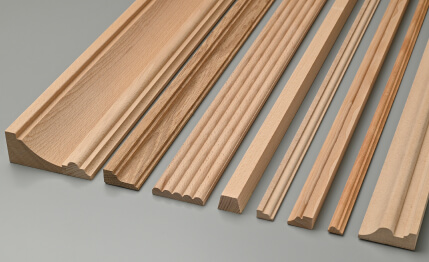
A smooth rectangular profile (no relief, only geometry) says: "Here is minimalism or strict neoclassicism." It pairs well with a similarly calm rosette and a delicate stucco accent — nothing more.
A profile with a fillet and a shelf (simple relief, classical proportions) says: "Here is modern classic or soft neoclassicism." It pairs well with a medium-diameter rosette with moderate ornamentation.
A profile with acanthus, egg-and-dart, and bead molding is formal classic. Such a molding is rich on its own, and the entire system should be at its level or slightly lower — but not several times simpler.
Molding width and system scale
The width of the molding determines the scale of the entire decorative system. If the molding is 25 mm, the corner blocks should be proportionate — compact. The rosette should be neat. The central accent of the frame should be delicate.
If the molding is 70 mm — that is a different system. Here, the rosette can be larger and Relief Decoration more expressive, and the corner blocks more noticeable.
Scale violation is one of the most common mistakes when selecting a set of stucco molding. People take a thin molding and pair it with large stucco decor. This creates an imbalance: the decor "overpowers" the frame.
Decor for moldings: corner elements in the same dictionary
Decor for Molding — corner blocks and inserts — must be selected from the same stylistic group. If the molding has acanthus leaves, the corner block should also have a classic relief. If the molding is smooth and geometric, the corner block should be equally strict.
What to buy for a molding frame in one style:
-
Moldings made of polyurethane — a profile that defines the style.
-
Decor for Molding — corner blocks of the same stylistic group.
-
Glue, putty, paint.
Ceiling stucco: how not to knock the ceiling out of the overall style
The ceiling is an area that often doesn't get enough attention when selecting stucco. And that's a mistake. It is the ceiling that 'closes' the system from above. And it is the ceiling that most often turns out to be 'extra' in the decorative ensemble.
A typical situation: walls are decorated with thin moldings in the spirit of modern neoclassicism. A calm, elegant system. And suddenly on the ceiling — a lush rosette with a diameter of 600 mm with baroque curls, deep relief, large leaves. This is not one room. These are two different rooms superimposed on each other.
Rule of matching ceiling and walls
Ceiling molding should be at the same stylistic level as the wall decor. A slight 'enhancement' is allowed — the ceiling can be slightly richer than the walls, but not dramatically. If the walls are modestly decorated, the ceiling should not shout.
The principle of correspondence works according to three parameters:
-
Style: one stylistic family.
-
Scale: the rosette and cornice should be proportionate to the moldings.
-
Relief weight: if the molding is light, the cornice should also be light.
Ceiling cornice: continuation of the molding system
The cornice around the perimeter of the ceiling is a continuation of the molding system. It should "recognize" the moldings on the walls. If the moldings have a fillet, the cornice has a fillet. If the moldings have a geometric profile, the cornice has similar geometry.
The width of the cornice in the ceiling area is generally greater than the width of the wall molding: the cornice "holds" the wall-ceiling transition and has a different scale task. But the relief and style must match.
Buy ceiling stucco molding It should be done simultaneously with the wall moldings — then you can compare them side by side and ensure stylistic unity before installation.
Ceiling rosette: the final chord of the system
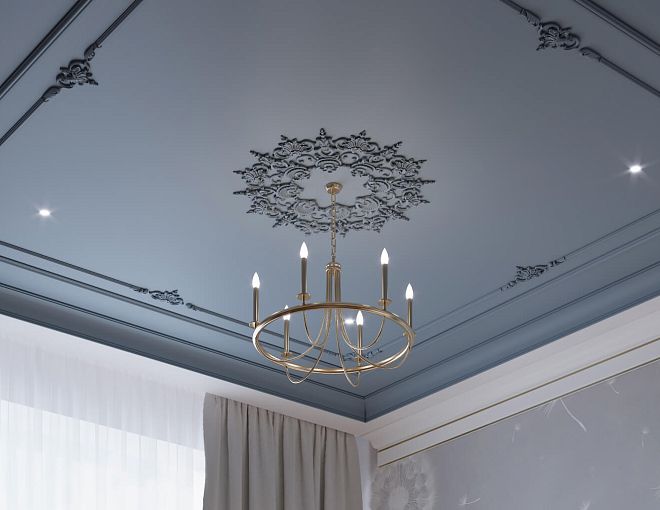
ceiling rosettes — this is a separate category of products. The rosette is not just a chandelier frame. It is the decorative center of the ceiling. It sets the mood of the upper plane.
How to choose a rosette in the same style as the rest of the decor:
For modern classic. A rosette with a diameter of 200–350 mm and moderate relief. A calm ornament without complex multi-level details. Pure symmetry.
For neoclassicism. A rosette of 250–400 mm with a geometric or architectural ornament. Precise lines, minimal "natural" relief.
For formal classic. A rosette from 400 mm with a rich three-dimensional ornament: leaves, curls, multi-level relief. This is the decorative center of a formal ceiling.
For a minimalist interior with moldings. A rosette of 150–250 mm with a clean profile. Delicate, not attracting unnecessary attention.
For a natural motif. A rosette with a leaf or floral ornament — in the same ornamental theme as the Relief Decoration on the walls.
Important point: the rosette should be chosen already knowing the diameter of the chandelier. A rosette smaller than the chandelier visually gets lost. A rosette significantly larger dominates the chandelier.
Decorative stucco: how to choose a motif that doesn't clash with the moldings
Decorative stucco is accent elements. They don't structure the space like moldings do — they animate it. A medallion above the mirror. A frieze above the console. A stucco overlay in the center of a frame. Each of these elements is a voice in the ensemble. And the voice must sing in unison with the others.
The main question when choosing: what motif is already set by the moldings? And what fits that motif?
Strict geometric molding
If the molding is geometric, the decorative stucco should also be geometric or neutral. A medallion with a clear symmetrical ornament. A horizontal frieze with a regular rhythm. A corner accent with a square or hexagonal motif.
What doesn't work: natural motifs with soft curves, baroque swirls, asymmetrical ornaments.
Classic molding with acanthus
Acanthus molding pairs well with Decorative stucco plant motifs — but in moderation. Acanthus, laurel leaf, palmette — classic ornaments that support the overall vocabulary.
It's important not to overload: if the molding is already rich with acanthus, the decorative overlay should be calmer. It complements, not competes.
Molding with a natural motif
A natural motif gives freedom for buy decorative moldings the same theme: leaves, branches, flowers, birds. The main thing is to maintain unity of the image. If the molding has leaves, the overlays should also have leaves, not birds. One natural image, repeated in several places, creates a cohesive theme.
Detail level: the "weight" of the relief must match
There is a concept that professionals call "visual weight." An element with a deep, complex, multi-layered relief is "heavy." An element with a thin line and shallow detailing is "light."
In one system, all elements should be approximately the same visual weight. Or increase from light to heavy with logic: the molding is light, the corner blocks are medium, the central accent is slightly heavier. This creates hierarchy, not chaos.
When a light molding is combined with a very heavy decorative overlay, the overlay "kills" the molding. It becomes an insignificant background for overly loud decor.
Stucco decor: how to add individuality without chaos
Relief Decoration — this is the most individual level in the system. Here the character of the interior manifests itself most clearly. And here mistakes most often occur — when each purchase is made separately, without an overall concept.
The main principle: stucco decor should repeat or develop the motif already set by the moldings. It should not introduce a new theme.
Rule of motif repetition
One well-chosen motif, repeated in several places, creates the feeling of a "designer interior" — intentional, thoughtful. Random elements in each place create a feeling of chaos.
Example: a natural motif with leaves. The decision is made — leaves. Then:
-
Above the mirror — a decorative overlay with leaves.
-
In the center of the molding frame — a medallion with leaves.
-
On the sides of the sconce — paired overlays with leaves.
-
On furniture facades — small stucco overlays with leaves.
One theme, several points. This is called a "visual rhyme." The eye finds a repeating image — and the interior is perceived as a system.
The rule of one motif
Don't take three different ornamental themes into one interior. One motif — and its variations. Variations can be of different scales (small at the sconce, large above the mirror), but one ornamental vocabulary.
Paired stucco decor: symmetry as a sign of intention
Buy Molded Decoration in paired execution — means investing in symmetry. And symmetry in a classic interior is a sign of a deliberate decision, not an accident. Two identical (or mirrored) elements on the sides of the mirror, on the sides of the sconce, in the lower corners of the frame — this is what distinguishes professional decor from amateur.
Paired decor costs a little more (two items instead of one), but the visual result is incomparably higher.
Where to place stucco decor within the system
-
Above the mirror — a central accent, one element at the center of the top edge.
-
In a molding frame — at the center of the frame or in the upper third.
-
At a sconce — paired decor on both sides of the light fixture or a small accent above it.
-
On a furniture facade — a small overlay at the center of the facade.
-
In a niche — a central element on the back wall.
-
On the frieze above the panel — a horizontal ornament at the center of the span.
Decor for moldings: how to assemble a frame that doesn't fall apart
Let's return to molding frames. A frame consists of several elements: the profile itself, corner blocks, and possibly additional decor inside the frame. All three must speak the same language.
Decor for Molding — these are corner blocks and inserts that are mounted as part of the frame. Their main task is to decoratively complete the perimeter of the frame. But if the corner block has a relief from a completely different style than the molding itself, the frame "falls apart" into pieces.
How to choose corner blocks for molding
First — by planting width. This is a technical point: the block width must exactly match the molding width.
Second — by relief style. If the molding has leaves — the corner block has leaves. If the molding is geometric — the corner block has a geometric pattern.
Third — by visual weight. The corner block is slightly "heavier" than the molding — this is normal and even correct: the corner attracts attention, it is an accent point. But "slightly" — not "several times".
Central decor inside the frame and corner blocks
If the frame has both corner blocks and central decor, there must be a hierarchy between them. Either the corner blocks are dominant, and the central decor is delicate. Or the central decor is dominant — and the corner blocks are subdued.
Two equally "loud" centers — corner and central — will compete. One main, one secondary.
Color: the last but not least level of consistency
When style, scale, relief, and motif are selected — the simplest and most effective tool to unify everything into a single system is color.
All stucco elements in one space are best painted in a single color. This is a fundamental rule. White molding, white rosette, white overlays — they may differ in style, but a single color creates a sense of system.
White color: a universal solution
A single white or neutral tone is a "quiet" system. Molding in the color of the wall sounds delicate. All decor in the color of the wall — and the emphasis is not on the decor itself, but on the structure it creates.
Contrast color: a deliberate decision
If the moldings, cornice, and rosette are painted white, and the walls are a rich tone, the stucco acts as a contrasting element. This is a strong decision that requires confidence.
Important: all stucco elements must be the same color. You cannot paint moldings white and decorative overlays gold. That's two different vocabularies again.
Nuance tone: a complex solution for a complex interior
You can paint all the stucco in one nuance tone — slightly warmer or cooler than the wall. This creates volume without contrast. Requires precise color selection — the difference must be minimal, otherwise the stucco starts to look dirty.
Purchase formulas: how to assemble a set for a specific style
Now — to practice. Four stylistic formulas with specific lists.
Formula 1. "Calm modern classic"
For a bedroom, living room, quiet study. A delicate, elegant result.
What to buy:
-
Moldings made of polyurethane — medium profile 30–45 mm, simple relief.
-
Decor for Molding — corner blocks of calm relief.
-
Decorative stucco — one delicate central accent.
-
Ceiling molding — calm cornice, rosette without overload.
-
ceiling rosettes — 250–350 mm, moderate ornament.
-
Glue, putty, paint matching the wall color.
Formula 2. "Formal Living Room"
For a representative space, hall, formal area.
What to buy:
-
Moldings made of polyurethane — wide, 55–90 mm, classic relief with acanthus.
-
Decor for Molding — corner blocks with rich relief.
-
Decorative stucco — paired elements in the main frame + central accent.
-
Relief Decoration — at the mirror, at the sconce, above the console.
-
Ceiling molding — wide cornice, large rosette.
-
ceiling rosettes — from 400 mm, rich ornament.
Formula 3. "Natural Decorative Motif"
For a bedroom, library, intimate space with a warm atmosphere.
What to buy:
-
Moldings made of polyurethane — neutral or leafy profile.
-
Relief Decoration with a natural motif — in several points of the room.
-
Decorative stucco — overlays with leaves or floral ornament.
-
Ceiling molding — cornice with a natural motif.
-
Socket with leaf ornament.
Formula 4. "Commercial Interior"
For a beauty salon, restaurant, showroom, director's office.
What to buy:
-
Expressive Moldings made of polyurethane — according to the brand's character.
-
Decorative stucco — in attention zones: above the entrance, above the reception, around the perimeter of the main hall.
-
Relief Decoration — a repeating motif in several points.
-
Ceiling molding — cornice + socket for the central light fixture.
Table: how stucco elements should match each other
| Style | Molding | Rosette | Decorative element | Crown Molding |
|---|---|---|---|---|
| Modern Classic | 30–50 mm, calm relief | 250–350 mm, moderate ornament | Delicate, single | Thin, with fillet |
| Neoclassical | Geometric, 25–45 mm | 200–300 mm, geometry | Geometric or neutral | Architectural |
| Classical entrance | 60–100 mm, acanthus | From 400 mm, rich relief | Paired, expressive | Wide, rich |
| Minimalism with moldings | 15–25 mm, smooth | Up to 200 mm, simple shape | One, very delicate | Thin or without cornice |
| Natural motif | Neutral or leafy | Leafy ornament | Floral, repeating | Leafy or calm |
Practical algorithm: how to go from style to order
Let's summarize in the form of a step-by-step algorithm. This is not theory — it is a specific sequence of actions.
Step one: Define the style. Ask yourself: what character should the room have? Strict, formal, natural, intimate, commercial? The answer to this question determines everything else.
Step two: Choose the moldings. They are the basic vocabulary. Width, profile, relief. Everything else is selected to match them.
Step three: Choose corner elements for the moldings. The style matches the molding, the fit width is precise.
Step four: Define the decorative motif. One motif — several points of application.
Step five: Choose decorative molding and stucco decor. The same motif, the same visual weight.
Step six: Choose ceiling decor. Cornice in the style of the moldings, rosette — in the style of the entire system, of the required diameter.
Step seven: Form a single order. Everything at once — not in parts.
Step eight: Paint everything in a single color.
How to assemble molding from the catalog correct — it is this algorithm. Not 'what looks nicer', but 'what speaks the same language'.
About the Company
STAVROS — a Russian supplier of polyurethane stucco decor for residential and commercial interiors. The STAVROS catalog features a full range of products for creating coordinated decorative systems: Moldings made of polyurethane of various styles and widths, Decor for Molding — corner blocks and inserts, Decorative stucco и Relief Decoration for walls, Ceiling molding for cornices and ceiling rosettes under chandeliers.
STAVROS helps you choose Set of stucco molding for interior as a coordinated system — taking into account the style, scale, proportions, and purpose of the room. You can buy ready-made stucco matching the Baroque style. Calculate the quantity: linear meters of cornices and moldings, number of rosettes, pilasters, consoles, corner elements. Add a ten to fifteen percent allowance for trimming. at STAVROS means getting not a set of beautiful details, but a ready-made decorative ensemble. All STAVROS products are made of solid extruded polyurethane: a stable, moisture-resistant, paintable material with a long service life.
Frequently asked questions
How to choose moldings in one style?
Start by defining the room's style — formal classic, modern classic, minimalism, natural motif. Then select moldings that match this style. Based on their relief, width, and character, choose ceiling decor, a rosette, decorative stucco, and a stucco accent. polyurethane molding catalog STAVROS contains elements from different stylistic groups.
Can different types of stucco molding be combined?
You can — if they are from the same stylistic family. Moldings, cornice, rosette, decorative overlays — all can be different in type, but must match in style, visual weight, and relief. Mixing classic with baroque or geometry with a natural motif is risky.
What to choose first: moldings or decorative stucco?
Always — moldings. They set the architecture and basic style. Then everything else is selected to match them. Moldings made of polyurethane — the first decision in the system.
How to know if a ceiling rosette matches the moldings?
Check three parameters: style (one stylistic family), scale (the rosette should not overpower the moldings or get lost next to them), visual weight of the relief (if the molding is light — the rosette is also light). ceiling rosettes The STAVROS catalog features different styles and sizes.
Which motif to choose if you want a natural interior?
One natural image — leaves, branches, or flowers — and repeat it in several spots: in the frame, above the mirror, near the sconce, on the furniture. Relief Decoration With a natural motif in STAVROS — several formats and sizes.
Do you need to paint all the stucco in one color?
Yes. A single color is the most powerful tool for combining different elements into a system. Even if the style and scale are well chosen, different colors will destroy the sense of unity.