Article Contents:
- White color is already chosen, but the pillar configuration is not yet
- One article number — four fundamentally different combinations for white color
- What actually arrives to the buyer
- Why white enamel does not hide poor preparation
- Manufacturer's zone
- Carpenter's or installer's zone
- Painter's zone
- Buyer's or general contractor's zone
- Who "Standard" suits
- What an honest "Standard" estimate looks like
- When the low price of "Standard" is misleading
- Where additional manual sanding is especially noticeable
- When "Prestige" is especially logical
- What "Prestige" does not promise
- A Simple Selection Criterion
- 1. Do you perform the final sanding of the wood?
- 2. Is this work included in the painting price?
- 3. What surface do you accept without an additional charge?
- 4. What primer and what enamel will be used?
- 5. Is a sample needed before painting the entire staircase?
- 6. Will all elements be painted at the same time?
- 7. Is there an additional charge for carved or complex profiles?
- When beech is especially reasonable
- When oak can remain justified
- Can you mix an oak handrail, beech balusters, and a beech post
- Why you can't choose "Under tint" based on the principle "it's higher quality"
- What to write in the order
- The relief is read through shadow
- The degree of gloss changes the perception of preparation
- Cold and warm white behave differently
- Formula for "Standard"
- Formula for "Prestige"
- Method 1. Request two estimates from one painter
- Method 2. Calculate the cost of preparation per hour
- Method 3. Order a sample before the series
- Why quantity affects the choice of sanding
- Pillar list
- Balusters
- Handrail
- Installation and finishing materials
- Check the surface with side light
- Do not fix the thread with a random tool
- Why you cannot unpack and forget on the construction site
- How to store several identical elements
- When exactly L-112 is needed
- When it's better to choose a different post
- Scenario 1. One post, third-party painter, separate payment for preparation
- Scenario 2. Own carpentry workshop
- Scenario 3. Four identical posts
- Scenario 4. The entire staircase is already ordered in oak
- Scenario 5. White post and natural oak handrail
- Scenario 6. Renovating an existing staircase
- Scenario 7. Hotel, restaurant, or public lobby
- Bright classic hall
- Contrasting staircase with dark steps
- Modern Neoclassicism
- Hall with colored walls
- Interior with warm oak floor
- Why specify the sanding quality
- Why pass on information about other elements
- Mistake 1. Considering 'Under enamel' as a ready white coating
- Mistake 2. Choosing 'Standard' at the minimum price
- Mistake 3. Buying "Prestige" hoping to immediately apply the finish
- Mistake 4. Not asking the painter about preparation
- Mistake 5. Assuming beech is automatically worse than oak
- Mistake 6. Assuming oak is automatically unnecessary
- Mistake 7. Choosing "For tinting" for white opaque finish
- Mistake 8. Ordering only one post out of several
- Mistake 9. Mixing "Standard" and "Prestige"
- Mistake 10. Painting the post before fitting
- Mistake 11. Not checking the handrail joint
- Mistake 12. Not including balusters in the painting estimate
- Error 13. Painting posts and balusters with different batches of material
- Error 14. Choosing color only by monitor
- Error 15. Not making a sample
- Error 16. Taking the word "white" as an exact specification
- Error 17. Not clarifying whether primer is included in the painter's price
- Error 18. Not clarifying intercoat treatment
- Error 19. Using too thick enamel to hide the nap
- Error 20. Roughly sanding decorative profile
- Error 21. Not protecting installation areas
- Error 22. Storing the post near wet work
- Error 23. Lose the marking
- Error 24. Count the price of one L-112 as the cost of the fence
- Error 25. Not check the fastener kit
- Error 26. Choose a post without a drawing
- Error 27. Buy another model just because of a similar price
- Error 28. Paint the handrail with the same system without checking operation
- Error 29. Not consider the delivery cost to the workshop and to the site
- Error 30. Not allocate responsibility for damage after painting
- Error 31. Not save the paint sample data
- Error 32. Order materials before approving the painting technology
- Error 33. Painting a surface contaminated with construction dust
- Error 34. Not comparing the full cost of "Standard" and "Prestige"
- Error 35. Ordering columns separately from the rest of the staircase specification
- Open the exact product card
- Check the size
- Choose the wood species
- Determine the sanding quality
- Specify the preparation for enamel
- Enter the exact quantity
- Add the remaining categories
- Check the total line
- Save the order
- Does L-112 come already white?
- What is the size of L-112?
- From which wood species can L-112 be ordered?
- What is better for white enamel — beech or oak?
- Will oak under white enamel look different?
- What does "under enamel" mean?
- What does "under tinting" mean?
- Can I order "Under tinting" and then paint it white?
- How does "Standard" differ from "Prestige"?
- Is "Standard" necessarily of poor quality?
- Can "Prestige" be painted immediately?
- Does "Prestige" need additional sanding?
- Who should do the final sanding of the post?
- How to ask the painter about preparation?
- Is primer included in the price of the post?
- How many coats of enamel will be needed?
- Is a test painting necessary?
- Can a white color be matched from a photo?
- Should the post and balusters be painted at the same time?
- Can the handrail be left natural?
- How many L-112 posts should I order?
- Do I need to buy a spare post?
- Can I order one L-112 as a sample?
- When should I paint the post — before or after installation?
- Can I drill an already painted L-112?
- Is the mounting hardware included in the set?
- What fasteners are needed for L-112?
- Can L-112 be used as a support post?
- How do I calculate the price of a finished white post?
- Why can't you compare only the price of "Standard" and "Prestige"?
- Can "Prestige" turn out cheaper in the full estimate?
- Can "Standard" turn out to be more advantageous?
- How to check the post upon receipt?
- What to do if lint is found on the surface?
- How to store L-112 before painting?
- Is it necessary to mark multiple posts?
- Can stair elements be painted by different craftsmen?
- How to match a white post with the baseboard and doors?
- Where can I see other posts?
- Where to buy L-112 with the rest of the stair parts?
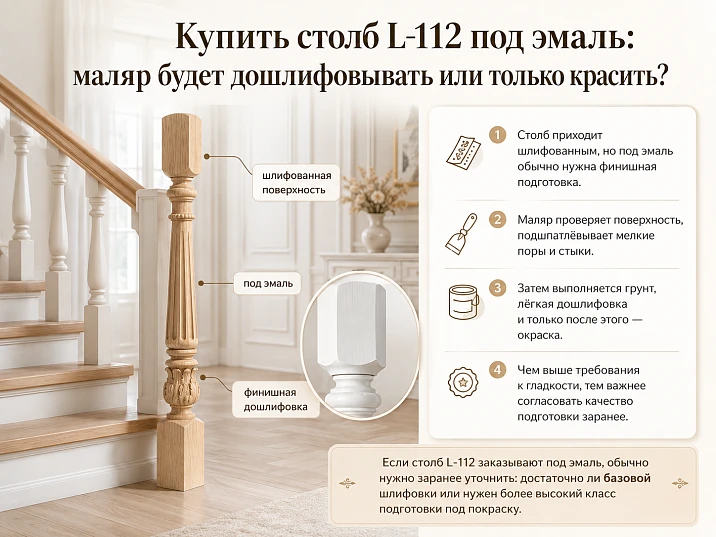
A white stair post seems like an almost ready-made solution. The color is chosen, the size is known, the model is liked — all that remains is to place the order and hand the product over to the painter. But it is at this moment that a question arises that can change the entire estimate: will the painter only apply white enamel, or will he first handle the final preparation of the wood?
In the L-112 card, the buyer sees a post sized 1200 × 100 × 100 mm, two wood species, two sanding qualities, and two regluing options. Formally, the choice looks simple: beech or oak, "Standard" or "Prestige," "For enamel" or "For tinting." In practice, each switch determines what arrives at the site, how much work remains for the finisher, and from which line items the cost of the finished white post is composed.
The phrase "order L-112 for enamel" does not mean "receive a white painted product." The buyer receives a wooden stair post prepared with future opaque coating in mind. Before the work is complete, surface inspection, local touch-up sanding, dust removal, priming, primer treatment, enamel application, and intercoat operations may be required. Their composition is determined not by advertising expectations, but by the chosen painting system and the agreement with the contractor.
Therefore, before buy L-112 post, you need to get a direct answer from the painter: what surface he accepts for work and whether touch-up sanding of the complex wooden relief is included in the painting cost.
The answer will determine which option turns out to be more advantageous. "Standard" may be a rational purchase for a workshop with its own preparation area. "Prestige" can reduce the amount of manual finishing if the post is handed to an external painter. Beech often has more commercial sense under opaque white enamel, but automatically declaring it the only correct species is not possible: the material must match the approved specification of the entire staircase.
The main calculation looks like this:
**price of the selected L-112
-
Delivery
-
surface inspection
-
additional touch-up sanding
-
primer
-
Enamel
-
painter's work
-
installation and associated costs
= cost of the finished white post.**
And only this amount allows for an honest comparison of options.
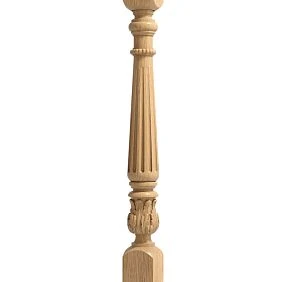
The white color has already been chosen, but the post configuration has not yet
The buyer often thinks that the decision is made immediately after choosing white enamel. After that, it seems all that remains is to find a wooden post of the required size. But the white color only determines the external result. The product card requires selecting several more characteristics, each of which affects the price and subsequent work.
| Parameter | Options in the L-112 card | What changes for the buyer |
|---|---|---|
| Size | 1200 × 100 × 100 mm | Determines the dimensions and compatibility with the project |
| Wood species | Beech or oak | Affects price, surface texture, and coordination with other elements |
| Sanding quality | "Standard" or "Prestige" | Determines the expected amount of manual finishing |
| Regluing quality | "Under enamel" or "Under tinting" | Related to whether the wood will be hidden or remain visible |
| Final color | Applied separately | White enamel is not included in the quality of sanding |
| Order | Cart or quick order | Before ordering, check the full selected line |
| Fastening | Requires separate verification | Cannot be considered automatically included without confirmation of the configuration |
| Other fence elements | Ordered separately | Balusters, handrail, and materials are included in the full staircase estimate |
The order line must specify not just “L-112 — 1 pc.”, but the full combination:
L-112, 1200 × 100 × 100 mm, beech, “Standard” or “Prestige”, for enamel, required quantity.
If the staircase includes several identical posts, this configuration is repeated for each item. You cannot accidentally order one post in “Standard”, a second in “Prestige”, and a third with preparation for tinting, expecting that white paint will hide any differences in preparation.




One article number — four fundamentally different combinations for white color
Even if you exclude the “For tinting” option and consider only opaque enamel, four basic combinations remain:
-
Beech, “Standard”, for enamel.
-
Beech, “Prestige”, for enamel.
-
Oak, «Standard», for enamel.
-
Oak, «Prestige», for enamel.
Each combination has its own price. But the difference in the cost of the blank does not yet show which option is cheaper after painting.
Suppose beech «Standard» costs less than beech «Prestige». If the workshop performs the final sanding in-house and has already included it in the overall contract, «Standard» can provide real savings. If an external painter charges for each hour of preparation separately, the difference may shrink or disappear.
Oak «Prestige» may have the highest price among the options considered. But if the entire staircase is specified in oak per structural or design specifications, you cannot replace just one post with beech solely for savings. The entire set is checked first.
Our factory also produces:

«For enamel» — not a white post and not finished painting
The label «For enamel» is easy to misread. The buyer sees the word «enamel» and imagines a product that only needs to be installed. In reality, this characteristic refers to the preparation of the wooden blank for a future opaque coating.
For opaque finishing, lamellas may be glued without strict matching of natural color and grain, since white enamel should cover the visual differences of the wood. This is commercially reasonable: the buyer does not pay for texture matching that will not be seen after painting anyway.
But the surface does not yet have:
-
white color;
-
primer layer;
-
finish enamel;
-
agreed degree of gloss;
-
protection from operating conditions;
-
finished mating with balusters and handrail;
-
eliminated traces of possible installation fitting.
Get Consultation
What actually arrives to the customer
The order contains a wooden post L-112 with the selected wood species, sanding quality, and re-gluing. This is a high-degree-of-readiness blank, but not a finished white architectural element.
Before painting, the contractor evaluates:
-
whether there is raised grain;
-
Are the transitions sufficiently worked out?
-
Do the ends require attention?
-
Are there areas that need final sanding?
-
Has the trial fitting been done?
-
Do the joint areas need to be covered or protected?
-
Is the primer compatible with the wood?
-
How does the enamel behave on the test sample?
-
How many layers does the system provide?
-
Is interlayer treatment required?
The phrase "under enamel" answers the question about the future type of coating, but does not replace the painter's technological map.
Why white enamel does not hide poor preparation
White color is associated with cleanliness and a smooth surface. That is why defects in shape are clearly visible on it:
-
raised nap;
-
deep scratches;
-
dust under the coating;
-
unfilled recesses;
-
rough transitions;
-
runs;
-
uneven degree of gloss;
-
trimming marks;
-
differences between adjacent parts.
Dense paint can cover the color and grain of wood, but it does not level the carving by itself. A thick layer used to hide roughness may, on the contrary, soften edges and fill fine relief.
Therefore, the question 'will the painter do additional sanding or just paint?' should be asked before purchase, not after the post is delivered.
Who is responsible for the surface: the manufacturer, the carpenter, or the painter
Problems arise when each participant assumes that someone else will do the preparation.
The buyer assumes that a product 'for enamel' can be painted immediately. The painter accepts the order only for applying the coating and does not include carpentry finishing. The installer plans to trim the post after painting. As a result, work stops, and the estimate increases already on site.
To prevent this, responsibilities are divided in advance.
Manufacturer's zone
The manufacturer produces the product in the selected configuration:
-
specific size;
-
beech or oak;
-
"Standard" or "Prestige";
-
re-gluing under enamel or under tinting;
-
declared degree of surface preparation.
Carpenter or installer zone
The carpenter checks the geometry of the project and performs operations related to the structure:
-
fitting;
-
marking;
-
fitting;
-
preparation of joints;
-
drilling;
-
possible trimming;
-
checking the handrail fit;
-
work with the base;
-
preparation of hidden mounting zones.
It is advisable to complete these operations before the final painting or to agree on a coating protection scheme.
Painter's zone
The painter is responsible for the finishing system they have accepted:
-
incoming inspection;
-
agreed final sanding;
-
dust removal;
-
primer;
-
primer treatment;
-
application of enamel;
-
interlayer operations;
-
color and gloss control;
-
correction of coating defects within the contract.
However, the painter is not automatically obliged to perform all the listed works. They must be specified in the estimate.
Buyer or general contractor zone
Buyer links stages:
-
transfers L-112 characteristics to contractors;
-
receives surface requirements;
-
checks who is responsible for each operation;
-
compares total cost of options;
-
orders compatible elements;
-
organizes a single color specification;
-
controls timing between fitting and painting.
"Standard": when own final sanding is already included in the process
The "Standard" quality should not be described as a defective or unsuitable option. The card allows for slight roughness and lint, meaning the buyer needs to plan for more careful inspection and possible manual finishing.
This option is reasonable not because white enamel will hide everything, but because the preparatory work is already included in the project.
Who "Standard" is suitable for
"Standard" can be considered when:
-
the furniture or staircase workshop has its own sanding section;
-
the painter accepts wooden blanks and finishes the surface themselves;
-
sanding is included in the painting price;
-
the contractor is familiar with carved details;
-
the timeline includes a preparatory stage;
-
the customer wants to control the surface according to their own technology;
-
a series of elements is acquired, which will be processed by a single thread;
-
the budget is compared with actual labor costs, not just with the price of the card.
What an honest estimate for the "Standard" looks like
The estimate should include:
**price of L-112 "Standard"
-
acceptance and sorting
-
manual final sanding
-
Dust removal
-
primer
-
primer treatment
-
white enamel
-
painter's work
-
delivery and installation costs.**
If the phrase "manual finishing" is absent, clarify whether it is hidden within the total painting price. Sometimes a craftsman writes a single "turnkey" cost but implies a full cycle. In another sentence, the same wording means only applying primer and paint to an already prepared surface.
When the low price of "Standard" is misleading
Let's consider two offers.
First: a more affordable "Standard" column, but the painter separately charges for several hours of work with the relief.
Second: a more expensive "Prestige", which after incoming inspection requires less manual finishing.
Comparing only the card prices will show the advantage of the first option. Comparing the full estimate may yield a different result.
One cannot claim in advance that "Prestige" will necessarily pay off. But neither can one consider "Standard" without the cost of preparation.
"Prestige": what the buyer pays extra for before painting
"Prestige" receives additional detailed manual sanding and is more prepared for subsequent finishing. The commercial meaning of this option is to reduce the amount of work that would have to be done after receipt.
The buyer pays not for the finished white color, but for a deeper preparation of the wooden shape.
Where additional hand sanding is especially noticeable
L-112 is not a simple rectangular beam. The post has profile transitions, decorative zones, edges, and areas that are harder to reach with machine tools. It is in such places that hand work matters.
Additional treatment helps:
-
reduce the prominence of fuzz;
-
prepare transitions more carefully;
-
preserve the shape of decorative areas;
-
reduce the painter's time;
-
lower the risk of missing roughness;
-
move faster to trial priming;
-
ensure consistent preparation of multiple parts.
When "Prestige" is especially logical
-
The post is handed over to an external painter who highly values the carpentry preparation.
-
The contractor accepts parts only with a high degree of preliminary readiness.
-
The project has several identical posts, and manual finishing is multiplied by the quantity.
-
Installation and painting are scheduled on a tight timeline.
-
White enamel has a smooth finish on which defects are noticeable.
-
The client does not have their own workshop.
-
The post is located in a well-lit area.
-
The finishing of the handrail and balusters should look uniform.
-
It is necessary to prepare a more predictable estimate in advance.
What "Prestige" does not promise
Even this option does not mean that you can:
-
unpack the column and immediately apply the final coat of enamel;
-
skip incoming inspection;
-
refuse priming;
-
ignore the paint manufacturer's requirements;
-
perform installation trimming after finishing without restoring the coating;
-
mix different painting systems;
-
not check surface cleanliness;
-
not do a test paint.
"Prestige" reduces the likely amount of initial manual finishing, but final readiness is determined by the specific coating system.
"Standard" or "Prestige": comparison through painter's work
| Question | "Standard" | "Prestige" |
|---|---|---|
| Is there machine sanding | Yes | Yes |
| Is there manual finishing | Provided, but slight roughness and lint are possible | Performed in more detail |
| Is the column ready for white color without primer | No | No |
| May local re-sanding be required | Yes | Also possible after inspection |
| Who it is especially suitable for | Workshop with its own preparation area | For a customer who wants to reduce the amount of finishing work |
| What to compare | Product price plus the contractor's work | Product price plus the remaining preparation |
| Whether it is a painted product | No | No |
| Can you choose without talking to the painter | Risky | Also undesirable |
The table does not declare a winner. It shows what questions need to be asked.
Simple selection criterion
Choose "Standard" if your contractor confirms:
Final sanding is included in the price. We accept products of this quality, prepare the relief ourselves, prime, and paint.
Consider "Prestige" if the contractor responds:
The price is quoted for painting a prepared part. Complex manual final sanding is calculated separately.
This is not a universal rule, but a way to translate an abstract quality name into money and responsibilities.
Seven questions for the painter before placing an order
The conversation with the painter should take place before payment L-112. It is better to send him a link to the card, size, selected wood species, and a description of the sanding quality.
1. Do you perform the final sanding of the wood?
A direct answer is needed: yes or no. Phrases like "we'll see on site" and "usually everything is fine" do not allow calculating the estimate.
Clarify what is included in the concept of final sanding:
-
removing lint;
-
processing transitions;
-
working with recesses;
-
checking edges;
-
correcting local scratches;
-
treatment after primer.
2. Is this work included in the painting price?
A painter may perform preparation but charge for it separately. Ask to split the quote:
-
preparation;
-
Priming;
-
interlayer treatment;
-
enamel;
-
additional work with complex relief.
This makes it easier to compare "Standard" and "Prestige".
3. What surface do you accept without extra charge?
Ask to describe the requirements:
-
absence of visible lint;
-
a certain degree of smoothness;
-
absence of deep scratches;
-
completed installation fitting;
-
clean edges;
-
absence of contaminants;
-
stable storage conditions.
4. What primer and what enamel will be used?
The article does not specify a particular brand or composition. But the buyer needs to know:
-
whether the materials are compatible with wood;
-
how many operations are included in the system;
-
whether an insulating layer is required;
-
what degree of gloss is planned;
-
how interlayer treatment will be performed;
-
where a test coat will be made.
5. Is a sample needed before painting the entire staircase?
White color has many shades. Even with the same name, they differ:
-
temperature;
-
density;
-
gloss level;
-
perception in daylight and artificial light;
-
combination with walls;
-
appearance next to doors and baseboards.
A sample helps to agree on the result before treating all posts and balusters.
6. Will all elements be painted at the same time?
It is better to include the post, balusters, and handrail in one painting specification. If they are painted in different weeks, with different batches of material, or by different craftsmen, differences in shade and gloss may occur.
7. Is there an extra charge for carved or complex profiles?
You cannot mechanically apply a single price per square meter of surface to a complex part. Relief requires more manual work, turning of the product, and control of recesses.
Beech or oak under white enamel: what are you paying for if the texture disappears
The buyer has already decided to cover the wood with an opaque white coating. A reasonable question arises: is there any point in ordering oak if its natural grain will not be visible?
In most purely decorative scenarios, beech under enamel looks like an economically sensible choice. The white layer hides color differences between lamellas, and the visual result is built on the L-112 shape, smoothness, and quality of painting.
However, the conclusion that "under white enamel you always need only beech" would be too categorical.
When beech is especially reasonable
-
The entire staircase is initially specified in beech.
-
The post, balusters, and handrail are painted with an opaque coating.
-
The natural grain should not remain visible.
-
The customer compares the price of the finished coating, not the status of the wood species.
-
The designer does not require oak for other reasons.
-
All elements can be ordered in a single wood species.
-
A single white set is required without mixing materials.
-
The contractor agreed on preparation for enamel.
When oak may remain justified
-
The rest of the staircase is already made of oak.
-
The designer requires a single wood species for all elements.
-
Some parts remain under a transparent finish, while the post is painted white.
-
The structural or production specification does not allow substitution.
-
The customer wants to keep a single material for the entire object.
-
Possible future rework of the coating is taken into account in the project.
-
The price difference is accepted deliberately.
-
The choice is coordinated with the staircase manufacturer and the finisher.
Is it possible to mix an oak handrail, beech balusters, and a beech post?
With opaque painting, visual differences in wood are reduced, but this does not mean automatic technological identity. Different species may behave differently in preparation, priming, and end-grain treatment.
Mixing should be part of the project, not a result of randomly choosing more affordable items.
If it is possible to assemble the post, balusters, and handrail from the same species and same preparation, such a specification is simpler for:
-
production;
-
the painter;
-
sorting;
-
re-order;
-
surface control;
-
soil matching;
-
cost calculation.
Under enamel or under tinting: the error of one switch
For white opaque finish, in the card select preparation "Under enamel". The option "Under tinting" is intended for situations where lamellas are matched by color and texture for a semi-transparent finish.
If the buyer intends to completely cover the wood with white color, the visual advantage of matching lamellas for tinting will not be used.
Why you cannot choose "Under tinting" based on the principle "it is more qualitative"
The two characteristics solve different tasks.
"Under enamel":
-
focused on opaque coating;
-
does not require making the natural pattern the main criterion;
-
matches the chosen white finish.
"Under tinting":
-
takes into account the visible texture;
-
needed for semi-transparent finishing;
-
makes sense when wood remains part of the design.
This is not a "worse — better" scale. These are different routes.
What to write in the order
For the task in question, the line should contain:
L-112, 1200 × 100 × 100 mm, beech or oak, "Standard" or "Prestige", for enamel.
Do not leave the last switch at its default. After selecting the wood type or sanding, the card may update the configuration, so before adding to cart, read all parameters again.
Why white enamel can be more demanding than a clear coating
A white post seems simple: the color is uniform, no need to match texture. But opaque finishing creates its own requirements.
The relief is read through shadow
After painting, the natural pattern disappears, and the shape of L-112 begins to be shown by:
-
highlights;
-
shadows;
-
profile transitions;
-
edge quality;
-
coating uniformity;
-
hall lighting.
An unevenness that was hidden by the pattern on raw wood may become more noticeable on a white surface.
The degree of gloss changes the perception of the preparation.
More pronounced gloss usually shows more clearly:
-
waves;
-
scratches;
-
difference in sanding;
-
dust;
-
local touch-ups;
-
Uneven layer thickness.
A matte surface may be perceived as softer, but it does not negate the preparation requirements. The degree of gloss is approved according to a sample.
Cool and warm white behave differently
The column is located near walls, steps, floor, doors, and lighting. Cool white next to a warm oak floor can appear bluish. Warm white can appear yellowish next to neutral walls.
Therefore, "painting it white" is not enough. The painting specification specifies a specific agreed color and appearance of the coating.
Full estimate of the finished white L-112
The card price shows the cost of the selected wooden blank. The finished white column appears after several stages.
| Estimate line | What's included | Who calculates |
|---|---|---|
| L-112 | Size, wood species, sanding, re-gluing | Seller |
| Delivery | Transportation to the site or workshop | Seller and transport party |
| Incoming inspection | Check of quantity and surface | Buyer, carpenter or painter |
| Fitting | Comparison with the project and joints | Carpenter or installer |
| Final sanding | Local or full manual finishing | Carpenter or painter |
| Dust removal | Preparation before primer | Painter |
| Priming | Layer or system according to technology | Painter |
| Primer treatment | Interlayer leveling | Painter |
| White enamel | Application of agreed coating | Painter |
| Final inspection | Color, gloss, texture, defects | Customer and painter |
| Installation | Installation according to project | Installer |
| Restoration of fitting areas | Local finishing after assembly | Painter |
Formula for "Standard"
**price of L-112 "Standard"
-
Delivery
-
cost of full necessary final sanding
-
priming system
-
Enamel
-
painter's work
-
Installation
= final cost.**
Formula for "Prestige"
**Price L-112 "Prestige"
-
Delivery
-
incoming inspection
-
possible local touch-up
-
priming system
-
Enamel
-
painter's work
-
Installation
= final cost.**
The difference is not only in the first line. It is determined by how many hours of preparation will remain after delivery.
Three ways to compare "Standard" and "Prestige" without self-deception
Method 1. Request two estimates from one painter
Provide the contractor with descriptions of both options and ask them to calculate:
-
acceptance of "Standard";
-
its final sanding;
-
painting;
-
acceptance of "Prestige";
-
possible local preparation;
-
painting.
This eliminates the difference between rates of different workshops.
Method 2. Calculate the cost of an hour of preparation
If the master quotes an hourly rate, estimate:
the difference in price between "Prestige" and "Standard" ÷ the master's hourly rate.
The resulting number shows how many hours of additional preparation can compensate for the surcharge. But the actual scope of work should be assessed by the contractor after familiarizing with the product.
Method 3. Order a sample before the series
For a large staircase, you can first order one post or an agreed surface sample to check:
-
the amount of additional sanding;
-
preparation time;
-
primer consumption;
-
the behavior of white enamel;
-
relief quality;
-
the real price of the work.
After that, the main batch is ordered in the chosen configuration. With this approach, you need to consider the lead times and the possibility of receiving the remaining elements of the agreed batch.
One post or several: preparation multiplies by the quantity
L-112 can be used as a starting, landing, or other post specified in the project. The exact quantity is determined by the staircase layout.
In a simple composition, the customer can order one prominent starting element. In a staircase with a landing, turn, balustrade, or railing on both sides, there may be several posts.
Why the quantity affects the choice of sanding
If additional fine sanding of one "Standard" takes a conditional amount of time, for four posts the work multiplies.
Formula:
preparation time for one post × number of posts = total preparation time.
The same applies to:
-
priming;
-
treatment of the primer;
-
application of enamel;
-
turns and drying;
-
relief control;
-
packaging after painting.
Therefore, "Prestige" may make more commercial sense in a series than as a single purchase. But a workshop with flow processing, on the contrary, can effectively prepare several "Standards."
Pillar list
| Number | Installation location | Article | Species | Sanding | Preparation | Quantity |
|---|---|---|---|---|---|---|
| C1 | Start of flight | L-112 | Beech | «Prestige» | For enamel | 1 |
| C2 | Platform | As per project | Beech | Agreed | For enamel | 1 |
| C3 | Balustrade | As per project | Beech | Agreed | For enamel | 1 |
The table shows that not every pillar automatically has to be L-112. The project may include other models. But the wood type, preparation, and future white color are better agreed upon for the entire system.
The pillar cannot be painted separately from the balusters and handrail in mind
The buyer chooses L-112 but sees it in a finished interior next to dozens of other elements. If the column will be white, the question arises: what color and quality will the balusters, handrail, under-rail parts, and floor framing be?
To assemble the railing, you need not only buy staircase components, but also to combine them in advance with a single finishing specification.
Balusters
If a white series is planned, it is reasonable buy balusters for the staircase with agreed:
-
wood species;
-
preparation for enamel;
-
quality of sanding;
-
quantity;
-
size;
-
decorative character.
It is not necessary to choose the same level of sanding mechanically. You need to check the available specifications of specific models and evaluate the painter's work across the entire batch.
Handrail
You can Buy a handrail for stairs to the overall system, but it is first checked by profile, length, and mounting assembly.
The handrail constantly contacts the hand, so requirements for the finish surface may differ from those for a decorative post. The color can match, while the top layer technology should account for load and maintenance.
Mounting and finishing materials
After agreeing on the technology, you can Buy materials for installation and finishing. The basket composition depends on the project and the contractor's recommendations. You cannot choose adhesive, primer, or consumable material just because the name mentions wood.
What to buy together with L-112
| Position | What it's for | What to agree on for white enamel | Where to choose |
|---|---|---|---|
| Pillar L-112 | Initial or reference element per project | Beech or oak, "Standard" or "Prestige", under enamel | buy L-112 post |
| Other pillars | Turns, platforms, terminations | Wood species, scale, and overall color | buy a wooden post for the stairs |
| Balusters | Fill the fence row | Quantity, shape, sanding, preparation | balusters for staircase to buy |
| Handrail | Forms the top line | Profile, length, joint, color, and finish durability | buy a stair railing |
| Fastening | Connects elements to the base | Wall material, construction, and access to the unit | Determined by the project |
| Priming system | Prepares the surface for enamel | Compatibility with wood species and enamel | Per painter's specification |
| White enamel | Creates an opaque color | Shade, gloss level, number of coats | Per painter's specification |
| Abrasive materials | Needed for finishing | Access to texture and shape retention | Per contractor's technology |
| Delivery | Consolidates the order | Timing, address, packaging | When placing an order |
| Installation | Completes installation | Sequence relative to painting | As per project |
The table helps avoid the main commercial mistake: counting the price of one L-112 as the cost of the entire white fence.
White hall as a single painting specification
A column does not exist separately from the room. In the hall, the following may be painted:
-
staircase columns;
-
balusters;
-
handrail;
-
under-rail details;
-
doors;
-
trim;
-
wall moldings;
-
baseboard;
-
Check the surface with side lighting
The lamp is directed along the column. Such lighting shows:
- nap;
- scratches;
- unfilled recesses;
- traces of processing;
- damage to edges;
- contamination;
- dents;
- areas requiring attention.
The inspection result is passed to the painter. If additional work is required, it is coordinated before applying the primer.
Do not fix the thread with a random tool
Rough sanding can:
- round the profile;
- change the edges;
- make symmetrical sections different;
- leave deep scratches;
- ruin the seating area.
The relief is finished with a tool and method that control the shape, not just make the surface pleasant to the touch.
Delivery and storage are part of the quality of the future painting.
Even a correctly chosen "Prestige" can be ruined by improper storage.
Before being sent to the painting workshop, the posts are protected from:
- direct moisture;
- sharp changes in conditions;
- heating appliances;
- dirty construction air;
- impacts;
- storage under heavy objects;
- contact with wet plaster;
- accidental marking on the front surface.
Why you can't unpack and forget on the construction site
Dusty and wet processes continue at the site. Wood and surfaces accumulate contaminants, which then complicate priming. Additionally, information about the configuration and belonging of each column will be lost.
How to store multiple identical elements
- Do not mix different SKUs.
- Keep labels.
- Assign a number to each post.
- Specify the installation location.
- Protect decorative areas.
- Store in stable conditions.
- Do not apply hard-to-remove markings to the front side.
- Do not place products in the passageway.
Marking is especially useful after a trial assembly: the painter returns parts in the same system, and the installer places them in the designated locations.
How not to confuse L-112 with a similar wooden post
A buyer may search for a "starting post for a staircase" and open several models of the same height. Similar overall size does not mean identical geometry, decorative character, or connection joint.
L-112 must be distinguished by:
- SKU;
- size 1200 × 100 × 100 mm;
- image and drawing;
- shape of decorative sections;
- material card;
- available sanding qualities;
- preparation for coating.
When L-112 is needed
- The model is approved by the designer.
- The ornament matches the balusters and the interior.
- The size fits the project.
- The profile is aligned with the handrail.
- A choice of beech or oak is required.
- The buyer is suitable for enamel preparation.
- Need the ability to compare "Standard" and "Prestige".
When it's better to choose a different column
- The height or cross-section does not fit.
- The decor is too active or too calm.
- The handrail does not align with the geometry.
- A different scale is needed.
- The project requires a square minimalist element.
- The remaining details belong to another line.
- A different structural role is required.
- The existing staircase sets different dimensions.
In this case, it is more reasonable buy a wooden post for the stairs after comparing several cards, rather than forcing L-112 into an unsuitable node.
Practical scenarios for selecting L-112 for white enamel
Scenario 1. One column, third-party painter, separate payment for preparation
The buyer orders one prominent initial column. The painter quotes:
- acceptance;
- manual preparation;
- soil;
- enamel;
- finishing treatment.
In this situation, it makes sense to request a price for two routes. "Prestige" can shorten a separate line of manual finishing.
Preliminary configuration:
- L-112;
- Beech;
- "Prestige";
- under enamel;
- 1 pc.
The decision is made after calculation.
Scenario 2. Own carpentry workshop
The staircase is made by a contractor with separate sections of sanding and painting. Wood preparation is part of the production process.
"Standard" may turn out to be more rational, because the workshop still checks and finishes each part according to its own map.
Preliminary configuration:
- L-112;
- beech or matched oak;
- "Standard";
- under enamel;
- quantity per project.
Scenario 3. Four identical posts
The staircase has two flights, a landing, and a balustrade. The project includes four identical L-112.
The surcharge for "Prestige" is multiplied by four. But the cost of manual final sanding of the "Standard" is also multiplied. The decision is made based on the total batch, not the price of a single item.
Comparison formula:
4 × price of "Standard" + preparation of four posts
versus
4 × price of "Prestige" + remaining preparation of four posts.
Scenario 4. The entire staircase is already ordered in oak
The balusters and handrail are made of oak, but will be painted with white enamel. The buyer is offered to replace only the post with beech.
Such a change cannot be accepted based on price alone. It is necessary to check:
- whether the replacement is approved by the designer;
- whether the painter's technology is suitable;
- whether the specification is not violated;
- whether any areas of wood will remain visible;
- whether there are requirements for a single wood species.
Scenario 5. White post and natural oak handrail
The post and balusters are painted white, the handrail remains oak. A two-color composition is possible here.
The buyer needs to decide:
- which wood species is chosen for the part hidden under the enamel;
- where the color boundary runs;
- how the junction is designed;
- whether the enamel gets on the visible oak;
- which elements are painted together;
- what installation order is chosen.
Scenario 6. Repair of an existing staircase
The new L-112 must replace the old column. The white color is already there, but the original wood species and coating formula are unknown.
Before ordering, check:
- size of the existing joint;
- height of the handrail;
- cross-section;
- mounting method;
- shade of the old enamel;
- gloss level;
- ability to repeat color;
- need to repaint adjacent elements.
In repairs, the cost of color matching and local restoration may exceed the difference between "Standard" and "Prestige".
Scenario 7. Hotel, restaurant, or public lobby
For commercial interiors, the following are important:
- batch repeatability;
- work schedule;
- downtime cost;
- maintenance requirements;
- possibility of local repair;
- color consistency;
- element labeling;
- control of multiple contractors.
«Prestige» can shorten the preparatory stage, but a large workshop can profitably process «Standard» in a flow. The decision is made by production calculation.
A white column in different interiors: the form remains, the environment changes
Light classic hall
L-112 is painted in one color with the balusters and baseboard. The white system unites the complex profile and the architecture of the room.
Commercial priority:
- single wood species;
- one preparation for enamel;
- agreed degree of sanding;
- one coat;
- simultaneous painting.
Contrasting staircase with dark steps
The white post and balusters contrast with the dark wood of the steps and handrail. Any unevenness in the line or difference in white becomes more noticeable against the contrast.
Need to carefully coordinate:
- painting boundaries;
- protection of dark parts;
- handrail junction;
- absence of white streaks;
- Assembly order.
Modern Neoclassicism
White enamel makes the decorative form calmer, but L-112 still remains an expressive element. It is important not to overload the fence with too many different ornaments.
Hall with colored walls
A white column reads brightly against a dark or saturated background. Side lighting shows the surface quality more strongly, so preparation and the degree of gloss become especially noticeable.
Interior with warm oak flooring
A white staircase can look warmer or cooler depending on the shade of enamel. The sample should be placed next to the actual floor, not chosen only on screen.
What the painter should receive together with the column
Before handing over, prepare a set of information:
- link or printout of the L-112 card;
- size 1200 × 100 × 100 mm;
- wood species;
- "Standard" or "Prestige";
- re-glue under enamel;
- quantity;
- installation location diagram;
- information about balusters and handrail;
- desired white shade;
- gloss level;
- information about trial assembly;
- marked installation zones;
- agreed readiness date.
Why specify the quality of sanding
Without this information, the painter may assume that all parts are accepted in the same condition. If part of the batch belongs to "Standard" and part to "Prestige", the cost and scope of preparation will differ.
Why provide information about other elements
A painter must understand that they are not painting a single post, but a system. Balusters have more repeating relief zones, a handrail has a long surface, and a baseboard has an extended profile. The same color requires a coordinated process.
Mistakes that increase the cost of white L-112
Mistake 1. Thinking "Under enamel" is a ready white coating
The buyer forgets to include primer, enamel, and labor.
Mistake 2. Choosing "Standard" at the minimum price
The cost of final sanding is not taken into account.
Mistake 3. Buying "Prestige" hoping to apply the finish coat immediately
Incoming inspection and the priming system are skipped.
Mistake 4. Not asking the painter about preparation
An additional invoice appears after delivery.
Mistake 5. Considering beech automatically worse than oak
Under a covering enamel, the visible texture ceases to be the main advantage.
Mistake 6. Considering oak automatically unnecessary
The project may require a single wood species for the entire staircase.
Mistake 7. Choosing "For tinting" for white opaque finish
The buyer pays for a characteristic whose meaning is not used.
Mistake 8. Ordering only one post out of several
A late additional order complicates the schedule and batch coordination.
Mistake 9. Mixing "Standard" and "Prestige"
The painter receives an unequal amount of preparation work.
Error 10. Painting the post before fitting
Trimming damages the coating.
Error 11. Not checking the handrail joint
After painting, the junction needs additional work.
Error 12. Not including balusters in the painting estimate
The post is ready, but the railing section is not yet ordered or painted.
Error 13. Painting posts and balusters with different batches of material
The white shade and gloss level may differ.
Error 14. Choosing color only by monitor
Real lighting changes perception.
Error 15. Not making a sample
The entire batch is painted before the result is approved.
Error 16. Taking the word "white" as an exact specification
The shade and surface appearance are not defined.
Error 17. Not clarifying whether primer is included in the painter's price
The commercial proposal turns out to be incomplete.
Error 18. Not clarifying intercoat treatment
After the first coat, additional work appears.
Error 19. Using too thick enamel to hide the nap
Small relief areas lose clarity.
Error 20. Roughly sanding the decorative profile
Shape L-112 changes.
Error 21. Not protecting installation zones
Glue or compound gets on unsuitable coating.
Error 22. Storing the post near wet work
Surface condition deteriorates before painting.
Error 23. Losing the marking
Several posts return to random places.
Error 24. Taking the price of one L-112 as the cost of the fence
Balusters, handrail, and installation are not included.
Error 25. Not checking the kit for fasteners
The site is missing parts for installation.
Error 26. Choosing a post without a drawing
The size fits by height, but not by the joint.
Error 27. Buying a different model only because of a similar price
The shape and compatibility change.
Error 28. Painting the handrail with the same system without checking operation
The handrail experiences constant contact with the hand.
Error 29. Not accounting for delivery costs to the workshop and to the site
Logistics appears in the estimate too late.
Error 30. Not assigning responsibility for damage after painting
The installer and the painter argue over who restores the coating.
Error 31. Not saving paint sample data
It is impossible to replicate the system during repairs.
Error 32. Ordering materials before approving the painting technology
The compounds turn out to be incompatible or unnecessary.
Error 33. Painting a surface contaminated with construction dust
Defects appear under the coating.
Error 34. Not comparing the total cost of "Standard" and "Prestige"
The decision is made based on a single line of the price list.
Error 35. Ordering a post separately from the rest of the staircase specification
The wood species, preparation, and color start to diverge.
When L-112 is truly suitable for white enamel
The model is worth considering if:
- size 1200 × 100 × 100 mm is confirmed by the project;
- the decorative shape is consistent with the staircase;
- beech or oak is needed;
- an opaque white finish is planned;
- the "Under enamel" option is selected;
- the difference between "Standard" and "Prestige" is clear;
- the painter confirmed the scope of work;
- the remaining elements can be included in the general specification;
- the trial assembly is scheduled before the finish;
- the full estimate was calculated in advance.
When it's better to choose another option
Another column or another configuration is needed if:
- size L-112 is not suitable;
- the ornament does not match the balusters;
- the handrail requires a different geometry;
- the project provides for a different starting element;
- fully visible natural wood is needed;
- the selected breed does not match the rest of the staircase;
- the customer wants a finished painted product, not a blank for finishing;
- the painter does not work with wooden relief;
- it is impossible to organize a fitting before painting;
- the estimate for finishing exceeds the budget;
- a different character of the interior is required.
Ready-made commercial selection matrix
Situation Species Sanding Re-gluing What to check White staircase, own workshop Beech or as per project "Standard" For enamel Is finishing included in production White staircase, third-party painter Beech or as per project "Prestige" for comparison For enamel How much preparation will remain The entire staircase is approved in oak Oak According to the estimate For enamel Is replacement of the wood species permissible One trial column As in the future order Compared option For enamel Actual preparation time Several identical pillars One wood species One level For enamel Total cost of the batch White part and natural handrail As per project For painter's work Under enamel for white parts Boundary of finishes Repair of existing staircase After inspection According to project status For enamel Match of size and color The matrix does not replace the project, but helps prepare the conversation with the contractors.
How to place order L-112 on STAVROS
Open the exact product page
Check the name and article number. A similar post in the neighboring card may have a different size and shape.
Verify the size
L-112 has dimensions 1200 × 100 × 100 mm. It must be confirmed by the project, not just visually appealing.
Select the wood species
For white opaque finish, consider beech and compare it with oak in the context of the entire staircase. Do not change the wood species of one item without approval.
Determine the sanding quality
The choice depends on the painter's answer:
- who does the final sanding;
- how much it costs;
- What surface level is accepted;
- How is a complex profile calculated.
Specify the preparation for enamel
Check that the selected row does not have the value "For tinting" left.
Enter the exact quantity
Count all installation points. One post in a photo does not mean one post in the project.
Add the remaining categories
Create a list of balusters, handrails, fasteners, and materials. Do not postpone assembly until L-112 is already painted.
Check the final line
Before payment, read:
L-112 — 1200 × 100 × 100 mm — beech or oak — "Standard" or "Prestige" — for enamel — required quantity.
Save the order
Make a copy of the specification for the painter and the installer. This way, each contractor will see which option they are working with.
FAQ: questions before ordering L-112 for white enamel
Does L-112 arrive already white?
No. The "For enamel" option means preparing the wood for a future opaque coating, not an applied white color.
What is the size of L-112?
The confirmed size of the post is 1200 × 100 × 100 mm.
From which wood species can L-112 be ordered?
The card includes beech and oak.
What is better for white enamel — beech or oak?
Often beech makes more commercial sense because the texture will be covered. But the final choice depends on the specification of the entire staircase, project requirements, and agreement on wood species.
Will oak under white enamel look different?
After an opaque coating, the wood grain is hidden, but the material can affect preparation and must match the project. The final appearance is determined by the entire painting system.
What does "under enamel" mean?
The lamellas are prepared for a scenario with an opaque coating, where the natural color and grain are not the main visible criteria.
What does "for tinting" mean?
The lamellas are selected by color and texture for a semi-transparent finish that preserves the wood appearance.
Can I order "Under tinting" and then paint it white?
The technical possibility should be discussed with the contractor, but there is usually less commercial sense in selecting lamellas for visible texture when fully covering paint is applied.
How does "Standard" differ from "Prestige"?
"Standard" allows slight roughness and fuzz. "Prestige" receives more detailed hand sanding and is better prepared for subsequent finishing.
Is "Standard" necessarily of poor quality?
No. It is a variant with a different expected amount of preparation. It is reasonable to choose it when your own workshop performs the final finishing.
Can "Prestige" be painted right away?
Applying the finish immediately without inspection and primer cannot be promised. The requirements are determined by the painting system, and the surface undergoes incoming inspection.
Is it necessary to do final sanding on "Prestige"?
After inspection, local touch-up or interlayer treatment may be required. But the expected volume of initial manual work should be less than for "Standard".
Who should do the final sanding of the column?
The contractor whose responsibility is specified in the contract: the carpenter, installer, or painter. This work cannot be automatically considered included.
How to ask the painter about preparation?
Provide the L-112 characteristics and ask two direct questions: "What surface do you accept?" and "Is the final sanding included in the painting price?"
Is primer included in the price of the column?
There is no reason to consider primer part of the wooden product. Painting materials and work are calculated separately unless the card or contract explicitly states otherwise.
How many layers of enamel will be required?
The article does not specify the number of layers. It is determined by the selected coating system and the contractor.
Is a test painting necessary?
Yes, for a responsible project, a sample helps approve the white shade, gloss, and texture quality before painting the entire batch.
Can the white color be matched from a photograph?
Inaccurately. The screen, lighting, and surrounding materials change perception. The sample needs to be evaluated in the actual room.
Should the post and balusters be painted at the same time?
It is advisable to include them in one painting specification to reduce the risk of differences in shade and gloss.
Can the handrail be left natural?
Yes, if a two-tone composition is provided for by the project. The boundary between the white and transparent finishes needs to be agreed upon in advance.
How many L-112 posts should I order?
The quantity is determined by the staircase project: the start of the flight, landings, turns, and balustrade. It cannot be calculated from a single photo.
Do I need to buy a spare post?
A spare of such a large product should be justified by the project. For checking the color, it is more reasonable to use a finish sample rather than automatically buying an extra post.
Can I order one L-112 as a trial?
One element can be used to assess scale and technology, but the subsequent batch must be coordinated in terms of timing, wood species, and configuration.
When should the post be painted—before or after installation?
The choice depends on the technology. It is advisable to perform a dry fit and major cuts before the final painting to avoid damaging the finished coating.
Can I drill an already painted L-112?
Technically, installation operations are possible, but they create a risk of damaging the enamel. Holes and fitting should be planned in advance.
Is the mounting hardware included in the kit?
The configuration needs to be checked in the card and the order. Fasteners for a specific base are calculated separately.
What fasteners are needed for L-112?
It depends on the staircase design, the base, and the mounting assembly. A universal option cannot be assigned without a project.
Can L-112 be used as a support post?
The role of the post is determined by the project. The size and installation method must be confirmed by the designer or staircase manufacturer.
How to calculate the price of a finished white post?
Add the price of the selected L-112 configuration, delivery, preparation, primer, enamel, painter's work, installation, and possible coating restoration.
Why can't you compare only the price of "Standard" and "Prestige"?
Because the different amount of additional sanding changes the cost of work after purchase. You need to compare the final price of the finished painted product.
Can "Prestige" turn out to be cheaper in the full estimate?
Maybe, if the additional manual preparation of the "Standard" costs more than the difference between the blanks. But this is confirmed by the calculation of a specific painter.
Can the "Standard" turn out to be more profitable?
Yes, if the workshop itself effectively finishes the surface and this work is already included in the production process.
How to check the column upon receipt?
Check the article number, size, wood species, sanding quality, preparation for enamel, quantity, and surface condition.
What to do if lint is found on the surface?
Record it before painting and agree with the contractor on the finishing method. Do not try to hide the lint with a thick layer of enamel.
How to store L-112 before painting?
In stable conditions, away from moisture, heating devices, dusty processes, and mechanical damage. It is better to keep the packaging labeling.
Is it necessary to label multiple columns?
Yes. The number helps return each post to its place after fitting and painting.
Can stair elements be painted by different craftsmen?
Yes, but the risk of differences in color, gloss, and surface quality increases. A single contractor or a common technological map simplifies control.
How to match a white post with the baseboard and doors?
Approve one color sample, primer, gloss level, and painting procedure. Different materials still need to be checked with separate test coatings.
Where can I see other posts?
In the catalog of wooden stair posts, you can compare models by size, shape, and available characteristics.
Where to buy L-112 with the other stair parts?
The L-112 card and component catalogs are available on STAVROS. Before ordering, create a full list of posts, balusters, handrail, and materials.
The decision is made not between two prices, but between two scopes of work.
To buy L-112 post for white enamel without unexpected cost increases, you first need to determine not the color, but the division of responsibilities.
Does the painter only paint the prepared surface? Then the cost of sanding should be calculated separately, and "Prestige" must be compared with "Standard" based on the total amount.
Does the painter or an in-house workshop perform all manual preparation within the already agreed price? Then "Standard" can become a rational configuration if the contractor accepts such surface quality and knows how to work with the relief.
Beech under opaque white enamel often allows you to avoid paying for a visible grain pattern that will be hidden anyway. But replacing oak with beech must match the design of the entire staircase. In the order line, "Under enamel" is selected, not "Under tinting". "Prestige" does not mean a ready-made white post, and "Standard" does not mean a defect.
Before payment, record:
- size 1200 × 100 × 100 mm;
- beech or oak;
- "Standard" or "Prestige";
- preparation for enamel;
- exact quantity;
- cost of bringing to the finished coating;
- composition of the remaining staircase components.
STAVROS allows you to select a specific L-112 configuration, choose posts, balusters, handrails, and related materials in one system. The buyer gets the opportunity to calculate not an abstract price for a wooden blank, but the real cost of a finished white railing — with clear preparation, agreed finishing, and pre-distributed responsibility among the carpenter, painter, and installer.