Article Contents:
- Quick answer: when Rubicon HL-034 can be installed without re-drilling
- Green, yellow, and red scenarios
- Why 183 mm matters just as much as 160 mm
- Width of 27 mm and decorative frame of the facade
- Height of 24 mm and opening trajectory
- Method 1. Measuring on the inner side of the facade
- Method 2. Measurement after dismantling
- Method 3. Measurement with a caliper
- Method 4. Paper strip with two marks
- Why you need to check several facades
- Traces from narrow round supports
- Wide sockets or square heels
- Long backing plate under the old handle
- Soft facades and pressed areas
- Chips around holes
- How to make a template
- What can be seen with the template
- Layout with a height of 24 mm
- What to measure
- Signs of a screw that is too short
- Signs of a screw that is too long
- Why you shouldn't paint the handle without checking the old holes
- Why it's better to finish the entire batch at once
- Beech for opaque color
- Oak for visible texture
- A test finish is needed in both cases
- Paint to match the facade color
- Make it contrasting
- Preserve the natural shade
- Tint to match existing wood
- Why finishing is calculated for the entire set
- The outermost door near the wall
- Corner section
- Drawer under countertop
- Dishwasher and built-in appliances
- Vertically or horizontally
- Two-door wardrobe
- Four-door wardrobe
- Wardrobe against the wall
- Heavy door
- Chest of drawers with four drawers
- Nightstand with door and drawer
- Old lacquered furniture
- Advantage of the new marking
- Why buy or approve a sample first
- Template for series drilling
- Center distance and overall length
- HL-034 and ready-made painted handle
- Staple handle and profile handle
- Wooden and metal handle
- Two wooden models with 160 mm centers
- Scenario 1. Metal staple on a smooth kitchen facade
- Scenario 2. Handle on a wide metal strip
- Scenario 3. Dresser with loose holes
- Scenario 4. Cabinet next to a side wall
- Scenario 5. Oak dresser and desire to preserve texture
- Scenario 6. White kitchen and handles matching the facade color
- Scenario 7. Kitchen mixes 160 and 128 mm
- Before removing all hardware
- After removing the test handle
- During dry fitting of Rubicon
- After final finishing
- Mistake 1. Measuring the total length of the old handle
- Mistake 2. Measure from edge to edge of the holes
- Mistake 3. Check only one door
- Mistake 4. Look only at the number 160
- Mistake 5. Don't remove the old handle before ordering
- Mistake 6. Assume that the new handle will definitely cover the mark
- Mistake 7. Don't account for the long decorative trim
- Mistake 8. Tighten the handle over a dent
- Mistake 9. Install new hardware into damaged holes
- Mistake 10. Paint the handles before fitting
- Mistake 11. Consider 'Prestige' a ready-made protective finish
- Error 12. Using unpainted wood in the kitchen without a protection solution
- Error 13. Choosing oak and covering it with dense paint without calculation
- Error 14. Choosing beech under a transparent finish, expecting an oak grain pattern
- Error 15. Ordering handles at different times for the same piece of furniture
- Error 16. Not making a test finish sample
- Error 17. Not checking the length of included screws
- Error 18. Compensating for a long screw with a random set of washers
- Error 19. Using an incompatible screw
- Error 20. Not checking the end panel next to the wall
- Error 21. Not opening the adjacent drawer during the test
- Error 22. Install on the frame bevel
- Error 23. Place the body flush against the decorative frame
- Error 24. Count the doors but forget the drawers
- Error 25. Order handles for all facades, although some have 128 mm
- Error 26. Add a large margin instead of a list
- Error 27. Leave old dirt under the new support
- Error 28. Tighten screws too much into a wooden handle
- Error 29. Not consider the direction of texture and finish
- Error 30. Paint each handle separately without a reference sample
- Error 31. Calculate the cost only by the price of one handle
- Error 32. Choosing a finish only by appearance
- Error 33. Using an aggressive cleaner for the facade
- Error 34. Not keeping the old handles until the work is completed
- Error 35. Confusing HL-034 with another version of the model
- Error 36. Not checking the material in the cart
- Error 37. Not checking the quantity before payment
- Error 38. Expecting an absolute match of the natural pattern
- Error 39. Installing before the finishing is fully completed
- Error 40. Choosing Rubicon only because it was liked in a photo
- Open the exact card
- Check the size
- Choose beech or oak
- Check the sanding and workmanship
- Enter the quantity
- Check the fasteners
- Add materials
- Choose the ordering and delivery method
- Save the specification
- Will Rubicon fit if the distance between the screws of the old handle is 160 mm?
- Is 160 mm the length of Rubicon?
- How to correctly measure the center-to-center distance?
- Can it be measured by the screw heads from the inside?
- What to do if it turns out to be 159 or 161 mm?
- Will Rubicon cover the marks of the old metal handle?
- The total length of the old handle was more than 183 mm. Is that a problem?
- What to do with scuffs around the holes?
- Can Rubicon be installed on a chipped facade?
- Will the handle fit a frame facade?
- Can Rubicon be installed vertically?
- Can an old horizontal layout be turned vertical without renovation?
- How far does the handle protrude above the facade?
- Will Rubicon fit an end kitchen door?
- Will neighboring handles collide?
- Is the mounting included in the price?
- What to do if the screws are too short?
- What to do if the screws are too long?
- How to measure the thickness of a drawer front?
- Can I use old screws?
- Is the handle already painted?
- What does the "Prestige" sanding finish mean?
- Can I install an unpainted handle and use it?
- What to choose — beech or oak?
- Is beech always cheaper?
- Can oak be painted with opaque enamel?
- Can beech be tinted?
- Do I need to order all handles in one batch?
- How many handles are needed for a two-door wardrobe?
- How many should I order for a chest of drawers with four drawers?
- How do I calculate the kitchen?
- Is a spare handle needed?
- Can I order just one first?
- Won't the batch differ from the sample?
- How do I calculate the final cost?
- Can I replace the handles myself?
- Do I need to remove all old handles at once?
- How do I avoid mixing up handles during finishing?
- What should I use to clean the area under the old handle?
- Can I cover the old mark with a decorative backing?
- Is Rubicon suitable for children's furniture?
- Is the handle suitable for a bathroom?
- Is it suitable for commercial furniture?
- How do I care for Rubicon after finishing?
- Where can I see other sizes and shapes?
- Where can I buy Rubicon with delivery?
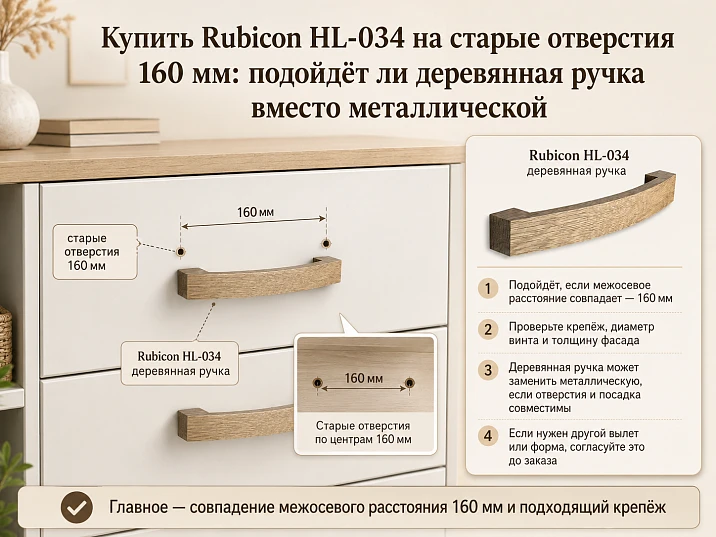
The old metal handle has been removed, leaving two holes on the facade, and the ruler shows 160 mm between them. The buyer is already ready to purchase Rubicon HL-034 and install a wooden pull in the same spot. The model does indeed have a center-to-center distance of 160 mm, so it can be considered for such a replacement. But the word 'can' here only means the beginning of a check, not guaranteed compatibility with any furniture.
To buy Rubicon HL-034 instead of the previous metal bracket without re-drilling the facade, five conditions need to be confirmed. The centers of the old holes must be exactly 160 mm apart. The total length of the new handle, 183 mm, must fit the facade. The wooden supports must cover the marks left by the old hardware. The included screws must match the thickness of the door or drawer. After installation, the handle, 24 mm high, must not hit the wall, adjacent door, countertop, or another facade.
All five points matched — the replacement has good prospects of proceeding without new holes. Only the center distance matched — it's too early to order a set for the entire kitchen. One old handle might have narrow round legs, another wide metal plates, a third a long decorative strip hiding scuffs and chips. Rubicon will attach at the same points but is not obligated to cover the previous mark.
The model has another feature important for the estimate: HL-034 is supplied without a ready decorative coating. The buyer chooses beech or oak, receives a "Prestige" sanding and a mounting kit, and plans the color and protective finish separately. Therefore, the cost of furniture renovation consists not only of the number of handles. The calculation includes the chosen wood species, trial finishing, main materials, possible screw replacement, and delivery.
This article does not retell the general furniture hardware catalog and does not attempt to determine which handle each cabinet needs. The task is specific: to understand whether Rubicon HL-034 will fit existing 160 mm holes and what to check before placing an order.
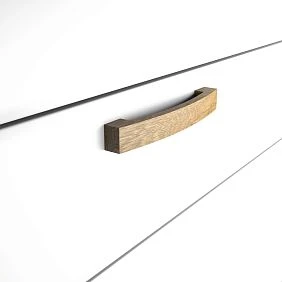
Quick answer: when Rubicon HL-034 can be installed without re-drilling
Preliminarily, the handle is suitable for replacement if the following conditions are met simultaneously:
| Check | What must match | Why one value is not enough |
|---|---|---|
| Center-to-center distance | 160 mm from the center of the first hole to the center of the second | The total length of the old handle does not determine the screw placement |
| Facade condition | No cracks, large chips, or damaged holes | A new handle will not restore a weakened base |
| Covering traces | Rubicon supports cover scuffs and marks from old hardware | Matching screws does not guarantee matching base areas |
| Facade thickness | Included screws provide proper fit | A screw that is too short won't catch the threads, too long won't tighten the handle |
| Free space | Dimensions 183 × 27 × 24 mm do not interfere with furniture movement | The new shape may protrude differently than a metal bracket |
| Quantity | All doors and drawers have been counted | One trial handle and a full set solve different tasks |
| Finishing | Color and protective system have been selected | Unpainted wood cannot be considered ready for everyday use without an agreed finish |
If the first row does not match, Rubicon HL-034 will not be a direct replacement for the previous holes. If any other row does not match, installation may still be possible, but will require facade repair, different screws, finish changes, or choosing a different model.




Green, yellow, and red scenarios
For a quick preliminary assessment, it is convenient to divide situations into three groups.
Green scenario: old holes are exactly 160 mm, no damage around them, the previous handle was mounted on small supports, the Rubicon cardboard template covers the marks, and the screws fit the facade thickness. You can proceed to order a sample or a calculated set.
Yellow scenario: centers align, but doubt remains about overlap of traces, screw length, or free play of the door. First, a template, a photo of the inner side of the facade, and a trial installation of one handle are needed.
Red scenario: distance measured from edges of holes, old holes are loose, metal plate left a wide damaged outline, or the door almost touches the wall when opening. Buying a full set without additional preparation is not recommended.
Our factory also produces:


What exactly does the size Rubicon HL-034 mean
The card specifies the line 183 × 27 × 24 × 160 mm. Four numbers describe different parameters. They cannot be added, rearranged, or read as one overall size.
| Parameter | Value | What the buyer checks |
|---|---|---|
| Overall length | 183 мм | Does the handle fit on the facade and cover the previous trace |
| Width | 27 мм | Does the model look too massive and does it conflict with the facade frame |
| Height above the facade | 24 мм | Is the grip sufficient and is there no collision with the wall or adjacent furniture |
| Center-to-center distance | 160 мм | Will the mounting points match the existing holes |
| Material | Beech or oak | How the handle will be painted or tinted |
| Sanding | «Prestige» | What is the degree of preliminary surface preparation |
| Finish | Without ready-made coating | The finish needs to be included in the order and work schedule |
| Mounting | The kit is included in the price | The screw length is still checked against the specific facade |
| Purchase | Cart or one-click checkout | Before payment, the material and exact quantity are selected |
| Receiving | Contact us to confirm shipping to your destination. | Cost and terms are checked during checkout |
The main practical point of the table is simple: 160 mm is not the handle length. Rubicon is 23 mm longer than the center-to-center distance. If the mounting points are symmetrically positioned relative to the overall shape, part of the body remains beyond the outermost centers. It is this extra length that determines whether the new handle will cover the mark left by the old one.
Get Consultation
Why 183 mm matters no less than 160 mm
Suppose the previous metal bracket had a center-to-center distance of 160 mm, but its total length was 210 mm. After removal, a wear mark about 200 mm long remained on the facade. Rubicon will fit into the old holes, but its 183 mm body may not cover the edges of the mark.
The reverse situation is also possible. The old handle had a total length of 170 mm, while the Rubicon is 183 mm. The new model will cover the previous outline in length, but the width and shape of the supports need to be checked. A narrow wooden contact will not hide a wide round imprint just because the entire handle is longer.
Width 27 mm and decorative frames of the facade
On a smooth surface, the width of 27 mm is mostly assessed visually. On a framed facade, it becomes a mounting constraint. The handle must not extend onto the frame profile, hit the bevel, or rest partially on the flat surface and partially on the relief.
If the old metal bracket was placed in a narrow central panel, make a template 27 mm wide and apply it to the installation spot. Do not rely only on the distance between screws: the Rubicon body occupies its own area.
Height 24 mm and opening trajectory
The height shows how much the handle protrudes above the front surface. For the user, this is the space for gripping. For the furniture, it is an additional dimension that moves together with the door or drawer.
Pay special attention to checking:
-
outer kitchen doors near the wall;
-
facades next to a tall refrigerator;
-
swing wardrobe in a narrow niche;
-
corner sections;
-
drawers passing next to adjacent handles;
-
doors under the protruding countertop;
-
furniture near the door trim;
-
dressers in a narrow passage.
The old metal bracket could protrude 18 mm, while the new wooden one — 24 mm. The difference of just 6 mm seems small until the door starts hitting the plastered wall or the adjacent front.
You need to measure centers, not edges, and not the body of the old handle
The most common mistake when replacing hardware occurs even before choosing a model. The buyer applies a tape measure to the old handle, sees about 160 mm on the outer edge, and looks for a “160 mm handle.” But for brackets, the center-to-center distance is used — the distance between the centers of the mounting holes.
The scheme looks like this:
center of the first hole → 160 mm → center of the second hole.
Not like this:
-
left edge of the first hole → right edge of the second;
-
outer edge of one support → outer edge of the other;
-
total length of the metal bracket;
-
distance between the inner sides of the legs;
-
distance between screw heads by eye.
Method 1. Measuring along the inner side of the facade
This is the most convenient option if the screw heads are visible inside the door or drawer.
-
Open the facade.
-
Find the centers of the two mounting screws.
-
Place a ruler through their midpoints.
-
Measure the center-to-center distance.
-
Repeat the measurement at least twice.
-
Check the second handle on the same piece of furniture.
If it comes out to exactly 160 mm, the first criterion is met.
Method 2. Measurement after disassembly
Remove the old handle and work with the holes on the front or inner side. If the edges of the holes are even and their diameter is the same, determining the center is not difficult.
For a hole with a diameter of 5 mm, the distance from one outer edge to the other is not equal to the center-to-center distance. If you measure from the left edge of the first hole to the left edge of the second, with the same diameter, you can get a value close to the centers. But you should not rely on this: the holes may be broken, enlarged, or drilled at an angle.
It is more reliable to mark the middle of each hole and measure between the marks.
Method 3. Measurement with a caliper
A caliper is useful when precision is required and the holes have clear edges. You can measure the distance between the same-named edges of holes of the same diameter, and then double-check the centers.
This method is especially useful for a series of kitchen fronts, where an error of 1–2 mm will be repeated on dozens of handles.
Method 4. Paper strip with two marks
If the metal handle is still installed, but access to the screws is inconvenient:
-
Remove one handle.
-
Press thick paper against the inner side.
-
Mark the centers of the holes.
-
Check the distance with a ruler.
-
Keep the strip as a reference template.
On the template, you can immediately mark the total length of Rubicon 183 mm and width 27 mm.
Why you need to check several fronts
On mass-produced furniture, holes may repeat, but repairs, door replacements, and manual drilling can introduce differences. On a kitchen with twelve fronts, one drawer may have a different center-to-center distance. An order based on a single measured door will result in an extra handle or the need to re-drill a separate element.
Create a report:
| Facade | Old center distance | Hole condition | Base trace | Rubicon is preliminarily suitable |
|---|---|---|---|---|
| Door 1 | 160 мм | Even | Narrow | Yes |
| Door 2 | 160 мм | Even | Narrow | Yes |
| Box 1 | 128 мм | Even | Narrow | No |
| Box 2 | 160 мм | One hole broken | Wide | After renovation |
| Pencil case | 160 мм | Even | Long plank | Check with template |
After such a check, the quantity ceases to be approximate.
Why a 160 mm match does not guarantee a replacement without traces
Two handles can have identical mounting points and completely different bases. A metal model often rests on the facade with round washers, square heels, or a long decorative plate. The wooden Rubicon has its own contact shape. The matching screws only indicate that the mounting axes can meet the holes.
It does not answer the questions:
-
will the new handle cover the old dent;
-
will the faded area remain visible;
-
will the wood cover the scratch from the metal leg;
-
will the base stand on a flat surface;
-
will the edge of the old mark end up next to the new support;
-
will the holes turn out to be too wide;
-
whether the thin facade is deformed.
Marks from narrow round supports
This is the most favorable situation. If the previous bracket touched the facade with small round pads and there are no deep damages around, Rubicon can cover most of the marks.
But first check the contact zones with a template. You cannot assume that any wooden support is wider than a metal one.
Wide rosettes or square heels
A metal handle could have bases with a diameter of 25–35 mm or square pads. After removal, the following remain:
-
matte circles;
-
indented contours;
-
scratches;
-
shade difference;
-
traces of varnish;
-
dirt along the edge.
The overall width of Rubicon 27 mm does not mean that each bracket covers a circle of 27 mm in diameter. You need to look at the shape and drawing of the specific model, and then make a template of the mounting zones.
Long backing plate under the old handle
Some metal brackets are installed on a decorative strip significantly longer than 183 mm. After its removal, an area is exposed that has not faded or gotten dirty along with the rest of the facade. The new handle may cover the holes, but not the entire color difference.
Possible solutions:
-
local facade restoration;
-
full painting of the door;
-
decorative backing plate per separate project;
-
selection of a handle with a larger coverage area;
-
refusal to replace without repair.
Soft facades and pressed-in areas
On some surfaces, the metal support leaves a dent over time. The wooden handle may sit on it not with its full plane, but with its edges. This creates misalignment and unstable tightening.
First, the surface is restored or the possibility of even seating is assessed. Tightening the screw harder to "pull" the wood to the unevenness is dangerous: it can damage the facade or the handle.
Chips around holes
A small chip may be hidden under the base. But if the facade material is damaged, the screw does not get reliable support. This is especially important for chipboard and MDF, where the hole may have widened from repeated tightening of the metal handle.
First, the repair issue is addressed. New hardware should not be used as a patch for a weakened fastening.
Cardboard template Rubicon: check before paying for the set
A product photo shows the shape, but does not overlay it on your facade. The most useful home test is a full-size template.
You will need:
-
thick paper or cardboard;
-
ruler;
-
pencil;
-
awl or thin punch;
-
Painter's tape.
How to make a template
-
Draw a rectangle 183 × 27 mm.
-
Draw the longitudinal axis.
-
Mark two mounting centers at a distance of 160 mm.
-
Position them symmetrically relative to the total length.
-
Punch through the marks.
-
Cut out a rectangle.
-
Align the punches with the old holes.
-
Secure the template with painter's tape.
-
Evaluate the front from the front and side.
The rectangle shows the outer dimension, not the exact contoured shape of the handle. For assessing overlap of traces, it is better to use a printed drawing or an accurate tracing, if available.
What is visible using the template
-
does the length of 183 mm fit;
-
does the body not overlap the frame;
-
is the old scuff mark covered;
-
does the handle not look too large;
-
does it not intersect with the decorative molding;
-
is there enough distance to the edge;
-
are the handles positioned identically across the row of facades;
-
does the horizontal installation not conflict with the drawer lines;
-
can the model be placed vertically on a tall cabinet.
Layout height 24 mm
Flat cardboard does not show the protrusion. To check the opening trajectory, make a simple 3D model:
-
fold the cardboard to a thickness of about 24 mm;
-
secure it in the area of the future handle;
-
slowly open the door;
-
check the wall, adjacent facade, and countertop;
-
pull out adjacent drawers.
Such a mockup will not convey grip comfort, but it will show dangerous collisions.
The mounting kit is included, but the screws still need to be checked.
Having a mounting kit is convenient: the buyer does not have to search for screws from scratch. However, the kit cannot automatically account for the thickness of any facade.
On furniture, you may encounter:
-
thin doors;
-
standard panel fronts;
-
framed fronts with thickening in the mounting area;
-
fronts with overlay;
-
double walls;
-
drawers where the screw passes through the front and inner panel;
-
restored parts with washers or inserts.
What to measure
The full screw path is measured from the inner surface to the threaded connection of the handle. For a regular door, this is the thickness of the front. For a drawer, an additional wall may need to be considered.
Write down:
-
material thickness;
-
presence of an inner overlay;
-
screw head seating depth;
-
washer, if provided;
-
required depth of engagement into the handle mounting.
Do not choose screw length based on general advice. Match the set to the specific furniture.
Signs of a screw that is too short
-
thread does not reach the handle;
-
screw engages only a few threads;
-
handle pulls away from the front;
-
connection loosens quickly;
-
no firm contact when tightening.
Signs of a screw that is too long
-
the screw bottoms out before the handle is pressed;
-
a gap remains between the support and the facade;
-
the handle moves;
-
the head does not sit inside;
-
there is a desire to add random washers just for the length.
The correct solution is to choose suitable fasteners of the same type and compatible thread, rather than compensate for the mistake with excessive tightening.
First fitting, then finishing and final installation
Rubicon HL-034 is supplied without a ready-made coating. This gives freedom of color choice, but requires the correct sequence.
Undesirable route:
-
Paint the entire set.
-
Remove the old handles.
-
Detect wide marks.
-
Start fitting the screws.
-
Damage the coating during adjustment.
Safer route:
-
Measure all facades.
-
Check the template.
-
Order one handle or a calculated set.
-
Perform a dry fit.
-
Check the screws.
-
Remove the handles.
-
Do a test finish.
-
Process the entire batch.
-
Let the coating reach the specified strength.
-
Perform the final installation.
Why can't you paint the handle without checking the old holes?
If one hole is misaligned, during fitting you will have to adjust the facade or refuse the replacement. Any work with a tool near an already painted wooden handle creates a risk of chipping and scratching.
Why it's better to finish the entire batch at once
Handles from the same kitchen or dresser are perceived together. Differences in shade, gloss, and coating thickness will be more noticeable than on individual items.
Simultaneous processing helps to align:
-
one composition;
-
one preparation;
-
the same number of layers;
-
application direction;
-
drying time;
-
degree of matteness;
-
color result.
Beech or oak: the choice depends on what remains visible
Rubicon HL-034 can be ordered in beech or oak. Both options retain the same size and center distance, but the finish reveals them differently.
Beech for opaque color
Beech is reasonably considered when handles will be painted with opaque enamel in the color of the facade or in a contrasting shade. Under a dense coating, the natural pattern ceases to be the main visual argument.
This scenario is suitable if the buyer wants:
-
white handles on a colored kitchen;
-
handles matching the cabinet color;
-
black wooden hardware;
-
a calm solid-color set;
-
repeating the color of the baseboard or doors;
-
replace metal, but without introducing a noticeable texture.
You cannot promise that beech will always be cheaper: the current price must be checked in the selected card. The commercial meaning of beech here is primarily related to the finish.
Oak for visible texture
Oak is chosen when a transparent or semi-transparent finish is planned and the wood grain should remain visible.
It is better to order handles in one batch. Natural material does not have to repeat like a printed pattern, but simultaneous processing simplifies matching similar elements and creating a common shade.
Oak is appropriate if:
-
facades match the oak countertop;
-
there is an oak baseboard in the room;
-
handles should support the wooden furniture legs;
-
a warm natural accent is required;
-
oil, varnish, or tinting system is planned;
-
the buyer accepts natural texture differences.
A test sample is needed in both cases
White enamel, dark paint, clear oil, or stain can change the perception of the shape. On a small sample, check:
-
shade;
-
shine;
-
preservation of edges;
-
grip convenience;
-
coating resistance to touch;
-
combination with the facade;
-
behavior of the composition on the ends.
Before serial finishing, it is better to treat one handle or a test area using the same method that will be used for the entire set.
An unpainted handle is an opportunity to choose a finish, not readiness for immediate installation.
The word "unpainted" is sometimes perceived as "natural, so it can be left as is." For fitting — yes. For permanent use on a kitchen, dresser, or cabinet, it is better to decide on the finish in advance.
A furniture handle is touched by hand daily. The surface is exposed to:
-
natural skin moisture;
-
household dust;
-
traces of cosmetics;
-
kitchen dirt;
-
water drops;
-
cleaning agents;
-
friction of rings and nails.
The coating is chosen considering the room, frequency of use, and desired appearance. A specific system cannot be prescribed without its manufacturer's technical requirements, but the buyer needs to plan preparation and protection as a separate stage.
Paint to match the facade color
Rubicon can be turned into an extension of the door. This technique suits light, colored, and dark facades.
The advantage is not that the handle disappears. The wooden shape remains visible through:
-
volume;
-
shadow;
-
24 mm protrusion;
-
smooth line of the bracket;
-
tactile difference from the facade.
Before painting, compare the material of the handle and the base. The same enamel can look different on wood and on previously painted MDF if the preparation and primer differ. Therefore, the test sample is evaluated directly on the facade.
Make it contrasting
A black, graphite, dark green, or other contrasting handle changes the rhythm of the furniture more than metal hardware of the same color. Wood softens the visual coldness, and the wide plane of Rubicon creates a noticeable line.
Contrast requires careful layout. In a kitchen with twenty facades, each handle becomes a repeating graphic sign. If one is installed higher or turned differently, the error is immediately noticeable.
Preserve the natural shade
A transparent finish highlights the material. In this case, the differences between beech and oak become part of the design. Before ordering the entire series, you need to decide:
-
whether the pattern should be calm or pronounced;
-
how much the handles should match the countertop;
-
whether they will be lighter or darker than the facade;
-
Is tinting required?
-
How noticeable is the natural variability.
Tint to match existing wood
Attempting to exactly match the shade of old furniture is harder than choosing a new contrast. The color is affected by the wood species, the age of the facade, old varnish, lighting, and the finishing compound sample.
The check is done not by the name "natural oak" or "walnut," but by an actual color swatch next to the furniture.
Where to purchase finishing materials and what to include in the estimate
Once the finishing method is chosen, you can buy materials for wood finishing, but the cart is formed according to the technology of the specific compound. The category helps gather the needed items, but the buyer should not mix materials only by color or marketing name.
The estimate may include:
-
material for a test sample;
-
main finishing compound;
-
brush or other recommended tool;
-
preparation agents;
-
consumables for interlayer treatment;
-
materials for facade protection;
-
additional screws of suitable length;
-
packaging for the drying batch.
Why finishing is calculated for the entire set
One handle and twenty handles require different volumes, but consumption cannot be determined by simply multiplying the area. Some material remains on the tool, some goes to testing, and a complex shape requires processing from all sides.
For budgeting, the formula is useful:
trial finish
-
preparation of the entire batch
-
main material
-
consumables
-
Labor
= cost of finish.**
An unpainted handle may cost less than the finished version, but the buyer pays with time and finishing work. This is not a drawback, but a freedom of personalization that must be considered honestly.
Kitchen: you need to check not only the doors, but also the entire opening scenario
Replacing handles in the kitchen seems like a simple serial task: count the facades, order identical brackets, rearrange them. In practice, the kitchen contains several types of opening.
The outermost door near the wall
It can open almost to the wall. The old metal handle was thinner or positioned closer to the plane. Rubicon protrudes 24 mm, so the mockup is checked at the full opening angle.
If the handle touches the wall, the options are:
-
limit the opening angle with a standard solution;
-
protect the wall;
-
choose different hardware;
-
change the placement if the facade is not yet drilled;
-
refuse direct replacement on this door.
One different handle in a row can look random. The solution is evaluated for the entire kitchen.
Corner section
Two doors or adjacent drawers can pass next to each other. Handles should not collide when opened simultaneously.
The check is performed not only in the closed position:
-
Open the first door.
-
Pull out the adjacent drawer.
-
Check the intersection of trajectories.
-
Repeat in reverse order.
-
Take into account the volume of fingers when gripping.
Drawer under the countertop
The handle height can bring it closer to the overhang of the countertop. The user should be able to freely insert their fingers without touching the bottom edge.
A 24 mm thick template shows the dimensions, but to assess comfort, it is useful to order one Rubicon and try the grip.
Dishwasher and built-in appliances
Appliance fronts may have a different thickness, internal fasteners, and load mode. You cannot automatically use the same screw as on the adjacent door. First, check the front construction and the feasibility of installation.
Vertically or horizontally
Existing holes already determine the orientation. If the old bracket was vertical with 160 mm centers, Rubicon can be considered in the same position. Moving to horizontal will require new holes and repair of the previous ones.
For a kitchen with a combined layout, the rules are fixed:
-
on doors — vertically;
-
on drawers — horizontally;
-
on narrow fronts — according to a separate scheme;
-
On the equipment — after checking the design.
Cabinet: 160 mm may match, but the new handle will still turn out to be uncomfortable
Tall hinged doors give Rubicon enough space in length. The main risks are related to the position and adjacent doors.
Two-door wardrobe
If each door has one metal bracket, usually two Rubicons are required. But before ordering, check the distance from the handle to the central joint.
Too close placement creates two problems:
-
wooden handles may almost touch;
-
there is not enough space for fingers between them.
The 27 mm width and body shape differ from the old metal. Even with the previous holes, the gap will change.
Four-door cabinet
Four identical handles create a rhythm. Here especially important are:
-
one height;
-
same orientation;
-
same shade;
-
coincidence of traces of old bases;
-
no differences in holes.
Measure all four facades, not just one. If the central and side doors have different widths, the handles may still be at the same distance from the edge, but this needs to be confirmed.
Cabinet against the wall
The outermost panel repeats the kitchen issue: the 24 mm protrusion may touch the wall, trim, or curtain.
Heavy door
Ease of grip is more important than visual matching. Rubicon has a bracket shape, but the effort on a specific solid door is best assessed on a sample. The handle should not feel too thin or uncomfortable for the user.
Dresser and nightstand: old metal traces are especially noticeable on horizontal facades
On the dresser, the handles are close to the line of sight and are often lit from above. Wear around the previous bases may be more noticeable than on lower kitchen cabinet doors.
Chest of drawers with four drawers
Preliminary quantity — 4 pcs. But options are possible:
-
one handle centered on each drawer;
-
two pulls on wide fronts;
-
different handles on the top narrow and bottom wide drawers.
You need to count the existing mounting points. If each wide drawer already has two metal handles of 160 mm, the dresser will require not four, but eight Rubicon handles.
Nightstand with a door and a drawer
One piece of furniture can have two different patterns. The door has 160 mm holes, the drawer has a knob handle. Ordering two identical Rubicon handles just for symmetry is not possible without re-drilling the drawer.
Old lacquered furniture
Under the metal supports, the lacquer may have retained its original shade, while the exposed surface has darkened. After removal, light spots will appear. A new handle will cover them only if the contact area matches.
In such a situation, first decide whether:
-
local restoration;
-
painting the entire facade;
-
preserving traces as an acceptable result;
-
installing a decorative backing;
-
choosing a different model.
New furniture: why check replacement if holes are not yet drilled
For new furniture, the scenario is simpler: Rubicon does not have to adapt to old traces. But the 160 mm center distance still needs to be included in the drawing before manufacturing the facades.
Advantage of new marking
You can choose:
-
installation height;
-
indent from the edge;
-
horizontal or vertical orientation;
-
position relative to the frame;
-
a single line on all drawers;
-
gap between paired handles.
Why buy or approve a sample first
The drawing specifies 183 × 27 × 24 × 160 mm, but does not show the tactile feel and real scale on the facade. One trial handle helps the cabinetmaker prepare the drilling template and agree on the position.
Template for series drilling
Once the model is approved, a precise jig is made. It reduces the risk of misalignment on multiple doors. Even a 1 mm error is noticeable in a long row of kitchen drawers.
How many Rubicon HL-034 to order
The quantity is determined not by the name of the furniture, but by the number of opening facades where this particular model is specified.
| Furniture | Preliminary principle | What can change the quantity | ||||||||||||||||||||||||||||||||
|---|---|---|---|---|---|---|---|---|---|---|---|---|---|---|---|---|---|---|---|---|---|---|---|---|---|---|---|---|---|---|---|---|---|---|
| Two-door wardrobe | 2 handles | One common door, different opening scheme | ||||||||||||||||||||||||||||||||
| Chest of drawers with four drawers | 4 handles | Two handles on a wide drawer | ||||||||||||||||||||||||||||||||
| Cabinet: door and drawer | 2 handles | Different center distance on the drawer | ||||||||||||||||||||||||||||||||
| Kitchen | By the number of matching fronts | Different distances, appliances, knob handles | ||||||||||||||||||||||||||||||||
| Cabinet with four doors | 4 handles | Paired handles or separate long fronts | ||||||||||||||||||||||||||||||||
| Wardrobe | According to the list of doors and drawers |
Different zonesWhat to buy together with Rubicon HL-034Replacing hardware rarely ends with just one pack of handles. You need to consider trim, suitable screws, and possible updating of adjacent wooden parts.
The table does not mean that all items are needed by every customer. It helps to avoid discovering after delivery that the handles are there, but the trim and matching screws are not provided. Room update: handles, furniture, and wooden trimReplacing metal hardware with wooden ones often becomes part of a general room update. In one project, you can select handles, furniture decor, and buy wooden skirting board under the same tint or opaque enamel. This approach is especially appropriate when:
It is not necessary to literally paint all elements with one compound without checking. Different parts have different working conditions. But a common sample of color and gloss level helps avoid accidental inconsistency. Rubicon HL-034 and similar solutions: what exactly not to confuseCenter-to-center distance and overall lengthA handle with an overall length of 160 mm is not equal to a model with a center-to-center distance of 160 mm. For Rubicon, the overall length is 183 mm. HL-034 and the ready painted handleHL-034 is considered an unpainted model. The buyer independently plans the finish. Do not expect that the box will contain a handle of the color shown in the interior or on the visualization. Bracket handle and profile handleThe bracket is attached at two points and protrudes above the facade. The profile model may have a different geometry and method of interaction with the edge. Matching length does not make them interchangeable. Wooden and metal handleMetal can have thin legs and a small body thickness. Wood requires a different cross-section shape. Therefore, a new handle with the same holes changes:
Two wooden models with 160 mm centersEven the same center distance does not mean the same length, width, supports, and overlap of traces. For a complex replacement, you need to compare drawings, not just the "160 mm" filter. When it is better to open the general catalog rather than adjust RubiconIf the holes are not equal to 160 mm, the new model is not a direct replacement. You can buy furniture handles after selecting a different center distance and size. The general catalog is needed if:
You should not drill new holes just for the sake of a chosen design without assessing the repair of the previous ones. Sometimes a different model provides a neater replacement without interfering with the facade. Practical scenarios: which solution to chooseScenario 1. Metal bracket on a smooth kitchen facadeGiven:
Actions:
The probability of direct replacement is high. Scenario 2. Handle on a wide metal plateGiven:
Rubicon will not cover the entire area. Repair or another model is needed. Ordering the full set without restoration will lead to visible rectangles around the handles. Scenario 3. Dresser with loose holesThe center distance matches, but one metal handle was wobbly, the hole is enlarged. First, the facade is reinforced professionally. Installing a new handle into a damaged hole does not solve the problem. Scenario 4. Cabinet next to a side wallThe centers align, no marks. But the door opens to the wall, and the old bracket protruded less. A 24 mm 3D model shows contact. Need to change the opening limit or choose a lower-profile model. Scenario 5. Oak dresser and desire to preserve the textureOak is selected. Handles are ordered in one batch, a test finish is done, then the entire series is processed simultaneously. Scenario 6. White kitchen and handles matching the facade colorBeech can be considered for opaque finishing. A test sample is needed so that the wood and facade look consistent in shade and gloss. Scenario 7. In the kitchen, 160 and 128 mm are mixedRubicon fits only part of the facades. Possible solutions:
The decision is made based on visualization and repair cost, not on the desire to use one model at any cost. Installation without re-drilling: a reasonable sequenceThe article does not replace the manufacturer's instructions or the work of a furniture maker, but the checking order helps avoid damage. Before removing all hardware
After removing the test handle
During dry fitting of Rubicon
After final finishing
Mistakes that prevent replacing with 160 mmError 1. Measure the total length of the old handleThe customer takes 160 mm along the body as the center-to-center distance. The holes do not match. Error 2. Measure from edge to edge of the holesThe diameter and damage to the edges distort the result. Centers are needed. Error 3. Check only one doorSome furniture may have other holes. Error 4. Look only at the number 160The length of 183 mm, width of 27 mm, and height of 24 mm are ignored. Error 5. Do not remove the old handle before orderingHidden damage remains under the base. Error 6. Assuming that a new handle will necessarily cover the markThe shape of the supports differs between metal and wood. Error 7. Not accounting for the long decorative trimAfter dismantling, a noticeable area of a different color remains. Error 8. Tightening the handle over a dentThe supports fit unevenly, damaging the facade more. Error 9. Installing new hardware into damaged holesThe connection remains weak. Error 10. Painting the handles before fittingIf screws do not match or are replaced, the coating gets damaged. Error 11. Considering "Prestige" a ready-made protective finishThis is the quality of sanding, not painting. Error 12. Using unpainted wood in the kitchen without a protection solutionThe surface gets dirt and moisture from hands. Error 13. Choosing oak and covering it with dense paint without calculationThe buyer pays for the material but does not use the visible texture. Error 14. Choosing beech for a transparent finish, expecting an oak patternThe wood species look different. Error 15. Ordering handles at different times for the same furnitureIt is harder to get a consistent batch and identical finish. Error 16. Not making a test stainThe color on wood differs from the sample on paper or screen. Error 17. Not checking the length of included screwsThe set fits, but the thickness of the facades varies. Error 18. Compensating a long screw with a random set of washersThe connection looks and works unpredictably. Error 19. Using an incompatible screwYou can damage the threaded part of the handle. Error 20. Not checking the outermost facade near the wallThe handle hits when opening. Error 21. Do not open the adjacent drawer during the testTwo handles collide. Error 22. Install on the frame bevelThe support does not fit with its entire surface. Error 23. Place the body flush against the decorative frameVisually and technically, the handle lacks space. Error 24. Count the doors but forget the drawersThe set is incomplete. Error 25. Order handles for all facades, although some have 128 mmExtra items appear. Error 26. Add a large margin instead of a bill of materialsThe margin does not fix different hole sizes. Error 27. Leave old dirt under the new supportAfter installation, a contour is visible around the tree. Error 28. Tighten screws too much into the wooden handleThe facade or mounting assembly can be deformed. Error 29. Not considering the direction of texture and finishHandles in one row look different. Error 30. Paint each handle separately without a control sampleThe batch differs in color and gloss. Error 31. Calculate the cost only based on the price of one handleFinishing, screws, repairs, and delivery are forgotten. Error 32. Choose the finish only by appearanceDaily hand contact is not taken into account. Error 33. Use an aggressive cleaner for the facadeThe old coating can be damaged before fitting. Error 34. Not keeping the old handles until the work is completedIf a problem occurs, the furniture remains without working hardware. Error 35. Confuse HL-034 with another version of the modelThe buyer receives a different finish or configuration than planned. Error 36. Not checking the material in the cartOak was replaced with beech or vice versa. Error 37. Not checking the quantity before paymentOnly one test pen remains in the cart instead of the entire batch. Error 38. Expecting an absolute match of the natural patternWood has natural variability. Error 39. Installing before the finish is fully completedThe coating is damaged by tools and touch. Error 40. Choosing Rubicon just because it looked good in a photoCompatibility is determined by measurements and the facade. Who is Rubicon HL-034 suitable for replacingThe model is worth considering if:
When it is better to choose a different handle or first repair the furnitureRubicon is not a direct solution if:
How to place an order on STAVROSOpen the exact product cardThe name must contain Rubicon HL-034 without accidental substitution with another model. Check sizeIn the card, check the line 183 × 27 × 24 × 160 mm. The last value is the center distance. Choose beech or oakThe solution is related to the future finish and the remaining wooden parts. Check sanding and workmanshipThe model has "Prestige" quality and is supplied without a ready-made coating. This needs to be communicated to the finisher. Enter quantityThe quantity corresponds to the list, not the number of furniture items. Check the fastenersThe set is included in the price, but before installation the length is matched with the facade. Add materialsIf finishing is done independently, a full set is prepared in advance. Choose order and delivery methodThe card includes a cart and one-click purchase, and the order can be delivered across Russia. Current terms are checked before payment. Save specificationUseful to note: Rubicon HL-034 — 183 × 27 × 24 × 160 mm — beech or oak — «Prestige» — without ready coating — quantity. FAQ: questions before replacing a metal handle with Rubicon HL-034Will Rubicon fit if the distance between the screws of the old handle is 160 mm?Preliminarily yes. But additionally, you need to check the total length, base marks, hole condition, facade thickness, and free movement of the door. Is 160 mm the length of Rubicon?No. The total length is 183 mm, and 160 mm is the distance between the centers of the mounting holes. How to correctly measure the center-to-center distance?Measure from the center of the first hole to the center of the second. Do not use the external length of the old bracket. Can it be measured by the screw heads inside?Yes, if their centers are clearly visible and the screws are not tilted. It is better to recheck the result after removing one handle. What to do if the result is 159 or 161 mm?First, check the accuracy of the measurement and the condition of the holes. You cannot forcibly pull the wooden handle to mismatched holes. Will Rubicon cover the traces of the old metal handle?Not always. This depends on the overall length and shape of the supports of the previous hardware. Use a full-size template. The overall length of the old handle was more than 183 mm. Is that a problem?It can be a problem if a long mark or a zone of a different color remains. The fasteners will match, but the edges of the previous outline will remain visible. What to do about scuffs around the holes?Assess whether they are covered by the new handle. If not, restoration of the coating or a different model will be required. Can Rubicon be installed on a chipped facade?Only after assessment and repair of the base. The handle does not replace restoration of a damaged hole. Will the handle fit a frame facade?It will fit if both supports are on the same flat plane and the body does not overlap a bevel or profile. Can Rubicon be installed vertically?Vertical installation can be considered if existing holes are positioned vertically at 160 mm apart and there is enough space for the 183 mm length. Can the old horizontal layout be turned vertically without repair?No. Changing orientation will require new holes, and the old ones will need to be covered. How far does the handle protrude from the facade?The confirmed height is 24 mm. This dimension is checked against the wall and adjacent doors. Will Rubicon fit an end kitchen door?Only after checking full opening. The protruding handle may touch the wall. Will adjacent handles collide?This depends on the placement of the fronts. Open adjacent doors and drawers with a 3D mockup. Is the mounting included in the price?Yes, the mounting kit is included in the package. However, the screw length needs to be checked against the thickness of the front. What to do if the screws are too short?Select compatible screws of appropriate length and thread. Do not install a connection with insufficient thread engagement. What to do if the screws are too long?Use fasteners of the correct length. The handle should press against the front without gaps or random compensators. How to measure the thickness of the drawer front?Consider the entire path of the screw. In some boxes, it passes not only through the decorative front but also through the inner wall. Can old screws be used?They can only be considered after checking the thread, length, condition, and compatibility with the new handle. Is the handle already painted?No. Rubicon HL-034 is supplied without a ready-made coating. What does "Prestige" sanding mean?This is the degree of surface preparation. It does not replace the selected protective and decorative finish. Can an unpainted handle be installed and used?For temporary fitting — yes. For permanent use, it is better to determine the protective finish in advance, taking into account the room. What to choose — beech or oak?Beech is often considered for opaque painting, oak — for visible texture. The decision depends on the project and finish. Is beech always cheaper?You should not rely on this without checking the product card. The current price depends on the selected material. Can I paint oak with opaque enamel?The technology needs to be coordinated with the finisher. But with a full opaque color, the visible advantage of oak texture is not utilized. Can beech be tinted?Possibility and result are checked with a test stain. Beech will not become visually identical to oak just because of a similar shade. Do I need to order all handles in one batch?Preferably, especially with a transparent finish. This makes it easier to match the wood and process the set at the same time. How many handles are needed for a two-door cabinet?Usually two, if each door leaf has one bracket. Count the actual installation points. How many should I order for a chest of drawers with four drawers?Four with one handle per drawer. If wide drawers have paired brackets, the number will be higher. How to calculate a kitchen?Make a list of all doors, drawers, and appliance fronts. Include Rubicon only where holes and conditions are compatible. Is a spare handle needed?For a large batch, a reserve may be useful as a sample or replacement. Its quantity is determined deliberately. Can I order one first?Yes. A sample is useful for checking fit, grip, screws, and finish. Will the batch differ from the sample?Natural wood has variability. With a transparent finish, it is better to order the main series in coordination and process them together. How to calculate the total cost?Multiply the current price of the selected material by the quantity and add finishing, possible screws, facade repair, delivery, and installation. Can the handles be replaced independently?Yes, if the holes and fasteners are compatible, the facade is not damaged, and the finishing technology is clear. Complex repairs are better left to a specialist. Do I need to remove all old handles at once?No. First, remove one on a test facade to assess hidden marks. How not to mix up handles during finishing?Number them and the facades, especially if the wood is distributed according to the pattern. What should be used to clean the area under the old handle?The method depends on the facade coating. First, use a gentle method and test it on an inconspicuous area. Can an old trace be covered with a decorative backing?The backing can be considered as a separate design solution, but it must match in size, material, and mounting. Is Rubicon suitable for children's furniture?The solution depends on the construction, finish, placement, and safety of the specific furniture. The protrusion and absence of collisions need to be checked. Is the handle suitable for a bathroom?The possibility depends on the protective finish and the room's conditions. Unpainted wood cannot be evaluated separately from the finish. Is it suitable for commercial furniture?It may be suitable after checking comfort, intensity of use, finish, and the ability to service the set. How to care for Rubicon after finishing?Follow the rules of the chosen coating. Do not use products that may soften, discolor, or scratch the finish. Where can I see other sizes and shapes?In the general catalog, you can choose handles with a different center distance, dimensions, and type. Where can I buy Rubicon with delivery?The exact product card is available on STAVROS. Before ordering, choose beech or oak, specify the quantity, and check the delivery conditions. Five values that solve the replacement issueRubicon HL-034 can indeed be considered instead of a metal handle for 160 mm holes. But the decision is not made based on a single number. Before ordering, write down:
Then add the condition of the holes, the shape of the old bases, beech or oak, future finishing, and the exact quantity. Only after this does the phrase "handle on old holes 160 mm" turn into a full specification. STAVROS offers Rubicon HL-034 as an unpainted wooden pull handle with confirmed center-to-center distance and a mounting kit. The buyer does not have to pick random hardware from a photo, but can match the drawing to existing furniture, choose the material, prepare a unified finish, and order a complete set. If the centers match, the traces are covered, the screws fit, and the handle moves freely with the facade, replacing a metal bracket with a wooden Rubicon goes without new holes and without random compromise in appearance. |