Article Contents:
- Round tabletop ST-030: which characteristics are actually confirmed by the product card
- Why you cannot buy a round tabletop based only on the 1148 mm diameter
- Which three dimensions to take from an already purchased underframe before ordering ST-030
- 1. Maximum size of the upper part of the base
- 2. Size of the actual support area
- 3. Full height of the base to the tabletop mounting plane
- Mistake: measuring only the maximum size of the underframe
- Mistake: considering 1148 mm as "approximately 1200" and not making a template
- Mistake: considering any oak ST-030 as solid wood
- Mistake: choosing the tabletop material separately from the base
- Error: drilling fasteners in place without a diagram
- Error: counting an item from the "related products" block as a ready-made compatible pair
- Error: forgetting about the height of the finished table
- What is the exact size of ST-030?
- Is ST-030 really round?
- What is ST-030 made of?
- Can it be called an oak tabletop?
- Is ST-030 suitable for a dining table?
- Can it be used for a coffee table?
- How to calculate the overhang of a round tabletop?
- If the support is 800 mm, what will be the overhang?
- Can you rely on the maximum width of the underframe legs?
- What should be measured on the underframe first?
- Will ST-030 fit STL-041?
- What to do if the underframe is from another manufacturer?
- How to check the 1148 mm size in a room without 3D visualization?
- Will exactly 24 mm be added to the height of the underframe?
- Can ST-030 be drilled wherever convenient?
- What to choose — oak or beech finish?
- When is it better not to buy ST-030?
- Where to see other round and wooden tabletops?
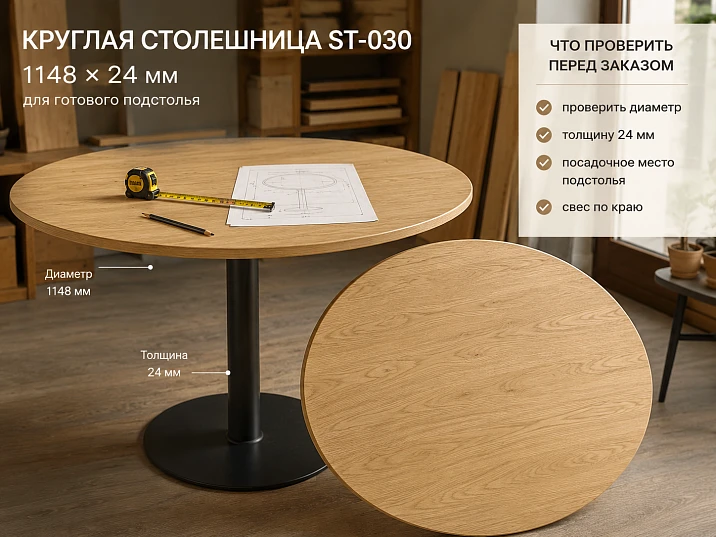
The underframe has already been purchased and is physically in the room or workshop. Now a round tabletop is needed, and ST-030 with dimensions of 1148×1148×24 mm has been selected from the catalog. At this stage, it is easy to make a typical mistake: see the round top of the base, compare it with the diameter of 1148 mm, and decide that compatibility is confirmed. Matching shape and approximate size is not enough.
Before ordering ST-030, you need to check at least four things: the actual top geometry of the underframe, the size of the support area, the location of mounting points, and the final height of the finished table. The overhang of the tabletop relative to the support and surrounding furniture is assessed separately. If these parameters are not checked, even a visually suitable round tabletop may turn out to be inconvenient for mounting, protrude excessively beyond the base, conflict with chairs, or give the wrong table height.
ST-030 has another feature that is important to consider before purchasing. It is not a solid round slab of oak or beech. According to the product card, the construction uses MDF, solid wood, and veneer: for the oak version — oak/MDF/oak veneer, for the beech version — beech/MDF/beech veneer. The contour part is made using solid wood, and the surfaces are veneered. Therefore, the material should be chosen not by the simplified formula "I want solid wood," but by the actual construction, finish, and combination with the already purchased base.
If the dimensions of the underframe have not yet been taken, the correct sequence is: first measurements and template, then calculation, then checking the mounting, and only after that ordering. The model itself can be viewed and buy ST-030 tabletop, when it is clear that its geometry fits your specific base.
Round tabletop ST-030: which characteristics are actually confirmed by the product card
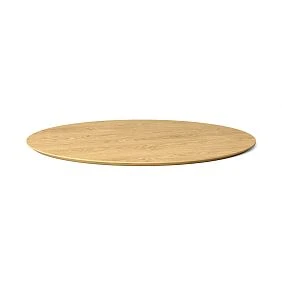
To check compatibility, it is useful to separate confirmed characteristics from assumptions. The ST-030 has a fixed size of 1148×1148×24 mm. Since the shape is round, the first two dimensions describe the outer dimensions in two mutually perpendicular directions, i.e., effectively a diameter of about 1148 mm. The thickness is 24 mm.
The product card indicates a beveled profile and modern styling. It also directly states its use in dining and coffee table constructions. This is more important than general marketing wording because it allows discussing two real scenarios: a high dining table and a low coffee table. They share the same tabletop, but the requirements for base height and proportions are completely different.
| Parameter | Confirmed value |
|---|---|
| Article number | ST-030 |
| Shape | Round |
| Size | 1148×1148×24 mm |
| Thickness | 24 мм |
| Profile | Beveled |
| Option 1 | Oak / MDF / oak veneer |
| Option 2 | Beech / MDF / beech veneer |
| Sanding quality | «Prestige» |
| Application | Dining and coffee tables |
In the article, this construction must not be replaced with the phrase "solid wood tabletop." Such simplification affects not only terminology. The buyer may expect a completely different structure of the underside, different mounting logic, and a different finishing method. For ordering, the actual modification specified in the product card is what matters.
One should also not invent an allowable load. If the manufacturer does not publish a specific limit for the chosen base and mounting scheme, the article should not turn the general tabletop size into a load-bearing capacity calculation. Compatibility is a separate engineering task involving the support area, the number of mounting points, the underframe construction, the position of the fasteners, and the actual condition of the bottom surface of ST-030.
For the buyer, the conclusion is simple: 1148 mm is only the outer size of the tabletop, not a ready answer to whether it fits the base.




Why a round tabletop cannot be bought based only on the diameter of 1148 mm
The diameter answers only one question: how much space the top of the table occupies in plan. It does not show what exactly the tabletop will rest on or whether the fasteners can be safely placed. Two different bases can have the same outer diameter but completely different top structures.
One base may have a wide ring as its top. Another may have a cross shape. A third may have four mounting plates. A fourth may have a central column with a small top platform. In each case, with the same 1148 mm tabletop, the geometric overhang will be calculated differently, and the fastening scheme may not depend on the widest outer size at all.
Therefore, before buy a round tabletop, you need to know not only the diameter of the model you like, but also the geometry of the place where it actually attaches. Measuring the lower legs or the maximum span of decorative details is not enough.
It is practically useful to divide the base dimensions into three groups:
-
Maximum outer dimension. Shows how much space the base takes up in the room.
-
Top dimension under the tabletop. Shows the geometry of the part of the frame directly under the surface.
-
Actual support zone. Shows the area or contour through which the load and fasteners are transferred to the base.
Sometimes all three sizes are close. Sometimes they differ by hundreds of millimeters. It is in the second case that buying "by diameter" most often leads to an error.
If the base is from another manufacturer, you will additionally need its drawing or at least a photo of the top part with dimensions. The seller's words "fits tabletops around 1200 mm" are useful as a preliminary reference, but do not replace a specific diagram.
Our factory also produces:
Which three sizes to take from an already purchased underframe before ordering ST-030
If the underframe is already at the site, most of the check can be done independently with a tape measure and a straight ruler. You don't need to start with a dozen sizes. First, three basic parameters are taken, which allow you to understand whether it makes sense to continue selecting ST-030.
Get Consultation
1. Maximum size of the upper part of the base
Measure not the lower legs or the decorative spread at the bottom, but the part that is located directly under the tabletop. For a round top part, record the outer diameter. For a square or rectangular one, record two sides. For a cross-shaped one, record the maximum spread along the axes.
This dimension is needed for a preliminary calculation of the visual overhang and to check whether the upper structure of the base will come too close to the edge of the tabletop.
2. Size of the actual support area
This is the most important dimension, but it is often skipped. The support area may be smaller than the maximum upper dimension. For example, a decorative apron visually has a diameter of 800 mm, but the tabletop actually rests on four pads forming a conditional circle with a diameter of 620 mm. In this case, calculating the overhang from 800 mm and calculating it from 620 mm are two different tasks.
If the support has a complex shape, it is useful not to try to reduce it to a single number. Take the distances between the extreme points of the support in several directions and mark them on a sketch.
3. Full height of the base to the plane of tabletop installation
Measure from the floor to the surface on which ST-030 will actually rest or to which it will be attached. If an additional mounting plate, gasket, or other component is provided between the base and the tabletop, its thickness is taken into account separately.
After this, you can preliminarily estimate the final table height. For a simple scheme without recessing the mounting assembly, the reference looks like this:
base height + 24 mm = approximate height of the finished table.
The word "approximate" is fundamental here. If the lower plane of the tabletop fits into a structural groove, if there is a separate mounting plate between parts, or if the base is partially recessed, the actual addition may differ.
These three measurements do not confirm compatibility definitively, but they quickly filter out clearly unsuitable options.
Round tabletop 1148 mm: how to preliminarily calculate the geometric overhang
For a symmetrical base with a known upper support width, a simple calculation can be used:
geometric overhang on one side = (1148 − support zone size) / 2.
If the support zone is conventionally round and has a diameter of 700 mm:
(1148 − 700) / 2 = 224 mm.
With a support of 800 mm:
(1148 − 800) / 2 = 174 mm.
With a support of 900 mm:
(1148 − 900) / 2 = 124 mm.
| Conditional size of the support zone | Diameter ST-030 | Geometric overhang on one side |
|---|---|---|
| 700 мм | 1148 мм | 224 мм |
| 800 мм | 1148 мм | 174 мм |
| 900 мм | 1148 мм | 124 мм |
| 1000 мм | 1148 мм | 74 мм |
This table shows only geometry. It is not a table of permissible overhang by strength. One cannot conclude that 224 mm is “allowed” and 250 mm is “prohibited” if the manufacturer does not publish such a relationship. For a strength assessment, information about the base structure, number and position of fasteners, materials, and loads is needed.
However, the geometric calculation perfectly solves another task: it helps compare options before purchase. If an existing underframe has a top zone of 1000 mm, the edge of ST-030 will be only 74 mm away from it by radius. Visually, the base will fit very close to the edge. If the support is 700 mm, the edge will be significantly farther. These two compositions look different even with the same tabletop.
There is another nuance. The formula works only for a centered round support. If the fastening or base is offset relative to the center, the overhang on the sides will be uneven. Then you need to calculate separately for each direction.
Why the outer size of the underframe and the size of the support under the tabletop are not the same thing
Imagine a base with four inclined legs. At the bottom, they spread to 900 mm, at the top they connect to a frame of 650 mm, and the tabletop itself is attached to four plates located even closer to the center. Which of these sizes should be used for the overhang?
If the task is to understand how much space the base takes up under the table, 900 mm is important. If the task is to assess the visual proportion of the top frame relative to the tabletop, 650 mm is useful. If the task is to check the fastening, the coordinates of the four plates are needed. One number cannot describe such a structure.
Therefore, a measurement of "table base width 800 mm" without clarification says little. Before ordering, it is necessary to specify on the sketch what exactly is measured:
-
outer span of the legs;
-
diameter of the top ring;
-
width of the apron frame;
-
dimensions of the mounting plate;
-
distances between the centers of the mounting holes.
This discipline is especially useful when the tabletop and the base are purchased from different manufacturers. One catalog may specify the maximum product dimension, another the mounting size. The numbers may look compatible, although they refer to different parts.
If the user wants to buy a base for a table After the tabletop has already been selected, the task is solved in reverse order: first the diameter of ST-030 is known, then the upper assembly of the base is checked against it. But when the underframe has already been purchased, its geometry is the initial constraint.
How to check the centering of ST-030 on the base before drilling and installation
Even if the dimensions are compatible, the question of the center position remains. A round tabletop is visually very sensitive to displacement relative to a symmetrical base. An error of a few centimeters can be noticeable on one side as an increased overhang, and on the other as too close an approach to the support.
It is better to check centering not "by eye," but by marking. On a template with a diameter of 1148 mm, two mutually perpendicular axes are drawn and the center is marked. On the underframe, the geometric center of the upper support area or the center specified by the mounting diagram is also found. After aligning the centers, the distance to the extreme points of the base is checked in four directions.
If the base is asymmetrical, the geometric center may not coincide with the optimal position of the tabletop. For example, one side of the underframe is specially offset to accommodate a chair or decorative element. Then the decision is made according to the working drawing, not by automatic centering.
Before drilling or fixing, it is useful to perform a "dry" assembly: install a cardboard circle of 1148 mm on the base, align it, check the view from above and from the side, and then photograph it from several points. Such a test is cheaper than fixing an already drilled tabletop.
ST-030 tabletop with a thickness of 24 mm: how to check the final table height
A thickness of 24 mm seems like a small value, but for a finished underframe it directly affects the final height. If the base is designed for a different tabletop, a difference of 10–20 mm can change the seating position at the table, the position relative to chair armrests, or the height of a coffee table next to a sofa.
The basic calculation is performed in millimeters. Suppose the actual height of the base to the support plane is 726 mm. If ST-030 is installed on top without additional recessing:
726 + 24 = 750 mm.
This is the already calculated table height. If there is a mounting plate between the base and the tabletop with a thickness of, for example, 6 mm, which is added to the height:
726 + 6 + 24 = 756 mm.
If part of the mounting assembly goes into the bottom plane of the tabletop, the formula changes. Therefore, the article should not promise that the finished table will always be exactly 24 mm higher than the base.
When checking the height, you need to look not only at the table itself. Place a chair next to it that will actually be used. Check the seat height, the presence of armrests, the thickness of the apron or the upper part of the base. For a dining table, the free space under the tabletop is important, not just the total height from the floor.
For a coffee table, the situation is the opposite: a base that is too high plus 24 mm can turn a low table into a disproportionately tall piece. Therefore, the same ST-030 requires different bases depending on the scenario.
Wooden tabletop for a dining table: will a diameter of 1148 mm fit the room
Even a tabletop that is perfectly compatible with the underframe may not fit the room. A circle with a diameter of 1148 mm should be checked not separately, but together with chairs and movement paths.
The most practical way is to make a template on the floor. For this, masking tape, cardboard, or paper is enough. Mark a circle with a diameter of 1148 mm in the intended location of the table, then arrange real chairs. There is no need to try to calculate convenience only from the room plan.
Check several scenarios:
-
chairs pushed in;
-
a person sitting at the table;
-
one chair is pulled out for seating;
-
a door or cabinet opens nearby;
-
a person walks past the table;
-
the chair is turned relative to the wall;
-
a sofa, console, or kitchen island stands nearby.
Do not insert a universal "correct passage" figure into the article unless it concerns a specific regulated task. In a real apartment, convenience depends on the layout, direction of movement, type of chair, and how often the passage is used.
The template is especially useful in a small space. In the catalog, the figure 1148 mm is perceived abstractly. On the floor, a circle of almost 1.15 m immediately shows the real scale.
If the template turns out to be too large, there is no need to "adjust" the room to the chosen product. It is more rational to return to the category and see what other tabletops for a table to buy It can be done on the existing base and room.
Round tabletop for a coffee table: the same ST-030, but a different task
The ST-030 card allows use not only in a dining table, but also in a coffee table. This does not mean that the same base set fits both options. The scale of the entire piece changes.
For a coffee table, three proportions need to be checked: the diameter of the surface relative to the sofa area, the height relative to the seat, and the visual mass of the base. A circle of 1148 mm is a large surface. On a low underframe, it can work as a central coffee table in a large living room, but in a small area it can take up most of the free space.
Here, a floor template is even more useful than for the dining scenario. Chairs are not needed, but you need to assess the distances to the sofa, armchairs, and walkways. Place several items on the template that would usually be on the table: a tray, books, a decorative object. This helps to understand whether such an area is really needed.
For height, you cannot use the formula chosen for the dining table. If an underframe with a height of 720–730 mm has already been purchased, using it with ST-030 as a coffee table will give a completely different proportion than low furniture. But without data on the specific base, the article should not declare any height as "forbidden." The task is to show that the purpose changes the requirements for the base.
ST-030 oak/MDF/oak veneer: what exactly the customer buys
The commercial query "buy oak tabletop" is often perceived as a request for a solid oak slab. For ST-030, this would be an inaccurate description. According to the product card, the oak version has a combined construction: oak, MDF, and oak veneer.
The manufacturer describes a contour edging using solid wood and veneering of the surfaces. This construction is important for ordering for two reasons.
The first is finishing. The buyer sees the natural texture of oak, but must coordinate the finish specifically with the actual surface and edge material. If an oak frame for transparent finishing has already been purchased, you need to compare not just the word "oak," but the tone, grain pattern, fiber direction, and the future coating system.
The second is fastening. You cannot automatically assume that any point on the lower surface behaves like a solid oak board. The fastening method must match the construction of the specific product and the recommendations of the manufacturer or furniture maker.
If the task is — buy wooden tabletop, it is more correct to compare models by actual composition, profile, size, and intended finish. The word "wooden" is useful as a product category, but it should not blur the differences between solid wood and combined construction.
For ST-030, the oak version makes sense if its appearance and finish support an existing base or interior. If the base is beech, painted with enamel, or made entirely of metal, the decision may be different.
ST-030 beech/MDF/beech veneer: when to choose the beech version
The beech version has the same size 1148×1148×24 mm and the same overall logic of the combined construction: beech, MDF, and beech veneer. Therefore, in terms of geometry, choosing between oak and beech does not change the overhang calculation or compatibility with the base. What changes is the material and finishing task.
If the underframe is already made of beech and a clear or semi-transparent finish is intended, the beech version allows you to build the piece in a single wood species. But even in this case, you should not expect an automatic shade match without a sample and finish approval. Natural wood and veneer have variability in grain and color, and the final tone depends on the coating.
If the base is painted with an opaque enamel, the species of visible parts may play a lesser role. Then the buyer must decide why they need the beech modification of ST-030 and whether the texture will remain visible at all.
If the base is from another manufacturer, it is especially important to compare finish samples. The words "natural beech" in two catalogs do not guarantee the same color. One element may be without tinting, another may be under stain or varnish with a noticeable change in tone.
The commercial query "buy beech tabletop" in this scenario should lead not to a blind choice of wood species, but to checking the entire set.
Why the material of the underframe and the material of the tabletop should be coordinated before purchase
The tabletop and the base are perceived as one piece of furniture. If they are bought separately, it is easy to get formally compatible parts with different visual logic.
An oak base and a beech ST-030 can technically exist in one table if the mounting fits. But this should be a deliberate design decision. With a transparent finish, differences in grain and tone will be noticeable. With an opaque enamel, they may almost disappear, but then the surface preparation and coating system need to be coordinated.
Another option is a wooden tabletop on a metal base. Here, matching the wood species is not required at all, but the color of the metal, the scale of the base, and the visible overhang are important. A heavy-grained oak surface on a thin metal support looks different than a calmer beech one.
Therefore, the choice of material begins after answering two questions:
Will the wood texture be visible?
Should the tabletop visually continue the material of the base or contrast with it?
If there are no answers, it's too early to buy based only on the breed name.
How to check the mounting area of ST-030 before placing an order
The diameter and overhang can be checked with a cardboard template, but the template does not show the structure of the underside. For final compatibility, the mounting assembly is needed.
First, study the already purchased underframe. You need to understand how the manufacturer intends to connect it to the tabletop: through holes in the mounting plate, through separate fasteners, through embedded inserts, through a frame rail system, or in another way.
Then you need to match this diagram with the bottom surface of ST-030. If the tabletop has factory mounting zones or embedded inserts, it is critical to know their coordinates. If the manufacturer allows drilling on site, you still need to know the acceptable mounting method.
The main mistake is to start drilling just because "it's not visible from below anyway." The bottom plane is part of a combined structure, and an incorrect location or depth of fasteners can damage the product. The article should not provide a universal screw pattern, length, or spacing without confirmed mounting documentation.
Before payment, it is useful to prepare a package of four materials for the manager or furniture maker:
-
model and photo of the underframe;
-
drawing of the upper part of the base;
-
dimensions and coordinates of mounting points;
-
selected modification of ST-030.
If there is a mounting plate on the base, photograph it strictly from above with a ruler in the frame. Such a photo often explains the situation faster than a long description over the phone.
Can ST-030 be considered automatically compatible with STL-041?
No. Even if ST-030 appears alongside STL-041 in STAVROS materials or falls within the approximate size range, this does not replace checking the specific assembly pair.
For compatibility, current data on both products is needed: base modification, drawing of the tabletop's lower plane, type of mounting element, and actual dimensions. If one of the products is already with the buyer and has been modified, the original card certainly does not confirm the actual condition.
The practical meaning of this example is broader than the specific ST-030/STL-041 pair. The catalog shows products by category, style, or possible application, but the buyer should not turn the proximity of cards into an engineering conclusion.
If the base is still being selected, you can go to the section and to buy a base for a table, then request confirmation of the specific pair. If the base has already been purchased, its actual drawing remains the starting point.
Round tabletop and round table frame: why the frame size does not equal the tabletop diameter
In frame catalogs, the outer dimension of the base itself is often indicated. The customer sees a number close to the tabletop diameter and concludes that the dimensions should match. This is incorrect logic.
The frame is almost always inside the tabletop contour. Therefore, the tabletop can be larger than the outer size of the frame's upper part, and the amount of this excess is part of the designed overhang. How much larger depends on the design and style.
If the frame has an outer size, for example, about 1000 mm, this does not mean that a tabletop of exactly 1000 mm is needed for it. Conversely, you cannot automatically select any frame with a size less than 1148 mm based on a 1148 mm tabletop.
Therefore, the section buy a table frame useful for selecting alternatives, but each combination is still checked against the drawing.
The more complex the frame — angled legs, shaped aprons, carved details, metal plates — the less useful it is to compare a single number from two cards.
How to order ST-030 if the underframe is from another manufacturer
This is one of the most common scenarios. The base has already been purchased from a furniture workshop, from another brand, or made to a custom design. The buyer wants to use ST-030 with it.
In such a situation, compatibility cannot be confirmed just by the words "base for a round tabletop." The buyer needs to gather the initial data or request it from the base manufacturer.
Minimum set:
-
drawing of the base from the top and side;
-
size of the upper mounting area;
-
distances between mounting points;
-
type of mounting holes;
-
actual height;
-
acceptable range of tabletop sizes, if specified by the manufacturer;
-
weight or mounting method restrictions, if any.
After that, the data is compared with ST-030. If there is no drawing, it is useful to take measurements manually and take photos. But the more expensive the tabletop, the less sense it makes to save on verification.
You cannot base a solution on the phrase “we used to have a round tabletop about one meter twenty.” The old surface could have had a different thickness, different mounting hardware, and a different center of gravity.
Why make a full-size template of a 1148 mm circle
The template solves two tasks at once: it checks the room and helps to see the table relative to the underframe. For this, an exact plywood copy is not required. Cardboard, thick paper, or a contour with masking tape is sufficient.
If a paper circle is needed, the radius of ST-030 is half the diameter:
1148 / 2 = 574 mm.
From the center, 574 mm is marked along the circumference and the outline is drawn. To assess the space, it is even acceptable not to cut out the circle, but to mark several points of the circumference on the floor.
Then the template is transferred to the underframe. The center is marked, aligned with the center of the base, and the actual overhangs are observed. If the base has decorative protrusions, it is immediately visible how close they come to the edge.
The template helps identify problems that are not visible in the numbers:
-
the edge overlaps the passage;
-
one chair is pressed against the wall;
-
the base looks too small under a large surface;
-
on the contrary, the massive frame almost reaches the edge;
-
the table visually dominates the room;
-
the center has to be shifted due to the layout.
If doubts arise after the template, it is better not to place the order on the same day. Compare an alternative diameter from the tabletop category in the same spot. This is cheaper than returning to the issue after delivery.
How to check ST-030 on a finished underframe: a working algorithm before payment
The entire check can be reduced to a sequence that is convenient to go through using a checklist.
Step 1. Record the model and condition of the base. If the underframe is already assembled, check whether the top part has been changed after purchase.
Step 2. Take external dimensions. They are needed for overall geometry and assessing space in the room.
Step 3. Take the dimensions of the actual support. Do not confuse them with the maximum size of the legs.
Step 4. Find mounting points. Record distances between them and hole types.
Step 5. Measure the height of the base. Count up to the actual contact plane with the tabletop.
Step 6. Build a circle of 1148 mm. A full-size template is better.
Step 7. Align centers. Check overhangs in at least four directions.
Step 8. Check the room. Place chairs or furniture around the template.
Step 9. Check the material. Choose oak or beech finish in relation to the base trim.
Step 10. Agree on the mounting. Get confirmation on the bottom plane and installation diagram.
Step 11. Double-check the product card. Ensure the current modification, availability, price, quality, and delivery terms.
Only after this does the purchase become conscious. The person already knows not just "I like ST-030," but understands why this particular model suits their base and room.
Typical mistakes when buying a round tabletop for a ready-made base
Mistake: measuring only the maximum size of the under-table
Reason — the buyer assumes the outer dimension describes the entire structure. Consequence — incorrect overhang calculation and misunderstanding of the actual support area.
How to prevent: separately measure the top frame, support platform, and mounting points.
Mistake: considering 1148 mm as "approximately 1200" and not making a template
Reason — a difference of a few centimeters seems insignificant. Consequence — the table may fit worse in the room or conflict with chairs.
How to prevent: build a template of the actual size of 1148 mm.
Mistake: considering any oak ST-030 as solid wood
Reason — simplified reading of the material name. Consequence — incorrect expectations regarding construction and finish.
How to prevent: use the exact designation "oak/MDF/oak veneer" or "beech/MDF/beech veneer".
Mistake: choosing the tabletop material separately from the base
Reason — the desire to place an order faster. Consequence — a noticeable difference in wood species or finish within a single item.
How to prevent: compare samples, tone, and coating system before payment.
Error: drilling fasteners on site without a diagram
Reason — it seems that the underside does not require care. Consequence — risk of damaging the combined structure or getting a weak joint.
How to prevent: agree on the mounting area and fastener type.
Mistake: considering an item from the "related products" block as a ready-made compatible pair
Reason — the catalog interface is perceived as a configurator. Consequence — dimensions may be close, but fasteners and bottom geometry will not match.
How to prevent: verify the drawings of specific modifications.
Error: forgetting the height of the finished table
The reason is that attention is focused on the diameter. The consequence is that after installation, the table becomes higher or lower than expected.
How to prevent: calculate the full vertical dimension before ordering.
When it is better not to buy ST-030 for an existing table base
A good commercial article should be able to stop a purchase if the product doesn't solve the task. ST-030 should not be ordered just because you like its shape or material.
Rejecting the model is logical if the 1148 mm round does not fit in the room. If the template blocks the passage or interferes with opening furniture, the reduced convenience cannot be fixed with proper mounting.
The second reason is incompatible top geometry of the base. If the mounting plate extends too close to the edge, and the acceptability of such a joint is not confirmed, choosing ST-030 based on appearance is risky.
The third reason is the impossibility of correct mounting. If the table base provides a specific system, and the bottom surface of the tabletop is not designed for it, it is better to look for another surface or an adapter agreed with the manufacturer.
The fourth reason is unsuitable final height. This is especially important if the base already has a fixed height and cannot be changed.
The fifth is an unsuitable construction or finish. The buyer may require solid wood, a different thickness, a different edge, or a fully paintable surface. In such a case, there is no need to convince yourself that ST-030 "almost fits."
The sixth reason is incorrect scale. The table base may look too small or too massive relative to the 1148 mm circle, even if it formally fits inside it.
If one of these problems arises, it is more useful to return to the category where wooden countertops buy, and use the identified limitation as a filter: a smaller diameter, a different thickness, a different material, or a different construction is needed.
What to check in the ST-030 card immediately before payment
The article may be published for a long time, and commercial parameters change. Therefore, the price and stock quantity should not be turned into eternal values within the text.
Immediately before payment, the buyer should check:
Article number. The cart must contain exactly ST-030.
Size. 1148×1148×24 mm.
Material. Oak/MDF/oak veneer or beech/MDF/beech veneer is selected.
Quality. "Prestige", if exactly this modification is specified in the product card at the time of ordering.
Quantity. For one table, one tabletop is usually needed, but the project specification should be final.
Current availability. Warehouse status changes.
Current price. It is checked in the card immediately before ordering.
Delivery and packaging. For a large round product, it is important to understand how it will be delivered to the site and whether the packaging can be carried through doors, staircases, and elevators.
The last point is often forgotten. The diameter of the tabletop itself is 1148 mm, and the transport packaging may have a larger external size. If the premises are in a building with narrow staircases or a small elevator, the delivery route should be checked in advance.
How to prepare a specification for ST-030 for a ready-made base
The specification should be short but unambiguous. Do not write to the manager "need a round oak tabletop about 1150". This leaves too many interpretation options.
For the oak version, a working entry may look like this:
ST-030 / 1148×1148×24 mm / oak-MDF-oak veneer / quality "Prestige" / 1 pc.
For the beech version:
ST-030 / 1148×1148×24 mm / beech-MDF-beech veneer / "Prestige" quality / 1 pc.
The base data is added to the specification:
-
table base model;
-
height;
-
size of the upper mounting area;
-
mounting diagram;
-
top view photo;
-
required purpose — dining or coffee table.
If the underframe is from another manufacturer, this information is especially important. The manager sees not an abstract "round base", but a specific task.
After checking, you can buy ST-030 tabletop already as part of the approved assembly, not as a part "for fitting."
What to buy together with a round tabletop if the project is not yet fully equipped
If the base already exists, there is no need to overload the article with random categories
Where to buy the round tabletop ST-030 and see alternatives
If the check of the base, overhang, fastening, and height was successful, the route is short: round tabletop ST-030 is selected in the required material and added to the order after the final verification of commercial parameters.
If ST-030 does not fit in diameter or design, there is no need to change the original under-table just for one model. It is more rational to open the category and Buy a tabletop for a table, using the already known limitations.
For example, after the check it may turn out:
-
a diameter smaller than 1148 mm is needed;
-
a larger surface is required;
-
a different thickness is needed;
-
a different edge is required;
-
the design must be of a different type;
-
a different finishing logic is needed;
-
a model is required for which it is easier to align the fasteners with the existing base.
So rejecting ST-030 does not return the buyer to the starting point. On the contrary, after measurements, he already knows exactly which tabletop to look for.
If the top of the underframe is square: why the overhang on the side does not yet check the corners
For a round tabletop, it is especially easy to make a mistake with a square top frame. The buyer measures the side of the square, substitutes it into the formula, and gets a nice overhang. But the extreme points of the square frame are not in the middle of the sides, but in the corners, that is, farther from the center.
Suppose the top support frame is 700×700 mm and is precisely centered under ST-030. In the middle of each side, the geometric overhang will indeed be:
(1148 − 700) / 2 = 224 mm.
However, the distance from the center of the square to its corner is greater than half the side. For a square, it is calculated as half the diagonal:
700 × √2 / 2 ≈ 495 mm.
The radius of the ST-030 tabletop is 574 mm. Consequently, the purely geometric margin from the corner of such a square frame to the circle:
574 − 495 ≈ 79 mm.
That is, the phrase "overhang of 224 mm" describes only the middle of the side. Toward the corner, much less remains to the edge of the tabletop.
Consider a square of 800×800 mm. At the middle of the side:
(1148 − 800) / 2 = 174 mm.
Half the diagonal of the square:
800 × √2 / 2 ≈ 566 mm.
To the circle with a radius of 574 mm, in the direction of the corner, only about:
574 − 566 ≈ 8 mm.
Such a calculation does not automatically mean that the 800×800 mm frame is or is not suitable in terms of strength. It shows something else: a square that seems noticeably smaller than the diameter of 1148 mm when comparing "800 vs 1148" approaches almost the very edge of the circle with its corners. Visually and structurally, this is a completely different situation than a round support with a diameter of 800 mm.
It is useful to know the geometric limit. The maximum side of a square that can theoretically be inscribed in a circle with a diameter of 1148 mm without the corners extending beyond the circumference is approximately:
1148 / √2 ≈ 812 mm.
But this figure is not a recommended size for the underframe and not an installation standard. It is only a geometric boundary for a perfectly centered square. A real project needs allowance for the edge, fastening, manufacturing technology, and possible displacement.
Therefore, for a square underframe before ordering ST-030, at least two parameters are measured: the side of the top frame and its diagonal. Even better is to transfer the actual contour of the base onto a paper template of the tabletop.
If the top support is cross-shaped or shaped: the maximum radius from the center needs to be calculated
A cross-shaped support creates another problem. It has no single diameter that correctly describes the location of all points. One arm may be longer than another, a decorative element may protrude outward, and the mounting plate may have an asymmetric shape.
For a preliminary geometric check, it is convenient to use the concept of the maximum radius of the base: the distance from the assumed center of the tabletop to the farthest point of the top structure.
For ST-030, the radius is 574 mm. If the farthest point of the top frame is at a distance of 460 mm from the center, the geometric radial reserve to the edge of the circle is:
574 − 460 = 114 mm.
If another protrusion is at 540 mm from the center, in that direction only:
574 − 540 = 34 mm.
This already shows why the measurement "total base width 920 mm" can be misleading. If 920 mm is obtained between two symmetrical points, half is indeed 460 mm. But if the design is offset and one side protrudes by 540 mm, a simple calculation of 920/2 does not describe the situation.
The working check for the figured base looks like this:
-
determine the assumed center of ST-030;
-
draw axes on the base;
-
measure the distances from the center to all the most protruding points of the upper node;
-
compare each distance with the radius of 574 mm;
-
transfer the contour to the template;
-
separately check the mounting points.
If any point geometrically extends beyond the radius of 574 mm, the centered ST-030 physically does not overlap that part of the base. If a point is inside the circle with a small margin, this does not yet mean compatibility — questions of fastening, visual edge, and permissible design remain.
Three examples of checking one diameter of 1148 mm with different bases
The same size ST-030 can produce completely different results depending on the shape of the top node.
| Scenario | Base geometry | What the first calculation shows | What needs to be checked additionally |
|---|---|---|---|
| А | round support Ø700 mm | uniform overhang 224 mm | fasteners and admissibility of such support |
| Б | square frame 700×700 mm | 224 mm in the middle of the sides | corners: about 79 mm remains to the circle |
| В | square frame 800×800 mm | 174 mm in the middle of the sides | corners approach the circle by about 8 mm |
| Г | shaped support | One width is not enough | maximum radius of each protruding point |
This table explains the main rule of the article better than any general recommendation: the tabletop diameter should be matched with the base contour, not with a single number from the card.
Particular caution is needed with bases that have a decorative top part. In the photo, the protrusion may seem small, but when transferred to a circle of 1148 mm, it turns out that it is the corner of the decorative element that determines the minimum distance to the edge.
What to do if the underframe formally fits under ST-030 but looks too large
Geometric compatibility and visual compatibility are different things. For example, a square frame of 800×800 mm almost fits geometrically into a circle of 1148 mm. This does not mean that the table will look as intended.
For the beveled profile ST-030, the edge visually participates in the silhouette of the tabletop. If the massive top frame comes close to the edge, from certain angles it may feel as if the base is "propping up" the edge. On another underframe with a smaller top zone, the tabletop will read more freely.
This can be checked without professional rendering. On the ST-030 template, draw not only the outer circle but also the contour of the actual top frame. Look from above, then place the template at the actual height and evaluate from the side. A photo at eye level often reveals disproportion better than a plan.
If the base is visually too large, there are three possible solutions: choose a different tabletop, choose a different underframe, or consciously accept a denser composition. You cannot automatically advise reducing the base or moving the mounting hardware—such changes require a separate project.
Prepayment checklist: what data must be known without the word "approximately"
Before payment, it is useful to open the specification and make sure it contains no vague words: "about," "approximately," "similar," "should fit."
For ST-030, the following must be known:
| What we record | What should be recorded |
|---|---|
| Tabletop model | ST-030 |
| External size | 1148×1148 mm |
| Thickness | 24 мм |
| Material | Oak/MDF/oak veneer or beech/MDF/beech veneer |
| Top support shape | round / square / cross / shaped |
| Maximum support size | actual number in mm |
| Maximum protrusion radius | actual number in mm for complex shape |
| Base height | actual number in mm |
| Fastening | diagram or confirmed method |
| Centering | confirmed by template |
| Room | circle 1148 mm checked on site |
| commercial parameters | price, availability, and delivery rechecked before payment |
If at least in the lines "support", "fastener", or "height" only an assumption remains, the order has not yet passed technical verification.
This discipline is especially important in the scenario from the article's topic: the table base has already been purchased. Returning to the choice of the base can be more difficult than choosing a different tabletop, so the existing geometry should be perceived as an initial technical condition, not as a detail that can be "somehow adjusted" later.
FAQ
What is the exact size of ST-030?
The confirmed size is 1148×1148×24 mm. The tabletop is round, so the first two dimensions describe the outer dimensions in two directions; the thickness is 24 mm.
Is ST-030 really round?
Yes. In the product card, it is described as a round tabletop with a beveled profile.
What is ST-030 made of?
There are two versions: oak/MDF/oak veneer and beech/MDF/beech veneer. This is a combined construction, not a solid slab of solid wood.
Can it be called an oak tabletop?
In everyday and commercial search, such wording is understandable, but in a technical description, it is better to specify the construction: oak/MDF/oak veneer. Otherwise, it gives the impression of solid wood.
Is ST-030 suitable for a dining table?
The product card directly indicates the possibility of use in dining table constructions. But the specific table base still needs to be checked for height, support area, and attachment.
Can it be used for a coffee table?
Yes, such use is also specified by the manufacturer. For the coffee table scenario, you need to separately check the height and the scale of the 1148 mm diameter relative to the sofa area.
How to calculate the overhang of a round tabletop?
For a centered symmetrical support, the geometric formula is used: (1148 − support zone size) / 2. The result shows only the geometric overhang and is not confirmation of permissible load.
If the support is 800 mm, what will the overhang be?
With a conditional round support zone of 800 mm in diameter: (1148−800)/2 = 174 mm on each side.
Can we rely on the maximum width of the table base legs?
No. The maximum external dimension and the actual upper support zone can differ noticeably. For mounting, the dimensions of the upper assembly are needed.
What should be measured on the table base first?
The maximum size of the upper part, the actual support zone, and the height to the tabletop installation plane. Then the coordinates of the mounting points are recorded.
Will ST-030 fit STL-041?
The pair cannot be automatically considered compatible. Even if the dimensions look suitable, you need to check the current drawing, the specific modification of the base, and the mounting scheme.
What to do if the table base is from another manufacturer?
Request its drawing or independently take the top dimensions, height, and mounting points. Then compare them with ST-030 and agree on the installation method.
How to check the size of 1148 mm in a room without 3D visualization?
Make a full-size template of the circle. The radius is 574 mm. The outline can be marked on the floor with painter's tape and check chairs, walkways, and neighboring furniture.
Will exactly 24 mm be added to the height of the underframe?
Only if the tabletop is installed directly on top without additional elements or recessing. If there is a mounting plate or another component, the final height is calculated based on the actual structure.
Can ST-030 be drilled anywhere convenient?
The article cannot recommend arbitrary drilling. The bottom surface belongs to a combined structure, so the mounting area and type of fasteners must be coordinated with the manufacturer or cabinetmaker.
What to choose — oak or beech finish?
They are identical in geometry. The choice depends on the finish, base material, and whether the wood texture should match the underframe or create contrast.
When is it better not to buy ST-030?
When the diameter doesn't fit in the room, the support area or fasteners are incompatible, the final height doesn't work, a different thickness or construction is required, or the visual scale of the tabletop doesn't match the base.
Where can I see other round and wooden tabletops?
In the category you can wooden countertops buy and compare alternatives by size, material, and profile.
Bottom line: first check the base, then order ST-030
ST-030 has clear initial geometry: a circle of 1148 mm and a thickness of 24 mm. There are two combined versions — oak/MDF/oak veneer and beech/MDF/beech veneer. For a buyer who already has the underframe, the main question is not whether the material is appealing. It is necessary to confirm that the specific surface works properly with the specific base.
You should start with three measurements: the top dimension, the actual support area, and the height. Then check the fasteners and build a full-size template of the 1148 mm circle. The geometric overhang can be calculated using a formula, but this calculation must not be confused with confirmation of strength.
If the template fits the room, the overhang is compositionally acceptable, the base allows correct attachment of ST-030, and the final height matches the table's purpose, the model can be included in the specification. The material is chosen after this: the oak version for one finishing task, the beech version for another.
If at least one of the key parameters doesn't align, rejecting ST-030 would be a more professional decision than trying to "adjust on site" an already purchased expensive part. In the STAVROS category, you can look at other sizes and constructions, keeping all the measurements taken as a ready-made technical specification.
That is why the correct order for a ready-made underframe looks like this:
table base → measurements → support area → fasteners → template Ø1148 → overhang → height → material → check the product card → order.
So a round tabletop is purchased not by approximate diameter matching, but as a pre-verified part of a specific table.