Article Contents:
- What counts as cabinet furniture components
- Structural materials
- Functional technical hardware
- Visible furniture hardware
- Decorative components
- Why MDF and particleboard should not be confused with the concept of a “component”
- The handle must be approved before drilling
- Coated and uncoated handles are different configurations
- When handle unification stops being beneficial
- Leg height must be stored in the BOM
- Leg + fastener = one structural assembly, but several BOM lines
- Why one size does not work on all fronts
- Left and right elements
- Why you can't purchase only linear meters
- Additional thickness must appear in the design documentation
- The same module on different items
- COMMON and LOCAL — not a quality rating
- A common component must have a master card
- What cannot be standardized just to reduce the item list
- Aggregation does not mean a single physical delivery
- COMMON SKU is more useful to calculate via free stock
- The sample is linked to the BOM revision
- The prototype verifies component interaction
- "Quality hardware" means measurable parameters
- A handle and a leg must exist not only in the catalog but also in the internal library
- When a new supplier needs to be tested via prototype
- Example: a handle is changed
- Example: a leg is changed
- An approved alternative is better to create before a shortage
- An old item must not be deleted from the database
- What to check during incoming inspection
- A new batch should not be mixed with the old one right away
- What a good RFQ looks like
- RFQ and purchase order must describe the same configuration
- Repeat order after a few months
- Service reserve and production reserve are different stocks
- Actual consumption improves the next order
- Kitchen furniture
- Cabinets
- Chests of drawers
- Chests of drawers
- How to use STAVROS in a master BOM
- What components are needed for case furniture production?
- What is case furniture made of?
- What material should be used for a furniture carcass?
- Why can't the material be stored as a single line "wood" or "MDF"?
- Which handles are suitable for case furniture?
- How to unify handles between a wardrobe and a chest of drawers?
- When does a single COMMON SKU become a bad idea?
- How to choose legs for case furniture?
- What is included in a support mounting assembly?
- Which decorative elements are suitable for fronts?
- What reserve should be kept in stock?
- Why doesn't a combined order have to be received in a single delivery?
- What to do if a COMMON SKU suddenly becomes unavailable?
- How to create a change request for a common component?
- When should samples be ordered?
- What is an approved sample?
- How to set up incoming inspection for a COMMON SKU?
- How to label a common SKU?
- How to organize a reorder?
- What to do with leftovers after completing one model?
- How to calculate linear meters between different models?
- How to calculate panels for multiple models?
- When is it better to keep a LOCAL SKU?
- Buying components for cabinet furniture: what should a supplier request include?
- Where to buy components for cabinet furniture?
- What result should a master BOM deliver?
- A practical example of a master BOM for a collection of four products
- How to calculate the total purchase of legs together with fasteners
- How much does an extra SKU cost, even if the part itself is inexpensive?
- When an expensive LOCAL SKU is still justified
- What to do if one model is discontinued from the collection
- What happens if a new model is added to the collection
- How to assess the risk of production stoppage for a COMMON SKU
- How to plan purchasing if one SKU is used in different finishes
- How a master BOM helps service
- How master BOM helps the designer
- How master BOM helps the commercial department
- When it's too early to buy components
- How to build a master BOM if the collection is already in production without a standard
- How to audit an existing collection before a new purchase
- How to count COMMON when the geometry is the same but the finish is different
- Who should own the master BOM
- It's better to separate the material catalog and the component catalog
- Where the boundary between "hardware" and "decor" lies
- What the request "components for case furniture" means at the factory level
- Final checklist before series purchasing
- Final production scheme
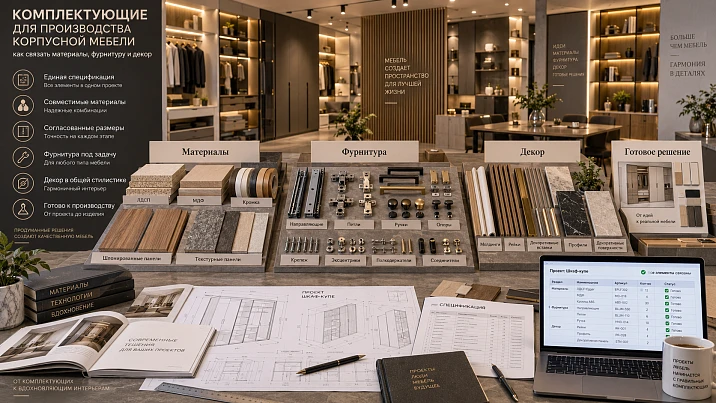
A manufacturer rarely produces a single piece of furniture. One collection may include a wardrobe, a chest of drawers, a bedside table, a tall cabinet, a display cabinet, and kitchen modules. If handles, supports, moldings, and decorative elements are selected separately for each product, the nomenclature quickly grows to dozens of similar SKUs. After a few batches, the warehouse stores nearly identical handles, the process engineer maintains several drilling schemes, and procurement each time re-clarifies which specific profile belongs to a particular model.
Components for the production of cabinet furniture should be designed not per individual product, but as a system for the entire collection: model → carcass → facade → external hardware → supports → decor → mounting parts → SKU → master BOM → approved sample → prototype → batch → repeat purchase.
The main goal is to increase the share of common components where this does not worsen design and ergonomics, and to keep local SKUs only where they are truly needed. One handle design can have several sizes. One molding profile can work on a wardrobe, a chest of drawers, and a bedside table. One support system can use a common mounting plate but different heights. This way the collection remains cohesive, and production remains manageable.
In this article, STAVROS is considered as a supplier of visible and decorative components: wooden furniture handles, legs and supports, hardware for legs and handles, decorative overlays, moldings, slatted panels, and samples. Hinges, slides, lift mechanisms, and other internal mechanisms are also part of the overall furniture BOM, but they should not be artificially attributed to the STAVROS assortment if they are not presented in the corresponding catalog.
What belongs to cabinet furniture components
To build a master BOM, first divide all items by type. This helps avoid mixing material, finished hardware, and semi-finished products within the same purchasing logic.




Structural materials
These are the bases from which carcasses, facades, back panels, and internal parts are formed:
- Laminated chipboard;
- MDF;
- Chipboard and HDF in those assemblies where they are provided for by the design;
- solid wood;
- other panel and wood materials according to the project.
The material is usually purchased in sheets, formats, or blanks, and then turned into specific parts. Therefore, it cannot be considered the same type of item as a finished handle or leg.
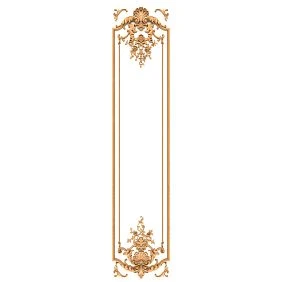
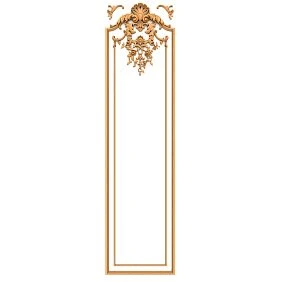
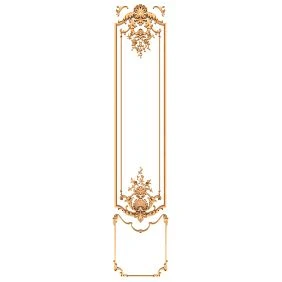
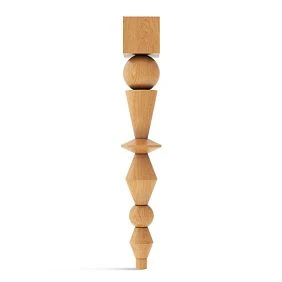
Our factory also produces:
Functional technical hardware
This group includes hinges, slides, mechanisms, and connectors. They are critical for furniture, but their detailed selection is beyond the STAVROS assortment discussed in the article. In the master BOM, they must still exist as separate lines.
Get Consultation
Visible furniture hardware
This is exactly where STAVROS is directly integrated into the production system:
- furniture handles;
- legs;
- supports;
- related mounting parts.
Decorative components
They form the visual language of the collection:
- decorative overlays;
- Moldings;
- furniture moulding;
- cornices;
- slatted panels;
- other local decorative elements.
This separation is also commercially useful: an MDF sheet, a finished handle, and a moulding have different purchasing units, different control rules, and different methods of calculating reserves.
BOM — the main document of a furniture series
For a single cabinet, a set of notes will suffice. For a line of five to ten products, you need a BOM where each purchased item has its own code, SKU, and quantity for a specific model.
| Code | Category | Supplier SKU | Material | Qty per model | Critical data |
|---|---|---|---|---|---|
| H01 | Handle | HL-___ | Oak | 2 | Size, fit, finish |
| L01 | Leg | MN-___ | Beech | 4 | Height, mounting |
| D01 | Overlay | N-___ | Beech | 2 | Size, orientation |
| M01 | Molding | MLD-___ | MDF | By cutting | Profile, length |
| P01 | Panel | PAN-___ | MDF / solid wood | By layout | Module, thickness |
The entry "wooden handles — 2 pcs." is too vague. Production needs a specific model, size, material, finish, and mounting geometry. For molding, a cutting map is also required. For the panel — module and layout.
It is convenient to store two identifiers in the master BOM:
INTERNAL CODE / SUPPLIER SKUThe internal code is used in the factory's ERP or PDM, the supplier SKU — for direct reordering.
What cabinet furniture is made of: material is selected by component
The query "what cabinet furniture is made of" cannot be reduced to a single material. The carcass, facade, back panel, and visible parts solve different tasks.
| Node | Main function | What is important to specify |
|---|---|---|
| Housing | Geometry and load-bearing structure | Material, thickness, decor, edge |
| Facade | Appearance and opening | Material, finish, drilling, texture |
| Back panel | Carcass closure and structural role | Material, thickness, installation method |
| Handle | Grip and front hardware | SKU, dimensions, fit |
| Leg | Support and final height | SKU, height, mounting |
| Decor | Visual system | SKU, scale, coordinates |
The material for cabinet furniture is not chosen on the principle of "one best for everything." Particleboard can be rational for the carcass, MDF — for a painted or milled facade, solid wood — for a handle or leg. Even within a single piece of furniture, materials can vary by functional layers.
Why MDF and particleboard should not be mixed with the concept of "component"
A board is a material or blank. A handle is a finished component. An overlay is a finished decorative component. A molding is a profile that may still require cutting. A panel is a modular decorative layer.
In BOM, these are different types of items. If they are combined into one group "furniture materials," procurement becomes harder to calculate units, lead times, and stock.
A single furniture collection must have a SKU architecture
A collection rarely consists of a single model. For example:
- wardrobe;
- dresser;
- pedestal;
- tall cabinet;
- display case;
- kitchen modules.
If each item gets its own handles, its own legs, and its own moldings, the number of SKUs grows faster than the range of finished furniture. Therefore, even at the design stage, it is useful to determine: which components will be shared across the collection, and which will be local.
Working logic:
COMMON SKU — the component is used in several models.
LOCAL SKU — the component is needed by only one model or one scale.
The goal is not to make everything COMMON. The goal is to remove random differences that do not create value for the customer.
How to build a unified handle system for a furniture collection
Handles are one of the best candidates for unification. STAVROS has a separate category wooden furniture handles, where one design idea can exist in several sizes and finishes.
For a collection, the following scheme is rational:
one design series → several sizes → application rules by model.
For example:
H-S / NIGHTSTAND / DRAWER
H-M / DRESSER / WARDROBE SMALL
H-L / WARDROBE / TALL UNIT
This way the wardrobe, chest of drawers, and nightstand look related, but are not forced to use the same physical handle size.
The handle must be approved before drilling
After drilling the front, the center-to-center distance or mounting point becomes part of the construction. Therefore, the master BOM for the handle records:
- supplier SKU;
- size;
- center-to-center distance, if applicable;
- hole coordinates;
- orientation;
- the material;
- finish;
- list of models where the handle is allowed.
Coated and uncoated handles are different configurations
If the factory needs a ready-made finish from the supplier, use a specific item from the section handles with coating. If the furniture collection is tinted or painted within production, the section may be useful handles without coating.
These options cannot be mixed in one line. Even identical geometry with a different finish means different purchasing configurations.
When handle unification stops being beneficial
A single handle should not be forced onto a small drawer, a tall cabinet, and a wide front if it compromises grip or visual scale. Therefore, the target unit of standardization is the SKU family, not necessarily a single item.
For each form factor, it is useful to have an approved pairing:
| Facade type | Recommended level | What to Check |
|---|---|---|
| Small drawer | H-S | Grip, centering |
| Dresser / nightstand | H-M | Proportion and center-to-center |
| Tall cabinet | H-L | Installation height, projection |
Legs and supports as the second cross-cutting system of the collection
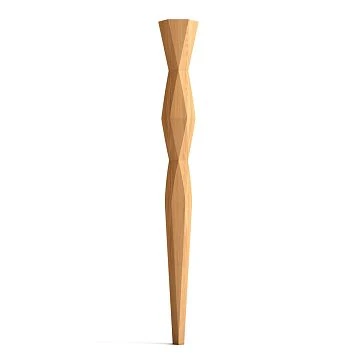
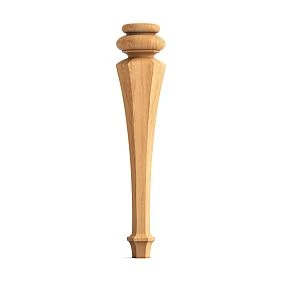
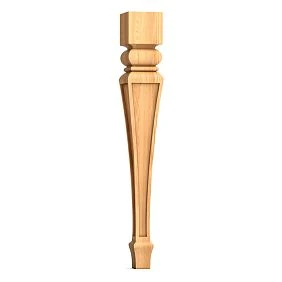
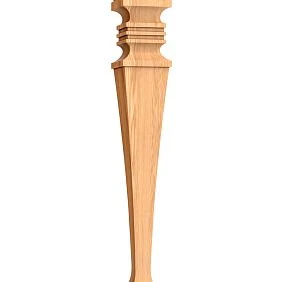
Legs and supports are another group that can be standardized by family. Catalog furniture legs and supports STAVROS already separates usage by furniture types, including dressers, cabinets, nightstands, tables, and other items.
For the collection, you can use:
- one style of legs;
- several heights;
- one type of wood;
- one finish;
- a common mounting system.
Leg height must be stored in the BOM
The same support model in different sizes represents different purchasing items. Height affects:
- the final height of the product;
- floor clearance;
- visual proportions;
- compatibility with adjacent furniture;
- installation detail.
Therefore, records MN-XXX are insufficient if an item has multiple variants. A full configuration is required.
Leg + fasteners = one structural assembly, but multiple BOM lines
In the hardware for legs and handles studs, mounting plates, and glides are included. For production, they must be stored separately:
LEG SKU
STUD SKU
PLATE SKU
FOOT SKU
The assembler must not select the plate for the leg independently. A compatible assembly is approved in advance and becomes part of the model.
Decorative overlays: standardize the ornamental language, not a single size
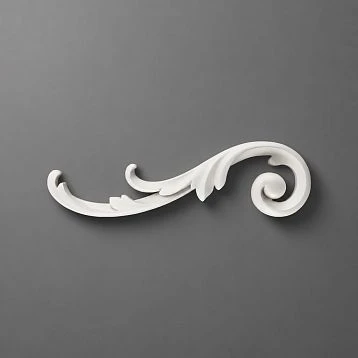
Decorative overlays from the catalog STAVROS can be used on the fronts of cabinets, dressers, nightstands, and other items. But a single overlay rarely suits all scales.
It is more useful to build a family:
- a large element for the cabinet;
- a medium one — for the dresser;
- a small one — for the nightstand;
- consistent styling and material;
- a coordinated finish.
Why one size does not work on all fronts
The scale depends on:
- facade widths;
- heights;
- handles;
- molding frames;
- free margins;
- symmetry.
If one overlay looks right on a wardrobe, on a nightstand it may cover almost the entire surface. That is why the ornamental motif is standardized, not necessarily the physical size.
Left and right elements
Asymmetric decor is stored as separate rows:
D01-L / N-___
D01-R / N-___
Coordinates and orientation are specified on the drawing. This way, the warehouse and assembly do not reinterpret the composition.
Furniture profiles — a separate master BOM category
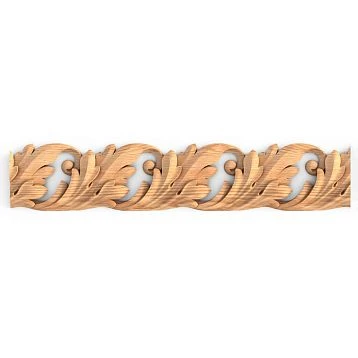
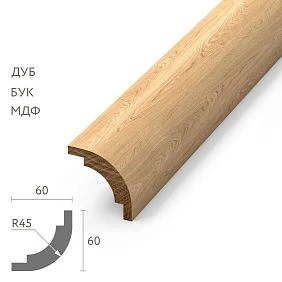
STAVROS Trim can be used as a facade molding, top cornice of a wardrobe, plinth, decorative band of a chest of drawers, or buffet profile.
A profile differs from a handle or overlay in that its purchasing unit is a physical strip, while its production unit is a specific part after cutting.
Therefore, the scheme:
Profile SKU → commercial length → parts map → cutting → number of strips.
Why you can't purchase only linear meters
Suppose one frame requires:
- 2 × 900 mm;
- 2 × 500 mm.
The finished length is 2800 mm. But if the commercial strip is 2400 mm, the mathematical division 2.8 / 2.4 does not give a real purchasing answer. You need to lay out the parts across the strips and check which leftovers can be used in other models.
For a collection, such cutting is best planned for several products at once. The leftover from a long wardrobe can cover a short frame of a nightstand or chest of drawers.
Slatted panel as a furniture component
Current STAVROS slatted panels are used, among other things, on furniture fronts, wardrobes, nightstands, kitchen islands and radius parts. For BOM, this is a separate decorative layer on top of the structural base.
Need to consider:
- panel SKU;
- the material;
- module;
- thickness;
- direction of the slats;
- edge cuts;
- end finishing;
- additional mass;
- impact on handles and hinges.
The additional thickness must appear in the design documentation
The panel changes the actual thickness of the front or side panel. This affects gaps, opening, handle position, and alignment with adjacent elements. Therefore, this decision cannot be added after the main design documentation has been released without verification.
The same module on different items
If the slatted system is used on a wardrobe, a chest of drawers, and a kitchen island, this is a good COMMON SKU. But the layout will be local: the front width and the number of modules differ.
How to create a master BOM for the entire furniture collection
The strongest production model is not a separate file for each item, but a single master BOM that shows which components are used in which products.
Instead of:
wardrobe.xlsx
dresser_final.xlsx
nightstand2_new.xlsx
kitchen_new_latest.xlsx
better to have one manageable matrix:
| SKU | Category | Wardrobe | Chest of drawers | Cabinet | Kitchen | Status |
|---|---|---|---|---|---|---|
| HL-01 | Handle | 4 | 6 | 2 | 12 | COMMON |
| MN-01 | Leg | 4 | 4 | 4 | — | COMMON |
| N-01 | Overlay | 2 | 4 | 2 | 6 | COMMON |
| MLD-01 | Molding | By map | By map | By map | By map | COMMON |
| PAN-04 | Panel | Zone 1 | — | Zone 1 | island | COMMON |
| HL-07 | Handle | — | — | — | 4 | LOCAL |
Such a table answers several questions at once: how many models depend on a single SKU, where the local complexity lies, which component can be purchased in a consolidated batch, and what will happen if the supplier changes a specific item.
COMMON and LOCAL are not a quality rating
COMMON does not mean "better." LOCAL does not mean "redundant." This is a classification of applicability.
A COMMON SKU is needed by several models and therefore has a greater impact on purchasing, service, and the risk of production stoppage.
A LOCAL SKU is needed by one product or one configuration. It may be fully justified if it creates an important product differentiator.
A shared component must have a master card
For each COMMON SKU, it is useful to store:
- supplier SKU;
- internal code;
- the material;
- size;
- finish;
- drawing;
- approved sample;
- list of models;
- last accepted lot;
- approved alternative;
- clean URL.
Why reducing the number of SKUs lowers more than just the warehouse
Fewer unique parts means not only fewer boxes on the shelf. Each new item creates its own lifecycle.
For one SKU, you need:
- search and approval;
- drawing or technical data;
- sample;
- RFQ;
- purchase order;
- Acceptance;
- storage location;
- marking;
- service reserve;
- replacement history;
- repeat order.
If two similar handles differ only because designers of different models chose them independently, merging them into one family reduces operational complexity without losing value.
What should not be unified solely to reduce the number of SKUs
Do not force unification:
- handles that are inconvenient on one type of facade;
- legs of different required heights;
- overlays of different scales;
- moldings, if one profile disrupts the proportions of a small facade;
- panels, if the geometry requires a different module;
- fasteners with different mounting geometry.
The goal is reasonable standardization, not the minimum number of SKUs at any cost.
How to aggregate total demand across all models
Master BOM allows purchasing to be calculated not by products, but by components.
Suppose one handle is used:
- in wardrobes — 400 pcs.;
- in dressers — 600 pcs.;
- in cabinets — 300 pcs.;
- in kitchen modules — 700 pcs.
Gross requirement:
400 + 600 + 300 + 700 = 2000 handles.
If the buyer issues four separate RFQs, the supplier sees four small orders. If demand is aggregated, a general program and delivery schedule can be discussed.
Aggregation does not mean a single physical delivery
The total volume can be divided by months or furniture programs:
Q4 forecast: 2000 pcs
LOT 1: 600
LOT 2: 800
LOT 3: 600
This way the factory gets the commercial effect of the total volume without overloading the warehouse.
COMMON SKU is more useful to calculate via free stock
Net requirement:
gross − free stock + production reserve = purchase.
The service reserve cannot be deducted if it is already reserved for sold furniture.
How to split batches by furniture programs
Even a common SKU is useful to label by program or production batch. This simplifies traceability.
Working marking:
COLLECTION / SKU / LOT / QTY
For example:
CLASSIC-A / HL-01 / LOT-H07 / 400
MODERN-B / HL-01 / LOT-H08 / 300
If a finish problem occurs, it is possible to determine where a specific lot went.
Physically identical parts after incoming inspection can be consolidated in the warehouse if the internal quality system allows it, but the supply history must be preserved.
Approved sample before series launch
For every visually significant COMMON SKU, it is useful to keep a physical reference sample:
- the handle;
- leg;
- overlay;
- molding fragment;
- panel sample;
- finish sample.
STAVROS has a separate section product samplesIt presents samples of moldings, baguettes, slatted panels, and other demonstration items for design and production work.
Not every specific SKU is necessarily available as a ready catalog sample. For a handle, leg, or individual item, the possibility of a test purchase should be clarified separately.
The sample is linked to the BOM revision
The reference sample or card stores:
SKU
MATERIAL
FINISH
APPROVED DATE
BOM REV
USED IN MODELS
If the finish changes, the old approved sample should not automatically remain valid.
The prototype should be assembled at the key scales of the collection
You don't have to build a prototype for every SKU of finished furniture. It's more useful to choose a representative set — models that test the extreme scales of the system.
For example:
- a nightstand — a small front and a compact scale;
- a chest of drawers — a medium front and several drawers;
- a wardrobe — a tall front and a long vertical;
- a kitchen module — frequent use and a different construction.
If a family of handles, legs, and decor works well across these four scenarios, it's easier to expand it further.
A prototype tests how components interact
A handle that's good on its own can conflict with an overlay. A good leg can produce the wrong overall height. A panel can interfere with opening. That's why a prototype is needed not only to test the product, but also to test the entire composition of the model.
Supplier and component quality: what a furniture factory needs
For a factory, the query "furniture hardware manufacturer" doesn't mean finding the brand with the longest catalog, but checking how well the supplier can support a serial production process.
For each component, the factory needs:
- a stable SKU;
- exact dimensions;
- the material;
- configuration options;
- drawing or technical data;
- a clear finish;
- possibility to obtain a sample;
- a lead time for a specific volume;
- ability to reorder;
- batch marking.
At STAVROS, the technical infrastructure includes catalogs, DWG and 3D for furniture handles, legs and frames, mouldings, slatted panels and carved decor. For a designer, this is more convenient than working from a photograph alone.
“Quality hardware” means measurable parameters
Quality furniture hardware in serial production should be described not with the word “premium,” but with specific characteristics.
| Parameter | What it means for the series |
|---|---|
| Geometry | Matches the drawing and the mounting point |
| Size | Consistent from batch to batch |
| Material | Conforms to specification |
| Finish | Comparable to the approved sample |
| Labeling | SKU and lot are uniquely identified |
| Repeatability | The next batch reproduces the product |
| Compatibility | The fastener and the furniture component function as a single assembly |
If a supplier changes the model without notice or uses a different finish under the same code, for the furniture factory this is already a product change.
The handle and the leg must exist not only in the catalog but also in the internal library
After approval, the component master-card stores:
INTERNAL CODE
SUPPLIER SKU
CATEGORY
MATERIAL
SIZE
FINISH
DRAWING
APPROVED SAMPLE
USED IN MODELS
LAST ACCEPTED LOT
ALTERNATIVE
STATUS
This way, the designer and the buyer do not start the search anew for each item in the collection.
When a new supplier needs to be tested via prototype
If a component is critical in terms of geometry or appearance, a single commercial proposal is not enough. A new supplier must confirm actual compatibility.
This is especially important for:
- handles with pre-defined drilling;
- legs that determine the overall height;
- moldings that are part of the frame;
- panels with a fixed module;
- visible finish across the entire collection.
If a supplier offers an "analog," it first becomes a CANDIDATE, then goes through sample/prototype, and only after approval receives APPROVED status.
Change management: one SKU can affect the entire collection
The main advantage of a master BOM shows up not in the first purchase, but during a change. If one COMMON SKU is used in four models, replacing it should automatically show the entire impact list.
Change request entry:
OLD SKU → NEW SKU
REASON
AFFECTED MODELS
DRAWING IMPACT
FINISH IMPACT
STOCK IMPACT
EFFECTIVE LOT
APPROVAL
Example: handle is changing
The old handle H01 is used in the wardrobe, chest of drawers, and cabinet. The new version has the same center-to-center distance, but a different projection and finish.
Need to check:
- grip on all fronts;
- visual scale;
- color next to each collection;
- remnant of the old handle;
- service obligations;
- from which batch the new version takes effect.
If the new center-to-center distance is different, the impact becomes even wider: front drawings and drilling templates change.
Example: leg is changing
If COMMON LEG is used on a nightstand and a dresser, the new height affects two finished products at once. Even a 20 mm difference can change the relationship with the bed, sofa, or other furniture.
Therefore, a change request should update not only the procurement line but also the final furniture dimensions.
An approved alternative is best created before a shortage
For critical components, this scheme is useful:
PRIMARY SKU → APPROVED ALTERNATIVE → CONDITIONS.
Conditions may vary:
- for a handle — the same center-to-center distance and allowable projection;
- for a leg — the same height and mounting point;
- for molding — a compatible profile;
- for a panel — the same module or a pre-recalculated layout.
If a replacement requires reworking the furniture, it is not a “quick analog” but a new product revision.
An old position cannot be deleted from the database
After replacement, SKUs are moved to ARCHIVE or SERVICE, but not erased. Several years later, the service department must understand which handle or leg was actually installed on the sold furniture.
Incoming inspection, RFQ, and repeat purchasing
Even a perfectly configured master BOM does not work without procurement and receiving discipline. A supplier may ship the correct SKU in the wrong finish, the warehouse may mix a new and an old batch, and the buyer may accidentally repeat an order using an outdated revision. Therefore, the procurement loop must be as formal as engineering documentation.
What to check during incoming inspection
Before distributing a new batch across models, check:
- supplier SKU;
- internal code;
- the material;
- size;
- finish;
- quantity;
- visible damage;
- fastener kit completeness;
- compliance with the approved sample;
- LOT.
For a handle, the main risk may be center-to-center distance. For a leg, it is height and mounting interface. For molding, it is cross-section. For a panel, it is module and thickness. Inspection must be tied to the critical parameters of the specific SKU.
A new batch should not be mixed with the old one right away
Until receiving is complete, it is better to store the new LOT separately. If a discrepancy in finish or geometry is found, the factory will be able to localize the problem. After ACCEPTED, the physical warehouse may combine batches if the internal system allows it, but traceability must be preserved.
What a good RFQ looks like
The query "cabinet furniture components buy" for B2B manufacturing should contain not a general list of categories, but the actual requirement.
| SKU | Material | Execution | Models | Total requirement | Need date |
|---|---|---|---|---|---|
| HL-01 | Oak | FINISH-02 | Wardrobe, chest of drawers, cabinet | 1300 + reserve | ___ |
| MN-01 | Beech | RAW | Chest of drawers, cabinet | 900 + reserve | ___ |
| N-01 | Beech | FINISH-02 | Wardrobe, chest of drawers | 420 + reserve | ___ |
| MLD-01 | MDF | For Painting | Wardrobe, kitchen | Cutting planks | ___ |
Additionally, specify the forecast for the next order, the need for a sample, the delivery address, and a link to the current master BOM revision.
The RFQ and purchase order must describe the same configuration
If the RFQ was for a handle with a coating, but the PO was accidentally issued for the version without coating, the commercial chain has already diverged. Therefore, before sending the order, it is useful to compare the PO with the master data line by line.
Control:
- SKU;
- the material;
- finish;
- size;
- quantity;
- need date;
- delivery location;
- approved sample reference.
Repeat order after several months
You don't need to write to the supplier: "make the same handles as last time." A repeat RFQ is built on the saved configuration:
SUPPLIER SKU
INTERNAL CODE
MATERIAL
SIZE
FINISH
PREVIOUS LOT
NEW QTY
NEED DATE
BOM REV
The price and lead time are rechecked, but the technical identity of the product is not recreated from scratch.
Service reserve and production reserve are different stocks
The production reserve is consumed during manufacturing. The service reserve is needed for furniture that has already been sold. If they are stored as a single number, production will gradually "eat into" the stock intended for future repairs.
Useful statuses:
- FREE STOCK;
- PRODUCTION RESERVED;
- SERVICE RESERVE;
- QUARANTINE;
- CLAIM.
For a COMMON SKU, the service reserve is especially important: the same handle can be installed on several types of furniture and on a large number of sold items.
Actual consumption improves the next order
After a batch, it's worth saving plan vs actual:
ORDERED: 1400
USED: 1320
SCRAP / DAMAGE: 8
SERVICE RESERVE: 40
FREE STOCK: 32
The next reserve can already be calculated based on real data rather than a universal percentage.
Master BOM as the top level for wardrobes, kitchens, dressers, and nightstands
This article should function as the top level of the architecture. Kitchens, wardrobes, chests of drawers, and cabinets each have their own local specifics that should not be repeated within a single hub across dozens of paragraphs.
The correct internal linking model:
- general rules for COMMON/LOCAL SKU, procurement, samples, and master BOM — here;
- specifics of kitchen furniture — in the child vertical;
- specifics of wardrobes — in a separate article;
- specifics of chests of drawers — in a separate article;
- specifics of cabinets — in a separate article.
Kitchen furniture
Kitchens have a large set of modules, frequent repetition of handles, and a strong dependence of the facade architecture on the collection. A detailed production breakdown is provided in the material about components for kitchen furniture production.
Wardrobes
For wardrobes, the height of the fronts, long handles, the back panel, slatted panels, and the difference between L/R decor matter. These topics are covered in detail in the article about components for wardrobe production.
Chests of drawers
A chest of drawers offers a different scale: several drawers, repeating handles, legs, and decorative front elements. A child material is used for it about components for chest of drawers production.
Nightstands
For nightstands, the final height, support, mounting plate, handle, and compact front are especially closely connected. A separate breakdown is available in the article about components for nightstand production.
This way, the general level does not replace the specifics of individual products. It answers the factory's question: how to build a unified component system for the entire line and then detail it for each type of furniture.
How to use STAVROS in master BOM
Used for initial search STAVROS Main Catalog. A broader section of wood and MDF products combines the main furniture groups.
After selecting specific SKUs, the factory can use a page for furniture manufacturers for B2B communication. The current page offers special prices, shipping from one unit across Russia, a personal manager, and adherence to deadlines.
It makes sense to include STAVROS in the master BOM specifically in those places where the assortment is confirmed:
- handles;
- legs and supports;
- hardware for legs and handles;
- moulding;
- Plates;
- slatted panels;
- samples.
There is no need to attribute a full set of internal mechanisms for cabinet furniture to the company if a specific product group is not represented.
FAQ and final checklist of the master BOM for cabinet furniture
What components are needed for the production of cabinet furniture?
At least four levels must be distinguished: structural materials, functional technical hardware, visible hardware, and decorative components. The carcass and fronts include panel or wood-based materials. The internal mechanics include hinges, slides, and connectors. The visible outer layer includes handles, legs, and supports. The decorative layer includes overlays, moldings, trim, and panels.
Almost every item that is purchased separately carries its own risk of being missing, incorrect, or substituted. Therefore, it must have its own BOM line.
What is cabinet furniture made of?
Cabinet furniture is made from several materials, not one mandatory material. Particleboard is often used for straight carcasses with a finished decorative surface. MDF is used for painted, milled, and other parts where subsequent processing matters. HDF and other thin panels can be used for back walls. Solid wood is reasonable for visible and three-dimensional parts if natural wood is part of the design.
The choice must be made for a specific assembly, not by the formula "all furniture must be made of one material."
What material should be used for a furniture carcass?
The material for cabinet furniture is determined by the design, part thickness, joining method, surface visibility, and budget. If the carcass must be straight and the panel's finished decor is acceptable, particleboard is often the rational choice. If a painted or milled part is required, MDF is considered. But a specific piece of furniture may combine different materials in the carcass, fronts, and visible elements.
Why can't a material be stored as a single line "wood" or "MDF"?
Production needs the specification level. For solid wood, it is important to know the species and finish. For MDF, the thickness, surface, and subsequent finishing. For particleboard, the manufacturer or internal code, decor, thickness, and edge banding. The more serial the production, the more dangerous general names without an exact configuration are.
Which handles are suitable for cabinet furniture?
Those that are compatible with a specific front in terms of size, fit, center-to-center distance, projection, and ergonomics are suitable. For a collection, it is advantageous to look for a single design series in several sizes, rather than four completely different handles for a wardrobe, chest of drawers, cabinet, and kitchen.
The handle must be approved before serial drilling. Once holes are made, replacement becomes an engineering task.
How to unify handles between a wardrobe and a chest of drawers?
First, one design series is selected. Then it is checked which sizes work at each front scale. If a medium handle is convenient and visually appropriate on both items, it can become a COMMON SKU. If a tall wardrobe requires a long handle and a chest of drawers requires a medium one, one design series is retained, but two sizes appear.
In the master BOM, these are still two supplier SKUs or two size configurations, but they belong to one visual system.
When does a single COMMON SKU become a bad idea?
When its unification creates a compromise in function or design. For example:
- the handle is too small on a tall front;
- the leg is right for a cabinet, but makes the chest of drawers too tall;
- the overlay is well scaled on a wardrobe, but overloads a small front;
- the molding is too wide for the cabinet;
- the panel module creates an inconvenient cut on one model.
In this case, a LOCAL SKU is justified.
How to choose legs for case furniture?
You need to start with the finished product. Set the final height, clearance, material, visual scale, and mounting assembly. Then select the LEG SKU and related STUD / PLATE / FOOT. If one style is needed for several models, you can use a leg family in different heights.
It is critical to remember: the leg height is part of the furniture's overall dimensions. It cannot be changed without checking the model.
What is included in the support mounting assembly?
It depends on the specific design. A stud, mounting plate, glide, and other elements are possible. In the BOM, they are stored as separate lines, even if the assembler perceives them as one set.
This is needed for accurate calculation, incoming inspection, and to prevent the situation where the legs have arrived but the mounting hardware is missing.
Which decorative elements are suitable for fronts?
Suitable are those that match the scale and do not conflict with the handle, milling, and adjacent frames. A wooden overlay can work as a central or corner accent. Molding — to create a frame. Slatted panel — to provide a relief layer.
If the facade already has active milling and expr
What reserve should be kept in stock?
There is no fixed percentage. For a frequently used handle with a short lead time, one reserve; for a unique leg, another. For linear trim, the reserve depends on cutting; for panels, it depends on modules and offcuts.
When calculating, take into account:
- delivery time;
- price;
- damage history;
- minimum packaging;
- number of models using the SKU;
- service obligations;
- possibility of using the remainder in the next series.
Why does the total order not have to be received in a single shipment?
An aggregated forecast helps the supplier understand the overall program volume, but shipments can be split into several lots according to the production calendar. This reduces inventory and preserves the benefits of planning.
The key is that each lot retains an identical technical configuration or is separately approved as a new revision.
What should be done if a COMMON SKU suddenly becomes unavailable?
Do not look for a random substitute on the day production stops. For critical parts, it is better to have an approved alternative in advance. If there is none, the new candidate must pass technical validation: dimensions, fit, finish, and a prototype on the affected models.
The Master BOM helps you quickly see the affected models and assess the scale of the change.
How should a change request be submitted for a common component?
You need to specify the old SKU, new SKU, reason, affected models, impact on drawings, finish and inventory, as well as the effective lot. If a handle with a different center-to-center distance is changed, the affected models must receive new facade revisions. If only the supplier changes but the part is completely identical and this is confirmed, the change may be simpler — but it still must be documented.
When should samples be ordered?
A physical sample is especially needed if the component:
- used for the first time;
- visible on several models;
- has a natural wood texture;
- has a critical finish;
- sets the scale of the facade;
- is planned for a large production run.
A physical sample is more useful than another render: it shows the real size, profile, surface, and color.
What is an approved sample?
This is a physically approved reference of a specific configuration. It is linked to the SKU, material, finish, date, and BOM revision. New batches are accepted based on it when a characteristic cannot be fully described by a single dimension.
An approved sample must not be consumed in the current assembly.
How to set up incoming inspection for a COMMON SKU?
The more models depend on a position, the higher its criticality. During receiving, check identity, geometry, finish, and damage before distribution across programs. Do not mix a new batch with the old one until ACCEPTED.
If a defect is detected, traceability allows you to hold a specific lot and avoid stopping all furniture batches unnecessarily.
How to label a common SKU?
Minimum:
SUPPLIER SKU / LOT / QTY
For distribution across programs:
COLLECTION / INTERNAL CODE / SUPPLIER SKU / LOT / QTY
If material and finish are critical, they can also be included on the label.
How to organize a reorder?
A reorder must reference the master card, not an old screenshot. Supplier SKU, material, size, finish, previous lot, quantity, need date, and BOM revision are provided.
Price and lead time are checked again. The technical configuration remains the same unless a change request was issued.
What to do with leftovers after completing one model?
If the SKU is COMMON, the leftover can move to other active programs. If it is LOCAL and the model is discontinued, you need to separate the service reserve, archive stock, and surplus. You cannot automatically treat everything as free warehouse stock.
How to calculate linear footage between different models?
First, create a parts map for the wardrobe, chest of drawers, nightstand, and other items. Then combine parts by a single SKU and break them down by commercial lengths. This way, a short offcut from the wardrobe can cover the nightstand frame.
This is exactly where the master BOM delivers direct material savings without changing the design.
How to calculate panels for multiple models?
Unlike a handle, a panel is not always counted as "pieces per product." You need a layout for each front and module. After that, identical physical modules can be aggregated across the entire program.
It is important not to lose orientation, color, and finish. Panels with the same SKU but different finishing scenarios may require different purchasing lines.
When is it better to keep a LOCAL SKU?
If a component creates a noticeable product difference, performs a unique function, or is required for only one geometry. For example, a long handle on a flagship wardrobe, a large overlay on a sideboard, or a flexible panel for a curved island.
LOCAL becomes a problem only when it appeared by accident and does not create value.
Buying components for cabinet furniture: what should a supplier request include?
A good request includes:
- supplier SKU;
- internal code;
- material;
- finish;
- total requirement;
- breakdown by batches;
- need date;
- delivery location;
- forecast;
- sample requirement.
The phrase "buy cabinet furniture components" is useful as a commercial intent, but the actual order must be much more precise.
Where to buy components for cabinet furniture?
STAVROS offers visible and decorative components — handles, legs and supports, related furniture hardware, overlays, mouldings, slatted panels and samples. After selecting specific SKUs, the factory can transfer the total requirement for the furniture program through the B2B channel for manufacturers.
What result should the master BOM deliver?
After a few months, a new batch of furniture should be produced without re-selecting handles, legs and decor. The purchaser sees the total requirement, the warehouse understands the stock, the technologist knows the compatibility, the service sees the actual configuration, and the designer understands which elements form the language of the collection.
Practical example of a master BOM for a collection of four products
Suppose the factory produces a wardrobe, a chest of drawers, a bedside table and a tall cabinet. The designer wants to preserve a common language: oak handles, beech legs, one moulding profile and related overlays.
| Component | Wardrobe | Chest of drawers | Cabinet | Tall cabinet | Class |
|---|---|---|---|---|---|
| HL-100-S | — | — | 2 | — | LOCAL by size |
| HL-100-M | — | 6 | — | — | LOCAL by size |
| HL-100-L | 4 | — | — | 2 | COMMON |
| MN-210 | 4 | 4 | 4 | — | COMMON |
| MLD-020 | By map | By map | By map | By map | COMMON |
| N-FAMILY-S | — | — | 2 | — | LOCAL size |
| N-FAMILY-M | — | 4 | — | — | LOCAL size |
| N-FAMILY-L | 2 | — | — | 2 | COMMON |
At first glance, the collection has many SKUs, but in fact the architecture remains simple: one handle series, one overlay series, one leg, and one molding. Different sizes exist because the fronts have different scales, not because each model was designed independently.
This is precisely what reasonable standardization means: not the minimum number of lines in the ERP, but the minimum number of independent design decisions.
How to calculate the total purchase of legs together with fasteners
If MN-210 is used on a dresser, a nightstand, and a wardrobe, procurement needs to aggregate not only the legs but the entire mounting assembly.
For example:
- 100 wardrobes × 4 legs = 400;
- 120 dressers × 4 = 480;
- 200 nightstands × 4 = 800.
Total demand by LEG SKU — 1680 units.
If each leg uses one stud, one plate, and one glide, the gross requirement for each related item will also be 1680 units. But if some wardrobes use a different plate due to the bottom thickness, the master BOM must split the mounting assembly:
LEG MN-210: 1680
STUD FUR-A: 1680
PLATE FUR-A: 1280
PLATE FUR-B: 400
FOOT FUR-C: 1680
That is why “leg — 1680 pcs.” does not describe the full procurement task. The weak point of a series is often not in a large visible part, but in a small installation item.
How much does an extra SKU cost, even if the part itself is inexpensive?
An exact universal amount cannot be given, because factories have different processes. But the cost of complexity can be broken down.
A new SKU creates:
- designer time for verification;
- a new card in ERP/PDM;
- RFQ and approval;
- sample;
- storage location;
- separate acceptance;
- risk of mis-sorting;
- separate service reserve;
- separate change history;
- repeat commercial request.
If a new handle costs only 50 rubles less than the old one, but creates one new SKU for a single cabinet, the savings may prove insignificant against the operational complexity. Therefore, value engineering must consider not only the price per unit, but also the cost of managing the nomenclature.
When an expensive LOCAL SKU is still justified
If a component forms the key differentiator of the product, its locality is normal. For example, a flagship sideboard may have a unique large overlay that no other item has. For the sake of such a visual centerpiece, there is no need to break the design and forcibly use a smaller COMMON element.
A rational LOCAL SKU usually has one of the following reasons:
- special geometry;
- unique function;
- flagship design;
- different scale;
- special installation;
- limited edition.
The problem arises when the reason sounds like "it just happened."
What to do if a model is discontinued from the collection
Suppose a nightstand is discontinued, but its H-S handle was used only on it. Then the status of this SKU changes from ACTIVE to SERVICE/ARCHIVE.
Before closing:
- calculate the quantity of nightstands sold;
- determine the service stock;
- check whether the H-S can be used in another active model;
- separate the free stock from the mandatory service stock;
- retain the supplier and last accepted lot;
- do not delete master-card.
If the client needs a replacement in two years, the service will be able to restore the exact configuration.
What happens when a new model is added to the collection
A new item first checks the existing library of COMMON components:
- whether a handle family is suitable;
- whether one of the existing leg heights is suitable;
- whether the current mounting plate can be used;
- whether there is a related overlay of the required scale;
- whether the current moulding profile is suitable;
- whether the existing slatted system can be used.
Only after this is a new LOCAL SKU created. This procedure prevents uncontrolled proliferation of the nomenclature.
How to assess the risk of production stoppage for a COMMON SKU
The more models depend on a single part, the higher its leverage and at the same time its risk. A COMMON SKU requires more careful inventory planning and alternatives.
Simple matrix:
| Parameter | Low risk | High risk |
|---|---|---|
| Number of models | 1–2 | Many models |
| Lead time | Short | Long |
| Alternative | Has approved | No |
| Stock inventory | Sufficient | Minimal |
| Impact on design | Easy to replace | Requires facade rework |
A shared handle for five models can be economically beneficial, but it is wiser to have more mature planning for it than for a local decorative element.
How to plan procurement when one SKU is used in different finishes
Identical geometry does not mean a single procurement line. For example, handle H01 may be used in natural oak for one collection and in a dark finish for another.
Then the master BOM must distinguish:
H01 / OAK / NATURAL
H01 / OAK / DARK
They can only be aggregated at the level of base geometry or forecast, but physical batches cannot be mixed as a single free stock.
How the master BOM helps the service team
The service team gets a direct chain:
model → production batch → as-built BOM → supplier SKU → service reserve.
Instead of asking “what handle was there?”, the system shows the exact position and finish. For a furniture chain, this significantly reduces repair time and lowers the risk of installing a visually similar but different part.
How the master BOM helps the designer
Standardization does not limit design if the library is built correctly. The designer sees existing families and understands where COMMON SKU can be used and where a new element is truly justified.
This turns the library into a tool:
- quickly assemble a new model;
- preserve the brand language;
- see available sizes;
- understand approved finishes;
- avoid accidental duplication of nearly identical parts.
How master BOM helps the commercial department
The commercial department can see the cost of the external package for each model and for the entire collection. If the PREMIUM line becomes more expensive due to several local parts, this becomes measurable rather than intuitive.
Scenarios can be compared:
- one common handle versus two sizes;
- COMMON leg versus local tall one;
- molding across the entire collection versus only flagship models;
- panel on all fronts versus local accent zones.
This way, the cost decision is made without breaking engineering compatibility.
When it is still too early to buy components
Even a favorable commercial offer should not be turned into a PO if:
- the fronts are still changing;
- the handles are not approved;
- the legs have not been checked for height;
- mounting node is not closed;
- overlays have no coordinates;
- linear trim has no cutting plan;
- panel has no layout;
- prototype is not verified;
- master BOM still contains CANDIDATE instead of APPROVED.
Early purchasing turns engineering uncertainty into warehouse risk.
How to build a master BOM if the collection is already in production without a standard
You don't have to wait for a new collection. The existing assortment can be normalized in stages.
- Export all active models.
- Compile a list of handles, legs, overlays, profiles, and panels.
- Remove technical duplicate names and match them to real supplier SKUs.
- Mark where one component is used in multiple models.
- Find nearly identical SKUs and check why they exist separately.
- Link physical samples to active items.
- Flag items without drawings or a confirmed finish.
- Create a COMMON / LOCAL classification.
- Assign an owner for master data.
On the first pass, there is no need to change furniture immediately. The task is first to see the actual nomenclature. Only after that can duplicates be reduced in subsequent product revisions.
How to audit an existing collection before a new purchase
Before a large reorder, it is useful to check not only the stock but also the applicability of each common component.
| Question | What does a “no” answer mean? |
|---|---|
| Is the SKU still in use? | The item needs to be moved out of ACTIVE |
| Is there an approved sample? | The reference standard needs to be restored |
| Is the Supplier SKU confirmed? | There is a risk of ordering a different item |
| Is the finish up to date? | A new sample / approval is needed |
| Alternative verified? | High risk of stoppage during shortage |
| Service reserve separated? | Free stock may be overstated |
Such an audit is especially useful if the collection has existed for several years and suppliers or finishes have changed during that time.
How to count COMMON if the geometry is the same but the finish is different
The same handle may be common in form but different in commercial configuration. For example, light and dark collections use the same size but different finishes.
It is convenient to separate two levels:
DESIGN FAMILY = H01
PURCHASE SKU A = H01 / FINISH-LIGHT
PURCHASE SKU B = H01 / FINISH-DARK
At the design level, this is one COMMON component. At the purchasing level, they are two physical items that cannot be mixed in the warehouse. Such a two-level reference helps avoid overstating the actual variety of designs while maintaining purchasing accuracy.
Who should own the master BOM
The Master BOM sits at the intersection of design, engineering, procurement, and quality. Therefore, it should not be a personal Excel file of the buyer or the engineer.
Roles can be divided:
- the engineer is responsible for compatibility and drawings;
- design — for the visual system and approved finish;
- procurement — for supplier SKU, price, lead time, and supplier;
- quality — for accepted lot and samples;
- product/production owner — for ACTIVE / ARCHIVE and change approval.
Even if these roles are performed by two people, the responsibility must be clear. Otherwise, different departments maintain different versions of the "correct" component.
It is better to separate the material master data and the component master data
In a factory, it is useful not to mix materials for furniture manufacturing and ready-to-purchase components in a single master data catalog. An MDF or chipboard sheet is described by thickness, decor, format, and edge banding; a handle — by supplier SKU, fit, and finish; a molding — by profile and commercial length. These items have different units of measure and different stock rules.
Therefore, master data can be divided into two layers:
MATERIAL MASTER
→ panel and wood materials
→ thickness
→ decor
→ format
→ finish

COMPONENT MASTER
→ handles
→ legs
→ fasteners
→ overlays
→ trim
→ panels
This way, materials for furniture manufacturing do not compete in the system with finished hardware, but are connected only within the BOM of a specific model.
Where the boundary lies between "hardware" and "decor"
Hardware for cabinet furniture production includes functional and face components, but a decorative overlay or slatted panel may have a different procurement logic. A handle is needed for interaction with the facade, a leg — for support, and an overlay — for visual composition.
Nevertheless, hardware for cabinet furniture production and decorative elements must appear in the same BOM, because they are physically installed on the same product and may conflict with each other in terms of geometry.
For example, a handle and an overlay on the same facade require a joint check of coordinates. A leg and a plinth — a joint check of height. A panel and a handle — a joint check of thickness and overhang.
What the request "components for cabinet furniture" means at the factory level
For a procurement specialist, components for cabinet furniture are not a single catalog, but a managed set of supplied items. It includes external elements that can be identified, ordered, received, put into storage, and repeated in the next production run.
And the expression "cabinet furniture components" is useful to understand through applicability: which components are common to several models, which are local, which are critical for stopping production, and which can be replaced without redesigning the structure.
Final checklist before serial purchasing
| Check | Status |
|---|---|
| Each model has an up-to-date BOM | OK / HOLD |
| Collection master BOM created | OK / HOLD |
| COMMON and LOCAL SKUs classified | OK / HOLD |
| Handles approved before drilling | OK / HOLD |
| Leg heights included in furniture dimensions | OK / HOLD |
| LEG and mounting hardware linked | OK / HOLD |
| Overlays have scale and coordinates | OK / HOLD |
| Linear trim calculated via the parts map | OK / HOLD |
| Panels have a modular layout | OK / HOLD |
| Critical SKUs have an approved sample | OK / HOLD |
| Prototype verified at key scales | OK / HOLD |
| Approved alternative identified for critical items | OK / HOLD |
| Gross requirement aggregated across all models | OK / HOLD |
| Service reserve separated from free stock | OK / HOLD |
| RFQ and PO match in configuration | OK / HOLD |
| Incoming QC defined | OK / HOLD |
| LOT traceability is maintained | OK / HOLD |
| Reorder possible via master-card | OK / HOLD |
If several critical lines remain on HOLD, it is too early to release a large order. The product system must first be stabilized.
Final production scheme
- Break down each model into materials, mechanisms, visible hardware, and decor.
- Create model BOMs.
- Consolidate a common supplier SKU reference.
- Mark COMMON and LOCAL.
- Assemble families of handles, legs, and decor by scale.
- Verify installation compatibility.
- Form the collection master BOM.
- Select a representative prototype.
- Approve physical samples.
- Form approved alternatives.
- Aggregate demand across the entire program.
- Subtract available stock.
- Separate the service reserve.
- Prepare the RFQ.
- Verify PO against master BOM.
- Accept the delivery as a separate LOT.
- Perform incoming inspection.
- Distribute components by production batch.
- Save as-built information.
- Repeat orders by SKU and configuration, not from memory.
This is how components for cabinet furniture production turn from a set of individual items into the architecture of the entire product line. The factory gets fewer random SKUs, larger consolidated purchases, clear interchangeability, and the ability to repeat the next batch without searching for components again.