










































































Article Contents:
- What is a classic stucco set and why it only works as a whole
- Full composition of the classic STAVROS stucco set
- Decorative overlays — the semantic center of the wall
- Moldings — the architectural skeleton of the interior
- Cornices — the transition line from wall to ceiling
- Ceiling rosettes — accent in the center
- Linear moldings — decorative lines and bands
- Capitals — architectural vertical
- Molding decor — the finishing touch
- How to assemble a classic stucco set by zones
- Wall stucco: frames, belts, accents
- Ceiling stucco: rosette, cornice, linear belt
- Doorway stucco: capitals, linear elements, overlays
- Living room: how to assemble a full classic set
- Study: strictness and scale
- Hall and entryway: first impression
- How to choose the right size of elements
- Ceiling height — the starting point
- Wall width and overlay size
- Molding rhythm
- Furniture scale
- Symmetry
- Classic interior style: how to choose the right direction
- Strict classicism (neoclassicism, Palladianism)
- Neoclassicism
- Versailles (ornate Baroque and Rococo)
- Neoclassicism in modern interiors
- Standard sets: from minimal to architectural
- Minimum kit
- Wall set
- Ceiling set
- Architectural set
- Why polyurethane is the right choice for classic stucco molding
- Mistakes when choosing a classic stucco molding set
- Buying individual elements without an overall scheme
- Mixing incompatible collections
- Placing small decor on a large surface
- Making a large rosette in a low room
- Ignoring the width of the molding
- Skipping corner elements
- Not thinking about color in advance
- Where to buy a classic stucco molding set STAVROS
- Practical tips for installing classic stucco molding
- Tools and Materials
- Foundation Preparation
- Marking
- Joints and corners
- Painting
- FAQ: Answers to the Most Popular Questions
There are interiors that are remembered instantly. Not because of expensive furniture or rare stone on the floor, but because they have architectural character. The walls speak. The ceiling lives. Every transition, every line, every accent works as a unified system. This is the classic stucco molding set in action.
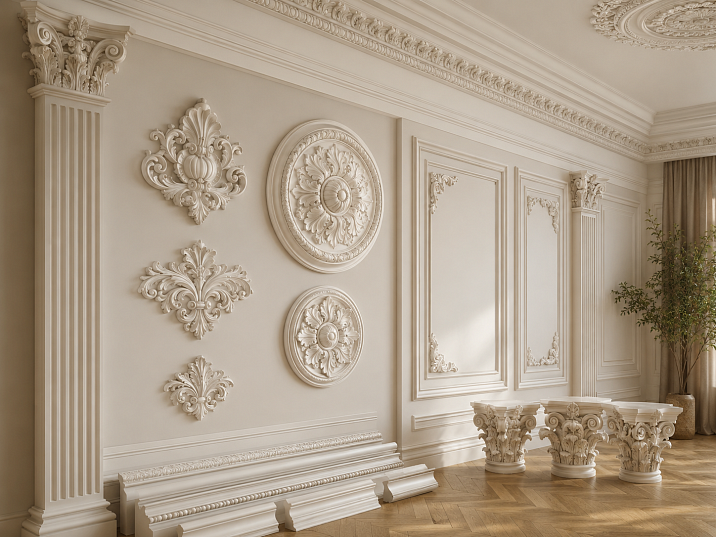
Polyurethane moldings STAVROS is not a separate decorative element on the wall. It is a comprehensive system where the overlay sets the accent, the molding builds the frame, the rosette decorates the center of the ceiling, the linear molding gathers the lines into a single rhythm, the cornice completes the transition from wall to ceiling, and the capitals add architectural scale. When all elements are correctly selected and work together, the result is indistinguishable from the historical finish of palace interiors.
This article is not a style overview or a theoretical excursion into the history of stucco decor. It is specific: what is included in the classic set, how to select elements by zones, how to choose the right size, and how to avoid common mistakes.


What is a classic stucco molding set and why it only works as a whole
Most buyers start with one element. They liked a rosette — they bought it. They saw a beautiful molding — they added it. The result is eclecticism without intent: each element is good on its own, but together they do not form an interior.
Classic is arranged differently. Everything is subject to a system of proportions, rhythm, and hierarchy. A small element emphasizes a large one. A horizontal line balances a vertical one. The rosette on the ceiling echoes the overlay on the wall. The cornice completes what the baseboard started. That is why Relief Decoration they buy as a set — not individual pieces.
STAVROS offers the 'Classic' collection, which includes all elements of the classic set: baseboards, cornices, moldings, decor for moldings, ceiling rosettes, linear molding, brackets, and capitals. All are designed in a unified style, with consistent motifs and proportions — allowing them to be combined without risking harmony.




Full composition of the classic STAVROS stucco molding set
Let's break down each element — not as a dry list, but as a living part of the interior system.
Our factory also produces:


Decorative overlays — the semantic center of the wall
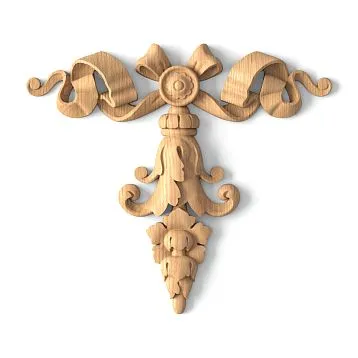
An overlay is a three-dimensional stucco element placed on a wall, panel, door leaf, or between walls. It creates a focal accent: the eye first goes here, then spreads to the other details of the set.
In a classic interior, overlays are usually symmetrical — one or two from the center. Their motifs: acanthus leaves, rosettes, cartouches, meander, palmettes, shells. The size of the overlay should match the area of the plane: for a wall 2.5 m wide, an overlay of 30–50 cm is suitable, for a wide panel — 60–90 cm.
STAVROS stucco is made of high-density polyurethane, ensuring precision of relief, ease of installation, and resistance to deformation. The surface is ready for painting: matte, tinted, or patina imitation.
Get Consultation
Moldings — the architectural skeleton of the interior
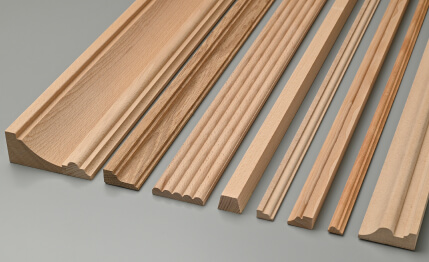
A molding is a decorative profile strip that forms frames, belts, and plane boundaries. Without molding, a classic interior is impossible: it is moldings that build the visual structure of the wall, divide it into panels, frame mirrors and niches, and create outlines around overlays.
Moldings made of polyurethane STAVROS are produced in several profiles: from laconic smooth rods to richly profiled belts with ornament. Width — from 20 mm to 100 mm and more, allowing you to choose a molding both for a modest frame around a mirror and for a large-scale belt in a grand hall.
Important: molding is chosen with a length margin. Connections are made at a 45° angle, which requires precise cutting — this must be considered when calculating the footage.
Cornices — the transition line from wall to ceiling
A cornice is the most technically complex and visually significant element of a classic set. It covers the angle between the wall and ceiling, creating depth and shadow, and giving the room a finished look.
The height of a cornice in a classic interior is selected proportionally to the ceiling height: for rooms 2.7–3.0 m — a cornice of 7–10 cm, for 3.0–3.5 m — 10–15 cm, for high formal rooms — from 18 to 25 cm. A wider cornice in a low room creates a oppressive effect and visually reduces the height — this is one of the most common mistakes when selecting independently.
Polyurethane Crown Molding STAVROS have a hollow construction, which facilitates installation and hides wall irregularities. Profiles range from a strict dentil to rich Baroque forms with cyma, ovolo, and astragal.
Ceiling rosettes — an accent in the center
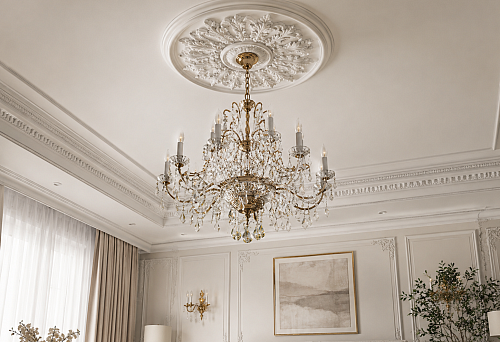
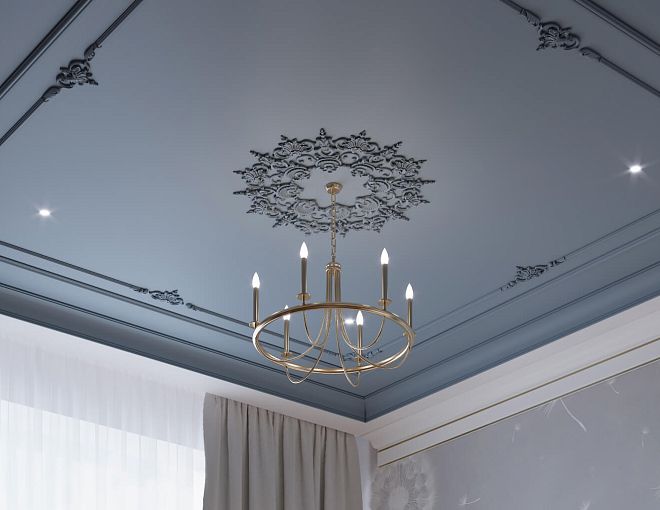
A ceiling rosette is a round or polygonal ornamental element placed in the center of the ceiling. Traditionally, it served as a base for a chandelier, but in a modern interior, the rosette is independent — it is an architectural accent that organizes the space of the ceiling plane.
The diameter of the rosette is selected based on the calculation: no more than 1/4 of the smaller room dimension. For a room 4×5 m, the optimal rosette is 80–100 cm. A small rosette in a large room gets lost, while one that is too large feels oppressive.
polyurethane rosettes STAVROS — from small accent rosettes with a diameter of 20 cm to large multi-tiered ones with a diameter of over 90 cm. The relief features acanthus leaves, petals, geometric motifs, and Empire-style ornaments. All rosettes are designed with installation in mind: the central hole allows for running the wire for the chandelier.
Linear moldings — decorative lines and bands
Linear moldings are decorative profiles used as linear elements: decorative rods, bands, dividing lines, and frames. Unlike moldings, Polyurethane trim usually has a thinner and lighter profile — it sets the rhythm without overloading the space.
In a classic set, the following moldings are used:
-
as a belt between the cornice and the wall
-
as a horizontal band dividing the wall into a lower panel and an upper part
-
as a frame element inside the panel
-
as a trim around the perimeter of the ceiling plane
STAVROS moldings are installed with liquid nails or construction adhesive, are easily cut at any angle, and accept any paint.
Capitals — architectural vertical
A capital is the crowning element of a column or half-column. It is the most "weighty" decorative element in a classic interior: it sets the scale, adds grandeur, and organizes a vertical accent.
In interior applications, capitals are used:
-
on pilasters (flat wall columns)
-
on corner columns in arched openings
-
as independent decorative accents on the wall
-
in the framing of door portals
Polyurethane capitals STAVROS are produced in classical order forms: Ionic (with volutes), Corinthian (with acanthus leaves), Tuscan (minimalist). The lightness of polyurethane allows them to be installed without wall reinforcement — unlike plaster or stone counterparts.
Decor for moldings — the finishing touch
Decor for Molding — these are inserts, corner elements, terminations, and rosettes used at molding intersections, frame corners, and span centers. It is the decor for moldings that turns a simple profile frame into a full-fledged stucco cartouche.
Corner elements include:
-
rectangular with ornament
-
corner connectors
-
central (for the middle of a long span)
-
finishing (for the edges)
How to assemble a classic set of moldings by zones
Wall moldings: frames, bands, accents
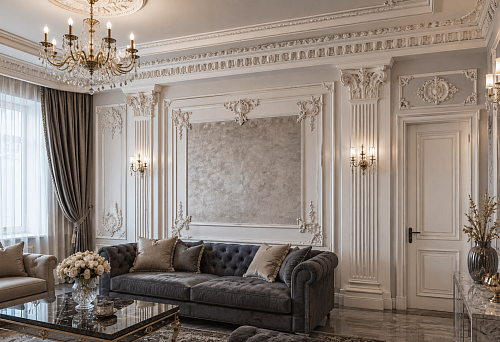
A wall in a classic interior is not just a plane. It is a field for architectural expression. The basic wall decoration scheme includes three horizontal levels: base (baseboard and lower band), main (panel with frames and overlays), and upper (frieze and cornice).
Minimum set for a wall:
-
Moldings made of polyurethane — panel frames
-
central overlay inside the frame
-
Decor for Molding — corner inserts
Extended set for a wall:
-
lower Trim like a belt above the baseboard
-
moldings for creating two or three panels across the wall width
-
central overlay in each panel
-
Decor for Molding in the corners
-
upper linear belt under the cornice
Key principle: panels must be proportional. Two equal panels look symmetrical and strict. Three create rhythm. Five are only appropriate in a long hall. Asymmetry without justification destroys the classical order.
Ceiling stucco: rosette, cornice, linear belt
The ceiling in a classical interior works on the principle of 'frame and center'. The frame is Cornice, which goes around the entire perimeter. Inside the frame there may be Trim — an additional belt set back from the cornice. The center is Rosette.
Classic ceiling scheme:
-
Cornice around the perimeter — creates transition and depth
-
Inner molding strip — optional, but adds layers
-
Central ceiling rosette
-
Additional accent rosettes in corners (for large surfaces)
In rooms with niches or multi-level ceilings, molding is used to outline each level. This creates a unified rhythm and visually connects the levels.
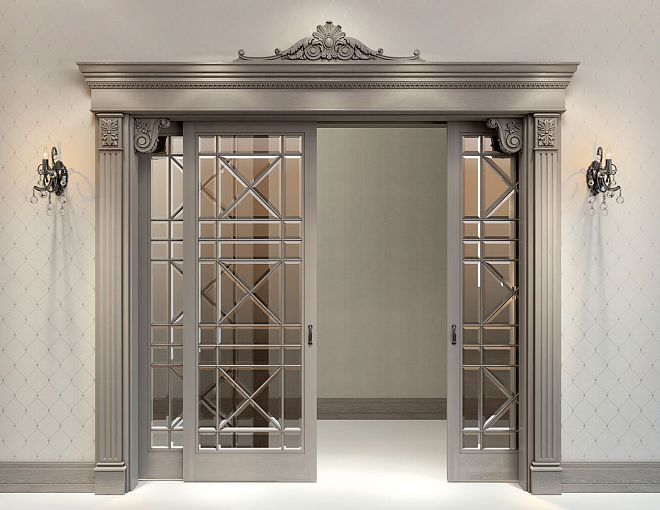
Molding for doorways: capitals, molding strips, overlays
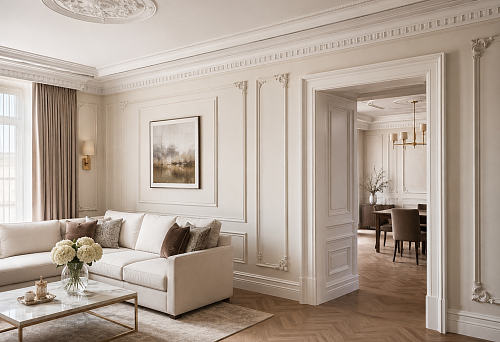
A doorway is an architectural portal that sets the first impression of a room. In a classic interior, it cannot be "just an opening." Its design follows an order scheme:
-
Pilasters on the sides of the opening with capitals at the top
-
Overdoor overlay (keystone or horizontal composition)
-
Molding as a profiled framing of an arched or straight opening
Even in a modest simple version molding trim with corner decor for moldings dramatically changes the perception of the doorway.
Living room: how to assemble a full classic set
The living room is a formal space where the most lavish set of moldings is appropriate.
Recommended composition:
-
Ceiling cornice around the perimeter — choose according to room height
-
Central ceiling rosette — diameter from 60 to 90 cm
-
Moldings on walls — three panels on the main wall, two on the side walls
-
Central overlays inside each panel
-
Corner decor for moldings at all frame joints
-
Linear molding as a horizontal belt at 90–100 cm from the floor
-
Capitals on pilasters on the sides of the fireplace or main mirror
All classical stucco direction from STAVROS is combined into a collection with coordinated motifs — which eliminates stylistic dissonance when using different elements from the same collection.
Study: rigor and scale
In the study, classicism takes on a different character — more restrained, but no less expressive. Here are appropriate:
-
Strict Moldings made of polyurethane without ornament — smooth profiles with expressive shadow
-
Medium-height cornice — 8–12 cm
-
Small rosette or its absence — replacement with a recessed light in a smooth ceiling
-
Capitals of the Tuscan order as the most laconic
-
Molding as a book belt — a horizontal band dividing the wall at the level of the top shelves
Hall and entrance area: first impression
The hall is the most indicative area in terms of architectural decor. This is where the first impression of the entire interior is formed. In the hall, the following work:
-
Large symmetrical Polyurethane appliqués on the walls
-
Cornice with a rich profile
-
Rosette in the center of the ceiling — preferably multi-tiered
-
Capitals on columns or pilasters on the sides of the entrance
-
A strict linear belt binding all walls into a single horizon
Symmetry in the hall is mandatory. Any asymmetry is perceived as a mistake, not a design technique.
How to choose the right size of elements
The most common mistake when buying classic moldings is choosing the size 'by eye' without calculating proportions. The result is either 'microscopic' decor on a large wall or an overloaded interior with elements that overwhelm the space.
Ceiling height is the starting point
It is the ceiling height that determines the permissible height of the cornice, the width of the molding, and the diameter of the rosette. Use the following approximate table:
| Ceiling Height | Cornice height | Molding width | Socket diameter |
|---|---|---|---|
| 2.5–2.7 m | 5–7 cm | 20–40 mm | 30–50 cm |
| 2.7–3.0 m | 7–10 cm | 40–60 mm | 50–70 cm |
| 3.0–3.5 m | 10–15 cm | 60–90 mm | 70–90 cm |
| 3.5 m and above | 15–25 cm | 80–120 mm | 90–120 cm or more |
Wall width and panel size
The panel should occupy no more than 1/5 of the width of the panel in which it is placed. For a panel 150 cm wide, a panel up to 30 cm is restrained. Up to 40 cm is full. Up to 50 cm is rich but not excessive. Larger only in formal rooms with a height of 3.5 m or more.
Rhythm of linear elements
The distance between repeating elements of the molding (decorative band with a repeating motif) should not exceed 3–4 lengths of the motif itself. Otherwise, the rhythm is lost and the band is perceived as a random set of details.
Furniture scale
Classic stucco scales with furniture. If the living room has large sofas and armchairs with high backs, the moldings and overlays can be voluminous. If the furniture is elegant and thin-legged, the stucco decor should be more delicate and refined.
Symmetry
Any set of classic stucco is built from the central axis: a rosette in the center of the ceiling, overlays symmetrically from the center of the wall, molding frames of equal size with identical gaps. Check symmetry before installation: a slight shift in a real room is much more noticeable than on a drawing.
Style within classic: how to choose the right direction
"Classic" is a broad concept. Within it, there are several directions, each dictating its own set of elements, proportions, and ornamental motifs.
Strict classic (neoclassicism, Palladianism)
This is the most restrained direction. Minimal ornament, clear horizontals, dentils and cyma reversa instead of rich cornices, smooth bands instead of intricate moldings. Suitable for modern apartments with high ceilings where architectural depth is desired without pomposity.
Elements: Moldings, Crown Molding, Trim with geometric profiles. From the STAVROS collections — "Classic".
Empire
Empire is classic in full regalia. Symmetry is brought to military strictness. Ornaments: laurel branches, eagles, torches, palmettes, meander. Cornices are multi-tiered, rosettes are rich, overlays are large.
Elements: Capitals of the Corinthian and Ionic orders, volumetric Outletsmassive Moldings. In STAVROS — Empire collection.
Versailles (lavish Baroque and Rococo)
Here it's no longer strictness, but luxury. Asymmetrical Rococo motifs, shells, scrolls, acanthus leaves in motion. Molding frames curve. Rosettes are multi-tiered. Overlays are large cartouches with ornament.
Elements: rich Polyurethane appliqués, multi-tiered Outlets, twisted molded belts. In STAVROS — «Versailles» collection.
Neoclassicism in modern interiors
It's a synthesis: the rigor of classical proportions plus modern materials and a restrained palette. Moldings here are an architectural accent, not a dominant feature. One molding instead of three, a rosette without a chandelier, a cornice without a complex profile.
For this style, choose from the section Polyurethane Items — it offers the widest range for any complexity of the set.
Standard sets: from minimal to architectural
Sometimes you don't need a full palace system, but a well-chosen minimum — two or three elements that make the interior read as classical. And sometimes — a complete architectural set for a grand hall. STAVROS covers both scenarios.
Minimum kit
Three elements that create a classical character with minimal investment:
-
Molding — a frame around a mirror or painting
-
Decorative insert — inside the frame
-
Molding decor — corner inserts at intersections
This set works even in small rooms with low ceilings without feeling cramped.
Wall set
Allows you to fully decorate one or more walls:
-
Moldings to create 2–3 panels
-
Central applique in each panel
-
Decor for Molding in the corners of the frames
-
Trim as a horizontal band
Ceiling set
Fully decorates the ceiling plane:
Architectural kit
For formal rooms with ceiling heights from 3.0 m:
-
Capitals on pilasters or columns
-
Multi-tiered Cornice
-
Trim on several levels
-
Large applique — central and corner
-
Multi-tiered Rosette 80–120 cm in diameter
-
Decor for Molding at all nodal points
Why polyurethane is the right choice for classic stucco
Historically, stucco was made from plaster. And classic plaster stucco is beautiful — in palaces, restored architectural monuments, and historical interiors. But it has limitations that make it inconvenient for modern use.
Let's compare:
| Parameter | Gypsum | STAVROS polyurethane |
|---|---|---|
| Weight | Heavy | Lightweight |
| Installation | Complex, requires reinforcement | Glue + mechanical fastening |
| Relief accuracy | High for handmade | High for industrial production |
| Moisture resistance | Low | High |
| Temperature response | Brittle under vibration | Elasticity |
| Painting | Primer required | Any paint |
| Price | High | More affordable |
Polyurethane in the production of decorative molding ensures precise reproduction of complex ornamental reliefs — acanthus leaves, volutes, meanders, cartouches. At the same time, the product remains lightweight, which simplifies and speeds up installation, allowing one person to work with it without scaffolding.
Moisture resistance makes polyurethane molding applicable in bathrooms and kitchens — where plaster would inevitably deteriorate. Elasticity prevents cracking under minor structural deformations of the building.
Mistakes when choosing a classic set of stucco molding
Let's analyze the most common mistakes — not for criticism, but so you don't make them.
Buying items one by one without an overall plan
This is the most common mistake. You bought a beautiful rosette, then found another molding, then an overlay from a third collection — as a result, the interior looks like a store display, not a well-thought-out space. Classics require a plan before purchase.
Mixing incompatible collections
An Empire-style overlay with a Rococo molding in the same room is a mistake. Each collection has its own plastic language: scale of details, character of curves, type of ornament. Within one collection, everything matches. Between incompatible collections, a professional eye is needed.
Placing small decor on a large surface
A molding 20 mm wide on a wall 3 meters high is not readable. It simply disappears. Choose elements with an understanding of viewing distance: the farther the viewer, the larger the decor should be.
Making a large rosette in a low room
A rosette with a diameter of 80 cm with a ceiling of 2.5 m "pulls" the ceiling down. The room visually shrinks. For standard apartments with ceilings up to 2.7 m — rosettes up to 50 cm.
Ignoring the width of the molding
A molding wider than 60 mm with a ceiling of 2.6 m creates a feeling of tightness. A molding narrower than 20 mm in a high room gets lost. Always correlate the width with the height and area.
Skipping corner elements
Molding frames without a corner decoration for moldings look unfinished. It is the corner insert that creates the "node", completes the frame, and turns a set of profiles into a solid architectural detail.
Not thinking about color in advance
Polyurethane Moldings sold white and painted on site. This is a plus: any shade, any patina, gilding, or contrasting color. But painting needs to be planned in advance: primer, type of paint, color selection in the context of the entire interior.
Where to buy a classic set of STAVROS stucco molding
The full range is available on the official website. Below are direct links for each kit category:
-
polyurethane moldings buy — decorative overlays, the full range
-
STAVROS "Classic" Collection — a style selection of all classic interior elements
-
Polyurethane moldings and cornices — profiles, rods, cornice systems
-
Polyurethane trim — decorative lines and belts
-
polyurethane rosettes — ceiling accents of all diameters
-
Polyurethane capitals — order elements for pilasters and columns
-
Decor for Molding — corner inserts, finials, central elements
-
All products made of polyurethane — full catalog
Additionally — style collections, if you have already decided on a direction: Empire style for formal interiors and «Versailles» for rich Baroque decor.
Practical tips for installing classic stucco
Tools and materials
-
Liquid nails or polyurethane adhesive
-
Adhesive gun
-
Putty knife for applying adhesive
-
Construction level and tape measure
-
Miter box or miter saw for cutting at an angle
-
Painter's tape
-
Acrylic sealant for joint sealing
Foundation Preparation
The surface must be dry, level, and dust-free. Minor unevenness on the wall is hidden by the adhesive — polyurethane is flexible and fills small gaps. For reliability, large and heavy elements (cornices, capitals) are additionally secured with self-tapping screws and dowels, which are concealed under a layer of finishing putty.
Marking
Before applying the adhesive, mark the layout with a pencil. For molding frames — check the diagonals. For cornices — check the horizontal level. For rosettes — find the geometric center of the ceiling.
Joints and corners
Moldings are joined at a 45° angle. The cut is made with a miter box. After installation, all joints are sealed with acrylic sealant and sanded — this becomes invisible before painting. Corner elements decoration for moldings are installed first, straight spans — between them.
Painting
After installation and drying of the glue, all stucco is primed and painted together with the walls or ceiling. Classic options:
-
White on white — the detail is revealed through shadow
-
Contrast color — stucco stands out
-
Patina (ochre, umber) — imitation of aged decor
-
Gilding — for ceremonial elements and accents
FAQ: answers to the most popular questions
What is STAVROS stucco made of?
Made of high-density polyurethane. This is a synthetic material that accurately reproduces complex stucco relief, is lightweight, moisture-resistant, and accepts any paint.
What is the difference between molding and trim?
Molding is a profiled decorative strip, typically wider and used for frames, belts, outlines. Trim is thin decorative rods that create rhythm and additional lines without overloading the space.
What is needed for a minimal classic set?
Molding, central overlay, and decor for moldings (corner inserts). These are three elements that create a classic accent on the wall with a minimal budget.
Do you need a ceiling rosette if there is no chandelier?
No. A ceiling rosette is an independent decorative element. It works even without a chandelier, organizing the center of the ceiling plane. It is especially effective in combination with recessed perimeter lighting.
Can elements from different collections be used?
Carefully. Within one collection, all elements are coordinated. Between close collections (e.g., "Classic" and strict "Empire") — it is possible provided there is a unified scale. Between "Versailles" and minimalist neoclassicism — the risk of dissonance is high.
Which cornice to choose for a 2.7 m ceiling?
The height of the cornice is 7–10 cm. The profile should have a cyma or ogee, without an overloaded ornament. This will support the classic character and not reduce the visual height of the room.
Where can I see the entire range of STAVROS stucco decor?
On the page Polyurethane Items — full catalog by categories: overlays, moldings, cornices, rosettes, linear elements, capitals, decor for moldings.
Can polyurethane stucco be installed in a bathroom?
Yes. Polyurethane is resistant to moisture and temperature changes. This is one of the key advantages over plaster. With reliable fixation and high-quality painting with moisture-resistant paint, durability in the bathroom is not inferior to dry rooms.
How to calculate molding quantity?
Measure the perimeter of the framing area, add 10–15% for waste when cutting at angles. For a frame system, calculate the length of each span and the number of frames. When ordering through the STAVROS website, you can clarify the calculation with specialists.
What paint to use for patina on stucco?
Base layer — white matte paint. Then apply a patinating compound (umber, ochre, bronze) in diluted form, wipe with a cloth so that the pigment remains in the recesses of the relief. The result is an aged effect, close to historical samples.
Classic set moldings from polyurethane — this is not an expensive luxury for a select few, but an accessible tool for creating an interior with architectural character. The main thing is not to buy chaotically, but to assemble a system: from cornice to baseboard, from central rosette to corner decor. This is exactly how Classical molding — works as a single organism, where each element enhances the whole.