










































































Article Contents:
- What are polyurethane products for interior
- How this article differs from other interior materials
- How to choose polyurethane products by application area
- Walls: three levels of decor
- Ceiling: three elements of the system
- Bottom line: baseboard as a decorative element
- Frames, panels, and accent zones
- How to assemble a set of polyurethane decor: three levels
- Minimum set: three items
- Medium set: five items
- Extended set: eight items
- Selection table: task — element — section
- Polyurethane wall products: what exactly to buy
- Polyurethane ceiling products: assembling the composition
- Polyurethane products for frames and decorative panels
- How not to buy too much: selection algorithm
- Polyurethane interior products: by room
- Living Room
- Bedroom
- Hall and Foyer
- Office
- Mistakes when choosing polyurethane products for the interior
- Where to buy STAVROS polyurethane interior products
- FAQ: polyurethane interior products
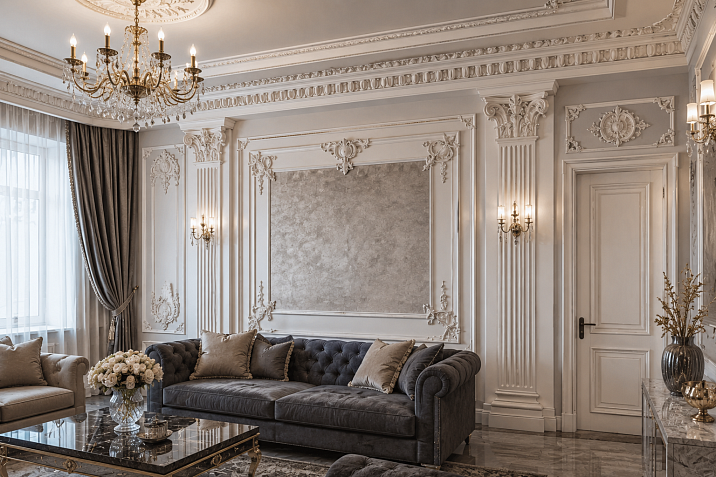
Imagine two people renovating identical apartments with the same layout. Both have the same wallpaper, the same paint, similar furniture. But the first one enters their apartment and feels: empty. The second one — and the eye immediately catches something expressive, complete, "expensive" even without expensive materials. What's the difference? In architectural decor. In the layer that turns a renovated apartment into a meaningful interior.
polyurethane interior items STAVROS is exactly that layer. Moldings, Moldings made of polyurethane, cornices, baseboards, ceiling rosettes, PU overlays and decorative elements for interior wall, ceiling and accent zone finishing. Not a random set of details — a coherent system where each element knows its place.
To avoid buying random decor and overpaying for what you don't need — first define the task: wall, ceiling, frame, accent, or the lower line of the room. And go to the correct section of the catalog. This is what the article is about: not ideas and inspiration, but a specific selection scheme.
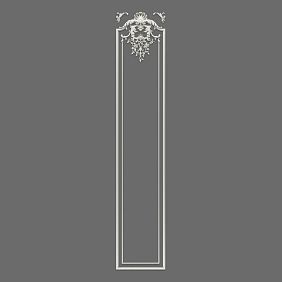
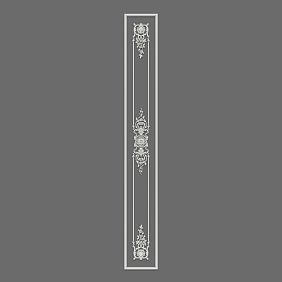
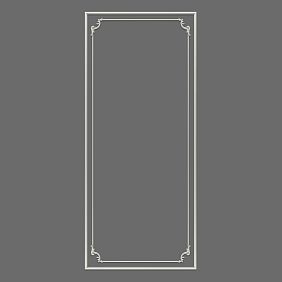
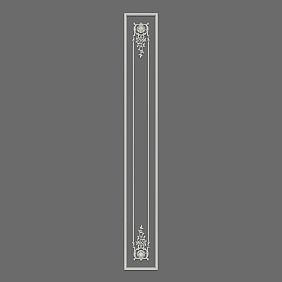
What relates to polyurethane interior products
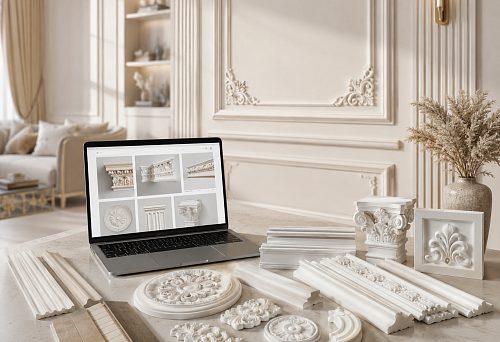
The question "what exactly to buy" requires understanding the system. Decorative polyurethane elements for interior finishing — this is not one product and not one category. This is an architectural system where each element has its own zone and its own role.
Full composition:
Moldings are linear decorative profiles for frames, horizontal bands, and decorative lines on walls. Width from 15 to 120+ mm. Standard segment length is 2 m. Installed horizontally, vertically, diagonally — depending on the task.
Cornices are ceiling profiles for finishing the joint between wall and ceiling. Height 40–200 mm. They set the upper horizontal line of the room and create an architectural transition between two planes.
Baseboards are lower profiles for finishing the joint between wall and floor. Height 35–150 mm. In a classic interior, they are not a utilitarian detail but a decorative element with a clear profile.
Ceiling rosettes are individual round or polygonal elements for decorating the chandelier attachment point. Diameter 200–800+ mm. They create a decorative center of the ceiling.
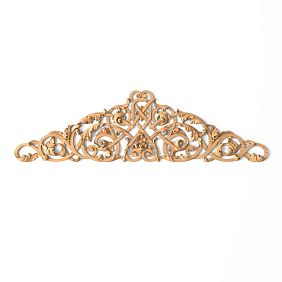
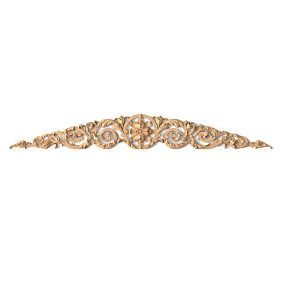
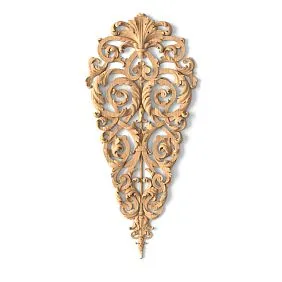
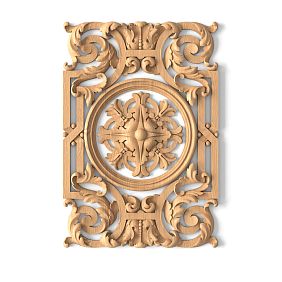
PU overlays are individual decorative elements for accent zones: medallions, cartouches, ornamental inserts. Installed on walls, in the centers of frames, above doorways.
Wall decor — wall decorative elements for accent zones, horizontal friezes, ornamental bands, and decorative panels.
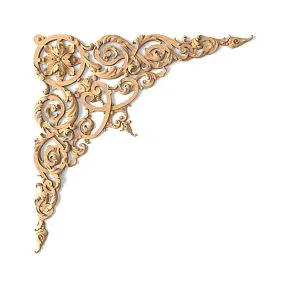
Decor for moldings — corner blocks, inserts, and connecting elements for frame schemes. They cover corner joints of moldings and add a decorative accent in frame corners.
Decor for ceilings — additional ceiling elements for extended ceiling compositions: rings around the rosette, ornamental bands, ceiling medallions.
All eight types are Polyurethane moldings in a broad sense: a decorative system for interior finishing. They do not compete with each other — they complement. And it is in combination that they give the result for which the interior is called "professionally designed."
Why polyurethane and not plaster? Three arguments that decide everything:
-
Weight. A standard 2 m polyurethane molding weighs 300–800 g. A plaster equivalent weighs 1.5–4 kg. The difference is fundamental when mounting on a wall without fasteners.
-
Installation. Mounting adhesive, 15–20 minutes of fixation, no dowels or drilling. Plaster requires primer, screws, and experience.
-
Processing. Polyurethane is cut with a utility knife or hacksaw. Any angle, any radius, any contour — without special equipment.




How this article differs from other materials about interiors
This does not overlap with what has already been written. Understanding the difference is simple:
-
"Stucco molding in the interior" is about ideas and inspiration. It answers the question "what does it look like."
-
"Stucco molding on the wall" is about a specific area of application.
-
"Stucco molding on the ceiling" is similar, but for the ceiling.
-
The installation instructions are about how to glue. They are in in a separate guide.
This article answers one question: what exactly to buy and which catalog section to go to. Here — not general ideas, not inspiring photos, not instructions. Here — the structure of the decor system, a kit selection scheme, and direct links to real STAVROS product sections.
Each block is a specific element, a specific task, and a specific URL.
Our factory also produces:



How to choose polyurethane products by application area
The most common mistake is to start choosing with the product, not the task. "I want something beautiful on the wall" is not a request, it's a guarantee to buy the wrong thing. Start with the zone: wall, ceiling, bottom line, frame, accent. Then — with the function. Then — with the specific catalog section.
Get Consultation
Walls: three levels of decor
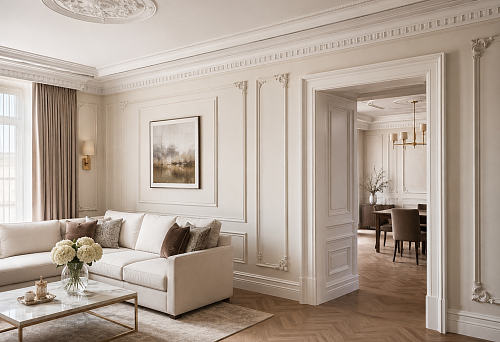
The wall is the largest plane in the room. It forms the visual character of the room. Polyurethane wall decor for walls is built on three levels.
Level 1 — linear elements. Moldings made of polyurethane create horizontal and vertical lines. One horizontal belt at a height of 90–100 cm from the floor divides the wall into a "base" and a "main field". Two belts create a classic three-part division. A frame scheme of moldings turns a flat wall into a structured surface with clear geometry.
Level 2 — decorative accents. PU overlays — point decorative elements. A medallion above the door. A cartouche in the center of the frame. An ornamental insert on the accent wall. Each such element adds a semantic point and makes the decor rich.
Level 3 — wall ornamental zones. Wall Decor — for horizontal friezes, ornamental strips, decorative wall panels. This level is for interiors where the wall decor should be rich and detailed.
For walls you need:
-
Moldings — frames, belts, decorative lines
-
Wall Decor — ornamental accents and wall zones
-
PU overlays — point decorative elements
-
Decor for Molding — corner blocks for frames
What is important to understand: moldings are the skeleton of wall decor. Without moldings, there is no frame. Without a frame, there is no structure. The other elements are the "flesh" on this skeleton. But it is the skeleton that determines whether the decor will look well-thought-out.
Ceiling: three elements of the system
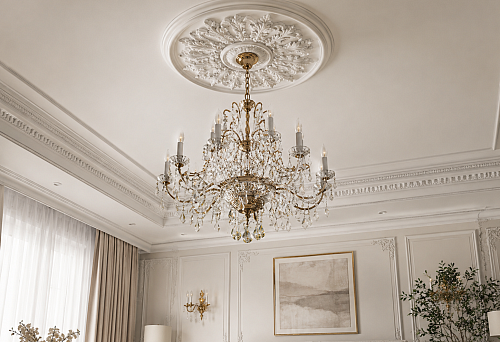
The ceiling is the fifth wall, visible from everywhere. Polyurethane Ceiling Moldings is built from three elements.
Cornice — the foundation of any ceiling system. a polyurethane cornice installed along the perimeter of the ceiling and decorates the junction of two planes. Without a cornice, this junction is just a boundary, an angle. With a cornice, it becomes an architectural transition. Cornice height: 40–200 mm. For a 2.5 m ceiling — 50–80 mm. For a 3 m ceiling — 100–140 mm. For formal rooms with a 3.5 m ceiling — 140–200 mm.
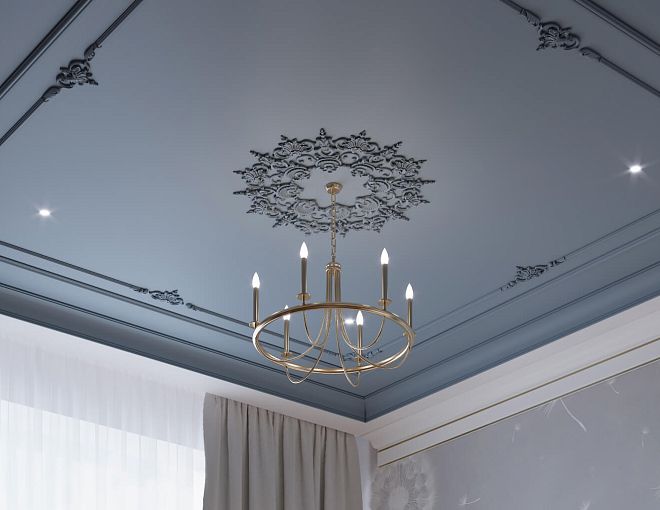
Ceiling rosette — the center. ceiling rose made of polyurethane installed at the chandelier attachment point. Diameter — proportional to the room's area and height. Up to 14 m² — 250–380 mm. 20–30 m² — 400–600 mm. Over 35 m² — 550–800 mm. The rosette covers the cable attachment point and visually "anchors" the light fixture to the ceiling.
Ceiling decor — development of the composition. polyurethane ceiling decor — ornamental rings around the rosette, ceiling medallions, additional decorative belts. For spacious halls with high ceilings, for classic formal interiors — an extended ceiling composition is mandatory.
Principle of coordinating ceiling elements: the cornice and rosette must be in the same stylistic direction. A smooth geometric cornice — with a geometric rosette. A cornice with floral relief — with an ornamental rosette. Mismatch is perceived instantly.
Bottom line: baseboard as a decorative element
Polyurethane Baseboards — the lower decorative line of the room. In a good interior, the baseboard is not a "gap cover." It is a full-fledged decorative profile with height and relief matching the cornice and moldings.
Classic proportions: baseboard height is 60–80% of the cornice height. Frame molding width is 40–60% of the baseboard height. This is not a strict rule, but proportion violations are immediately visible: a too-high baseboard "eats up" the lower part of the wall, a too-low one "gets lost" near the floor.
Height of polyurethane baseboards in the STAVROS catalog: from 35 to 150+ mm. The choice depends on the specific ceiling height and interior style.
Frames, panels, and accent zones
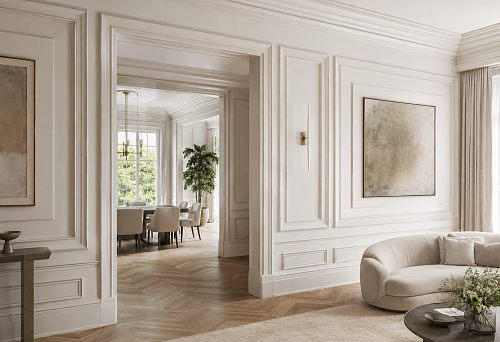
The frame decorative scheme is one of the most expressive techniques in interior design. The wall is divided into rectangular fields by moldings. Each field is a "frame" with a clear architectural outline. Result: a flat surface turns into a structured wall "picture."
For frame schemes, you need:
-
Moldings — the perimeter of each frame
-
Decor for Molding — corner blocks for the four corners of the frame
-
PU overlays — central accent elements inside the frames
A corner block is a fundamental element. Without it, the four ends of the molding meet at a 45° angle — this requires perfectly precise cutting and still looks less expressive than a decorative corner block. Decorative polyurethane elements for interior finishing in the form of corner blocks — this is a solution that simultaneously simplifies installation and enriches the decor.
How to assemble a polyurethane decor kit: three levels
The rule "buy everything at once" works poorly. The rule "start with the minimum and expand as needed" always works.
Minimum kit: three items
Three elements that already change everything:
-
Moldings for horizontal lines or frames on walls
-
Cornice for ceiling perimeter design
-
Skirting for the bottom line
This set creates the basic architecture of the room: top, bottom, horizontal wall pattern. The wall gains scale and structure.
Who it suits: rental apartment, first experience with decorative molding, budget renovation with a quality finish.
Cost of the kit for a 15 m² room: approximately 3,000–8,000 rubles depending on the width of the profiles and series.
Medium set: five items
Adds a ceiling centerpiece and decorative accents — the interior gains completeness:
A ceiling rosette completes the upper plane and 'puts a dot' in the center of the ceiling. Overlays accentuate frames or openings. Five items are already a full architectural story, not just 'something on the walls'.
Who it suits: living room, bedroom, study in classic or neoclassical style.
Extended set: eight items
Complete system — from baseboard to ceiling decor:
All eight elements in a single system — this is no longer 'stucco', it's architecture. Walls with frame schemes, corner blocks, and overlays. Ceiling with cornice, rosette, and concentric ornamental rings. Baseboard proportional to the cornice. This is a grand interior in full scope.
Who it suits: classic and neoclassical interiors, country houses, representative hotels, restaurants, private mansions.
Selection table: task — element — section
| Task | What to choose | Catalog section |
|---|---|---|
| Buy polyurethane products for interior | General section | Polyurethane Items |
| Frames and decorative lines on walls | Moldings | Moldings |
| Finish the joint between wall and ceiling | Cornices | Crown Molding |
| Lower decorative line of walls | Baseboards | Baseboards |
| Design a chandelier and create a ceiling center | Ceiling rosettes | Outlets |
| Decorative accents on walls and frames | PU overlays | applique |
| Decor of wall panels and accent zones | Decor for Walls | Wall Decor |
| Corner and connecting elements of frames | Decor for moldings | Decor for Molding |
| Extended ceiling composition | Decor for Ceilings | ceiling decor |
Polyurethane products for walls: what exactly to buy
A wall decor system is not just "glue a molding". It is a sequence of decisions, each affecting the result.
Step 1. Choose a scheme. Horizontal belt (one line) or frame scheme (contours)? Belt is faster, simpler, less material. Frame scheme is more expressive, monumental, requires more elements.
Step 2. Choose the molding width. Width determines the "weight" of the decor. Narrow molding (20–35 mm) is delicate, for small rooms and modern interiors. Medium (35–65 mm) is universal, suitable for most rooms. Wide (65–120 mm) is monumental, for large walls and classic interiors.
Step 3. Add corner elements. For each frame, four corner blocks are needed from decoration for moldingsThe corner must match the width of the molding.
Step 4. Decide on overlays. PU overlays in the center of each frame — this is the transition from "geometry" to "decor". One overlay changes the perception of an entire frame.
Step 5. Calculate the footage. Perimeter of each frame × number of frames + 10–15% reserve. Reserve is mandatory: cutting molding at an angle results in material loss.
Example calculation for an accent wall 4 × 2.8 m with three frames 1.0 × 1.2 m: perimeter of one frame = 4.4 linear meters. Three frames = 13.2 linear meters. 15% reserve = 15.2 linear meters. 2 m pieces = 8. Corner blocks = 12 pieces. Overlays = 3 pieces (optional).
Polyurethane products for the ceiling: assembling the composition
A ceiling system of three elements — cornice, rosette, ceiling decor — is built on a single principle: from the perimeter to the center.
Cornice — perimeter. First, the cornice is selected. It sets the style and scale of the entire ceiling system. Polyurethane ceiling cornices in the STAVROS catalog — from laconic 40 mm profiles to monumental 200 mm cornices with developed relief.
Rule for choosing the height of the cornice:
-
Ceiling up to 2.7 m: cornice 50–90 mm
-
Ceiling 2.7–3.0 m: cornice 90–130 mm
-
Ceiling 3.0–3.5 m: cornice 120–170 mm
-
Ceiling above 3.5 m: cornice 150–200+ mm
Rosette — center. Chosen in the same style as the cornice. polyurethane rosette — this is not a "circle under the chandelier." It is the architectural center of the ceiling plane, visible from any point in the room.
Decor for ceilings — development. Polyurethane ceiling decoration — for rooms where one rosette is not enough. An ornamental ring around the rosette (diameter 30–50% larger than the rosette) creates a ceiling "picture" with several concentric zones.
Matching rule: cornice and rosette — one style direction. Geometric cornice + geometric rosette. Floral cornice + floral rosette.
Polyurethane products for frames and decorative panels
Frame scheme is the most "expressive" wall decor technique. Three usage options.
Boiserie — frames from baseboard to cornice or to a fixed height. The entire wall becomes "paneled." Requires wide moldings (50–100 mm), corner blocks, and uniformity of all frames.
Accent wall — one wall (behind the sofa, behind the headboard, behind the desk) with a frame scheme. The other walls are plain. The concentration of decor creates focus and depth without overloading the entire room.
Decorative panel — one or several large frames in a non-standard position: above the fireplace, between windows, on the end wall of a staircase. polyurethane decorative moldings For such panels, choose those with maximum relief — they should "hold" the eye even when used singly.
All three options share the same set:
The difference is in scale, molding width, and number of frames.
How to avoid buying too much: selection algorithm
Seven steps that eliminate mistakes.
1. Define the zone. Wall? Ceiling? Bottom line? Frame? Accent? One zone — one priority.
2. Select a base element for the zone. Wall → molding. Ceiling perimeter → cornice. Bottom line → baseboard. Ceiling center → rosette. Accent → overlay.
3. Add related elements. For molding — corner blocks. For rosette — cornice. For cornice — baseboard. For overlay — molding frame.
4. Check size. Cornice 130 mm with a 2.5 m ceiling — too massive. Rosette 250 mm for a 40 m² hall — too small. Proportions are key.
5. Check style. All elements — one style direction. Minimalism + minimalism. Classic + classic.
6. Calculate footage with reserve. Linear elements: perimeter × 1.1–1.15. Piece elements: by number of zones.
7. Go to the correct catalog section. Polyurethane Items — starting point. Profile subsections — for precise selection.
Polyurethane products for interiors: by room
Living Room
Maximum decorative richness is justified here. The living room is a space of representation, and Polyurethane decor for interiors in the living room it works at full strength.
Recommended set for a living room 20–35 m²:
-
Cornice 110–150 mm
-
Moldings 45–70 mm for three frames on an accent wall
-
Rosette 450–600 mm
-
Corner blocks for frames
-
PU overlays (one per frame — optional)
-
Baseboard 85–110 mm
Style for the living room: from moderate neoclassicism to rich classicism — depending on ceiling height and room scale.
Bedroom
Restrained but complete. Polyurethane molding for interior in the bedroom works in a "delicate accent" mode.
Recommended set for a bedroom of 14–20 m²:
-
Cornice 70–95 mm
-
Molding 30–50 mm for the frame behind the headboard
-
Rosette 320–450 mm
-
Baseboard 60–85 mm
-
Corner blocks for the frame
Color: white or cream. Without patina, without gold — pure "architectural white."
Hall and Entrance
The first room a guest sees. molded decoration made of polyurethane in the hallway — this is what forms the first impression of the home.
Recommended set for the hallway:
-
Cornice 80–110 mm
-
Horizontal molding strip at a height of 100 cm
-
Baseboard 80–100 mm
-
For the accent wall opposite the entrance — one frame with corner blocks
A concise scheme works even in a small hall. Cornice + strip + baseboard = an architectural "frame" for the entire space.
Office
Strictness and focus. An office is not a place for lavish decor. Polyurethane products for the office — this is a moderate or minimal set.
Recommended set:
-
Cornice 65–85 mm, smooth or with a geometric profile
-
Molding 35–55 mm for vertical frames on the work wall
-
Baseboard 60–80 mm
-
Rosette 280–400 mm, geometric
No floral ornaments. Only clear lines. Only architectural rigor.
Mistakes when choosing polyurethane products for interior
Buying overlays without moldings and a general scheme. An overlay without a frame is a "sticker" on the wall. It must be part of a system.
Mixing interior and facade decor. These are different materials with different characteristics. Facade decor is for outdoor use. Indoors — only interior series.
Choosing a cornice without considering ceiling height. A 160 mm cornice with a 2.5 m ceiling will turn the space into a "cave." Scale is always a priority.
Not linking the baseboard with the cornice and moldings. Three different profiles bought randomly will not create a system. Proportionality and stylistic unity are needed.
Buying moldings without calculating a reserve. The "not enough" mistake is one of the most frustrating. Always +10–15% to the calculated footage.
Ignore corner elements. Without decoration for moldings frames look unfinished. Corner block is not an option, but a mandatory part of the frame scheme.
Link to a non-existent URL. All transitions — only to real catalog sections. Main: Polyurethane Items.
Where to buy polyurethane products for interior STAVROS
Full range polyurethane products for interior collected in the main section of the STAVROS catalog. For precise selection — profile subsections:
-
moldings, cornices, and baseboards — linear profiles
-
Crown Molding — ceiling perimeter
-
Baseboards — bottom line
-
ceiling rosettes — ceiling center
-
PU overlays — accent elements
-
Wall Decor — wall ornamental zones
-
Decor for Molding — corner and connecting elements
-
ceiling decor — extended ceiling compositions
All items — with photos, article numbers, sizes and prices. For painting with acrylic paint. On mounting adhesive without special tools.
STAVROS — Russian manufacturer and supplier of decorative polyurethane stucco for interiors. Complete system of interior finishing elements: from basic cornice to extended ceiling compositions with rings and medallions. Stylistically coordinated collections — from minimalist to classic. STAVROS interior system is not a set of parts, it is architecture in your home.
FAQ: polyurethane products for interiors
What is included in polyurethane products for interiors?
Moldings, cornices, baseboards, ceiling rosettes, PU overlays, wall decor, decor for moldings and ceiling decor. Full section: Polyurethane Items.
Where to start choosing?
By defining the zone: wall, ceiling, bottom line, frame or accent. Then — the base element for that zone, then — related elements.
Can I buy only one element?
Technically — yes. Practically — one element without a system works worse. Minimum: molding + cornice + baseboard.
Do I need to take all elements from one series?
Preferably from one style direction. One series is ideal, but not necessary.
Can polyurethane molding be painted?
Yes. Acrylic paint of any color without preliminary priming.
How to calculate the required footage?
Perimeter of the area × 1.1–1.15 (with a margin of 10–15%). Divide by the length of one piece (usually 2 m).
Where to buy everything for STAVROS interiors?
Main section: Polyurethane Items. All profile subsections are there as well.