










































































Article Contents:
- What you can buy in the STAVROS stucco online store
- How this article differs from the catalog
- How the STAVROS polyurethane stucco catalog works
- General section: polyurethane products
- Moldings, cornices and baseboards: linear profile
- Polyurethane cornices: ceiling line
- Polyurethane baseboards: lower architectural line
- Polyurethane ceiling rosettes: center of the ceiling
- PU overlays: piece accents
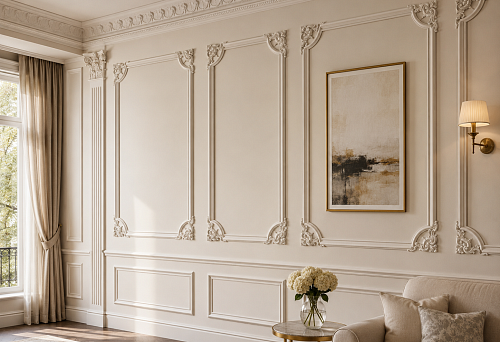
- Polyurethane wall decor: wall compositions
- Molding decor: corner elements and inserts
- Ceiling decor
- Navigation table for the STAVROS catalog
- How to choose polyurethane stucco by task: four scenarios
- Scenario 1. I want stucco on the walls — how to start
- Scenario 2. I want to decorate the ceiling — what to take
- Scenario 3. I want a full set for the living room
- Scenario 4. Small room — what to take to avoid overloading
- How to assemble a stucco kit before purchasing
- Minimum kit
- Medium set
- Extended set
- How to choose a stucco style: five architectural directions
- Modern classics and contemporary
- Neoclassicism
- Classic
- Neoclassicism
- Interior with high ceilings
- How to avoid mistakes when choosing stucco in an online store
- How to calculate footage and quantity before purchasing
- What to reinforce with internal links in the text
- STAVROS collections: how to find a stylistically consistent set
- Where to buy polyurethane stucco: final links
- FAQ: how to choose polyurethane stucco in an online store

Imagine the situation: you have decided on stucco. You open an online store, see dozens of sections, hundreds of items — moldings, cornices, rosettes, overlays, baseboards, wall decor, decor for moldings. And instead of the joy of anticipation — confusion. Where to start? Which section to open? What to buy first?
This article exists precisely to eliminate this confusion once and for all.
В STAVROS polyurethane molding online store A decorative set is assembled from specific catalog elements: moldings, cornices, baseboards, ceiling rosettes, PU overlays, wall decor, and molding decor. The purpose of this article is not to sell you a product directly (the catalog is for that), but to explain the logic of selection: which section to open for your task, how a cornice differs from a molding, how to check element compatibility, how to calculate the quantity and avoid buying too much.
Polyurethane moldings — it's a system. Buying "some stucco decoration" means buying a random element that either won't fit in size, won't match in style, or will turn out to be not what you needed. Buying a set consciously means getting an interior where all details work together.
Let's start from the very beginning.


What you can buy in the STAVROS stucco decoration online store
The main principle of the STAVROS catalog: polyurethane moldings — it's not "stucco decoration in general," but a system of products divided into functional groups. Each group addresses a specific decorative task in a specific area of the interior.
Eight main groups:
-
Moldings, cornices, and baseboards — linear profiles for walls, ceiling, and floor
-
Cornices — ceiling line, plane junction
-
Baseboards — bottom line, final touch near the floor
-
Ceiling rosettes — the center of the ceiling plane for a chandelier
-
PU overlays — individual accent elements
-
Wall decor — wall panels, belts, frame decor
-
Decor for moldings — corner elements, frame inserts
-
Ceiling decor — additional ceiling elements
If you are looking for where to buy molded decoration made of polyurethane — you are in the right place. But you need to buy not "something," but specific items for specific areas.
Polyurethane as a material is not chosen by chance. It is lightweight: a standard 2 m long molding weighs 300–600 g. It is dense: the relief is conveyed accurately, the edges are sharp. It does not deform under normal room conditions. It is cut with a regular hacksaw or a sharp utility knife. It is painted with any acrylic paint. It is glued with mounting adhesive without special tools. For interior decor, it is the optimal material.




How this article differs from a catalog
This is an important point — without it, the article loses its meaning.
STAVROS Polyurethane Product Catalog — это место для выбора и покупки конкретных товаров. Карточки с фото, размерами, артикулами, ценами, кнопкой «купить». Именно туда нужно идти, когда вы уже знаете, что именно вам нужно.
Эта статья — навигатор. Она отвечает на вопрос «какой раздел открыть» ещё до того, как вы зашли в каталог. Она объясняет разницу между молдингом и карнизом, между розеткой и накладкой, между декором для стен и декором для молдингов. Она показывает, как собирается комплект из разных категорий в единую систему.
Разделение простое:
-
Хотите посмотреть товары и купить → Polyurethane Items
-
Хотите понять, что именно вам нужно → читайте эту статью, затем переходите в нужный раздел
Важная оговорка: статья не заменяет каталог и не конкурирует с ним. Каждый смысловой блок ниже завершается прямой ссылкой на соответствующий товарный раздел. Это и есть правильная логика: объяснить — направить — купить.
Our factory also produces:



Как устроен каталог лепнины из полиуретана STAVROS
Разберём каждый раздел отдельно. Не формально, а с объяснением: что это такое, чем отличается от соседних разделов, когда именно он нужен.
Get Consultation
Общий раздел: изделия из полиуретана
Polyurethane moldings — главный раздел каталога. Это отправная точка для любого, кто ищет декоративные элементы из ПУ. Здесь собраны все восемь групп изделий: от молдингов до потолочных розеток.
When to open: when you haven't yet decided on a task and want to see the full range. When searching by key query «buy stucco» or «buy polyurethane decor» — and want to see the entire spectrum of possibilities.
What is important to understand about this section: it does not display products in random order. Items are organized into groups — and it is the structure of these groups that helps you navigate. But if you already know you need a cornice — go directly to the cornices section.
Moldings, cornices, and baseboards: linear profile
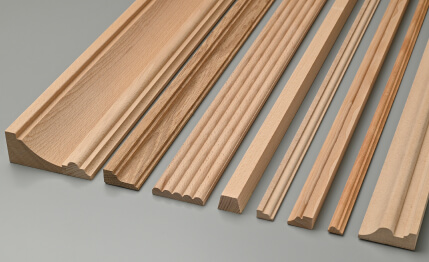
Polyurethane moldings, cornices, and baseboards — the largest group in the catalog. These are linear profiles: long segments of standard length (usually 2000 mm) with a specific cross-section.
Molding, cornice, and baseboard — three varieties of one group. How do they differ?
Molding is a universal profile. Used on walls: for frames, door/window surrounds, horizontal bands. The cross-section is usually simple: rectangular or semicircular relief, chamfer, simple profile. Width — from 20 to 120 mm.
Cornice is a profile with a more complex cross-section, designed for the transition from wall to ceiling. The cornice has an «overhang» — a horizontal shelf that extends onto the ceiling plane. This creates a visual separation of the wall from the ceiling and a sense of «completeness» in the interior. Cornice height — 50–160 mm depending on profile complexity.
Baseboard is a profile for the bottom line of the wall. Installed at the floor: hides the gap between the wall and flooring, creates the lower architectural line. Height — from 50 to 200 mm.
When to open the section molding: for any linear tasks. Frames on walls, door/window surrounds, horizontal bands, transitions between zones.
Polyurethane cornices: ceiling line
Polyurethane Crown Molding — a separate section for ceiling profiles with projection. Here are collected cornices of different scales: from laconic 60 mm to developed classic 160 mm.
How to choose a cornice based on ceiling height:
-
Ceiling 2.5 m → cornice 50–70 mm, projection 30–50 mm
-
Ceiling 2.7–2.8 m → cornice 70–100 mm, projection 50–70 mm
-
Ceiling 3 m → cornice 90–120 mm, projection 60–90 mm
-
Ceiling 3.5 m and above → cornice 120–160 mm, projection 80–120 mm
The proportion "ceiling height → cornice size" is a basic rule. Breaking it means getting either a "scratch" under the ceiling (too small a cornice) or an overhanging heavy shelf (too large a cornice).
A polyurethane ceiling cornice is mounted with glue without dowels or special tools. For walls 4–5 m long, 2–3 pieces of 2 m each are needed: profile joints on straight sections are made at a right angle with alignment of the relief.
Polyurethane skirting boards: the lower architectural line
Polyurethane Baseboards — this is the element that is bought last, but in vain. The skirting board is the lower horizontal line of the room. It "closes" the interior from below just as the cornice closes it from above.
The principle of choosing baseboard height: approximately 50–60% of the cornice height. Cornice 90 mm → baseboard 50–55 mm. Cornice 120 mm → baseboard 65–75 mm. This creates visual balance: the interior "holds" equally confidently at the top and bottom.
STAVROS baseboard range: height from 60 to 200 mm. Profiles are smooth (for modern style) and with relief (for neoclassical and classic styles). Standard segment length — 2000 mm.
Calculation of baseboard footage: room perimeter minus width of doorways, plus 10% reserve. Example: room 4 × 5 m, door 0.9 m. Perimeter = 18 m − 0.9 m = 17.1 m + 10% ≈ 19 linear meters = 10 segments of 2 m.
Ceiling rosettes made of polyurethane: center of the ceiling
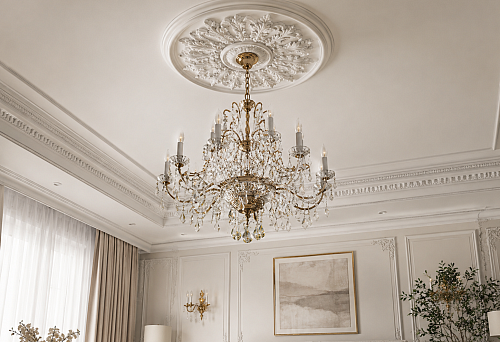
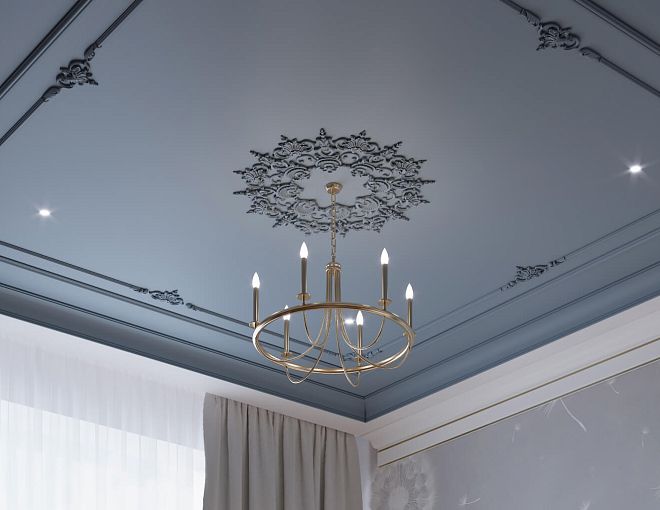
Polyurethane ceiling rosettes — a decorative element that is mounted in the center of the ceiling plane under the chandelier. The rosette simultaneously hides the electrical cable outlet point and creates an architectural center of the ceiling.
How to choose the diameter:
-
Room up to 12 m² → rosette 200–300 mm
-
Room 15–20 m² → rosette 300–450 mm
-
Room 20–30 m² → rosette 400–550 mm
-
Hall from 30 m² → rosette from 500 mm
Additional guideline: the diameter of the rosette should be 1.5–2 times larger than the diameter of the chandelier base. This creates a feeling of "framing" the light fixture, rather than just a "backing".
The style of the rosette should match the style of the cornice and moldings. For neoclassicism — geometric relief with moderate ornament. For classicism — developed floral relief. For modern classicism — smooth or with minimal relief.
PU overlays: piece accents
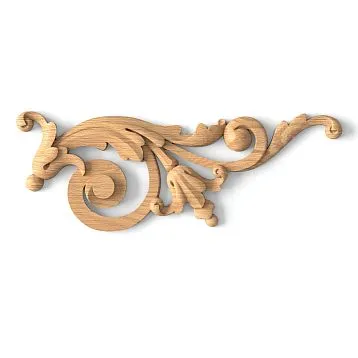
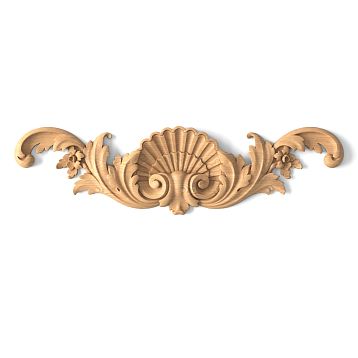
PU overlays — these are piece polyurethane decor for accent zones. Unlike linear profiles (molding, cornice, baseboard), overlays are piece products: each with an individual shape and relief.
What are PU overlays by function:
-
Decorative accents on walls — installed in the center of a frame, above a door, in the corner of a niche
-
Capital for pilaster — upper decorative element of a vertical accent
-
Base for pilaster — lower element of a vertical accent
-
Keystone — upper accent in an arched opening
-
Medallion — round or oval decorative element
Sizes of PU overlays in the STAVROS catalog: from small decorative inserts 80 × 80 mm to large accent elements 300 × 400 mm and more. Choose based on the scale of the frame or opening, not separately from the system.
Polyurethane wall decor: wall compositions
Polyurethane wall decor — for creating extensive wall decorative systems: panels, bands, frame fields, vertical accents.
How is wall decor different from moldings? Molding is a linear profile for outlines. Wall decor includes more diverse shapes for filling and decorating the surface.
Typical applications:
-
Horizontal band on the wall (dividing the wall into upper and lower zones)
-
Decorative panels in the boiserie area
-
Vertical accents between frames
-
Filling fields of frame schemes
Polyurethane wall decor works in pair with moldings: molding defines the outline, wall decor fills the field.
Decor for moldings: corner elements and inserts
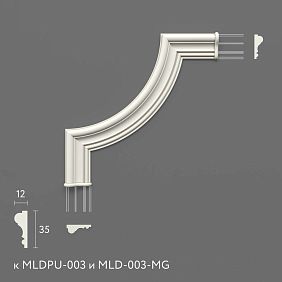
Decor for polyurethane moldings — corner blocks, inserts and decorative elements for frames. This is the element that turns a simple molding contour into an expressive frame with decorated corners.
The corner element is mounted in the corner of the frame: it hides the ends of the molding and creates a decorative accent. One corner block — instead of cutting two profiles at 45°.
Important: corner elements are selected for a specific molding profile. The size and cross-section of the block must match the width of the molding. Do not select corner elements separately from the molding — only as a pair.
Ceiling decor
polyurethane ceiling decor — additional ceiling elements: medallions, beams, decorative inserts. For rooms with high ceilings and a classic style — this is an addition to the rosette and cornice.
Navigation table for the STAVROS catalog
| Your task | Which section to open | Link |
|---|---|---|
| Buy polyurethane stucco in general | All polyurethane products | moldings catalog |
| Frames on walls | Moldings | Moldings |
| Ceiling line | Cornices | Crown Molding |
| Bottom line near the floor | Baseboards | Baseboards |
| Chandelier decor | Ceiling rosettes | Outlets |
| Accent elements | PU overlays | PU overlays |
| Wall panels and belts | Decor for Walls | Wall Decor |
| Frame corners | Decor for moldings | Decor for Molding |
| Ceiling beams and elements | Decor for Ceilings | ceiling decor |
How to choose polyurethane stucco for your task: four scenarios
The abstract principle of "define your task" works better when tasks are shown concretely. Let's look at four real scenarios.
Scenario 1. I want stucco on the walls — how to start
You've seen framed walls — rectangular molding contours that create rhythm and depth. You want that in your home.
What you need:
-
Moldings made of polyurethane — choose a profile by width (30–60 mm for standard rooms) and style
-
Decor for Molding — corner elements (4 pieces per frame)
-
Optionally: PU overlays to the center of the frames
Calculation: draw a diagram of the frames on the wall with dimensions. Add up the perimeter of each frame — this is the length of molding. Multiply the number of frames by 4 — this is the number of corner blocks.
Scenario 2. I want to decorate the ceiling — what to take
Ceiling decor is the most noticeable: it is visible from the entire room at once.
What you need:
-
a polyurethane cornice — along the perimeter of the ceiling. Length = room perimeter + 10%
-
Ceiling rosette — one, in the center of the ceiling under the chandelier
If the ceiling is high (3 m and above) and the style is classic — add ceiling decor.
Important: the cornice and rosette must be in the same style. A laconic cornice + a rich ornamental rosette — a mismatch. Choose from the same collection or from series close in style.
Scenario 3. I want a complete set for the living room
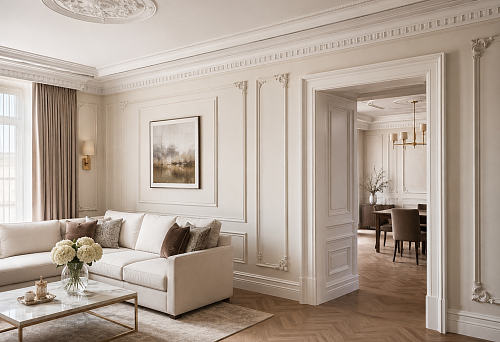
This is the most common task: a person is renovating a living room and wants a "real" interior.
What is included in the full set:
-
Cornice around the ceiling perimeter
-
Socket in the center under the chandelier
-
Moldings on accent walls (frame scheme)
-
Corner elements for moldings
-
Baseboard along the floor perimeter
-
PU overlays — optional, for accents
This is exactly what should be called "buy a set of polyurethane stucco" — not one product, but a system of six to eight items.
Polyurethane decor for interiors — all necessary groups in one section.
Scenario 4. Small room — what to take to avoid overloading
Bedroom 12 m², hallway, study. Stucco is needed, but cannot be overloaded.
Minimal and safe set:
-
Cornice 60–80 mm (ceiling, without complex relief)
-
Baseboard 60–70 mm (simple profile)
-
Small rosette, 250–350 mm
Wall moldings — optional. For a small room: one thin molding profile along the perimeter of each wall at a height of 90–100 cm from the floor (horizontal belt) — this creates a sense of order without overload.
Decorative overlays — restrained or none at all.
How to assemble a set of stucco before purchasing
Three configuration levels for different tasks.
Minimum kit
For whom: any apartment or house, first experience with polyurethane stucco, modern style, small spaces.
Contents:
Result: the room gains completeness and an architectural look with minimal investment.
Medium set
For whom: living room, bedroom, study. Neoclassical or modern classic. Ceiling 2.7–3 m.
Contents:
-
Moldings with corner elements
-
PU overlays — 2–4 accent elements
Result: a full-fledged interior with rhythm on the walls, a center on the ceiling, clear lines at the top and bottom.
Extended set
For whom: an apartment or house in a classic or neo-baroque style, ceiling 3 m and higher, spacious rooms.
Contents:
-
Moldings — outer and inner frame scheme
-
Decor for Molding — corner elements
-
Crown Molding — developed profile, 120–160 mm
-
Baseboards — 100–160 mm
-
ceiling rosettes — diameter from 500 mm, rich relief
-
Wall Decor — belt elements and panels
-
PU overlays — capitals, bases, central accents
-
ceiling decor — if necessary
This is an interior with a full architectural language — from baseboard to cornice.
How to choose a stucco style: five architectural directions
The material is polyurethane. But the style determines what the moldings, cornices, overlays, and rosettes will be like. Let's break it down by direction.
Modern Classic and Contemporary
Thin profiles, smooth surfaces, minimal ornament. Cornice 60–80 mm without complex relief. Baseboard 60–80 mm, smooth. Molding for frames — 25–35 mm. Rosette — simple, without floral relief, diameter 250–350 mm.
The essence: one profile — one function. The decor says 'architecture', not 'decoration'.
Neoclassicism
The most popular style in modern apartments. Moldings 35–55 mm with moderate relief. Cornice with break and chamfer, 80–110 mm. Baseboard 80–120 mm. Rosette with geometric or moderate floral relief, 350–500 mm.
Key: symmetry in everything. Frames are symmetrical, overlays are symmetrical, the style of the cornice and rosette is unified.
Classic
Rich cornices 120–160 mm with full profile. Baseboard 100–160 mm. Frame schemes on all walls. Rosettes 450–600 mm with developed ornament. Overlays are large, with floral or antique-style relief.
In STAVROS for the classic style — Classic Collection и Versailles Collection.
Empire
Monumentality and solemnity. Large cornices with simple but powerful profiles. Overlays with military and antique motifs. Rosettes of large diameter with geometric relief. Brackets in the upper zone of pilasters.
Collection of neoclassicism — for this direction.
Interior with high ceilings
Ceiling 3 m and higher is a separate task. The scale of decor must match the height: small molding gets lost, small rosette "drowns". Cornice at least 110–160 mm. Baseboard 120–200 mm. Rosette from 500 mm. Moldings for frames from 50 mm.
How to avoid mistakes when choosing stucco in an online store
Here are practical warnings. Each of them is a real mistake made during the first order.
Don't start with a single random item
"I'll buy one molding and see" — a path to the molding being the wrong size, wrong style, and without corner blocks. First — the kit diagram. Then — the purchase.
First, define the zone
Wall, ceiling, floor, frame, opening? Each zone has its own section in the catalog. Opening the general "polyurethane products" section is good for browsing, but buy from a specific subsection.
Check dimensions before ordering
Ceiling height → cornice size. Pilaster width → molding width. Chandelier diameter → rosette diameter. Everything is connected. Buying a 160 mm cornice for a 2.5 m ceiling means getting an oppressive overhanging profile.
Match everything in one style
Cornice from one series — rosette from another, molding from a third. If the series are not coordinated in style, the decor "argues" with itself. Use STAVROS collections: all elements within a collection are designed in a unified architectural key.
Don't forget corner blocks
A molding frame without corner elements is just four profile segments with protruding ends. Or with a 45° cut that requires precision. Corner blocks from decoration for moldings — mandatory part of the order for frame schemes.
Do not confuse cornice, molding, baseboard, and rosette
Cornice — ceiling profile with overhang, for wall-to-ceiling transition. Molding — linear profile for walls and frames. Baseboard — lower profile near the floor. Rosette — individual ceiling element under the chandelier. These are different products with different functions.
Go directly to the correct section
Not 'I'll look at everything' — but 'need a cornice → open the cornice section'. This saves time and eliminates confusion.
Add a 10–15% margin
For each item. Molding is cut with trimmings. Cornice — also. Baseboard — also. The margin covers waste, defects, and calculation errors.
How to calculate length and quantity before purchase
Calculation for a standard room 4 × 5 m, ceiling 2.8 m.
Cornice = perimeter × 1 + 10% = 18 lm + 1.8 = 20 lm = 10 pieces of 2 m
Baseboard = perimeter − door width + 10% = 18 − 0.9 = 17.1 + 1.7 = 19 lm ≈ 10 pieces
Molding for one accent wall (frame 3.6 × 1.0 m):
Frame perimeter = (3.6 + 1.0) × 2 = 9.2 lm + 10% = 10.2 lm = 6 pieces
Corner blocks = 4 pieces
Rosette = one, diameter 400 mm (for a room of 20 m²)
PU overlays = 1 piece in the center of the accent frame
Total items for order: 5 items from 4 different catalog sections. This is a working set — not "buy one thing", but assemble a system.
What to strengthen with internal links in the text
The article serves as SEO support for the main product section. Each link in the text transfers page weight to the corresponding catalog URL.
Link priority:
-
Main priority: Polyurethane moldings — primary commercial URL
-
Second level: Moldings, PU overlays, Wall Decor, Decor for Molding, Crown Molding, Baseboards, Outlets
Installation questions — in articles: installation of polyurethane molding.
STAVROS collections: how to find a stylistically consistent set
Choosing items individually and hoping for stylistic unity is difficult. STAVROS collections solve this problem: all products within a collection are designed to work together.
-
Classic — for classic and neoclassical interiors
-
Neoclassical — monumental style, solemnity
-
Versailles — lush classics, formal interiors
Starting a selection from a collection is faster and more reliable than picking elements one by one from different series.
Where to buy polyurethane stucco: final links
Full catalog Decorative polyurethane moldings STAVROS — in one section. Separate categories:
STAVROS is a Russian manufacturer and supplier of decorative polyurethane products for interiors. A wide catalog, stylistically coordinated collections, real items with dimensions and photos. All elements are paintable, glue-on, no special tools required. For those who want architectural decor, not just "some stucco molding."
FAQ: how to choose polyurethane stucco in an online store
Where to buy STAVROS polyurethane stucco?
Main section: Polyurethane Items. For precise selection, go to a specific subsection: moldings, cornices, baseboards, rosettes, overlays.
What is included in the polyurethane stucco catalog?
Moldings, cornices, baseboards, ceiling rosettes, PU overlays, wall decor, molding decor, ceiling decor.
Which section should I open for wall stucco molding?
For frame schemes: Moldings + Decor for Molding. For wall panels: Wall Decor.
Which section should I open for ceiling stucco molding?
Crown Molding — for ceiling profile. ceiling rosettes — for decor under the chandelier.
What is the difference between a cornice and a molding?
A cornice is a profile with an overhang for transitioning from wall to ceiling. A molding is a linear profile for walls and frames. Different functions, different application areas.
How do I know how much molding to buy?
Draw a diagram of the frames with dimensions. Calculate the perimeter of each frame. Add all perimeters and add a 10% margin. Get the molding footage for the order.
Are corner pieces needed?
Yes, for any frame schemes. 4 corner elements per frame. Section: Decor for Molding.
Can I select elements from one collection?
Yes — this is the most reliable way. Classic, Neoclassical, Versailles — stylistically coordinated sets.