Article Contents:
- What is classic furniture and why it is trending again
- What a classic living room consists of: essential and additional set
- Basic set
- Extended set
- Decorative level
- How to choose furniture for the size of the living room
- Small living room (up to 18–20 m²)
- Living room in a city apartment (20–30 m²)
- Spacious hall (from 35 m²)
- Kitchen-living room
- Light or dark classic furniture: how to choose correctly
- Light classic furniture
- White classic furniture
- Dark classic furniture
- Walnut and brown shades
- Furniture matching floor and door color
- Wood, MDF, veneer: what classic furniture is made of
- Solid wood
- MDF with wooden details
- Veneer
- Carved decor and applied elements
- Classic style furniture handles
- Furniture legs with profile
- How not to overload a living room with classic furniture
- Do not mix several shades of wood
- Do not place too many items
- Repeat decorative motifs
- Leave 'air'
- How to combine classic furniture with moldings, baseboards, and frames
- Furniture and wooden baseboards
- Furniture and wall moldings
- Furniture and frames for paintings and mirrors
- Furniture and Lighting
- Modern Classics and Neoclassicism: A Separate Discussion
- Signs of Modern Classics
- How to Distinguish Neoclassicism from 'Just Classics'
- Mistakes When Choosing Classic Furniture for the Living Room
- Choosing Only by Photo
- Not Considering Ceiling Height
- Not Looking at Material and Finish Quality
- Buying Furniture Without Connection to Doors and Baseboards
- Mixing Too Different Styles
- Forgetting about lighting
- Practice: how to choose classic-style living room furniture — step-by-step logic
- FAQ: answers to popular questions about classic living room furniture
- Which classic furniture to choose for a small living room?
- Light or dark classic furniture — what to choose?
- What is better: classic furniture made of solid wood or MDF?
- How to combine classic furniture with an existing interior?
- Can classic furniture be used in a modern apartment?
- What is a "classic furniture set" and do you need one?
- Where to see classic living room furniture?
- About the Company STAVROS
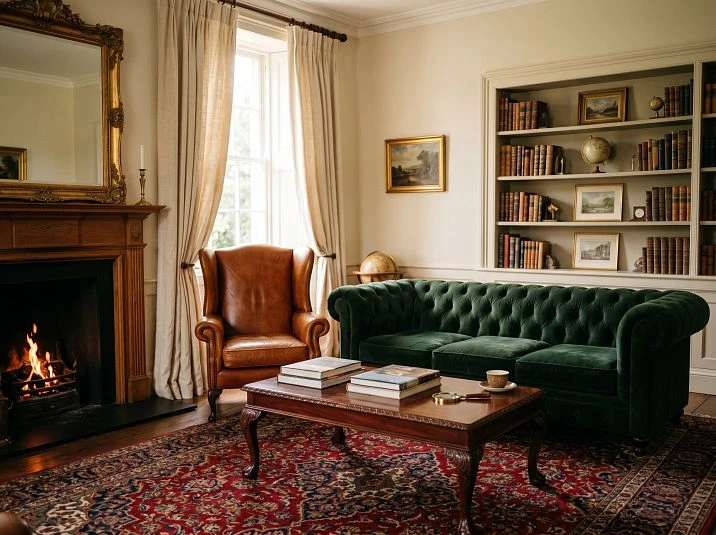
Classic style in the living room is a choice that reflects a certain understanding of interior design. Not a trend, but a conviction. Classic Furniture for the Living Room does not age with trends — it remains relevant precisely because it appeals to something deeper than seasonal taste. To proportion. To details. To the quality of material that is visible and tangible.
But this is where the complexity begins: classic is one of the most multifaceted styles in furniture, and it is easier to make a mistake when choosing than it seems. Heavy furniture in a small room. Mismatched wood shades. Overloaded carved decor against white smooth walls. All of these are common stories that end with a rethinking of the entire living room.
This article is a practical guide for those who choose Classic Furniture consciously. Size and proportions, light and dark shades, wood and decor, connection with baseboards and doors — all of this is here. With specific guidelines, not general words about "beauty."
What is classic furniture and why is it trending again
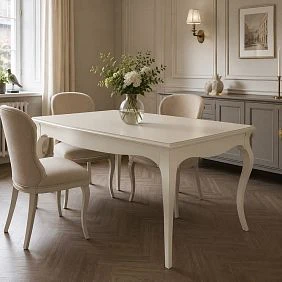
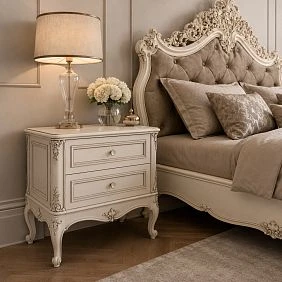
Before talking about choosing, it is worth understanding what exactly we call the classic style in furniture. Because "classic" is such a broad word that it encompasses Louis XVI style with gilded legs, an English Victorian living room with dark walnut, and modern neoclassicism with clean lines and restrained decor.
The common denominator of classic furniture is several stable features:
-
Pronounced facade profile: moldings, cornices, frame structures
-
Decorative legs with profile: turned, carved, curved
-
Natural materials or their high-quality imitations: solid wood, veneer, MDF with finishing
-
Restrained color palette: ivory, cream, walnut, cherry, white, gold
-
Symmetry as a basic arrangement principle
Why does classic come back? Because people are tired of disposable interiors. Classic furniture is an investment with a horizon not of five years, but of twenty. It is not thrown away when fashion changes — it is passed on, restored, integrated into a new context. And it organically accepts this new context because it has its own language that needs no explanation.




What a classic living room consists of: mandatory and additional set
The question 'what to put in the living room?' is one of the first that arises when furnishing. The answer depends on the area, usage scenario, and your priorities. Let's look at the composition of a classic living room from basic to expanded.
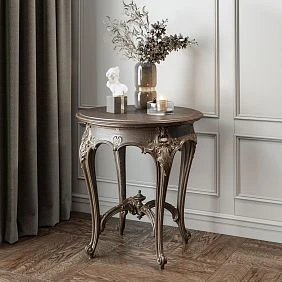
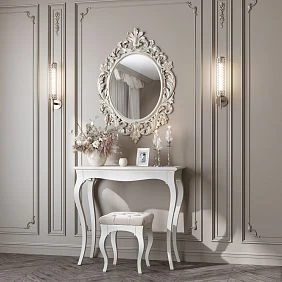
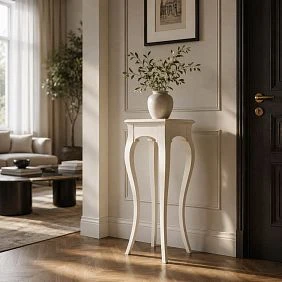
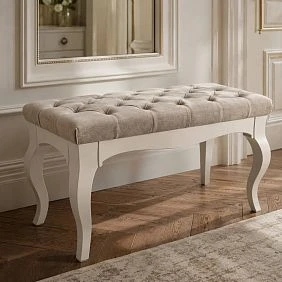
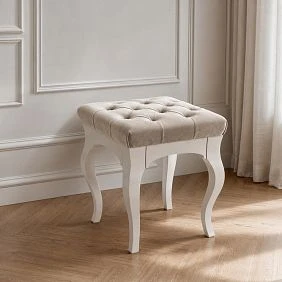
Our factory also produces:
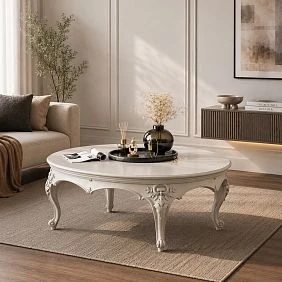
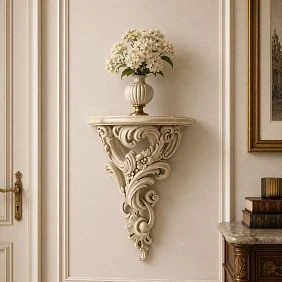
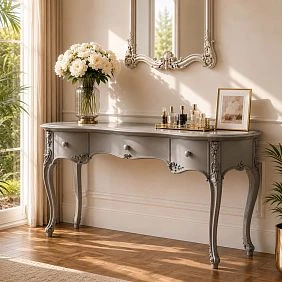
Basic set
This is the minimum that creates a full-fledged space for living and entertaining guests:
-
Sofa — the central element of the living room. In a classic version — with a wooden frame, visible profiled legs, armrests with carved or turned details
-
Two armchairs — symmetrically relative to the sofa or next to it
-
Coffee table — with wooden legs, glass or wooden tabletop
Get Consultation
Extended set
For a spacious living room or for those who want to create a complete interior ensemble:
-
Display cabinet — for dishes, books, decorative items. In a classic style — with glazed facades in a frame surround, wooden cornice
-
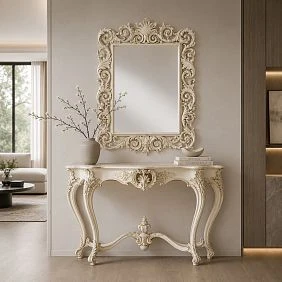
Console — against the wall or behind the sofa. One of the most expressive elements of a classic living room
-
Chest of drawers — for storage and decorative function. A mirror or painting is placed on it
-
TV cabinet — in a classic design, this is not just a cabinet, but furniture with facades, moldings, and coordinated decor
-
Bookcase or shelving — for a work area or library inside the living room
Decorative level
It is this level that turns good furniture into a finished interior:
-
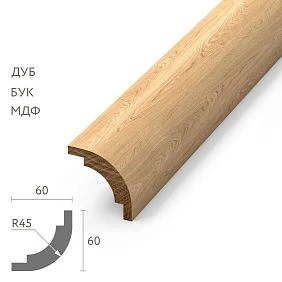
Wooden Skirting Boards with a pronounced profile
-
Wooden moldings for walls and ceiling area
-
wooden furniture handles — details that tie all the furniture into a single ensemble
-
Furniture legs with a profile for updating or replacing on existing furniture
How to choose furniture for the size of the living room
One of the most painful mistakes when buying classic furniture is the mismatch between the scale of the items and the size of the room. Classics tend to be monumental, and in a small space this can work against you.
Small living room (up to 18–20 m²)
A small living room requires discipline when choosing furniture — especially classic ones. Three principles apply here: light shades, compact forms, moderate decor.
-
Sofa: not corner, length up to 200 cm. Preferably straight, without massive armrests
-
Armchairs: one instead of two, or two small accent chairs instead of full-sized ones
-
Coffee table: small, possibly with glass for visual lightness
-
Storage: vertical solutions (tall display cabinet or wardrobe) preferred over wide cabinets — they take up less floor space
Ornament and decor on facades in a small space — moderate. For a small living room Classic Furniture choose from series with more restrained facades: frame profile without deep carving, thin legs, light cornices.
Living room in a city apartment (20–30 m²)
Standard square footage for a city apartment — the most common task. Here a full set is already possible: sofa + two armchairs + coffee table + TV cabinet. At 25+ m², a console or display cabinet is added.
Ceiling height is no less important than area. With a ceiling of 2.7 m, a tall display cabinet with a cornice will hit the ceiling — solutions up to 2.2–2.4 m are needed. With a ceiling of 3.0 m and above, a classic tall wardrobe with a cornice will fit organically.
Spacious hall (from 35 m²)
For a spacious hall — especially in a country house — there are virtually no restrictions on scale. Large sofas with wide armrests, pairs of armchairs, tall display cabinets with pronounced cornices, carved consoles, and chests of drawers work well here. buy classic furniture For a large space — it means not being afraid of scale and expressiveness.
Here, the rhythm of arrangement is important: classicism requires symmetry. Two armchairs on either side of the sofa. A pair of lamps on the console. A mirror strictly along the axis above the mantelpiece. Breaking symmetry in a classic interior is always a deliberate artistic decision, not an accident.
Kitchen-living room
A combined space is a separate story. Here the task is twofold: the furniture must be functional for eating (or at least coffee/tea) and at the same time appropriate as part of the living room.
In the classic version — a dining area with a round or oval table on carved legs, chairs with soft seats and backs. The living room area — a sofa with its back to the dining area, facing the window or TV cabinet.
Important: the furniture of the kitchen area and the living room area should belong to the same color and style story — not identical, but from the same "family."
Light or dark classic furniture: how to choose correctly
The color of the furniture is the second most important parameter after size. It determines the mood of the interior and dictates all other decisions: wall color, type of flooring, shade of curtains and decor.
Light classic furniture
Light classicism — these are cream, ivory, bleached, vanilla tones. It visually lightens the space, making the room brighter and more spacious. This is the best choice for:
-
Small living rooms where you need to visually expand the space
-
Apartments with insufficient natural lighting
-
Interiors in a modern-classic or Provencal style
-
Living rooms with bright accent elements (paintings, textiles) that should "read" against the background of calm furniture
Light classic-style furniture for the living room requires more careful maintenance — light surfaces show dirt faster. But they are also easier to clean with regular care.
White classic furniture
White is the purest, most "declarative" version of light classics. White color in furniture requires contrast: the floor should not be white, the walls don't have to be either. White furniture against a background of warm coffee-with-milk or terracotta walls is one of the most expressive classic combinations.
Gold furniture handles work well with white furniture: they create a warm accent that saves white from being cold. wooden furniture handles in "antique" or "old gold" finish — exactly what is needed for a white classic facade.
Dark classic furniture
Dark furniture — walnut, wenge, dark cherry, ebony — creates a feeling of solidity, strictness, and richness. It is a choice for large, well-lit living rooms. In a small dark room, dark furniture creates a visual "collapse" — walls, furniture, and floor merge into a single dark mass.
A dark classic living room requires contrast lighting: several sources of warm light (floor lamps, table lamps, a chandelier with shades) create a play of light and shadow that reveals the richness of dark wood.
Walnut and brown shades
Walnut is perhaps the most "classic" of all shades of classic furniture. Warm brown with a reddish or golden tint. It is neutral in a good sense: not too light and not too dark, not cold and not overly saturated.
Walnut furniture goes well with wooden parquet, with warm shades of walls (beige, cream, light gray with a yellow undertone) and with wooden skirting boards the same or a close tone.
Furniture matching the color of the floor and doors
This is a fundamental issue of consistency that is often ignored. The rule: furniture and floor should not be the same color — the boundary between furniture and floor should be readable. A slight contrast — different shades of the same tone or different tones while maintaining overall warmth — works best.
Doors and furniture, on the contrary, work well in a close tone: dark doors + dark furniture, light doors + light furniture. This creates a feeling of thoughtfulness and coherence of the space.
Wood, MDF, veneer: what classic furniture is made of
Material is not just a technical issue, but a matter of quality, durability, and the feel of the furniture.
Solid wood
Classic furniture made of solid wood — is the highest category. Monolithic wood, heavy, tactilely rich, reacting to light with a play of texture. Carving on solid wood is real carving, not imitation: the relief is clear, deep, with shadows.
Solid wood "breathes" — it reacts to humidity and temperature. This requires stable conditions in the room and high-quality finishing. However, solid wood can be restored an unlimited number of times: repainted, re-toned, polished — and the furniture looks like new.
The most popular species for classic solid wood furniture: oak, beech, walnut, cherry, birch, linden.
MDF with wooden details
Most furniture in the "medium — above average" price range is made from MDF: a homogeneous material with a smooth surface, ideal for painting and milling. Facades are milled (a profile is created), painted with enamel, or covered with veneer.
Wooden details — legs, Decorative Inserts, cornices, handles — are made from solid wood and complement the MDF body. This combination provides an optimal price-quality ratio: a stable body + natural accents.
Veneer
Veneer is a thin slice of natural wood glued onto a base (MDF or chipboard). It provides a natural texture at a more affordable price. Veneered furniture looks rich but requires careful handling: veneer is not as easy to restore as solid wood, and it is more difficult to repair if damaged.
Carved decor and overlay elements
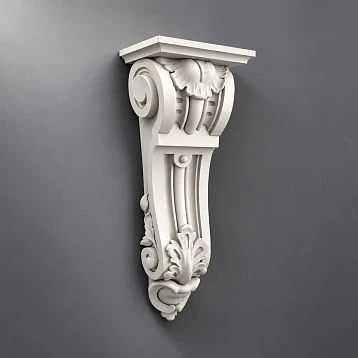
It is the carved decor that makes classic furniture "classic" — distinguishing it from merely "strict" or "boring." Carved furniture decor — these are overlay wooden elements: rosettes, cartouches, overlay moldings, corner overlays, ornamental inserts in panels.
They are glued or attached to facades, creating a relief that, under normal lighting, gives a rich play of shadows. When painted in a single color, carved overlays look like part of the facade — a volumetric relief, not a separate detail.
to buy, which will allow you to transform your furniture using carved wooden elements. You can use the C-003-3 decor set to decorate furniture, walls, doors, or any other surface. The C-003-3 decor set is made of oak or beech, known for their strength, durability, and beauty. You can buy the C-003-3 decor set at the Stavros decor store, which specializes in producing and selling decorative elements and hardware for furniture and interiors. At the Stavros decor store, you will find a wide selection of decor sets of various shapes, sizes, and styles. You can choose from the catalog allows you to "update" or "classify" existing furniture: add overlays to simple facades, replace handles and legs — and the furniture acquires a different status.
Furniture handles in classic style
wooden furniture handles — a detail that is often underestimated. Meanwhile, it is the handles that, upon close inspection, determine the level of furniture. A standard metal handle on a beautiful facade is a dissonance. A wooden handle with a turned profile matching the facade — unity.
For white classic furniture — handles in "gold," "bronze," "antique" colors. For walnut — solid wood handles matching the tone or with a gold accent. For dark furniture — dark handles or matte gold.
Furniture legs with profile
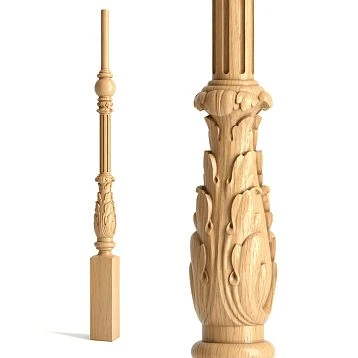
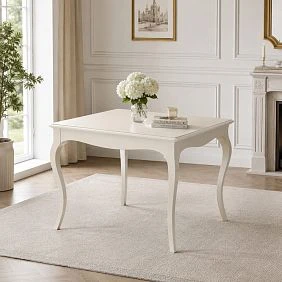
Furniture legs — a detail as significant as handles. A classic leg is turned, curved (saber, cabriole) or straight with a profile. It determines the character of the piece: a heavy straight leg — strict classic, a curved cabriole — Rococo or Louis XV.
When updating furniture, replacing legs is one of the most effective and affordable ways to change its character.
How not to overload a living room with classic furniture
The paradox of the classic style: the richer each individual item, the stricter the overall discipline of the space should be. The mistake many make is accumulating details and items until the room stops 'breathing'.
Do not mix several wood shades
One of the most common interior mistakes in a classic living room is a mismatch in wood shades. A sofa in walnut, a TV cabinet in dark cherry, a console in light beech — three different woods that do not create unity.
Rule: main furniture pieces — in one tone. Accents (frames, handles, decor) — in the same tone or in a noble metal (gold, bronze).
Do not place too many items
The living room should be convenient for movement. The minimum passage between furniture items is 80 cm. Space to walk around the sofa is 50–70 cm. An overloaded room where you literally squeeze between furniture is a sign of poor planning, not wealth.
Repeat decorative motifs
The unity of a classic interior is created through the repetition of motifs. The ornament of the handles echoes the ornament of the legs. The profile of the baseboard echoes the profile of the display case cornice. Wooden moldings on the walls — in the same style as the moldings on the furniture facades.
This doesn't mean "everything is the same." It means "everything is from the same vocabulary."
Leaving "air"
Empty space on the wall is not discomfort, but an accent. The empty part of the wall between the display case and the console creates a pause that allows each item to "sound" individually. Cluttered walls in a classic living room look like a store, not a home.
How to combine classic furniture with stucco, baseboards, and frames
Classic furniture does not exist in a vacuum. It works in context — and this context is created by details that unite furniture pieces with the room's architecture.
Furniture and wooden baseboards
Wooden Skirting Boards with a pronounced profile — the first "interlocutor" of furniture in the room. They set the tone around the entire perimeter of the space: height, profile shape, color.
In a classic living room, the baseboard should be high — from 80 to 120 mm and higher. A thin baseboard of 40–50 mm in a classic interior looks poor. A high baseboard with a stepped profile creates the correct architectural base for the entire space.
The color of the baseboard is coordinated with the furniture: in a light interior — a cream or white baseboard; in a dark one — a baseboard in the tone of the furniture or slightly lighter.
Furniture and wall moldings
Wooden wall moldings — frame panels made of of wooden moldings — create a decorative "carpet" on the walls, which visually increases the height of the room and creates a feeling of expensive finishing. This is one of the most effective techniques of a classic interior, available at moderate cost.
The molding profile should echo the profile of furniture cornices and the baseboard profile. The height of the panels is from one third to half the height of the wall.
Furniture and frames for paintings and mirrors
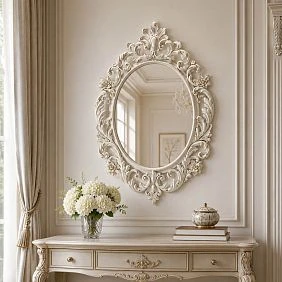
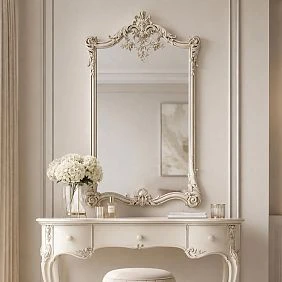
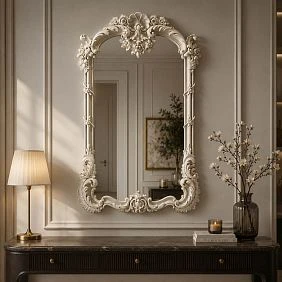
A mirror above a console or chest of drawers is a classic technique. The mirror frame should be coordinated with the furniture underneath: a similar tone, an echoing profile. Frames and furniture that are too different create a feeling of a randomly assembled set.
Wooden frames for mirrors and paintings from the catalog are selected for specific furniture: profile width, tint tone, presence of ornament — all these parameters should work in an ensemble with the main items of the living room.
Paintings in a classic living room are hung symmetrically: a pair of identical canvases on either side of a fireplace or mirror, a vertical group along the window axis. Asymmetric gallery-style hanging is more of a modern than a classic interior technique.
Furniture and lighting
Lighting is part of the decor, not a technical issue. For a classic living room — multi-level lighting: chandelier (central light), floor lamps (diffused light near the sofa and armchairs), table lamps on the console and chest of drawers, possibly sconces on either side of the mirror.
Warm white light (2700–3000K) is the standard for a classic interior. Cool white (4000K and above) creates an "office" effect that ruins the atmosphere.
Modern classic and neoclassicism: a separate discussion
Speaking of classic living room furniture, one cannot ignore modern classic. This is the most sought-after direction today: it takes discipline, symmetry, and quality of details from classic style, but removes heavy pomposity and gilded overload.
Signs of modern classic
-
Simple but pronounced facade profile: without complex carving, but with a clear molding
-
Neutral colors: gray, warm white, graphite, linen, cream
-
Metal decor: matte gold, matte bronze, nickel — not glossy or pompous
-
Concise decorative decor: overlays only in accent areas
-
Quality fabrics for upholstered furniture: natural linen, velvet, leather without colorful prints
Modern classic is the most versatile: it works in standard city apartments with low ceilings, in country houses, and in studios with zoning.
How to distinguish neoclassicism from "just classics"
Neoclassicism is a stricter style. Clean lines, absence of ornamental curls and plant motifs, emphasis on architectural profile rather than decorative carving. Greco-Roman motifs: fluting, meanders, acanthus leaves in geometric simplification.
For a neoclassical living room, furniture is chosen with clear straight legs, frame facades without ornamentation, and a minimal amount of decorative overlays.
Mistakes when choosing classic furniture for the living room
There are mistakes that are made over and over again — because when buying furniture, emotional response is often more important than pragmatic assessment.
Choosing only by photograph
A photograph is a poor advisor when buying furniture. It does not convey volume, does not show the real tone in your lighting, does not let you feel the material. A photo in a catalog is in professional light, at the right angle, on a neutral background. In your living room, it will be different.
If possible, look at furniture in a showroom. If that's not possible, study photos of interiors where the furniture is placed in real conditions, not in catalog shots.
Not considering ceiling height
The height of the furniture should match the ceiling height. A display case 2.4 m high under a 2.7 m ceiling creates an overhanging effect and makes the room visually lower. Furniture should be at least 30–40 cm lower than the ceiling — so there is "air" at the top.
Do not look at the material and quality of finish
Externally similar sofas can have fundamentally different lifespans. What to look at: frame type (solid wood vs chipboard vs plywood), filler (spring block vs foam), upholstery fabric quality, leg attachment method. Furniture with wooden legs with threads screwed on bolts is more reliable than with overlay legs on glue.
Buying furniture without considering doors and baseboards
This is perhaps the most commonly overlooked connection. Wooden doors with profiled architraves, high wooden baseboards — and furniture in a completely different tone and style. The disconnect is obvious: the furniture looks like it 'moved in' from another apartment.
Always consider furniture in the context of architectural elements: doors, baseboards, moldings, window reveals. They should speak the same language.
Mixing too many different styles
One baroque sofa + art deco armchairs + a Scandinavian shelving unit = eclectic without intent. Eclecticism is a complex style requiring specialized knowledge. For most, it ends up as a 'motley collection.' If you're not confident in eclecticism, stick to one direction.
Forgetting about lighting
A classic living room with a single ceiling light fixture loses most of its decorative potential. The relief of legs, wood texture, play of moldings — all of this works only with proper multi-level lighting.
Practice: how to choose furniture for a classic-style living room — step-by-step logic
Let's condense everything into a practical algorithm that works for any living room size.
Step 1. Measure the room: length, width, ceiling height. Note the locations of doors, windows, outlets, and radiators.
Step 2. Determine the usage scenario: just a living room, living room + workspace, living room + dining room, living room + children's area.
Step 3. Record existing elements that cannot be changed: floor color, door type and color, height and profile of existing baseboards.
Step 4. Choose the tonal key: light, dark, or mid-tone. Base it on lighting and size.
Step 5. Determine the basic furniture set based on the area. Start with the main items (sofa, armchairs) — they will take up most of the budget and space.
Step 6. Select additional items, coordinating them with the basics in tone and style.
Step 7. Define the decorative level: handles, legs, frames, overlays, moldings. This is where the connection between furniture and room architecture emerges.
Step 8. Choose lighting and textiles to complete the ensemble.
FAQ: answers to popular questions about classic living room furniture
What classic furniture to choose for a small living room?
For a small living room up to 20 m² — light shades, a compact sofa (length up to 200 cm), one or two armchairs, a coffee table, a TV cabinet. No wide display cabinets or heavy sideboards. Moderate decor on facades, thin legs, minimal applied carved elements.
Light or dark classic furniture — which to choose?
Light furniture visually expands the space and works better in small, poorly lit rooms. Dark furniture creates a sense of solidity and richness but requires a large area and good lighting. For most city apartments — light and medium shades.
What is better: classic furniture made of solid wood or MDF?
For long-term investment and restorability — solid wood. For the optimal price-quality ratio — an MDF body with wooden details (legs, overlays, handles made of solid wood). Fully MDF with wood imitation is a budget option, but the service life and tactile feel are inferior.
How to combine classic furniture with an existing interior?
Focus on the color and tone of the doors: the furniture should be in a close range. The color of the baseboards is coordinated with the furniture or walls. Frames for paintings and mirrors — in the tone of the furniture. If the doors are light — the furniture is light or neutral; if dark — the furniture is in a dark or medium tone.
Can classic furniture be used in a modern apartment?
Yes, provided you choose a modern-classic or neoclassical direction: clean lines, neutral colors, moderate decor. Heavy Baroque classic with gilding will look inorganic in a modern apartment. Neoclassicism is absolutely appropriate.
What is a "classic furniture set" and do you need one?
A set is furniture from one collection: a sofa, armchairs, a table, a cabinet — with the same style, tone, leg and handle decor. Buying as a set guarantees consistency. But you can also put together a set yourself if all items are from the same tonal and style family — even from different manufacturers.
Where to see classic furniture for the living room?
In the classic furniture a range of classic-style furniture is presented, as well as all related elements for creating a cohesive interior. There you can also select decor, handles, legs, frames, and moldings.
About the company STAVROS
A beautiful classic-style living room is not just beautiful furniture. It is a system: furniture, decor, baseboards, moldings, frames, handles, and legs that speak the same language.
STAVROS produces and offers the full range of elements for creating a classic living room interior. In the catalog classic furniture — sofas, armchairs, display cabinets, consoles, chests of drawers, and tables in classic style. Nearby — Decorative Inserts for furniture, Furniture Handles и Legs, Wooden Skirting Boards, Moldings и frames for mirrors and paintings.
This means that in one catalog you can select not just furniture, but an entire interior: from the main piece to the last detail that makes the room complete.
Start your selection with the catalog STAVROS classic style furniture — and create a living room that will remain relevant in twenty years.