Article Contents:
- Why the budget for molding should be calculated as a set, not per piece
- What makes up the total budget for molding
- Minimum budget: targeted result without overspending
- HIWOOD polystyrene moldings: minimum price, maximum effect
- Strategy: one zone — full effect
- Mid-range budget: moldings plus rosette and decorative molding
- Ceiling rosette: a small detail with a big impact
- Decorative molding inside the frame: an accent that makes it look expensive
- What to buy with a medium budget: order structure
- Above average: a system solution for three surfaces
- Ceiling stucco: when a cornice is not an option, but a rule
- Profile coordination: why it matters
- Expensive interior: a complete set as an architectural statement
- Multi-level wall panels: a classic technique for an expensive result
- Decorative stucco in an expensive interior: where and how
- Painting stucco in an expensive interior: color as a tool
- Selection table: what to buy for each budget
- What you can't skimp on: three non-negotiable points
- How to choose molding without a designer: a practical algorithm
- Typical mistakes when choosing molding on a budget
- Molding for different styles: a brief guide to choosing profiles
- FAQ: popular questions about choosing molding on a budget
- What molding to buy if the budget is small?
- What can't you skimp on when buying molding?
- What to add to moldings to make the interior look more expensive?
- Do you need to buy ceiling molding right away?
- How to calculate the number of moldings?
- Can you use different profiles in one room?
- How long will polyurethane stucco molding last?
- About the Company STAVROS
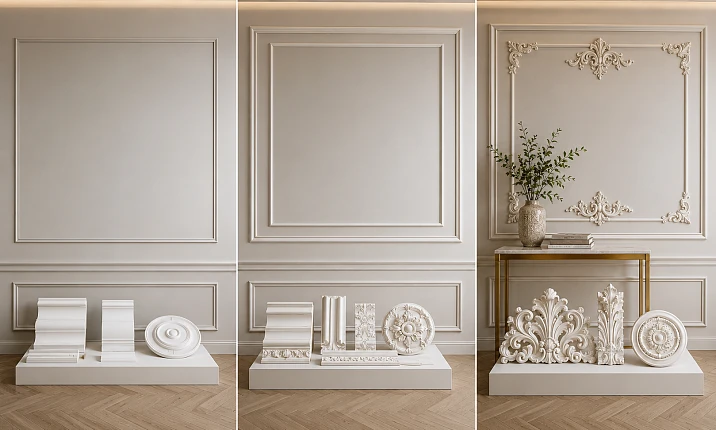
The question "how much to spend on molding" is one of the most practical that arises during renovation. And the answer is not as obvious as it seems. Many start with the price of one molding strip — and that's where they make their first mistake: the budget for molding is calculated not by the price of one piece, but by the complete set for a specific task. The good news: Buy moldings you can fit any budget — and each time get a result that works.

Why the budget for molding should be calculated as a set, not per piece
Imagine: a person sees a molding strip for 350 rubles and thinks — great, cheap, I'll take it. But then it turns out that one wall needs 15 linear meters, each piece is 2 meters, so 8 packages — that's already 2,800 rubles. Plus glue — 400–600 rubles. Plus paint — another 500–800 rubles. Plus a 10–15% allowance for cutting. Total: what looked like "peanuts" turns into a normal expense. This is not bad — it's just the truth you should know in advance.
That's why a professional approach to choosing molding by budget starts not with a catalog, but with a sheet of paper. On it — the room plan, wall perimeter, ceiling height, location of the door, mirror, chandelier. Only after that does it become clear what exactly needs to be bought and in what quantity. And only then — the profile, ornament, and price category are selected.
Polyurethane molding is good because it covers all budget levels without compromising quality. HIWOOD series polystyrene moldings cost from 250 rubles per 2-meter strip and give a neat, modern result. MLDPU series polyurethane moldings are more complex in profile, starting from 1,740 rubles per strip, but create a completely different architectural impression. This is not "cheaper is worse," but simply different tools for different tasks.
To avoid confusion and overpaying, it's important to understand one thing: an expensive-looking interior is created not by the amount of molding, but by the right set of elements for a specific budget. One well-chosen molding strip works better than five unsuccessful ones. You can buy ready-made stucco matching the Baroque style. Calculate the quantity: linear meters of cornices and moldings, number of rosettes, pilasters, consoles, corner elements. Add a ten to fifteen percent allowance for trimming. wisely means buying what you need, not everything in sight.




What makes up the total budget for molding
Before moving to specific scenarios, let's fix the cost structure. It is the same for any budget — only the scale changes:
-
Main profiles (moldings, cornices, baseboards) — the largest item, depends on the perimeter of the walls and the chosen profile
-
Decorative elements (overlays, rosettes, decor) — the second largest block
-
Consumables (glue, acrylic sealant, putty) — a small but mandatory item
-
Material reserve for trimming and errors — 10–15% of the calculated quantity
-
Paint or primer-enamel — depends on the surface area and number of coats
Reserve — an item that should never be skimped on. A shortage of 2–3 molding strips at the final installation stage means stopping work, searching for the required item in stock, and losing time. It is better to take extra and return the remainder than to face a situation where the needed molding is out of stock.
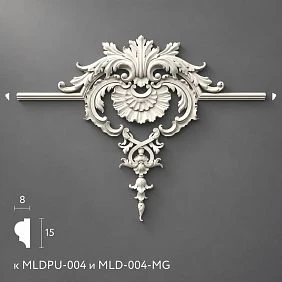
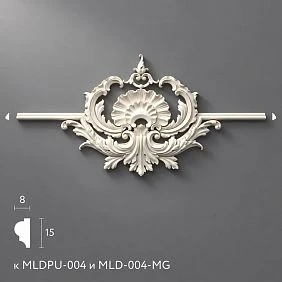
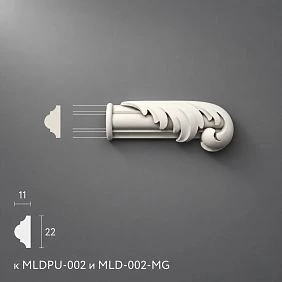
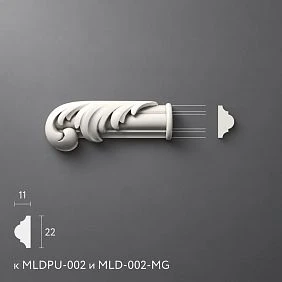
Our factory also produces:
Minimum budget: targeted result without overpaying
A limited budget is not a death sentence. It is a condition of the problem that can be solved elegantly if you choose the right strategy. The main principle of a minimum budget: do not try to cover the entire space at once, but choose one specific area and make it flawless.
Which area to choose? The one that is seen first and most often. In the living room — the wall behind the sofa or with the TV. In the bedroom — the wall behind the headboard. In the hallway — the wall with the mirror. In the study — the wall behind the desk. One accent area, designed precisely and neatly, changes the perception of the entire room — much more than moldings on all walls made from the cheapest profile.
What to buy on a minimal budget? The basic set looks like this: Moldings made of polyurethane for one accent wall, mounting adhesive, acrylic sealant, and paint. From the HIWOOD line, this could be molding D22 (22 mm × 10 mm × 2 m, 350 rubles), TR10 (10 mm × 10 mm × 2 m, 250 rubles), or LD20 (20.5 mm × 10 mm × 2 m, 360 rubles). For a wall 3.5 meters wide and 2.5 meters high — a frame of 3 × 2 meters will require about 10 linear meters of molding. At the price of D22 — that's 5 planks at 350 rubles each = 1,750 rubles. Plus consumables — total 3,000–3,500 rubles for a fully decorated accent wall.
Get Consultation
HIWOOD polystyrene moldings: minimum price, maximum effect
The HIWOOD series consists of polystyrene moldings with excellent surface quality that are easy to cut, hold glue well, and accept paint flawlessly. In the STAVROS catalog, they are available in a wide range of profiles: from the very thin TR10 (10 mm) to WIP50 (50 mm) and W1060 (60 mm). For a minimal budget, profiles with a width of 20–32 mm are optimal — they are expressive enough to create a readable frame structure and cost from 300 to 530 rubles per plank.
Polystyrene is a lighter material compared to polyurethane. It is perfect for interior solutions, cuts well with a regular utility knife, and requires no special tools. The only nuance: polystyrene is slightly more brittle when bent, so it needs to be handled carefully during transportation and installation. But for frame panels on a flat wall, this is not a problem.
The "one zone — full effect" strategy
Practice shows: one properly decorated wall works better than moldings around the entire perimeter of the room made from the cheapest profile. Why? Because the accent zone is the focal point of the gaze. It attracts attention and creates the impression of thoughtful design. Moldings on all walls without an accent turn into a background that is perceived as "something is there, but it's unclear why."
With a minimal budget, it's better to make one wall with three neat frames from D22 molding than to run TR10 moldings around the entire perimeter of the room. The first option looks expensive. The second — just "something added."
buy polyurethane moldings for such a task, you can order the exact quantity — the catalog allows you to select the desired profile and calculate the footage for a specific wall size.
Medium budget: moldings plus a rosette and decorative stucco
An average budget opens up fundamentally different possibilities. Here you can think not about one wall, but about the overall impression of the room. And this is where elements that make the interior visually more expensive come into play: a ceiling rosette, Buy decorative stucco for accent zones and the first elements of ceiling decor.
Why do these three components transform an interior from "neat" to "expensive"? Because they work on a different principle. Moldings organize the plane — creating structure and order. The chandelier rosette fixes the center of the ceiling and adds a vertical axis around which the entire composition of the room is built. Decorative stucco inside frames or near a mirror creates accents — focal points for the eye. Together, all three elements create a synergy that is hard to explain in words but easy to feel: the room begins to seem larger, calmer, and of higher quality.
Ceiling rosette: a small detail with a big effect
ceiling rosettes made of polyurethane — it is a decorative element that is mounted on the ceiling around the connection point of a chandelier or central light fixture. It seems like a small detail. But its effect is disproportionately large: the rosette turns a "hole in the ceiling with wires" into an architectural accent around which the visual center of the room is formed.
For an average budget, you don't need the largest and most complex rosette. A medium diameter — 300–500 mm — with a neat ornament is sufficient: acanthus leaves, a geometric border, a light bas-relief. Such a rosette costs in the range of 1,500–4,000 rubles, is installed in 30–40 minutes, and completely changes the feel of the ceiling. If you complement it with a ceiling cornice around the perimeter, the result is doubled.
An important nuance: the rosette is chosen in proportion to the diameter of the chandelier. The rosette should not be smaller than the base of the chandelier — otherwise the chandelier will "stick out" of the rosette. The optimal ratio: rosette diameter = chandelier base diameter × 1.5–2.
Decorative stucco inside a frame: an accent that makes it look expensive
Another element for an average budget is a decorative overlay or small stucco decor placed inside a molding frame on an accent wall. This solution works on the principle of a picture in a frame: the molding creates the framing, and the decorative element inside becomes the content. This technique gives the wall a narrative quality — a feeling that there is a concept behind it, not just a set of finishing materials.
For an average budget, one or two decorative accents are enough — there is no need to overload every frame. The principle of "less, but more precise" works flawlessly here. Buy Moldings In the STAVROS catalog, you can find solutions for any task: corner overlays, horizontal decors above mirrors and consoles, small floral accents.
What to buy with a medium budget: order structure
With a medium budget, the purchase set looks like this:
-
Buy polyurethane moldings — for decorating 1–2 walls or an accent zone + a ceiling cornice around the perimeter
-
Ceiling rosette — 1 piece, diameter proportional to the chandelier
-
Decorative overlays or stucco decor — 1–3 elements for accent points
-
Glue, sealant, putty, 10–15% reserve
-
Paint or primer-enamel
Above average: a systematic solution for three surfaces
Above average: a system solution for three surfaces
When the budget exceeds the "average" range, a qualitative shift occurs: stucco ceases to be a decoration for individual zones and becomes a system covering walls, ceilings, and key decorative points. It is this systematic approach that distinguishes an "above-average" interior from a merely "neat" one.
What changes? First, moldings appear not on one wall but around the entire perimeter of the room, creating a unified horizontal rhythm. Second, Ceiling molding it ceases to be an optional element and becomes mandatory—the ceiling cornice coordinates the walls with the ceiling, eliminating a sharp boundary. Third, decorative accents are placed deliberately: not "somewhere," but at pre-selected points that support the overall composition.
Ceiling stucco: when the cornice is not an option but a rule
Buy ceiling molding for an above-average interior means adding an element that works in multiple directions at once. A ceiling cornice around the perimeter hides the technical joint between the wall and ceiling—a joint that even in the neatest renovation looks awkward. The cornice creates a smooth transition, visually raises the ceiling, and gives the room a finished look.
For an above-average interior, polyurethane cornices with a relief profile 60–100 mm wide are optimal. Such a cornice is expressive enough to be a visible decorative element but does not overwhelm the space. In the STAVROS catalog, ceiling stucco is represented by a wide range of profiles—from laconic polystyrene to complex polyurethane with ornamental relief.
If the room is planned to have ceiling lighting, the LB32 cornice (HIWOOD polystyrene, 32.5 mm × 24.0 mm, 650 rubles per 2 m) is specifically designed for laying LED strips. This is an elegant way to hide the light source and achieve soft reflected light from the ceiling—an effect characteristic of expensive hotel rooms.
Coordinating profiles: why it matters
The most common mistake with an "above-average" budget is buying wall moldings and ceiling cornices from different series with mismatched profiles. As a result, a cornice with a baroque scroll coexists with a geometric molding in the Art Deco style—and the entire effect of systematic design falls apart.
The rule is simple: all profiles in one room must belong to the same ornamental language. If the wall moldings are classic (with a shelf and a heel), the cornice is chosen from the same style. If the moldings are geometric, the cornice must also be geometric. In the STAVROS catalog, the assortment allows you to assemble coordinated solutions within a single line.
Expensive interior: a complete set as an architectural statement
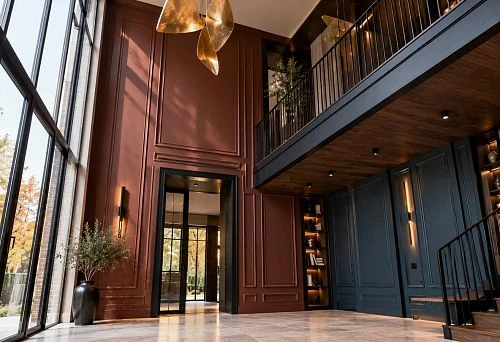
An expensive interior is not about "more stucco." It's about a system where every element is in its place and works in an ensemble with the others. Moldings on all walls, ceiling stucco, a rosette under the chandelier, decorative overlays, stucco decor at accent points — all together create a sense of architectural thoughtfulness that is unmistakable.
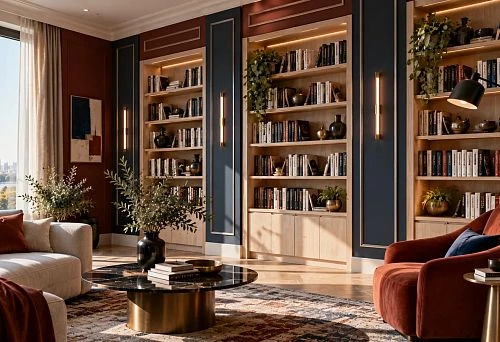
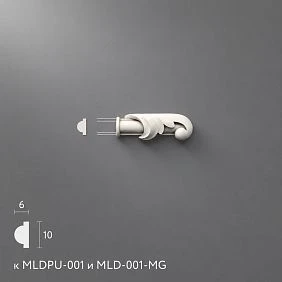
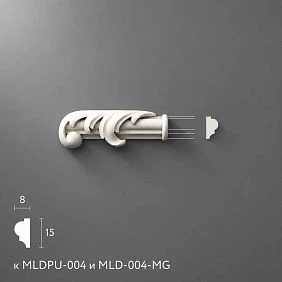
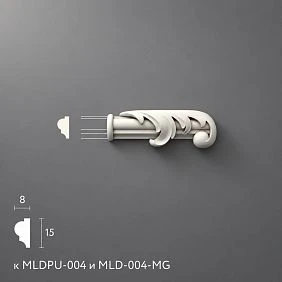
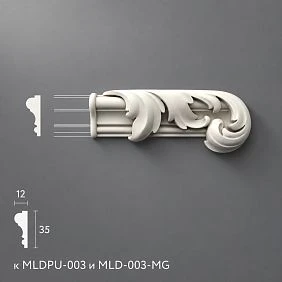
How does an expensive interior differ from an average one at the level of stucco selection? First, the molding profile: for an expensive result, polyurethane moldings with a more complex relief are chosen — MLDPU-002 (5,460 rubles), MLDPU-003 (7,580 rubles), or MLDPU-027 (from 3,990 rubles). Second, coverage: moldings appear not only on the accent wall but on all walls, forming multi-level panels. Third, details: decorative overlays in the corners of frames, stucco decor above the fireplace, console, or arched opening, a large-diameter ceiling rosette with rich ornamentation.
Multi-level wall panels: a classic technique for an expensive result
One of the most effective techniques in an expensive interior is multi-level wall panels. The wall is divided by height into three zones: from the baseboard to a height of 80–90 cm (lower panel), from 90 to 170–180 cm (middle panel), and from 180 to the ceiling (upper zone). Each zone is decorated with its own molding — or the same one, but in different configurations. Decorative overlays are placed in the corners of the frames — corner elements that give the frame a finished look and create a sense of handcrafted work.
This technique has been used in classical architecture for several centuries — and it continues to work flawlessly. A wall with multi-level panels made of quality moldings looks as if an experienced architect worked on it, not the apartment owner on a day off.
Decorative stucco in an expensive interior: where and how
With an expensive budget buy decorative moldings it is worth it for several specific functions. The first is accent overlays in the upper corners of molding frames: they create the feeling that the frame is not just cut at a 45° angle but assembled by hand using decorative corner elements. The second is horizontal decor above the fireplace, if there is one, or above a faux "fireplace" made of moldings, which can be created from scratch. The third is large stucco decor above the main mirror or on the accent wall — an independent decorative element that becomes the semantic center of the space.
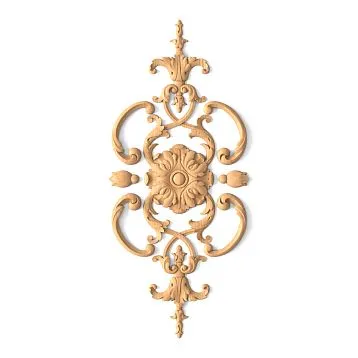
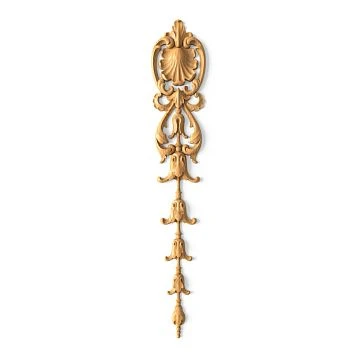
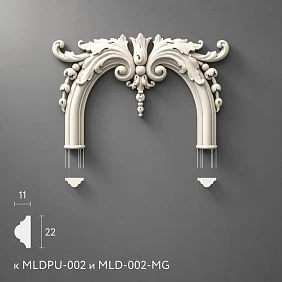
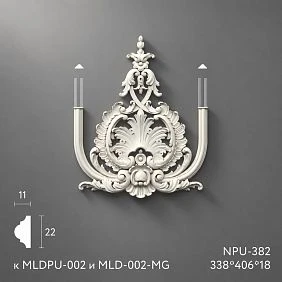
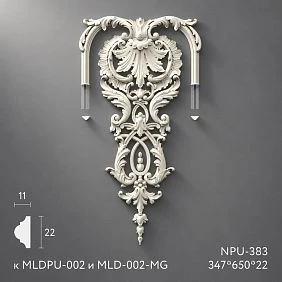
In the STAVROS catalog, decorative overlays are presented in a very wide range — from small corner elements NPU-470 (590 rubles) to large baroque decors costing 20,000–30,000 rubles. For an expensive interior, you don't have to limit yourself to one element — 3–5 correctly placed overlays create a sense of a rich but not overloaded space.
Painting stucco in a luxurious interior: color as a tool
One of the most powerful tools for creating a luxurious look is not the amount of stucco, but its painting. Two main approaches:
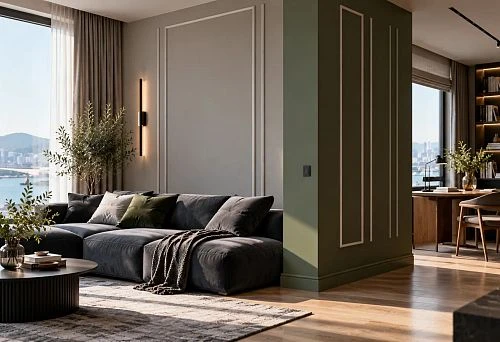
Tone-on-tone with the wall — moldings and decor are painted in the exact color of the wall. Effect: a textured wall with architectural depth, concise and luxurious. Works well in light interiors, especially white, cream, and light gray.
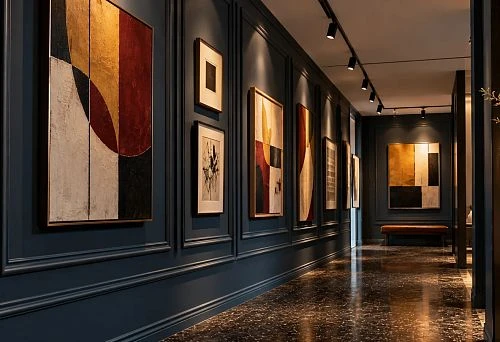
Contrasting color — moldings in a darker or completely different color relative to the wall. Classic: white moldings on a dark blue or olive wall. Effect: expressive 'frames' creating the feel of a mansion, not an apartment in a standard building.
The third approach is patination or imitation of gilding on decorative overlays and stucco decor while maintaining the neutral color of the moldings. This technique literally adds a sense of 'aged' aristocracy to the interior — and requires minimal investment: a special patina paste is applied with a brush or cloth over the base paint.
Selection table: what to buy for each budget
| Budget | What to buy | Where to buy |
|---|---|---|
| Minimal | HIWOOD moldings (1 wall), glue, paint, spare | Moldings made of polyurethane |
| Medium | MLDPU moldings + ceiling rosette + 1–2 decor items | ceiling rosettes |
| Above average | Moldings around the perimeter + ceiling stucco + decor | Ceiling molding |
| Expensive | Full set: walls + ceiling + rosette + overlays | Buy decorative stucco |
| Without a designer | HIWOOD moldings + rosette + 1 accent + spare | Buy moldings |
What you can't skimp on: three non-negotiable points
There are three items you cannot skimp on regardless of budget — this is a rule, not a recommendation.
First — the amount of material. Running out of molding mid-installation means work stoppage, searching for the right SKU, and a very high chance that the needed profile is out of stock or the batch has a different shade. A 10–15% reserve is always mandatory.
Second — the quality of the adhesive. Polyurethane and polystyrene products require a special construction adhesive — not 'liquid nails' from the nearest store, but a compound compatible with polyurethane. The wrong adhesive doesn't just hold poorly — it can deform or dissolve the product's surface. This is a disaster that cannot be fixed after painting.
Third — final painting. Unpainted moldings look like an unfinished renovation. This is especially critical for white factory-made products on colored walls: the contrast will be jarring and inappropriate. Two coats of acrylic paint in the desired color is a mandatory final step that turns a building material into an interior element.
How to Choose Molding Without a Designer: A Practical Algorithm
Many want to do without a designer — to save money, maintain independence in choices, and avoid explaining their preferences for months. This is an absolutely realistic task if you follow an algorithm.
Step 1: Define the room and the main task. What is needed: structure a wall, frame a mirror, add a socket, finish a ceiling? One task — one set.
Step 2: Measure the perimeter of the required surfaces. Walls — horizontally and vertically. Ceiling — along the perimeter. This will give you specific numbers for calculating the quantity of moldings.
Step 3: Determine the style. Classic/Neoclassical — MLDPU moldings with a relief profile. Minimalist/Modern — HIWOOD with a thin profile. Art Deco — geometric moldings, strict rectangles. Do not mix styles in one space.
Step 4: Choose the main and secondary elements. Moldings are the base. Cornice — if a connection between wall and ceiling is needed. Rosette — if there is a chandelier. Decor — one accent element.
Step 5: Calculate the quantity, add 10–15% reserve, and place an order. In the STAVROS catalog, you can select the desired profile, view exact dimensions, and order with delivery.
Typical Mistakes When Choosing Molding on a Budget
Several characteristic scenarios that repeat over and over — and which are easy to avoid if you know about them in advance.
“I’ll buy a little to try” — purchasing two or three strips of molding “to see how it looks.” As a result, one small fragment is installed, which looks like unfinished work, the owner gets disappointed and puts everything off for six months. Rule: molding only works with sufficient coverage — at least one full wall.
"I'll take the cheaper one and replace it later" — choosing the cheapest profile with the mindset of "we'll redo it properly later." But "later" never comes, because the stucco is glued on permanently and removal is a separate renovation. It's better to choose the right profile for your budget right away — even if it's just one, even if only for an accent wall.
"I'll buy everything at once" — the opposite scenario: buying ten different decorative elements at once without a plan. As a result, half stays in boxes, and the other half is installed chaotically. The rule: plan first, then buy.
"I'll save on the reserve" — the most expensive saving possible. Already described above, no need to repeat.
Stucco for different styles: a brief guide to choosing a profile
Different interior styles require different profiles — and this is not a matter of taste, but an objective requirement for spatial consistency. Here's a short but comprehensive cheat sheet.
Classic, neoclassical, baroque — polyurethane moldings MLDPU-002, MLDPU-003 with rich relief. Decorative overlays with floral and architectural motifs. Large-diameter ceiling rosette. Multi-level wall panels.
Modern style, loft, minimalism — polystyrene moldings HIWOOD D22, LD32, D40. No ornamentation. Only geometry. Monochrome painting in the wall color.
Art Deco — moldings with stepped or flat profiles. Strict rectangular frames without rounding. Contrast painting or gold accents.
Provence, shabby chic — light floral decorative overlays, small stucco accents near mirrors and consoles. Medium-width moldings with a soft profile. Painting in white or cream with a slight aged effect.
Scandi, hygge — thin moldings HIWOOD TR10 or D10 in white on white walls. Minimum decor. Maximum purity of forms.
FAQ: popular questions about choosing stucco molding on a budget
What stucco molding to buy if the budget is small?
The optimal solution is buy polyurethane moldings HIWOOD series for one accent wall: D22 or LD32 moldings, glue, acrylic sealant, and paint. This is enough to make one area of the room look thoughtful and expensive. Don't spread yourself thin over the entire perimeter with limited funds — it's better to make one spot flawless.
What should you not skimp on when buying stucco molding?
You cannot skimp on three things: the amount of material (a 10–15% reserve is mandatory), the quality of the mounting glue (only compositions compatible with polyurethane), and the final painting (without it, the molding looks like a building material, not decor).
What to add to moldings to make the interior look more expensive?
Three steps: add Buy a ceiling rosette under the chandelier — it creates a visual center of the ceiling. Add decorative molding to one accent point. Coordinate the painting of the moldings — tone-on-tone with the wall or in contrast. These three steps work on any budget.
Do you need to buy ceiling stucco molding right away?
If the room already plans to have moldings on the walls and a chandelier, Buy ceiling stucco molding it should be ordered simultaneously with the main order. The ceiling cornice is installed last — after wall moldings, but before final painting. If purchased at different times, there is a high risk that the profiles will not match in style or base coating color.
How to calculate the number of moldings?
Measure the perimeter of the required walls (in linear meters). For frame panels, calculate the perimeter of each frame and add them up. Divide by the length of one strip (usually 2 meters). Add 10–15% reserve. Round up to a whole number of strips.
Can different profiles be used in one room?
Yes, but within the same ornamental style. For example, a wider molding for outer frames and a narrower one for inner frames. The main rule: profiles must belong to the same visual language. If you mix classic with geometric, the interior will lose its integrity.
How long will polyurethane stucco last?
Polyurethane products do not crack over time, do not swell from moisture, do not yellow, and do not deform under normal operating conditions. With proper installation and painting, this is a solution for decades without any technical maintenance.
About the company STAVROS
STAVROS is a Russian supplier of decorative polyurethane and polystyrene products for interiors and facades. The company offers a full range moldings for any budget: from economical polystyrene moldings of the HIWOOD series at 250–650 rubles per strip to complex premium polyurethane decorative elements. The STAVROS catalog includes moldings, cornices, baseboards, ceiling rosettes, decorative overlays, and ready-made kits for creating architectural interiors. All products are made from European materials, have passed quality control, and are delivered throughout Russia. STAVROS works with private buyers, designers, construction companies, and finishing teams — with full order support from quantity calculation to delivery to the site.