











































































Article Contents:
- Main principle: zone first, then decor
- How to set priorities
- Moldings for the living room: what they do to the space
- Wall behind the sofa: how to build a frame system
- Symmetry or asymmetry?
- Moldings on all walls or just one?
- Moldings in the TV zone: how to design the wall with a TV
- Moldings near windows: piers and slopes
- Ceiling rosette for the living room: chandelier as part of the interior
- How to choose the size of a rosette for a chandelier
- Is ceiling molding around the perimeter necessary if there is a rosette?
- How to coordinate a rosette with wall moldings
- Ceiling cornice: height for the living room ceiling
- Decorative molding for the living room: when the room needs an accent
- Where exactly does decorative molding work in the living room
- How to choose the size of a decorative element
- Decorative molding in the color of the wall or white?
- Stucco decor for the living room: an expressive detail with character
- Corner overlays: a detail often overlooked
- Decorative panels and friezes
- Stucco decor on living room furniture
- Neoclassical living room: complete set
- What exactly to buy for a neoclassical living room
- How not to overload the living room with stucco
- Three rules of balance
- What to do if you've already bought 'extra' items
- Purchase scenarios: what you need for a specific task
- Wall behind the sofa — from scratch
- The chandelier looks lonely on the ceiling
- Need one accent without redoing the entire living room
- Want a complete interior from scratch
- Table: stucco for the living room by task
- Practical installation details: what’s important to know
- Installation sequence
- How to avoid visible seams
- How much glue is needed
- FAQ: key questions before purchasing
- About the Company STAVROS
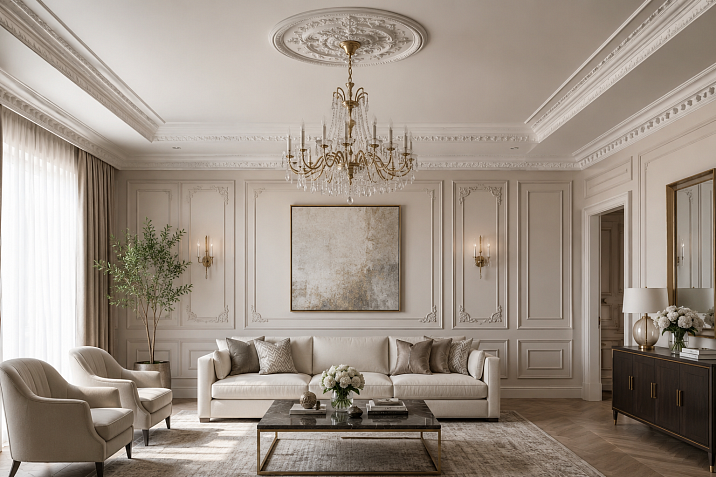
The living room is the only room that everyone sees. Guests, relatives, and the owners themselves every evening. It’s a space where you want to feel good — not just cozy, but also beautiful. That’s why stucco for the living room is not a whim, but a deliberate step toward making the main room truly main.
But where to start? Moldings, ceiling rosette, decorative stucco, stucco decor — each of these elements does something to the space. The question is not “beautiful or not,” but “where exactly, what exactly, and in what sequence.”
Molding for the living room works differently than stucco in a bedroom or hallway. The living room is a multifunctional space: here you relax, socialize, watch movies, entertain guests. Here there is a sofa and a chandelier, a TV and a mirror, curtains and furniture — and each of these elements creates its own visual weight. The task of stucco is not to add another “beautiful object,” but to tie everything into a single system where no element feels superfluous.





Main principle: first the zone, then the decor
The most common mistake is to start with the question "which stucco is prettier." This is a path to nowhere: there are many beautiful moldings and rosettes, but without understanding the task, the choice will be random.
The right approach is the opposite. First: which zone of the living room needs to be decorated? What exactly looks unfinished, too empty, or doesn't contribute to the overall picture right now?
A living room is usually divided into several functional zones, each with its own stucco logic:
-
The wall behind the sofa is the main decorative plane of the living room, the most noticeable one
-
The ceiling with the chandelier is the center of the room from above, which often remains unfinished
-
The TV zone is a horizontal accent plane that can be structured with frames
-
The fireplace zone — if there is a fireplace, it is a ready-made architectural accent that requires framing
-
A mirror or console — point decor that needs framing and support
-
The spaces between windows are vertical planes that can be enriched with frames
-
One accent wall — if the living room is large, one wall can be decoratively richer than the others
Once you answer the question "what are we designing," choosing stucco becomes much easier. Buy molding for a specific task means getting a result, not a set of random details.




How to set priorities
If the budget is limited or you are working with stucco for the first time, start with one zone. The highest return on investment comes from the wall behind the sofa. This is what everyone entering the living room looks at, what appears in the frame during video calls, and what immediately catches the eye.
The second most important zone is the ceiling with a chandelier. If there is a chandelier but no ceiling rosette, the chandelier looks like a wire with a lamp. A small rosette ceiling molding instantly turns the chandelier into an interior element.
All other zones are additions to the main system.
Our factory also produces:





Moldings for the living room: what they do to the space
Molding for the living room is a linear decorative profile from which frames on walls are formed. Frames structure the wall plane, divide it into visual fields, and give the interior architectural quality.
Why do moldings work better in the living room than in other rooms? Because the living room is the most spacious room. Large wall planes without structure are perceived as empty. Molding frames turn these planes into a meaningful surface—without overloading, but by organizing.
Get Consultation
Wall behind the sofa: how to build a frame system
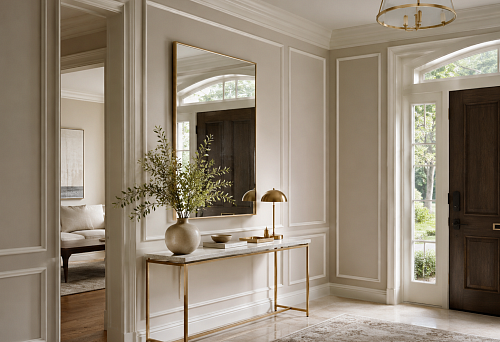
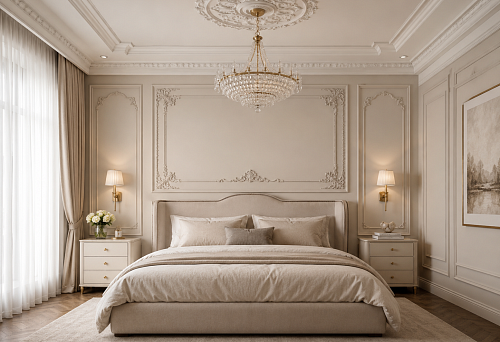
The wall behind the sofa is a classic area for moldings. Three or four symmetrical horizontal frames, aligned in height with the sofa back — and the wall transforms from a background into an architectural feature.
How to build a frame system behind the sofa:
Determine the width of the frames. Three frames behind a three-seater sofa — each frame is roughly equal to the width of one seat. This creates a visual rhythm that aligns with the sofa as an object.
Determine the height of the frames. The lower edge of the frame is 30–40 cm from the floor (above the baseboard). The upper edge depends on the ceiling height. With a ceiling of 2.7 m, frames can occupy 60–70% of the wall height. With a ceiling of 2.5 m — 50–60%.
Molding width. For a living room with a 2.7 m ceiling, the optimal molding width is 30–50 mm. A narrower molding gets lost on a large wall. A wider one may overwhelm.
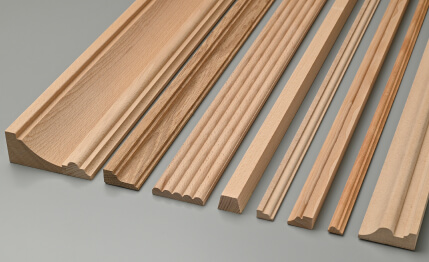
Profile. A smooth heel profile is versatile and works in any interior. An Ionic profile with moderate ornamentation is for neoclassicism. A stepped profile is for a modern style.
Buy polyurethane moldings for the wall behind the sofa means marking the wall, measuring the perimeters of the frames, and ordering with a 15–20% allowance for corner cuts.
Symmetry or asymmetry?
In a living room, moldings more often work symmetrically. A symmetrical frame system creates a sense of order, calm, and classical regularity. This is the language of most residential living rooms.
Asymmetry is acceptable in avant-garde, designer spaces — when asymmetry is a deliberate stylistic choice, not the result of a mistake.
Moldings on all walls or just one?
Depends on the living room area and ceiling height.
Living room up to 20 sq m with a 2.5 m ceiling. Moldings — on one accent wall. On the other walls, they will create a feeling of tightness.
Living room 20–30 sq m with a 2.7 m ceiling. Moldings on two walls — the accent wall (behind the sofa) and one adjacent wall. The rest are neutral.
Living room over 30 sq m with a ceiling of 3 m or higher. Moldings around the entire perimeter — organic. A large space 'accepts' the frame system without overload.
Moldings in the TV area: how to design the wall with a television
The TV area is a specific task. The television itself is a strong accent: a dark rectangle on the wall. Moldings around it help integrate the screen into the wall's architecture — so the TV doesn't look like a hanging 'black hole', but part of a decorative composition.
Scheme: one large frame around the perimeter of the TV with a small gap — or a system of three frames, where the central one aligns with the TV's position. In this case buy polyurethane moldings for the TV wall, it should be in the same profile as the moldings on the wall behind the sofa — if both zones are in the same room.
Moldings near windows: piers and slopes
Piers between windows are vertical planes that often remain empty. Moldings made of polyurethane Here, vertical frames are created that align with the vertical rhythm of the windows. The result is that the wall with windows is perceived as a single rhythmic plane, rather than a set of openings and piers.
Ceiling rosette for the living room: chandelier as part of the interior
A chandelier in the living room is not just a light source. It is the visual center of the room. And if the chandelier simply hangs from a hook in the ceiling, it looks like a temporary solution.
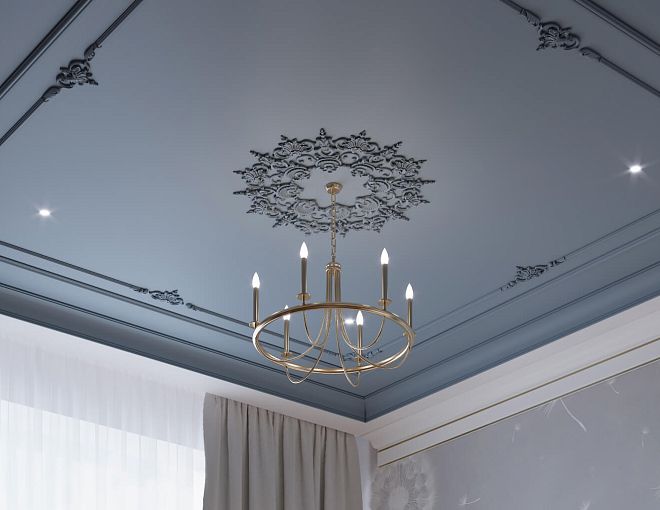
Ceiling rosette for the living room is a decorative element installed on the ceiling around the chandelier's suspension point. It 'receives' the chandelier, creates an architectural frame for it, and transforms the center of the ceiling from a technical spot into a decorative accent.
How to choose the size of a rosette for a chandelier
The diameter of the rosette is determined by several parameters:
Chandelier diameter. The rosette should be larger than the chandelier's base — but not so much that it visually 'overwhelms' the chandelier itself. Guideline: the rosette diameter should be 1.5–2.5 times the diameter of the chandelier's base.
Living room area. For a room of 15–18 sq. m — a rosette with a diameter of 40–55 cm. For a room of 20–25 sq. m — 55–70 cm. For a spacious living room over 30 sq. m — 70–90 cm.
Ceiling height. With a ceiling of 2.5 m — a moderate-diameter rosette. A large rosette on a low ceiling creates a feeling of pressure. With a ceiling of 3 m or higher — a large-diameter rosette is appropriate and monumental.
Living room style. Classic — a rosette with ornament: acanthus leaves, laurel garlands, volutes. Neoclassical — a rosette with moderate ornament. Modern style — a rosette with a clean geometric profile or minimal relief.
Is ceiling molding around the perimeter necessary if there is a rosette?
A rosette is a point accent in the center of the ceiling. It completes the chandelier but does not complete the ceiling as a plane. If the living room is large and the walls are decorated with moldings, a ceiling without a cornice looks unfinished: the walls are "dressed," but the top is bare.
Ceiling molding — a cornice around the perimeter — connects the rosette with the cornice line. This closes the decorative system: a baseboard at the bottom, frames on the walls, a cornice around the ceiling perimeter, a rosette in the center of the ceiling. The living room begins to read as a designed whole.
How to coordinate the rosette with wall moldings
An important rule: the rosette and moldings must belong to the same style family. If the walls have a smooth bead molding — a rosette with minimal ornament or a geometric profile. If the moldings have Ionic ornament — a rosette with classic acanthus ornament.
The rosette does not have to be in the same profile as the molding. But it must speak to the molding in the same stylistic language.
Ceiling cornice: height for the living room ceiling
Ceiling 2.5 m — cornice 40–55 mm. Neat, not oppressive.
Ceiling 2.7 m — cornice 55–70 mm. Well readable, expressive.
Ceiling 3 m — cornice 70–90 mm. Monumental transition.
Ceiling 3.5 m and higher — cornice 90–120 mm. Architectural boundary.
Buy ceiling molding for the living room — means first measure the perimeter of the room and the ceiling height, then choose the cornice profile.
Decorative stucco for the living room: when the room needs an accent
Moldings create structure. The rosette completes the ceiling. And decorative stucco for the living room — is the next level: a point accent that adds character and individuality.
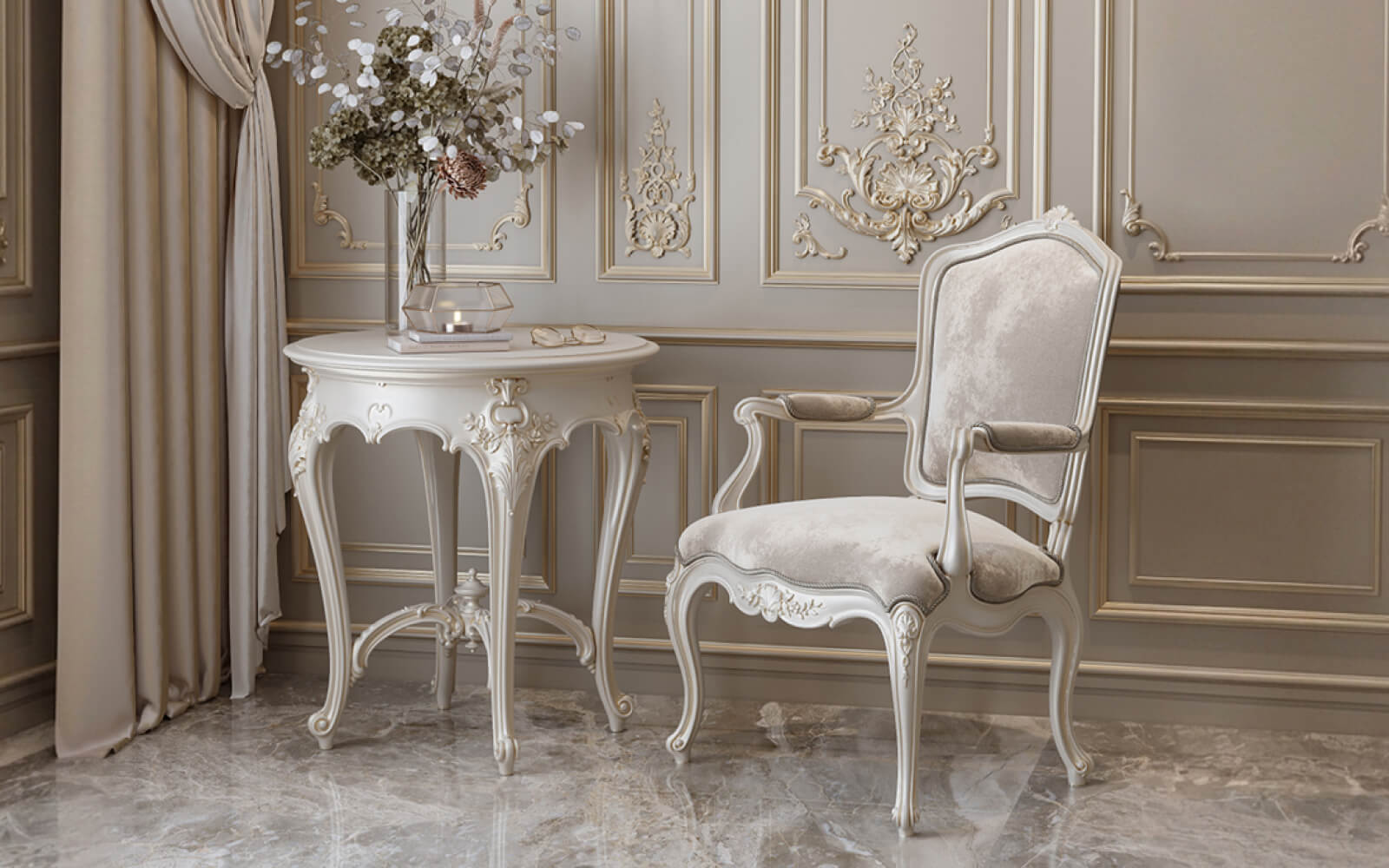
Decorative stucco is individual elements: medallions, cartouches, corner overlays, ornamental inserts. They do not create a linear system like moldings, but work as "decorative signs" at specific points in the space.
Where exactly in the living room does decorative stucco work
Inside a molding frame. This is a classic technique: a molding frame creates a field, and a decorative element in the center of this field — a medallion or cartouche — completes the composition. Without a central accent, the frame may look empty.
Above a console or chest. A console against the wall is a ready-made accent zone. A decorative element above it connects the furniture with the wall, transforming the console area from a "thing by the wall" into a well-thought-out decorative composition.
Above the fireplace. The fireplace area is the most formal element of the living room. The most expressive decor is traditionally placed above the fireplace mantel. A cartouche or medallion above the fireplace is a classic, impeccable technique.
Next to a sconce. Wall sconces often look like isolated objects. A decorative element next to a sconce integrates the light fixture into the overall wall composition.
Above a mirror. A mirror in the living room is an important object. A decorative element above it completes the vertical axis: mirror + element above = a finished decorative vertical.
How to choose the size of a decorative element
The size of the decorative element is determined by the scale of the zone in which it works:
-
Above a console 100 cm wide — a medallion with a diameter of 30–40 cm
-
Inside a frame 60–70 cm wide — an element with a diameter of 25–35 cm (occupies 40–50% of the frame width)
-
Above a fireplace with a mantel 120–150 cm — a cartouche 50–70 cm wide
-
Next to the sconce — a small element 15–25 cm
A too small element gets lost. A too large one overwhelms. Optimal: the decorative element takes up about 40–50% of the width of the zone where it is installed.
Decorative stucco in the color of the wall or white?
In modern interiors, more often: in the color of the wall — the element reads through light and shadow, delicate and contemporary. In classic and neoclassical — a white element on a colored wall — expressive and clear. Gold — for formal living rooms in classic style.
buy decorative moldings with good, deep relief — a mandatory condition for working in monochrome painting. Without clear relief, a tone-on-tone element simply disappears.
Stucco decor for the living room: an expressive detail with character
molded decor for the living room — this is a broader concept, including not only medallions and cartouches, but also decorative corner overlays for frames, ornamental inserts, small relief panels, frieze strips.
If moldings are the architecture of the wall, then stucco decor is its decoration. It is chosen after the structure is created.
Corner overlays: a detail often overlooked
Corner overlays are decorative elements installed in the corners of a molding frame. They serve a dual function: they hide the joints of the moldings at the corner (simplifying installation) and add decorative expressiveness — a small ornament in each corner of the frame.
In a classic living room style, corner overlays are an essential element of a complete system. They give the frame a finished and cohesive look.
Decorative panels and friezes
In a large living room with high ceilings, stucco decor can be used as a decorative panel — a horizontal ornamental band on the upper part of the wall between moldings and the cornice. This is a classic technique typical of formal interiors.
Frieze strip of stucco decoration above the molding frames is a horizontal accent that "closes" the upper zone of the wall and connects the frames with the ceiling cornice.
Stucco decor on furniture in the living room
An interesting application of stucco decor is decorating furniture. Small overlays on cabinet fronts, shelves, and sideboards visually integrate the furniture into the room's decorative system. This works if the furniture is of a classic or neoclassical style and has flat fronts that can be enhanced with relief.
Buy Molded Decoration for furniture means choosing small overlays with a coordinated ornament and gluing them onto the fronts with acrylic mounting adhesive. Painting to match the furniture makes the decor an organic part of the piece.
Living room in neoclassical style: complete set
A separate and very popular task is stucco for a living room in neoclassical style. This is the most common style for residential living rooms in Russia: white doors, furniture with framed fronts, neutral walls, classic chandelier.
What exactly to buy for a neoclassical living room
Moldings. Profile with moderate relief — Ionic, ogee, stepped. Width 35–50 mm. Color — white or matching the wall, depending on preferences.
Frame system. Three to four frames behind the sofa, aligned with the sofa's width. Possibly — two to three vertical frames on the adjacent wall.
Ceiling rosette. Diameter — according to the room area and chandelier diameter. Ornament — moderate classical (acanthus, volutes). Color — white.
Ceiling cornice. Along the perimeter. Profile — matching the wall moldings. Height — according to the ceiling height.
Decorative stucco. One medallion or cartouche — inside the central frame behind the sofa or above the console.
Corner ornaments. In each corner of the frames. Matching ornament.
This is a complete set for a neoclassical living room. The result is an interior that reads as an expensive, well-thought-out solution.
How not to overload the living room with stucco
The living room is a large space, and the desire to 'decorate everything' is especially strong here. But overload in the living room destroys precisely the feeling for which it was all started: the feeling of an expensive, calm, well-thought-out interior.
Three rules of balance
Rule one: one main accent. The living room should have one main decorative area — the wall behind the sofa, the fireplace wall, or the wall with a mirror. This area is the most saturated. The rest support it without competing.
Rule two: the ceiling does not compete with the walls. If the walls are saturated with molding frames, the ceiling cornice should be restrained. If the ceiling has a large expressive rosette, the moldings on the walls can be more modest.
Rule three: one ornamental language. All elements — moldings, rosette, cornice, decorative overlays — should belong to one ornamental family. Do not mix baroque ornament with art deco, do not place Ionic and acanthus in different scales next to each other.
What to do if you have already bought "extra" items
If after installation it seems that there is too much stucco — the first step: paint everything in the color of the wall. This immediately reduces the visual "loudness." The moldings stop shouting and begin to quietly structure.
Second step: remove one type of element. If there are frames, decorative overlays, and a cornice — perhaps the decorative overlays are currently superfluous. Remove them (without losing the fastening) and evaluate the result.
Purchase scenarios: what is needed for a specific task
Wall behind the sofa — from scratch
What to buy:
-
Moldings made of polyurethane — profile 35–50 mm, reserve +15%
-
Mounting acrylic adhesive
-
Acrylic sealant for joints
-
Paint — matching the wall color or white
-
Corner overlays (optional)
-
One decorative element for the central frame (optional)
The chandelier looks lonely on the ceiling
What to buy:
-
Ceiling rosette — diameter matching the area and chandelier
-
Mounting adhesive
-
Paint matching the ceiling color
-
Ceiling Molding Purchase — cornice around the perimeter (optional, but recommended)
Need one accent without redoing the entire living room
What to buy:
-
Buy decorative stucco — medallion or cartouche for a specific spot
-
Mounting adhesive
-
Paint
Want a cohesive interior from scratch
What to buy:
-
Moldings — on the accent wall (and optionally on all walls)
-
Ceiling rose
-
Ceiling cornice around the perimeter
-
Decorative stucco molding — for the central accent
-
Corner overlays
-
Glue, sealant, paint
Table: stucco molding for the living room by task
| Task | What to buy |
|---|---|
| Wall behind the sofa | Moldings 35–50 mm, glue, paint |
| Chandelier without decor | Rosette by diameter, glue, white paint |
| Unfinished ceiling | Ceiling molding — cornice around the perimeter |
| One quick accent | Decorative stucco — medallion or cartouche |
| Large empty wall | Moldings + decorative element in the central frame |
| Solid interior | Moldings + rosette + cornice + decor |
| Neoclassical | Moldings + rosette + cornice + corner overlays + decor |
| Living room up to 20 sq. m | One accent wall, rosette, modest cornice |
Practical installation details: what's important to know
Installation sequence
Correct sequence of installing moldings in the living room:
-
Marking — draw all frame lines and the position of the ceiling cornice with a pencil
-
Installation of the ceiling cornice — start from the ceiling (work "top-down")
-
Installation of the rosette — together with the cornice or immediately after
-
Installation of moldings — horizontal elements first, vertical after
-
Sealing of joints — fill all connections with acrylic sealant
-
Final painting — after the sealant has dried
How to avoid visible joints
Joints of moldings at the corners of frames should be cut at a 45-degree angle. Use a miter saw or miter box for this. Precise cut + acrylic sealant + painting = invisible joint.
Long horizontal moldings are joined at a 45-degree angle (not butt joint). This hides the connection line.
How much glue is needed
Approximate consumption of mounting glue — one tube 380 ml per 4–6 linear meters of molding. For a living room with a wall perimeter of 12–14 m for frames and cornice, 5–7 tubes of glue are needed.
FAQ: main questions before purchase
Which stucco molding should I choose for the living room?
For wall structure — Moldings made of polyurethane. For the chandelier — a ceiling rosette. For accent points — Decorative stucco or Buy Moldings. To finish the ceiling — a cornice.
What to buy for the wall behind the sofa?
Moldings 35–50 mm, glue, sealant, paint. Optional — corner covers and one central decorative element in the main frame.
Is a ceiling rosette needed if the chandelier is already hanging?
Yes, if the chandelier is simply hanging on a hook. The rosette is mounted with glue around the hook — the pendant does not need to be removed. The operation takes 20–30 minutes.
How not to overload the living room?
Choose one main zone. Keep one style and one ornamental language for all elements. Paint to match the wall color — this will reduce visual load.
Should moldings and the ceiling rosette be from the same manufacturer?
Not necessarily the same manufacturer — but definitely from the same stylistic family. The molding profile and the rosette ornament should speak the same decorative language.
What should I buy for a small living room up to 18 sq m?
One accent wall with moldings, a ceiling rosette under the chandelier. The cornice — neat, small. Decorative stucco — one element in the main frame. That's enough.
How much does a full set of stucco for a living room cost?
It depends on the area, the chosen profile, and the number of elements. Moldings, cornice, rosette, glue, paint for a living room of 20–25 sq m — when contacting a STAVROS specialist, you can get an accurate calculation for specific dimensions.
About the company STAVROS
A living room is a room you want to do once and for a long time. Not to redo in three years, not to regret a random choice. That's why it's important that the stucco is high-quality: with a clear relief, precise geometry, and a stable surface.
STAVROS is a Russian manufacturer of decorative polyurethane products. In the STAVROS catalog: Moldings made of polyurethane a wide selection of profiles, Decorative stucco и Relief Decoration for accent zones, Ceiling molding for cornices and rosettes. The entire range — at the link: Buy moldings.
All STAVROS products are made from high-quality dense polyurethane, ready for painting, and accurately reproduce the ornament. STAVROS specialists will help you choose a set for the living room, taking into account dimensions, style, and purpose — so that each element works not on its own, but as part of a single well-thought-out space.