Article Contents:
- The detail that makes all the difference
- Why wooden handles transform the look of furniture
- What types of wooden handles are there: a complete overview
- Button Handles
- Bracket handles
- Long Wooden Handles
- Recessed handles
- Handles with and without coating
- Wooden handles for the kitchen: what you need to know
- Coating is a must
- Grip comfort is the first functional criterion
- Size in proportion to the facade
- Classic or modern kitchen?
- Handle color and facade color
- Wooden handles for cabinets: proportions are everything
- Long handles for tall doors
- Brackets for medium-sized cabinets
- Knob handle — only for small sections
- Classic cabinet with carved facades
- Wooden handles for a chest of drawers: rhythm of drawers
- Same handles on all drawers
- Handle placement centered on the drawer
- Knob or bracket for a chest of drawers?
- How to combine handles with furniture decor
- If the facade is already decorative
- If the facade is simple and smooth
- Furniture moldings and handles: a systematic approach
- Overlay decor and handle in the same line
- Wooden handles for a classic interior
- What to consider when buying: a practical checklist
- Practical table: what to buy for different tasks
- Mistakes when choosing wooden handles
- Frequently Asked Questions
- About the Company STAVROS
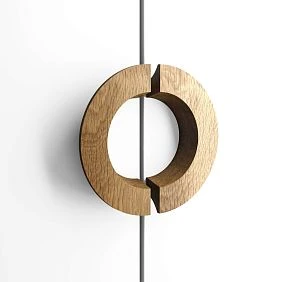
The detail that makes all the difference
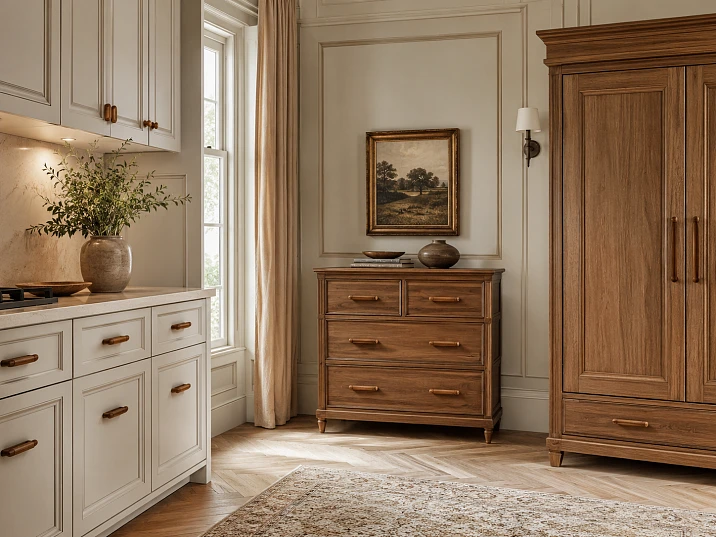
Imagine two completely identical dressers. One sits in a store with plastic chrome handles, the other with wooden handles made of solid beech in a warm walnut tone. This is the same piece of furniture, the same construction, the same size, the same body color. But they look different. So different that a person is willing to pay more for the wooden option — without even thinking about why.
The answer is simple. The handle is the first point of tactile contact with the furniture. It's what you grab with your hands every day, dozens of times. It's a detail seen from arm's length. And it is this detail that forms the first and most lasting impression of the furniture — whether it looks expensive or cheap, thoughtful or generic, unique or faceless.
wooden furniture handles — it's not just hardware. It's a statement about the character of the interior. Where warmth, naturalness, craftsmanship, or a classic detail is needed — metal always loses to wood. Wood is alive, warm to the touch, visually rich. It works where cold metal creates a feeling of facelessness.
The purpose of this article is to help you choose a handle that doesn't just "fit," but completes your interior. Because a correctly chosen handle can truly make furniture look more expensive. And a wrong one can ruin the entire facade.




Why wooden handles change the look of furniture
There is a principle in interior design that works at any level of complexity: an accent detail defines the style of an object more strongly than its basic shape. A cabinet can be neutral, almost faceless — but a wooden handle with an expressive form moves it into a completely different stylistic category. A kitchen can be simple and affordable — but a correctly chosen wooden handle adds warmth, coziness, and character that plastic or cheap metal will never provide.
Why wood specifically? Because it carries what human perception recognizes as "naturalness" and "value." The texture of wood is unique for each piece, unrepeatable. Tactility — warm, pleasant, alive. Visual density — honest: wood looks like what it is. It doesn't pretend.
Furthermore, a wooden handle works within a system. It connects the furniture facade with a wooden floor, wooden beams on the ceiling, a wooden dining table, wooden picture frames. It creates a family of material rhymes within the interior that make the space cohesive and harmonious.
Furniture Handles made from solid oak and beech — these are the materials that simultaneously provide strength, beauty of texture, and durability. Oak is denser, with an expressive pattern. Beech is softer in tone, with a more uniform texture. Both materials accept oil impregnation and painting perfectly, while retaining the tactile warmth of living wood.
Our factory also produces:
What types of wooden handles exist: a complete overview of types
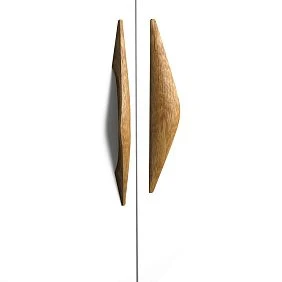
Before choosing, you need to understand the typology. Wooden handles for furniture are divided into several categories, each of which has its own area of application and logic of selection.
Get Consultation
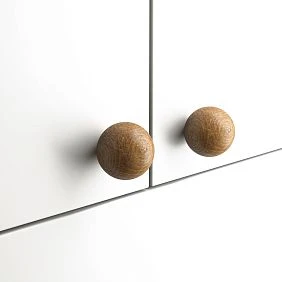
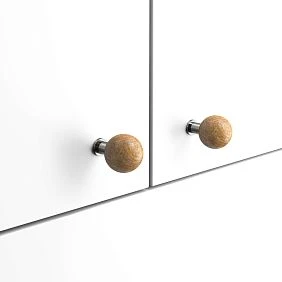
Button Handles
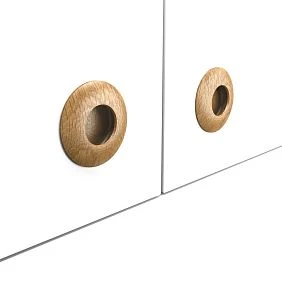
The most compact form. A small protruding element that is mounted with a single screw in the center. A knob handle is a concise solution for small drawers, lightweight fronts, nightstands, jewelry boxes, and chests of drawers with narrow sections. Its main advantage is unobtrusiveness: it does not dominate the facade, does not distract attention, and works as a quiet accent.
A round wooden knob handle is one of the most versatile options. It can be installed on almost any furniture: from Scandinavian minimalist to classic. The round shape has no direction; it can be mounted without reference to horizontal or vertical.
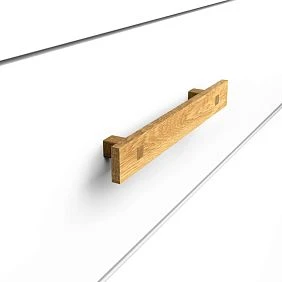
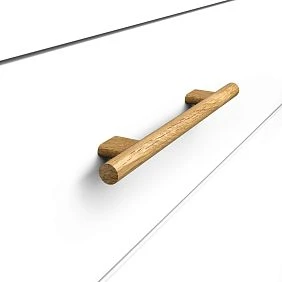
Pull handles (bail handles)
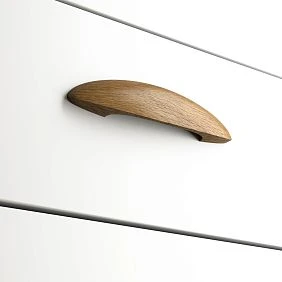
A classic bracket is a U-shaped profile that is attached with two screws. This is the most ergonomic type of handle: comfortable grip, ability to pull the facade in any direction, good load distribution on the facade. wooden hook handle — a traditional solution for chests of drawers, kitchen drawers, bedside tables, and wardrobes with hinged sections.
A wooden bracket works well in interiors styled as country, Provence, Tuscan, rustic, as well as classic and neoclassical. It is visually simpler than a long handle, but functionally more convenient than a knob. The bracket is a balance between practicality and aesthetics.
Center-to-center distance — the distance between two mounting points — is typically 64, 96, 128, 160 mm. It should be chosen based on the width of the facade: narrow facade — 64 mm, wide — 96 or 128 mm.
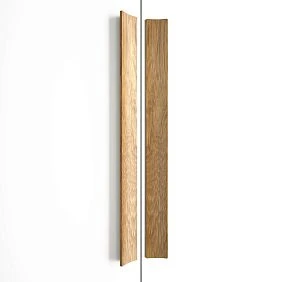
Long wooden handles
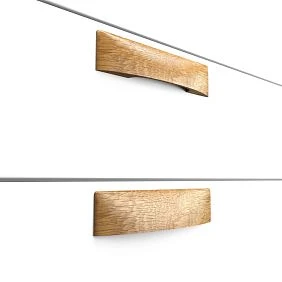
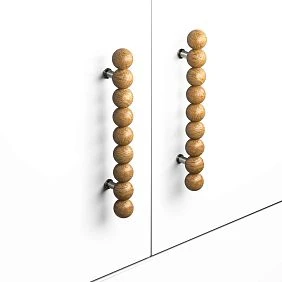
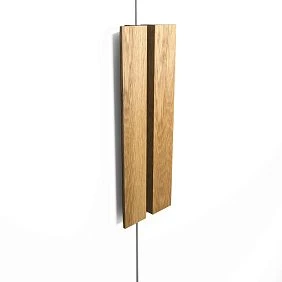
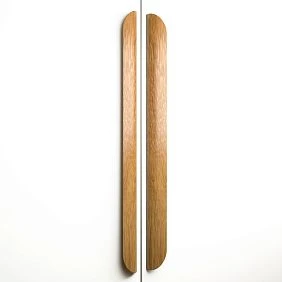
Long handles are for large facades: tall cabinets, tall units, kitchen cabinet doors, large chest drawers. Length from 150 to 600 mm and more. A long handle creates an expressive horizontal or vertical line on the facade, which is an independent decorative element.
Wooden long handles for kitchen units are a particularly popular option in modern and Scandinavian interiors. One horizontal handle across the entire width of the upper door, repeated on all facades — this is a rhythmic, clean, very modern technique.
Recessed handles
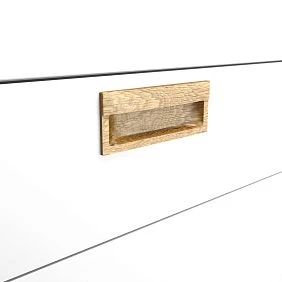
Wooden recessed handles — these are handles without a protruding part above the facade surface. They are recessed into the facade, creating a smooth, flush effect. This is the calmest, most "quiet" solution — for interiors where a clean facade without extra details is needed.
A recessed handle works well in modern and minimalist interiors, where facades should not "speak." But it requires careful installation: the depth of the recess must be precise, the edges clean. This is a more complex installation than an overlay handle, but the result is exceptionally neat.
Handles with and without coating
This division is practical. Wooden handles with coating — are painted in one of the basic colors: black, white, brown, or transparent. The painting provides protection from moisture, dirt, and mechanical damage. This is a ready-made solution that can be installed without additional treatment.
Handles without coating — "pure" wood, ready for self-treatment: oil, wax, varnish, stain, paint of any color. This is an option for those who want to exactly match the interior color or work on an individual project where standard colors are not suitable.
Wooden handles for the kitchen: what is important to know
The kitchen is the most demanding space for furniture fittings. Here, handles are taken most often, humidity is higher than in other rooms, grease splashes and constant cleaning occur. Therefore, the choice of wooden handles for the kitchen is subject to several practical requirements, in addition to aesthetic ones.
Coating is a mandatory condition
For the kitchen, choose Wooden handles with coating. Professional painting provides surface protection from moisture, grease, dirt, and accidental splashes. A handle without coating in the kitchen is a risk: unprotected wood absorbs moisture and grease deposits, darkens in areas of greatest contact, and loses its appearance much faster.
Coated wood at the same time retains all its aesthetic qualities: the texture is visible through the paint, tactile warmth does not disappear, the character of the material remains. A protective layer is simply added, making the handle suitable for kitchen use.
Grip comfort is the first functional criterion
Kitchen drawers and fronts are often pulled, frequently with wet hands or under load. The handle must provide a secure, comfortable grip. A bracket with a center distance of 96–128 mm is the optimal option for lower kitchen drawers: it is grasped with the entire palm, allowing smooth and effortless pulling.
For upper facades — where you mostly pull with two or three fingers — you can use lighter handles: knobs for small doors or long horizontal handles for wide facades.
Size in proportion to the facade
A wooden kitchen handle should be proportional to the size of the facade. A small knob on a wide kitchen door looks lost. A long handle on a narrow drawer looks absurd. A rough guideline: the handle should occupy 1/3 to 2/3 of the facade's width or height.
Classic or modern kitchen?
For a classic kitchen with milled facades, carved cornices, and patinated details — wooden handles with expressive shapes: brackets with figured arches, knobs with relief surfaces, forms with soft or baroque curves. These are handles that 'speak' the same language as the classic facade.
For a modern kitchen with smooth matte facades — wooden handles of simple geometric shapes: rectangular long ones, thin oval brackets, minimalist knobs without ornamentation. The wooden material adds warmth, the form maintains cleanliness.
Handle color and facade color
Here, one principle applies: the handle color should either match the facade color (monochrome approach, the handle is read through form, not color), or be natural wood against a painted facade (contrast approach, the handle is an accent).
A dark wooden handle on a light facade is a strong, expressive technique. A light wood handle on a dark facade is equally convincing but rarer. A handle in the same tone as the facade is a delicate, almost invisible approach where only the form works.
Wooden handles for cabinets: proportions are everything
A wardrobe is a large furniture unit with big facades and tall doors. This is where the issue of handle-to-facade proportion is most acute. A small handle on a tall wardrobe door is not "neatness" — it's a disproportion that immediately catches the eye.
Long handles for tall doors
For tall wardrobe doors, the best option is Wooden long handles. A length of 300–500 mm on a facade 1800–2200 mm high is the correct proportion. The handle is mounted vertically, creating a strong vertical line that emphasizes the height of the wardrobe.
Horizontal placement of a long handle on a wardrobe facade — for more modern solutions. This looks especially striking when all wardrobe doors have identical long horizontal handles positioned at the same height: it creates a rhythm that organizes the wardrobe facade into a single visual system.
Brackets for medium-sized wardrobes
For sliding wardrobes, double-door wardrobes, and wardrobes with facades 400–600 mm wide — a wooden bracket with a center-to-center distance of 96–160 mm. This is a reliable, convenient, and visually balanced form.
Knob handle — only for small sections
A knob on a wardrobe facade — only if the section is truly small: a pull-out drawer 100–150 mm high, a small lower section. On a full-size door, the knob gets lost and creates a feeling of carelessness.
Classic wardrobe with carved facades
Classic bedroom or living room furniture — a cabinet with milled facades, a cornice on top, decorative moldings on the doors — requires a handle that is organic to this language. A wooden handle with a smooth, figured shape — a bracket with a soft curve of the arch, a button with a relief base, a long handle with a variable cross-section — all these are the right options. A straight metal handle on a classic cabinet is a dissonance that even a person without a design education will notice.
Wooden handles for a chest of drawers: the rhythm of drawers
A chest of drawers is a special case. Here there are three to eight drawers, each with its own handle. And it is on the chest of drawers that the handle works not as a single accent, but as a rhythmic element, repeating along the entire height of the piece.
This means that on a chest of drawers, the error of choice is multiplied by the number of drawers. If the handle is ugly or disproportionate — you see it eight times in a row. If the handle is chosen successfully — you see a rhythmic, beautiful vertical sequence that turns the chest of drawers into a decorative object.
Identical handles on all drawers
The simplest and most winning approach is identical handles on all drawers. A single type, a single size, a single orientation. This creates rhythm and order that make the chest of drawers visually complete.
The exception is chests of drawers where the drawers are of different sizes. In this case, you can use the same type of handle, but with different center-to-center distances (proportional to the width of the drawer). All handles are of the same model, but narrow drawers — 64 mm, wide ones — 96 or 128 mm.
Positioning the handle in the center of the drawer
On a chest of drawers, the handles should be in the center of the facade — horizontally and vertically. A handle shifted to the edge or to the top of the drawer disrupts symmetry and immediately looks sloppy. Marking before installation is a mandatory step.
Button or bracket for a chest of drawers?
Depends on the size of the drawers. For narrow drawers (height up to 120 mm) — a knob. For wide and deep ones — a bracket or a long handle that provides a comfortable grip when pulling out a heavy drawer.
A classic chest of drawers with straight fronts and medium-width drawers is an ideal candidate for a 96 mm wooden bracket in a neutral or dark finish.
How to combine handles with furniture decor
This is the strongest — and most underestimated — block when choosing handles. A handle does not exist in a vacuum. It exists on a front that can be smooth or have decorative elements: carved overlays, moldings, milled inserts. And it is the relationship of the handle with this decor that determines whether the front will look cohesive.
If the front is already decorative
If the furniture front already has decor for furniture — carved overlays, corner elements, ornamental inserts — the handle should be more restrained. It should not compete with the decor, should not overpower it. A calm wooden knob or a simple bracket in the tone of the front is the right solution. The front already speaks enough. The handle is the last, quiet touch.
If the front is simple and smooth
A smooth, neutral front is a canvas. This is where a wooden handle can be expressive, can be the main decorative accent. A handle of an interesting shape, unusual size, with expressive wood texture — on a smooth front it works as a small-scale piece of art. The only decor that carries all the semantic load.
Furniture moldings and handles: a systematic approach
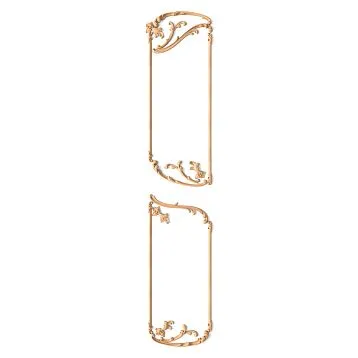
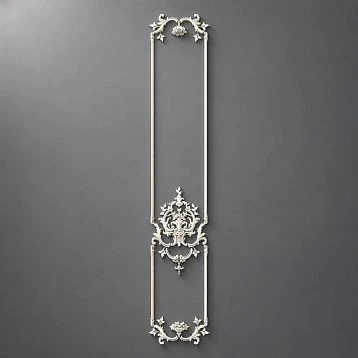
If you plan to update your furniture comprehensively — adding handles along with Moldings for furniture — it's important that both elements are stylistically coordinated. Moldings on the facades of a cabinet or chest create framed panels. A handle inside these frames or at the center of the lower part of the frame is already an architectural system, not just a "placed handle."
For classic furniture, this system works flawlessly: Wooden moldings the facade sets the frame, decorative overlays in the corners add ornamentation, and a wooden handle at the bottom of the frame completes the facade as a unified decorative statement. This is what "custom" furniture looks like — even if all components are purchased and installed independently.
Overlay decor and handle in the same line
One of the most reliable ways to avoid stylistic dissonance is to choose handles and buy furniture decor from a single source, from one manufacturer. This ensures consistency in the character of the ornament, the scale of details, and the overall stylistic tone. Random decor from different manufacturers on the same facade is a sure path to eclecticism that looks not like a bold design technique, but like chaos.
Wooden handles for a classic interior
A classic interior requires a special conversation about the handle. Here, furniture is Classic Furniture with carved cornices, milled facades, patina, curved legs, ornamental details. It is in this context that a wooden handle must be both expressive enough not to get lost, and restrained enough not to overpower the rich facade.
Which shapes work in classic style? A bracket with a figured, softly curved arch is organic. A knob with a relief base is suitable for small drawers. A long handle with a variable cross-section, slightly thicker towards the center, works on large fronts. A straight, strict geometric shape is generally not the best choice for classic style: it belongs to a different coordinate system.
Color for classic style: dark brown, walnut or dark oak is a traditional option. White with patination is for light classic, Provence, neoclassical in cream tones. Natural wood (transparent impregnation) is for Scandinavian and modern classic in light tones.
What to consider when buying: a practical checklist
Before placing an order for wooden handles, go through this list — it will help you avoid most common mistakes:
-
Type of front. Hinged, pull-out drawer, drop-down? Each type has its own requirements for the shape and installation of the handle.
-
Size of the front. Width and height determine the type of handle and its length. A knob is for small ones. A long handle is for large ones.
-
Center-to-center distance. For brackets — make sure the selected center-to-center distance matches the already drilled holes (if any) or corresponds to the chosen mounting template.
-
Coating. Kitchen and bathroom — only handles with coating. Bedroom, living room, study — you can choose handles without coating for self-treatment.
-
Color. Matching the front (monochrome) or contrast (accent)? Both options work but require a conscious choice.
-
Furniture style. Classic, neoclassical, Scandinavian, country, rustic, minimalism — each style has its own language of shapes.
-
Decor on the facade. Are there carved overlays, moldings? If yes — the handle should be more modest.
-
Quantity and reserve. Count precisely, add 5–10% reserve for possible changes.
Practical table: what to buy for different tasks
| Task | What to buy |
|---|---|
| Update an old dresser | Wooden knob handles or pulls, a single model for all drawers |
| Make the kitchen warmer and cozier | Wooden handles with coating, pulls or long ones for lower facades |
| Select handles for classic style | Figural pulls or knobs with relief, dark or transparent finish |
| Make the facade visually cleaner | Recessed wooden handles, flush effect |
| Update tall cabinet | Long wooden handles, vertical orientation |
| Make furniture more expensive and expressive | Handles + overlay decor + moldings for furniture |
| Furniture with carved facades | Subtle staples or buttons in the color of the facade, without additional decor |
| Scandinavian kitchen | Long wooden handles with clear coating, horizontally |
| Provencal bedroom | Wooden staples with soft lines, light or brown color |
Mistakes when choosing wooden handles
Let's break down typical mistakes — so you don't repeat them.
Error one: the handle does not match the scale. A handle that is too small on a large facade — and vice versa. Measure the facade before choosing a handle. The calculation is simple: the handle should occupy at least 1/4 of the width (or height) of the facade.
Error two: different handle models in the same space. Different models on a cabinet and a dresser in the same room — this is not "eclecticism", it's chaos. Use one handle model on all furniture in one room.
Error three: ignoring the decor on the facade. If the facade is already richly decorated — an active handle increases overload. And vice versa: a modest handle on a bare facade — a loss of decorative potential.
Error four: incorrect center-to-center distance. You ordered handles with a center-to-center distance of 96 mm, but the drawer already has holes drilled at 64 mm. Result: extra holes, patches, a ruined facade. Always measure existing holes before ordering.
Error five: the handle is not coated in the kitchen. Unprotected wood in the kitchen will darken in the grip area after a few months and will look untidy.
Frequently asked questions
Which wooden handles are best to buy for the kitchen?
For the kitchen, wooden handles with a coating are optimal — brackets with a center-to-center distance of 96–128 mm for lower drawers and long handles of 200–400 mm for upper facades. Coating is mandatory: it protects against moisture, grease, and dirt during daily use.
What is better: a knob handle or a pull handle?
It depends on the size of the facade. A knob — for small drawers and light doors: facade height up to 150 mm, width up to 300 mm. A bracket — for everything larger: it provides a comfortable grip and proper load on the fasteners. In the kitchen and on a dresser, a bracket is more practical than a knob in most cases.
Can wooden handles be installed on modern furniture?
Yes, and this is one of the best techniques for "warming up" a modern interior. A wooden handle on a smooth matte facade adds warmth and naturalness that neither metal nor plastic provides. Choose simple shapes: long rectangular, thin brackets, minimalist knobs.
How to choose handles for classic furniture?
Look at the character of the facade decor. Rich carving, active overlays — choose a calm handle: a bracket without excessive ornament, a button in the tone of the facade. Facades with simple milling — you can add a handle with a figured shape. The single rule: the handle supports the furniture style, not competes with it.
What is better: handles with coating or without?
For the kitchen and bathroom — with coating, undoubtedly. For the bedroom, living room, study — both options work. Handles without coating allow you to paint them in the exact color of the interior. Handles with coating are ready for installation immediately, requiring no additional work.
Do I need to buy handles with a reserve?
Always. The standard reserve is 5–10% of the calculated quantity. This is insurance against installation errors, chips during drilling, or changes in layout.
How to correctly mark the installation location of the handle?
Button — center of the facade on both axes. Bracket — center of the facade on the vertical axis, center distance symmetrical from the vertical center. Long handle — centered vertically, horizontally — at a height of 1/3 from the bottom edge of the facade (for horizontal placement) or symmetrically centered (for vertical). Use a laser level or painter's tape with markings.
Can wooden handles be combined with metal ones?
Within one room — extremely cautiously. If it is a conscious design technique: wood on some furniture items, metal on others — then it works. If it is a random choice, the result will feel like inconsistency. It is better to stick to a single material for hardware in one space.
About the company STAVROS
Everything discussed in this article — Furniture Handles made of solid oak and beech, Wooden handle hooks, Mortise wooden handles, decor for furniture, Moldings for furniture — all this is produced and sold by STAVROS.
STAVROS is a Russian company with its own production of solid wood, polyurethane, and polystyrene products for interiors and facades. STAVROS furniture handles are manufactured using 3D milling from hardwoods — oak and beech — and are available both with a professional coating (black, white, brown, transparent) and without coating for self-treatment.
In addition to handles, the STAVROS catalog offers a full range for comprehensive furniture design: wooden overlays and ornamental carved panels, solid wood moldings and cornices, classic furniture from own collections, as well as polyurethane stucco for walls and ceilings. All this allows creating a cohesive, stylistically unified interior from a single source.
Order from one piece. Delivery to any region of Russia and CIS countries. Mounting hardware is included in the kit.