Article Contents:
- Break down the furniture model into individual parts
- Why four, twelve, and one hundred parts are counted differently
- Which operations are reasonable to keep in-house
- Which operations are especially sensitive to small batches
- How to calculate in-house manufacturing without omissions
- Don't confuse cost with expenses that will disappear after purchase
- The price of a finished part is only the beginning of the purchase calculation
- Account for the area that delays furniture production
- Turned parts: when a ready-made profile reduces work
- Legs are chosen before manufacturing the carcass
- Carved overlay instead of finishing the entire facade
- Wooden handles: cost of the mold and precision of attachment
- Molding is calculated by cutting layout, not just by linear meters
- Table for deciding on each item
- The sample verifies both the design and the calculation
- Transfer the decision into the working documentation
- For a repeat series, review only the conditions that have changed
- A ready-made serial part or custom furniture parts
- Where to buy ready-made furniture parts for a small batch
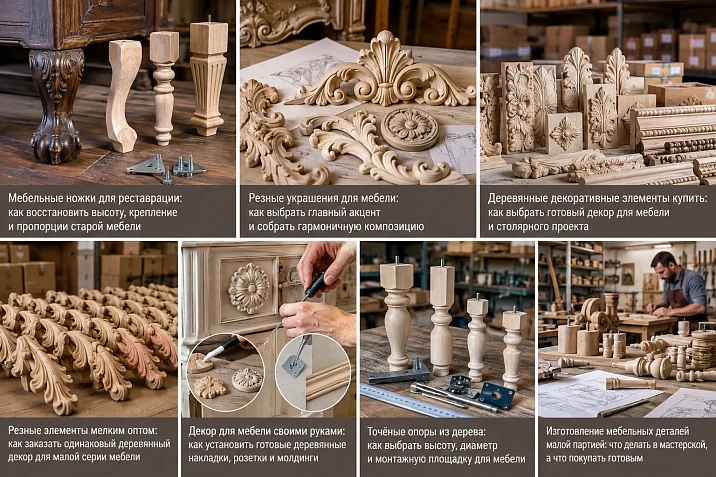
Eight identical cabinets need thirty-two legs. A block for one support may cost noticeably less than a ready-made part, but after purchasing the wood, the work has only just begun: you need to prepare the blanks, set up the machining, achieve a uniform profile, carry out sanding, and check the attachment. For a small series, these operations can take more time than making the cabinet body itself.
The production of furniture parts in small batches is planned for each item separately. The workshop can make the carcass using its own equipment, buy the legs and handles, and perform the finishing of the entire set in-house. The decision depends on the quantity, complexity of shape, readiness of operations, and the actual workload of people and machines.
Two paths to the same result should be compared: a part ready for installation with the required geometry and surface quality. The price of the blank and the price of the finished element show only part of this path.
Break down the furniture model into individual parts
Start with the bill of materials. List the carcass parts, fronts, supports, handles, overlays, sockets, moldings, and fasteners. For each item, specify the quantity per product, material, and required condition before assembly.
A conditional example for eight cabinets with two side panels, two handles, and one decorative overlay each:
| Position | Per cabinet | For eight cabinets | What needs to be compared |
|---|---|---|---|
| Carcass side panel | 2 pcs. | 16 pcs. | In-house cutting and processing versus a possible external service |
| Furniture leg | 4 pcs. | 32 pcs. | Complete manufacturing of the support with the purchase of a suitable model |
| Wooden handle | 2 pcs. | 16 pcs. | Manufacturing of the mold and fastening with a finished version |
| Carved overlay | 1 pc. | 8 pcs. | Custom threading with the installation of a catalog component |
The table shows part of the configuration, not the full composition of the cabinet. In a real project, separate rows are needed for the remaining body parts, fronts, slides, and joints.
Only truly identical parts can be combined into one item. Supports of different heights, left and right overlays, and handles with different fastenings require separate calculation. Eight furniture sets do not yet mean eight identical production operations.
At this stage, it is not necessary to definitively choose the method for producing each part. What matters is seeing the full scope and understanding which items require separate production preparation.




Why four, twelve, and one hundred parts are calculated differently
Many operations have a preparatory part that is performed before processing the batch: installing the tool, setting the stops, checking the program, the clamping, and the first part. If preparation takes the same time for different volumes, a small batch accounts for a large share of it.
Suppose one operation requires 120 minutes of preparation and then 15 minutes of processing for each part at the same workstation. These are conditional numbers to explain the calculation; they are not standards for turning or threading.
| Number of usable parts | Batch preparation | Batch processing | Total time | Average per part |
|---|---|---|---|---|
| 4 pcs. | 120 min | 60 min | 180 min | 45 min |
| 12 pcs. | 120 min | 180 min | 300 min | 25 min |
| 100 pcs. | 120 min | 1500 min | 1620 min | 16.2 min |
The processing time for a single part itself has not changed. The difference arose from how the preparation was distributed. The example does not account for defects, additional changeovers, or breaks; in a working calculation, these are estimated separately.
No rule such as “always buy up to twenty pieces” can be derived from the table. If suitable tooling is already set up and the operation is mastered, a small order may turn out to be convenient for in-house production. If a new complex process has to be created for the sake of a hundred parts, their quantity alone does not make production profitable.
It is also not worth expanding the batch just for the sake of an attractive unit cost. Extra parts require material, time, and storage, and their use in the next order may not materialize.
Our factory also produces:
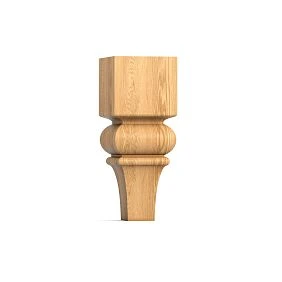
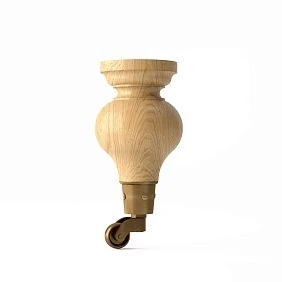
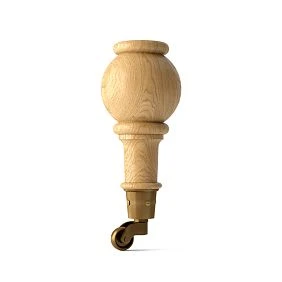
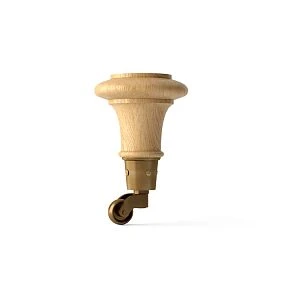
Which operations are reasonable to keep in-house
Usually, the first operations considered are those the workshop already performs consistently: cutting, processing simple panels, drilling using proven templates, and making simple slats. But the decisive factor remains the readiness of the specific area.
If there is an accurate cutting map, the right tool, and a clear production time, the in-house route is easy to verify. For a case of non-standard width, this can be especially convenient: the workshop retains the ability to change dimensions and coordinate joints with the other components.
A different situation is a seemingly simple part for which there is no suitable operation. For example, a small handle requires not only cutting out the shape but also achieving identical rounded corners, safe edges, a clean surface, and precise fastening. External simplicity does not always mean a short production path.
The useful question is: “Can we get the entire batch at the required quality and with clear costs?” Having a machine answers only part of that question. The operator’s experience, tooling, verification of the result, and available time all matter.
Get Consultation
Which operations are especially sensitive to small batches
A complex turned profile, deep threading, shaped cross-section, and a new spatial model require preparation that is difficult to estimate based on wood cost. The calculation includes design, tool selection, trial machining, and correcting the first results.
For a carved element, significant work may remain after the machine: cleaning out recesses, removing machining marks, and sanding hard-to-reach areas. If only the program’s run time is taken into account, the estimate will be incomplete.
For a repeating shape, it is useful to make a trial part and record the actual operations. Divide the time into batch setup, machining one workpiece, manual finishing, and inspection. Sometimes it turns out that the longest step is not the carving, but preparing the surface for the chosen finish.
Ready-made wooden furniture parts become interesting precisely where purchasing them removes a labor-intensive step without worsening the design. But if the purchased part has to be re-milled, significantly trimmed, and finished for a long time, the advantage needs to be recalculated.
How to calculate in-house manufacturing without omissions
For each part under consideration, make a short list of operations: obtaining the workpiece, machining, drilling, surface preparation, inspection, finishing, and transfer to assembly. Indicate who performs the work and which equipment is used.
A batch calculation can be represented as follows:
Cost of in-house manufacturing = batch setup + materials and consumables + equipment operation + labor + inspection and corrections + planned finishing.
Cost of a good part = batch costs ÷ number of parts suitable for installation.
The composition of each line must be determined in advance. If the equipment operation rate already includes operator labor and electricity consumption, they cannot be added again in other lines. If setup includes programming and a trial run, the same hours should not be counted again under a separate heading.
Material is calculated based on actual blanks and cutting layout. A finished carved leg and a rectangular block for processing it have different volumes. Allowances, technological areas, and waste must not be lost between the sketch and the lumber purchase calculation.
The actual costs of spoiled blanks are already included in material consumption and completed work. After that, the cost is divided by the number of good parts. Adding another surcharge on top for the same accounted-for defect is incorrect. For a preliminary estimate, data from similar operations is used, and for a new shape, explicit uncertainty is left until a sample is made.
Do not confuse cost with expenses that will disappear after purchase
For evaluating a workshop product, full cost is needed. But when deciding on an already accepted small order, it is useful to separately see which future expenses will actually change if ready-made components are purchased.
For example, rent for the premises usually will not disappear because of refusing to make thirty-two legs. A previously purchased machine will not become cheaper either. If the rent allocated to these legs is entirely recorded as “savings from purchasing,” the monetary effect will be overstated.
On the other hand, forgoing new special tooling, purchasing blanks, or an additional paid shift can genuinely reduce order expenses. These changes need to be highlighted in the comparison.
The workshop owner’s working time also matters, even if they do not charge themselves for each operation. However, freed-up hours and saved money are different results. If the craftsman uses this time for another confirmed order, an additional production opportunity arises. If there is no other work, the expected revenue cannot be recorded as an already received benefit.
For a long-term decision—for example, whether to buy a new machine for a permanent series—the calculation will be broader. A one-time comparison for the current batch does not replace an assessment of future equipment utilization.
The price of a finished part is only the beginning of the purchase calculation
A purchased component also needs to be brought to an agreed-upon state before installation. Delivery, acceptance, necessary preparation, mounting adaptation, and your own finishing are added to the product price. If the sample requires separate shipping, it is counted as preparatory project expenses.
Cost of the purchased option = price of the required quantity of parts + receiving the batch + inspection and rework + preparation for mounting and the specified finishing.
The comparison must end at the same stage. You cannot compare your own painted leg with a purchased unpainted one and draw a conclusion based only on the two final totals. First bring both calculations to the "ready for installation" state, or choose another common boundary.
Pay especially close attention to rework. A few minutes for a new hole and redoing the entire top platform are different tasks. After a significant change to the support, a new connection check and a design review may be required.
Delivery of a mixed order is allocated sequentially so that its full cost is not attributed to each group of parts. It is convenient to first compare the entire set, and then, if necessary, allocate the shared expenses in the chosen way.
Leftovers and reserve are also visible in the calculation. If eight strips are needed for the work but more must be purchased, the paid purchase and the material actually used in this batch will not match. The possibility of using the remainder later is noted separately, without assuming that any offcut will necessarily be useful.
Take into account the area that delays furniture production
A machine may be occupied not by the most expensive operation, but it is its queue that determines the order's completion date. Such an area limits output: while it processes complex legs, the fronts for the same series cannot be finished on it.
In this case, purchasing the component can reduce the delay. You need to check the specific time freed up and the work that will take its place. Savings in an area that does not affect the deadline may barely change the furniture shipment date.
Finishing often stays in the workshop with both options. If the main queue has formed in the painting area, buying unfinished legs by itself will not clear that queue. However, an option with different surface preparation can reduce part of the manual work — this is tested on a sample.
Compare calendar timelines as well. Turning them yourself in a few hours does not mean they will be ready tomorrow if the equipment is booked through the end of the week. A ready catalog model is also not necessarily in stock. The decision requires the workshop's actual queue and a confirmed lead time for the chosen version.
Turned parts: when a ready profile reduces work
For a batch of identical supports, the in-house route includes preparing blanks, setup, turning, shape checking, and sanding. You need to compare not only the overall height and the largest diameter. The positions of thickenings, transitions, necks, and the upper mounting section are important.
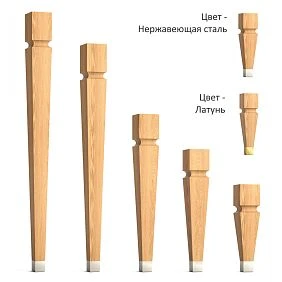
If the workshop rarely performs such work, Turned furniture legs allow you to consider an already defined shape. Its dimensions can be included in the project and checked on a sample before starting the cabinets.
Buying is especially useful when the chosen model fits without significant modification. Shortening a leg can change not only the height but also the proportions of the profile, the shape of the lower support, or the upper mounting. Such actions bring back into the workshop part of the operations that were supposed to be excluded.
If in-house turning has long been mastered, templates are available, and parts are repeated regularly, the internal route may be quite rational. Compare the actual time of a familiar operation with the full cost of obtaining a ready component. The fact that a part is turned does not by itself determine the decision.
For a composite assembly, you can consider wooden constructor elements. However, combining modules requires checking the connections and overall geometry. Several ready-made parts do not turn into a workable support without a developed assembly unit.
Legs are chosen before the carcass is manufactured
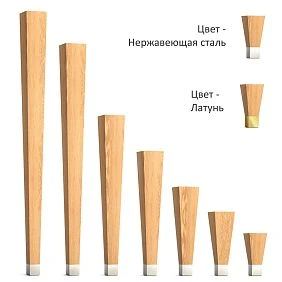
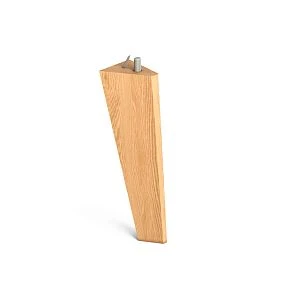
When the workshop decides to buy Wooden furniture legs, the choice must enter the project before drilling and assembling the base. The support affects the final height of the furniture, the offset from the edge, the size of the mounting plate, and the location of the fasteners.
The actual height is checked after installation. Part of the component may go into the carcass or connecting joint, while the mounting plate adds its own dimension. Therefore, a single height figure in the catalog is not enough for the final calculation of the furniture.
The number of supports is taken from the design. Four legs are a common option, but a long carcass may have additional intermediate supports. They cannot be removed from the bill of materials just because four expressive side components have been selected in the catalog.
Load capacity and stability are assessed based on the furniture and its joints. A large diameter or massive pattern does not provide a ready-made permissible load value. Selecting a catalog component does not replace checking the fastening to a specific carcass.
If the entire project is finished in the workshop, you can consider from STAVROS open boundless possibilities for designers, furniture makers, and anyone striving to create unique high-quality furniture.. For carved furniture legs the preparation of complex relief is assessed separately. It is this that can differ noticeably between two models of similar size.
A carved overlay instead of finishing the entire facade
For several identical chests of drawers, it is sometimes convenient to make a simple front and install a ready-made carved element on it. This removes the production of the ornament itself from your own workflow, but adds marking, installation, and finishing of the joint.
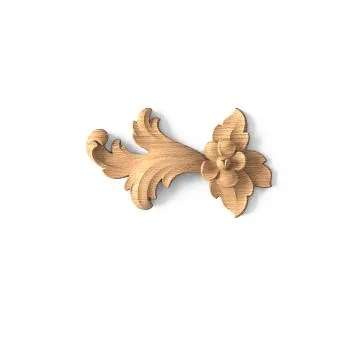
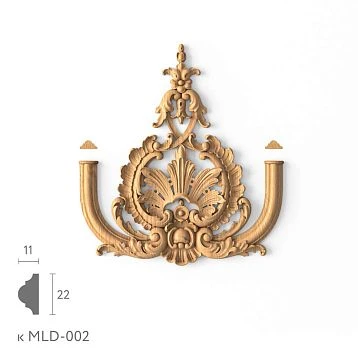
Carved decorative inserts for furniture are compared with your own carving by the finished appearance. The overlay element protrudes above the base and has a separate mounting surface. It does not always reproduce the result of carving directly in the solid front. If the project requires a single carved panel, the replacement must be agreed upon as a change in construction and appearance.
In the in-house option, take into account model creation, program preparation, machining, and hand finishing. In the purchased option, check dimensions, orientation, contact area, mounting compound, and finish. For a paired design, the calculation includes both sides, not just double the quantity of one SKU.
Repeating Wooden sockets are evaluated by the same logic. A compact part may use little material but require a separate model and careful hand finishing. A ready-made version can eliminate this preparation, provided it matches in size and design.
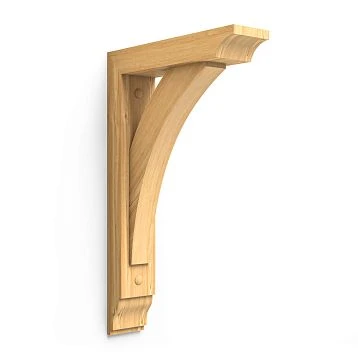
For brackets, a distinction is additionally made between decorative and load-bearing function. An externally suitable element does not yet confirm the ability to transfer load to it. When comparing options, consider the entire assembly, including fastening and furniture performance requirements.
Wooden handles: cost of shape and precision of fastening
For a small batch, a handle sometimes seems like a convenient part to make in-house: the blank is small, and little material is needed. But a repeating shape, rounded edges, comfortable grip, surface quality, and fastening require several operations.
If sixteen identical handles for eight cabinets are being compared, it is useful to make one test piece and record the entire process. Finishing time is measured separately: it is difficult to estimate from the size of the blank. The area constantly touched by the hand must be finished especially carefully.
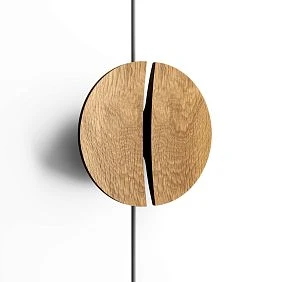
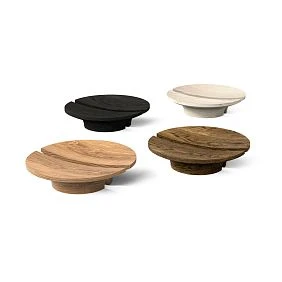
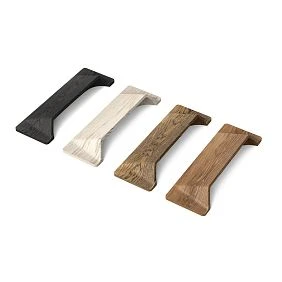
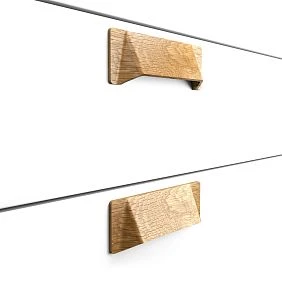
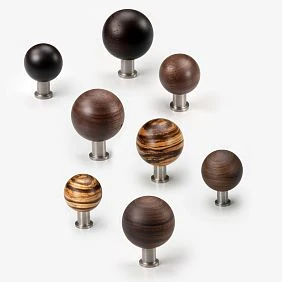
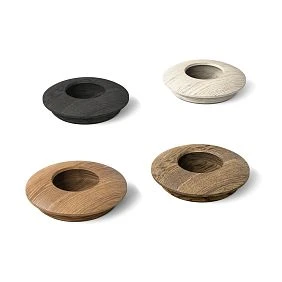
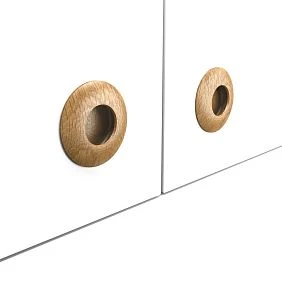
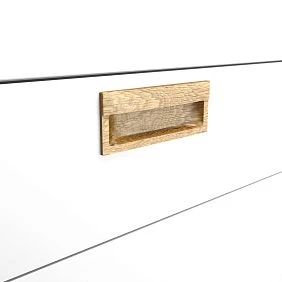
Ready Wooden furniture handles are included in the project before drilling the fronts. For a handle with two mounting points, the center-to-center distance, projection, and hole positions are important. For a knob handle, check the position of the single point, contact, and fastening method.
The drilling template is made according to the selected version and a verified sample. Drilling all fronts to an approximate size and then selecting a handle means transferring the risk of rework from a small part to the entire furniture series.
When comparing, take into account the completeness of the supply. The presence of fasteners, their size, and their suitability for the thickness of a specific front must be confirmed. The word "ready" does not mean that any handle will install on any door without additional parts.
Linear trim is calculated by cutting plan, not just by meters
For a simple profile with existing tooling, in-house milling may be convenient. For a complex shaped section, you will have to evaluate the tooling, setup, test passes, and surface preparation. For a short project length, these operations can make up a substantial part of the costs.
Ready Wooden moldings for furniture they are purchased by available strip lengths, but used by the dimensions of individual sections. Therefore, the calculation path is as follows: determine the parts of the frames and trims, create a cutting plan, then calculate the commercial strips.
A conditional example for straight segments: four sections of 700 mm are needed. The total usable length is 2800 mm. Three blanks of 1000 mm give 3000 mm of material, but each yields only one solid 700 mm section. There will be no fourth section. For this supply option, four blanks will be required, and the possibility and consumption with a different cutting plan are checked separately.
The numbers in the example do not indicate the lengths of a specific product. They show why the sum of meters cannot be considered a sufficient check of the purchase. In a real project, cuts, end trimming, angles, profile direction, and ornament placement are additionally taken into account.
Comparison with in-house milling should also take the cutting plan into account. If the workshop can produce blanks of suitable length and reduce waste, this affects the result. If separate tooling is required for this, its cost is returned to the calculation.
Table for deciding on each item
A single attribute rarely gives a final answer. A small batch may be advantageous within the workshop for a mastered operation; a complex ready-made part may turn out to be inconvenient due to long delivery or incompatible fastening. The table helps choose the direction of verification, but does not replace calculation.
| Situation | Argument for making it yourself | Argument for a ready-made part |
|---|---|---|
| Simple geometry | The operation is familiar, the tool is ready | Buying can still help with a busy area |
| Complex terrain | There is a proven model and machining process | A suitable model eliminates new setup |
| unique shape | Dimensions and pattern can be made to project specifications | Makes sense only if a catalog substitution is acceptable |
| Short run | Setup is minimal or already completed | Setup costs for in-house operation are too high |
| Repeat furniture | Tooling and experience are reused | An agreed model allows repeat purchasing |
| Limited lead time | Material and free work center are available | On-time delivery of the required variant is confirmed |
| Loaded machine or craftsman | It is possible to reschedule without delays | The purchase frees up a bottleneck work center |
| Complex joint | It's easier to make the required fit right away | The sample confirms installation without significant rework |
First, rule out options that don't provide the required design, quality, or timeline. Then compare the costs of the remaining ones. A cheap part of the wrong size doesn't become a good solution just because of its price.
If the values are still unknown, note what's missing: a trial run, a timeline response, a sample, or clarification on the fasteners. Such a note is more useful than a formal plus in the "buy" column.
The sample verifies both the design and the calculation
Before starting a series, you need to confirm that the chosen path works. For in-house manufacturing, this means a trial part with actually measured operation times. For purchasing, it means an instance of the required version installed in a prepared assembly or tested on a suitable mockup.
Check the dimensions, material, surface quality, and fastening. For decor, assess the scale and fit; for a support, the connection to the carcass; for a handle, the grip and drilling pattern. Perform a trial finish if it remains in the workshop.
After verification, update the calculation. Suppose preparing a purchased item was expected to take five minutes, but the actual work took twenty. This doesn't yet prove that buying is unprofitable, but the options should now be compared based on twenty minutes. A conditional difference of fifteen minutes across thirty-two parts amounts to eight hours.
You can view available sets in the section product samplesAt the same time, a sample kit for getting acquainted with the material does not necessarily replace a full-size part of the selected item code: the composition and purpose are checked separately.
The result of the test is recorded in writing: which version is accepted and what operations the workshop performs after receipt. If the sample needs to be kept for comparison, it is not included in the part count for the furniture at the same time.
Transfer the decision to the working documentation
After comparison, each item gets a sourcing method: made in the workshop, purchased as a standard part, or an agreed external operation. At the same time, the remaining in-house work is specified. For example, a purchased unfinished leg still undergoes finishing and installation.
For in-house production, keep the drawing, material, sequence of operations, and verified dimensions. For a purchased component — the full item code, link, size version, material, preparation quality, and quantity per product. If one item code has several sizes, one number without characteristics does not describe the selected part.
drawings and product models help link the purchased element to the carcass project. After checking the sample, update the location of holes, mounting points, and adjacent parts. The approved version is passed to production so that cutting, purchasing, and assembly do not work from different data.
Finishing is recorded separately from the wood name. "Beech" or "oak" do not explain the required quality of the blank and surface preparation. In the description quality of wooden products STAVROS distinguishes between veneer options for enamel and for tinting, as well as surface treatment categories. The selected version affects the work that remains with the workshop.
This gives small-batch production of wooden parts a clear boundary of responsibility. The list shows what arrives ready-made, what is made in-house, and who brings the component to installation.
For a repeat series, review only the changed conditions
A saved article number and a verified sample eliminate the need to search by photo again. But before the next production run, the availability of the required material and size, the delivery time, and the current offer are still checked. An item being present in the catalog does not guarantee immediate shipment.
A custom route can also change. After the first series, tooling, a program, and processing experience already exist. Part of the initial preparation will not need to be repeated, although tool setup and first-part inspection may remain. Therefore, a quote for a second order will not necessarily give the same result.
Do not spread the initial costs across an indefinite number of future series as if all of them had already been ordered. For planning, it is useful to consider the confirmed batch separately and a possible repeat separately. This will show how much the decision depends on future volume.
After the actual production run, record the deviations: how much time preparation and setup took, whether the materials were sufficient, and whether there were any reworks. This information turns the next estimate from an assumption into a verifiable assessment.
If a single missing purchased item halts the production run, find out in advance the terms for reordering it or agree on an acceptable substitute. A similar model may require different holes and change the appearance, so the fallback option is also checked before an urgent need arises.
A finished serial part or custom furniture parts
Custom manufacturing is required when the project specifies a unique profile, exact non-standard dimensions, a special fit, or a pattern that cannot be replaced by a catalog item. The work can be done in-house or discussed with a suitable contractor.
At the same time, there is an intermediate option: outsource only one operation. For example, the workshop prepares the blanks and performs the finishing, while a specialized department processes the complex shape. Then material transfer, requirement coordination, transportation, and result inspection are added to the estimate.
A finished serial model is suitable when its geometry and execution satisfy the project. If the furniture has to be significantly modified for it, the cost of changing the design is also included in the comparison. It is especially important to agree on the substitution after the product has been approved by the customer.
The “made to order” note on a product page does not automatically mean manufacturing any shape according to the buyer’s drawing. The production terms for a selected catalog model and the possibility of custom development are different matters. They are clarified separately. A production plan cannot be based on the unconfirmed assumption that the supplier will make any required version.
Where to buy ready-made furniture parts for a small batch
In the STAVROS catalog you can select ready-made wooden elements for furniture и Carved wooden decoration for inclusion in your own project. It is more convenient to start with the items whose preparation, shaping, or hand finishing is the most labor-intensive.
To buy furniture parts with clear benefit for the workshop, prepare a list of the required models, sizes, materials, and quantities. Specify the desired surface condition and further finishing. Compare the offer with your own route to the same degree of part readiness.
В conditions for manufacturers shipping from one piece is stated. This allows considering a separate purchase to test a new component. The lead time, cost, and available finish are confirmed for a specific order; a small batch size by itself does not establish a fixed discount.
After a successful trial, record the selected part in the list and clarify the date of receiving the full set. For eight cabinets, this may mean your own carcasses, purchased legs and handles, ready-made overlays, and general finishing in the workshop. Such a scope of work is justified when each purchased item truly removes an extra operation, fits the design, and allows completing the series within the agreed timeframe.